







There’s a moment I find especially haunting in Stanley Kubrick’s 2001: A Space Odyssey. It’s not the death of HAL (although who wasn’t moved while watching the soft-voiced computer betray a humanity that Dave Bowman, the astronaut disconnecting him, barely got close to exhibiting). No, what I’m thinking of comes before. WAY before.
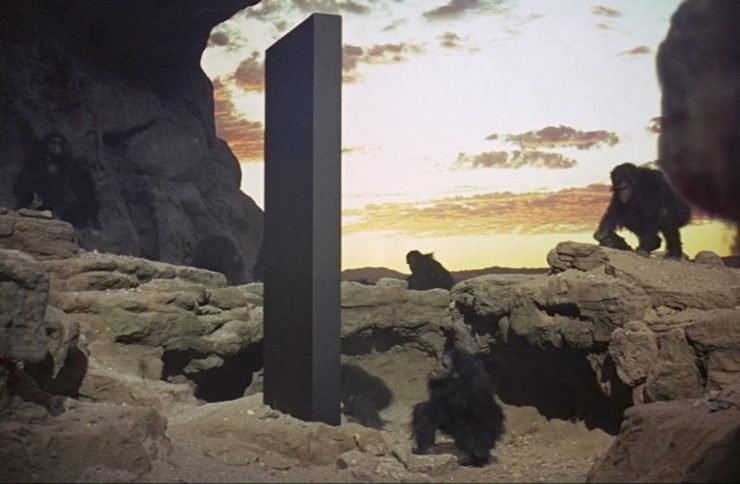
It comes, in fact, in the “Dawn of Man” sequence, even before the SF stuff officially kicks in. It comes as the man-ape tribe—if you can even call it a tribe—cower at night, under a protective outcropping of rock. At this point, their rolls of the evolutionary dice have repeatedly come up snake eyes: They survive on whatever eats their barren environs provide; one of their members succumbs to a leopard attack; and they’ve been driven away from their water hole by more aggressive rivals. Now, in the dark, they huddle together, listening to the muffled roars of nocturnal predators, barely daring to issue their own, ineffectual challenges. And this is the moment that catches me: Kubrick cutting to a close-up of Moonwatcher (Daniel Richter), the de facto leader of these proto-humans, as he stares into the dark, the brilliant costume design of Stuart Freeborn allowing us to take full measure of the man-ape’s nascent humanity as he gazes out into the unknown.
I think about that moment. For Moonwatcher, it must exist in a continuum—this can’t be the only night when these creatures have been all-too-conscious of the threats without. I think about how instinct and a developing intelligence have led them to their best defense against unknown terrors: the security of a sheltering rock, and the comfort of each others’ presence.
And, in the next scene, the man-apes’ confidence in this meager brand of security is shattered. Legend has it that Moonwatcher and his tribe were, upon the dawn, originally supposed to behold a pyramid plunked down before them. Kubrick nixed that, opting instead for the black monolith. There couldn’t have been a more genius decision. The juxtaposition of this precise, elemental form against the chaos of the natural world—heralded by Ligeti’s breathtaking Requiem—serves as a perfect metaphor for these creatures being brusquely confronted with the realization that the world, the universe, is greater than what looms outside of their humble…hell…wholly inadequate shelter. The cosmos has come a-knockin’, and everything these almost-humans thought they knew has turned out to be wrong.
It’s human nature to seek security, predictability. We are pattern-forming creatures, anything that breaks the comfort of routine can alter us in profound, sometimes life-changing ways. Nature does it on the more malevolent side with hurricanes, earthquakes, and insanely contagious and deadly viruses; and on the more benign side with stuff whose random improbability shakes us from our cozy preconceptions: the Grand Canyon; and whales; and a moon to remind us there’s a whole expanse of possibilities beyond the place to which gravity holds us.
But humans can also have a hand in changing the way we see things. There’s art, storytelling, and— specific to our purposes—the movies. Not all movies, mind you; sometimes you just wanna see Vin Diesel make a car go really fast. But for a filmmaker who’s so motivated, the visceral experience of watching a film can propel viewers into a better understanding of themselves, and everything around them.
Any type of movie can do this. Yojimbo casts a sardonic eye on the unintended consequences of getting vicarious pleasure from watching the bad guys pay for their sins. Nashville surveys a frequently derided music genre and finds within it pockets of nobility. Judas and the Black Messiah examines the daunting moral triangulations behind the fight for equality.
But of all the genres, science fiction seems the most suited to the task. Straight drama, or comedy, or even musicals remain rooted in our earthly, observable realities; what can be glimpsed outside your window can also be up on the screen. SF—by dint of reaching beyond, by speculating on the possible, by asking, What if…?—can break through the simple equation of “what is seen is what is,” can prompt us to imagine alternatives, and can get us to question whether what we know about ourselves is as absolute as we believe.
That’s the thing that keeps drawing me back to SF, the opportunity to—forgive the archaic term—have my mind blown, my preconceptions shattered, my—forgive the Bill Hicks-ism—third eye squeegeed clean. What I want to do in this ongoing series of articles is take a look at the films with that power, divine what messages they might be trying to convey, and consider the lessons we as humans can take away from them.
Buy the Book

Until the Last of Me
And let’s start with that poster child of mindblowers—the “Ultimate Trip,” as the MGM marketing department once proclaimed—2001: A Space Odyssey. For a sec, though, let’s just ignore the whole final act—the psychedelic stargate voyage and the telescoped lifetime-in-a-Presidential-Suite bit—and examine something a little bit more subtle, something that director Stanley Kubrick, with an assist from Arthur C. Clarke, was threading throughout the course of the film.
Kubrick is on record as saying that the only overtly funny thing in the film is the shot where Dr. Heywood Floyd (William Sylvester), en route to the moon, struggles to decipher the arcane instructions of a zero-gravity toilet. But that doesn’t mean Kubrick’s tongue wasn’t firmly planted in his cheek in a number of other moments. Given the director’s keen eye toward our frailties, there’s no way he could tell this tale of humanity’s initial adventures beyond our earthly realm without casting an acerbic eye on how we might cope with crossing the threshold into the vastness of space.
In the Dr. Floyd sequences, it takes the form of the creature comforts we might bring with us. There are simulated chicken sandwiches, and sterile, corporate conference rooms, and brand names everywhere. (One of the grand, unintentional ironies of 2001 is that, by the titular year, most of those brands no longer existed.) Little things to tether us to our earthbound lives, to shield our minds from the implications of what we are confronting, the same way a spaceship’s metal bulkheads would protect our bodies from the icy vacuum of the infinite.
But then, at the end of the act, is the encounter with TMA-1—the Tycho Magnetic Anomaly 1—a single, simple, black monolith standing at the bottom of a human-made pit. An enigma for which comforting, logical—by human standards—explanations are nowhere to be found. Could it be a natural formation? Nope, it was “deliberately buried.” Maybe it’s a part of a larger structure? (Temples on the moon? Hitler’s secret Nazi space base?) Nuh-uh. Excavation reveals just the single, elemental artifact. There is, quite literally, no earthly explanation for it, and no amount of Howard Johnson’s Tendersweet clam rolls will mollify the sledgehammer realization that humanity has encountered something beyond its ken. When the monolith emits a single, high-energy radio burst in the direction of Jupiter, it’s as much a wake-up call to comfortable, cosseted humanity as it is to whatever lifeforms are awaiting the alert.
There’s a reset as we move into the next act, aboard the spaceship Discovery and its secret mission to Jupiter. So secret, in fact, that astronauts Dave Bowman (Keir Dullea) and Frank Poole (Gary Lockwood) have not been clued in. Thus, their mandate is tightly focused and mundane: Monitor ship systems—with the help of their omnipresent computer HAL 9000 (voiced by Douglas Rain)—and get their cargo, a trio of cryogenically slumbering scientists, to the planet. Routine is not only the order of the day (whatever you’d care to define as ‘days’ when you’re no longer bound to a rotating sphere), but also a comfort. The time is filled with performing calisthenics, eating meals, getting your ass beat at computer chess, et cetera. Even when HAL detects that a critical piece of radio hardware is on the verge of failure, it doesn’t stir much reaction. The astronauts are secure in their training, and there are SOP’s for dealing with such emergencies.
From its release, the standard rap against 2001 is that it’s boring, with the Discovery sequence being held up as culprit number one. The stock response to that is that Kubrick is taking a radical approach to getting us to appreciate the scale at which this story is being told, using time as a surrogate for the vast distances and cosmic perspective that these characters will confront. That’s a valid argument, but I think Kubrick had another goal here as well. In hammering home the stultifying routine, in imbuing his astronauts with the blandest personalities as possible—Poole receives birthday greetings from his parents with the same cool demeanor he greets the possibility that their all-knowing computer might have blown a few circuits—the director is getting us into a zone where a small but uncanny disruption of the order can land like an uppercut.
Depending on which cut of the film you watch, that moment comes either after the intermission or after Bowman and Poole determine HAL might have to be disconnected. When Poole goes on his second EVA, it’s only natural for one to think, What, again? It’s the same oxygen hiss, the same measured breathing. While the shots and cutting are not exactly the same, they feel that way. It’s tempting to say to yourself, “We’ve been here before, Stanley. Why the deja vu?” Routine, routine, routine.
…Until, as Poole floats toward the antenna, the pod spins of its own volition. And even before it begins accelerating toward the astronaut, our brain snaps to attention. Something is different. Something is wrong. By the time Kubrick jump cuts toward HAL’s glowing red eye, our sense of normalcy has been shattered.
https://www.youtube.com/watch?v=_EEa5Rubm7E
From that moment on, nothing is routine. Bowman ignores protocol to embark helmetless on his rescue mission; HAL exhibits a cold ruthlessness in executing the hibernating scientists and denying Bowman entrance back into the ship; and Bowman is forced to do the unthinkable: exercise creative thought in order to find a way to save himself—surely the pod’s explosive bolts could not have been intended to facilitate a risky reentry through the vacuum of space.
And then, after Bowman executes the traumatizing lobotomy of HAL and has his perception of the mission upended by Dr. Floyd’s video briefing, we get to Jupiter, and “beyond the infinite.” A lot has been made (understandably) of 2001’s final act, and the advent of the Starchild. Generally, it has been interpreted as an uncommonly optimistic fade-out from the typically cynical Kubrick, the idea that humanity has the capacity to evolve beyond war and violence, to become creatures connected to the greatness of the universe. What’s frequently missed in that read is a caveat: Growth will not come via some mystical, cosmic transformation, but with an act of will. Over the millennia, humanity has exhibited an almost insurmountable capacity to cling to the known, the familiar, the comforting. But, just as Bowman only manages to make it to his transmogrification by breaking out of his routine, so we must make that terrifying move beyond habit if we are to evolve.
In 2001: A Space Odyssey, Kubrick turned his astringent eye towards humanity clutching at its reassuring comforts and calming patterns, and strove to show us what’s possible if only we could see beyond them, if we were willing to abandon our instinctual lunge toward the safety of habit and embrace the infinite potential of a greater universe. The film has been described as trippy, but we should not forget that a trip can only begin when we’re brave enough to take the first step.
* * *
2001: A Space Odyssey has been analyzed, poked, prodded, deconstructed, and reconstructed ever since the moment of its release. I don’t presume mine is the only, or even the most accurate, interpretation. If you have your own thoughts, let’s hear them. Keep it friendly and polite, and please comment below. (And if your main contribution is going to be, “I found it boring,” read on).
I don’t typically consider it my place, when someone says, “I didn’t care for this film,” to respond, “That’s ‘cause you watched it wrong.” In the case of 2001: A Space Odyssey, I’ll make an exception. As noted above, Stanley Kubrick took the radical step of using time to get us to appreciate the magnitude of humanity’s move into space. You can’t watch 2001 like a regular film, you have to experience it, give yourself over to its deliberate pacing. If your sole exposure to the film occurs in a brightly lit living room, with your significant other telecommuting in the periphery and a smartphone delivering Tweet updates by your side, that’s not gonna work for a film formulated to virtually wash over you in a darkened theater.
In the absence of 2001’s rare return to the big screen —the most recent was the Chris Nolan restoration on the film’s 50th anniversary three years ago—the best approach is to find as large a video screen and as kick-ass a sound system as you can wrangle, turn off all the lights, power down all communication devices, and commit. For all the ways that 2001 has been described, there is one thing that’s for sure: It’s a film that demands your complete and undiluted attention. Do that, and you’ll discover why it’s attained its exalted status.
Dan Persons has been knocking about the genre media beat for, oh, a good handful of years, now. He’s presently house critic for the radio show Hour of the Wolf on WBAI 99.5FM in New York, and previously was editor of Cinefantastique and Animefantastique, as well as producer of news updates for The Monster Channel. He is also founder of Anime Philadelphia, a program to encourage theatrical screenings of Japanese animation. And you should taste his One Alarm Chili! Wow!

Brilliant reflection on my favourite film of all time.
Minor nit: Discovery is headed to Saturn in Clarke’s novel, but not in the film, in which the ship is going to Jupiter. Saturn is the more photogenic choice, of course, and there’s also the spectacular image of the moon Iapetus and the wonderful visuals all of that would have entailed, but the special effects were beyond even the capabilities of Kubrick and Douglas Trumbull at the time, and they made do with the king of the planets (which, as it turned out, also has rings, but they didn’t know that).
Trumbull later went on to direct Silent Running, in which Bruce Dern, with the more advanced SFX technology available, does in fact take Valley Forge to Saturn and through its rings. I think Trumbull did it just to show that he could, after having been unable to make it work for 2001.
2001 is a film that really needs to be seen on a theater screen with a great sound system. I saw it during one of its reissues in the 70’s and every time the bass dum dum hit the entire row of seats vibrated in sync with the music.
Making it Jupiter in the film turned out to be a lucky break, once (probable) liquid water was discovered on Europa.
Correct that this is not a film to be watched, but to be experienced immersively. How I love it for that.
Agree with Dan about 2001 being a masterpiece (and not subject to “Your Milage May Vary” politesse). It is Kubrick at his most Kubrickian (even as I don’t agree with his meta-thesis that to be sentient is to kill).
Also, @1 and @3 are correct about movie vs book 2001…and how fortuitous it was that they were at Jupiter, both for Europa’s water and the greater mass of Jupiter putting it into a better position for it’s upgrade to Sol B during the movie2010 that was in most ways just a generic sci fi/action movie, but at least redeems HAL and possesses a slightly more optimistic take on human nature.
One of my favorite moments in 2001 is watching the “tribe” of astronauts gather ’round their monolith, and then we see Dr. Floyd reach out to touch it with his suited hand, precisely mimicking Moonwatcher’s gesture.
And, really, how did 2001 lose an Oscar for Best Make-up to Planet of the Apes?
@1: What I always thought was fascinating about 2001 is Clarke wrote the novel and the screenplay at the same time. The novel and the film both started from the same early drafts, then deviated as each picked up steam. So where I will often blame screenwriters for butchering the adaptation, can’t do it this time!
But I recommend both reading the novel and watching the film, in either order. The novel has a lot more depth and better narration, but the visuals in the film are just fantastic.
I was a junior in high school when this movie first came out in 1968. The thing to do at the time was to take acid or mescaline and sit in the first row. I was afraid to try so I never got that experience. I had to settle for seeing it straight!
@1: Yes! We’ve updated the article–thanks!
Speaking of “mundane” that is exactly how it hit me when I had to watch this marvelous, wondrous visual sequence of docking the ship all the while being subjected to what was to me a very mundane sound track. Blue Danube Waltz? Good grief. I was so familiar with it that it held no wonder for me at all, and totally spoiled the effect
@10, how odd. I adore the Blue Danube to that sequence.
I’m with princessroxana on this – the “Blue Danube” waltz was an inspired choice, as the visual of the docking sequence is as stately and graceful as any ballroom waltz.
I was incredibly disappointed when I finally saw this movie. None of its important plot points are explained or resolved. It sets up a story that it doesn’t finish. I don’t understand what Kubrick and Clarke were thinking when they made it. Maybe Clarke’s book is better?
For me, it’s as if the MGM The Wizard of Oz said “THE END” after Dorothy and her companions fall asleep in the poppy field, or if in The Hound of the Baskervilles, as Holmes and Watson are investigating the deaths and the mysterious hound, Watson suddenly kills everyone on the estate except for Holmes, is then killed by Holmes, and as Holmes attempts to flee the estate, he transforms into a giant cockroach and we’re told the case has been solved, with no explanation for the deaths, hound, Watson’s insanity, or Holmes’ transformation.
(13)
I don’t think it was meant to be easily explained. It’s what you think the story means, which places it not so much in the realm of popular cinema like The Wizard of Oz but rather the sort of avant-garde video you might see in an art museum.
There are quite a few interpretations out there—many you can find around the web. But if you need an in-universe explanation, check out the sequel, 2010. A decent movie in its own right.
This is one of my favourite movies. I think the story is told visually and aurally far more than with dialogue. In fact, I think the dialogue is the most surface level part of this film and it goes much much deeper (intentionally.)

I’ve watched this flick multiple times over 40+ years, and the human characters are boring! However, the (then) future technologies depicted in this film are fascinating and awe inspiring, e.g., the Discovery, Space Wheel & HAL 9000. The human characters are “meh” at best. I think a major theme of this movie is that human technologies are becoming far more interesting and exciting than the humans who use those technologies.
This is more accurate than you may know, as the original screenings of the movie had the second EVA sequence in fact having the same shots, cutting, and length as the first did! (There was also a sequence of Bowman running ‘around’ the ship’s interior in the same way we saw Poole did when we first viewed the Discovery.) Kubrick made a wise move in trimming those scenes, striking a compromise between implying the banal routines for the astronauts and subjecting the audience to them.
One resource I’d highly recommend to explore more about “2001” is Michael Benson’s book about the movie’s creation, titled “Space Odyssey”: https://www.goodreads.com/book/show/35297381-space-odyssey
Ah yes, you reminded me of the fact that originally the monolith was going to be a pyramid, and such a great decision to go with the former. A pyramid suggests that Egypt and South American tribes were somehow tapped into something related, which cheapens the notion. Not only do pyramid structures exist naturally in rocks and crystals, but the dimensions of the monolith(squares of the first three primes) categorically do *not*. A brilliant move.
When this film was re-released back in the 70s with a new surround sound system, I sat through three consecutive showings(back when you could do such things). I swear, no drug use was involved. In the modern age of scrubbing through shows the moment you get “bored”, it would never get made, mores the pity.
There’s a lot of eating going on, with berries al fresco, in-flight meals, moon bus sandwiches, Discovery’s galley and Bowman’s last meal. Is there a meaning there? It seems excessive.
(19)
I would guess it’s picking up on the theme from the opening sequence, with early man being inspired to develop the first weapon in order to eat.
I personally have adjusted to the fact that the ending of 2001 makes no damn sense and just enjoy the music and fantastic visuals. The trip to the moon is my favorite bit.
My understanding is 2001 is also the first literary work collaborative effort using satellite communications. Clark and Kubrick communicated with text over satellite link. Kubrick didn’t need to goto siri Lanka.
There are good documentaries on the making of the film. I recommend finding them.
@@@@@ 16: To be fair, that’s par for the course with Clarke. He never wrote vivid or memorable characters, and what actually happened to them was the least of his concerns. They functioned as placeholders for the fascinating worlds he envisioned, and nothing more.
@23/Ashrgrove: I haven’t read Clarke in, perhaps, 40 years. From what I remember of Clarke’s writings, it seems that Clarke thought humans will eventually evolve beyond the need for technology, e.g., the ending of Childhood’s End and 2001.
@19
Years back I read an excellent critique of 2001 (which made much the same case as this analysis does) and it pointed out that one of the subtler jokes that while there is a lot of eating, it’s not until Bowman has a meal while living with the aliens that anyone has anything that looks palatable and tasty.
It’s interesting to see the differences between how spaceflight was envisioned in the mid 60s when the production design for the film was done, versus the reality that later emerged.
I still enjoy the sensawunda, but Kubrick and his fx team got stuck in the gravity-well mindset when they showed how people inside a large spaceship would get from point A to B, how ships would dock with a space station, how they would get to different places on the moon, and how they would do EVA’S in deep space.
The human race had almost no spacewalking experience at the time and no experience in large enclosed spacecraft, so that’s understandable. But still, when you watch it today, it’s a little awkward seeing people walking down velcro walkways with grabby slippers, or flying a space bus over the lunar surface, or taking a pod 100 yards back to the antenna unit and leaping over to the ship, etc.
@@@@@ 24: For what I have read, particularly the sequels to 2001, he had, or he evolved towards, a particular view of technology focused on the happiness of human beings. I think Bowman’s luxurious’ quarters at the end of the movie are a hint of this.
Also, a technology so advanced that it becomes invisible. “Indistinguishable from magic,” says his First Law, but the future life he describes in Odyssey Three, 3001 is basically Paradise or Faerie. Beautiful gardens where tame lions roam, that sort of thing.
I was a senior in high school when this came out, and I had the good fortune to see it in Cinerama and surround-sound. I went back to see it four more times before it left town (no drugs involved, in my viewings). I didn’t have explanations for a lot of it, but understood that not everything has to be put into words for it to be meaningful and important. It was really a cosmic experience.
love this film and this article reminds me why. The Discovery act is the strongest. Yes they are professional and boring, that is indeed the point (in the same way the trip to the moon was a business class routine journey)
But when Dave is disconnecting Hal and we hear him, for the first time, emotionally break and telling Hal that he would like to hear it sing Daisy I realised the whole sequence was a background to this scene.
i’ll never tire of watching it.
Great cinema
To fully understand the movie, one must read Clarke’s book explaining the masterpiece [begs the question: if it needs explaining, is it a masterpiece?] called “The Lost Worlds of 2001” [which happens to be available as a PDF online https://ia800505.us.archive.org/18/items/SpaceOdyssey_819/The_Lost_Worlds_of_2001_-_Arthur_C_Clarke.pdf ]. After reading this book, years ago, I felt the film was a masterpiece. ;-)
This has been one of my favorite movies for a long time, but I had never seen it on the big screen until the 50th anniversary tour. It was the most amazing experience I’ve had for a classic movie at the theater. Even just a few seconds into it, with the sun rising behind the Earth, in that dark theater – it was a completely different experience from seeing it on tv. It should definitely be seen on the big screen.
A couple of small errors in the comments to point out. Poole doesn’t make a “second EVA”, the first EVA was performed by Bowman. Bowman wore a red spacesuit and Poole a yellow one. In the first EVA sequence, Poole is quite clearly shown monitoring proceedings from the control deck while Bowman is EVA. Secondly, Clarke and Kubrick did NOT communicate by text over a satelite link. Clarke lived in the Chelsea Hotel for the duration of the writing process, though his permanent residence was Sri Lanka. It was Clarke and Peter Hyams who communicated electronically during the making of the sequel 2010.
This film changed me. I saw it I don’t know how many times in Cinerama and that was a full immersion experience. Tried sitting in the front row once but it overwhelmed my senses. I speculated on the meaning of the monolith for several years until I read the book. I bought a copy of the movie on VHS, then DVD and still watch it from time to time. It changed my perspective on Science Fiction. Kudos to Clarke and Kubrick.
Back in 1970s Australia you couldn’t download a movie or even go to the video store and rent it and so while I heard a lot about it I had to wait until it was 10 years ago to see it. With 3 mates we travelled the hour and half, 2 bus rides to watch it. We came out so stunned we could barley discuss it and missed the 2 buses home as we were so distracted, we went back the next week and watched it again. I’ve probably watched it about 10 times the mostly on the big 70mm print with sound track — each part is still so intriguing.
This film was the first to let the audience know what it might feel like to go to space, though actual astronauts’ opinion on this would be most welcome.
In addition, and much like Tarkovsky’s “Solaris” response to 2001, Kubrick leaves plenty of time to think and feel about his chosen topic.
I could not agree more with Mr. Persons: “If your sole exposure to the film occurs in a brightly lit living room, with your significant other telecommuting in the periphery and a smartphone delivering Tweet updates by your side, that’s not gonna work”