






“The City on the Edge of Forever”
Written by Harlan Ellison
Directed by Joseph Pevney
Season 1, Episode 28
Production episode 6149-28
Original air date: April 6, 1967
Stardate: unknown
Captain’s log. The Enterprise has detected waves of time that cause turbulence in space, making for a risky orbit over the planet that’s the source of the waves. The helm overloads, injuring Sulu badly enough to cause a heart flutter. McCoy gives him a small dose of cordrazine (which Kirk describes as “tricky stuff”). Sulu’s fine, but another bit of turbulence causes McCoy to stumble forward and inject himself with the entire vial, which sends him into an adrenaline-fueled, drug-induced panic. He runs from the bridge, screaming about assassins and murderers, and goes to the transporter room, taking out the chief and grabbing his phaser, then beaming down to the surface.
Kirk takes a landing party that also includes Spock, Scotty, Uhura, and two security guards. Spock reports that the ruins are 10,000 centuries old. At the center of it all is a giant ring, which is apparently the source of all the time displacement, even though it just looks like a big stone ring.
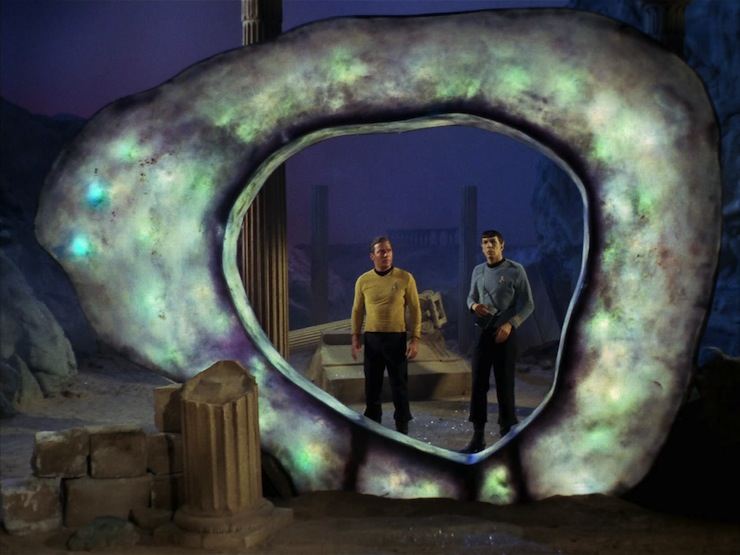
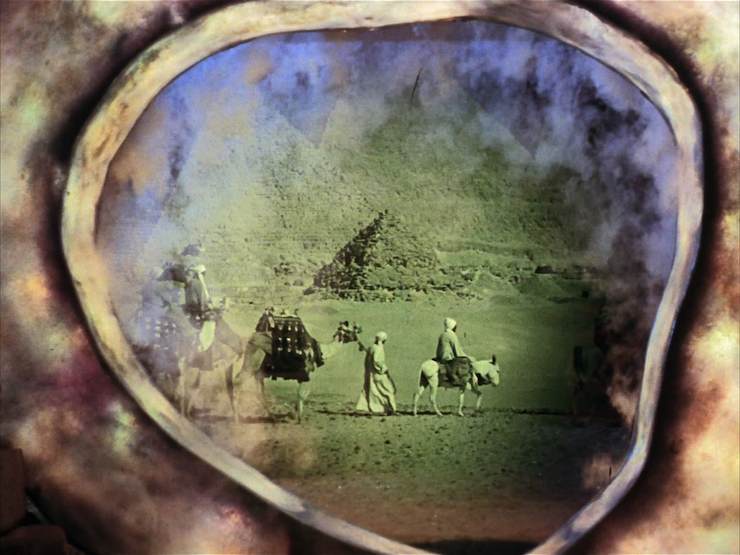
When Kirk asks, “What is it?” the stone ring actually answers, saying it is the Guardian of Forever. It is a portal through time, and to prove it, the portal shows images from Earth’s history.
McCoy is found and stopped by the search parties, rendered unconscious by Spock’s nerve pinch. Kirk ponders whether or not they could go back in time a day and stop McCoy from injecting himself, but the centuries are zooming by far too fast for that to be practical.
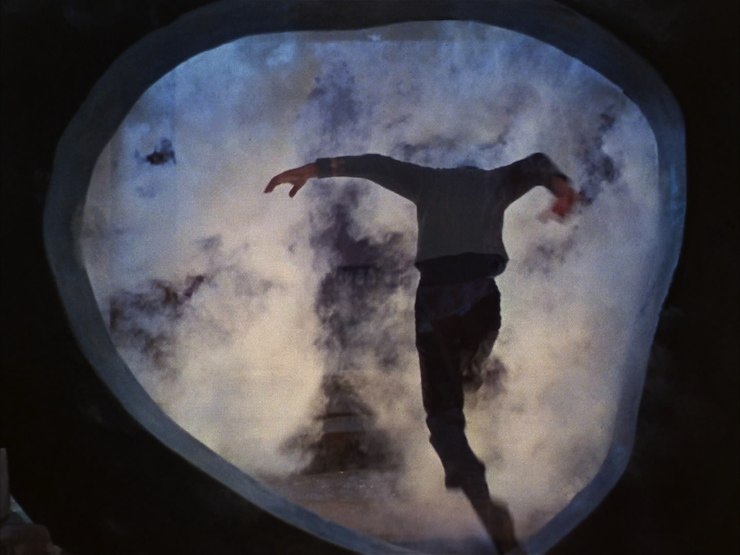
However, as they are transfixed by the Guardian’s quickie view of Earth history, McCoy wakes up and dives into the portal before anyone can stop him.
Uhura was in the middle of a conversation with the Enterprise, but the communicator went dead once McCoy jumped through. The Enterprise is no longer in orbit—somehow, McCoy changed history when he went back in time.
Spock was recording with his tricorder when McCoy leapt through, and he is able to approximate when to jump—within a month or so of McCoy’s arrival, he hopes. Kirk orders each member of the landing party to wait as much time as they think is wise and then take a shot at it themselves. At worst, they’ll be able to live out their lives in the past.
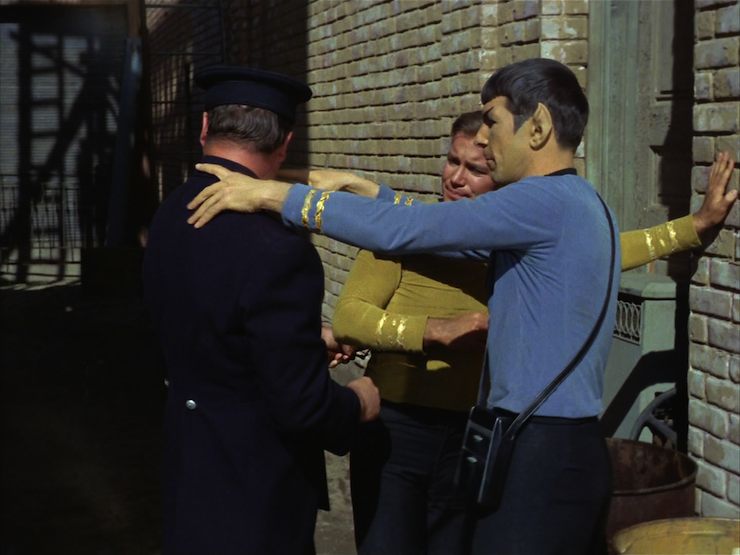
They find themselves in New York during the Great Depression. Their anachronistic clothing and Spock’s ears get them lots of funny looks, and their theft of clothing gets the attention of a uniformed police officer. Kirk thumphers around trying to explain Spock’s ears before Spock finally takes pity on him and neck-pinches the cop. They run away to the basement of a mission, where they change clothes, including a nice wool cap for Spock.
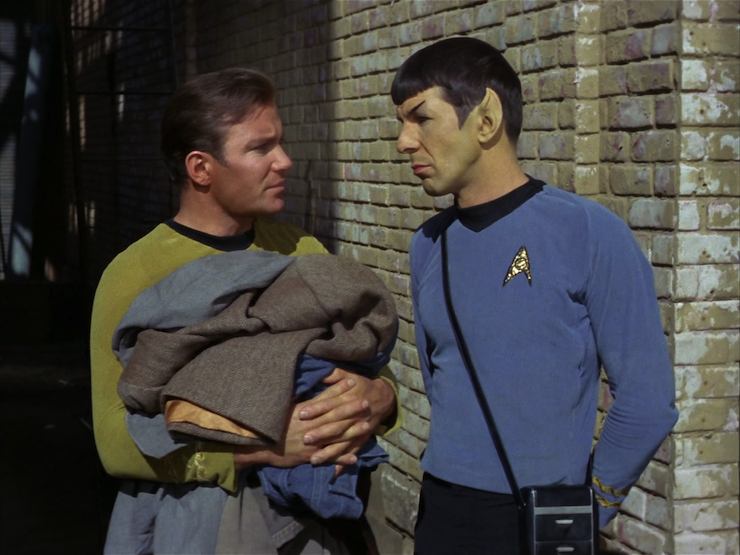
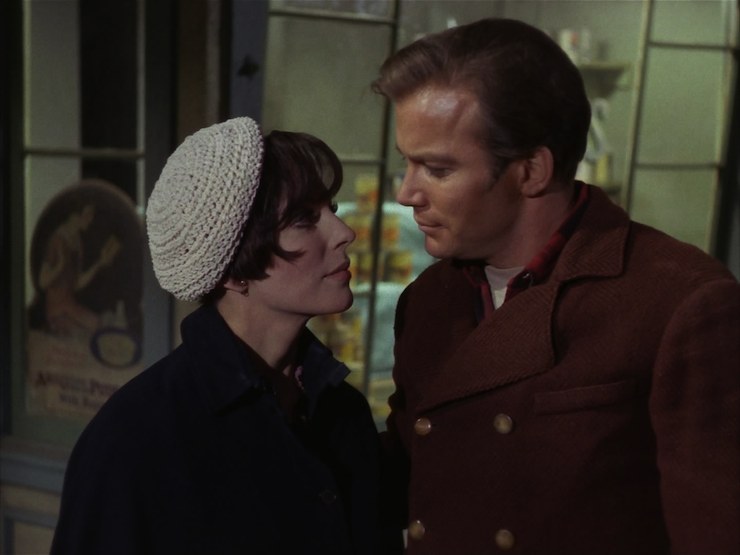
The mission is run by a woman named Edith Keeler, who hires them to clean the place for fifteen cents an hour. That night, they go to the mission’s soup kitchen for dinner, for which the “payment” is to listen to Keeler speechify. She speculates quite accurately about the future—predicting atomic energy and space travel—and Kirk finds her captivating.
Keeler also provides Kirk and Spock with a room for two dollars a week. Over the next several weeks, Spock endeavors to construct a computer to link up with the tricorder so he can view the images on it, but the primitive equipment of the era combined with their meager salaries makes the work slow and difficult.
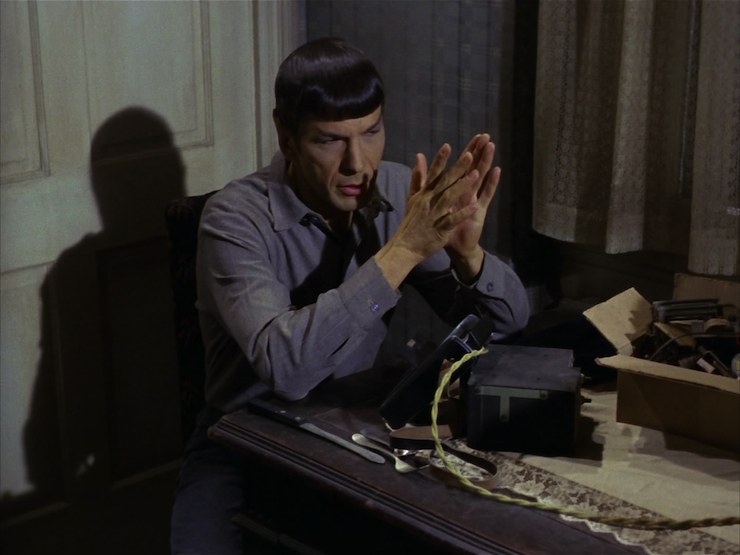
Spock steals some tools to aid in his engineering project. Keeler not only catches him at it, but can tell that they don’t belong there, and that Spock belongs by Kirk’s side. Keeler lets them off the hook only if Kirk will walk her home.
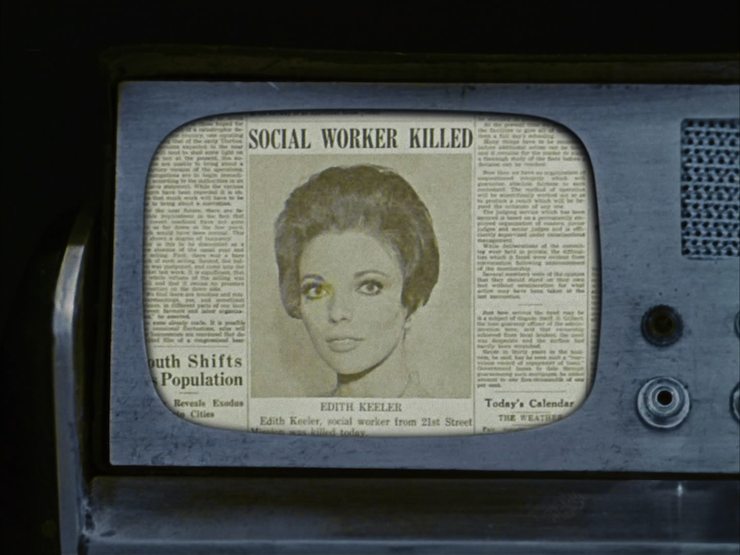
Eventually, Spock’s work serves him well. He finds that Keeler is the fulcrum. In one strand of history, Keeler meets with President Roosevelt in 1936; in another, she is killed in a traffic accident in 1930. The problem is, they don’t know which one is the proper time frame—Spock’s jury-rigged mess of a computer burns out before he can determine that, and it will take time to fix. What worries Kirk—who is falling in love with Keeler—is that she will need to die to restore the timelines.
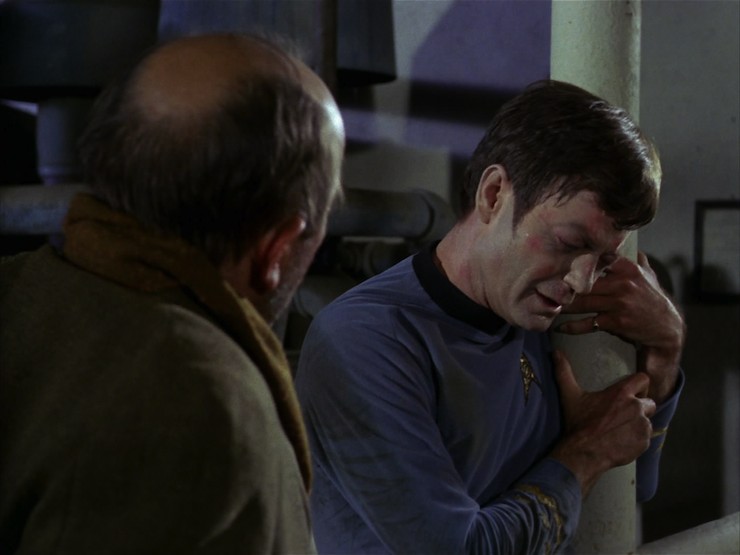
McCoy shows up, still in his cordrazine-induced haze. He finds a bum who is in the midst of stealing a jar of milk, eventually suffering a total breakdown and collapsing. The bum searches McCoy’s unconscious body, but only finds the phaser he stole from the transporter chief, which he then uses to disintegrate himself.
The next morning, McCoy, still a mess, wanders into Keeler’s mission. She puts him on a cot to recover.
Spock finally gets his doodad working again, and the news isn’t good: because McCoy did something to save Keeler from dying in a traffic accident, she goes on to form a very influential pacifist movement, one that slows the United States entering World War II. Because of that, Nazi Germany is able to develop the atomic bomb first and use it to win the war. Keeler was right in general—peace is better than war—but her timing sucked, as it led to fascists ruling the Earth.
Keeler continues to care for McCoy, who assumes he’s demented or unconscious, refusing to believe that he’s really on “old Earth” in 1930. She brings him a newspaper and he offers to do some work around the mission to thank her. She says they can talk about it in the morning, as she’s going to a Clark Gable movie with “her young man.” McCoy has no idea who Clark Gable is, to Keeler’s shock.
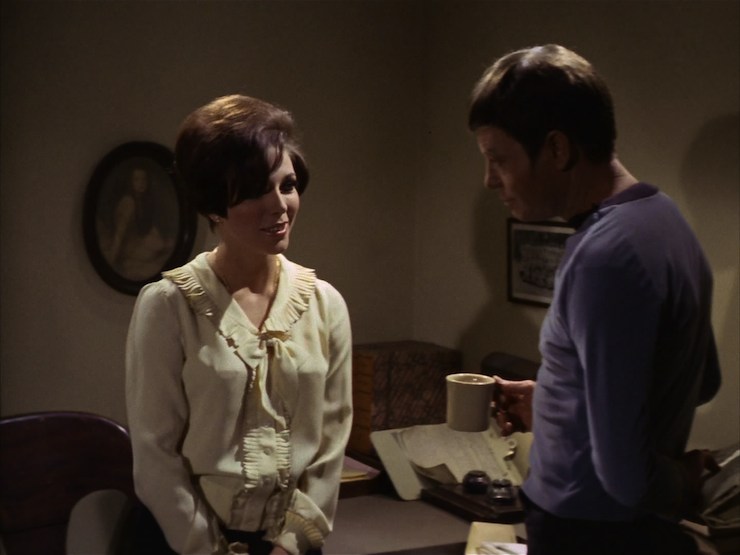
She meets with Kirk, and he has the exact same confused reaction to the name Clark Gable, which leads to her mentioning that “Dr. McCoy said the same thing.” An elated Kirk is thrilled to learn that McCoy is in the mission, and he runs back across the street to grab Spock—and then McCoy comes outside and everyone’s happy to be reunited. A very confused Keeler wanders into the street, and doesn’t see the car barreling down on her.
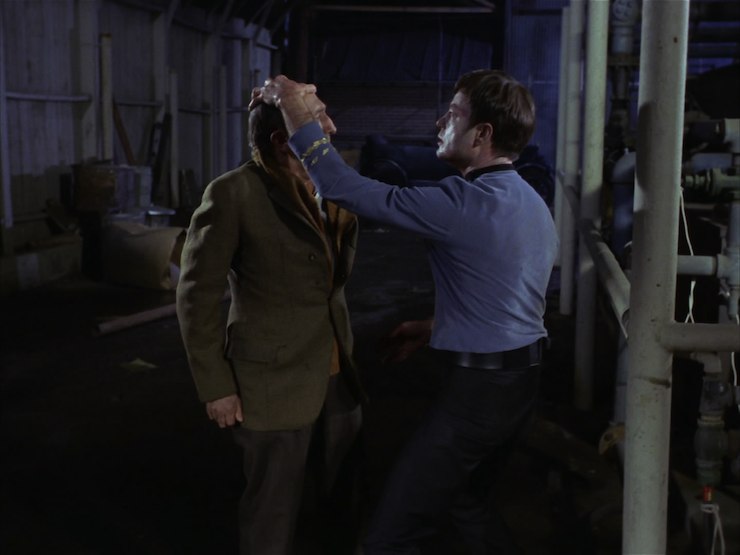
McCoy moves to save her; Kirk stops him, and they watch as Keeler is killed. McCoy is appalled that he let her die, but Spock assures McCoy that Kirk is quite aware of what he did.

The trio return through the Guardian (which apparently gave them time to change back into their uniforms). From the landing party’s perspective, Kirk and Spock only left a moment ago. But the Enterprise is back in orbit, and so a grim Kirk says, “Let’s get the hell out of here,” and they beam back.
Can’t we just reverse the polarity? The Guardian is both alive and a machine, which it says is the best way it can explain things based on how inferior Federation science is. Spock is somewhat offended by that.
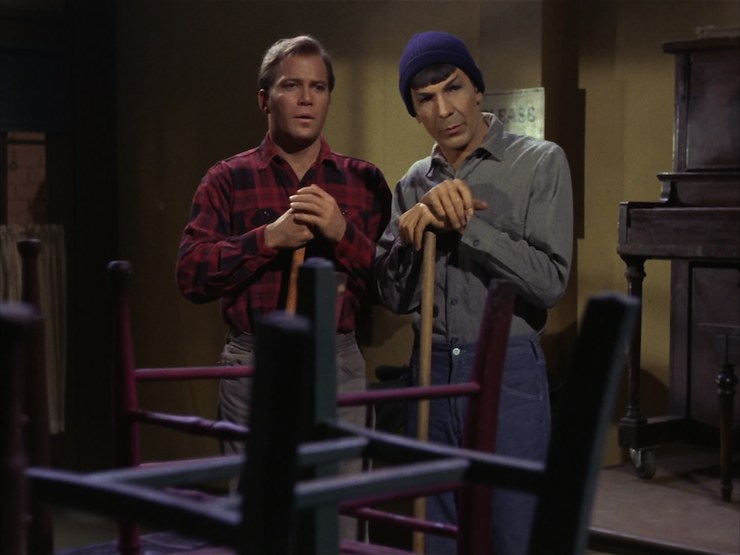
Fascinating. Spock refers to technology he is forced to work with in 1930 New York as akin to “stone knives and bear skins,” which would take root in popular culture as an expression relating to primitive tech.
I’m a doctor not an escalator. McCoy is in a full-on paranoid haze for most of the episode, and even when he recovers, he thinks he’s still having delusions, based on the fact that he doesn’t believe that he’s in 1930.
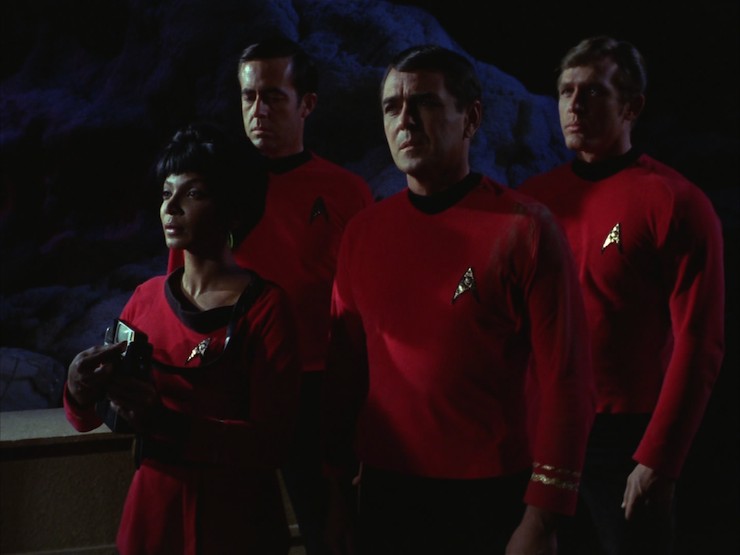
I cannot change the laws of physics! Scotty takes over the helm after Sulu is injured, and joins the landing party for no compellingly good reason.
Hailing frequencies open. The role of recording the landing party missions that used to go to Rand, and then went to the various yeomen who followed her, now falls upon Uhura, who is also the one who stays in touch with the Enterprise on the landing party. It’s not much, but at least she gets off the ship for a change.
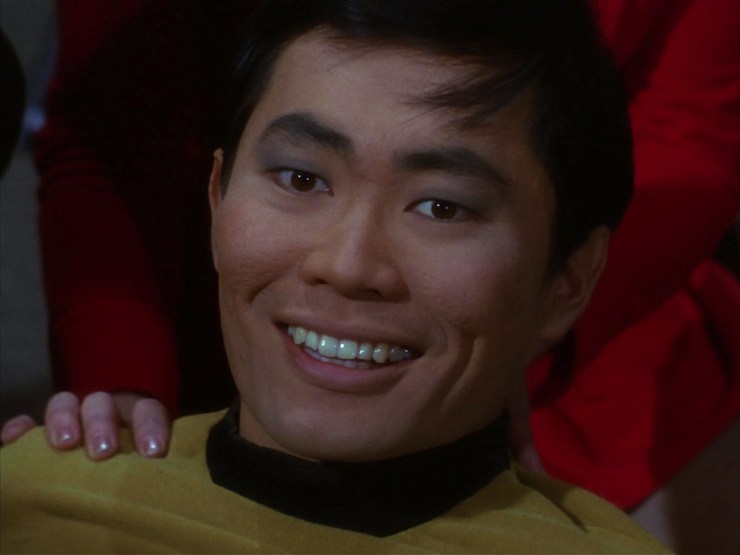
Ahead warp one, aye. Sulu is badly injured enough to warrant being injected with cordrazine. The goofy smile he has when he wakes up indicates just how good a drug it is…
Go put on a red shirt. Despite being on high alert, security utterly fails to stop McCoy from entering the transporter room and beaming down to the surface.
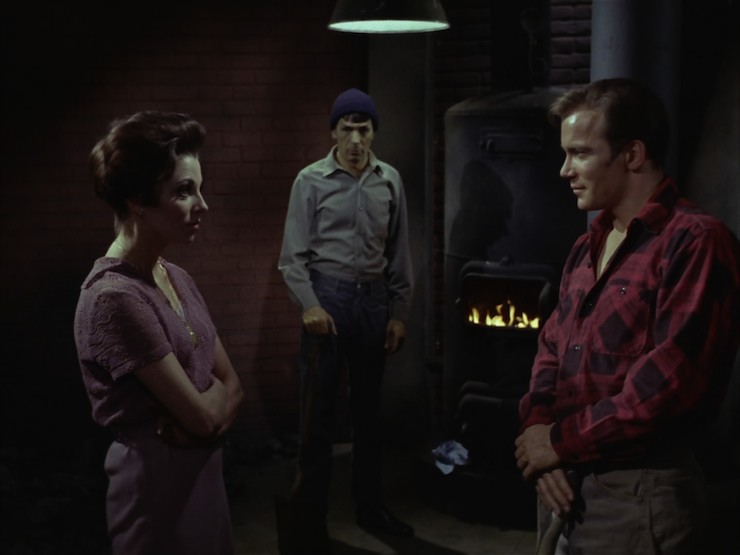
No sex, please, we’re Starfleet. Kirk and Keeler fall pretty hard for each other. It’s actually very sweet.
Channel open. “Since before your sun burned hot in space and before your race was born, I have awaited a question.”
The Guardian’s very poetic way of introducing itself.
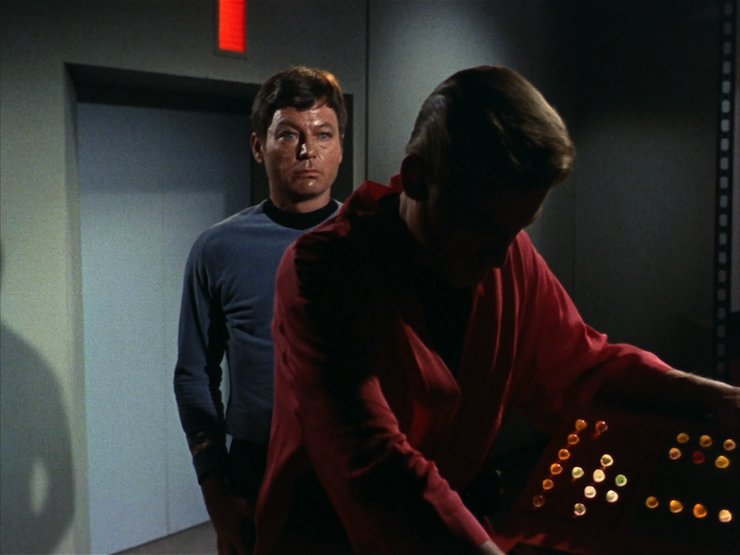
Welcome aboard. John Harmon plays the bum who is disintegrated by McCoy’s phaser, Hal Baylor plays the cop, and Bartell LaRue does the voice of the Guardian. Enterprise crew are played by regular guests John Winston and David L. Ross alongside recurring regulars DeForest Kelley, James Doohan, Nichelle Nichols, and George Takei.
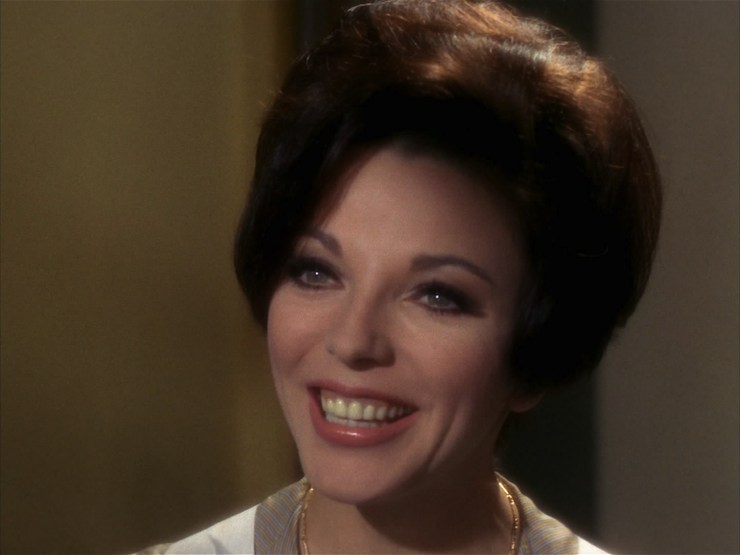
But the big guest, of course, is the radiant Joan Collins, already a lead in several films throughout the 1950s, a regular guest on several shows in the 1960s, and whose most famous role (probably even more so than her role here, though it’s close) was as Alexis Carrington in Dynasty during the 1980s.
Trivial matters: This has consistently been at or near the top of pretty much every list of best Star Trek episodes. Indeed, most lists of top episodes of the original series have this and “The Trouble with Tribbles” occupying the top two slots. In 2009, TV Guide ranked it at #80 in their list of top 100 TV episodes of all time. (That same list had TNG‘s “The Best of Both Worlds Part I” at #36.)
Harlan Ellison’s script was, rather famously, rewritten—Stephen W. Carabastos, Gene L. Coon, D.C. Fontana, Gene Roddenberry, and Ellison himself all took passes at it, with Fontana’s draft being the one that was primarily used, though Ellison retained credit. Roddenberry refused to allow Ellison to use his pseudonym “Cordwainer Bird” for the episode. (Ellison has always used that pseudonym when he felt he was rewritten unjustly.) The feud between Ellison and Roddenberry over the rewrites continued until the latter’s death.
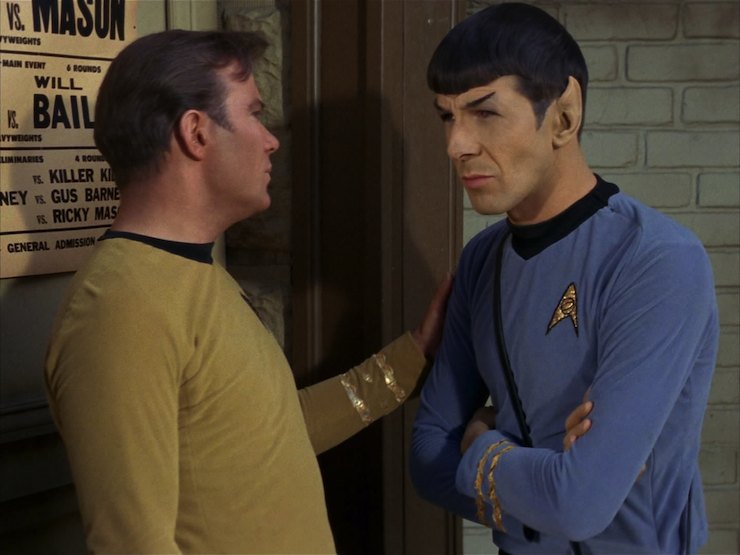
This episode has the only use of “hell” as an expletive in the series.
The quickie views of history through the Guardian are mostly clips from various old Paramount films.
A poster is seen advertising a boxing match between Kid McCook and Mike Mason in Madison Square Garden. A poster advertising their rematch is visible in a scene taking place in San Francisco in 1930 in the DS9 episode “Past Tense Part II.”
Ellison’s original script—which won the Writers Guild of America Award for Best Written Dramatic Episode—can be found in his 1996 book The City on the Edge of Forever: The Original Teleplay that Became the Classic Star Trek Episode. In addition, IDW recently adapted Ellison’s original script into comic book form, with art by JK Woodward.
The final version of the episode won the Hugo Award for Best Dramatic Presentation in 1968. All five nominees in that category were Star Trek episodes, the other four being second-season episodes “The Trouble with Tribbles,” “The Doomsday Machine,” “Mirror, Mirror,” and “Amok Time.” That was a good year for Ellison, who also won for Best Short Story (for “I Have No Mouth and I Must Scream”) and was nominated for Best Novelette (for “Pretty Maggie Moneyeyes”; he lost to Fritz Leiber’s “Gonna Roll the Bones”).
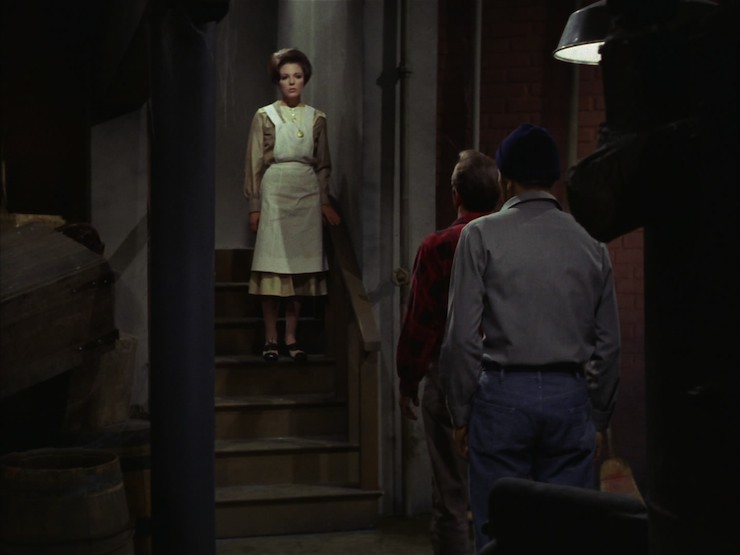
James Blish’s adaptation in Star Trek 2 used elements of both Ellison’s original script and the final draft.
Bantam’s first-ever fotonovel was an adaptation of this episode, which also included a short interview with Ellison.
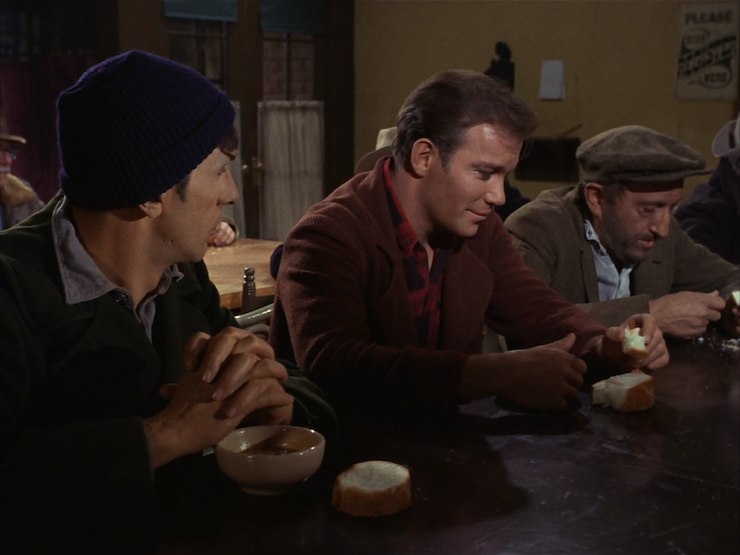
The Guardian of Forever will show up again in the animated episode “Yesteryear.” It also plays a role in tons of tie-in fiction, among them The Devil’s Heart by Carmen Carter, Imzadi by Peter David, Yesterday’s Son and Time for Yesterday by A.C. Crispin, Crucible: McCoy: Provenance of Shadows by David R. George III, and bunches more. George’s novel explores the alternate timeline created by McCoy going into the past in which World War II ended differently and there was no Federation, following McCoy’s entire life in the 20th century in that history. The Guardian is also seen in issue #56 of Gold Key’s Star Trek comic by George Kashdan and Alden McWilliams, as well as issues #53-57 of DC’s second monthly Star Trek comic, a storyline entitled “Timecrime” by Howard Weinstein, Rod Whigham, Rob Davis, and Arne Starr. The Guardian is also used in the Star Trek Online videogame.
William Shatner chose this episode as his favorite for the Star Trek: Fan Collective: Captain’s Log DVD set.
To boldly go. “Let me help.” The writing process is a tricky thing. There’s a belief that—even in the very collaborative media of TV and movies—a singular vision is preferred to writing by committee. Shows like Buffy the Vampire Slayer and Babylon 5 and Breaking Bad and the first four seasons of The West Wing are based primarily on the talents of the singular vision of the person running the show who also did most of the writing or at least ran a very tight writers room (Joss Whedon, J. Michael Straczynski, Vince Gilligan, and Aaron Sorkin, respectively).
And yet, plenty of great shows—including all the iterations of Star Trek—are very much not that. For all that people talk about “Roddenberry’s vision,” the fact of the matter is that Gene Roddenberry has never been the singular vision of Star Trek except for The Motion Picture and the first season of TNG. The success of the original Trek is as much on the backs of Gene L. Coon and Robert Justman and Herb Solow and D.C. Fontana as Roddenberry, and he wasn’t even the show-runner for the third season.
One of the best written movies in the history of the world is Casablanca, which was written by about nine thousand different people with rewriting happening not just during filming, but after it—the iconic final line, “Louie, I think this is the beginning of a beautiful friendship” was written after the film wrapped and Humphrey Bogart dubbed it in later.
Sometimes multiple cooks actually gives you a gourmet meal, and this is one such. Very little of Harlan Ellison’s actual script remains intact, but the spirit of what Ellison was going for is the heart of what makes the episode great. Unlike the very theoretical debates in “Tomorrow is Yesterday” regarding Christopher and his family, the impact of time travel here is quite real. The landing party is trapped on the Guardian’s world with the only way out an imprecise time portal. They have to fix history, particularly when they realize that the reason for the change is that the Axis powers won World War II.
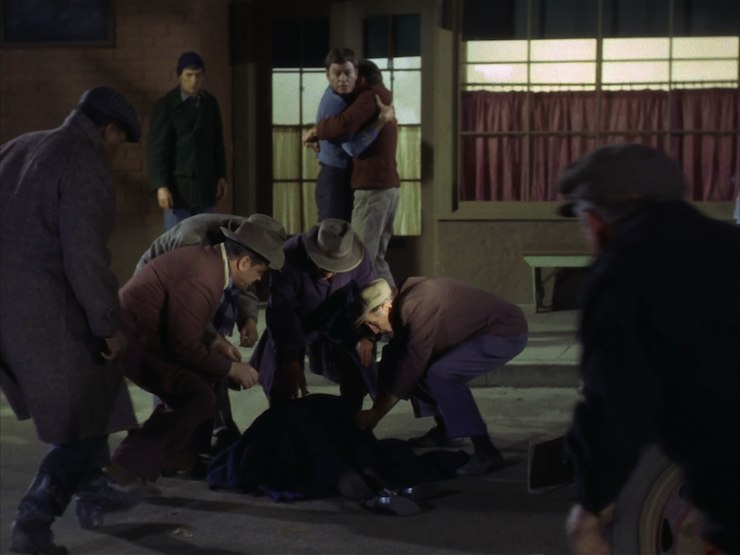
And of course the choice Kirk has to make is to let Keeler die. The very same visionary woman he’s fallen in love with.
What makes this episode so great is what makes the best Star Trek episodes great: it’s about people. Kirk isn’t just saving history, he’s saving history by allowing the violent death of a woman he’s come to love. The stakes are both large in terms of the course of history, and small in terms not only of Kirk’s feelings, but also allowing a great woman to die before her time. Because Keeler is a great woman, even though her work in 1930 only affects a few down-on-their-luck people in lower Manhattan. But her compassion is what enables three time-displaced Starfleet officers to even survive in the first place. Yet it’s never that simple. As Spock says, her desire for peace is absolutely the right thing, but at entirely the wrong time, as war was the only way the Third Reich and its allies were going to be stopped.
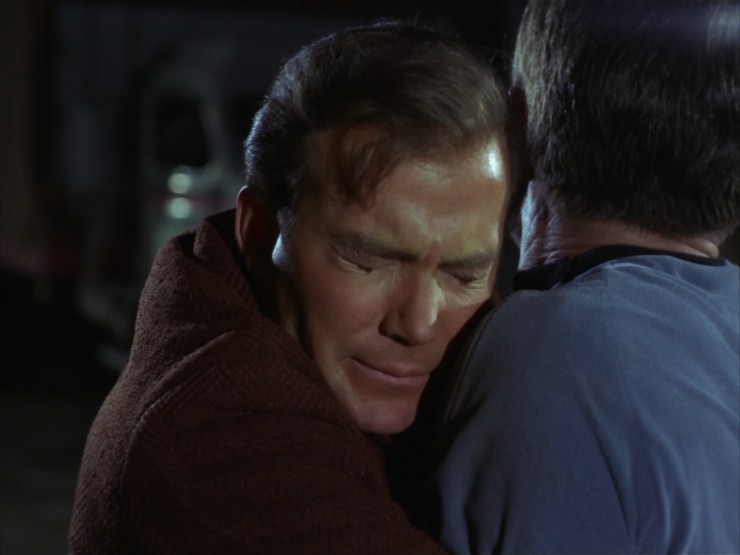
And what makes Kirk a good captain is that he makes the choice to stop McCoy. He lets one woman die so that billions of others might live.
Warp factor rating: 10
Next week: “Operation—Annihilate!”
Keith R.A. DeCandido‘s Heroes Reborn eBook novella Save the Cheerleader, Destroy the World is now available for preorder. One of six novellas tying into the new NBC series, Keith’s tale will be released on the 20th of November, and can be preordered from Amazon, Barnes & Noble, or Kobo.

“Mechanical-rice picker” may be the funniest scene in the series.
wiredog: Really? I found it irritating and offensive, honestly. Not even the funniest scene in the episode. (That would be either McCoy’s scenes with Keeler or the stone knives and bear skins bit.)
—Keith R.A. DeCandido
“He knows, doctor. He knows.”
Still hoping for Joan Collins and Shatner to be reunited in a NuTrek film that references the timeline where he saved her and they fight Nazis together as the Resistance.
I kind of wonder how the mission fared without her. I also wonder about the origins of the Guardian, as I’m sure many have.
Ellison’s original script also appeared in the 1975 anthology “Six Science Fiction Plays”, edited by Roger Elwood. It’s different in several ways from the version in the later book, which has some additional scenes in it. Those scenes seem to fill a few plot holes in the first published version, so it may have been the first rewrite.
I’ve always liked the voice of the Guardian. When it says, “A question,” it just resonates through the room. And I’ve always liked the weird effect the goofy thing has — a circular, semi-transparent light bulb.
This is my favorite Star Trek episode of all time because it is about people as Keith had said. Though I did not see this in its original run and I have had the luxury of comparing it with other Star Trek series and movies, even with other sci-fi series, this is still my favorite. :-)
Keith, Howie’s DC storyline was “Timecrime,” not “Mindcrime.”
And let’s not forget the anachronism: Clark Gable was still a virtual unknown in 1930. His only film credit for that year on IMDb is as “Extra (uncredited)” in DuBarry, Woman of Passion. He didn’t begin to make a mark until the following year.
As for the rewriting, I feel the aired version is much stronger than Ellison’s, from what I’ve seen of it. Having the person who changed history be someone we care about rather than some random guest star makes it more emotionally engaging. And having Kirk be the one who makes the hard choice is more wrenching.
Still… I doubt that Edith’s speech about the future was quite so hokey in the original version. “In some kind of space ship?” The literalism of her focus on space travel, rather than something more inspirational about humans embracing peace and mutual respect or something like that, has always felt like a misstep to me.
It’s also disappointing we couldn’t see some of the altered history. The original script had the Enterprise transformed into a pirate ship — an idea that was probably an inspiration for the aired version of “Mirror, Mirror” later on (since the original alternate universe in that episode was not an evil-twin version, just a less advanced Federation).
The Guardian of Forever kind of bugs me. As I had Dr. T’Viss observe in DTI: Watching the Clock, what kind of “guardian” actively invites people to go rummaging around in the thing it’s meant to be guarding? I mean, seriously, they make a mistake that basically destroys their entire civilization, and then the Guardian says “Let me be your gateway” and invites them to do it again. Dude! You had one job!
(I wonder, was that line meant as a setup for future Guardian episodes?)
Classic episode, of course. It’s not really my favorite (which changes like the weather) but undoubtedly one of the best. Other moments I love that haven’t been mentioned: McCoy’s freakout after he accidentally injects himself, and Kirk shutting down the bum talking dirty about Edith. But the crowning glory of this episode is Bones’ personal variation on the 60’s TV instant-knockout-chop-to-the-neck. Picard got a maneuver, so I think it’s only fair that the body chop/neck chop combo gets named after the good doctor.
This is Dammit Jim from Sci-Fried. We liked this episode so much, we wrote a song about it. http://sci-fried.bandcamp.com/track/left-behind. We actually performed it this year while we were the house band at STLV. It was awesome seeing Joan Collins and William Shatner onstage again. Most of their presentation was about this episode.
Thanks, Dammit Jim, both for the link and for showing up here on the rewatch! :)
—Keith R.A. DeCandido
The Guardian of Forever kind of bugs me. As I had Dr. T’Viss observe in DTI: Watching the Clock, what kind of “guardian” actively invites people to go rummaging around in the thing it’s meant to be guarding? I mean, seriously, they make a mistake that basically destroys their entire civilization, and then the Guardian says “Let me be your gateway” and invites them to do it again. Dude! You had one job!
Since time-travel is so easy in ST universes, it’s always amazing that the timeline stays stable at all. I used to wonder if the Guardian had some responsibility for that – damping out major ‘unauthorized’ changes by ships that time-travel through slingshot methods (or making sure the ships crewed by people who really want to influence history just crash into the sun), manipulating other time-travel to ensure that the coincidences that kept the past smooth in ‘past tense’ actually happened, etc. And then only travelers who use the Guardian itself are allowed to make major changes. Harder to make that theory work as more and more time-travel episodes and movies happen.
@8: Personally, I thought the reference to space ships was a good red herring. The Enterprise has disappeared, so the simplest explanation is that the world lost a prominent defender of space travel. At this point I was thinking it was too easy that to save the future, they had to save the woman Kirk loved rather than letting her die. Which is what made Kirk’s and Spock’s later discussion about how she was right but at the wrong time so devastating.
@13: Interesting perspective. I never thought of that.
The problem with this episode is that Keeler didn’t actually have to die. Kirk could’ve asked the Guardian to bring her into the future with them — her influence on history is removed just as effectively as with a car accident, and she gets to see the beautiful future she dreamed about.
I’m unclear on how Spock got Edith’s obituary. In order to have both the obituary and the Edith with FDR article he would have had to record the Guardian twice, once before McCoy changed history and once after. But once McCoy interfered the original history is gone. Or is history “wibbly-wobbly-timey-wimey” enough for the Guardian to retain a memory of the original history and give the recording to Spock along with the history with McCoy?
Sean: there is no evidence to support the notion that the Guardian would be so accommodating…….
—Keith R.A. DeCandido
I’m not enough of an Ellison fan to know the specific likelihood of this, but as an adult I’ve always thought Keeler was more or less explicitly based on Dorothy Day: soup kitchen, dignity of work, very simple life, and an ardent political pacifist. Day continued to advocate absolute pacifism and Ghandi-type non-violent resistance even during and after WWII. She was popular in the 60’s and GR and HE might well have known who she was. Yeah, she’s the same Day name-dropped by Pope Francis yesterday to Congress. Day’s absolute pacifism even in response to total war/genocide (which is not Catholic teaching, btw) looks to be just what this episode finds tragically inadequate.
I think this episode was easily the best of the first season, maybe even the whole series. My favorite line is when Spock deadpans “Jim, Edith Keeler must die”. Always the pragmatist.
@16/richf: The landing party remained unchanged by the timeline shift even though the ship disappeared. Clearly those in the vicinity of the Guardian and its time fields were protected from the change. So Spock’s tricorder memory of the original history would’ve been preserved for the same reason their own memories of the original history were preserved. He scanned the Guardian’s first playthrough of history, which would’ve given him the original version of events; then McCoy went back and changed things, and Spock scanned again, getting the new version of history. So both versions were contained in the tricorder.
Count me among the people who prefer the televised version over Harlan’s original teleplay.
Though I must say, Scott & David Tipton and J.K. Woodward did a spectacular job adapting Harlan’s version into a graphic novel. I stared at the last page alone for about 15 minutes before I could finally bring myself to close the book. We’ll never get to see Harlan’s version in live-action, but this comes pretty close to capturing what it would have felt like.
This is the episode my daughter and I chose to watch last year on September 8, for Star Trek’s 48th anniversary. It’s long been my very favorite (with “The Doomsday Machine” and “Mirror, Mirror” right behind). This episode is quite simply a masterpiece, and while it was heavily rewritten, Harlan’s brilliance shines through despite all the extra hands. (And I do agree with the changes made by those hands–in particular, Kirk could not be allowed to look so ineffectual at the climax. And I much prefer McCoy being the reason that history changes instead of the one-shot character Beckwith, whose final fate was certainly powerful, but would have been damned hard to accomplish visually on a 1967 television budget.)
Incidentally, the Guardian ended up playing a pivotal role in DC’s FIRST Star Trek series, issue #33, which was the 20th anniversary issue and featured the movie-era Enterprise crew encountering their younger selves from the first season of TOS. Wonderful story, in case you’ve never read it. Written by Len Wein with art by Tom Sutton and Ricardo Villagran.
Great episode. I also much prefer the aired version to the original teleplay (or more precisely, the graphic novel – I haven’t read the teleplay itself), for all the reasons already mentioned and a few others:
In the graphic novel, they don’t use tricorder readings to find out how the timline splits up. Instead, the Guardian provides them with the information that they have to find a “focal point”, and gives the following description: “Blue it will be. Blue as the sky of old earth and clear as truth. And the sun will burn on it, and there is the key.” This is apparently enough to identify Edith Keeler as the focal point, because when they see her for the first time, she wears a blue cloak with a pin formed like a sun, and her name is “Kee-ler”.
Now, that’s half mystical and half silly. Utilizing tricoder readings is much better. It also means that Spock never builds his cool computer using “stone knives and bear skins” (I can never get enough of that computer). And the love story between Kirk and Keeler is so much more tragic when he meets her and falls in love with her without already knowing that she is connected to their task.
Another thing I didn’t like in the grahic novel is that Keeler doesn’t run a mission, thus doing down-to-earth, useful work; instead it seems to be her job to give speeches. This also means that Kirk and Spock never work for her. But I liked that Kirk has no problem with falling in love with his boss, and I liked that the whole story revolves around the mission.
The artwork was great, though.
Tangential addendum to the tie-in fiction: In Final Frontier by Diane Carey, the frame story picks up right after this episode, as the Enterprise returns to Earth and Kirk spends some time on the family farm, considering resigning from Starfleet in the throes of his heartbreak. He finds letters from his father, which catapult us back into the adventures of George Kirk (Carey’s depictions of George Kirk and Robert April in this novel and in the sequel, Best Destiny, are simply terrific). In the meantime, McCoy comes to visit Jim Kirk and apologizes for the “intern’s mistake” of fooling around with a loaded hypo in high turbulence. He is unsuccessful at persuading Kirk from his intent to resign.
But later, Spock comes to see him in the barn, and that’s where I see the only parts of Ellison’s script that I missed in the filmed version. If I recall correctly, Ellison wrote that Kirk could not allow Edith Keeler to die, and it is Spock who stops McCoy, as the one able to put logic above emotion. But in Ellison’s script, as in Carey’s book, Spock goes to Kirk and – not quite apologizes, but expresses his regret at the pain Kirk is in. I haven’t read them in years, but I believe in both Carey’s book and Ellison’s script, Spock points something out that Kirk needed to know: “You did make a difference. In the original history, she died. But in the altered history, she was loved before she died.”
Both of Carey’s books are strongly recommended among the best of the tie-in fiction. Even if I’m misremembering them mumblety years later. :)
Harlan Ellison is responsible for some of the greatest speculative fiction ever produced for television.
Demon with a Glass Hand and Soldier for The Outer Limits, The City on the Edge of Forever for Star Trek, and Paladin of the Lost Hour for The Twilight Zone are all absolutely brilliant.
#8
Guardian of Forever is a curious name, isn’t it? What precisely is it guarding? And since it comes off as far superior to us lowly humans, what would it care about some Chaplin impersonator winning a war on a distant rock anyway? Time is somehow mutable through this thing, and forever isn’t is so forever as it turns out. So maybe Portal of Screwing with Your Past and Your Love Life is a more accurate name.
The coda with Spock and Kirk is also present in James Blish’s adaptation in Star Trek 2.
—Keith R.A. DeCandido
Spock’s comment about stone knives and bearskins is not my favorite reference to antique technology. McCoy makes a passionate speech about medical care in this period, saying people were “sewn up like garments.” That one always chilled me.
I always thought of the term “Guardian” as used here to be more in the sense of looking after and being responsible for “Forever,” i.e. Time itself. It never occurred to me that looking after history precluded making any changes to it.
@27/MeredithP: Yes! I fondly remember that line whenever someone has an operation and I get a look at the stitches.
While I wouldn’t change a thing about this episode, I wonder about the possibilities of Kirk telling Edith essentially: “We’re from the future. According to history you were supposed to die today. Instead, why don’t you come with me?”
@30/nms72: But how would they get back to their own time with her? They had no way to contact the Guardian, only the promise that they would be returned if they were successful.
@30, they also didn’t know what day it was destined to happen. If they had, they would have been on the lookout for McCoy instead of going to the movies
Anyway, I have to question whether Edith’s movement would really have made that much difference. There were already plenty of factions in America insisting that we should stay out of WWII for various reasons, from pacifism to isolationism to being actively sympathetic to the Nazis. But Pearl Harbor silenced those voices. I doubt that one more voice in the anti-interventionist chorus would’ve tipped the scales so radically. I think David R. George’s Crucible: McCoy does offer a possible explanation for this, but I forget what it was.
Of course, the episode does have its chronological anomalies that suggest a subtly different history than the one we know. There’s the Clark Gable thing I mentioned above. There’s the diegetic use of the song “Goodnight, Sweetheart,” which wasn’t released until 1931. Also, the calendar on the wall in the mission is for a 30-day month beginning on a Thursday, and there was no such month in 1930. The calendar (and the other things) would fit September 1932, except that it seems to call out the 14th as a holiday. Also, from what I can determine, I don’t think you could see Orion’s Belt in the night sky from NYC on September ’32.
A couple of points:
A stronger pacifist movement, especially one where Keeler personally knows and has influence with FDR, could prevent or delay the United States oil embargo of Japan that convinced the Imperial government that a sneak attack and war on their own terms was needed. No oil embargo=no Pearl Harbor, at least not as it occurred in our timeline.
The shooting script if I recall had “Richard Dix” as the actor Edith mentions, not Clark Gable. However, on one of the final rewrites someone pointed out that even in 1966 nobody remembered Richard Dix so the reference would make little sense to the audience. It was changed to Gable on the last re-write…GR and DC and company knew that it wouldn’t be completely correct historically speaking but felt that a reference to Dix would confuse and distract the audience.
Greatest Trek story ever.
@34/John Sickels: Interesting point about Japan, but I’m not so sure. Japan’s war in the Pacific wasn’t specifically directed against the US, but was part of a larger campaign to conquer all of East Asia and the Pacific Islands. We Westerners think of WWII as beginning in 1938, but the war in Asia had been going on since Japan invaded Manchuria in 1931, and the 1937 Nanking Massacre turned US sentiments against Japan. The attack on Pearl Harbor was just one part of a Japanese offensive to conquer Southeast Asia and the Dutch East Indies, and was mainly about removing the US Fleet as an obstacle to that effort, though that backfired hugely.
The oil embargo in 1941 was a reaction to Japan’s invasion of French Indochina, a condemnation of their aggression. True, Roosevelt was aware the embargo could be a provocation and expressed a readiness to retaliate if Japan attacked other countries, but I’m not sure it follows that a more pacifist US would have been willing to continue supplying oil to a nation as warlike as Japan was at the time.
I really should try to find what Crucible says about it, but I’m eating a grilled cheese sandwich and my fingers are greasy.
As for the Clark Gable thing, I can understand going with a better-known actor, but then, why not also bump up the year to 1932 or so? There wasn’t any specific reason it had to be 1930, and it would’ve fixed several anachronisms if they’d just changed one digit.
If memory serves, Spock’s Viewmaster shows us the Third Reich winning (I doubt the alliance between Germany and Japan would’ve lasted long after conquering their respective slices of the world). The Keeler peace movement may have been enough to hold back aid to Europe at a critical point and perhaps even convince the American public we were in the wrong war after the disaster at Kasserine Pass.
Or maybe after Edith was pulled out of the way of that truck she stepped on a butterfly.
Okay, I checked Crucible: McCoy, and it just says that the pacifist movement led Japan to conclude that America wasn’t enough of a threat to their plans to justify attacking Pearl Harbor in ’41 — though they eventually did in ’44, after most of Europe and Asia had fallen and the USSR was on the verge of defeat. They did launch their invasion of the Dutch East Indies and Malaya on schedule, but left Hawai’i out of it. I’m not sure how much difference a pacifist movement would really have made there, given that the US was pretty staunchly anti-interventionist already. But the book doesn’t go into any greater detail about the cause and effect.
Also, from what I can determine, I don’t think you could see Orion’s Belt in the night sky from NYC on September ’32
Orion generally rises a little before midnight in late september (irrespective of the year, and almost irrespective of your location) and is overhead at sunrise. I suppose it’s unlikely they’ve stayed up quite that late.
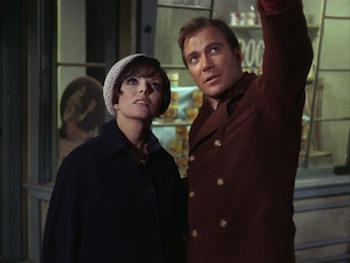
@39/Bruce: One thing I take into account is that they were in the city and would presumably have had buildings blocking their view of the horizon. Also, as the picture at the beginning of the post makes clear, Kirk is pointing pretty high in the sky. So it would have to be a time of year when Orion was close to the zenith in the evening when a man would be walking a woman home.
@36/Christopher:
But maybe a more pacifist US wouldn’t have moved their fleet to Pearl Harbor prior to the invasion.
@41/Jana: Maybe, but — although I’m mainly going by Wikipedia here to refresh my memory — it seems to me that Roosevelt was already defying the overall mood of the American people when he pushed for a military response to Japanese and German aggression, including the movement of the fleet to Pearl Harbor. There were already plenty of anti-war forces putting pressure on FDR to back down, but he stuck to his guns, so to speak, in spite of that. So as I said, I’m not convinced that adding Edith Keeler’s movement to the chorus that already existed would’ve changed that much. She would’ve had to be incredibly persuasive to change FDR’s mind about it.
But then, maybe that’s the idea. She was a remarkable, inspiring enough woman to make Captain Kirk fall in love with her and consider sacrificing his universe for her. Maybe it was just her personal charm and her gift with words that swayed Roosevelt when nobody else could, or that swayed a large enough movement that FDR didn’t have the political capital left to keep pushing for war. So it would’ve been her charisma and rhetorical gifts, her exceptional ability to sway minds, that made her a linchpin of history — sort of a counterpoint to Hitler himself in that regard.
However, that leads me to another question: Even as a pacifist, would she necessarily have wanted the US to stay out of the war? She would’ve surely seen the dangers of German and Japanese aggression, all the lives they were taking. Even Gandhi declined to suggest that Hitler could be defeated with pacifism. He believed that method would be effective against the British Raj because Britain believed itself to be a moral and benevolent nation and could be motivated to back down in India if they were shown that the Indian people were not savages in need of suppression and that it was they themselves who were the aggressors, a role they wouldn’t willingly embrace. But Hitler was a willing aggressor, as was Hirohito, and so Gandhi did not argue that pacifism would be the right response to them. So would Keeler really have seen things so differently?
What if the Keeler movement had enough sway to have a more isolationist president elected instead of Roosevelt at some point? Maybe the 1940 election. That could change quite a lot of things. And even if Keeler came around to seeing Hitler had to be defeated through war, it may have been too late at a certain point, like the defeat of Russia, the Nazis developing the atomic bomb first, etc.
I like to think of this alternate universe leading to the Terran Empire. Has that ever been explored in the novels?
@42/Christopher:
That’s a very good question. Maybe it would have taken her longer to see the dangers? When Japan conquered parts of the French colonial empire, maybe she would have thought that both regimes were equally in the wrong, that it would be best to stay neutral and provide humanitarian aid (if possible), and that a powerful and peaceful US could, in the long run, serve as a good example for the world? (I’m having a harder time justifying a similar line of reasoning regarding Germany, though.)
I used Wikipedia to check my facts too… what would we do without it?
@43
I thought we were in the mirror universe?
As for plausibility, WW2 always seems to be such a mess of coincidences and near run things you could probably justify pretty much any permutation of victory. It is an alien time travelers playground.
It would not take much to alter the outcome of WW2 and throwing a Keeler-led peace movement into the mix may be enough of a butterfly wing-flap to tip the balance. Remember Spock said the movement “delayed” the entry of the US into the war, not prevented it outright. There are a huge number of “hinges” if you will that could have resulted in the European front being a stalemate if they had tipped in a different direction, long enough to drag things out.
Perhaps in the Keeler-TL the Manhattan Project doesn’t get funded at the same level or at the same time as it did in OTL.
Only the Guardian of Forever knows!
In any event, despite some flaws it’s a terrific piece of television drama that holds up 50 years later. Shatner’s acting in the last three minutes of the show is incredible. He could really act when he put his mind to it. And I prefer what DC and GR and GC and company came up with by committee to what Ellison wrote, which was a great story in itself but would not work with the Kirk character as established in the series.
This was one of the few episodes of TOS I watched before this year, and I guessed that it would end up near the top of my favorites once I watched the rest. And I was right; only The Trouble with Tribbles edged it out. What can I say – when it comes to Trek, I seem to be pretty much in line with the fans and critics (The Inner Light is my favorite episode of TNG, and The Visitor is probably my favorite of DS9, but I’m not done with that rewatch yet).
It’s no coincidence that all these episodes are much more focused on human(oid) relationships than on technology. (Well except Tribbles, which was just pure fun.) As Keith says, “What makes this episode so great is what makes the best Star Trek episodes great: it’s about people.”
As a strong pacifist, I have thoughts on the “wrong time for peace” theme, but can’t put them into words at this time.
@47/Pax – When I was a kid that line about peace being the right message “at the wrong time” stuck out like a sore thumb. Coming out of Spock’s mouth, we were presumably supposed to take it as logical, but it’s not logic, just rhetoric. (I didn’t know what rhetoric was when I was that young, but I could tell it was hollow.)
This was an excellent episode overall, but it’s also Ellison finding a pretext to make pacifists into the bad guys, which is consistent with the personality and worldview he would express throughout his life.
Oh, and The Inner Light is also my favorite TNG episode. Quaker leanings, you know.
The length of this conversation is yet more proof of how good this episode was. Not just as an episode of Star Trek, but as a time travel story. “What if?” is one of the most powerful questions that we can ask.
@43/George: That’s a good point, that maybe FDR wouldn’t have been re-elected in ’40. Maybe Keeler campaigned for Wendell Willkie, who argued that FDR was too eager for war, and helped him win. (Though that’s not how Crucible handled it.)
@44/Jana: The point is, the issue isn’t what Edith believed, because in real life, lots of people in the US already believed we shouldn’t go to war, but FDR defied them. Keeler’s belief wouldn’t have mattered unless she could’ve had an impact on Roosevelt that the numerous other anti-war factions didn’t.
Maybe Guardian of Forever is a poetic mistranslation of its language? Perhaps the meaning is closer to Doorman of Forever. If its job was to stop time travelers, it would do that better just by not existing.
Was the original timeline different from the one they restored? Did Edith Keeler’s accident occur under different circumstances? The restored timeline has her dying specifically because of Kirk suddenly interrupting their date to see McCoy and she was confused and a bit miffed about the whole thing. Maybe the original timeline disappeared between McCoy jumping through and Kirk and Spock going through not McCoy saving her but Kirk having to decide to go to in the past to set the circumstances? Otherwise, the restored timeline would be subtly different from the original. Time travel paradoxes make my teeth ache.
Keeler also could have convinced FDR not to have helped Britain with supplies for the European Theater prior to Pearl Harbor. The USA was a already fighting a low grade undeclared naval war against Germany in ’40 & early ’41. My grandfather served on a destroyer that protected the convoys, his journal entries mentioned his ship depth charging a U-boat during such a cruise that they believe they sunk. If FDR had not been using the Navy against the Germans prior to the official entry to WWII, Hitler might not have declared war on the USA after Pearl Harbor (the Axis Treaty did not require it), and FDR might have had a difficult time getting support to declare war on Germany.
Dynasty was one of my Mom’s shows when I was a kid, I never made the connection between Alexis Carrington and Edith Keeler until she pointed it out. I remember being a bit flabbergasted about it.
@50/Crusader75: Well, maybe not to stop time travelers, just to regulate who has access. A guard doesn’t keep everyone out, just the ones who aren’t authorized to be there. A guard who admits any random person who shows up isn’t doing a very good job of guarding.
I figure the Guardian was old and worn out, which was why it was giving off all that time turbulence, and so maybe it wasn’t thinking clearly. Maybe it was just lonely.
#50
Many thanks to your grandfather for his service.
As for the Axis Treaty, wasn’t there a clause or something that said when any one of the three nations was at war with another nation, like the US, the other two had to join in the fight? I could have that wrong, but I was under the impression Hitler was somehow obligated to help the Japanese Empire after Pearl Harbor. Or maybe it was just another dumb tactical decision on his part. (Back to Wikipedia…)
Germany was not obligated obligated by treaty to declare war on the US since Japan was the aggressor at Pearl Harbor. IIRC Hermann Goering mentioned this at the Nuremberg Trials and there were those in the Nazi leadership who thought Hitler was foolish to take the step and declare war.
It is true there was the low-grade undeclared naval war already going on with convoy escort in support of Great Britain, but that could have remained at a low undeclared level with the US focusing resources against Japan in the Pacific, had Hitler not declared war.
Eventually the US would have been drawn in directly but it did not have to be in December 1941. A wiser Hitler could have bought more time, pushing back invasions of North Africa/Italy/France for at another year or two and enabling him to concentrate on the USSR without US/UK distractions, the 8th Air Force bombing attacks, lend-lease to Russia, etc. Fortunately Hitler was not wise.
@49/Christopher: You talked about both issues in @42 – first about the question why she might have had a bigger influence on Roosevelt than the other anti-war forces, and in your last paragraph about what she herself might have believed. I liked your thoughts on the first issue and had nothing to add, so I just tried to answer your last question.
@46/John Sickels: The Manhattan Project didn’t influence the outcome of the war against Germany because Germany was defeated before they were finished. Which is why they dropped the bombs on Japan instead.
Okay, here we go. From Wikipedia:
According to the terms of the Anti-Comintern Pact, Germany was obliged to come to the aid of Japan if a third country attacked Japan, but not if Japan attacked a third country. Nevertheless Hitler, almost entirely without consultation, chose to take the upper hand and declare war against the U.S, wanting to do so before, he thought, Roosevelt would declare war on Germany.
Keeler didn’t need to influence FDR; only some members of Congress. The Neutrality Patrol might’ve been stillborn, preventing supplies from crossing the Atlantic. Rearmament had been proceeding since the late 30s- Abyssinia, Manchuria and Hitler’s baby steps toward domination alerted just enough people to start ship construction and aircraft designing- but more awareness of what the warmongering FDR was up to, or a well expressed pacifist viewpoint, could have delayed Atlantic convoy escorts needed for supplies to Britain and the USSR. (The Pacific mattered less; Japan did not have the ability to conquer much more than it’s early 1942 zenith).
And did Spock fall on his tricorder and break it? What happened to its playback function?
@56/sps49: I figure the issue with the tricorder was that it had simply recorded so much data from the Guardian that it exceeded the capacity of the device’s inbuilt computer to process it, so he needed to tie into a larger computer (or makeshift mnemonic circuit) to handle the data. After all, it’s not just about the ability to play data back, it’s about the ability to find the particular data you want, to filter it out of everything that was going on in the world throughout history.
Honestly, what bugs me is that, after the Guardian’s discovery, and certainly by the TNG era, the Federation should’ve known enormously more about history than they were shown to know. They should’ve had historians scanning the Guardian’s playback of every planet’s history and then spent decades sifting through the data and learning everything they needed to know about every past event. But there’s no indication that this was ever done. In one of my books (probably Watching the Clock), I tried to explain that the Guardian’s data was just so dense that finding useful information amid all the chaff was itself a very difficult and time-consuming data-mining process, the work of decades — like how there are a bunch of fossils in museums all over the world that have been dug up and stored away but never really studied, and much of the work of making new discoveries in the field emerges from re-examining fossils that were stored away decades earlier. And I figure there must be a certain amount of blurring/overlap over a given span of time that makes it hard to pin down exactly when events occurred relative to each other. After all, Spock’s tricorder had data on Edith’s death in the original timeline even though that occurred weeks after McCoy jumped through and reset things. So events within a few weeks or months of each other might all be blurred together, coming out of the Guardian at the same time and thus hard to sort out. Which would’ve been another reason Spock’s tricorder alone wouldn’t have been adequate to mine the data for the specifics he needed.
Also, of course, “Yesteryear” established that you could alter history just by scanning it through the Guardian, so I think that after that, the Federation would’ve banned using the Guardian for historical research. Federation historians would’ve been limited to the scans that were made between “City” and “Yesteryear.” Not to mention that Starfleet probably classified the Guardian, given how powerful and dangerous it is, so any historical data collected from the Guardian would probably be classified too, to avoid uncomfortable questions about how it was obtained.
CLB @57- Yeah, it’s a good thing the Borg apparently never knew about the Guardian.
But I don’t think there were enough electronic components in the world to make a typical flash drive or processor equivalent, setting aside whatever the Star Trek future uses and the failure rate of gobs of vacuum tubes.
I like the idea that the Guardian was lonely. And if you think about it, it kind of did guard the timeline–while the guardian returned everyone after they restored the timeline, it didn’t return McCoy after he messed it up in the first place, and everyone on the planet was left there to attempt to fix it again. So the lonely guardian let McCoy mess it up, but then it let Kirk and Spock fix it (because more people to go through).
But how was the rest of the landing party supposed to know when to jump without Spock’s tricorder?
“Since before your sun burned hot in space (4.5 billion years ago) … I have awaited a question.” I guess whoever built those 10,000 century (1,000,000 year) old ruins never asked it a question.
54–Yes of course. But my thinking was that late US entry in the war does not, by itself, guarantee that the Nazis get the A-bomb first. To guarantee that you have to push back the Manhattan Project too.
So my personal Keeler Butterfly Theory goes like this:
A) Edith does not die in 1930
B) By February 1936 she is prominent enough to have the ear of FDR
C) Isolationist movement is even stronger than in OTL
D) By 1940 the situation has changed enough that either
D-option-1) FDR doesn’t run for a third term, or
D-option-2) FDR is defeated by Wilkie or a different isolationist Republican (Lindberg?)
D-option-3) FDR does win in 1940, but there is no oil embargo against Japan. Pearl Harbor does not happen, and/or
D-option-4) No funding or reduced funding for Manhattan Project
E) By late 1940s Hitler has the bomb and US doesn’t.
@57: The animated series shows that historians are using the Guardian to study the past, but only by travelling through it apparently, which seems far more dangerous to the time stream than just scanning.
@59: by ‘A’ question, it meant The question, the one about Life, The Universe, and Everything.
@60/John Sickels: I gather it’s actually pretty unlikely that the Nazis would ever have developed an atomic bomb of their own. It’s not a project they were pursuing all that seriously to begin with, according to NOVA. They were winning, after all, and thus didn’t feel the same need to develop a superweapon that the Allies felt. They put more research effort into developing rockets than atom bombs. They only shifted focus to atomic research once the tide turned against them and they were at risk of defeat. So in an alternate history where the US was late to enter the war and the Nazi conquests were more successful, they probably wouldn’t have bothered to develop an atomic bomb. At least, it doesn’t seem like it would’ve been a pivotal part of their victory.
@61/Athreeren: No — the historians that stayed behind were scanning Vulcan’s past with their tricorders while Kirk and Spock were visiting Orion’s past, and that caused Vulcan history to change because Spock wasn’t there. So yes, it was the scanning alone that caused the timeline to be altered. In unusual circumstances, yes, but the stakes are high enough that I can’t imagine anyone would be willing to risk such a monumental accident again.
City on the Edge of Forever is one of two Original Series episodes I constantly revisit every year. The other one being Trouble with Tribbles.
Needless to say, this is as perfect as it gets. It’s the most emotionally relevant time travel story ever told. In this case, we get a very vulnerable Kirk, and Shatner rose to the occasion. The thing about this particular story with Edith Keeler is that it doesn’t play like the average Kirk romance plot. This is no clichéd one-night-stand where Kirk boinks the girl of the week. This is a story where Kirk is clearly smitten and taken away by her presence. He’s usually the dominant force in a relationship. This time around, she had the power even though he had the knowledge. He’s torn apart because of that. That’s why the tragic ending ressonates so deeply. “Let’s get the hell out of here” is Kirk’s best line in the series, and Shatner is at his most subdued as he plays it. Downright perfect storytelling. Personal stakes going up against universal stakes. Kirk makes the only sensible, yet brutal choice. Easily one of the best – if not the best – episodes of original Trek.
Radiant is a good way to describe Joan Collins as Edith. Great performance.
My only very minor quibble with the episode involves the rather contrived method for drugging up McCoy. They needed a plot device to get this time travel story rolling, and I feel this could have done better. But then again, it’s still better than Ellison’s original idea, which involved a drug dealing crewman.
And speaking of Harlan Ellison (I hope he doesn’t read this)….
I knew about the production controversy long before I even saw the episode, thanks to Shatner’s Star Trek Memories. I admire Ellison’s work, I can understand some of his contentuous attitude towards the establishment and the way people tend to dance around being truthful. I actually sympathize with him more often than not. But nevertheless, I cannot understand his attitude towards being rewritten. What exactly did he expect when he accepted a television writing assignment? That his original draft – which apparently took eons to arrive, according to Bob Justman – would be left unchanged? This is television. He’s a freelancer. You’re writing to serve the vision of an executive producer/showrunner. Obviously, this was going to be revised by Roddenberry, Coon and Fontana. And I’m glad it did. Hell, he still got full writing credit, which means he got more money, and residuals. TV is a collaboration, and the final word comes from the producer. I intend to address this again on A Private Little War.
According to Justman, the original draft had a scene with Kirk being chased by a thousand extras. In 1960’s TV, you were lucky if you could afford 10 people (extras cost money). Either he was dense about the way TV worked or Ellison was somehow predicting a CG crowd 35 years prior to Lord of the Rings.
@62: Fully agree about the extreme unlikelihood of the Nazis developing an atomic bomb. Their atomic bomb program was miniscule compared to the Manhattan Project. Though this isn’t the last time that Star Trek will seriously overestimate Nazi Germany’s capabilities. The most egregious example is probably in Patterns of Force where Spock agrees with a statement that Nazi Germany was the most efficient state in Earth’s history; a claim that any credible scholar of World War 2 knows is utterly ridiculous. Nazi Germany was in fact incredibly inefficient (largely by design as Hitler deliberately gave overlapping areas of responsibilities to his subordinates and encouraged bureaucratic infighting so as to keep his flunkies divided and dependent on him.)
@63/Eduardo: The thing is, that “cliche” of Kirk sleeping with the girl of the week didn’t exist in the first season. We saw him resist his attraction to officers under his command (Rand, Noel), we saw him have wistful reunions with old flames (Ruth, Areel), we saw him being unresponsive to women’s interest in him (Eve, Miri), and we saw him use flirtation as manipulation to achieve a goal (Andrea, Lenore). The only hint of any kind of womanizing was Miss Piper’s reference to Helen Johanssen as a woman in Kirk’s past in “The Menagerie.” The first season consistently painted Kirk as a man who generally focused on his duty but who was capable of deep caring for the women in his life. His relationship with Edith is perfectly consistent with that, not a contrast at all. Indeed, you’ll note that it’s actually the first Kirk romance story in the entire series, because everything before it was either a reunion with an old flame, a deferred or denied romance, or an empty flirtation.
It was only in the second and third seasons that the writing of Kirk was brought somewhat more into line with the standard characterization of womanizing male action heroes like Jim West or Napoleon Solo. But we still see a lot of the old patterns. He plays along with Sylvia’s seduction in pursuit of an advantage over a foe, and attempts to seduce Kelinda for the same reason (without success). He romances Marlena to maintain his cover, and wins her over with his greater decency than his counterpart possesses. Janet Wallace is another old flame. He’s seduced by Nona for her own reasons. He’s not even himself with Thalassa. His romance with Shahna is the one instance in season 2 where we really get the cliche of the spaceman teaching the spacebabe how to love, and the only really shallow womanizing we see is in “Wolf in the Fold” (with the implied tavern-crawling) and with Drusilla the slave girl in “Bread and Circuses” (which was deeply problematical, since a slave can’t actually give consent). In season 3, we have Kirk being love-potioned by Elaan, genuinely falling in love with Miramanee, trying to seduce Miranda for the good of the ship and totally bombing, being seduced by Deela and Marta and playing along, being manipulated into falling for Odona and Rayna, and having his old flame Janice Lester try to kill him. So we still get a mix of genuine (if usually whirlwind) romances, old flames from the past, and manipulations on his or someone else’s part. Really, the whole notion of Kirk as a shallow, casual womanizer is a myth based on a few atypical instances.
And I disagree that “he’s usually the dominant force in a relationship.” As the above examples show, he’s often the one being pursued.
I totally agree about Ellison’s attitude, though. If he didn’t want to be rewritten, why participate in a collaborative medium like TV? I don’t think he was “dense,” though. I think it’s just that he had trouble reining his imagination in to the limits of TV budgets. But then, that’s why they had Bob Justman. Ellison’s Outer Limits script “Demon With a Glass Hand” was written as an impossibly costly chase across much of Los Angeles, but Justman figured out they could afford it if they shot the whole thing inside the Bradbury Building.
@60/John Sickels: My mistake – I thought you meant that any one of the changes you mentioned might have altered the timeline by itself. Yes, it makes sense in combination.
@65/Christopher: I would go even further. While I agree that the scene in Bread and Circuses is problematical, for the reason you mentioned, I wouldn’t regard it as womanizing – after all, Kirk wasn’t there of his own free will either, and he never asked for a slave girl. So it’s really just Wolf in the Fold, and everybody is out of character there. (I mean, Scotty hating women? Did you see him with Carolyn Palamas and Mira Romaine? OK, I really hate that episode.)
@37/GeorgeKaplan – “I doubt the alliance between Germany and Japan would’ve lasted long after conquering their respective slices of the world”
See also: US, USSR. :)
@48/AlanBrown – Oh, I don’t know, we’ve had much longer conversations about much sillier things. :)
@65/Christopher: I was referring mainly to the old flames, in this case. The point I was making was that while he cared for women like Helen Noel, he didn’t really love them, at least that’s how I feel it comes across. He romanced them, but he didn’t love them the same way he loved the Enterprise, Spock, Bones, Edith, or the way he would love David later on (would Antonia and Carol Marcus qualify?).
Otherwise, I think only Miramanee comes close to being someone Kirk might have truly loved, but the whole memory loss situation murkies that whole scenario on Paradise Syndrome (which deserves its own discussion when the rewatch gets there).
@68/Eduardo: I dunno, it always seemed to me that the young Kirk must’ve had really intense and complicated feelings for Ruth, given how poignantly he reacted to seeing her (and given how sad and gentle their love theme was). I’ve always figured she was very important to him in some way, and it’s a bit odd that nobody in the tie-in field ever seems to have fleshed out that relationship. As for Areel or Janet, we don’t know enough about their relationships with him to judge how they went.
And he didn’t romance Helen. He’d danced and flirted with her at the Christmas party (when he’d thought she was a civilian passenger, according to a deleted scene from the script), but that was just idle party flirtation, nothing more. The rest was all brainwashing.
I always look to this episode as a rejoinder to those who think William Shatner can’t act. Yes, when the gentleman channels his inner ham scenery is chewed at a rate to make a Cuisinart blush, but . . .the shock and loss in his face and body language when Edith dies, the soul-deadened fatalism in his voice as he orders the landing party “the hell out of here”. . .
Bill Shatner can act, ladies and gentlemen. No arguments.
62 and 64: Agreed, it seems quite true that the Nazis were nowhere close to being able to build a bomb and that their research was relatively low priority. However, I’m not sure this was completely public knowledge back in 1966. . .IIRC, it was historical research in the late 60s/70s/80s that revealed how far away they really were. I think Ellison and the Trek writing staff can be forgiven; I don’t think the truth as well-known when they wrote it.
The “Efficient Nazi” thing in “Patterns of Force” is a different matter…if I remember my historiography from grad school, by ’67 it was pretty well established among historians that the National Socialists were actually very inefficient. The assumptions behind that episode were based on a 30s/40s viewpoint and an old stereotype of “Prussian order” I imagine. Less forgivable.
Here’s another thought on the German bomb program.
I don’t think it would have been easy to conquer the Soviet Union by conventional means. It’s a vast country, and others have failed before. So I imagine that in the altered timeline, the war in the east dragged on. Maybe because of that they intensified their efforts later on; or one of the scientists simply came up with a brilliant idea that led to a breakthrough.
@72/Jana: But German “superweapon” efforts were focused more on developing rockets than atom bombs. If they’d succeeded, they could’ve launched hundreds of rockets with conventional bomb payloads and devastated Russia’s cities remotely. That could’ve been quite an effective superweapon of its own, without the need to develop atomic bombs. Just because atomic bombs were the superweapon of choice in our history, that doesn’t make them the only option. Heck, given how fond the Nazis were of deadly medical experiments, maybe their superweapon of choice would’ve been a biological or chemical payload delivered by rocket. They certainly had no qualms about using deadly gas in other contexts.
@18/Xena – I wondered the same thing, about a possible connection between Edith Keeler and Dorothy Day; but a commenter on that blog recently pointed out to me that Ellison has said Edith was based on, or at least heavily inspired by, Sister Aimee Semple McPherson.
@73/Christopher: I don’t think Germany would have had the resources to build enough of those rockets and bombs. And since Spock mentions rockets carrying atom bombs, that’s what I assumed too. That would mean far less rockets would be needed.
But really, none of this is even remotely realistic. Germany never had the resources to win the war anyway. They were vastly overestimating themselves right from the start. I’m clutching at straws here trying to come up with a plausible backstory for the episode.
@74/Mike: If the IDW graphic novel (which I’ve read) really is the same story as the teleplay (which I haven’t), Ellison’s Edith Keeler didn’t run a soup kitchen. So the connection may still be true, if one of the other writers came up with it and changed her character accordingly.
@75/Jana – Great minds think alike! I was just thinking this morning that this script went through many hands after Ellison’s, and someone mentioned above that, in the IDW graphic novel, all Edith seems to do is give speeches.
On the other hand, Aimee Semple McPherson, though best remembered (arguably) as as preacher, did a substantial amount of charitable work, too. Quoth Wikipedia: “Drawing from her childhood experience with the Salvation Army, in 1927, McPherson opened a commissary at Angelus Temple which was devised to assist the needy on a much larger, formalized scale. The Commissary was virtually the only place in town a person could get food, clothing, and blankets with no questions asked. It was open 24 hours a day, seven days a week, and became active in creating soup kitchens, free clinics, and other charitable activities as the Great Depression wore on. She fed an estimated 1.5 million people.”
Regardless, I like that Edith (“Sister Edith Keeler,” but only in the credits) does the works of mercy like both McPherson and Day. And, given that we have no indication of her religious belief (if any) onscreen, I appreciate that she does it without constant sermonizing. Even when “it’s time to pay for the soup,” she isn’t thumping the Bible.
@76/Mike: Um, it was me who wrote that it seems to be her job to give speeches in the graphic novel, and maybe I wasn’t entirely fair. She does some charitable work too. There’s a scene where she tells Kirk that she’s about to return some stolen merchandise to its owner where the thiefs were “some young boys [who] made a mistake”. And there’s a brief mention of a “milk kitchen” where she seems to work. She’s mostly shown giving speeches, though.
And she’s actually called “Sister Edith Keeler” when they first meet her. It’s written on a sign next to her: “Hear Sister Edith Keeler speak”.
I still prefer her portrait in the episode because she mainly does useful stuff there, with the speeches as an extra, not the other way round.
You know, I’ve felt for a while that Joan Collins was miscast as Edith. She was gorgeous and luminous, to be sure, but too posh and refined for a character who was written as a strong-willed, streetwise, no-nonsense New Yorker. I feel that the scripted characterization would be a better fit to a more earthy actress with more of an edge — maybe Vera Miles, say, or Louise Fletcher. (Although apparently Fletcher was taking a hiatus from acting at the time to raise her family, so scratch that.) I like the idea of Kirk falling for her because she’s tough and smart and scrappy rather than because she looks and sounds like a fairy-tale princess.
@77/Jana – Hi, Jana… Since there’s no tone of voice online, I’m not sure if I caused offense or not. If I did, I apologize; it was inadvertent. When I chimed in, I was simply too lazy to go through the comment section and find who said it so I could properly attribute. (If I didn’t cause offense, well, no harm done!)
I did read the graphic novel, and I don’t doubt the bits you mention are there. They just didn’t stick out for me. My intent was to agree with you, but thanks for pointing out the nuances in Ellison’s original.
Is that sign you mention in the on-air episode, or the graphic novel? All I meant was, I am 99% confident she is never addressed or audibly called “sister” in the finished episode.
At any rate, I think we’re in agreement, but just wanted to apologize if I stepped on your toes.
@78/Christopher – I always got the impression that Kirk fell for her more for her spirit, vision, and compassion than for her beauty (although, of course, that didn’t hurt). Were it filmed today, though, I could see them casting along the lines you suggest, to make that point clearer. But almost all the women on TOS are attractive by the standards of the day, and then get the soft lens treatment on top of that. But, yeah, it would be great to see Edith after a long day’s work in the slums – she would not be as clean or put together as Joan Collins is, for sure!
@79/Mike: Please don’t worry, I wasn’t offended! I’m sorry if I “sounded” like that. And yes, I think we agree on all the major points.
The sign is in the graphic novel, when Kirk and Spock meet her for the first time, somewhere in the middle of chapter 3. (I wanted to give you the page number, but the pages aren’t numbered.)
@79/Mike: Well, yes, that’s exactly my point — that’s how the dialogue and the story were written, and I don’t think Joan Collins fit that story and characterization as well as another actress would have. And there were certainly actresses who were beautiful but could’ve more plausibly conveyed a streewise, tough New Yorker — Diana Muldaur, maybe, or Michele Carey. The issue isn’t that Collins was beautiful, the issue is that she didn’t seem to fit the personality of Edith as scripted, that Edith’s lines would’ve fit an edgier, earthier voice and attitude better than her refined, upper-class diction and manner.
@81/Christopher: And Diana Muldaur could have had a TOS hat trick! I’m not as convinced that Collins doesn’t fit the part as scripted – I think she hits the “tough” notes well enough (“If you can’t kick the booze, or whatever…” etc) – but I do like your vision for the casting all the same.
@80/Jana – Glad I didn’t offend. The lack of pagination in graphic novels is often a nitpick I have, too. Really, how difficult is it to add them?
@81/Christopher: It never occurred to me to question the casting, and imagining someone else as Edith Keeler took some getting used to, but – you’re right. That would have been even better.
Like Sean, on 15, I also wondered what prevented them from trying to take Edith with them to the future. Just yell at the Guardian, he’ll hear it!
@8 – Chris: Agreed, the changes to Ellison’s script that made McCoy and Kirk involved are for the better.
@37 – GeorgeKaplan: “Spock’s Viewmaster” is my #newbandname.
@84/lordmagnusen: We don’t know if the Guardian would have listened – maybe they did yell at him between scenes, and he didn’t react.
Though I don’t think that’s what happened. I think Kirk allowed himself to put off thinking about the whole issue for a day or two because it was too painful and because he thought he still had enough time.
I think in general, this episode hasn’t held up well with time for the simple fact that its legend has outgrown it and has made it impossible to compare.
The first time I heard of this episode was in the early 90s, when they re-ran Leonard Nimoy’s Star Trek memories. I was about 11-12 years old, and having just really gotten into TOS. He talked about it being his favorite episode or something to that effect.
Now, when it actually aired, it really felt different. Just one of ‘those’ episodes where the tone and delivery was different. The Big 3’s roles and dialogue more in-depth. Kind of like watching a movie. I agree, that part of Edith Keeler talking about Star Ships on star treks is too much of a stretch, but I fully understand it’s to build up her character to make her ‘different’. That way, when she dies, it’s meaningful and a real loss.
And watching the ending for the first time, even though I knew about it from “Memories”, it was something that was different than any other normal TOS episode. Memorable and haunting. Now, ever the years, with so much online material, one is reminded of it all the time, to the point of it losing that mystique and aura.
Update: I just rewatched it right after posting that comment, and wow, it actually beat my expectations after it went low. Really does deserve its standing as the best ‘Trek’ episode. And Joan Collins and Shatner truly oozed magnetism of which I don’t think has been repeated on screen in the franchise.
A wonderful episode with an absolute heartbreak of an ending. How many of us could have made the split second decision that Kirk did?
One thing that I found incredibly sad that usually just gets a quick mention, if at all, is that there are people who have absolute;y no effect on history at all, no matter how small. A man is literally erased from existence, leaving no physical remains at all and it doesn’t make any difference at all. Edith doesn’t die and it’s felt across the ages and across the galaxy. Someone else dies and it’s like they never existed at all.
Here’s a little tidbit I never noticed before: 7 people beam back up to the Enterprise at the end of the episode, but the Enterprise transporter has only 6 pads. (6 people originally beamed down; the recovered McCoy returned with them.)
@88/Phil: In “Day of the Dove,” they beam up nine people at once, but materialize the four Starfleet officers first and hold the five Klingons in the beam until later.
Also, the ship theoretically has more than one transporter room, though scripts often assume there’s only the one.
I would argue the casting of Joan Collins was perfect. Casting a grittier more earthy actress for the role would have been what’s Central Casting called for. I think Collins luminous performance is one of the reasons this episode is so memorable. You are right in suggesting she’s not an exact match for how we would cast that character. But if they had casted say, Louise Fletcher, I would be less convinced that the character would have the charisma and cult of personality to become a nationally recognized pacifist. I would argue the Edith Keeler character needed to stand out, she needed to appear somewhat different and out of her element, just like her “young man”, Jim Kirk.
I totally agree that this probably is one of the most memorable and entertaining episodes in the series. However, the existence of a machine like the “Guardian of Forever” seems troubling to me on many levels, mainly because anyone who happens to visit it and jump in, can apparently alter the timeline of history, suggesting that any number of people could keep constantly fooling around with it and there would be no fixed historical timeline at all, unless of course there are many timelines existing simultaneously, in which case one has to wonder which is the “real” one. The machine even goads visitors into doing this by pitching that “many such journeys are possible.” This seems irresponsible at best in terms of preserving the historical timeline. Any thoughts?
@91/DrCroland: See comment #8!
@91: Personally, I think SF Debris summed it up best: “Perhaps your new name could be something like Butterfingers on the Edge of ‘Whoopsie, Did I Do That?'”
@92/JanaJansen: You’re right, ChristopherLBennett did make the same point. Thanks for calling my attention to that. :-)
It would have been interesting to see Edith’s reaction to WW2 if Kirk had taken her with him. Would she realize that her pacifism had been at the wrong time?
Ellison was reportedly notoriously difficult to get along with. I’m not surprised his work went through heavy rewrites.
Kirk here makes the necessary but oh so painful choice to save history. And it does make him a better Captain than say, Katheryn Janeway, who wanted to save her crew and ship at the expense of everyone else in “Endgame.”
In the written version that appears in James Blish’s “Star Trek” collections, it’s implied by Spock that the world “tore itself apart” trying to overthrow the Nazis and that space flight “as they knew it” never developed. Hence, no Enterprise, although its counterpart, a ship called the Condor, appears in the graphic novel.
I doubt Edith would support someone like Lindbergh who was sympathetic to the Germans. She might have been wrong, but she was no anti-Semite. Also, given that she was unknown in the original timeline, why would Kirk assume that she would become famous? As for Clark Gable, she may have been prescient enough to recognize his future star potential.
It seems that the Guardian might have been created hastily by its creators so that they could escape into their world’s past. But why was it even still active? Or did it turn on when the Enterprise approached the planet?
I think Kirk asks Spock “What the hell?” in “Amok Time” as he approaches Spock’s quarters during the “Plomeek Soup Incident.”
“Mechanical rice-picker” might be offensive by today’s standards but it cracks me up.
A Mirror Universe version of Edith Keeler appears in Decipher:Through a Glass, Darkly, where she uses what she learns from Kirk’s mirror universe counterpart to create a powerful family dynasty.
Re Harlan Ellison: He could be notoriously difficult to get along with. He was highly protective of his work to the point of being stubborn & sometimes obstinate about it (“Soldier” and his legal dispute with James Cameron over The Terminator is a good example). The Edge of Forever saga has been extensively written about, by both Ellison’s defenders and detractors, with even some of his supporters making the case that he might have been in the wrong over his original script.
@96/mspence: “It seems that the Guardian might have been created hastily by its creators so that they could escape into their world’s past.”
That sounds more like the Atavachron from “All Our Yesterdays.” The Guardian was evidently something much vaster than that, existing for billions of years and able to access any world’s history. “Yesteryear” called it the nexus of the universe’s timelines.
“I think Kirk asks Spock “What the hell?” in “Amok Time” as he approaches Spock’s quarters during the “Plomeek Soup Incident.””
No, he says “What the devil is this all about?” http://www.chakoteya.net/StarTrek/34.htm
Apparently, the bum who phasers himself into ether with Dr. McCoy’s phaser was not crucial to Earth’s future. Or, was he?
I love how Spock berates himself for not thinking about the fact he could have been recording living history with his tricorder instead of being mesmerized by the Guardian’s coolness! It’s a nice little touch that highlights Spock’s fallibility and that he’s not always the smartest person in the room. Err, planet…
I could never understand the purpose of having a screen on the tricorder, if one couldn’t actually play the data back on that screen. Except for the hi-tech sensors, somebody could build a tricorder today with functioning video– though I suppose on such a tiny screen it might be a tad hard to read text So why can’t they do that in the 23rd century? Spock needs a computer helper to see his recordings? What a silly plot.
@100/Ron: It wasn’t about the screen! His tricorder contained centuries’ worth of historical data downloaded at high speed from the Guardian. That was a huge amount of information to sift through, and he needed more processing power than the tricorder contained to search through it all and find the relevant data. Remember, he said that he was “building a mnemonic memory circuit out of stone knives and bearskins.” He needed memory, not video.
This is an undeniably great episode, but as with most (if not all) time travel stories, it subtly falls apart upon any real reflection of the proposed scenario.
Upon McCoy’s traveling back and altering the timeline, the members of the landing party find themselves stranded, with no Enterprise in orbit, no ship or crew to return to. Taking this element to its logical conclusion, the landing party should not have remained in a place they had no means of traveling to, delivered there by ship that no longer existed. In a far fetched acceptance of remote possibilities, the members of the landing party could still exist in the altered universe, but would not be present on that planet at that time. In that location, at that time in the altered future, they should have blinked out of existence the moment Dr McCoy prevented Edith Keeler’s demise.
You can make up theories around some possibilities of people in the portals immediate control are somehow protected from this type of historical correction I suppose, but nothing of this nature is hinted at in the episode structure. The fact that the Enterprise blinked out of existence strongly indicates the crew members should have as well.
Such is the nature of timeline interference and time paradoxes in general… too much for our primitive brains to fully comprehend.
@102/Phil Adams: It was made clear from the start that the Guardian planet was surrounded by temporal ripples, so implicitly the whole world was within the Guardian’s field of influence and would’ve been protected from timeline changes.
The episode that’s really inconsistent about it is “Yesteryear,” because at the start, the people left behind around the Guardian are affected by the time change, but at the end, Kirk is not affected when Spock returns.
@102
This same problem is later covered in the movie First Contact when the Enterprise is following the Borg sphere into its “temporal wake.” Data theorizes they’re not changed by the Borg affecting the past because they’re still within the wake. So, proximity to a time machine or time something or other can be taken into account.
I have wondered about the use of phasers on the Enterprise. Presumably, everyone in Starfleet has phaser and has been extensively trained in their use. But is everyone on board armed at all times? Do they carry them at all times? Even when people are off-duty? I can understand security guards needing to be armed – but what about the doctors, nurses, technicians, etc.? Seems like having 430 people armed with a very lethal weapon would be extremely dangerous. Come to think of it, were McCoy, Nurse Chapel ever armed with phasers? I know McCoy had a phaser with him on ‘City on Edge of Forever’ but that was one he stole from another crewman during his drugged out frenzy.
McCoy phasered the mugato in A Private Little War.
@105/Palash Ghosh: “But is everyone on board armed at all times? Do they carry them at all times?”
No reason they would — they’d be assigned for landing parties/away missions only. There are episodes where we see people being given equipment belts with phasers, communicators, etc. in the transporter room before beaming down.
After all, the TOS uniforms had no pockets. They’d have nowhere to keep a phaser without a utility belt. (Well, you could hide a phaser-1 in your boot shaft, I guess, but that’s about it.)
The belts were replaced with velcro on the pants fairly early on. And a phaser 1 was usually on the waist at the back, under the shirt. No need for pockets.
@108: Right, thanks for reminding me. Still, there’s no sense carrying weapons everywhere aboard ship, any more than you’d need to carry a tricorder everywhere. They’d only be issued for duty-specific reasons, e.g. landing parties or security service.
Like everyone else, I really like this episode. However, I break it into two main parts. The first acts where McCoy takes the hypo and loses his mind, but somehow pulls off — escaping the bridge… eluding all of security on the ship including… beaming himself exactly to the right spot… and then the Enterprise not thinking about scanning for human life and bringing him back on board — well, I think it stretches logic. All of that sets up the meat of the episode and perhaps the best 35 minutes of Star Trek history. I was never a fan of that first part, though…