






“Spectre of the Gun”
Written by Lee Cronin
Directed by Vincent McEveety
Season 3, Episode 1
Production episode 60043-56
Original air date: October 25, 1968
Stardate: 4385.3
Captain’s log. The Enterprise goes to Melkotian space, under orders to make contact with the locals, and they find a buoy which parallels the ship, adapting to every course change, and also closing in on them. When the ship stops moving forward, the buoy also stops and finally communicates: they have encroached upon the space of the Melkot (which they kind of already knew). Each crew member hears the buoy’s voice in their native tongue—English for Kirk, Vulcan for Spock, Russian for Chekov, and Swahili for Uhura. Kirk’s attempt to communicate back is met with silence, so Kirk decides to beam down anyhow.
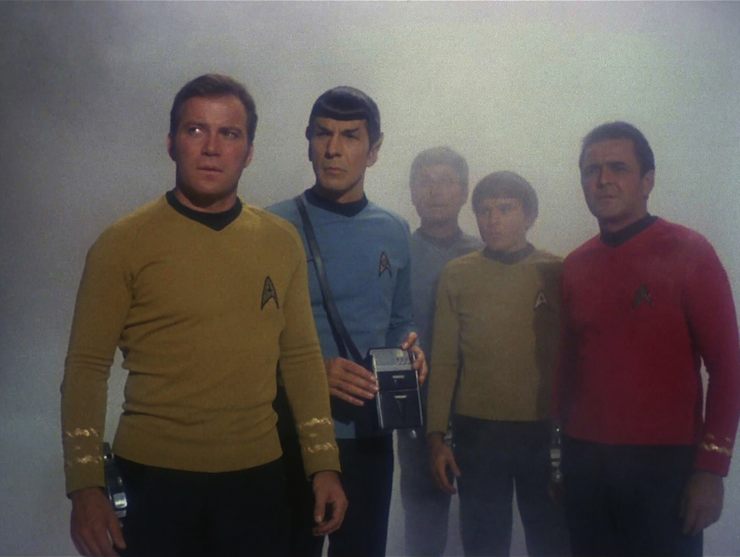
Kirk, Spock, McCoy, Scotty, and Chekov beam down into a region that is covered in fog. None of their instruments work, and they are confronted by a Melkotian, who says they will be punished for disobeying their buoy.
The punishment is death via a scenario pulled from Kirk’s mind: the fog disappears and they find themselves in a vague, incomplete facsimile of 1881 Tombstone, Arizona. Everyone’s phasers have been changed into 19th-century revolvers. Kirk checks a newspaper to discover the place and date, and it’s the day of the infamous gunfight between the Clantons and the Earps. Sheriff Johnny Behan appears and greets them as Ike, Tom, Frank, Billy, and Billy which means that they’re the Clantons. Both Kirk and Spock know the history well—the others not so much, and Kirk tells an apprehensive Chekov that the Clantons lost the feud.
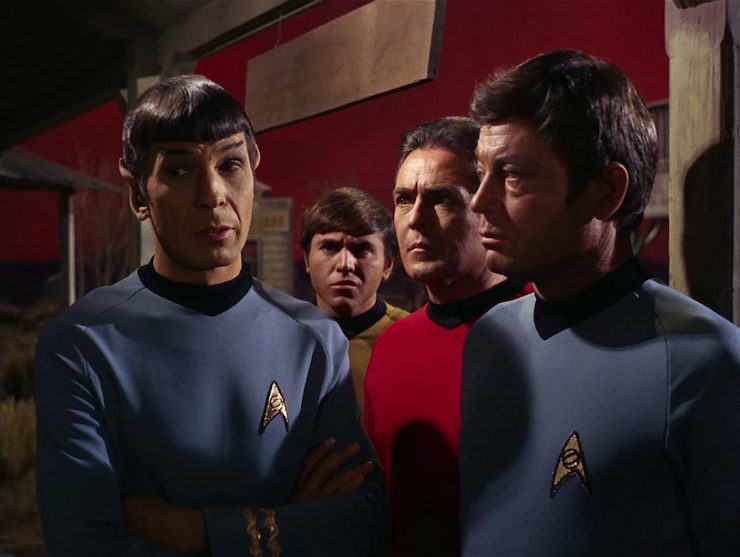
A quick shootout occurs outside a saloon. The landing party go in to be greeted as the Clantons (with everyone surprised that they’re still in town), with a woman, Sylvia, greeting Chekov with a kiss. Morgan Earp is also in the saloon, and there’s almost a confrontation, but Spock preaches caution, trying to avoid a quick draw.
Morgan starts something by pulling Sylvia off Chekov, but he decides not to get into a five-on-one fight and leaves. Spock believes he was trying to provoke them into drawing first.
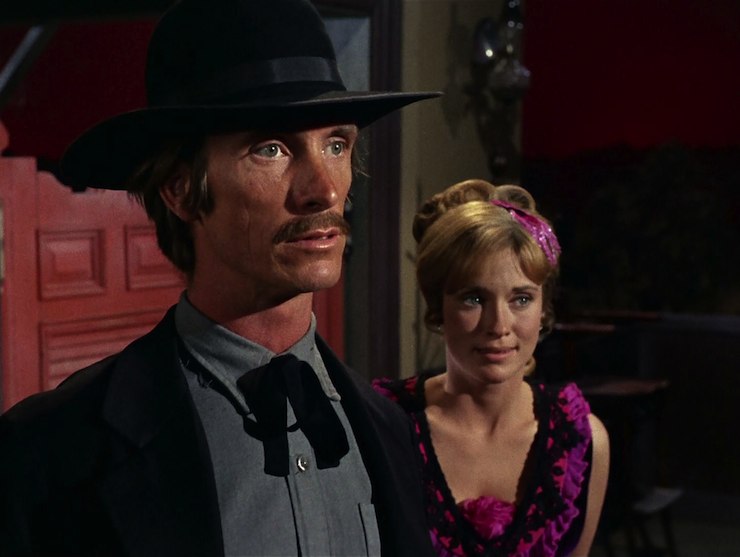
Kirk doesn’t get how everyone can see them as the Clantons when they’re still in uniform. He tries to convince the bartender that he’s James T. Kirk and he’s wearing totally different clothes from what anyone else is wearing. The bartender doesn’t buy it, figuring it’s one of the usual Clanton jokes.
So Kirk goes to the marshal’s office and tries to convince Virgil and Wyatt Earp that he doesn’t want trouble and he isn’t Ike Clanton, but Virgil doesn’t buy it and throws a punch. Kirk doesn’t get into the full fisticuffs, throwing up his hands and refusing to draw. Then Wyatt gives him an ultimatum: be out of town by five. If they’re in town at 5:01 he won’t wait for the Clantons to draw first.
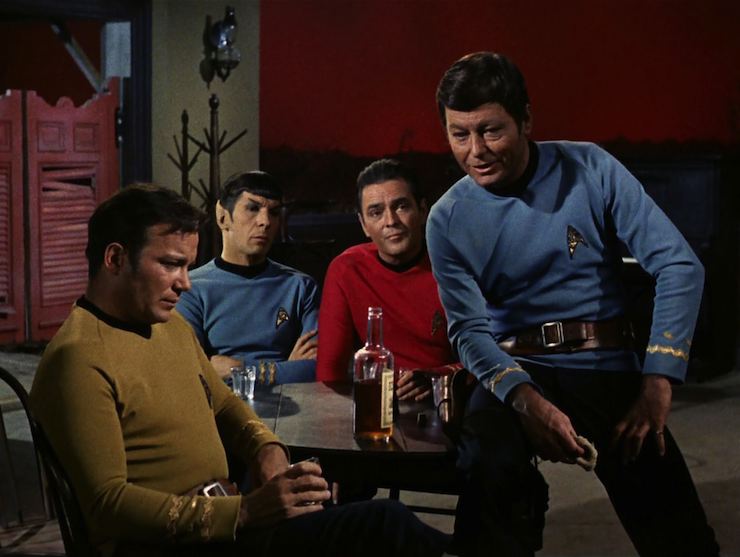
McCoy treats Kirk’s jaw with bourbon, and then pries Chekov off Sylvia so they can leave town. Except they can’t—there’s a force field keeping them within the Tombstone city limits. Since they’re stuck there, they try to figure out how to deal with the Earps with what they’ve got on hand, and they hit on tranquilizers made from local plants and available matériel.
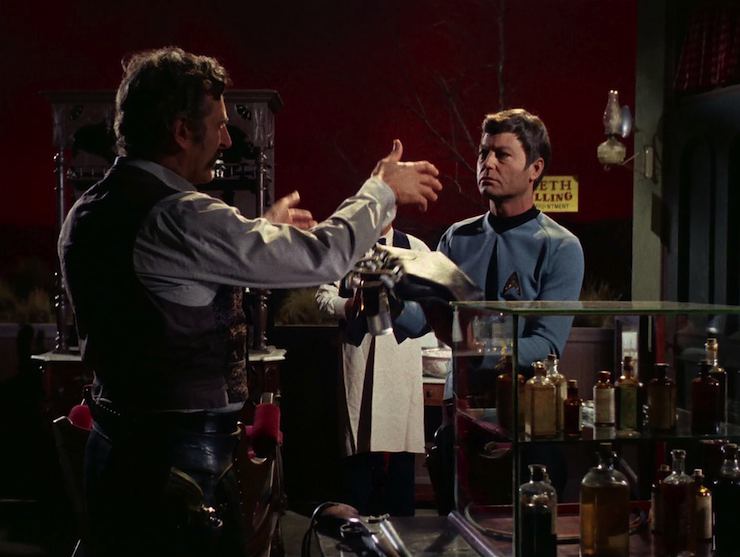
Unfortunately, McCoy tries to get his equipment from the dentist, but that puts him in confrontation with Doc Holliday. However, Holliday decides to be magnanimous and let McCoy have what he needs, even giving him his medical bag—as long as his “emergency” is over by five.
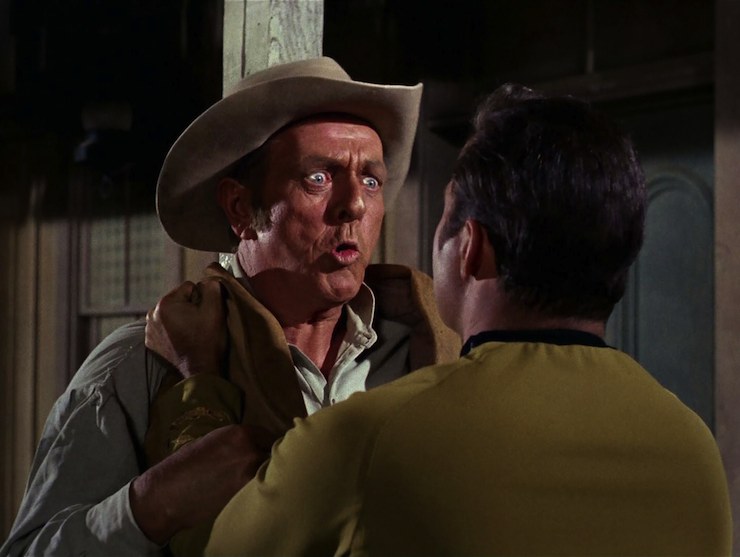
Chekov bumps into Sylvia while obtaining stuff Spock needs for his delivery system. Their discussion—which includes the upcoming dance and the possibility of marriage—is interrupted by Morgan, who socks Chekov in the face. When Chekov tries to get Morgan to take his filthy mitts off Sylvia, Morgan shots him in cold blood (his revolvers are both still holstered). The landing party comes running, as do the other Earp brothers. Kirk holds Scotty back and refuses to take the bait—they still need to get their tranq guns ready.
As they’re prepping the tranqs, amidst attempts to deal with Chekov’s death, Spock points out that Chekov’s analogue from history, Billy Claiborne, was one of the survivors of the gunfight. This gives Kirk hope that they can alter history. Leaving Spock, McCoy, and Scotty to work on their weapons, Kirk goes to Behan to try to get the sheriff to stop the fight, but as far as Behan’s concerned, this is the best way to get rid of the Earps.
The others finish their work, and they test it on Scotty—on whom it has no effect whatsoever. This, however, gives Spock an idea. He believes that this entire thing is a sophisticated illusion created by the Melkotians. Spock mind-melds with each of the others to reinforce the belief that none of it is real.
When the Earps and Holliday show up at the O.K. Corral, their bullets have no effect on the landing party. Wyatt decides to jump Kirk, but when given the opportunity to shoot Wyatt, Kirk declines—and then they’re all back on the Enterprise bridge. Chekov is alive and well, and the buoy is still in front of the ship—but then it self-destructs.
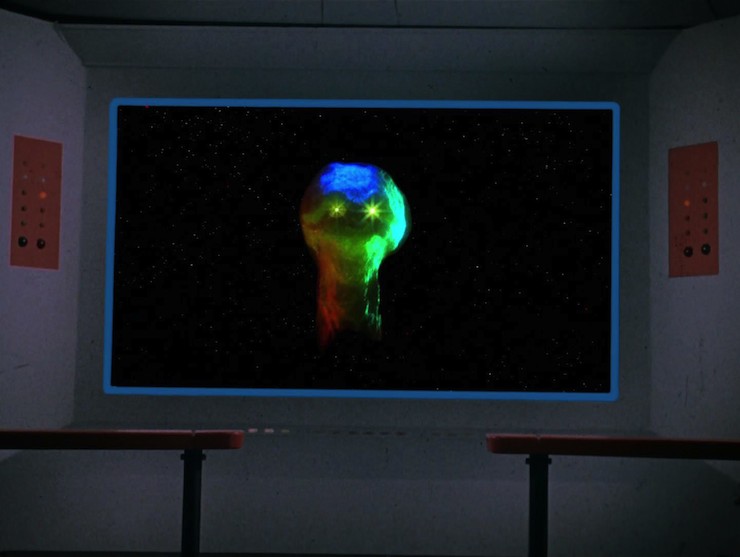
The Melkotian shows up on their screen, surprised that Kirk didn’t kill Wyatt when he had the chance. Kirk says they use violence only when necessary. They prefer peaceful contact. The Melkotian is impressed, and invites them down to the planet for a more pleasant conversation.
Can’t we just reverse the polarity? Spock, McCoy, and Scotty can create gas grenades that will render someone unconscious with materials available at a 19th-century apothecary and dental office. Because they’re just that awesome. Or, rather, they would be if it had worked.
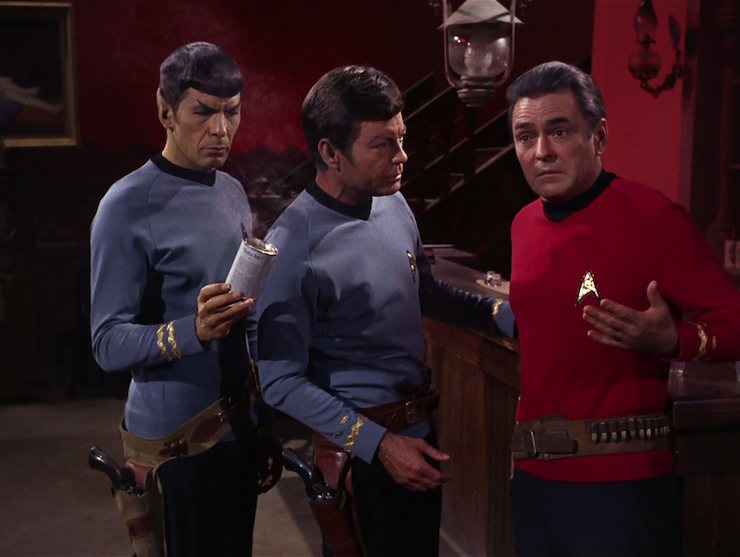
Fascinating. Despite Kirk being the person from whom the Melkotians took the scenario, it is Spock who acts like the expert, because Spock must, of course, be the expert on everything.
I’m a doctor not an escalator. McCoy tries to talk to Holliday doctor to doctor, but Doc views Bones as a Clanton only.
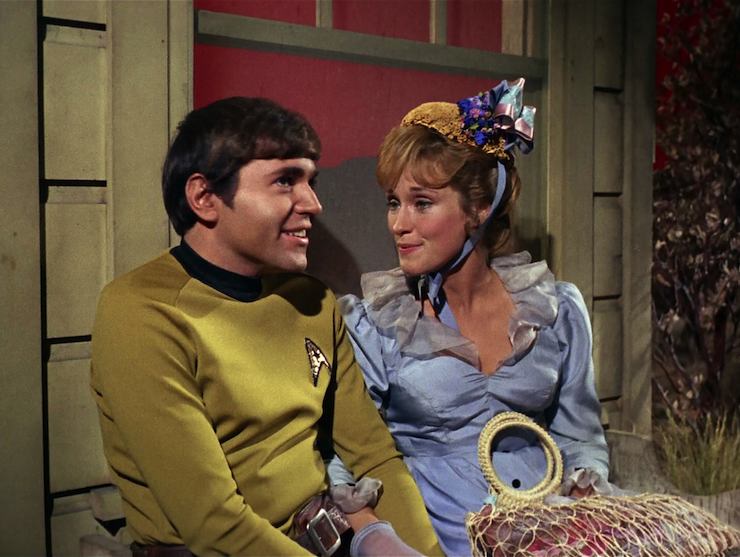
It’s a Russian invention. Chekov is the one who starts the ball rolling on the tranq solution, as he mentions the poisonous snakes and cacti in the area. When it’s all over, he only recalls smooching Sylvia, not getting shot, which is nice for him.
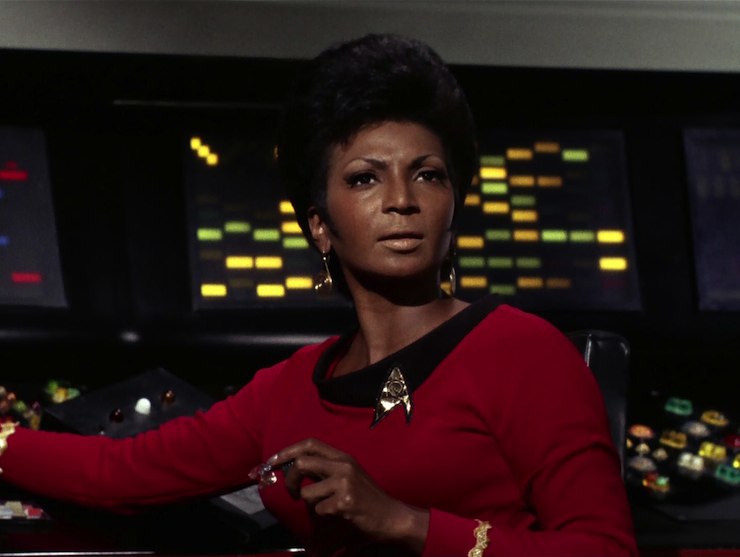
Hailing frequencies open. Uhura gets to open hailing frequencies a lot.
I cannot change the laws of physics! Scotty flies off the handle to go after the Earps after Chekov is shot. He also develops a taste for bourbon, going so far as to slug down a shot “for the pain” before Spock tests the tranq on him, never mind the fact that it’s completely painless.
No sex, please, we’re Starfleet. Chekov justifies his multiple smooches with Sylvia by saying that Kirk always tells them to maintain good relations with the native population. He doesn’t actually waggle his eyebrows, but he comes pretty close.
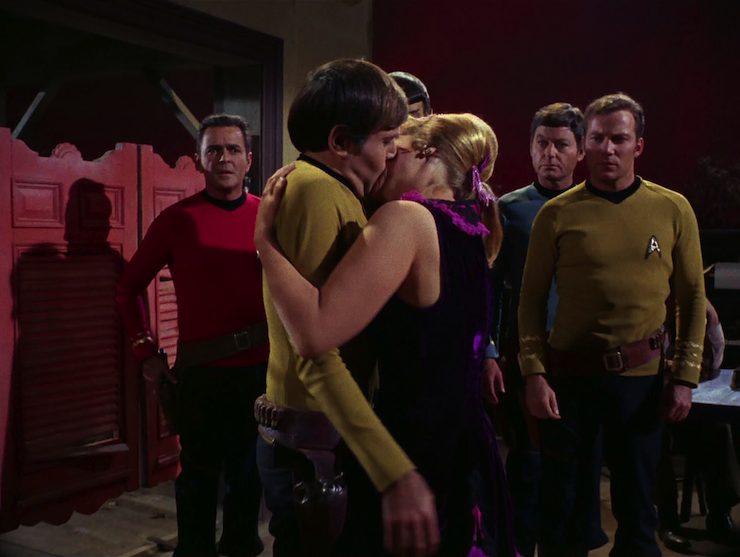
Go put on a red shirt. Since there are no security guards on the landing party, the role of dead meat falls to Chekov. But since he’s a regular, he’s only mostly dead, not all dead, and is fine at the end.
Channel open. “Ten minutes and it’s all going to end at the O.K. Corral. Well, we’re going to wait right here until well after five o’clock—we’re not going to move from this spot!”
The last thing Kirk says before the Melkotians forcibly move them from that spot to the O.K. Corral.
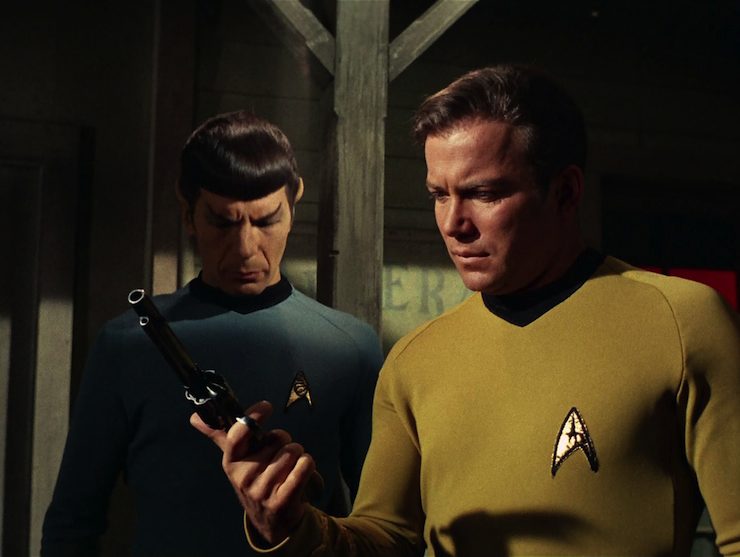
Welcome aboard. Ron Soble, Charles Maxwell, and Rex Holman play the Earp brothers, Sam Gilman plays Holliday, Bill Zuckert plays Behan, Charles Seel plays the bartender, Ed McCready plays the barber, and Bonnie Beecher plays Sylvia. This is McCready’s fifth and final appearance in a small role in a Vincent McEveety-directed episode (not surprising, as it’s also McEveety’s final episode). Holman will next be seen in Star Trek V: The Final Frontier as J’onn.
Recurring regular James Doohan plays both Scotty and the voice of the Melkotian buoy, while Abraham Sofaer does the voice of the Melkotian. (Sofaer last appeared as the Thasian in “Charlie X.”) We’ve also got recurring regulars Nichelle Nichols and Walter Koenig.
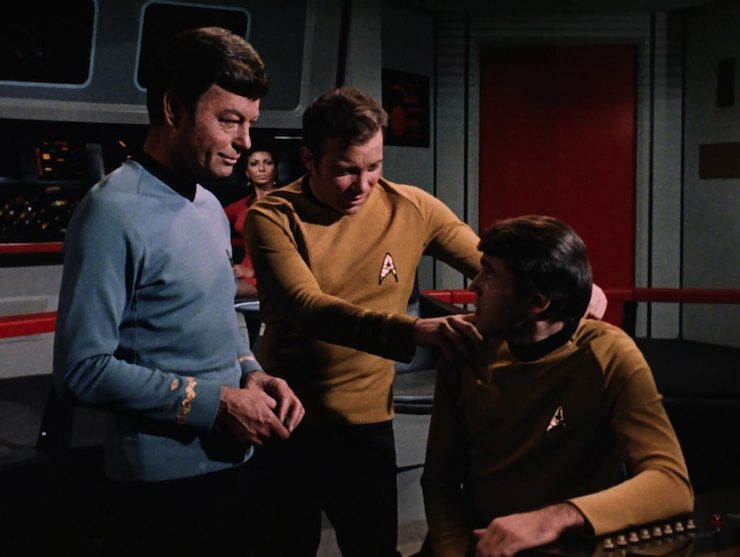
Trivial matters: With the commencement of the third season, John Meredyth Lucas was no longer the show-runner, and D.C. Fontana was also out as script consultant, while Gene Roddenberry’s executive producer credit was largely ceremonial at this point, as he’d moved on to other projects. Fred Freiberger took over as producer, assisted by Robert Justman and Arthur Singer.
Lee Cronin was a pseudonym for former show-runner Gene L. Coon. While he was no longer on the production staff, he did continue to write for the show, though all his third-season contributions were done under this nom de plume.
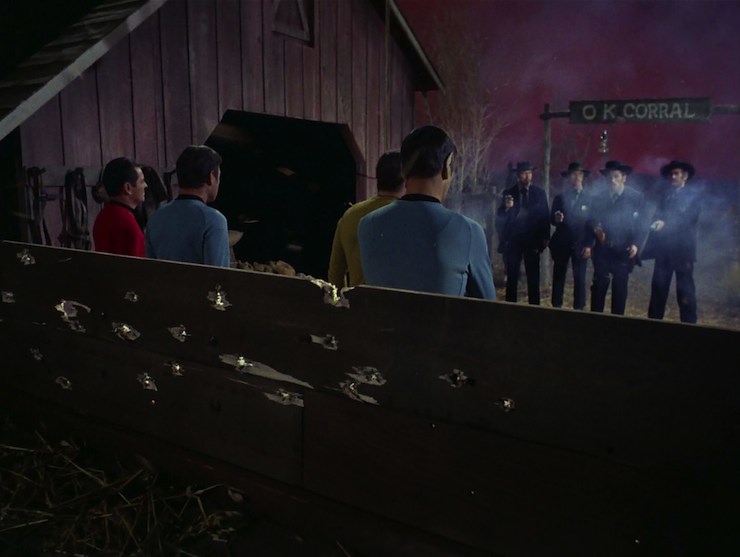
The original title for the episode was “The Last Gunfight.” That title was used in James Blish’s adaptation in Star Trek 3.
The original gunfight between the Clantons and the Earps in Tombstone did indeed occur on the 26th of October in 1881. This episode conveniently aired the week of the 87th anniversary. It is also marred with inaccuracies, mostly due to the simplified and popularized versions of the story that had propagated throughout the 20th century. For starters, despite the proliferation of the O.K. Corral as the centerpiece of the gunfight, it actually occurred in the alley outside C.S. Fly’s Photographic Studio. Virgil Earp was the marshal of Tombstone, not Wyatt—though in 1966, Wyatt’s legend had been exaggerated in the popular consciousness, mostly thanks to Stuart N. Lake’s hagiographical biography Wyatt Earp: Frontier Marshal and the John Ford movie My Darling Clementine. Also the gunfight wasn’t due to an ultimatum by the Earps, it was completely spontaneous, and happened at 3pm, not 5pm.
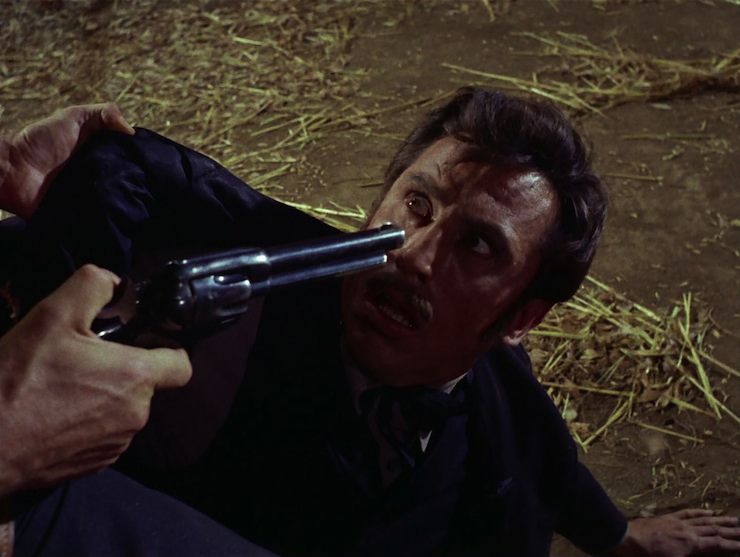
This was one of Bonnie Beecher’s last roles before she retired from acting. She is married to Hugh Romney, a.k.a. “Wavy Gravy” (counterculture hero and the MC at Woodstock), and changed her first name to Jahanara.
DeForest Kelley was no stranger to dramatizing 1881 Tombstone: he previously played Ike in an episode of You are There and Morgan in the 1957 film Gunfight at the O.K. Corral.
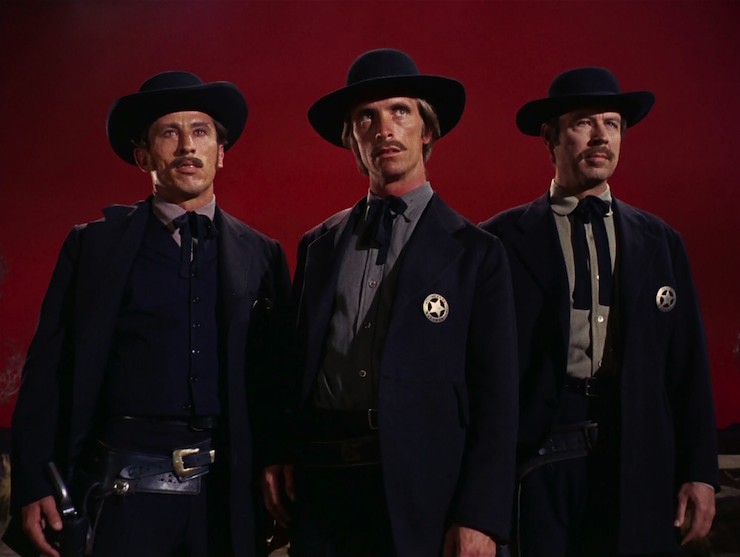
In 1881, the Earps, Behan, and Holliday were all in their 30s, but the actors playing them in this episode were all in their 40s and 50s. (To be fair, folks aged more quickly and had lower life expectancies in the late 19th century.)
To boldly go. “Draw!” On a philosophical level, this is a good Trek episode. We have Starfleet’s mission of seeking out new life and new civilizations—Kirk’s mission is explicitly stated to make contact with the Melkotians—and we have our heroes’ desire to be compassionate. The Earps and Holliday take every opportunity to provoke the landing party, but whether it’s McCoy in Holliday’s office, Kirk in the marshal’s office, or the whole gang at the saloon and at the O.K. Corral, they keep their revolvers holstered. Even Chekov, when he defends Sylvia’s honor, remains unarmed.
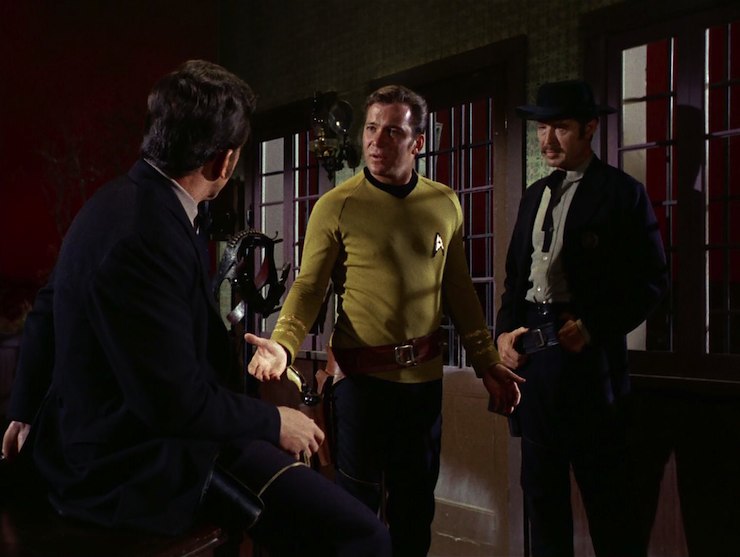
And of course in the end, the Melkotians—just like the Metrons in another Gene Coon script, “Arena“—are impressed with Kirk’s unwillingness to kill someone trying to kill him, leading to diplomacy in the place of violence.
(Oh, and here’s another nail in the Kirk-is-a-maverick myth’s coffin: even after a warning from the buoy, he goes to Melkot and beams down because that’s what he was ordered to do. The mythical maverick Kirk would thumb his nose at orders that endangered his ship, but back in the real world of the actual TV show that aired 50 years ago, Kirk is a good soldier who follows orders.)
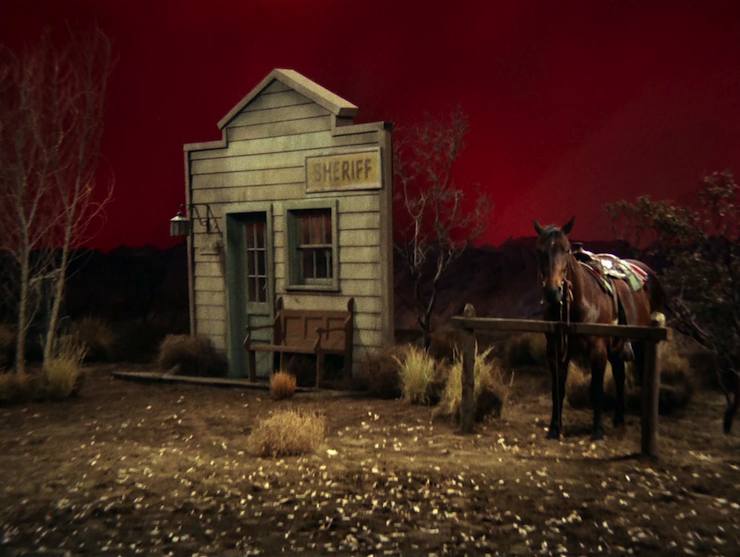
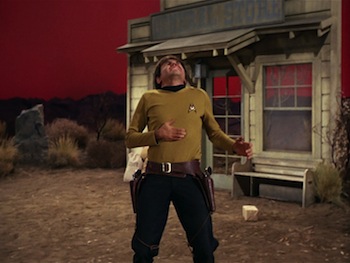
While this won’t always be true in this season of reduced budgets, the financially mandated studio set and incomplete buildings for Tombstone actually works in the episode’s favor, creating a surrealist atmosphere that adds to the tension. And the Melkotians are much more alien than we’re used to seeing (which is one of the hallmarks—and virtues—of the third season, as we’ll also see in places like “The Tholian Web” and “Is There in Truth No Beauty?”).
Having said all that—man, is this episode dumb. I can forgive the inaccuracies about the gunfight in Tombstone, partly because it’s rigged for maximum kill-the-landing-party potential, partly because it’s pulled from Kirk’s memories, which are likely scattershot in the extremis, and partly because the myths about Wyatt Earp were pretty well entrenched in the popular consciousness five decades ago. But if the Melkotians are in it to kill the intruders, why such an elaborate setup? Why is Spock (the only person not native to Earth) the one providing all the historical information when it’s Kirk’s memories this is coming from? If Spock’s mind-meld convinces them that this is all unreal, how come Kirk can still get into a fistfight with Wyatt?
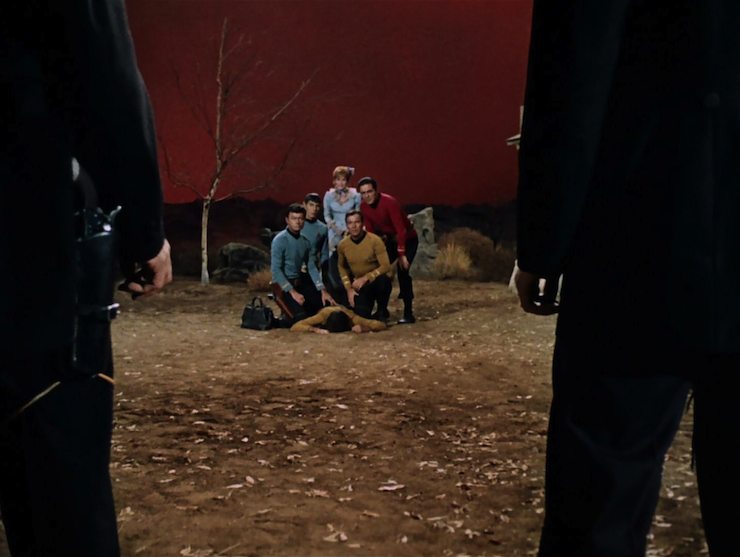
And while I admire that it has the same philosophical bent as “Arena,” it also is pretty much the same story, with the main difference being that the jury-rigged weapon made with local material doesn’t work here, and it’s also made less interesting by recycling Western costumes and props lying around the Desilu lot instead of being a fight against an alien.
Warp factor rating: 4
Next week: “Elaan of Troyius”
Keith R.A. DeCandido has no idea how it managed to be May already…

I wouldn’t go as low as a 4, because as you say, it sticks to the philosophy.
Actually, the promotion of Wyatt’s role and the general hagiography of the whole Earp clan goes all the way back to the very early days of Hollywood. Wyatt retired there and played a big role in getting the first OK Corral film made in 1919. (There was a bad movie with James Garner and Bruce Willis that loosely used that as a framework.)
But probably the most interesting thing about this episode and the thing that would have most puzzled audiences was the portrayal of the Earps in such a poor light. Within a very few years, it would not be uncommon to see the Earps as the aggressors and the Clantons as victims or at least the two groups as equally guilty and unpleasant, but the general pysche hadn’t shifted that far yet. The pendulum swung back in the 90s with Tombstone and Wyatt Earp, but the 70s were less than kind to the Earp legend.
I dunno, I think this is a fun episode, and I love its surrealist/minimalist sets. Its contemporary (and contemporarily KRAD-rewatched) series Batman also embraced minimalist sets in its third season as a cost-cutting measure, but those sets just looked cheap and lazy; TOS managed to bring a lot of style to it, perhaps because it had embraced a somewhat minimalist design philosophy from the get-go. And it enhances the story here. I suppose Coon’s original thinking was to do it on the Old West backlot, complete with period costumes for the crew, but that level of detail wouldn’t have fit the premise that this was all taken from Kirk’s mind. The fragmentary nature of the setting gives it a dreamlike quality that works well.
A lot of credit also goes to Jerry Fielding’s second and final musical score for TOS, which I like better than his score to “The Trouble With Tribbles.” It’s a rich and distinctive score that does a good job of blending a lively Western feel with the off-kilter eerieness of the premise. It was one of the TOS scores that got released in new performances on LP back in the ’80s, and it was one of my favorites of the available scores.
And yes, the depiction of the Earp-Clanton confrontation is inaccurate, but it’s far more faithful than the mess that was Doctor Who‘s “The Gunfighters.” And at least it didn’t have the same damn irritating song constantly butting in every few minutes to narrate the story. (Oh, no, now I’ve got it stuck in my head again…)
I agree, though, that the episode fell prey to the network’s pressure to make Spock the center of all things. It would’ve made more sense to have the two Americans, Kirk and McCoy, explain this part of their history to the Vulcan, the Scot, and the Russian. And that would’ve been a nice nod to DeForest Kelley’s prior experience with the story.
I was going to mention (rather late) Doctor Who. I’d ask if any more SF shows of such pedigree have used the gunfight as a story, but…I don’t think there are any. The Twilight Zone, maybe, but I’m pretty sure they skipped it.
There was an episode of The Real Ghostbusters called “Ghost Fight at the O.K. Corral,” featuring the ghosts of the Earps and Doc Holliday and loaded with Western jokes. I remember the bit where Egon and a ghost somehow ended up wearing the same dressing gown, and Egon drawled, “This gown ain’t big enough for the both of us.”
Wikipedia lists a couple of SF novels that deal with the gunfight: Frontier Earth by Bruce Boxleitner (or his ghostwriter), about aliens getting involved in events leading up to the gunfight, and The Buntline Special by Mike Resnick (who was an acquaintance of mine for a few years before his passing), which was a steampunk retelling.
Wish I was…
A wild-west hero!
https://youtu.be/VwsDU00pqFs
I figure the Melkotians didn’t make this an actual, honest-to-goodness death trap because they are the sort of people who are impressed by a refusal to make lethal violence the first resort. They were instead taking the measure of the folks on the Enterprise. If they’d gotten a different batch of aliens, maybe there would have been actual death involved. Or maybe they’d’ve played with the heads of those aliens and sent them away with missing or scrambled memories.
I don’t mind that it’s the same story as Arena; it’s a story I can watch repeatedly, it’s done in a novel way, and I didn’t find it dumb. Using a Western setting, of all things, for a story about how not to have a gunfight is a smart idea and puts the Western costumes and props to good use. I also like the combination of Western setting and “ghost story”, so to speak – the fog, the incomplete buildings, the red sky.
Making contact “at all costs” with powerful aliens who want to be left alone is a rather shitty assignment, isn’t it? At least in A Taste of Armageddon, they had the guy who gave the order on board so he could experience the consequences himself.
I do appreciate that Kirk and the crew take steps to try and understand the situation and avoid unnecessary violence. But as a western, this isn’t anything to write home about. Maybe it’s because I never bothered to learn more about Wyatt Earp, let alone watch any fictional adaptations of the character.
It’s a watchable episode, which is a good thing, considering season 3’s overall quality. I’d give it a 5, possibly a 6. This was definitely a case of creating a pretty good atmosphere on a limited budget. In a lot of ways, Spectre feels like an early template for what would eventually become the holodeck episode in the TNG/DS9/Voyager era (with the safeties off, obviously).
@Eduardo: I don’t think it’s supposed to be a Western. I think it deliberately uses the Western setting to be something else entirely.
I didn’t know the story of this particular gunfight either, though I’ve read the occasional non-fiction cowboy book as a child, and now I can’t hear any of the names without thinking of Star Trek.
@8/Jana: I agree. The fragmentary, surreal scenery makes it feel less like a Western and more like a sci-fi story built around illusion and mind games. It’s not taking Trek characters and inserting them into a Western setting so much as taking Western trappings and inserting them piecemeal into a Trek setting (complete with red-hued soundstage sky and fake mountains).
The reddish sky definitely helps to sell the place as a backlot illusion. One instance where the lack of resources and limited budget worked in the episode’s favor. The problem the way I see it is every story beat consists of basic worn western tropes, instead of proper worldbuilding. But I guess that’s partly the idea, with the whole place being a recreation.
Well at least it wasn’t the Stay Puft Marshmallow Man…
I think that Spock convinced them that the BULLETS weren’t real.
Earp is not a bullet.
Ergo
Kirk punch!
Spock convinced them that they couldn’t be hurt by an illusion. That doesn’t mean an illusion couldn’t be hurt by them. It’s about taking control of the illusion, like directed dreaming — using your willpower to shape the outcome you desire.
Keith, I guess there’s some tag missing or something as this post doesn’t show on TOS rewatch main page.
I like this episode, between 6 and 7 for me. Yes, it almost repeats the Arena, but the idea is worth reapeating, and it’s mostly well done. Fragmented town under red sky gives the whole episode a bit of nightmarish quality and everything looks bizarre enough, right how you would imagine a jalf-forgotten story pulled out of someone’s mind.
And it’s probably right that Spock remembers more than Kirk – his memory is far superior to human, if he read the story once he probably remembers it in exact detail while Kirk would have only vague recollection.
But I always wondered why Melkotians chose the cowboy scenario if they could get anything from Kirk’s mind. Westerns is not something I would associate with Kirk.
On a shallow note, I like how those leather belts look with Starfleet uniform.
@14 – The post should be on the main page now. Thanks!
random22: THE STA-PUFT MARSHMALLOW MAN WOULD’VE BEEN SO MUCH COOLER!
—Keith R.A. DeCandido
Aside from the other (major) weaknesses of this episode, one gaping hole is why the Melkotians would choose a death scenario for the landing party that had a survivor in real history. The only way I can see this rationalized is that maybe Kirk forgot that there was a survivor (only Spock seemed to know this) and the Melkotions, having pulled the scenario out of Kirk’s memory of history, assumed there were no survivors.
Another problem with the scenario is Sylvia. Why would the Melkotians bother to create the image of Sylvia as a love interest for Billy / Chekov when all they really care about is that the scenario should be the pattern for the landing party’s death. Was there a real Sylvia, and was she the real Billy’s fiancee? If Kirk didn’t remember that Billy survived, there’s no reason he would know about Billy’s girlfriend. There doesn’t seem to be any point in her being in the scenario at all, other than to give Morgan an excuse to “kill” Chekov, thereby leading to Spock’s solution.
I enjoyed this episode when I first saw it as a kid and I watched it last night for the first time in a number of years while taking a rest from studying. You know what? I still like it. My opinions on certain episodes have changed dramatically from how I remembered them, but I wouldn’t hesitate to give this a soft 7. From a psychological perspective, it’s fascinating (the deliberately unfinished sets are, for once in this season, a completely justifiable creative decision) and thanks to it being based on Kirk’s unreliable memories of the events of 26 October 1881 in Tombstone, AZ, it doesn’t have to be accurate. Presenting Spock as an expert on 19th century American is a bit of a stretch and I agree that it would have made more sense to have either of the two American characters in the principle cast-the Midwestern Kirk or the Southern McCoy-be shown as more knowledgeable about events that happened in the country that they came from. In light of what was to follow in this budget-slashed, Friday night death-slotted season, though, that’s a relatively minor critique. I love the scene when Chekov/”Billy Claiborne” gets shot and the characters are forced to conclude that the Melkotians are playing by their own script and don’t particularly care that Claiborne (and Ike Clanton) wasn’t killed on that fateful day.
Reckon I like this episode, but I like westerns in general. Put some gun belts on Kirk and friends, throw ’em in a weird and wacky situation, and I’m happy. And besides the awesome thinky stuff using their brains instead of guns, I really like the Twilight Zone/Outer Limits set design.
Frankly I don’t care about the alien’s logic for the whole thing. This series had a groovy Lewis Carroll quality about it, especially this season. It’s borderline psychedelic fantasy part of the time. ‘What rabbit hole we going down this week, Jim?’
17. richf -“Why would the Melkotians bother to create the image of Sylvia as a love interest for Billy / Chekov when all they really care about is that the scenario should be the pattern for the landing party’s death.”
Seeing as the scenario was taken from Kirk’s mind, I would have been surprised if there hadn’t been a comely woman in a skimpy outfit. He probably just imagined her the same as he imagined that there would be a bartender.
Once again, we have a situation like Corbomite and A Taste of Armageddon, where aliens put up a big No Tresspassing sign and Kirk totally ignores it. What does it take to keep Starfleet away when you don’t want to be bothered?
The sets wee spectacular in their simplicity. Another nice visual is the bright, primary uniforms of the landing party in contrast to the all black look of the Erps. A reminder that you don’t need lots of special effects and CGI to create an effective mood when you can do it with set design/decoration and costuming.
Story wise though, it’s a bit meh. Our intrepid crew are sentenced to death and we’re really supposed to think that will happen? The end of the story is known. However, the journey there is somewhat interesting. It’s a nice twist on Arena where McCoy’s attempt to make a weapon using native materials fails totally.
@20/kkozoriz: Yep, it’s A Taste of Armageddon all over again. I think that’s why Starfleet picked the Enterprise to do it – because they have been able to turn the tide in similar situations in the past. As I said, a rather shitty assignment.
“Seeing as the scenario was taken from Kirk’s mind, I would have been surprised if there hadn’t been a comely woman in a skimpy outfit.”
Really? I had the opposite thought – that this episode shows once more that Kirk isn’t excessively interested in flirting. Chekov, on the other hand, behaves exactly as he did in I, Mudd and The Apple.
Also: You consider that a skimpy outfit? But then, I live in Bavaria where dirndl dresses are a common sight, so I guess our standards are different.
21. JanaJansen – Skimpy for the time. After all, Kirk wasn’t thinking of a schoolmarm. I used to live in Las Vegas, I know skimpy.
I’m not suggesting that Kirk wanted someone to put the moves on, just that he’d consider her an essential part of a western town. He wasn’t thinking about this consciously after all. Also, Chekov doesn’t get off the ship much so he’s quite delighted to meet someone new. Meeting a comely lass on an alien planet is old hat for Kirk. Chekov’s just trying to catch ip.
I expect one could make a gas grenade from materials in a 19th century apothecary. After all, it is not that far removed in time from WWI and widespread chemical warfare tactics. That you could make something mostly harmless rather than a can of gasping death, is another.
Jim Kirk is nobody’s huckleberry.
Two unrelated thoughts:
Does this episode double the number of mind melds we see Spock perform? I remember Van Gelder, the Horta and Nomad. Any others?
Why is it so important to make contact with the Melkotians that they are ordered to do so at any cost? And the ending – they are invited to visit the planet, this time for real, and then the episode is over. I would have liked to see the delegation that meets them, and also what the planet really looks like. Has no one ever written a story about that?
JanaJensen: strictly speaking, he mind-melded with Kelinda in “By Any Other Name.”
—Keith R.A. DeCandido
24/@JanaJansen – Does his mental contact with the guard on Eminiar (?) count as a mind meld? I guess not, but maybe it’s in the ballpark? I had never thought about it, but you’re right – it’s a regular mind meld assembly line there at the end. (And also, in my head canon, made it that much easier for Spock to meld with McCoy on the fly at the end of TWOK).
China is no doubt asking something very similar about the USN in the South China sea. Presumably Starfleet’s reasoning is the same as America’s (“Nobody tells us where we can’t go”). It is a policy that comes to a predictable head in DS9 with the Dominion War, lets not think too hard about where that leads to with China in a couple of decades.
Never really noticed it until the rewatches, but it’s funny how many advanced civilizations either want nothing to do with other races or have elaborate tests before they’re willing to talk. Makes you wonder if the 31st century Federation is constantly in the holodeck while their android butlers prevent any pesky new aliens from pestering them.
Despite the plot holes, I’ve always liked this episode. @18’s soft 7 sounds about right. I just saw this one again recently and had to laugh at how Kirk looks like he’s ready the hit the sheriff while yelling “I can’t kill them. I can’t kill them.”
The director or someone must have told the Earp gang to not blink. It helps to give them an almost robotic quality. I watched for them to blink and I didn’t see any until the showdown at the corral where the wind machine was blowing.
My dad loves this episode and will never get why I’m not huge on it. I don’t really know either, I mean its not a terrible episode or anything, I’m just not a fan. Probably because I don’t like westerns.
On the parenthetical about Kirk Is Not A Maverick, Shatner’s novel Spectre actually points out how his century is viewed poorly by the 24th century: Basically an admiral points out that the 24th century isn’t like his time where they just warped off with their phaser pistols strapped on, shooting first and asking questions later, to which Kirk pointedly tells her they didn’t even do that in his time, they had rules and regulations to follow then as well as the perfect Federation they inherited (His words). And that always struck me as a call to real life pop culture that defines Kirk as a renegade who does whatever the hell he wants and to hell with the rules unlike that stodgy old Picard when in reality Kirk played by the rules as much as Picard did.
No one ever points out that unlike Sisko, Kirk and Picard didn’t commit espionage to get the Romulans to join in a war.
Well, in Sisko’s defense, Kirk and Picard weren’t involved in an actual war on their shows.
@31. Plus, Sisko is a BAMF, so there is that…
30. Loungeshep – Kirk was engaged in a war, Errand of Mercy. Of course, in that case the Organians told Kirk they didn’t want his help and that he should leave. Then, when the Klingons arrived and Kor said “Should one Klingon soldier be killed, a thousand Organians will die. I will have order. Is that clear?”. So, naturally, Kirk and Spock set out to do exactly what the Organians told them not to do, leading to the apparent deaths of two hundred Organian hostages. Hostages that Kirk knew Kor was holding. So, you can put Kirk more on the Sisco side of the equation.
Yea, this one had a few historical inaccuracies (though those can be explained away by the fact it was a holodeck projection of an alien mindmeld), and some cheesy moments, but I always felt this had a really Trek-ie (see what I did there?) solution to it, and that made it good for me. And I loved the surreal feeling of the whole thing–I’ve always felt Spectre was the ghost story that Catspaw dismally failed at trying to be.
The Earps have always had a waxy look to me, just from the makeup. Anyone else? I think it’s related to the surreality of the set, too.
@26/Mike: I’d say if Kelinda counts, the guard should count too, because Spock tries to do the same thing in both cases.
@33/kkozoriz: Well, the action that really results in the apparent killing of two hundred Organians is the Organians getting Kirk and Spock out of prison. And then Kirk tries to capture Kor (knowing he will probably fail) partially because he doesn’t want any more Organians to die. Of course, none of that would have happened if they hadn’t blown up that munitions depot in the first place.
random22 @27-
The South China Sea is international waters, and does not belong to the PRC any more than the Philippine Sea belongs to the Philippines. Consulting a map of the territorial disputes will illustrate the relative locations of China’s claims with China’s location.
It is a real situation very different from the fictional portrayal of a (well intentioned?) intrusion.
I like this episode. Compared with how most of this season will go, this was a good (if not great) start. A fun little episode. The low-budget set really does work here; as others have already said, it feels dreamlike and surreal.
Ah, season 3. I’m glad this was the season opener. There’s some really bad episodes this season, and I’m glad this wasn’t one.
I wasn’t able to post yesterday for some reason… hopefully this will go through.
@26/Mike: I’ve never thought of a light touch like Spock did with the Eminian guard as a “meld,” which implies a more total fusion of two minds into one, not simple communication.
In fact, TOS did not routinely use the term “mind meld.” This very episode was the debut of the term, and the only other time it was used in TOS was in the very next episode, “Elaan of Troyius.” It wasn’t used again until The Search for Spock, and it became standard afterward. In the first season, it was just called a “Vulcan technique” to probe or join minds. Season 2 called it a “mind probe” three times and a “mind touch” once. The animated series also used “mind touch” twice. Season 3 used “mind meld” twice, “mind link” once, and “mind fusion” once.
Although the terms were used interchangeably, I’ve always tended to assume that a mind touch was a basic communication and a mind meld a deeper fusion. But everything from the movies onward has defaulted to “meld” as the exclusive term.
I didn’t realize “mind meld” was introduced so late in the game. I’m glad it was. “Vulcan technique” makes me think, with no justification at all, of Data and his “multiple techniques” in “The Naked Now,” and I’d just rather not… Or, even worse, those old and horribly racist “ancient Chinese secret” laundry detergent commercials on 70s TV.
Maybe the multiple terms correspond to multiple degrees of mental union? Maybe it’s like the fabled (but, I am given to understand, mythical) “seven thousand words for snow” situation – only one Vulcan word, but shaded with levels of meaning depending on the context?
As for this episode, I really like it. I know the surrealism was a function of the budget, but it works; and, as many have said above, the historical mistakes are easy to explain because the Melkotians are drawing from Kirk’s memory. It would be fun for some future Trek to have the Melkotians encounter a 24th century or beyond Starfleet crew and have them draw Kirk’s era from that crew’s mind for a similar experiment! (Forgive me if someone suggested this above – it seems like an obvious sequel idea)
@30/Loungeshep – Didn’t Janeway and Kim have a conversation like that, too, in a Voyager episode? Janeway gets all dismissive of “the old days back in the Alpha Quadrant, Kirk and his era” — it made me mad at the time (ah, self-righteous Trekkie rage!), so it sticks out.
@40/Mike: As I said, the terms were used interchangeably, without any consistency about the depth of contact. Let’s see…
Dagger of the Mind: “an ancient Vulcan technique to probe into Van Gelder’s tortured mind” — The template for the mind meld as we know it.
Devil in the Dark: “the Vulcan technique of the joining of two minds” — Also a very deep fusion and blending of identities.
The Changeling: “mind probe” — Ditto.
By Any Other Name: “mind probe” and “mind touch” to refer to the telepathic suggestion used with the Eminian guard and Kelinda, much less of a connection than we’ve seen before.
Patterns of Force: “mind probe” to refer to Spock reaching Gill’s mind, but we didn’t see how deep it went.
Spectre of the Gun: “mind meld” to refer to what was basically hypnotic suggestion.
Elaan of Troyius: “mind meld” suggested but not used as an interrogation technique.
The Paradise Syndrome: “mind fusion” used for a full “our minds are one” joining.
Is There in Truth No Beauty?: “mind link” to refer to the full union of two minds.
One of Our Planets is Missing: “mind touch” for Spock allowing the cloud creature to see and speak through him, much like his “link” with Kollos.
The Infinite Vulcan: “mind touch” to refer to a full transfer of mind/memory from giant Spock to original Spock.
And I misspoke before about the movies; ST:TMP used “mind meld” for the contact between Spock and V’Ger’s memory crystal, and the term was also used in TSFS (referring retroactively to Spock’s katra transfer to McCoy in TWOK) and TVH (for Spock’s mental communication with the whales). So it was the movies, starting with TMP, that made it the default term.
MikePoteet: It was Voyager‘s “Flashback” that had the conversation you’re thinking of.
—Keith R.A. DeCandido
@35: I hadn’t caught that before, but you’re right. With Morgan Earp, not so much. But Virgil and especially Wyatt have a distinctively waxy pallor that, coupled with the clipped, menacing [alien?] way Ron Soble read his lines as Wyatt, effectively adds to the surreality of the piece.
@41/Christopher – To coin a phrase, “fascinating.” :) I was always struck by Kirk’s line to McCoy in ST III, “You’re suffering from a Vulcan mind meld, Doctor.” (1) Shatner inflects the phrase in such an odd way (imo). (2) Granted, McCoy is suffering, but is it really the mind meld’s fault, or its aftermath? Isn’t he really suffering from Spock’s “marbles” rattling around in his head? Or am I just splitting hairs? Anyway, I enjoyed your catalogue of the “theme and variations” on the term — I love trivia like that!
@42/krad – Right! Boy, it got me hot under the collar… one more reason I didn’t like Voyager. Now, some 20 years on, I want to watch it (frankly, the whole series) again and appreciate all I missed while it was on the air.
@44, I recently completed my rewatch of Voyager. While there is an unhealthy amount of crappy episodes, some of them are quite good. Once you get over the excessive technobabble and the fact that damage to the ship never sticks, you should find stuff to enjoy.
@44/Mike: I was wondering why the movies settled on “mind meld” as the standard term instead of one of the other options, considering that “mind probe” and “mind touch” were both used more often (counting TAS). So I checked my various text sources, and I found that The Making of Star Trek, written late in season 2, refers to Spock’s ability as “mind-melding,” probably the earliest use of the term. It’s possible Whitfield got it from the scripts to “Spock’s Brain” and “Elaan of Troyius,” though, depending on how early they were written. Or maybe it’s just the term Roddenberry had decided on, and so it got around behind the scenes. TMoST was the definitive ST reference book in its day, so it’s probably the source for the later standardization of the term. Interesting that it came more from a tie-in book than from the series itself.
EDIT: It occurred to me to check into the tie-in fiction that came out between TOS and TMP. 1970’s Spock Must Die! used yet another term, “mind-lock.” But the next original Bantam publication, the 1976 anthology Star Trek: The New Voyages (which was mostly reprinting earlier fanfiction stories), uses “mind-meld” consistently in multiple stories, and as far as I can tell, it was pretty standard in Bantam’s books from then on. So it was somewhere between 1970 and ’76 that it came to be regarded as the default term in the literature — even though TAS, in ’73-’74, used “mind touch” instead. I think The Making of Star Trek had to be the original source… but that just leaves the mystery of where it got the term.
I never did like this episode but having just rewatched it, I find it’s grown on me for many of the reasons already posted. I think at the time watching it as a kid I thought that if I wanted to watch a Western I would go into the next room and watch TV with my uncles. Give me phasers and aliens and spaceships, doggoneit! Now I realize the episode had phasers and aliens and spaceships all along — they just didn’t look like the above. Great trivia points that Deforrest Kelly was in a move about the OK Corrall, and Chekov’s hot girlfriend is now married to Wavy Gravy. That’s why I read the site.
In Trek-related news, William Schallert has passed away yesterday. He not only played Nilz Baris on Tribbles, but also Varani on DS9’s Sanctuary.
Hey folks! “Elaan of Troyius” will go up tomorrow rather than today. Sorry, life and stuff……
—Keith R.A. DeCandido
Thanks for the heads-up, no need to apologize.
An acceptable wait. Having rewatched it earlier this year, Elaan of Troyius is not a show I’m looking forward to revisit. Probably one of the top 5 worst episodes.
As a kickoff to the legendarily awful Season 3, this one was actually not too bad. It does have call backs to “Arena,” but that was a pretty darn good episode, so that’s not necessarily a bad thing. Interesting trivia points all around, especially with the genesis of the term “Mind Meld,” and the historical inaccuracy regarding the gunfight at the OK Corral (I like the notion that it was Kirk’s spotty historical memory that they drew from, therefore explaining any inaccuracies). It was interesting to see the putative lawmen presented as the bad guys in this scenario, with the outlaws being heroes to the town, who also wanted the Earps gone.
The end of this episode, and “Arena,” where Kirk and crew are rewarded for not killing when they have the opportunity, reminds me of some of my old computer adventure games. Back in the ‘80s, Sierra started the King’s Quest series. In those games, there were a number of puzzles that could ultimately be solved in more than one way. For example, you could use the knife you found to kill the dragon, or you could throw a bucket of water at it, making it less dangerous by removing its fire. Or you could kill the giant with a slingshot (ala Goliath), or you could evade it until it fell asleep. Without exception, in these instances, you always got more points if you chose the non-violent solution to the problem at hand.
Began my love of Star Trek as a lad in the late 70s. Now enjoying my own rewatches on BBC celebrating a common fifty-year anniversary with the TOS.
I find the TOR commentaries fun, intelligent perspective, and I read after every viewing. The authors appropriately ascribe mockery and praise to cheese and valor, respectively.
Have noticed a theme, throughout my two-month exposure to TOR, of continual allusion to sexist and racist themes in Star Trek. How are these allusions consistent with fun commentary on a decades old sci-fi show? Seems to me they dampen the fun of sci-fi, unless I am missing the point and this is some political/social commentary site.
@job, I’m right there with you in not only enjoying my ow rewatch, but getting so much more by coming here afterwards, from the trivia to the insightful observations. I think you’ve missed a point, though…Part of why Star Trek was such a phenomenon in it’s time–and beyond–is because it bucked (or tried to, as often as it could) the then-current trend of racist and sexist overtones in all of American popular culture. So it’s nearly impossible to have a discussion about TOS without touching on one or both subjects.
As for this episode in particular, while I’ve always rather enjoyed it, it was on this particular viewing that I really noticed how poorly established the final solution was. As much as the surreal surroundings made for good TV, the characters repeatedly acted, and tried convincing themselves that instead of being in a recreation of the situation, it was the real thing, like time travel…Why, the very first time they see a “man” shot outside the saloon, Spock makes a comment about how “at least we know death is real here”. It makes no sense, as they are clearly in illusory surroundings, yet they repeatedly try to convince themselves how real it is and how bound to “history” they are. I realize this is all to set up Spock’s “revelation” at the end, but I feel they work to hard to get to the point where it must be undone.
This could all be the fault of the minimalist staging. If the situation were realistic, the script makes sense. Since it weren’t, I think they missed the need for a rewrite here or there…
Has anyone else noticed the same?
As has been noted, the surrealism of the set and the weird robotic looks/movements of the Earp clan give this one a weird edginess. Despite the “old west” setting, this “looks” more sci-fi cool than any other TOS episode. I’m watching these with the way Netflix has them sequenced right now, so this is actually season 3 episode 8 for me, right after “Is there in Truth No Beauty” and for the second week in a row I’m enjoying the writing, especially for Spock’s lines. He has the pure-science explanation of how to survive by having no doubt of the illusion, then gets all poetic when he performs the mind-meld on the other three.
Favorite moment: Scotty taking some serious whiffs of the tranquilizer gas – I mean, you can see him sucking in that stuff by mouth and through both nostrils like some sort of gargantuan helmet-bong-hit. Least favorite moment, McCoy and Scotty getting all sanctimonious because Spock won’t take time to grieve for Chekov. During my rewatch, this is the episode where McCoy’s needling Spock about his Vulcanism jumped the shark. I mean, these guys have been travelling through the galaxy for years together. McCoy’s been on Vulcan; he’s encountered other Vulcans. I suppose McCoy thinks Spock should let his human side peek out more often, but geez, give it a rest already.
As Krad noted, DeForest Kelley plays Morgan Earp in the 1957 classic Gunfight at the OK Corral. I just watched it again last night. Not long as after Kelley’s character is introduced, Burt Lancaster’s Wyatt Earp and Kirk Douglas’s Doc Holiday are verbaly sparring, and Holiday says to Earp, “where’s your logic?” Earp replies, “to hell with logic.” Made me smile.
While reading Chris Bennett’s remarks about the Vulcan mind-meld, I noted that there were a couple of instances he had inadvertently omitted—and so I will mention them here. First, there was the scene in “The Omega Glory” where Captain Kirk and Captain Tracey were slugging it out and Dr. McCoy noticed that Spock was just watching. When McCoy asked what Spock was doing, the latter replied “I am making a suggestion” and fell silent. Spock had zeroed in on one spectator—Sirah—and was now doing what one could call telepathic hypnosis, more difficult because there was no physical contact but nonetheless effective, inducing her to pick up a communicator and get it to him and open it. Second, at the end of “Requiem for Methuselah”, a disconsolate Captain Kirk had fallen asleep at his desk. Spock and McCoy had been discussing the whole situation regarding Rayna, Flint and the former’s choice which had destroyed her, and as McCoy left the room he said sadly “I do wish he could forget her”, referring to the captain’s reaction. Then Spock performed what could only be called an act of compassion; he walked over to the desk, leaned over Kirk, initiated a quiet mind-meld and whispered one word: “Forget.” I had to choke up at that moment; it was so tragically beautiful, and it demonstrated how Spock really cared for his captain. Oh yes—there was still another incident, perhaps not a mind-meld as we know it but a gripping display of Spock’s telepathic powers—in “And The Children Shall Lead”. Seeing Kirk losing command of himself and his ship, Spock got him off the bridge (even while Tommy was pounding his fist over and over), and in the elevator, or turbo-lift, or whatever one wants to call it, he got the captain’s attention and used those full telepathic abilities to force the demon from Kirk’s mind and restore his command and control of himself and the Enterprise. Then when he asked “Where to, Captain?”, Kirk, now himself again, replied “To auxiliary control, my Vulcan friend. THIS SHIP IS OFF COURSE!” And, of course, we must not forget the scene near the end of “Star Trek II”, where Spock, unable to reach Captain Kirk because they were separated by a glass partition, knocked McCoy out with the classic nerve pinch and the regretful explanation that there wasn’t time, performed a rapid-fire mind-meld, and as he transferred his katra to Bones said quietly and emphatically, “Remember.” And two gripping scenes in “Star Trek III”—the meeting between Kirk and Ambassador Sarek, where the latter inquired if he could join Kirk’s mind; that meld revealed that Kirk didn’t have Spock’s living spirit—but McCoy did. (Poor Bones—it seemed he had all Spock’s marbles and no idea what to do with them.) And finally, the dramatic “fal-tor-pan”—the refusion, performed on the altar at Mount Seleya, in which T’Lar in her official capacity actually did a double mind-meld with both Spock and McCoy to restore the missing katra to its rightful owner. That was one of the most breathtaking scenes ever.
@57/Zita Carno: I was not making a comprehensive list of all instances of mind melds being used, but simply of the various things they were called, in order to demonstrate that the term “mind meld” did not become the default term for the process until after TOS and TAS.
Whatever one wants to call it, it was a terrific demonstration of the power of the mind (in Vulcan, “wuh tepul t’wuh kashek”) and what Spock—and others that followed—could do with it. And I have to admit that it has given me a new appreciation of what the mind could be capable of. That is another reason why I have enjoyed, and will continue to enjoy the original series so much.To all I say, “dif-tor heh smusma”, “sochya eh dif” and whatever else can be said in Vulcan for a splendid New Year.
@26Mike Poteet: Yes, it would be in the ballpark. I remember that scene where it looked as if Spock were attempting to do a mind-meld through the wall—it’s not the first time, nor would it be the last, that he would do this. Of course, it’s more difficult because there’s no physical contact, but he made the mental contact—and I got a big charge out of it. Never try to figure out the power of the mind (wuh tepul t’wuh kashek) as Spock could do it, just enjoy it.
Guys, I just want to point out that a common theme that seemed to run through many episodes of the original Star Trek, including this one, was one of omnipotent godlike beings that had the power to do almost anything they wished. In this particular episode, I was very intrigued by Captain Kirk’s acceptance of the Melkotians’ invitation to visit their planet and establish diplomatic relations. This may sound ridiculous but I always fantasized about actually seeing this take place, the Enterprise crew hobnobbing with throngs of weird alien creatures that looked like chewed-up erasers with glowing eyes — man, that would have really been something to see.
@Dr. Croland—if you’ve ever seen “Journey to Babel”, there’s a whole slew of alien creatures—ambassadors one and all—to observe, to mix and mingle with, and to marvel at the myriad different species. There are even a few examples of Homo sapiens!
@Zita Carno — Yes, I have seen Journey to Babel come to think of it, but honestly I don’t think any of those alien creatures even came close to the Melkotians for pure weirdness. I still freak out a little even now, every time I see them encounter the Melkotian at the beginning of this episode, even though I’ve seen it a gazillion times. :-)
@61/DrCroland: That isn’t ridiculous at all! I’ve had the same fantasy. I would love to see what the planet really looks like, how the “chewed-up erasers with glowing eyes” live, and I would love to see the Enterprise crew interact with them. I would also like to know the reason why they had to make contact with the Melkotians in the first place. I like this episode, but it ends when things start to get really interesting.
@JanaJansen — I totally agree. But the typical Star Trek episode rarely if ever followed up on such things, due to budget limitations I guess. :-)
I like the way you folks, think. A followup to this episode would make an interesting novel or comic book.
@Redd — Yes, definitely. :-)
This is Walter Koenig’s favorite episode.
Me, not so much. Just too contrived, a script tailored for low budgets and the costumed planet of the week. I don’t see the OK Corral story surviving two centuries from now, and I certainly don’t see Spock (of all people) knowing the details.
If the goal was to test the Enterprise crew with an ethics dilemma emplaced in illusion, I could see perhaps a story halfway between “The Mark of Gideon” and “Mirror, Mirror”, with a dash of “Eternal Sunshine of the Spotless Mind” — each landing party member goes through separate (but ultimately connected) fantasies that uses their remembrance of life on the Enterprise and injects specific nightmarish elements that they must mentally overcome. Perhaps a “Rashomon” overtone.
It is barely hanging on these days. Of course back then it was only two generations ago, really. There were still people living then who remembered the Old West; very old people I admit, but nonetheless. There were children and adults who’d heard about the Old West from their parents and grandparents, so of course they’d romanticise it into an enduring myth. It is kind of the same way we all romanticise WW2. There are some very old people who were there, and the rest of us hear about it from our parents and grandparents, but like the Old West it will fade into mere history instead of living myth soon enough.
I disagree on that Spock shouldn’t know about it though. Of all the E’s crew, Spock is the one whose job it is to know everything so he probably should know about it in the same detail he knows about everything else. Such is the job of the crew’s Royal Smart Person.
Sometimes a story will fade into obscurity for a while and then be brought back to popularity by a new book or movie decades later. Maybe there was a resurgence of interest in the Old West during Kirk’s childhood. I can see an expansionist civilization like the Federation taking an interest in tales of earlier frontiers and embracing them as allegories for the final frontier.
Still, this is one case where Spock shouldn’t have been the expert. This was part of American history, so it would’ve made more sense for Kirk and McCoy to be the experts for a change.
@68/Kevin: I like the episode’s subversion of the Western genre. Climactic gunfights are such a typical Western trope, and this story is all about avoiding the gunfight. That’s a clever usage of the existing set and props.
I don’t enjoy being critical as this episode was better than some others this season, but. Kirk seemingly has orders to make contact with the Melkots at all costs without him being able to use his judgement at all even when told to bugger off by the space buoy. Next I guess is Kirk’s relentless attempts to tell obvious Melkotian made characters that the whole situation just isn’t what it seems, this makes Kirk look foolish to me. Then Chekov gets a gut shot and uses the old hand over the wound move to cover the mess which is just sad. Then we have Scotties obvious precautions taken to hide the right hand digit malfunction. It would be terrible to be Scotty with the director always saying remember turn so the camera sees your left side or no mr. Scott use the other hand or cut cut cut would somebody cut off that dam right hand or give him some mittens. You see Scotty in this episode with his gun on his right side then somebody must’ve said something because Scotty has the holster on the left side later on. And sort of speaking of Scotty what kind of low coverage gas grenade did they make that produces less fumes than a wet smoke bomb, were they gonna throw the thing and expect their adversaries to immediately pick it up and sniff it because that’s the only way to come in contact with the gas. And what’s with the lame picking Spock is doing constructing the gas canister, he just keeps poking at it while McCoy is lazily grinding away at the concoction like he’s making slow pudding or something. I don’t know but maybe the director and cast had just given up at this point in the series.
Soooo nobody’s wondering how they hell they got back to the ship?? They asked Chekhov how he was there and healthy. How’d y’all get back tho???
And if Spock did the mind meld how was Kirk about to shoot Wyatt Earp in the face? If you believed the bullets weren’t real then they should do anything to him.
This episode made me upset. I was invested…and disappointed ☹️ Season 3 is really weird…
@73/Alex: The James Blish adaptation contains what may have been a deleted scene from the script. Rather than being sent right back to the ship, they find themselves in a void where the Melkot addresses Kirk about his choice not to kill, saying that the bullets were still real to the “players” set against Kirk and that shooting them would’ve killed them (though whether that’s meaningful in an illusion is unclear). Then, once back on the bridge, Spock said no time at all had passed, implying they’d never beamed down to begin with and it had all been in their minds. Although it could be that Blish inserted the lines himself to paper over a plot hole. That was in his third volume of adaptations, early enough that he was still making his own embellishments sometimes.
At least, the part about no time passing was in the original outline.
Of course this was Koenig’s favorite episode.
I just had a fridge logic moment. If believing that bullets can kill is enough to die from them, why didn’t the gas canister work, when they believed that it would?
@76/BeeGee: At a guess, I’d say the difference is that they didn’t know the gas would work; that’s why they were testing it, after all. Spock was certain it would work, but Scotty, the test subject, was not. But even in the 23rd century, all of them would take it for granted, to a level of subconscious certainty, that being shot by bullets (in the absence of sophisticated medical care) would be fatal.
Wow! I was thinking there’s no use in commenting here since the rewatch was four years ago… but I see there are still comments from last year.
The biggest problem for me with this episode is that Kirk & co. should know that the people in the Old West scenario are illusions created by the Melkotians. So they should have no moral qualms about killing them- except that the plot demands that the Melkotians be impressed by the fact that they don’t kill. This makes the whole plot feel forced and phony. It was still a fun watch though and I’d give it a 5.
I love this episode! I don’t think it’s the best episode of season 3, but it’s among the most fun to watch for me. Everything from the minimalistic sets and the eerie red backdrop, to the ghostly atmosphere, to the unyielding caricatures of the Earps and the clever solution in the climax. It was a delightfully entertaining episode that all comes together and gives us a classic Trek ending! Sure it’s essentially the same payoff as “Arena”, but so what? The journey to get there is quite different.
A few things…
I love the new material for the Starfleet uniforms this season!
The Melkot design in this episode is certainly unique! It’s hard to imagine a real lifeform being essentially a disembodied head, but I still quite liked it.
Spock being the historian here doesn’t bother me too much. After all, he has demonstrated knowledge of human history on several occasions before. Although let’s not mention his war fatality figures from “Bread and Circuses”. It’s not Spock’s fault the writers apparently didn’t do any research!
One nitpick. In the first bar scene when Morgan Earp thinks Kirk is challenging him to the fast draw, Spock cautions Kirk to sit down and not move a muscle on either hand. And then what does Kirk do? He moves both hands before he sits down…
@@@@@20/kkozoriz:
To be fair, he didn’t ignore it by choice, it was forced upon him by Starfleet.
@@@@@72/russell fleenor:
I actually liked those scenes. It didn’t seem Kirk had much to lose from at least trying. I thought it showed a level of thoroughness from the hero that’s not always seen in a script. And the scene with Ed the bartender was an amusing scene to boot!
I wouldn’t have any clue how to make a smoke grenade if my life depended on it! That’s probably true of a lot of viewers, so I can’t say that the scene seemed off to me 🤷🏻♂️. At least when we see the finished gerenade, it actually does have holes as per Spock’s poking ;P
@76 “To be fair, he didn’t ignore it by choice, it was forced upon him by Starfleet.”
Which doesn’t make it any better. After all, the Prime Directive is supposed to Starfleet’s highest order. Who are they to ignore a races wish to be left alone? And they they’ve done it numerous times, starting as early as The Corbomite Maneuver.
“Starfleer ; “We’re just sooooo awesome that everone will want to be our friend, even if they don’t admit it at first.”
@80/kkozoriz: No, it certainly doesn’t make it better. My point is simply that it was not Kirk’s choice to make. He didn’t blatantly ignore the bouy, his orders were to make contact with the Melkot. From the dialogue, it’s quite clear the orders were not open to interpretation.
I complained before about weak justifications to reuse sets and costumes, but in this case I’ll let it slide since this isn’t another inexplicable case of a planet fixated on a single time period of Earth and for the nightmarish incompleteness of the location. It reminds me of Stephen King’s The Regulators (I wonder if this episode played any role in inspiring that story?). Not a very smart episode but it’s not half bad.
@@@@@ 24, JanaJansen
Does this episode double the number of mind melds we see Spock perform? I remember Van Gelder, the Horta and Nomad. Any others?
In The Voyage Home, Spock mind melds with a whale. He refuses to hijack her across time without getting permission.
@83/Fernhunter: He does! And in the first film, he mind melds with a Vulcan elder (or she with him) and a machine cloud creature. But all this comes later.
Spock might be extremely familiar with Earth history, because his mom, a Terran school teacher, taught him about Earth history.
@85/Paladin: My objection to Spock knowing history isn’t that it’s impossible to handwave, it’s that it would’ve been a better, more fitting storytelling choice in the first place if it had been Kirk or McCoy explaining Tombstone to the others. It would’ve felt more natural and thus wouldn’t need a handwave to rationalize it after the fact. I’m not looking for in-universe excuses, I’m lamenting a missed opportunity to write the story better.
@86/CLB: Good points. One aspect of TOS that has bothered me over the last 45 years is that, in many episodes, Kirk seems to out-science Spock. That is, Kirk comes up with the solution to a science problem before Spock does, e.g., Operation: Annihilate.
@87/Paladin: I think the idea there isn’t that Kirk knows more science, but that he’s better at lateral thinking and imagination.
I had more of a problem with early DS9 episodes where Chief O’Brien, an engineer, was better at coming up with science solutions than Dax, a 300-year-old science officer. Like the writers had trouble accepting that a woman could know more science than a man.
Has anyone upstream mentioned the telepathic similarities between the Melkots and the Talosians from the Menagerie? Both species are so powerful telepathically that they can project illusions far out into space!
@89/Paladin: It’s long been a common sci-fi trope that telepathy is basically magic and can do whatever impossible thing is convenient for the plot.
I like the idea of the whole OK Corral scenario being a test. I just don’t understand why Starfleet insists they make contact with the Melkots “at all cost” So, even though the Melkot buoy specifically warned them away, the Federation is going to barge into their space anyway. That makes no sense. The only reason for that would be they need the planet’s dilithium or need it as a trading route. But even that’s sketchy because just because they travel to the planet–that doesn’t mean the Melkots will go along with whatever the Federation wants. And we know the Federation doesn’t force planets to give them dilithium.
I just wish the beginning of the episode made more sense.
@@@@@ 91 – “So, even though the Melkot buoy specifically warned them away, the Federation is going to barge into their space anyway. That makes no sense.”
They did the same thing in The Corbomite Maneuver and A Taste of Armageddon.
@92
Oh, yes, that’s right they did. Just seems so anti-Starfleeet.
I’m not a big western fan, so this is not one I watch too often, but agree that the atmosphere is mysterious and fun here. Anyone notice and wonder why Kirk rigidly refers to Spock as “Science Officer” and Spock refers to Scotty as “Engineer Scott?” It’s the kind of thing that wouldn’t seem out of place in early S1 but is awkward here.
Trek was forward looking, but incredibly naive. If someone wants to kill you, they are going to kill you. They aren’t going to have a change of heart and be impressed because you refused to initiate or retaliate. They are just going to enjoy the satisfaction of killing someone they wanted to kill.
I agree with the message, but its the thinking of a 5 year old. This is what modern, “NuTrek” fans miss: The “message” must be tempered with common sense and a realistic understanding of human nature and the law of nature.
@95/Shoregrey: I think you’re overlooking that sometimes the kill/don’t kill decision is about pragmatism, not desire. Zookeepers never want to kill their animals, but if one of the animals runs amok and injures or kills a zoo patron, the animal is put down. Which seems deeply unfair to me, since it’s just acting out of instinct and was probably provoked into it in some way, but it happens. It’s the same with advanced aliens capturing primitive humans who wander into their territory and testing them to see if they’re a threat. If the humans prove to be killers, they’re destroyed for the safety of the population. If not, they’re allowed to live.
One thing that got cut out of “Arena,” but is kept in the James Blish novelization, is that the Metrons lied when they said that they’d let the winner of the Kirk/Gorn fight go free and destroy the loser. In fact, they intended to kill the winner, because the winner of a fight to the death would be the greater threat to them. When Kirk spared the Gorn, he proved to the Metrons that his people weren’t murdering savages, so they were spared. It’s the same here with the Melkot (unsurprisingly, as it’s by the same author, pseudonymously).
I don’t even mind that this episode rips off the ending of “Arena,” though it doesn’t carry the same weight, since it had already been established that, unlike the Gorn captain, the Earps weren’t real. I do agree that it should have been one of the humans who had all the Western knowledge, while Spock could still have shown off by being the one who figured out it was all an illusion. I also think it kind of just fizzles out at the end with that awkward exchange over violence. Still, I like it.
However, it doesn’t hold a candle to Doctor Who‘s “The Gunfighters,” which is a hoot.