







Star Trek VI: The Undiscovered Country
Written by Leonard Nimoy and Lawrence Konner & Mark Rosenthal and Nicholas Meyer & Denny Martin Flynn
Directed by Nicholas Meyer
Release date: December 6, 1991
Stardate: 9521.6
Captain’s log. We open with the explosion of Praxis, a Klingon moon, and the location of their primary energy production facility. The subspace shockwave from the explosion travels all the way to Federation space, where the U.S.S. Excelsior, under the command of Captain Sulu, is returning from a three-year survey of the Beta Quadrant, charting gaseous anomalies. The Excelsior is hit by the wave, which Science Officer Valtane traces to Praxis—but while he can confirm the location of Praxis, he can’t confirm the existence of Praxis. Most of the moon is gone. Sulu has Communications Officer Rand send a message asking if they require assistance. A distress call from the moon is overlaid by Brigadier Kerla, who responds to Sulu’s offer of help with a definitive “no,” calling it an “incident” that they have under control. Sulu is, to say the least, skeptical and has Rand report this to Starfleet Command.
Two months later, Kirk, McCoy, Scotty, Uhura, and Chekov are summoned to a classified briefing at Starfleet Headquarters. This surprises them, as they’re due to stand down and retire in three months. The other attendees are all admirals and captains. The Starfleet commander-in-chief announces that the Klingon Empire has only fifty years of life left, then turns the briefing over to the Federation Special Envoy: Spock. He explains that the destruction of Praxis will render the Klingon homeworld uninhabitable within five decades, and that Spock—at Sarek’s behest—has reached out to Chancellor Gorkon to discuss a peace treaty.
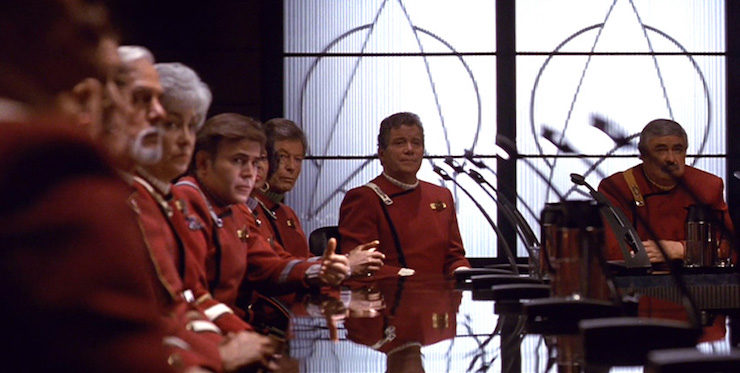
Cartwright is dead set against this course of action, and so is Kirk, feeling the Klingons are untrustworthy. So the captain is rather surprised to find that Spock has volunteered the Enterprise to escort Gorkon’s flagship to Earth for negotiations.
The meeting breaks up, leaving Kirk and Spock alone. Kirk is livid that Spock volunteered him, as he doesn’t trust the Klingons. When Spock points out that they’re dying, Kirk’s rather appalling response is, “Let them die.”
However, Kirk takes command, meeting Lieutenant Valeris, one of Spock’s protégés, who has volunteered to serve as helm officer. Valeris later overhears the end of Kirk’s log entry because Kirk left the door to his cabin open for no compellingly good reason. The log in question discusses how Kirk has never trusted the Klingons and how he can’t forgive them for the death of David.
Later, Valeris meets with Spock in his quarters to share a drink. He indicates that he’s grooming her to serve on the Enterprise, eventually to take command of her, as he will be retiring from Starfleet and entering diplomatic service. He also reminds her that logic is the beginning of wisdom, not the end of it.
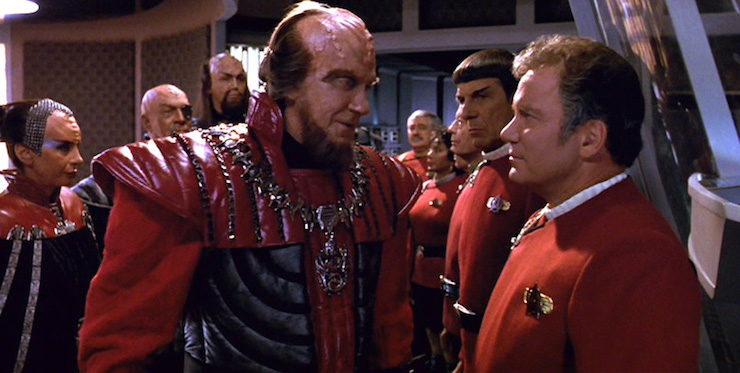
The Enterprise rendezvouses with Kronos One. Kirk muses that he’s never been this close to a Klingon ship, having apparently forgotten that he’s been on one in each of the last three films. Kirk and Gorkon speak, and Kirk invites Gorkon to dinner on the Enterprise, then grumbles, “I hope you’re happy” at Spock like a sullen teenager after the chancellor accepts. Chekov mutters, “Guess who’s coming to dinner?” and Valeris offers to have Romulan Ale be served at the dinner. (Kirk’s approving response: “Officer thinking, Lieutenant.”)
Gorkon, his daughter Azetbur, Kerla, General Chang, and two bodyguards beam aboard. Chang fangoobers Kirk, and after he takes them off for a tour, the two security guards, Burke and Samno, make racist comments about how Klingons all look alike and smell bad, until they are rebuked by Valeris.
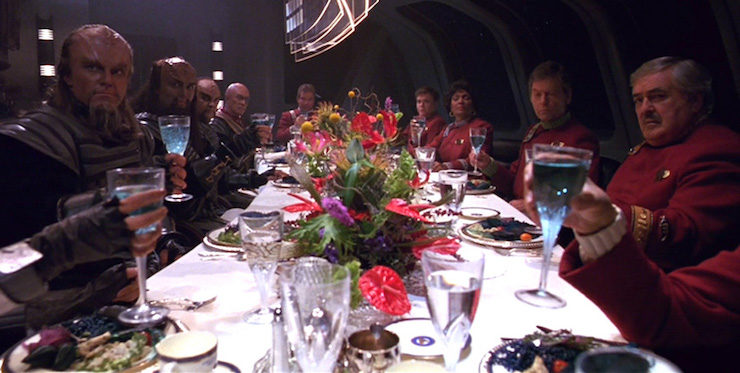
At the dinner, the Klingons are befuddled by the silverware, and then Gorkon offers a toast to “the undiscovered country”—which makes everyone uncomfortable, until he explains that he’s referring to the future, not death, as Hamlet was. It’s the first of several Shakespeare quotes, including Chang saying, “to be or not to be” in Klingon.
Attempts at conversation are hesitant and awkward, with the humans far more uncomfortable than the Klingons or the half-Vulcan. Kirk at one point even Godwins the conversation by noticing that Chang makes a comment about needing breathing room, which Kirk cites as a Hitler quote.
After dinner, the Klingons beam off, with Gorkon telling Kirk that he knows the captain doesn’t trust him, and that if there is to be a brave new world, it is their generation that will have the hardest time of it.
Once they dematerialize, the Enterprise crew sighs with relief, Uhura and Chekov decrying the Klingons’ table manners, Spock tartly reminding them that their own behavior was pretty damned wretched. Kirk wanders off to sleep the evening off, asking folks to let him know if there’s another way they can screw the evening up. He makes a note to the galley that Romulan Ale is never to be served at diplomatic functions.
Spock summons Kirk to the bridge, as he is detecting a large amount of neutron radiation. Then a torpedo fires on Kronos One, seemingly from the Enterprise, quickly followed by another. The second shot knocks the gravity out on the Klingon ship. Even as Scotty reports that the Enterprise still has all its torpedoes, two people in Starfleet security armor (complete with magnetic boots) beam to the Klingon ship, killing or maiming dozens of Klingons along the way before finally getting to Gorkon and assassinating him.
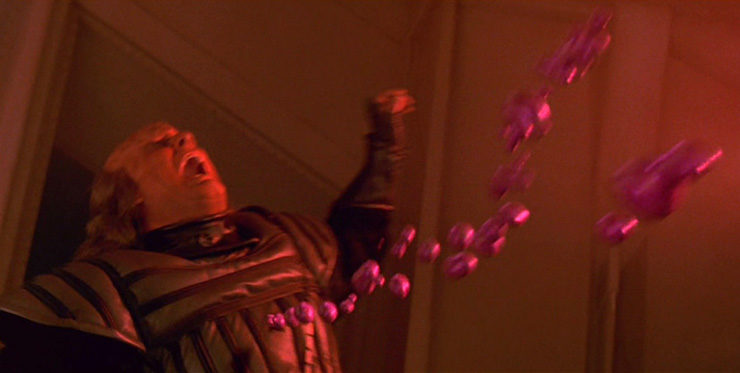
The assassins beam back. Chang accuses Kirk of firing on them without provocation, and Spock verifies that the Enterprise did fire, even though they have all their torpedoes. Kirk surrenders and beams over with McCoy, refusing to start a war on the eve of peace. Spock very deliberately touches Kirk’s shoulder in a manner that we’re supposed to notice. That will probably be important later.
Kerla almost fires on Kirk and McCoy as soon as they dematerialize, but he is willing to give Kirk’s denial the benefit of the doubt and bring them to Gorkon. The ship’s surgeon is also dead, so McCoy offers to try to revive the chancellor. Azetbur and Chang agree, but McCoy is unable to save him. Gorkon’s last words are to ask of Kirk, “Don’t let it end this way, Captain.”
Chang has Kirk and McCoy arrested for assassinating the chancellor. Spock assumes command, tells Uhura to fill Starfleet in and then he works to determine what, precisely, happened.
The Klingon ambassador meets with the Federation president. The president is not happy about Kirk and McCoy’s arrest, but both Sarek and Romulan Ambassador Nanclus concur that their arrest was legal. The president therefore abides, and the Klingon ambassador departs. Even as he goes, the Starfleet C-in-C, Cartwright, and Colonel West enter. They object to Federation citizens being abducted, but the president reminds them about that pesky rule of law. West displays a plan to rescue them with “acceptable” loss of life. When the president asks about the possibility of war, West boasts that Starfleet will “clean their chronometers.” The president, however, dismisses the Starfleet personnel—and Nanclus, who was inexplicably allowed to remain in this meeting that discussed military strategy despite being a diplomat from a hostile power.
The Enterprise is ordered to return to Earth. At Valeris’s suggestion, Uhura and Chekov fake a malfunction so they can’t receive communications. Scotty and Spock try to figure out why they have all their torpedoes, yet the sensors say they fired twice.
Azetbur and the president agree to try the peace conference again in one week’s time at a neutral location—but that location should be kept secret, and the conference will only happen if Kirk and McCoy are allowed to stand trial and no attempt at a rescue is made. Kerla and Chang are as eager to go to war as West and Cartwright were, but Azetbur wishes to do what her father wanted.
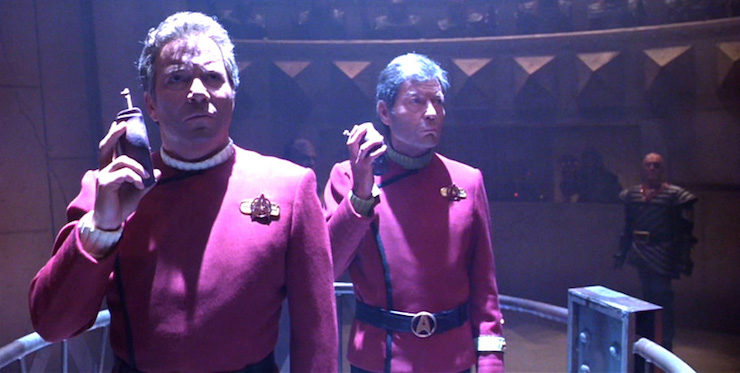
Kirk and McCoy stand trial. Chang himself prosecutes, with Colonel Worf defending. The trial is broadcast all over the galaxy, and when the magnetic boots are mentioned, Spock immediately starts a search for them. The president and some of his staff, as well as Sarek, watch from his office, as does the crew of Excelsior; Sulu has Rand send a message to the Enterprise offering assistance. Meanwhile, Chang accuses McCoy of being drunk and/or incompetent when he tried to save Gorkon, and then he uses Kirk’s earlier personal log against him to prove malice toward the Klingons on his part. He also admits that as captain, he is responsible for the conduct of his crew.
They’re found guilty, but in the interests of peace, they are not sentenced to death. Instead, they are sentenced to life in prison on Rura Penthe in the dilithium mines there.
Spock and the rest of the crew continue their investigation. They determine that there must have been a small Klingon ship that can fire while cloaked positioned beneath the Enterprise. He then has Valeris conduct a search—either the assassins came from the Enterprise, or the people who sabotaged the computer to make it look like they fired did. Or both. Either way, the saboteurs need to be found.
Kirk and McCoy arrive at the frozen wasteland of Rura Penthe. They befriend a woman named Martia, who informs them that there’s a contract out for their deaths. McCoy is, to say the least, thrilled.
Spock’s investigation continues, but there is no sign yet of the boots. He has Scotty pretend that the warp drive is down so they can’t return to Spacedock as ordered by Starfleet.
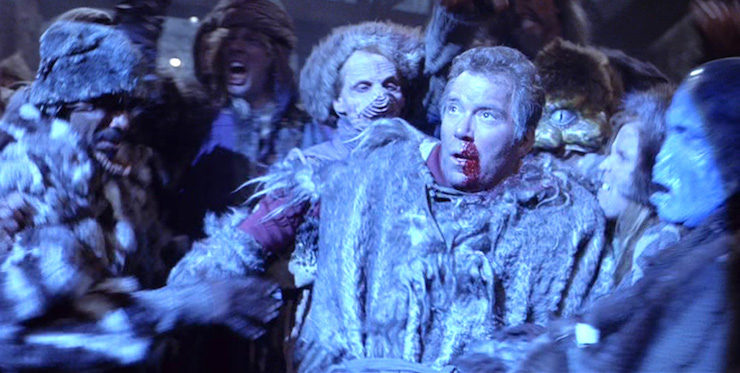
Kirk gains the respect of the other prisoners by beating one of them up, and then he and Martia smooch, because we must make sure all prison movie clichés are checked off. She has a way off the planet, but she needs a partner, and she thinks Kirk is the first person to come through Rura Penthe who can swing it.
Chekov finds traces of Klingon blood on one of the transporter platforms, and then they find magnetic boots in the locker belonging to Crewman Dax. Unfortunately, Dax is from an alien species with oversized feet, so he couldn’t possibly be the culprit.
Martia turns out to be a shapeshifter. In the form of a different alien, she accompanies Kirk and McCoy to a mining detail, then changes her shape to that of a little girl, thus sliding out of her leg irons. They sneak out through a bit of ductwork (because there’s always ductwork) and up a big rock to the surface, and thence past the magnetic field’s influence, thus freeing them to be transported.
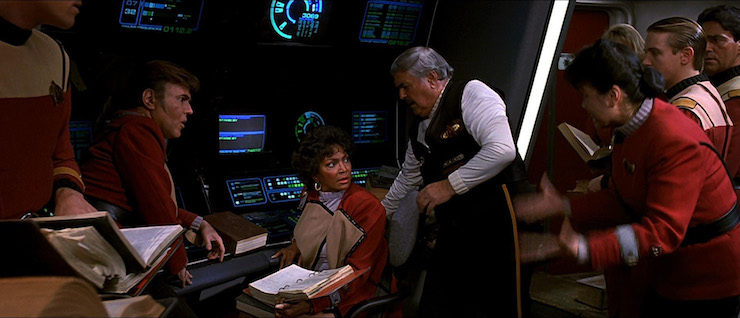
Uhura has been keeping an eye on the transponder that Spock put on Kirk when he touched his shoulder earlier, and once she detects that it’s outside the shield, Spock has Chekov set course for Rura Penthe. Uhura bluffs her way past a listening post by using dozens of books of the Klingon language, because it’s been a few minutes since we had a scene with forced laughter, and then they proceed.
Once Kirk, McCoy, and Martia have settled down with a flare, Kirk slugs Martia. The whole escape was far too convenient. He just hopes Spock arrives before Martia’s employers, who have promised her a full pardon in exchange for getting them out. Having them killed while trying to escape will make the most convincing cover story. The warden tracks them down, shoots Martia (who has assumed Kirk’s shape, which leads to Kirk fighting himself) and is about to tell them who’s responsible before Spock beams them up. Timing is everything.
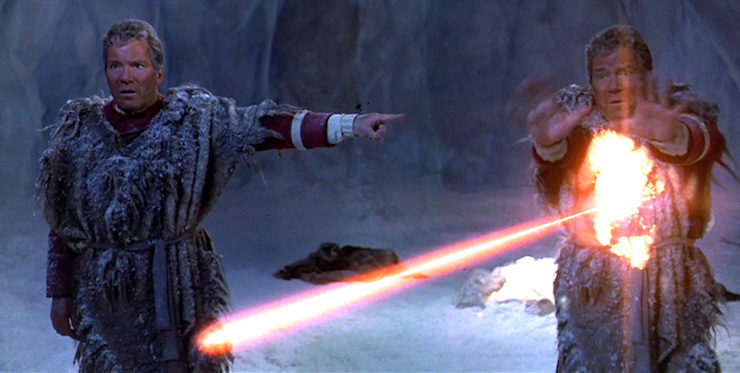
Scotty finds the uniforms used by the assassins. The uniforms belong to Burke and Samno, and their bodies are found in a corridor. They were killed by phasers used on stun at close range to their heads.
There’s at least one more saboteur, however, and Kirk thinks he knows who it is. He puts out a PA announcement, asking for a court reporter to report to sickbay to take a statement from Burke and Samno. Valeris then goes to sickbay armed to finish what she started when she killed the two yeomen. Spock is livid, and Valeris admits that she is part of the conspiracy, undertaken because Klingons can’t be trusted. As if to prove it, there are Klingons and Starfleet officers alike who are working together to keep peace from happening. Valeris refuses to name her co-conspirators, so Kirk orders Spock to forcibly mind-meld with her, and Spock agrees to do it, thus utterly destroying any vestige of heroism on the part of either character.
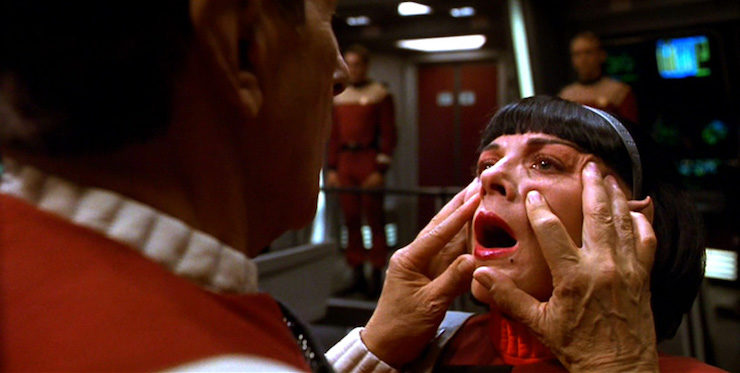
Spock forcibly grabs her, yanks her closer to him by the arm, and keeps her from moving away from him. The hand that doesn’t activate the meld has a tight grip on her hair. And when Spock probes deeper to find the location of the conference, she screams in agony.
While she doesn’t actually know the location of the conference, she does reveal that Cartwright, Chang, and Nanclus are all part of the conspiracy, and that Chang’s experimental Bird of Prey that can fire while cloaked is the only one. Uhura contacts Sulu on Excelsior, and he reveals that the new location of the conference will be Camp Khitomer. Both ships proceed there at maximum warp.
When the Enterprise arrives at Khitomer, Chang contacts Kirk from his cloaked ship and starts taunting Kirk and also firing on him. Spock and Uhura hit on the idea of detecting the ionized gas the Klingon ship must exhaust while at impulse, and Spock and McCoy modify a torpedo so that it can detect those gasses. Chang fires on both Enterprise and Excelsior when it arrives, but then the modified torpedo does its job and exposes Chang’s ship. Both Enterprise and Excelsior fire on it and destroy it.
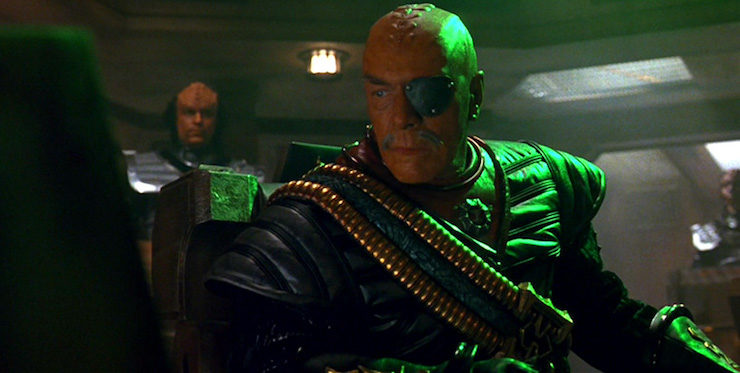
Meanwhile on Khitomer, the president and Azetbur discuss the peace process. A Klingon gets up and walks out of the conference, setting up a sniper rifle, intending to kill both the president and Azetbur. Kirk, Spock, Scotty, Chekov, Uhura, and Valeris beam down—the latter there mainly as evidence of her confession—as does Sulu with a landing party of his own. Cartwright and Nanclus are taken into custody, and Scotty shoots the sniper—who turns out not to be Klingon. Worf and the C-in-C unmask him to reveal West. Kirk makes a speech about how the future shouldn’t be the end of history and how important it is to finish Gorkon’s work. Everyone applauds.
Sulu says it’s good to see Kirk in action one last time, and Excelsior buggers off. Uhura reports that they’ve been ordered to return to Earth for decommissioning. Spock says that if he were human, his response to those orders would be, “Go to hell.” Kirk orders Chekov to set a course for the second star to the right and straight on til morning. Then he gives a benedictory log entry that wishes well to the next folks who command a ship called Enterprise, boldly going where no man—where no one has gone before.
Can’t we just reverse the polarity? The Klingons have developed a ship that can fire while cloaked, because the plot won’t work otherwise.
Fascinating. Spock is the one who—at Sarek’s urging—starts the dialogue with Gorkon following Praxis’s destruction. He, like most of the rest of the crew, is retiring, and he’s obviously getting ready to enter the diplomatic service, like his father, as seen in TNG when he’s an ambassador.
I’m a doctor not an escalator. McCoy tries heroically to save Gorkon even though he professes right there as he’s doing it that he doesn’t know much about Klingon anatomy. So how much good was he supposed to be doing, exactly? He also helps Spock modify the torpedo, because why use an engineer to do technical work when you can have one of your main characters violate his Hippocratic Oath?
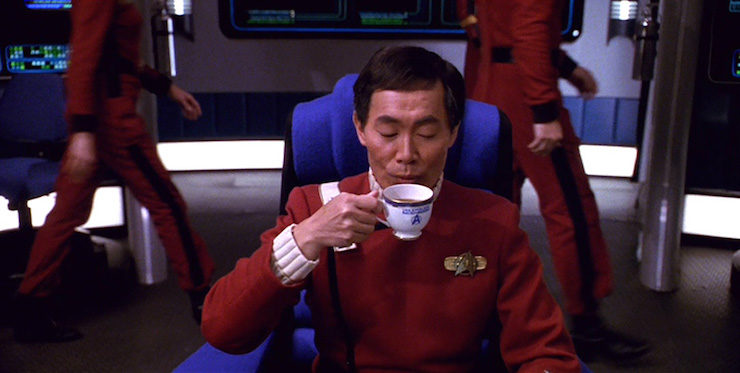
Ahead warp one, aye. Sulu finally gets the command he got in the script for The Wrath of Khan, as the movie opens with him in charge of the Excelsior, and also has him play a critical role in the climax.
Hailing frequencies open. Uhura inexplicably has absolutely no knowledge of the Klingon language whatsoever, nor is the Enterprise computer programmed with any information about it, since she and a half-dozen others are poring over a ton of codex books about the language.
I cannot change the laws of physics! Scotty accuses Azetbur of killing Gorkon herself, calling her “that Klingon bitch,” and opining to Spock that Klingons don’t value life “the way we do.” Yeah.
It’s a Russian invention. While he, Spock, and Valeris are searching the galley, Chekov doesn’t understand why the saboteurs didn’t just vaporize the boots. Valeris grabs a phaser (they keep phasers in the galley????) and vaporizes a stewpot, which immediately sets off an alarm. Chekov is supposed to be chief of security, you’d think he’d know this. Adding insult to injury, both Uhura and Scotty enter the galley asking if someone fired a phaser set on vaporize, so they both know this, and Chekov doesn’t?
Go put on a red shirt. Burke and Samno prove the perfect fall guys for Valeris, as they think all Klingons look alike and smell bad, and so she easily conscripts them to commit regicide and then she can later murder them with impunity, as they’re racist, murdering assholes.
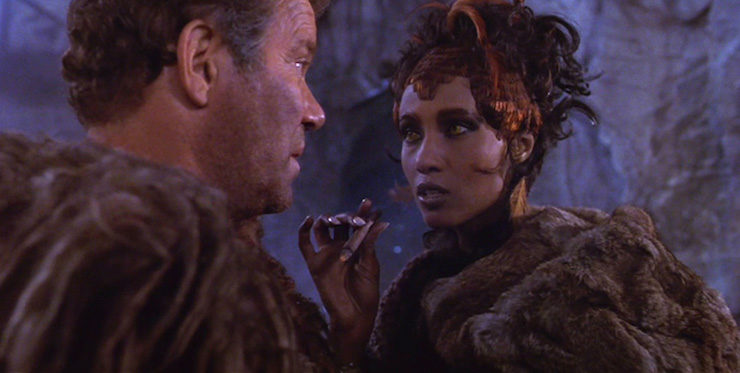
No sex, please, we’re Starfleet. After Martia kisses Kirk, McCoy just stares at him and asks, “What is it with you?”
Channel open.
“She doesn’t know.”
“Then we’re dead.”
“I have been dead before.”
–Spock determining that Valeris doesn’t have a vital bit of intel, Scotty lamenting this, and Spock making a funny.
Welcome aboard. The big guests are master thespians David Warner and Christopher Plummer playing Klingons, the former as Gorkon and the latter as Chang. Warner previously appeared in the last film as Talbot and will be on TNG as Gul Madred in the “Chain of Command” two-parter.
Back from The Voyage Home are Mark Lenard as Sarek, Brock Peters as Cartwright, and John Schuck as the Klingon ambassador. It’s the final appearance by all three as those characters, though Lenard has two chronologically later appearances on TNG that predate this movie, in “Sarek” and “Unification I.” The character of Sarek will subsequently be seen in the 2009 Star Trek played by Ben Cross and the upcoming Discovery played by James Frain, both chronologically prior to this film. Peters will next appear as Joseph Sisko in DS9‘s “Homefront,” while Schuck will next be in DS9‘s “The Maquis Part 2” as a Cardassian legate.
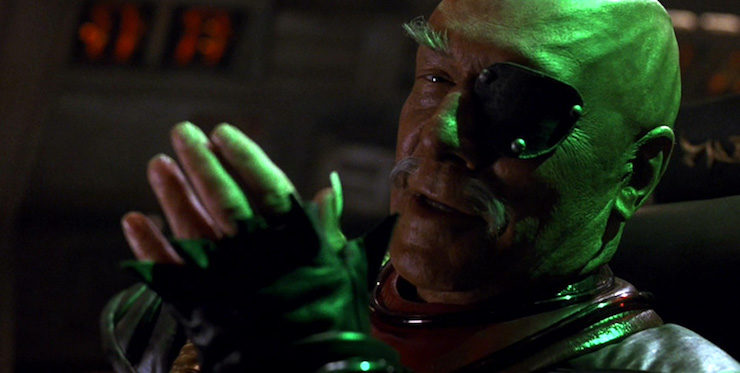
The Federation president is the first of three Trek roles for Kurtwood Smith, who will return on DS9 as Thrax in “Things Past” and Voyager as Annorax in “Year of Hell.” The C-in-C is the first of two Trek roles for Leon Russom, who will play Vice Admiral Todman in DS9‘s “The Die is Cast.” The Rura Penthe warden is the second of four Trek roles for W. Morgan Sheppard, who played Ira Graves in TNG‘s “The Schizoid Man” and will go on to play Qatai in Voyager‘s “Bliss” and the head of the Vulcan Science Council in the 2009 Star Trek.
Rosanna DeSoto plays Azetbur, Kim Cattrall plays Valeris, Paul Rossilli plays Kerla, and Iman plays Martia.
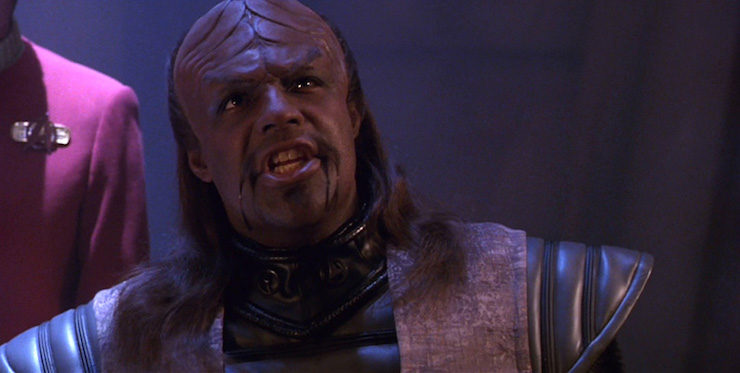
Michael Dorn appears as the Klingon lawyer assigned to defend Kirk and Spock. Credited only as “Klingon Defense Attorney,” he is named “Colonel Worf” in dialogue, and it was always the intention of both scriptwriters that he be the grandfather of the same-named character Dorn played on TNG and DS9.
Rene Auberjonois plays West. All his scenes were deleted from the theatrical release, but were restored on home video. Auberjonois would two years later be cast in the regular role of Odo on DS9, and also play Ezral in Enterprise‘s “Oasis.”
Christian Slater, the son of casting director Mary Jo Slater and a longtime Trek fan, makes an uncredited cameo as a member of the Excelsior crew. Also appearing as Excelsior crew are Jeremy Roberts as Valtane and Boris Lee Krutonog as Lojur, who both will return in Voyager‘s “Flashback.”
And, finally, we have the usual suspects of James Doohan, George Takei, Nichelle Nichols, and Walter Koenig, as well as Grace Lee Whitney. Doohan will next be seen in TNG‘s “Relics,” and both Takei and Whitney will next be seen in “Flashback.”
Trivial matters: This is the last time the entire cast of the original series will all be together on screen. Kirk, Chekov, and Scotty are next seen in Generations, with Scotty also appearing in TNG’s “Relics.” Sulu will next be seen in Voyager’s “Flashback” (the events of which are concurrent with this film). Spock’s next chronological appearance will be TNG‘s “Unification” two-parter, which aired a month before this film’s release (those episodes also have a few callbacks to this movie), and he will next appear in the 2009 Star Trek. This is the last appearance of Nichelle Nichols as Uhura and DeForest Kelley as McCoy, though the latter’s next chronological appearance is in TNG‘s “Encounter at Farpoint” (which aired four years prior to this); both characters are next seen in the 2009 Star Trek, played respectively by Zoë Saldana and Karl Urban.
This was the last Trek movie made in Gene Roddenberry’s lifetime. He saw a screener of the film two days before he died in October 1991, two months before its theatrical release. The movie was dedicated to him.
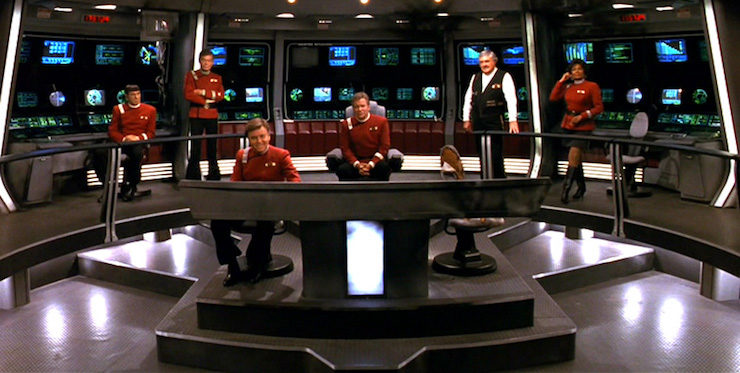
The Klingons and Federation were established as allies in the 24th century implicitly by Worf’s presence on the Enterprise bridge in uniform in “Encounter at Farpoint.” The alliance was more formally established in “Heart of Glory,” and was borne of Roddenberry wanting to show that Ayelborne’s prediction in “Errand of Mercy” would come true, that the Federation and Klingons would become fast friends. This movie, made in the wake of glasnost and the end of the Cold War between the U.S. and the Soviet Union, shows the process by which that alliance got started, complete with a Klingon chancellor whose name was inspired by Soviet Premier Mikhail Gorbachev, the architect of glasnost.
The dismal box office and reception for The Final Frontier meant this film almost wasn’t made, but the higher-ups at Paramount a) wanted to do something for Trek‘s 25th anniversary in 1991 and b) didn’t want the previous movie to be the original crew’s swan song. However, they also didn’t want this movie to cost any more to make than the fifth one, so Harve Bennett proposed a Starfleet Academy movie that could be done with younger and cheaper actors. However, the president of Paramount, Roddenberry, and the fanbase (when the notion was leaked) all rejected the notion vociferously, at which point Bennett quit in a huff. Leonard Nimoy was approached to develop the film, and he both suggested a glasnost allegory with the Federation and Klingons and requested that Nicholas Meyer be brought in. According to Nimoy, Meyer, and William Shatner, while Lawrence Konner & Mark Rosenthal were given co-story credit, nothing of theirs is actually in the movie. (They were hired at Paramount’s insistence.)
Nichelle Nichols and Brock Peters both had difficulty with lines given to them expressing racist attitudes toward the Klingons, using language that has been used in relation to African Americans. Nichols out-and-out refused to say, “Guess who’s coming to dinner?” and the line was transferred to Chekov.
Nichols also objected to Uhura being unfamiliar with the Klingon language, since as communications officer it would behoove her to be familiar with the language of the Federation’s enemies. Meyer overruled her. Interestingly, Star Trek Into Darkness will establish that Uhura is fluent in Klingon.
Both James Horner (who scored The Wrath of Khan and The Search for Spock) and Jerry Goldsmith (who scored The Motion Picture and The Final Frontier) were approached to score this film, but they both declined, leading to Cliff Eidelman being hired.
Sulu will again be seen in charge of the Excelsior in Voyager‘s “Flashback,” where it’s established that Tuvok was part of his crew at the time of this movie. The number of appearances made by Sulu and the Excelsior in the tie-in fiction are too numerous to list, but among them are The Sundered and Forged in Fire by Andy Mangels & Michael A. Martin, The Captain’s Daughter by Peter David, The Fearful Summons by Denny Martin Flynn (one of the writers of this film), The Last Roundup by Christie Golden, and One Constant Star by David R. George III, as well as several appearances in DC’s monthly Star Trek comic written by Howard Weinstein, as well as Marvel’s Star Trek Unlimited #8 written by Dan Abnett & Ian Edginton and IDW’s Captain’s Log: Sulu written by Scott & David Tipton.
Both Kirk’s middle name of Tiberius and Sulu’s first name of Hikaru are spoken aloud for the first time in live action here. Tiberius was previously used on the animated series in “Bem.” Hikaru was first used in the 1981 novel The Entropy Effect by Vonda N. McIntyre, and was given as Sulu’s first name extensively in the tie-in fiction thenceforth. It’s a rare instance of the tie-in fiction influencing something appearing onscreen. (Peter David was on the set when George Takei filmed the Excelsior scenes, and he encouraged Takei to use the first name for his log entry, which is how it got in there.)
Uhura is mistakenly credited as “Uhuru” in the closing credits.
Kronos is established as the name of the Klingon homeworld, thus supplanting “Kling,” briefly and hilariously used in “Heart of Glory.”
Khitomer had already been established as the site of a Klingon base attacked by Romulans (an attack that killed Worf’s parents) in TNG‘s “Heart of Glory” and “The Neutral Zone.” Your humble rewatcher dramatized that attack in the novel The Art of the Impossible. The peace treaty between the Federation and Klingons that resulted from the events of this movie will be established in DS9’s “The Way of the Warrior” as the Khitomer Accords.
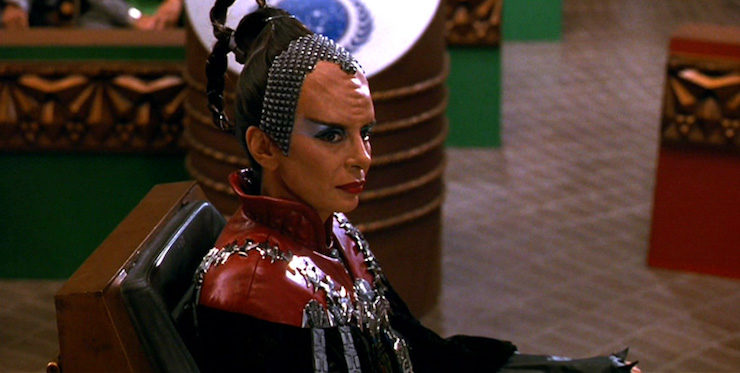
Klingon blood is fuschia colored in this film, the only time in the five decades that Klingons have been shown onscreen that their blood has been anything other than red.
The Klingon love of Shakespeare seen in this film has inspired several Klingon translations of the Bard’s work, including The Klingon Hamlet. When he created the Klingon language two movies previous, Marc Okrand deliberately made the language not have the verb “to be.” And then he was asked to provide the phrase, “to be or not to be” in Klingon.
Gorkon and Azetbur are both identified as the chancellor of the Klingon High Council. This title will retroactively be applied to the 24th-century leaders of the empire (K’mpec, Gowron, Martok) in “The Way of the Warrior.”
Gorkon appears in the Vanguard novel series by David Mack, Dayton Ward, and Kevin Dilmore, the Legacies trilogy by Greg Cox, Mack, Ward, & Dilmore, In the Name of Honor by Ward, and the Errand of Vengance and Errand of Fury trilogies by Kevin Ryan as an up-and-comer in the Klingon Empire. His history with Chang is chronicled in the Klingon Academy video game. A Federation starship will be named after him in the 24th century, as seen in “Descent.” In addition, your humble rewatcher will establish the Chancellor-class of heavy cruiser developed in the Klingon Defense Force and launched after the Dominion War, where all the ships are named after past chancellors, including ships named Gorkon and Azetbur.
Azetbur appears in the novels Sarek by A.C. Crispin and Serpents Among the Ruins by David R. George III, as well as the novella Its Hour Come Round by Margaret Wander Bonanno (part of the Mere Anarchy miniseries). Serpents shows her reign’s end at the wrong end of an assassin’s blade. TNG‘s “Redemption” established that women cannot serve on the High Council; Azetbur’s becoming chancellor seems to contradict this, but your humble rewatcher established in The Art of the Impossible and The Klingon Art of War that Azetbur’s reactionary successor Kaarg immediately passed the law that women could not serve on the council as an extreme reaction to Azetbur’s regime.
This movie is one of three times we see a change of power in the Klingon Empire. The other two—in TNG‘s “Reunion” and DS9‘s “Tacking Into the Wind“—involve someone winning a challenge to earn the chancellorship. This is the only time it’s seen as hereditary, and your humble rewatcher established in The Klingon Art of War that the naming of an heir was a tradition among Klingon emperors before the ascension of the High Council to control of the empire, and Gorkon revived that tradition with Azetbur.

Colonel Worf is seen again in The Art of the Impossible, where he’s been promoted to general by the early 24th century. He is killed in that novel, and it’s established that his son, Mogh, names his first-born son after him, thus fulfilling the intention of the scriptwriters of this film that Dorn be playing his own grandfather.
The events of this film provide the frame for the comic book miniseries Blood Will Tell written by Scott & David Tipton, as several Klingons look at past relations between the Federation and Klingons while trying to figure out how to proceed in the wake of Praxis’s destruction.
Several novels establish that Uhura starts a career in Starfleet Intelligence in the 24th century, with the seeds being sown by her attendance at the Khitomer Conference, among them the Lost Era novels Catalyst of Sorrows by Margaret Wander Bonanno and the aforementioned The Art of the Impossible, as well as the novels Vulcan’s Forge, Vulcan’s Heart, and the Vulcan’s Soul trilogy by Josepha Sherman & Susan Shwartz.
The “Unification” two-parter on TNG will establish that Spock met Senator Pardek at the Khitomer Conference. Pardek would be instrumental in getting Spock to go underground to Romulus in those episodes.
The DS9 episode “Blood Oath” established that Curzon Dax negotiated many treaties between the Federation and Klingons, and “You Are Cordially Invited…” formally established that Curzon helped negotiate the Khitomer Accords. Several novels—Forged in Fire, The Art of the Impossible, etc.—established that Curzon started his diplomatic career as an aide to Sarek.
Rura Penthe will be seen again in an earlier timeframe in Enterprise‘s “Judgment,” which will also have a Klingon court very similar to the one seen in this movie. It was also in the script for the 2009 Star Trek as the prison where Nero and his people were imprisoned for the twenty-five years between when George Kirk was killed and the primary events of the movie, but the reference was cut. That imprisonment is dramatized in the Nero comic book miniseries written by Tim Jones & Mike Johnson.
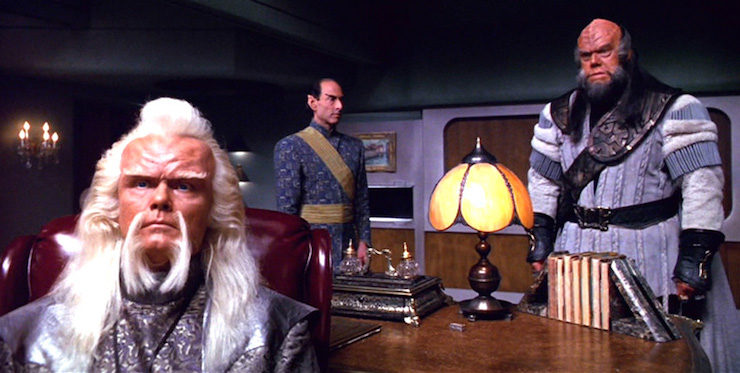
This movie establishes that the president’s office is in Paris. The Voyage Home has the president and the Federation Council meeting in San Francisco at Starfleet Headquarters, which never entirely made sense. The president’s office will still be in Paris when we see it next onscreen in DS9‘s “Homefront” and “Paradise Lost.” The building that houses the president’s office and the Federation Council Chambers is identified in David Mack’s A Time to Kill as the Palais de la Concorde (located on the Place de la Concorde in the City of Light), and the tie-in fiction has continued to use that designation, including in your humble rewatcher’s Articles of the Federation, the aforementioned Errand of Vengeance and Errand of Fury trilogies, and the Typhon Pact series, among others. (Some have theorized that the Council meets in San Francisco, while the president’s office remains in Paris, but it really doesn’t make sense that the president operates in a position that is separated from the council by eight time zones.)
The president is not named in the script, but J.M. Dillard’s novelization referred to his as Ra-ghoratreii. The novelization identified him as Deltan, but all other sources have had him be Efrosian (named after unit production manager Mel Efros, who worked on the previous two films; an Efrosian was also seen as a crew member of the Saratoga in The Voyage Home). Ra-ghoratreii will also be seen in tons of tie-in fiction, including the novels The Ashes of Eden by William Shatner with Judith & Garfield Reeves-Stevens, the aforementioned Sarek, and the Crucible trilogy by David R. George III, and the novella The Blood-Dimmed Tide by Howard Weinstein (part of the Mere Anarchy series). Articles of the Federation established that one of the conference rooms in the Palais de la Concorde is named after him.
The commander in chief is just called “Bill” in the script, but the novelization gives his last name as Smillie. The character will appear again in Forged in Fire and the Crucible trilogy.
Chang’s Shakespeare quotes come from Hamlet, Julius Caesar, Henry IV Part II, Henry V, The Merchant of Venice, Richard II, Romeo and Juliet, and The Tempest. Gorkon and Martia both quote Hamlet as well. In addition, there are references to Richard Nixon (“Only Nixon could go to China”), Sherlock Holmes (“if you eliminate the impossible, whatever remains, however improbable, must be the truth”—Meyer wrote three Holmes novels, one of which, The Seven Per-Cent Solution, he also adapted into a screenplay), Adlai Stevenson (“Don’t wait for the translation, answer me now!”), The Bridge on the River Kwai (the Rura Penthe warden’s speech to the new inmates), and Peter Pan (Kirk’s course request at the end).
Early drafts of the script had Saavik in the role that eventually became Valeris. Kirstie Alley declined to return, and Nicholas Meyer did not like Robin Curtis‘s portrayal, and rather than cast a third actor in the same role, they created the new character. Valeris‘s backstory and eventual fate are chronicled in the novel Cast No Shadow by James Swallow. She also appears in the DC comic book Star Trek Special #2 written by Steven H. Wilson, where she encounters Saavik at a point prior to this film. The Mirror Universe version of Valeris is seen in David Mack’s The Sorrows of Empire, where she tries to assassinate Emperor Spock, but is stopped by Saavik.
In addition to Dillard’s novelization, this film was adapted into comic-book form by Peter David, Gordon Purcell, & Arne Starr. Both the novelization and the comics adaptation included a dialogue exchange from the script between Sulu and Valtane, where the latter says that he’s committed treason, and Sulu replies, “I always hoped that if I ever had to choose between betraying my country or betraying my friend, I’d have the courage to betray my country,” echoing a line from E.M. Forster’s essay “What I Believe.” The scene was cut from the movie.
To boldly go. “Cry havoc! And let slip the dogs of war!” This movie utterly destroys the characters of Kirk and Spock for plot expediency, and while it’s the most revolting crime committed by this misbegotten disaster of a movie, it’s far from the only one.
Let’s get this out of the way: Kirk orders Spock to rape Valeris. Yes, that’s a charged comment; yes, that’s a serious allegation; yes, that’s utterly revolting. But it’s completely true. And just in case we’re not sure, Meyer films it that way, with Spock looming over Valeris, grabbing her arm, yanking her toward him when she tries to back off, and maintaining a firm grip on her hair while performing the meld. It’s a horrid act, a despicable violation of a person, and one that should never have been committed by people we have two-and-a-half decades of seeing as heroes up to this point.
But it’s just the latest in a series. None of the crew comes off well here. Kirk’s “Let them die!” is a horrifically bloodthirsty response from the guy who twice spoke of how the most important thing a person can decide is “I will not kill today,” who publicly upbraided one of his officers for his bigotry toward Vulcans and Romulans, and whose hallmark has been to seek out a compassionate response over a violent one where at all possible. Yes, yes, yes, a Klingon killed the son he barely knew three movies ago. That doesn’t make what he says any less revolting, and the fact that he goes along with being the Federation’s olive branch only reluctantly and whining like a four-year-old does nothing to make the character look like anything other than a racist shithead.
In that, he’s in good company. The dinner is a rhapsody in awkward, but Chekov and Uhura’s bitching about their table manners just because their culture involves eating with their hands comes across as the worst kind of racist, classist snobbery. When Spock acidly reminded them how shitty they all behaved, I was cheering.
This movie is full of racially charged commentary by our theoretical heroes, from Scotty’s line about how they don’t respect life the way we do to Cartwright’s alien trash line to Chekov’s citing the title of a movie about racist attitudes to Uhura’s gawking at the Klingons eating. To have such behavior from Uhura—played by an actor who was convinced to stay in the role due to its importance by Martin Luther King Jr. his own self—is a howlingly high level of tone-deafness. It’s to her credit that she out-and-out refused to say, “Guess who’s coming to dinner?” though the line is no better coming out of a white guy than it would be a black woman.
This wouldn’t be so bad if there was any kind of history of racist attitudes on the part of the Federation toward Klingons, but there really isn’t. The only time we’ve seen such is in “Day of the Dove,” and that was artificially imposed by the swirly thing, and that episode ended with the two crews cooperating and laughing together. The differences between the Federation and Klingon Empire has been portrayed, since “Errand of Mercy,” as political, not racial.
The hallmark of Star Trek when it debuted in 1966 was that it showed a united Earth, that we had put aside our differences, so that the bridge can have Russians, Asians, Africans, Europeans, and Americans all working together without it remotely being an issue. So for the show to celebrate its 25th anniversary by portraying the good guys as unrepentant racists is an insult to what made the show so important and groundbreaking in the first place. Some of them stay unrepentant, too! At the end, Uhura says that she feels the same as Valeris, even after everything is over, which is yet another notch on the character assassination belt, as Uhura has just sympathized with someone who murdered two of their crewmates in cold blood.
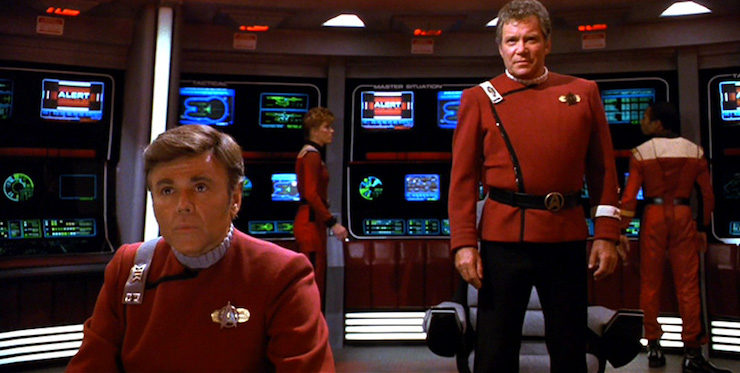
The only characters who come out unscathed are Saavik and Sulu, the former by the unwillingness to re-cast the role, so we get Valeris instead, the latter by virtue of being on another ship. Speaking as someone who always loved the character of Sulu, seeing him get his own command is a very nice touch, and gives him a big role to play in the story without stealing the spotlight from the big three. Uhura, Chekov, and Scotty are less well served by being stuck on the Enterprise, especially since the movie keeps marginalizing them to build up Valeris to make the reveal about her more effective, at which they’re only partially successful. As it is, Valeris’s betrayal isn’t much of a surprise, because who else could it be? While making our heroes into jerks is acceptable, making them into murderers would not be, and there’s nobody else on the ship who even has a speaking part.
Even leaving aside the character assassination, the racism, the rape—this is still a dumb movie. The entire plot is predicated on fear that Starfleet will be mothballed, as if the only reason Starfleet exists is to combat Klingons, which makes no sense. (There’s even a Romulan right there in the story. Plus, the whole seek-out-new-life-and-new-civilizations thing, which you’d think somebody would have remembered since it’s spoken at the top of every episode of the show, and was also used in two prior movies.) Somehow, Starfleet computers don’t have any information about Klingon language, and they have to consult a huge pile of books in order to communicate. And what if the listening post wasn’t run by a bored drunk? And that’s one of several scenes that are played for laughs that are forced and unconvincingly stupid (e.g., the revelation about Dax’s feet, “only Nixon could go to China”). When Excelsior and Enterprise battle Chang’s Bird-of-Prey, where are all the other ships in orbit? (The delegates to the conference had to get there somehow.)
The movie is not a total disaster. As I said, seeing Sulu in command of his own ship is a joy to see, and is the sort of thing we should have seen more of beyond this and Chekov’s being on the Reliant four movies ago—these people have grown older and should have actually advanced more in their careers. Christopher Plummer is simply superb as Chang, a wonderful antagonist. David Warner and Rosanna DeSoto both bring gravitas to their roles, with DeSoto in particular showing the struggle between two responses to her father’s death: revenge for his murder and needing to finish the work he started. Kurtwood Smith has similar gravitas as the president, trying to balance several different needs and agendas, and Leon Russom also gets credit for bringing some nuance that neither Brock Peters nor Rene Auberjonois are allowed to have (which is too bad, as both actors deserved better than this).
And in the abstract, the movie does a good job of showing the process of peace and alliance that had already been established as happening eight decades of story-time hence. The general storyline does a good job of showing the start of the road that led to Worf on the bridge of the Enterprise (casting Michael Dorn as his own ancestor is a nice nod to that, as well).
But this crew deserved a better sendoff than to be portrayed as racist relics who blithely commit horrid acts. By ordering Spock to commit rape, Kirk is no better than the allegedly untrustworthy Klingons, and Spock—the only member of the Enterprise crew who doesn’t come across as prejudiced—goes along with it unhesitatingly. Before this movie, I was sad to learn that this was the last hurrah for the Big Seven. After this movie, I never particularly wanted to see them again.
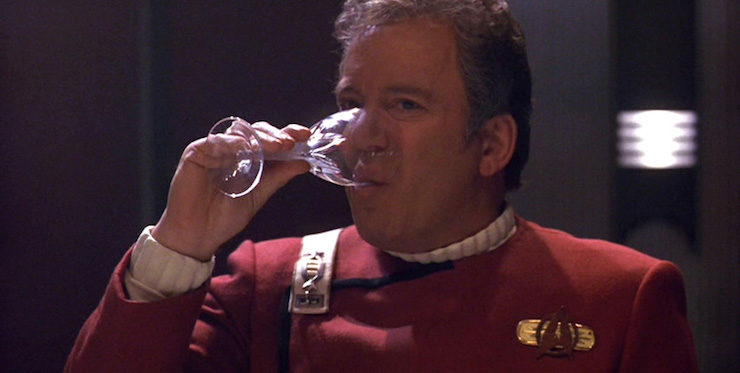
Warp factor rating: 2
Next week: Star Trek Generations
Keith R.A. DeCandido has several upcoming items available for preorder: Orphan Black: Classified Clone Report, out in August from Insight Editions (just in time for that series’ final episode); Nights of the Living Dead, edited by George Romero & Jonathan Maberry, which ties into the classic zombie film, with Keith’s story “Live and On the Scene,” out in July; Joe Ledger: Unstoppable, set in Maberry’s horror/thriller oeuvre, with Keith’s story “Ganbatte” featuring Lydia “Warbride” Ruiz, due in October; Stargate SG-1/Atlantis: Homeworlds, edited by Sally Malcolm, with Keith’s Carter-and-Teal’c story “Sun-Breaker,” out in eBook this month and print next month; and the omnibus Marvel’s Tales of Asgard, which collects Keith’s three novels Thor: Dueling with Giants, Sif: Even Dragons Have Their Endings, and Warriors Three: Godhood’s End, out in August (just in time for the release of Thor: Ragnarok).



For the record, I always had problems with this movie, and came to dislike it more and more as time went on. That metastasized this time — I went in expecting to be lukewarm on it, but watching it yesterday filled me with a degree of loathing that surprised me.
—Keith R.A. DeCandido
Quick note of correction Keith: Sarek will be played by James (Not David) Frain in Discovery. Enjoyed the article!
“The character of Sarek will subsequently be seen in the 2009 Star Trekplayed by Ben Cross and the upcoming Discovery played by David Frain”
That’d be James Frain…
InfiniteBatmans and Ben: Thank you both. I have no idea where “David” came from. It’s fixed.
—Keith R.A. DeCandido, ever-grateful for the edit function
I was finishing my master’s in Soviet Studies when this came out (I was actually working on a doctorate, but the Soviet Union collapsed on my dissertation!) so this film was of particular interest, considering how much of the original series was steeped in the Cold War. I always figured the filmmakers assumed that general movie audiences had little to no knowledge of Klingon-Federation relations — true for the folks I saw it with — which explains, without necessarily justifying, some of the more jarring illustrations of vitriol between the groups.
The compression of time needed for the events of the plot — which grew even more extreme in the Voyager “Flashback” retelling — was always a pet peeve; when I wrote the PREY trilogy last year, in which the NextGen crew is blamed for a Trek VI-level interstellar incident, we made sure each book got a full month of the timeline. (We did get to depict Sulu and Excelsior for a section previous to VI, which was fun.)
@5: Yeah for me the vitriol has always been played up because the average movie going audience may not understand the level of dislike the Federation may have for Klingons. Does it make sense: No!
Also, Loved Loved Loved the Prey Trilogy Mr. Miller! Thanks for giving me some Klingon goodness!
Camp Khitomer! Where the marshmelons roast you!
Interesting, I like this movie for all the reasons the reviewer dislikes it. (Well, except the mind rape scene, which could’ve been easily fixed had the arrogant Valeris challenged Spock to find the information in the mind meld. As it is, I usually fast forward through that part.)
On the subject of racism, yes, I actually like that it’s there. As recent events in the world have proven, people can backslide, and I appreciate the movie acknowledges that part of human nature. This is maybe my favorite version of Kirk, the bitter old racist who has to snap out of it and realize those people aren’t the monsters you think, as seen in Gorkon (David Warner! Yay!).
I’ve known several people like this in my own life. They haven’t snapped out of it yet, but there’s always hope…
(To elaborate on my above time compression comment: Tuvok’s account in “Flashback” puts Gorkon’s assassination as “two days later” following the disaster on Praxis. I could never see diplomacy working quite that fast!)
@7/RobotJack – If we had been given reason for the backsliding (no, “I’ll never forgive them for the death of my son” isn’t adequate, because it’s not just Kirk), that might have been okay. If the racism had been for social commentary, as with “Let That Be Your Last Battlefield,” that might have been okay. But I think Keith’s right – everybody gets racist in this movie just for the sake of suddenly being racist, and that’s what makes it grotesque.
#9 Yes, it would’ve been nice had they explained it, but I just figured some escalation in hostilities had taken place between movies. A massacre maybe. It’s not that big a reach for me.
Did you catch the way the Excelsior and the Enterprise were mixed up in the thrilling bit about finding a way to track the cloaked ship?
It’s the Excelsior that was just back from 3 years of cataloging gasses. That ship had all the special equipment.
But they’re making the special torpedoes on the Enterprise, where there is apparently no weaponry or engineering team ready and waiting to work on such a thing so they had to draft the doctor to …do stuff. With the special gas cataloging equipment on another ship.
That tracking the emissions of a cloaked ship never occurred to anyone before seems kind of weird, no?
The whole Klingon language and other forced humor shots were hard, but Uhura not knowing Klingon was the worst. So insulting. About as insulting as making her do a little hoochie-coochie dance to get horny exiles climbing up the dunes toward an ambush.
@10/RobotJack: Yes, in the novelization J.M. Dillard established the Kudao Massacre had killed settlers in Federation space.
(And thank for the kind words, InfiniteBatmans!)
#12 Wow, I didn’t know that. Too bad it wasn’t mentioned in the movie. Would’ve explained a lot.
Keith,
Thank you for this wonderful analysis of why TUC is a terrible, awful, no-good movie. I loathed it when it premiered, and every time I’ve watched it since (trying to understand its popularity among fans), I’ve grown to hate it more deeply, for all the reasons you discuss here–and then some!
-Chekov’s idiotic line about “inalienable human rights” might have worked when he was a green ensign, especially if someone corrected him about it, but in this film it’s just an insanely stupid line forced into his mouth for the plot. Bad writing on par with the Uhura/Klingon language garbage.
-The idea that they think they fired torpedoes because it LOOKS like they did when viewed on the viewscreen. Um…with sensors and scanners and all, they’d be able to see that the torpedoes came from a ship “below” Enterprise, and they’d have this info in SECONDS. Stupid writing.
-As much as I like Plummer’s performance, Chang’s nonstop quotations came across as a terrible attempt to echo TWOK’s literary allusions from Khan. Meyer should have been told no on this point.
-The mystery and investigation have all the depth and intelligence of a bad Scooby Doo episode. Scotty just randomly noticing the noisy air vent where the boots were? ugh…
TUC is a mockery of the characters, with Sulu being the only in-character TOS cast member. Everything else is a waste of material–and talent–and film stock–and time…
I have never understood the love for this film from so many fans–and I never will.
Here’s the part that always bugged me about the film: it wastes a perfectly good red herring. Spock reaches the conclusion that a cloaked Klingon ship must have fired on the Kronos One. Is it not more logical to assume that a cloaked Romulan ship would have been the one to fire? As the developers of cloaking technology, they might be presumed to be the first to develop the ability to fire while cloaked. And they have a vested interest in keeping the Federation and Klingons at each others throats. Not to mention a shifty Romulan ambassador who doesn’t serve much plot purpose otherwise. Have Spock assume the Romulans are behind this and let the audience make the leap that Valeris must be a Romulan spy. That would make the ultimate reveal of the Federation/Klingon conspiracy and Valeris as a “loyal” Vulcan that much more shocking. A missed opportunity in my book.
TomC: indeed and the Romulans have very good reason to keep the Federation and Klingons at war, as an alliance puts them against two cooperating powers.
—Keith R.A. DeCandido
“He also helps Spock modify the torpedo, because why use an engineer to do technical work when you can have one of your main characters violate his Hippocratic Oath?”
Hippocratic oath only applies to patients. McCoy, while clearly out of his area of expertise, was not violating the oath.
ragnarredbeard: I disagree that participating in the death of a dozen sentient beings isn’t a violation of, “first, do no harm.”
—Keith R.A. DeCandido
I initially liked this film with reservations, but I’ve since come to recognize a lot of the problems Keith points out, and so I like it a lot less now. I may not have been crazy about a lot of the creative decisions Harve Bennett made in TWOK, but he did have a pretty good handle on the characters, and his absence from TUC means that the characters aren’t quite themselves. Plus I think maybe Meyer and Nimoy were trying too hard to do an allegory for United States attitudes toward the Soviet Union, and thus imposed a level of hostility on the characters that they were never shown to have before. (Although the US/USSR tensions were, for most people, more political than ethnic. The objections were to each other’s governments, not their very existence.)
Some other issues I’ve had with the film:
The instantaneous shock wave from Praxis is silly. Calling it a subspace shock wave somewhat justifies its FTL motion, but this film introduced a trope that’s unfortunately become common in sci-fi films and TV, and is even generically known as “the Praxis effect”: depicting a “shock wave” in the 3-dimensional vacuum of space as an expanding circle in a flat plane, rather than a sphere. Why in the hell would it be flat????? Okay, granted, there are some phenomena that can focus emissions or ejecta in a similar way, but then, what are the odds that a passing spaceship would just happen to be directly in the plane of the expanding wave, and why couldn’t it just thrust perpendicularly to avoid it? The circular shock wave is a classic example of the inane tendency of film and TV to treat space as though it were the surface of the ocean and have everything happen in 2 dimensions.
Why is everyone retiring at once? McCoy and Scotty are significantly older than Kirk and Uhura, and Chekov is significantly younger. And the movie can’t make up its mind whether it’s the crew or the ship that’s being “decommissioned.”
Using “the undiscovered country” to mean the future instead of death is clumsy and arbitrary. It comes merely from Nicholas Meyer’s desire to recycle the title he didn’t get to use for TWOK, and it just doesn’t fit this story.
It makes no more sense for McCoy to know nothing about Klingon anatomy after 25 years dealing with them as an adversary as it does for Uhura to know nothing about their language.
The homing patch Spock puts on Kirk’s jacket shouldn’t work. For one thing, if it gives off a signal strong enough to recognize from parsecs away, why can’t it be detected at closer range? For another thing, what kind of prison lets its prisoners keep their clothing??? At the very least, they should be searched for just that kind of device. Later on, it’s pure luck that the Rura Penthe guards disintegrate the fake Kirk.
Aside from that, I was always offended by Kirk’s reaction of homophobic disgust when he realized Martia wasn’t always female. I’d grown up reading Roddenberry’s TMP novelization in which Admiral Kirk asserted in a footnote that he had no objection to love in any of its forms, so seeing him react in such a way was disturbing to me.
By the way, Keith, I think there was chatter in the Klingon translation scene about how they couldn’t use the universal translator because the Klingon sentries would detect it, which was why they had to use the books. It was still a dumb scene, though.
I’m ambivalent on the use of the word “rape” to describe the forced mindmeld. On one hand, I find the use of that word to be sexist in this context. It’s battery. It’s assault. It’s torture. It’s an invasion of her person. But if Valeris were male, “rape” wouldn’t be the word anyone would use. No one used it when Spock erased Kirk’s memory of Rayna, and that was just as blatant and uninvited an intrusion of Kirk’s privacy as this.
That said, the scene seems to be set up to evoke something sinister and unnecessarily sexual. As krad notes, the way Spock handles her is startling, and Valeris’s discomfort (ok, agony) definitely plays to that analogy.
But Spock isn’t forcing himself on Valeris as a means of self-gratification, nor to subjugate her. He’s trying to extract information. In that sense, he’s no more raping her than if he was sticking her with a knife to try to make her talk. JMO
@11/Laura Antoniou: I didn’t take it as the two ships being mixed up — I just assumed that the anomaly-mapping was a Starfleet-wide project, so a lot of ships had that sensor equipment aboard. I think maybe the novelization explained it that way, though I don’t recall.
@17/ragnarrredbeard: It may not be the Hippocratic Oath, but McCoy explicitly said in “The Empath,” “I will not take a life. Not even to save my own.” It was his personal oath, and this movie made him cavalier and cheerful about violating it. Not to mention that there’s no reason in hell why a medical doctor’s skills would be applicable to modifying a torpedo. If he can’t adapt his knowledge to cope with a different humanoid species’s anatomy, how could he possibly adapt it to cope with a weapon system?
Gene Roddenberry was pissed off about Star Trek 6 wasn’t he Chris L?
I agree that the sudden extreme racism of our heros is a problem.
What I don’t get (and people are probably going to crucify me for saying this) is the criticism of the mind-meld scene.
Yes, it was a violent act (and kudos for Meyer filming it straight in all its horror). But they needed the information quickly to avert a huge interstellar incident, and a meld (unlike – say – torture) is a perfectly reliable way to fetch that information.
It should also be noted that Valeris was caught red-handed as an accessory to murder. It’s not as if there was any possibility that they were harassing an innocent person.
So why would this be such a big deal?
Sure, you might argue that such hard-to-stomach scenes shouldn’t be present in a Trek film. You can – if you are so inclined – blame the scriptwriter for not giving the characters a less extreme option.
But can you really blame Kirk or Spock for doing what they did? Would you really have them do nothing and allow the conspiritors to disrupt the conference and kill countless people (as well as any hope for peace)?
What makes this piece of criticism even stranger, is the fact that we’re talking about James Kirk here. Now, there’s a guy who did some pretty questionable things for the greater good. The guy who threatened to destroy an entire planet in Taste of Armageddon. The guy who got involved in A Private Little War.
He did all that, yet when he orders fetching critical information from a murderess, people call it “a character assassination”?
I just don’t get it.
Chris: reportedly Roddenberry gave a thumbs up when he saw the film, then went home and called his lawyer to complain about everything that was wrong with it. Said lawyer was unable to bring those complaints to anyone’s attention right away because everyone was distracted by Roddenberry’s death. :(
—Keith R.A. DeCandido
@20/fullyfunctional: As Keith said, the reason it’s valid to describe the forced-meld scene as “rape” is because that’s how Nicholas Meyer deliberately directed it. He specifically chose to have Nimoy and Cattrall play it as a sexual act, and as a coercive one. It’s not something we’re reading into it, it’s something the director has personally admitted that he put in on purpose.
And I’ve seen a number of other works of science fiction that have described forced psychic invasion as an act of mental rape, and no, it is not only described that way when the victim is female. For instance, in TNG: “Violations,” Commander Riker is a victim of telepathic assault as well as Troi and Crusher. At the end, Tarmin refers to it as “this form of rape,” and he doesn’t exclude Riker’s victimization from that description.
Always wondered whether there was a effects-department connection between this film and the Star Wars Special Editions, where the Praxis effect got inserted into two different movies. Phil Plait wrote an article suggesting the effect made sense with the first Death Star, which was thinner in the middle.
I am certain it was used in all cases — including here — for no other reason than that it looked cool on the big screen, which is also why McCoy was sent to work on the torpedo. The filmmakers figured the audience wanted to see the Big Three all having an active hand in defeating the villain, and concocted a crazy way to make it happen without looking at the implications.
@25, as I said, I can make an argument both ways. When looking at it from the perspective of what the director was trying to evoke the word makes more sense. But in terms of what is actually occurring between these characters, and Spock’s motivations, I think the word torture is more precise. It’s still despicable. Just not THAT despicable.
Although I do have a liking for this movie, I can’t refute the criticisms about how dumb, uneducated or ill-informed the crew had to be. A lot of this was played for laughs, and I wish the writers had thought of other ways to ease the tension.
However, I have a thought about the racism portrayed in the movie. I consider it to be a cautionary tale about how even folks who think themselves enlightened can harbor unexamined prejudices. When reading about intersectionality in dealing with racism or sexism, I read frequent criticism about how white feminism (for example) doesn’t take into account the experiences of women of color. There’s always room to examine your beliefs, even if you are working hard at empathy and inclusiveness. I have a feeling that even many of us who believe in inclusiveness will look like dinosaurs at some point in the future when society has moved further in that direction, unless we continue to re-examine our attitudes and are willing to learn. I know I get educated in that area all the time, even with what I like to think are the best intentions on my part.
So much about this doesn’t age well. Revenge is a classic story, so is “save the whales”. There’s always an Ahab chasing after the white whale (and ST even reused it in FC), and there’s always an endangered something that needs saving. Shoehorning a Star Trek movie into the very-much current events of the end of the Soviet Union just doesn’t age well. (Nor did any of the other attempts to make statements about current events in Star Trek).
Then there is all the plot stupidity, from Kirk’s door not automatically closing for the first time in any Star Trek ever, to the screwup over gaseous anomalies, to the Klingon jailers never checking the prisoners’ clothes, to everything else.
Then there is the crew acting totally out of character. Having them all suddenly be racist is worse (though perhaps only marginally) than what happened to Uhura and Scotty in ST5.
I think we watched different movies.
We all are a bundle of unexamined prejudices, a walking and talking parcel of beliefs and some of them very negative ones, even the very best people, even when we try to be our best, we still have all this baggage. Often in pops out in ways that surprise us, and at times which we wouldn’t expect. When we are under stress, and the stress of retirement is one of the biggies, it is more likely. This is exactly what happened with the crew here.
Many of us never bother to examine and try to transcend these, some of us try and fail (and try, try, try, again), and a few of us do examine and tackle those prejudices when we become aware of them. That is also what happens here, we see those who will not change, those who struggle to change, and those who do change. We see our cast, as always, continuing the lifelong mission to become better people. Learning of their prejudices and learning to leave them in the past where they belong, no matter how uncomfortable it is to acknowledge and deal with them.
And frankly, I do appreciate the wall coming down in space story. I remember people, people who thought they were good people, going through a major cultural freak out as perestroika came into effect. I’m just saddened that in our world it was the people who would not move on who have seized control again and are recreating the same old comfortable-to-them mess that we almost put behind us.
“‘in alien’ ‘human rights’ the very name is racist.”
IN a way this line describes how I view the characters in this movie, Next Generation, and Voyager, the human ones anyways, for the last few years: Here’s the happy human crew of whatever ship bringing the golden wealth of civilization to these non human animals and they should just be happy we have even spoken to them. I don’t know, maybe it was a Voyager episode, or something in TNG, but since about 2013 I’ve developed this view that the humans in Trek are extremely arrogant and have this ‘bringing the gift of civilization’ colonialist mindset, that I find myself agreeing with Azetbur in this movie, agreeing with the Bajorans (Well, Kira with her ‘we don’t actually need you please leave’ attitude at the beginning of DS9) and Q that humanity really needs back off the galaxy and realize that the non humans of the universe are civilized and they don’t need human help.
Deep Space Nine, in my opinion, seems to be the only Trek show that actively tried to make it right that humans aren’t the demigods of the galaxy.
VI itself, its biggest sin is showing how poorly humanity will act when faced with major changes and maybe that’s what they were going for. That for all the technological advancements and all the betterment, when you get down to it people are just horrible.
It could’ve used a lot more rewrites.
I believe the Cold War context is so much a part (though not the only or most vital part) of the original series that Trek was served by having a story about this moment — especially since NextGen was already showing the next chapters, in which history did not end. People remember Trek VI more for being timely, but I think NextGen trumped it when the Soviet coup took place between the two parts of the Klingon civil war episode. (Everything I was studying vanished, but at the time I thought it just as well!)
Not mentioned in the above but I think worth noting is the teaser that “Unification Part II” dropped about the fate that befell Kirk — who in the trailer running at the time was shown being killed by a disruptor. That context at the time was a fun moment of TV-film synergy, and I wonder how many modern viewers know it predated the film release.
(And I see now where Keith did mention the callback! Never mind.)
@27/fullyfunctional: “But in terms of what is actually occurring between these characters, and Spock’s motivations, I think the word torture is more precise. It’s still despicable. Just not THAT despicable.”
I don’t accept the distinction. Rape has been used throughout history as a form of torture. I’d argue that it’s essentially a category of torture, because torture is the act of inflicting a traumatic and degrading experience on someone in order to assert dominance over them or subjugate them to one’s will.
And I don’t understand your use of “actual” to refer to the fictional interaction of the characters. “Actual” means real. The characters aren’t real. The director and writers of this movie are real. What Nicholas Meyer decided to put in his movie, his real-world choice to damage and demean Spock and Kirk as characters by having them do this, is more “actual” than the imaginary character motivations he used to justify it. So it’s backward to use the in-story character choices to excuse the filmmakers’ choices, because the former only exist because of the latter.
@28/sterling: You’re right about unexamined prejudices, of course, but the problem is that these characters haven’t shown that level of prejudice in previous stories. Heck, the previous movie ended with the Enterprise crew and the Klingons getting along and the prospect of improved relations between them. When this movie first came out, the complete reversal in relations since the previous movie was jarring and bizarre to see. As JJM mentioned, Dillard’s novelization posited a recent Klingon assault on a Federation colony (with Carol Marcus being badly injured in the attack, IIRC) to rationalize why the characters were suddenly so abnormally hateful toward the Klingons.
@19 “By the way, Keith, I think there was chatter in the Klingon translation scene about how they couldn’t use the universal translator because the Klingon sentries would detect it, which was why they had to use the books. It was still a dumb scene, though.”
@21: I didn’t take it as the two ships being mixed up — I just assumed that the anomaly-mapping was a Starfleet-wide project, so a lot of ships had that sensor equipment aboard. I think maybe the novelization explained it that way, though I don’t recall.
I had a chance to see a test screening (with a fair number of Star-Trek-literate astrophysicists) a few weeks before the real release of the movie – in feedback groups afterwards someone from our group identified the problem with the universal translator and the mixup about whether Excelsior or Enterprise had the anomaly-mapping equipment, and I think the language alluded to above (chatter about the Universal Translator – and changing Sulu’s log entry from “our mission to detect gaseous anomalies” to “starfleet’s mission to detect gaseous anomalies”) were added before the release version – you can kind of tell if you listen closely.
I’ve always found this story works a lot better for me if I imagine it as an out-of-continuity story. In my own personal headcanon, Star Trek VI is the adaptation of a 24th century novel about the real events of the Khitomer Accords. A novel where the author played up the tensions and wasn’t 100% faithful to the history of how things went down.
In the real world, I think in terms of communicating the challenges of the Cold War’s end to modern Americans, it did great. A great sci-fi movie but maybe not a great Star Trek movie, if that makes sense.
Either way – the best way for me to enjoy this movie is for it to not be in-canon. Which is fine! I love ‘The Final Reflection’ and ‘Splinter of the Mind’s Eye’, too, even as I accept that both deviate significantly from the characters and universes we know.
@34
If I grant that this is true it does not follow that all forms of torture are rape. You want a nasty-sounding word to describe the act of telepathically interrogating someone. Rape is a nasty-sounding word. But it is not a word that means telepathically interrogating someone.
So, basically missing this movie was a good move on my part. I didn’t see it when it came out and I still haven’t seen it. Good for me.
“The characters are handed the idiot ball.” That’s the term of art for the crew spontaneously regressing to Scooby Doo levels of investigative ability so as to advance the plot.
The attitudes of the characters might make sense in some kind of space opera Cold War allegory, but not these characters with this history as we understand it. The conceit of Star Trek is that “these are the continuing voyages,” so the audience comes to understand and extrapolate character personalities based on experience, and assume the writers are doing the same. That’s why “out of character” is a thing and we consider it a failure of writing, as opposed to accepting it as “an alternative take.” Rather, in this era of “continuity” we demand a special marker for “disregard everything you think you know” (“alternate timeline,” putting the characters in comic/movie/TV/animation, etc.).
I personally dislike calling the deplorable telephathic intrusions in Star Trek “rape” because I prefer to keep words unstretched. Yes, that’s what words do — they gain new connotations. But IMHO, the more immediate cause is that the real world has actions called “rape” and “torture,” and a scriptwriter can deploy those words to reliably create a specific emotional reaction (“what’s Spock doing? that’s reprehensible! wow, this must be serious”). The fictional world has brain scanners and long-range telepaths, so its characters should have a taxonomy of “mind-rippers” and “telepathic aggressions” — but our world doesn’t have those things, so the necessary neologisms would be just so much technobabble.
(Also, SF is often both allegory and worldbuilding — and the two can be uneasy bedfellows. Counselor Troi is telepathically invaded by an Ullian in the 24th century? Oh, we’re really telling a story about physical rape, applicable to viewers in the 20th. Or: RDA attacks the Na’vi with aircraft that resemble those of the Vietnam War? It’s not criticism of the U.S. military, but of recurring human aggressions most recently seen in Vietnam. That kind of thing.)
@37/ad: “If I grant that this is true it does not follow that all forms of torture are rape.”
Of course not, but that’s not the point. The point is that it seems like splitting hairs in this context. It’s pointless to argue that there isn’t a sexual component to the scene, because it’s a documented fact that Nicholas Meyer deliberately filmed it as a symbolic rape. He was handed a scene of a male authority figure forcibly extracting information from a female subordinate and he made a conscious choice to have the actors play up the sexual subtext. That is what I object to. Indeed, the fact that a mind-meld interrogation scene should not be sexual is exactly why it was gratuitous and offensive for Meyer to choose to direct the scene that way. I’m not saying “a forced mind-meld is rape.” I’m saying Nicholas Meyer treated it as if it were, and it was in dreadful taste for him to do that.
If I do look at it from an in-universe perspective, then my preference is to disregard Meyer’s direction of the scene and assume that it happened more like how Dillard portrayed it in the novelization, with Valeris consenting to the meld rather than fighting it.
“The Klingons would recognize the universal translator.” lolwut?
So they just HAPPENED to have books (which I thought was a non-thing considering the big deal about Kirk getting his) with the language around? lolwut?
This is one, tho, I love a lot despite it’s flaws. My problematic fav, I guess.
@41/JLSigman: I always saw the translation scene as a symptom of a problem both the fifth and sixth films had: The Voyage Home had been a hit as a comedy, so the studio insisted on comedy beats in the Trek films from then on, because that’s the bizarrely simpleminded logic of studio executives. So both TFF and TUC had gratuitous comedy shoehorned in, and it didn’t work well in either case.
@27 Fullyfunctional
How is it torture?
To quote Christopher’s apt definition:
“Torture is the act of inflicting a traumatic and degrading experience on someone in order to assert dominance over them or subjugate them to one’s will.”
And that’s not what the forced meld is all about.
Yes, the meld is traumatic, but that is not the point of the act. The trauma and suffering isn’t used for any purpose. It isn’t like real-world torture, when the entire point of the process is to be as traumatic as possible in order to make the victim talk (which is a terribly unreliable way to extract accurate information, by the way). It is just the the mind-meld process required to fetch the information happens to be extremely unpleasant.
You can call it assault. I’ll even accept the term mind-rape (especially in the way Meyer filmed it). But calling it “torture” is misleading, as this term implies a specific kind of intent that was simply not there.
@41/JLSigman
Yeah, and they also don’t have any computer translators.
The silliest thing about this scene is that they already had pocket electronic dictionaries in 1991 when the film was made.
So yes, that was idiotic beyond belief. It’s – by far – the most cringe-worthy scene in the entire film.
@21,
Yes, in Empath he said he wouldn’t kill. That was something like 25 years ago in the timeline. People change. If we take the movies as canon – and Paramount and CBS do – then they have changed. Or are you gonna argue that the movies aren’t canon?
Never bought kirk Hating Kligons.
@44/ragnarredbeard: “Canon” does not mean “true.” That’s a common fan myth. “Canon” means an original body of work as distinguished from its derivative works such as tie-ins and fanfiction. It’s a term used for the entire collective work rather than any individual part of it. Any long-running canon contains inconsistencies and contradictions, because it’s a work of fiction pretending to be a consistent reality rather than something that actually is a consistent reality. This is especially true if different parts of the canon come from different creators, since different creators can have contradictory ideas and approaches to the characters and the universe. Therefore, canons contain continuity errors.
So I am not saying the movie “isn’t canon” — I’m saying the movie contains a continuity error in its portrayal of McCoy. Or at least, that it makes a creative choice about how to portray McCoy that I disagree with.
Indeed, as Keith said, many of this film’s problems result from the characters being written out of character, behaving in ways that don’t make sense for their personalities. Saying “That’s the way it happened and you have to accept it” is nonsense. This isn’t a documentary of actual events, it’s a story some people made up. What happened in the story only got that way because the creators chose to tell it that way. And criticism of fiction is about evaluating the creators’ choices and whether they work or not. In this case, the choices the creators made about most of the characters were flawed and did not serve the characters well.
While it was good to see our guys one more time, the movie was flawed.
I *hated* the mind-rape. I felt it was extremely out-of-character and criminal to boot. When I bought the novelization and saw how the author “softened” the meld, *almost* making it consensual, I damned near threw the book across the room.
Who the hell is daft enough to serve Romulan ale at a volatile dinner? *lol*
@47/TBonz: Well, Valeris served the ale because she was against peace and was probably hoping it would trigger arguments and undermine relations. The real question, then, is why Kirk was okay with it. I mean, sure, he didn’t like the idea of getting along with the Klingons, but was he so badly out of character that he’d be fine with seeing his assigned mission fail?
@19: The homing patch Spock puts on Kirk’s jacket shouldn’t work. For one thing, if it gives off a signal strong enough to recognize from parsecs away, why can’t it be detected at closer range? For another thing, what kind of prison lets its prisoners keep their clothing??? At the very least, they should be searched for just that kind of device. Later on, it’s pure luck that the Rura Penthe guards disintegrate the fake Kirk.
Really, it’s even worse than that. The Klingons send Martia to encourage Spock and McCoy to escape, have her confirm that he has a way off the surface (his entire supposed purpose in the surface cover plan being having a way off the surface), low-key assist the escape up to the point when they’re outshield the beam range,then…. start explaining everything to him and act shocked when he escapes. When they just facilitated the escape! Maybe it can be rationalized as there being multiple factions in the prison working towards different goals, but it comes across very strangely.
I have actually seen this one more than once, and I had remembered it as better than this, though I confess I never liked it. No longer. From the greater sins of the racism and the rape, to the lesser sins of drastic character and world-building inconsistencies, I doubt I can ever watch this again. Certainly not the same way. All this has done for me is to drive home even harder that Nicholas Meyer should never have touched Star Trek. My already serious doubts about the new show are really ramping up now.
I have to say, this one ranks near the top of all Trek for me I can understand that some of the characters’ behavior is distasteful, but is it actually contrary to what we’ve seen before?
With regard to the prejudice angle, it’s definitely there in many ways in earlier episodes. Kirk describes the Klingons using some pretty loaded language to the Organians in Errand of Mercy. Additionally, there’s the “Klingons don’t take prisoners” line in TWOK, inferring that Kirk believes the klingons would murder the whole crew in the Kobayashi Maru scenario. In the film just prior to this one, Kirk replies that “the feeling is mutual” when Bones says the Klingons “don’t exactly like” him and calls them “Klingon bastards” even after they destroyed “God.”
Is Spock’s behavior toward Valeris much different from his invading the Eminian guard’s mind in “A Taste of Armageddon?” How about his control over the woman in “The Omega Glory?” In both those situations, the telepathic contact was unwanted by the other party Is this example any more distasteful than the other two? Spock clearly at least evidences disgust in what he felt he had to do when he states “she does not know” in a weakened tone at the end of the meld
Is Scotty’s reaction “that Klingon bitch …” (which isn’t in the theatrical version) necessarily out of character for someone willing to punch out a Klingon for insulting the original Enterprise? Would it be out of character for him to at least maintain a dislike for the people who led Kirk to destroy the Enterprise, lest they lay hands on Genesis and other secrets?
None of that excuses the behaviors shown by these characters – but the film itself doesn’t let them off the hook for it. Kirk (and, for that matter, the viewers) are forced to reexamine the Klingons. It doesn’t hurt that the Klingons in this movie are easily the most complex Trek ever gave us (Azetbur’s simultaneous wish for peace and that Kirk suffers for killing her father comes to mind).
Also, let’s keep in mind that the film indicates that it’s been about a decade since Star Trek IV (Bones indicates he’s been chief surgeon on the Enterprise for 27 years). If the Klingons were serious that “there shall be no peace as long as Kirk lives,” that does indicate at least a Cold War between the Federation and the Klingons Spock describes the situation, if memory serves, as “unremitting hostility.”
My daughter was 8 years old when I first introduced her to Star Trek – first through the Original Series and then the movies. When we got to this one, my daughter made me pause the movie when it got to Kirk’s “let them die” line. She then turned to me and said, “He is saying that because the people who killed his son were Klingons, and he thinks that all Klingons are like that. This movie isn’t about spaceships, it’s about learning not to hate people just because some people do bad things.”
And that’s the true victory Kirk and crew achieve: they don’t just defeat the external enemy (Chang and the other conspirators), but also their own prejudices and notions about their supposed enemies
It truly was a fine sendoff for this crew – and it’s a pity that that wasn’t the last voyage we got with Shatner’s version of Kirk …
#48 Kirk may have hoped the alcohol would take the edge off. Surely not all Klingons are angry drunks. But really, they should’ve gone with the green stuff.
I’m kind of surprised that no one seems to have picked up on an important point in the mind-meld scene: you just say that Nimoy acts the scene as he did because Meyers wanted it that way, but how would that ever explain Spock treating Valeris so roughly?
When I see that scene, I see Spock losing the balance and control he has gained over his emotions. He feels betrayed by one he regarded as his heir, one he has taught and guided. He is absolutely furious with her at that moment, and the last thing he needed to be doing was entering a mind-meld with her. As a result he commits the act in rage, not seeking answers but smashing his way through her mind until her screams of agony make him realize what he has done. When he says, “She does not know”, his voice is hoarse with the grief and horror he feels at his brutal violation of her mind.
I remember Uhura reacting to the moment when Valeris screams, almost in tears, but I always thought it was as much for seeing Spock like this, doing something like this in the midst of such anger, as for Valeris’ suffering.
I don’t know why people are so surprised at Spock’s forced meld with Valaris. He’s been doing stuff like this since the character was young. The first time we saw a meld, it was with Van Gelder, a man who was unable to give consent. Spock also is the guy who altered Kirk’s memories of a woman he’d known for an afternoon. Kirk certainly didn’t know about that. I don’t intend in any way to support what Spock did but you can hardly claim that what he did was out of character. If anything, the way it was filmed was much more honest than the way it had been portrayed in the past.
For all it’s flaws, and there are many, I enjoyed this one much more than III or V. For everyone talking about the characters acting out of character, did you watch the movie that came before this one? And while the crew may have been interacting with the Klingons at the end of TFF, Kirk didn’t seem to be enjoying them being on his ship.
I disliked this film when it was new. I was appalled at the crew’s racism and angry about the lame explanation for Kirk’s attitude towards Klingons – because one Klingon killed his son? Years ago? The son he hardly knew? And yet he calls him “my boy”? And keeps a black and white photograph in a frame that looks like something out of the twentieth century? Groan.
Also, there were too many parallels between the Klingons and the Soviet Union. Gorkon – Gorbachev. “Seventy years of unremitting hostility” – seventy years from the Russian Revolution to the fall of the Berlin Wall. Praxis is Chernobyl, and Rura Penthe is Siberia. I guess we’re lucky that they didn’t call them Chernix and Siberios.
Despite the numerous out-of-character moments, plot holes, and abovementioned problems, I like the film much better now. I flinch a lot when I watch it, but I still watch it. It’s probably my second favourite after TSFS. Here’s why:
At its core, this is a Gene Coon story. It’s “Arena” or “The Devil in the Dark” with Klingons. The problem is that it is a Gene Coon story by Nicholas Meyer, and Nicholas Meyer wouldn’t know subtlety if it hit him in the face. Hence the over-the-top racism. But there are also a lot of really good in-character moments. Concerning Kirk, we have to suffer through “I can never forgive them for the death of my boy” and “Let them die”, but then he goes and does his duty even though he hates it, and it only takes one sentence from the dying Gorkon (“Don’t let it end this way, Captain”) for him to realise that Gorkon is sincere and completely change his mind. Following that moment, the Klingons give him ample reason for hating them – they imprison him, convict him in a show trial and send him off to Siberia, er, Rura Penthe. But none of that matters because of this one moment. That’s Kirk at his best. And there’s some wonderful Kirk-McCoy interaction (“What is this? Multiple choice?”). Concerning Spock, I like to see him become the ambassador he is in “Unification”. And once again he does what he thinks is right without consulting with the people affected by his actions, just like he did in “The Menagerie”, “Operation: Annihilate!” and TMP. Only this time it goes wrong. I like the conversation between him and Kirk in his quarters – Spock admits that he has been arrogant, that his actions could have gotten Kirk and McCoy killed, and Kirk just brushes it aside and answers: “Peace is worth a few personal risks”.
As for the forced mind meld, am I the only one who thinks that we are supposed to be appalled – that this is a criticism of the cavalier treatment of obtaining information from captured adversaries in the TV show? Because this has bothered me when I rewatched TOS two years ago. Kirk threatens to strangle a Klingon guard in “Errand of Mercy”, they decide to use a truth drug in “The Man Trap”, they mention in passing that they have used both a “verifier scan” and a truth drug in “Journey to Babel”, and they threaten Kryton with a forced mind meld in “Elaan of Troyius”. I’m not saying that I disapprove of all of this, but I find it problematic that they never show any moral reservations. So the way I see it, the purpose of the scene here is to show that forcing information from an adversary is nasty and not to be taken lightly. I think it’s important to note that they don’t get what they want – Valeris doesn’t know where the peace conference is. They get this information from Sulu, and so easily that it makes the mind meld even more questionable in retrospect.
Finally, I like the film’s usage of colour. I generally don’t like the uniforms, but here they are put to good use. Everything in the film is red and grey and black and gloomy, up until the end. And then there’s the conference hall with colourful banners and colourful aliens and colourful clothing – a visual sign of the bright future.
55. JanaJansen – As for the forced mind meld, am I the only one who thinks that we are supposed to be appalled – that this is a criticism of the cavalier treatment of obtaining information from captured adversaries in the TV show? Because this has bothered me when I rewatched TOS two years ago. Kirk threatens to strangle a Klingon guard in “Errand of Mercy”, they decide to use a truth drug in “The Man Trap”, they mention in passing that they have used both a “verifier scan” and a truth drug in “Journey to Babel”, and they threaten Kryton with a forced mind meld in “Elaan of Troyius”. I’m not saying that I disapprove of all of this, but I find it problematic that they never show any moral reservations.
Exactly how I feel. The bit about the truth drug in JtB has bothered me for years but they mention it so casually that it would appear to be standard procedure. And they don’t know that the spy is actually an Orion so it would appear that there was no medical scan taken before the forced injection of drugs on a prisoner. What about the possibility of side effects? Do they think it’s so safe that it doesn’t even need a doctor to administer it? And what about the right to not incriminate yourself? Apparently that doesn’t exist in the future either. Apparently the Seventh Guarantee wasn’t in force at this point.
The truth of the matter is that Trek has always had their characters act in ways that we consider contradictory because they’re mostly interested in telling stories. If they have to alter the way a character has to act in order to tell their story, then they’ll do it. Remember Kirk being willing to let all the colonists die so he could go chase after the vampire cloud?
And Kirk has always been a bit, if not racist, then speciest. He had to remind himself that the Gorn was intelligent simply because it was reptilian. And at the end of TWoK he said this about his dead friend:
” Of all the souls I have encountered in my travels, his was the most…human.”
As if being human was the ultimate type of soul there could be.
And in this very movie he says:
“Captain James T. Kirk: Spock, you want to know something? Everybody’s human.
Captain Spock: I find that remark… insulting.”
And Spock points out how racist that sounds.
And can we really say that Azatbur is wrong when she calls the Federation a Homo Sapiens only club? After all, how many alien members have we seen? How many alien Starfleet Officers? How many ships with non-human names? It’s like a country club that points to the only black or Jewish member as an example of how they cannot possibly be racist.
Wow. That’s a pretty big assassination of the film and the characters based aroud the fact that they’re not the perfect virtuous shining examples of humanity that Krad apparently wants them to be. Because I absolutely loved this film and still do, perhaps precisely because of the journey the characters go through. I went through a time of thinking First Contact was a better movie but I’ve changed my mind, since this one has more of a depth to it.
I wonder if my opinion is coloured by the fact I experienced events in the same order as the characters. Because this film does seem to have been pitched as a prequel to TNG just as much as Enterprise was to TOS. It’s the bridging between the two eras, with Michael Dorn popping up as Worf’s ancestor to underline it. Expecting an audience to empathise with the dinner with Klingons when Picard does it all the time may have been a tall order in the same way as expecting an audience to be surprised when humans and Vulcans start getting on better. Personally, I had no interest in TNG until Unification convinced me to give it a chance so I went into the film with the same view as the characters, that the Klingons had always been the bad guys. There is a genuine sense of fear when the Klingons beam aboard. Even the party scene in TFF didn’t dispel the feeling that this was something new that could go wrong, that these guys could turn around and attack us. Humans and Klingons socialising wasn’t something that happened.
As for the mental rape (and I do accept that’s what it is), it’s hardly the first time Spock has used his mental powers on someone forcibly (“The Omega Glory” springs to mind) and so seems no more of a destruction of a character than McCoy having survived decades as a military doctor without having no problem with blowing up an enemy ship that’s trying to kill them all. The key thing is that it is portrayed as horrible. The rest of the crew squirm with discomfort. Nimoy knows just what he’s doing, playing Spock as even more controlled than usual, focusing on what needs to be done and ignoring the implications, until his pained “She doesn’t know” on realising he went on hurting her for nothing. It’s a powerful scene that’s meant to make us uncomfortable.
And I guess some people don’t like to be made to feel uncomfortable, that they’ve been blinded by Gene Rodenberry’s self-aggrandavising about how wonderful and perfect Federation society is or TNG’s tendency to portray Picard as a smug prig banging on about how humanity has evolved past all that icky stuff. I spoke at length in the TVH thread about how the attitude here seems 100% consistent with how human attitudes towards Klingons have been portrayed in the past. Heck, McCoy’s prejudiced about Vulcans, never mind Klingons. If you’re going to do a film about uncoming prejudice, then you need prejudiced characters and it needs to extend beyond the token guest star villain in order to have any effect. The review completely misses the point of Uhura’s comment at the end, ignoring the past tense and the fact that she’s not sympathising with a murderer, she’s realising that she behaved just as badly as one and reflecting on the fact with discomfort. It’s the same way that Kirk seeing his jerk reaction of “Let them die” reflected back at him with cold hard logic makes him stop and realise just how ugly that attitude is, with the scene between him and Spock that follows marking a major turning point as Kirk realises he’s been on the wrong side. Everyday prejudices used as justification by extremists is a big wake-up call. (Similarly, the review misses the fact that the claim Starfleet is going to be mothballed is immediately rebuffed by the commander-in-chief pointing out that they’re still explorers. Mind you, Scotty’s ranting about Azetbur was also cut from the theatrical release. Maybe someone thought it went too far or maybe someone thought that scene served no function other than to repeat things the audience already knew.) Frankly, I find Trek’s tendency to portray humans as a shining example that all other species should aspire to even more racist. If you think Sulu is spared here, try reading The Sundered, a very ugly book that portrays Sulu as a complete racist who thinks all humans are automatically wonderful and expects us to agree with him.
Yeah, the film has a few flaws, notably the contrived idea of all the crew retiring at the same time. But I’d rather a franchise that presents us with humanity on a continuing journey to overcome its limitations than one than portrays them as a shining beacon of excellence who never get it wrong.
Always felt there was something wrong with this movie, and it’s all laid out very well here I think.
The biggest problem I had during a TOS/TNG/DS9 chronological rewatch with my roommates in 2010-2011 was that this film basically dismisses the moral questions raised by what the Klingon Empire is. How are they any meaningfully different from the Borg? They encounter weaker cultures, enslave them, and massacre them if they resist. This is clearly shown in TOS and is one of the reasons why the Federation will, at most, have a non-aggression pact with them (better to allow some atrocities than creating the biggest atrocity of starting a war, especially one the Federation can’t win by the mid 24th century, as shown in “Yesterday’s Enterprise”). While this concept isn’t explored again until TNG’s “The Mind’s Eye,” which reminds us they really are still an Empire as always, it’s never contradicted, and the Enterprise’s uneasy interactions with the Klingon crew in “Heart of Glory” is exactly how you’d expect the Federation to interact with a genocidal, racist empire than enslaves pre-war people, like the Borg. An uneasy truce at best; hardly an alliance (though this is eventually altered and sort of retconned, as later appearances are much more jovial and suggest that they always have been). Especially considering the Klingon Defense Force’s behavior (remember the Klingon bragging about killing a Benzite Starfleet captain by ripping out his breathing equipment?) near the end of DS9, not to mention that they are implied to slaughter even surrendering Cardassian forces and Martok, the Klingon presented as the most enlightened and moderate, celebrates their eventual genocide at the hands of the Jem Hedar, it’s worth considering that it would have been totally justified to invade the Klingon Empire, “clean their chronometers,” and liberate potentially billions of innocent humanoids from their grasp. This is, after all, exactly what Janeway does to the Borg in “Endgame,” and it’s presented as heroic.
This only further reinforces the character assassination of the main crew as racist, in the vulgar, crude sense, as a bizarre and nonsensical plot element. Suddenly our crew is bigoted, even though they been established not to be judgment about the *non-objectionable* aspects of Klingon culture, such as eating with their hands, the way they smell (if this is even true, we do know from Enterprise that Vulcans have less BO than Humans so it’s possible Klingons have more though this never came up with Worf), or how they look, and they certainly would never have called them “bitches” or claimed they don’t love their families. All of this is completely inexcusable character assassination, though not as bad, of course, as Picard slaughtering pre-warp natives in a Mogadishu-style machine gun-mounted pickup truck.
Despite this, they are still naive about what the Klingon Empire is. What do they think making a real alliance with the Klingons will accomplish, knowing that they’re an oppressive empire? Nothing suggests they’re actually going to get the Klingons to give up any of their territory, since surely few of their possessions, save a few colonies settled by Klingons, would choose voluntarily to stay at this point, considering how they’ve surely been treated. By not only making a non-aggression pact, but allying with and assisting the Klingons, they may have doomed untold numbers of planets to slavery, genocide, and eventual replacement by Klingon colonists.
tl;dr – this movie is terrible, the characters are inexplicably racist *but* they’re not realistic about the Klingon empire and so, paradoxically, are actually really naive about what they are, and DS9 ultimately proves Kirk’s suggestion not to help the Klingons right.
@56/kkozoriz: I’d say Kirk’s attitude towards the Gorn is due to phobia rather than speciecism. He says so himself. And he doesn’t seem to have problems interacting with strange-looking humanoids or rock creatures.
Both of your “human” quotes are from Nicholas Meyer films. Meyer also made the Star Trek universe almost exclusively human again in TWOK, after it had become more diverse in the later TOS seasons, TAS and TMP. In this light, the fact that he makes Azetbur complain about the “homo sapiens only club” is really weird. I mean – is this self-criticism or hypocrisy?
I think the novelization put a different spin on the mind meld scene, where a good chunk of Valeris’ horror and agony is allocated to Spock inevitably sharing his own mind with her in the process and she is affected by the pain he bears in his soul about the Vulcan-human dichotomy, relationship to his father, etc. At least it tried to look at it another way.
@50/shiznatikus: “All this has done for me is to drive home even harder that Nicholas Meyer should never have touched Star Trek. My already serious doubts about the new show are really ramping up now.”
Meyer’s role on Star Trek: Discovery is smaller than the hype suggests. His credited title is “consulting producer,” which means he’s not actually on the core writing staff per se, but is just an advisor or occasional contributor. Usually the title “consulting producer” or “executive consultant” is used for a former showrunner who’s no longer in charge of a show but continues to offer advice and input on sort of a freelance basis. It’s not a full-time staff position, so you can be a consulting producer on more than one show at a time, just dropping in when you’re needed or being on call to answer questions over the phone. Sometimes it’s just an honorary title; Gene Roddenberry was an executive consultant on the Trek movies from TWOK to TUC, which means he was kept in the loop about the creative process, but his input and advice weren’t binding and he didn’t really see eye-to-eye with the filmmakers.
@51/Twels: The difference is, the attitudes the characters in TOS and earlier movies express about Klingons are mainly about the actions of their military. Saying that the Klingons as a military adversary behave in hostile or treacherous ways is a far cry from believing that Klingon civilians should be allowed to die out as a race. Disapproving of their treatment of prisoners or their actions in combat is a far cry from shaming them for their table manners. What we were shown in TUC was not political or military rivalry, it was racial bigotry. Which is a very different thing.
The former was a mild suggestion — just giving him the feeling that the prisoners might have escaped. It’s no more a violation than the old “Help! My fellow prisoner is sick!” ploy. As for the latter, it’s kind of a bad example, because Roddenberry’s unspoken assumption was that Vulcan males had an overpowering hypnotic sexual influence on females, so there actually was an implicitly sexual element to it that’s creepy by modern standards. Again, the real objection to the scene is not about how it can be rationalized in-universe, but about the fact that the director in real life chose to give the scene an unnecessarily rapey subtext.
@55/Jana: “the lame explanation for Kirk’s attitude towards Klingons – because one Klingon killed his son? Years ago?”
Yup. For one thing, it felt out of the blue — we’d seen no trace of such an extreme reaction toward Klingons in the previous two movies, so it felt incongruous to have that suddenly played up after so many years. And for another, Kirk would never be so stupid as to blame an entire species for a crime committed by one of its military personnel. One can forgive his “You Klingon bastard” in the heat of the moment, but it’s ridiculous in the context of everything we know about Kirk to think that he would continue to feel that way in earnest for the next 8 or 9 years — and especially that he’d show no trace of it in TFF, a relatively short time after David’s death, yet suddenly be consumed by it years later. It felt contrived to me from the beginning.
You have a good point about how the film shows the characters overcoming their negative attitudes, but the problem with the film is that those attitudes were never really there before, and the characters have to be initially portrayed out of character in order to show them learning lessons that they canonically already learned ages ago. So it’s basically cheating.
Both here and on Facebook, I’ve seen several people disagree with me by saying that at least this movie doesn’t succumb to Roddenberry’s late-life feeling that all the characters should be paragons of virtue, which isn’t my point at all, and perhaps I didn’t make it clear……..
My point isn’t that the characters are racist and 23rd-century humans shouldn’t be racist. My point is that these particular 23rd-century humans shouldn’t be this overtly racist. It’s not that it’s out of character for Gene Roddenberry creations to act like this, it’s that it’s out of character for this bunch of people to act like this. It makes no sense for a captain who upbraided Stiles in “Balance of Terror” to behave like this. It makes no sense for people who last behaved like this when influence by an alien entity in “Day of the Dove” and it was wildly out of character then to now act like this as if it were normal. It makes no sense for people who were utterly baffled by the conflict between Bele and Lokai to act like this now.
Distrust of the Klingon Empire and the Klingon military makes sense in the context of the previous 25 years of stories. The jump from that to “Let them die!” is too far and too unconvincing.
—Keith R.A. DeCandido
I don’t think the comparison with “Let That Be Your Last Battlefield” is entirely apt since it’s all a question of degrees. You think you’re superior to someone who is exactly the same as you biologically but has different colour skin: That’s baffling. You mistrust members of a different species who actually do have significant physical and cultural differences from you: That’s not necessarily right but it’s not the same thing. As Archer says in Storm Front, “On Earth, between human beings, war has been eliminated. But the galaxy’s a big place, with thousands of species. Not all of them have the same values we have.” You can go too far the other way and act as though everyone’s the same as humans but with different shaped ears or foreheads. One of the faults of latter-day Trek is that it tends to treat all alien species as humans with different make-up…or, worse, as if everyone should act the same as humans because the way humans do things is “right”. If you’re faced with a different species who have a different culture aspects of which your culture would consider abhorrent, then prejudice is not unexpected. It’s not the same as “Balance of Terror”, where Kirk upbraids Stile for being prejudiced towards Spock because he looks like a Romulan but isn’t one: That’s the equivalent of treating a Muslim from your own country as if they’re the same as ISIS.
(Oh, and McCoy demonstrated a willingness to kill in self-defence in his very first broadcast appearance when he killed the salt vampire. That phaser he carries isn’t just for show.)
cap-mjb: He only shot the salt vampire after Spock yelled at him for several minutes, after the salt vampire threw Spock across the room, and after the salt vampire started to kill Kirk. And then, finally, after muttering “God help me,” he shot the phaser. That’s a far piece from joyfully participating in modifying a weapon to make it a more effective means of killing twelve people.
—Keith R.A. DeCandido
Also, it’s plausible that McCoy, as a Starfleet commander, would’ve gotten basic training in how to fire a phaser. It’s totally nonsensical that Spock would consider a surgeon qualified to assist him with torpedo modifications. In fact, it makes no sense for either Spock (a science officer) or McCoy to be the one to do that. This isn’t TWOK, where there were only a few senior officers aboard a ship full of cadets, or TSFS, where there were only five people on the ship altogether. The ship is fully crewed with qualified personnel. There are plenty of engineers and ordnance specialists aboard. Heck, Chekov’s been a security/tactical specialist since TMP, so he should be the one in charge of modifying weapons.
Oh, and I don’t consider “The Man Trap” the best precedent anyway, because it was written before the concepts and characterizations were really settled on, and the crew’s determination to kill the salt vampire without making any attempt to communicate is rather out of character. Like I said before, canons can be inconsistent. Just because a character acted a certain way in a given installment doesn’t mean that they weren’t mischaracterized there.
It’s true that it’s completely illogical for Spock/McCoy to be doing the modifications, but in my opinion it’s a bit unfair to pick on TUC in particular for that, in that this franchise runs on that trope. How many times in TNG, for instance, did the bridge crew did everything? As one example among many, Riker was supposedly the best pilot on board in “Chain of Command”, despite the fact that logically there should have been a few people whose job it was to constantly drill and maintain proficiency on shuttle piloting, just so they had that skill if they needed it in an emergency. The same is true of the other series; Nog did way too much for a cadet/ensign, the senior crew did pretty much everything in Voyager, and TOS/Enterprise were pretty much the same way. So in some sense it’s a valid point, but it’s a bit like pointing out that in Doctor Who the TARDIS frequently lands in London.
I would have to agree with commenters who have said that what Spock did to Valeris was not rape, but more akin to beating a confession out of someone. It is still a supremely distasteful act, but one that is understandable under the circumstances. I’ve said in a previous rewatch that what saves Spock is the brokenness you can hear in his voice when he tells Kirk “she does not know”. What differentiates this from the TNG episode “Violations” is that Tarmin was clearing doing it to feel powerful and to get off; Spock was doing this to avoid galactic war. That is why I can forgive Spock for doing it and Kirk for ordering it. I never took it as sexual, but I was 10 when I first saw it.
As for the prejudice displayed by the crew, I don’t think it’s out of character. The Klingons threaten the Federations very way of life, they killed Kirk’s son (while he didn’t really know him, the Klingons robbed him of the opportunity to remedy that), insult them at every turn, and declare there will be no peace because Kirk defended himself against a murderous Klingon captain. No one on here is defending the Klingon’s actions, they are just condemning Kirk and crew for their negative feelings. People today hate for much less of a reason. Krad himself celebrated online when someone died whom he disagreed with politically (Roger Ailes). That said, the movie should have kept in a reference regarding the recent massacre in the novelization.
I will contend that Chekov comes across as a dunce (and if we’re being honest, he did in TOS as well. He must be an Admiral’s nephew), McCoy and Spock should not have been the one’s modifying the torpedo (maybe every engineer on the ship was busy), and Uhura should at least have had a working knowledge of the Klingon language. One of the things the Kelvin timeline got right was making Uhura a linguist as well as a communications specialist.
I get your hatred for it, but it is still one of my favorites. At least you rated it higher than the dumpster fire that is Star Trek V.
**side note. Thank you Keith for listing the books that tie into the various rewatches. I started reading the tie-in books because of these rewatches and am enjoying them immensely.**
@68/dunsel: Yes, but for one thing, the senior officers called on to do those tasks are actually qualified to do them, so it actually makes some degree of sense. Nog was trained as an engineer, so it was easier to accept him doing something engineering-related than it would’ve been to see him called on to perform surgery. It’s ridiculous for the movie to claim that a surgeon’s skills are somehow adaptable to torpedo modification, especially when the very same movie had previously claimed that his skills were so limited that they couldn’t even be adapted to a different humanoid species.
And for another thing, it’s actually in character for those crewmembers to be willing to do those things. McCoy being so cheerful about working on a device meant to kill an entire starship crew is inconsistent with his deep regard for life as established in “The Empath” and elsewhere.
@69/Jason: One more time: The issue is not what Spock did, because Spock is imaginary. The issue is what Nicholas Meyer did. The fact that the in-story situation shouldn’t be sexual is exactly why it’s so offensive that Meyer consciously chose to have the actors play it as sexual.
“People today hate for much less of a reason.”
Yes, but not these people. 25 years of previous Star Trek had shown us consistently that these particular characters were better than that. The problem is that the film artificially makes them more bigoted than they’ve ever been before in order to show them overcoming that bigotry.
Jason: Thanks! Glad to hear that I led you to tie-in fiction, as there’s been some excellent work done to spin off of Trek in prose form over the past fifty years……..
—Keith R.A. DeCandido
This is kind of interesting, as of last December:
Meyer: “I also think that the scene where Spock is doing the Vulcan mind meld on [Kim Cattrall’s character] Valeris to get information sort of looks like waterboarding to me, and doesn’t make me very happy to see it.”
IGN: Yeah, especially from Spock.
Meyer: Yeah. It doesn’t seem like the right thing.
IGN: Was that something you guys were aware of at all at the time?
Meyer: Not at all. Not at all. Never occurred to us.
http://www.ign.com/articles/2016/11/30/star-trek-vi-director-nicholas-meyer-on-his-regrets-about-the-film
Then there’s Cattrell, who definitely perceived a sexual aspect to the scene, and it sounds like she thinks her character may not have entirely disliked it….
Appearances are nice, but far more satisfying to our subject was the Vulcan mind-meld scene in which Mr. Spock desperately attempts to get deep into Valeris’ thoughts. Director Meyer chose to be unobtrusive during this critical moment. He circumvented the annoying interruptions caused by multiple-camera setups by enlisting a Steadicam to silently hover around the actors while they played out their agony.
Cattrall remembers it vividly.
“You could put anything that you wanted on it: pleasure, pain, sexual, mental. Was it a brain drain? Was it more than that? Because no one had ever seen two Vulcans do it.
“But for me it’s between pleasure and pain, and that’s how it felt doing it. It does feel orgasmic in some way, and it was like a wave when he was touching my head and then more and more and more and I’m trying so hard to control it. And in the end when I scream, people just don’t know what to say.”
http://articles.latimes.com/1991-12-01/entertainment/ca-912_1_mind-meld
That scene is so intriguing for many reasons expressed here and elsewhere. It seems to be out of character for Spock, and his motivations are not clearly expressed. The director has said he thinks the scene looks like torture, and elsewhere apparently he’s said he was going for an “erotic” feel. Cattrell thought it was similarly ambiguous, with elements of pleasure and pain. The more I re-watch the scene, and the more I read up on it from those involved in making it…. the more I like it as it is. You can read the scene as violent or sexual, nonconsensual or perhaps partly consensual… in varying degrees. I like ambiguity in fiction; it’s OK with me if characters don’t always do what is expected of them. That said, I’m not sure this was that out of character for Spock. He’s half human, and we’ve seen him “lose it” before. The stakes here are high, and the betrayal is staggering.
@70, but that’s what I’m saying. People today hate for the dumbest reasons. Is it that far of a stretch that people 300 years in the future will have similar feelings when they actually have cause, given the reasons I cited? The Klingons are a people who have always been painted as enemies of the Federation, so having Chekov dread them coming to dinner is understandable. This largely human crew is probably some of the first to actually share a meal with a bunch of Klingons, so it stands to reason that Chekov and Uhura are repulsed by how they eat. Humanity is constantly growing and Trek does a great job at showing that. No one bats an eyelash when Worf eats the same way in Ten-Forward. (I really wish they would have kept a reference to the recent massacre)
I will agree with you that Meyer should have never tried to play that scene sexually. That is grotesque. I guess I don’t get hung up on that because I never viewed it as sexual. Again, I was 10 when I first saw it.
Also, Azetbur’s critisism would make sense if it were leveled at Starfleet. The Federation is hardly a “homo-sapiens only club”.
As I understand it, McCoy’s in Enterprise’s chain of command (and does command it in Diane Duane’s “Doctor’s Orders” — so I would think that Starfleet would think it imperative that he be willing to take all steps while in that position, even if they violated his professional code. That was the subject of “Thine Own Self” in TNG, where Deanna takes the command test; you can’t sit in the chair unless you’re willing to spend lives to save lives.
I suppose, then, the filmmakers could justify the scene in saying that at that moment, McCoy was not in his role as a doctor, but as someone detached to the command crew as he was under orders from Spock, with the response to “he’s always in his role as a doctor” being “then he can never sit center seat.” I would suspect counselors have their own Hippocratic oath of some sort, but Deanna would have to work around it.
Regardless, as noted above I would be stunned if the rationale was anything more than “Fans want to see McCoy have a hand in the big scene — and we’ll give him the best line of the movie while he’s there.”
Apologies if this was posted already (I don’t have the time to read through all the comments) but in regards to Kirk’s “Let them die” line, there is this (copied from IMDB):
This is a test.
Holy crap. How the hell did I not see all that? I’m the one who blasted Kingsmen for being racist and sexist to a degree that actually made me physically ill. I’m the one who had that same reaction to the TV show Dollhouse. There are scenes I can’t watch in Blade Runner, and there are innumerable other examples of me disliking or outright hating very popular and beloved pieces of pop culture because of racism, sexism, classism, violence against women, or other such things.
WHY DIDN’T I WANT TO VOMIT AT THIS?
I should be angry that you made me see these things in a movie that I have genuinely enjoyed for nearly three decades. I’m not. I’m just aghast at myself for not seeing them until you pointed them out.
Hi Keith! I won’t deny that the film is flawed. But the flaws—the ones that you and I agree on, at least—just don’t bother me as much as they bother you.
Given the fact that the characters are significantly older now, more set in their ways, with a long history of fighting Klingons—some of whom were quite loathsome and brutal—I don’t think their being prejudiced at this stage of their lives is completely out of line. But they come to recognize that prejudice, see the ugliness of it, and ultimately overcome it, thus saving the day and ensuring a brighter future. That, to me, is quintessential Star Trek.
KRAD: “Valeris later overhears the end of Kirk’s log entry because Kirk left the door to his cabin open for no compellingly good reason.”
Actually, she came into the room unannounced. Kirk tells her, “You could have knocked.” You could make the case that Kirk should have LOCKED the door to his cabin, but he didn’t seem to have actually left it open.
KRAD: “The president, however, dismisses the Starfleet personnel—and Nanclus, who was inexplicably allowed to remain in this meeting that discussed military strategy despite being a diplomat from a hostile power.”
After the last few months with the current presidential administration, this doesn’t seem to be so far-fetched. Which makes this movie way ahead of its time. In any case, I’ve always had a notion as to why Nanclus was allowed to be at this meeting, and if I ever get to write the Star Trek novel that I really want to write, I’m going to include it there.
KRAD: “Both James Horner (who scored The Wrath of Khan and The Search for Spock) and Jerry Goldsmith (who scored The Motion Picture and The Final Frontier) were approached to score this film, but they both declined, leading to Cliff Eidelman being hired.”
I hadn’t heard that Goldsmith was approached. Just out of curiosity, what’s your source on this? And do you know why both he and Horner declined? Was it about money? (I’ve long suspected that Horner said no because he was insulted that he wasn’t asked back for STAR TREK IV, but that’s pure speculation on my part.)
KRAD: “Hikaru was first used in the 1981 novel The Entropy Effect by Vonda N. McIntyre, and was given as Sulu’s first name extensively in the tie-in fiction thenceforth. It’s a rare instance of the tie-in fiction influencing something appearing onscreen.”
Interesting tidbit: On Leonard Nimoy’s 1982-1987 TV show for Nickelodeon, Standby…Lights! Camera! Action!, he once had George Takei on as a guest, to discuss the making of STAR TREK III. So this was around the summer of 1984. And Nimoy introduced Takei as the actor who plays the Enterprise’s helmsman, Commander HIKARU Sulu. So the name had caught on, even with the folks in charge of the franchise at the time, fairly early on.
KRAD: “Nicholas Meyer did not like Robin Curtis‘s portrayal”
Has Meyer ever gone on the record about this and explained definitively that this was the reason he didn’t hire her? I’ve never seen him discuss it. It would be unfortunate if Curtis was blamed—and lost a paying acting gig—for portraying Saavik exactly the way her director (Nimoy) wanted her to do it. If the issue was her performance, Meyer presumably could have given her guidance to bring it more in line with his vision for the character. It may have just been a case of him being so intent on bringing Kirstie Alley back that he decided, “No Kirstie, no Saavik.”
KRAD: “nuance that neither Brock Peters nor Rene Auberjonois are allowed to have”
I don’t know, I thought Peters was able to show some nuance. There are different shades to his character throughout the movie. He’s shown to be fiercely anti-Klingon, disturbingly so, but then he’s all chummy with Kirk, commiserating with him about his doubts about the peace mission, and then at the end, he’s calling for Kirk’s arrest to save his own ass.
@11/Laura Antoniou
@21/CLB
Re: The Excelsior and the Enterprise
The confusion about the ships’ equipment to track gaseous anomalies is the result of an editing choice made in post production. I discuss it at length in my own review of the film at my blog:
http://glenngreenbergsgrumblings.blogspot.com/2012/01/star-trek-through-fresh-eyes-part-ten.html
Long story short: Kirk had dialogue early in the film that would have established that Starfleet has lately been charting and cataloging planetary atmospheres, and ALL Starfleet ships are now equipped with chemical analytic sensors. It got cut from the movie, so Uhura’s callback to this dialogue later on now seems like a major mistake. The real mistake was not catching this and fixing it, perhaps by adding this information to Sulu’s captain’s log at the very beginning.
@19/CLB
“[Harve Bennett’s] absence from TUC means that the characters aren’t quite themselves”
Bennett was there for TFF, and I’d argue that the characters REALLY weren’t themselves in that one.
@25/CLB
“the reason it’s valid to describe the forced-meld scene as “rape” is because that’s how Nicholas Meyer deliberately directed it. He specifically chose to have Nimoy and Cattrall play it as a sexual act, and as a coercive one. It’s not something we’re reading into it, it’s something the director has personally admitted that he put in on purpose.”
Do you have an exact source for this? I’d be interested to see what Meyer himself said, exactly. Was this something that he discussed in the DVD commentary? Been a long time since I listened to it. I remember that he originally described STAR TREK VI as “a small story about Spock in love,” which was put out to the press to completely throw people off the scent. When the PR machine started rolling as the release date approached, much was made about the mind meld between Spock and Valeris, and the “sexuality” and “sensuality” attached to it. I remember Kim Cattrall in particular playing up that aspect in interviews. But again, this was before the movie came out, and once I saw the movie, I took all that pre-release talk to just be more publicity-driven B.S. hype to feed into the false narrative that a big part of the movie was going to be about a romance for Spock. At any rate, I never saw ANYTHING sexual about the mind meld scene—not that rape is a sexual act anyway, it’s an act of violence. I did think the mind meld was both shocking and disturbing, but I never thought of it as rape. I considered it more along the lines of we now call “enhanced interrogation.”
Glenn: Regarding Valeris overhearing Kirk, watch the log entry scene again — Kirk’s cabin quarters are open the entire time. You can see the corridor clearly. And even if it wasn’t, the door makes a noise when it opens that Kirk should have been able to hear. Basically, Kirk left the door open — something that’s never been done in Trek before or since — in order to make the plot work.
W/r/t the music, my source is Memory Alpha. Goldsmith turned it down because he was unhappy with the previous movie, and Horner turned it down because he felt his career had moved past Star Trek. (La de dah….)
Regarding Nanclus being in the meeting, the analogy to the current administration doesn’t entirely hold up, especially given the line, “This president is not above the law.” *chuckle*
Not to speak for Christopher, but his “source” is the movie and the way Meyer obviously filmed it. And I agree with him.
—Keith R.A. DeCandido
@73/Jason: “People today hate for the dumbest reasons. Is it that far of a stretch that people 300 years in the future will have similar feelings when they actually have cause, given the reasons I cited?”
It’s not about “people” in the abstract. It’s not about blanket generalizations. It’s about these specific people that we’d known for 25 years, and who in the immediately previous movie had not shown a single inkling of this kind of bigotry in their interactions with the Klingons. TFF ended with the promise of newly friendly relations with the Klingons and the Enterprise crew seeming to welcome it. TUC opened with the Enterprise crew reflexively hateful toward the Klingons and reacting to the prospect of peace as if it were inconceivable. It’s jarringly contradictory.
When I first saw this movie, I knew almost nothing about TOS. So the bigotry and other nonsense didn’t strike me as out of character. It makes me think this would have been a better movie if it had been non-Star Trek SF.
Since I was also young, the movie also benefits from a simplistic model of good guys and bad guys, a lack of nuance, and a blithe acceptance of whatever the narrative wants you to believe.
In “The Galileo Seven”, McCoy advocates using lethal force against the natives. In “Operation: Annihilate”, he helps devise a way to kill the Denevan parasites. In “Metamorphosis”, he smiles on working out a way to kill the Companion. In “The Immunity Syndrome”, he volunteers to fly the shuttle to bomb the space amoeba. In “Return to Tomorrow”, he’s part of a plan to kill Henoch. Okay, you could argue many of those weren’t, or weren’t perceived to be, sentient but let’s not pretend that McCoy is consistently portrayed as someone who considers all life sacred, even when it’s trying to kill you and most of your friends.
@85/cap-mjb: People keep cherrypicking one part or another part of the McCoy-torpedo thing to defend, but the point is, it’s wrong on multiple levels. Handwaving away one aspect of it doesn’t magically erase all the other ways it’s wrong. Sure, I get the desire of the filmmakers to give McCoy something to do in the climax, but giving him that specific thing to do was a bad idea.
@86/CLB: Oh yes, I can see that part of the argument but it did feel like that was a secondary criticism to “McCoy violated his Hippocratic Oath! McCoy would never happily participate in the killing of another lifeform!” Star Trek does have a frustrating tendency to have its main character do things they’re not qualified to do just because they’re main characters. (For instance, La Forge seemingly taking charge of security in “Genesis” once Worf goes rogue.) As you say, it was an attempt to give McCoy something to do when he doesn’t have much to contribute except sarcasm after the Rura Penthe sequence and yes, it probably wasn’t the best choice. I just disagree that it’s a complete betrayal of McCoy’s character.
Maybe I interpreted the forced mind-meld differently. I didn’t see it as Spock causing her pain until she gave up the truth (like torture) or psychically “beating” her into it. I always saw it as him breaking down her defenses and invading her mind. The closest physical analogy I can come up with is if they were looking for a data disk and suspected she had swallowed it. The mind-meld would be the equivalent of strapping her down and cutting open her stomach to get the disk. But I seem to be in the minority, so maybe I need to re-watch that (again).
So here’s the way to have done this: Spock gets injured in one of the initial strikes on the bridge, but insists on going to work on the torpedo. McCoy insists on going with him to make sure he’s all right. McCoy’s there under his first duty, and is under no obligation to stop Spock from fulfilling his first duty to the ship.
62. krad – It makes no sense for a captain who upbraided Stiles in “Balance of Terror” to behave like this.
In that particular case, Stiles’ racism was directed at Kirk’s friend. And in the case of LTBYLB, it was based simply on skin colouration.
Trek VI has its issues. No doubt about that. There are parts of the film I really enjoy.
Unlike Wrath of Khan, I actually appreciate the cinematography this time around. Whether this is due to Meyer’s increased experience or Hiro Narita’s background, I can’t tell. I do think Herman Zimmerman’s visual design fares far better than Joe Jennings’s previous work. I do enjoy Cliff Eidelman’s score as well. It feels very distinctive from any of the previous films and manages to provide a chilling, yet hopeful atmosphere. One of my favorite pieces is during the sequence where Kirk, McCoy and Martia walk through Rura Penthe’s vast snowfields, plus that great panoramic shot which was actually shot in Alaska. I’m a sucker for silent sequences, much like the Enterprise flying through V’Ger in the first film, and this trek through the ice planet is one of the very few, scored beautifully by Eidelman.
I also appreciate seeing the characters actually age. This is the first time where Kirk truly looks old and worn out. McCoy, on the other hand, looks younger – but I can atrribute that to DeForest Kelley’s physical, vigorous performance when trying to revive Gorkon.
Despite the contrived nature of the plot, I do appreciate having Kirk realize the extent of his bigotry and hatred and willingness to change and forgive. His final line to Azetbur doesn’t carry nearly the same weight as say, Babylon 5, when G’Kar forgives Londo, but it does give some closure to his loss of David.
Regarding the character assassination, I feel Kirk is the only one who’s remotely justified in his feelings. Not he lost David (a potential relationship that was robbed away from him), but he was also forced to sacrifice the Enterprise thanks to the Klingons. And he had more of a relationship to that ship than he did to David. His reactions may be extreme, but I can understand where he’s coming from.
I don’t feel McCoy displays that much prejudice to begin with. So it’s really Scotty, Uhura and Chekov who really come off poorly in this particular film. There’s no precedent for their racist attitude, that’s for sure.
But I also feel that the film’s biggest casualty are the Klingons themselves. Nimoy, Nick Meyer and Denny Martin Flynn all but ignore the developments of Klingon society and culture that have been made over the past few seasons of TNG thanks to Moore, Hurley, Piller and the other writers. By the time this film was being made, Sins of the Father and Reunion had already aired, giving viewers a deep insight into Klingon politics. And then we also had episodes like Heart of Glory, A Matter of Honor and The Emissary, which gaves us even deeper insights into Klingon culture. Plus we’ve had Worf as the perfect Klingon model who revered concepts of honor, death and bravery (concepts that began to be challenged during the Klingon political arc). And of course, we’ve had memorable characters like K’Ehleyr, Gowron, Duras, Martok and many others who would form the basis for Klingon society and carry this very relevant arc to its superb conclusion years later on DS9.
The Klingons in this movie, on the other hand, barely feel like Klingons at all. They feel castrated, more victims than perpetrators, with zero traces of the violence or animal instincts, let alone any semblance of infighting amongst them. I feel Meyer and Flynn did this in order to make the Starfleet conspirators come across as even more heinous in their actions.
And Meyer compounds this problem by making General Chang a major villain. Even though Christopher Plummer gives a powerhouse performance (same as David Warner and Rosana DeSoto), I can’t help but feel Meyer tried to do a 2.0 version of Khan. What other reason is there for the character to spout Shakespeare all over every scene? Much like McCoy said, I’d pay real money if he’d just shut up.
One surprising performance among the Klingons to me was Michael Dorn. After 80+ episodes playing Worf, he managed to create a very distinct character (but who sadly also comes across as very un-Klingon-like thanks to Meyer’s choices).
I feel Cattrall gives a decent performance as Valeris, but I always try to picture this film with the Robin Curtis version of Saavik playing the role. I specifically said Curtis, because she’s the one who actually witnessed David’s death, and I can see that being the reasoning for her betrayal in the third act. She could rationalize it in a logical way, hiding her true feelings. Than again, I can only imagine how disturbing using her character would be, given the added impact of the mindrape scene. Nobody knew Valeris, and seeing Spock actually do this to Saavik would probably be even more overkill and morally reprehensible.
Reportedly, Gene Roddenberry was outraged and his last action before dying was having good old Leonard Maizlish begin the process of suing Paramount, demanding to cut at least 20 minutes of scenes he had problems with. Roddenberry had his issues, but I can’t say I disagree with him that much in this case. This film needed extra work.
@19/Christopher: Fortunately, John Knoll and the folks at ILM managed to correct the shock wave visual effect on ST: Generations, giving it more of a 3D expansion.
63. cap-mjb -(Oh, and McCoy demonstrated a willingness to kill in self-defence in his very first broadcast appearance when he killed the salt vampire. That phaser he carries isn’t just for show.)
Funny that McCoy didn’t stun the vampire. We know that the phasers can be used on stun, even though it’s early in the show’s run, because Kirk stuns Crater earlier in the episode.
@91: Correcting myself. I forgot to add a but in that third phrase. There are parts of the film I still enjoy in spite of its several issues.
@82 KRAD – If memory serves,the door to Kirk’s quarters is open because he dropped one his bags in the doorway. Valaris hands him the bag when she starts to talk to him. Still a clunky scene, but not as bad as having the door open for no reason at all…
90. kkozoriz, In LTBYLB, it was also racism between members of the same species. Kirk didn’t understand that because humanity had moved past that centuries ago.
I’m sorry, for all its flaws and blatant out of character behaviors, this is my favorite Trek movie. I didn’t understand how out of character this was when I first saw it, as I hadn’t seen TOS yet, and I enjoyed the hell out of it. General Chang is so badass with his eyepatch NAILED to his skull. :) (I was like 9 or 10, sue me.)
And like others mention, the story is still good, and it’s still very Trek… just not the character beats.
Come to think of it, I didn’t even know TNG existed, so “Colonel Worf” did not ring any bells for me.
I didn’t know that it was Peter David who encouraged Takei to use Sulu’s first name. That’s awesome!
@20 – fullyfunctional: If Valeris were male, I’d still be using the word “rape”.
@69 – Jason: I’m pretty sure krad, Christopher, John, and other writers who post here are thankful you’ve branched out into tie-in books. :)
@73 – Jason: This same crew shared a drinking establishment with klingons, and while they got into a fight, it wasn’t because they were disgusted at their manners. :)
96. MaGnUs, Fair point, but if I recall, they were only drinking there, not eating.
@97/Jason: We’re talking about seasoned space explorers who have made contact with dozens of different alien cultures in the course of their careers. It’s ridiculous to claim they’d be so parochial that they’d take offense at alien table manners, regardless of whether it’s a drink at a bar or a full-on banquet.
Even in the story as presented, the characters weren’t actually offended by the Klingons’ table manners — rather, they were predisposed to take offense at the Klingons, and the table manners just provided an excuse. That’s often the case with bigotry — people start with the hate and then make up arbitrary excuses for it. (Like, say, people who attack Muslim women for wearing head scarves, but would have no problem with a Catholic nun doing the same.)
You mean like Archer and Trip’s reaction to T’Pol eating a breadstick with utensils?
Trek regularly presents human (read American) culture as “normal”. Part of their mission, regardless of what the Prime Directive says, is to bring “human decency” to the poor, backwards races of the galaxy.
David Morgan-Mar, who drew/wrote the Planet of Hats recap of TOS & associated movies in comics form, is one of those who likes TUC. So I’m not with him there. However, I totally love the fact that in his comics-recap of TUC, General Chang is continually quoting “The Sound of Music.” Cracks me up every time.
http://www.mezzacotta.net/planetofhats/episodes/0117.html
Two scenes that I hated that haven’t been discussed…
1. Kirk: who? Who wanted us killed? Jailer: since you’re all going to die anyway, why not tell you? His name is….
*headdesk*
2. Worf: this isn’t Klingon blood. (Unmasks). Colonel west!
i mean, come the ^%*{ on. All it was missing was someone saying ‘I would have gotten away with it too, if it weren’t for you nosy kids, and your dog too!
Saavik: I am a huge fan of Planet of Hats, though I’ve been deliberately not reading them until after my rewatch of that episode/movie is done.
—Keith R.A. DeCandido
@72/fullyfunctional: Okay, so much for my theory that the mind meld was supposed to look like torture.
@75/Austin: I always liked Shatner’s delivery of the “Let them die” line, because even without a gesture, the regret shows. Both the tentative way he says it and his facial expression make clear that Kirk is appalled at himself for saying that, that it isn’t something he has ever said, or thought, before.
@101/FSS: Clearly this film is lacking a dog. The next film will remedy that.
Certainly not the best movie in the world, but ten times better than the dog pile that preceded it.
@103: “Okay, so much for my theory that the mind meld was supposed to look like torture.”
Jana, as my daughter would say… I know, right? :) The more quotes I find from the people who actually filmed and participated in the scene to find out what exactly they were going for, the more convinced I am that they had no idea at the time. They just thought it would be cool for Spock to open up a can of mind-meld whoop-ass on his own Vulcan protege who betrayed the Federation.
This was one of the first Trek movies I watched, so the idea that the characters would loathe an Empire they’d been at war with for a minor eternity didn’t seem preposterous to me. Plus, I played Klingon Academy before I watched the movie, so I cannot dislike it.
@99 – kkozoriz: Archer and Trip were not seasoned explorers with decades of experiences meeting alien cultures. They barely knew Vulcans.
I don’t think its completely true to say that the main TOS characters have never shown racially based hatred toward Klingons. Some of the “jokes” about the Bird of Prey in STIV skate pretty close to the line: there are lines implying that Klingon ships smelled bad and were infested with pests, their food is disgusting, etc. I think it’s fair to say these are the sort of comments that racists make when they want to talk about “those people” in coded language. So I would submit that there is at least some history of unexamined racial animus with certain characters (Scotty and McCoy, largely). It’s just unfortunate that this movie exaggerates it and spreads it around to nearly all the main characters, in order to artificially create a feeling of redemption at the movies conclusion.
Regarding the “let them die” comment, I’ve always seen that as an expression of resignation more that active hatred. Kirk expressing a “they’ve made their bed, let them lie in it” attitude. Which is still not a great look for one of the franchise’s heroes, but at least in keeping with an interpretation that Kirk is mostly old tired and worn out by this point in his career. Which feels to me like a reasonable interpretation of this movie.
108. cosmotiger – they’ve made their bed, let them lie in it” might not be correct if the JJ-verse is closely related to the main universe. In the Into Darkness tie in comic, which had Orci as a consultant, Praxis was destroyed on the orders of Admiral Marcus. It may be that the Klingons actually didn’t cause the destruction of Praxis and the Federation is simply pushing for the peace treaty to cover the fact.
The comic book prequel Star Trek: Khan revealed that this broken moon was the result of a mission to destroy Praxis by John Harrison for Section 31 (who learns his true identity as Khan while on said mission).
@109
Well, thank goodness the JJ-verse isn’t closely related to the main universe. Sounds like more of Orci’s 9-11 truther nonsense. Praxis couldn’t possibly be negligence. Has to be an inside job! Ugh.
One of the oddest plot holes in the movie is how exactly bad mining safety procedures cause a moon to explode and send a faster than light shockwave across the galaxy. I would dismiss it as a lame, obviously false Klingon cover story, but Spock appears to accept the account as true. A few more lines of technobabble about a subspace antimatter reactor or something would not have been out of place.
@111/cosmotiger: Sulu said that Praxis was the Klingons’ “key energy production facility.” True, Spock did say something about “overmining and insufficient safety precautions,” but mining wasn’t the only thing that happened there. Maybe Praxis was a natural dilithium source, and they built their main antimatter reactors there for convenience. We saw in TNG: “Pen Pals” that an energy buildup in a planet with a lot of dilithium can blow it apart. So maybe the overmining caused a moonquake that blew up a reactor and triggered a chain reaction in the dilithium.
Although the DS9: Millennium trilogy by Judith & Garfield Reeves-Stevens says that the Klingons tapped Praxis’s molten core for power using the same technique seen in DS9: “Progress.” And the book Federation: The First 150 Years says Praxis was mined for its abundant pergium, topaline, and uranium (but if they had an ample supply of topaline so close at hand, why did they need Capella?), and that it was destroyed by an exploding “quantum reactor.”
110. Stanislav – It’s close enough that old Spock instantly thinks of Khan Noonian Singh when nuSpock gives him the rather common name of Khan. We’ve seen that the various Trek parallel universes are usually quite closely related except for one or two usually minor differences.
Really, what are the odds that Kirk and Khan would encounter each other in a different universe, especially since Khan was found by someone else, years earlier than he was previously?
After reading your rewatch summary, I’ve decided not to rewatch the movie again and delete the digital copy I made when Syfy showed it. Originally I was motivated to rewatch it after listening to the commentary of Wrath of Khan, and Nicholas Meyer constantly talking about the wonderful things he fixed on ST6 that he couldn’t do on Wrath of Khan. Now I realize he Meyer was just giving himself kudos to ST6 instead of focusing on Wrath of Khan.
@88/DFT
YES! How can people miss this when it is so obvious?
You’re not alone in this. In fact, I wrote pretty much the same thing a few days ago (comments 23 and 43) and apparently people where so shocked by this view that they didn’t even debate it.
Yes, the scene is violent and hard to watch, but I imagine that a guy opening the stomach of someone to take a disc out won’t make for easier viewing :-)
@115/OThDPh: The difference is, if it had been a scene of forcible surgery, it’s unlikely the actors and director would’ve played it with a sexual subtext — and if they had, it would’ve been creepy as hell.
This movie sickened me, because in “Day of the Dove,” it took the actions of an entity that fed on hate to make the crew of the Enterprise behave the way they behave in this movie all by themselves (except for Spock and Sulu).
Whenever I say this, someone comes along and says, “But the Klingons killed Kirk’s son.” No. No, they didn’t. ONE PARTICULAR KLINGON killed Kirk’s son; the entire freaking SPECIES didn’t kill Kirk’s son. Realizing that one shouldn’t condemn an entire group for the actions of a single person is the sort of thing I expected Star Trek to teach ME; I never expected to have to teach it to Star Trek!
#117 This movie is still teaching that lesson, but instead of using an alien of the week or an ignorant crew member it makes Kirk and crew the bigots who have to learn something. A gutsy thing to do but one I appreciate. But then anything that would make Gene Roddenberry call his lawyer is probably something I’ll like. (Sorry, just not a fan of the man.)
@118/RobotJack: “it makes Kirk and crew the bigots who have to learn something.”
But only by giving them a specific type of bigotry they canonically never had before, which is an artificial and out-of-character way to do it. You aren’t really showing your characters learning anything if you arbitrarily make them unlearn it and then have them end up back where they already were all along. Imagine a Next Generation movie where Picard starts out craving profit and wealth and has to “learn” to let go of materialism and embrace personal enrichment instead.
If they wanted to do a story about the characters learning to overcome their prejudices, it should’ve either been a prejudice they’d already been shown to have — like, say, McCoy’s problem with Vulcans — or a prejudice they hadn’t previously recognized as a problem, like maybe their inability to accept artificial intelligences as beings with a right to exist.
I generally enjoyed this movie, though it has degraded for me over the years. The phaser scene in the galley always bugged me, but the final three-way battle is one of the best in Trek-film history, IMHO.
Never knew that Jerry Goldsmith was approached to do the score. Wish he would have chosen to do it. He was always the best Star Trek composer, though Cliff Eidelman’s score was decent
#119 That’s a valid criticism—if you care about canon and consistency across the series. Can’t say it’s ever been that important to me. I watch Star Trek like an anthology series. Indeed, variety is one of the things I enjoy most about Star Trek, in particular the movie series. They vary wildly in tone, subject matter, music, etc., from space clouds to space pecks to space whales to space gods to the space wall. I wish more movies series were like this, done one at a time rather than planned out for the next century. Lookin’ at you, Disney!
(And now since the Kelvinverse, and what appears to be the new Discoveryverse (wait and see), have gone off in their own stylistic directions, canon means even less to me than it did before.)
@121/RobotJack: It’s not about “canon,” a generally irrelevant concept which modern fandom is far too obsessed with. It’s about characterization. Stories aren’t about facts, but they are about characters. Series fiction is about spending time with people we know and are interested in having around. And that enjoyment relies on them acting in character, being the people we know and behaving in a way that we believe they could behave. You can tweak the details of their past experiences or the world they inhabit, but who they are should be consistent and familiar. Dr. Watson’s war wound may change its location without affecting your enjoyment of the story, but if Holmes suddenly disliked Watson rather than considering him a true and stalwart friend, then that wouldn’t feel right.
That’s what this is about — not cold, detached facts and events, but whether the characters feel like themselves. And in this movie, they don’t. They’re pettier, meaner people than they were before. Some things about them are familiar, but others are hard to recognize. And it just feels wrong.
@111/cosmotiger: I find it easier to believe that a moon explodes due to bad mining safety procedures than that a planet explodes all by itself, as happens in TWOK.
@122/CLB: Wowzers, that’s a bold statement. So the One True Way to consume and analyze series fiction is to focus on characterization? If a movie or episode or book that contains changes in characterization relative to previous installments doesn’t feel wrong then the viewer/reader has clearly missed something? Those of us who prefer series to focus more upon consistency of plot lines or world building than upon consistent characterization are doing it wrong?
There’s little doubt that the characterization in TFF and TUC have drifted quite a bit from those in TOS. That the changes seem to have been driven more by creative ego and film-industry machinations, rather than coherent development from previous installments, is a robust critique. These changes in characterization are a fair reason to dislike TFF and TUC, in whole or in part, if that’s the aspect of fiction that is most important to you. But to suggest that it is the only correct standard by which the films—or any multi-part fictional works—should be judged goes too far. Doesn’t matter how many novels/episodes/films you have consumed or written, no one should feel entitled to declare their personal aesthetic choice regarding the relative weight of characterization vs. plot vs. world building vs. whatever as a definitive standard.
@124/Ian: It isn’t true for fiction in general, but I’d say it is true for Star Trek, because the characters are a big part of why Star Trek is so beloved in the first place.
@119/ChristopherLBennett — Exactly! After 79 episodes, we KNOW these people, and in TUC they behaved in a way that the characters simply wouldn’t. When the plot forces your characters OUT of character, it’s bad writing.
Most people went to see the Star Trek movies because they’d seen the series, loved the characters, and wanted to spend time with those people again. Forcing the characters out of character undermines the whole point of going to this sort of movie.
And I’d have loved, loved, loved to have seen a movie where McCoy was forced to confront his prejudices against Vulcans! I wanted to see that so much that I even committed the sin of fan fiction to accomplish it. :-)
@124/Ian: “Wowzers, that’s a bold statement. So the One True Way to consume and analyze series fiction is to focus on characterization?”
What the hell?? I was explaining what was important to me. You assumed that my own personal objection was based on “canon” and I was correcting your mistaken assumption about my reaction. I wasn’t speaking for anyone else. (Although at least two other people have spoken for themselves in agreement with me.)
Just a quick reminder to keep the discussion civil and avoid personal attacks. The full community guidelines and moderation policy can be found here.
@CLB: Your viewpoint is well thought-out, and I respect it even if I disagree. But your post #122 is fully in the declarative mood, asserting claims about what things are without clearly qualifying that those assertions are what you believe things to be. I’m objecting to the tone of implied authority, not the sentiment itself. (Sorry to single you out for a viewpoint that others clearly share, but your prolific and generally detailed posts make for a target-rich environment. :-)
I recall being disappointed with this and several of the other films, but as I’ve gone through these re-watches I’ve been finding it more difficult to justify singling out any one movie or episode or narrative angle for blame or praise. The sheer breadth of canonical and tie-in Star Trek works seems to make it possible to argue a case for or against nearly anything—and find fellow travelers. Makes for fascinating if sometimes frustrating discussion threads..
Star Trek, TOS particularly, has always altered their characters to suit the story they want to tell. Look at Kirk cavalierly saying that the colonists on New Paris can die because he wants to kill the vampire cloud. Or the times he’s given the “The Prime Directive is our most sacred law” speech and then proceeds to break it for now good reason. Even what the PD allows and prohibits is subject to the whims of the story. It’s not like TUC is breaking any new ground in this regard. Especially since we know that Kirk has reason after the death of David and the fact that 5+ years have passed since the last movie. That’s comparable to the length of time between Where No Man Has Gone Before and The Motion Picture and look at how much the characters changed in that time.
@130/kkozoriz: Really? I find that the TOS characters are portrayed more consistently than the TNG ones. For example, I usually know in which situations Kirk will uphold the PD and in which situations he won’t (prior influence by others, societies controlled by machines that also threaten his people), but with Picard, I’m never sure.
131. JanaJansen – Differences in interpretation. As many folks have said, there’s lots of ways that they’ve been portrayed. We all concentrate more on some and give less weight to others.
Compare how Kirk reacts to Kor and later Koloth. The Federation was at war with the Klingons less than a year earlier and yet Kirk doesn’t seem to take them very seriously as a threat. Why? Because Tribbles required that the Klingons be used for humour. You would think that Kirk would take the threat of the Klingons much more seriously considering how he spoke about them to the Organians. Kirk and Koloth come across more as two old frienemies from college.
It was SUCH a cold war parable I could not it seriously. The “how” of the murder is neat though.
A disclaimer – first of all, I’d never watched TOS. My only exposure to TOS came through the movies and the TOS books I read. So, whatever grasp I had on the characters back then was a lot more nebulous perhaps than for those who watched the TV series, because every writer portrays them a bit differently.
Anyway, for me, it wasn’t like everyone “suddenly got” racist in this movie. It was more of an actual acknowledgement of entrenched assumptions that we all “know” aren’t true, but we allowed them to go unchallenged anyway. Racism towards certain social groups was all around me when I was a kid, but it was held under the polite veneer of a white, middle-class wish to ‘help’ those less fortunate – or at least, to encourage them to become more like us. It was refreshing to see old Uncle Kirk grappling openly with how he’d let his enemies become demonized, how he’d let himself feel better by taking part in it, and how he acknowledged he – the old guard – had to change.
I’m not necessarily saying the movie *intended* all of this social commentary, or that it played on the racism for much more than laughs and an attempt at a theme. But that’s what it meant to me, a kid in the 90’s: a problematic fave, sure; it’s still always been my favourite Star Trek movie.
Wrath of Khan was my least favourite movie. I never gelled on the insanity/revenge of one man villain – boo hoo, go have a fist fight at the Last Man Standing Saloon. I’d rather have a villain pretend to be manipulating and intelligent and working for the shadow government.
The David thing – I didn’t take it as being the sole reason Kirk had all this anger towards Klingons. It’s the surface excuse he used, that he thought explained all of his anger towards Klingons. A convenient excuse, but the truth went deeper. Even Spock grapples with (and temporarily loses to) his own deep, unrestrained rage when he does the forced mind-meld with Valeris.
And it contains my favourite two lines of Kirk/Spock dialogue:
Kirk: “Spock, you want to know something? Everybody’s human.”
Spock: “I find that remark… insulting.”
My biggest pet peeve, as a naive, uncritical TNG-raised kid? It looked like they ran out of money in their Klingon makeup budget.
@132/kkozoriz: True, the Kirk-Koloth interaction is odd. But then, so is telling Cyrano Jones to spend the next seventeen years collecting tribbles – that doesn’t seem like a satisfying solution to the problem. I think they had relaxed plausibility standards for comedies.
135. JanaJansen – Seeing as K-7 was totally infested with tribbles, including all the dead ones in the storage compartments, I don’t see how Jones could be expected to clean it up. And yet Scotty managed to totally clean up the Enterprise in a matter of hours. So Kirk just left a civilian station with a biological infestation and flew away.
Also, why is it so much more humane to send the tribbles to the Klingon ship where they will be mercilessly killed instead of using the transporter and beaming them into space (or simply not rematerializing them)? The crew had a big laugh over the former but Kirk & Scotty found the latter to be abhorrent.
The problem is that the characters don’t know they’re in a comedy. To them, it’s just another day at the office.
Same with the “sudden” racism.
Actually, this is directly addressed onscreen in the film, when Chekov says, “We must respond personally — the Universal Translator will be recognized!” during that particular scene. Nicholas Meyer ended up dubbing in this line in post-production when it was pointed out in test-screenings that the Enterprise computers would’ve been able to handle the task, but it was definitely dealt with at the end of the day.
No it’s not — Martia-Kirk was no longer wearing the leg-irons that Real Kirk was still wearing, having shapeshifted out of them (in the guise of the “little girl”) a scene or two earlier. The Klingon warden played by W. Morgan Sheppard deduces this when he looks at both of them standing side-by-side in that pic, and shoots the “fake” Kirk.
@138 I wish they’d been a bit more explicit about that difference in the movie, it would have saved so many fan arguments at the time. Oh, the flame wars that scene caused.
I just rewatched an episode of TNG in its HD remake, specifically season 4’s The Wounded. Both this film and that episode deal with officers who’ve spent too much of their lifetime mired in a war and grown accostumed to a certain degree of trepidation, distrust and inherent hatred of the other side (whether it’s Klingons or Cardassians).
It’s very noticeable just how better The Wounded is when compared to Undiscovered Country, and it adheres far better to Trekkian values, depicting a conflicted humanity aware of its pain, but at the same time striving to be better. Obviously the episode gains an advantage by placing the conflict on the guest star of the week, allowing Picard to be the stern voice of reason, and of course, Kirk and Captain Maxwell are very different characters, but the conflict itself is very much the same on paper.
The Bandsaw Vigilante: that was an attempt to paper over the problem, but it failed.
—Keith R.A. DeCandido
Definitely agreed, yeah, but I was just mentioning that to show that Meyer did at least recognize the problem, and made an attempt to correct it (unsuccessfully, as it turns out, but still).
The novelisation explains why the crew had to use books to speak to the Klingons: the saboteurs have been at it again, implying a much wider range of skills and/or infiltration on their part than the film would seem to suggest. That still doesn’t explain why Uhura doesn’t know any of the language…
@krad I just noticed you mentioned the stuff with Colonel West. That was not in the original theatrical release. Is the version you saw considered a Director’s cut? I am wondering if I saw Myer’s accepted version of the film.
@143/Moorkus Rex: “That still doesn’t explain why Uhura doesn’t know any of the language…”
To be grudgingly fair to the movie, the idea that Uhura was a skilled linguist was never actually established in canon until the 2009 movie. It was a well-established concept in the tie-in literature by the time TUC came out, but there was nothing to suggest it in the actual show and movies. As far as I can recall, the only language besides English that Uhura ever demonstrated knowledge of onscreen was her native language, Swahili, in “The Man Trap,” “The Changeling,” and “Spectre of the Gun.”
It is a bit implausible that the chief communications officer of one of Starfleet’s key vessels hasn’t picked up any of their main adversary’s language in 25 years of hostility, what with the frequent need to monitor enemy communications and whatnot. But I suppose the assumption is that the universal translator deals with that.
@145/Christopher: Even Kirk speaks a little Klingon in TSFS, so Uhura really should do so too.
146. JanaJansen, All Kirk was doing in TSFS was repeating what he heard Kruge say earlier when calling for transport. Uhura should know some Klingon though. I like how it was handled in 09 Trek.
@147/Jason_UmmaMacabre: Oh, you’re right! I never noticed that.
Hmm, this makes me wonder why Kirk heard Kruge’s Klingon as Klingon in the first place. What happened to the universal translator?
There’s nothing to say that Uhura doesn’t know a bunch of other languages. Just not Klingon. There’s all sorts of different races out there besides Klingons. Maybe she knows Kzinti, Orion and a bunch of others. Unless Starfleet makes it a requirement for communications officers to learn Kling, there’s no reason that we should expect that she knows it.
And frankly, I found nuUhura’s command of languages to be too much in the JJVerse films. And to show that she’s such an expert, the previous communications officer who couldn’t recognize Romulan, was made to look like an idiot. Not only does she know Romulan, she knows the all three dialects.PIKE: Scan Vulcan space, check for any transmissions in Romulan.
MALE LIEUTENANT: Sir, I’m not sure I can distinguish the Romulan language from Vulcan.
PIKE: (to Uhura) What about you? Do you speak Romulan, Cadet?
UHURA: Uhura. All three dialects, sir.
PIKE: Uhura, relieve the lieutenant.
A cadet, who’s not even graduated yet is better at the job than someone who’s already a Lieutenant, the same rand Uhura held in TOS. Imagine how it would look if she had been replaced by a cadet because she was unable to do her job.
And the main reason she knew Klingon in Into Darkness was to give her the opportunity to fight with SPock while they were preparing to invade the Klingon homeworld.
@148/Jana: “Hmm, this makes me wonder why Kirk heard Kruge’s Klingon as Klingon in the first place. What happened to the universal translator?”
Marc Okrand’s The Klingon Dictionary had a paragraph in the introduction talking about how Klingon officers and elites tended to speak to each other in English, both to show off their erudition (since English was a widely accepted lingua franca and speaking it was a mark of cosmopolitan learning) and to have private conversations without their subordinates understanding them. Apparently this was meant to explain why the Klingons in The Search for Spock sometimes spoke English and sometimes spoke Klingonese. So presumably Kruge was actually speaking English to Kirk and the others and Klingonese to his transporter officer. As a result, perhaps the translators weren’t engaged.
Wow. So much to say on my own particular thoughts on this film and in response to this critical and insightful review.
The Klingon blood in this film was fuschia because so much of it is spilt in violent context that if it were red then the film would have had to receive a more adult rating than PG. It was a cool digital effect for the era though. I haven’t watched the movie in years so maybe it doesn’t hold up that well.
Christopher Plummer is a fine Oscar-winning actor and he plays Chang well but I don’t find that the characterization is particularly Klingon. To me it’s just a British guy all dressed up in alien garb and slathered in dark makeup. He doesn’t even look particularly Klingon because his forehead ridges are relatively slight. If he were a Klingon-human hybrid that would help to explain things better to me. I thought Kruge and basically any other Klingon is more Klingon and alien-like than Chang.
Some of the humor was forced and coming off of Star Trek V you’d think they would have learned better. The Klingon translation scene on the Enterprose bridge is always particularly painful for me.
I had remembered reading decades ago the Roddenberry didn’t consider either Star Trek V or Star Trek VI canon and in regards to the latter I’m sure he must have felt disheartened with the characterization of our heroes (and his creations) suddenly becoming bigots and racists. Poor guy. At least he got to see the film and voiced his opinions on it before he passed but it’s too bad he couldn’t have left this world having seen a new Trek film he could feel proud of.
I get why the writers of the movie made our heroes become prejudiced to their lifelong adversaries, the Klingons, because it’s a reflection of the Cold War tensions between the US and the former Soviet Union, and then to see those tensions ease at the end of the film as a peaceful resolution is made. But we’re supposed to be dealing with enlightened humans far into the future and their attitudes just aren’t very Star Trek nor consistent with their previous portrayal in the prior movies or series so it just feels wrong.
Hearing Scotty say “that Klingon bitch” is always very jarring for me.
So Spock is grooming Valeris to become an officer on the Enterprise and someday be its captain? And then the Enterprise gets decommissioned (or is it just the senior officers) at the end of this movie anyway?
I guess it was a good thing that Robin Curtis replaced Kirstie Alley in Star Trek III and her performance was disliked enough such that a brand new character had to be created as the traitor (Valeris) and not “ruin” the character of Saavik.
I really enjoyed the soundtrack to the movie with its dark moody themes and it was my first Trek movie purchase on CD (I had upgraded from cassettes!).
This movie continued the makeup portrayal of the Romulans as without forehead ridges even though on Next Gen and the prequel series Enterprise they have them. This discrepancy has never been explained even though Enterprise went to the trouble to explain the difference in the appearance between non-forehead ridged and ridged Klingons.
How ironic that Harve Bennett’s prequel idea was poo-pooed when basically his concept of TOS characters at Starfleet Academy was used for the Star Trek 2009 reboot.
I was 12 when I went to Star Trek VI in the theater and I could just tell this was a more competently made film than Star Trek V and thus it made perfect sense why it returned the film series to its rightful stature and relative box office performance of the films prior to Star Trek V. It was a crowd pleasing, epic, rip-roaring adventure with major implications and a nice swan song for the original cast. But remember, I was 12, and I can more clearly see it’s many flaws today. Still, I can easily watch this movie and be entertained whereas Star Trek V is mostly groan-inducing embarrassing.
Okay, and now the mind-meld rape scene. Definitely dramatic and disturbing stuff but it is meant to be. You can liken it to a torture/interrogation tactic. That is the sort stuff ripe for fruitful debate. We can debate until then end of time whether it was right or not, but Kirk desperately needed that information so that in the end he could save lives and avert war and further conflict. Do the ends justify the means? I mean, what else should Kirk & company have done? Time was of the essence. I know that in “Chain of Command II”, which is an excellent exploration of the torture issue, Picard says torture is not an effective means for gathering information or something to that regard. But I’ve always struggled with whether that is completely 100% true. Sure there are those under duress that may make up stuff to just have the pain end but I can see where the tortured person could give up actual information, and where it is at all possible to save/help lives maybe it becomes justified? Anyway, it’s not a black and white issue. Maybe it just didn’t feel right in the Classic Trek setting and might have felt more at home on something like DS9 or another contemporary TV series like Homeland. But I am of the mind that sometimes you do have to do bad things in order for the “good guys” to ultimately triumph over evil (see DS9’s “In the Pale Moonlight” for an example of this and in particular Sisko’s struggles).
GarretH: Torture has repeatedly been proven to be ineffective as an interrogation tool. What actually works as an interrogation tool is interrogation. Just to give an example from recent history, torturing prisoners taken in the war on terrorism never revealed any usable intelligence. It wasn’t until the torture stopped and the prisoners were interrogated like human beings that the government received actionable intel that eventually led to tracking down Osama bin Laden.
Anyhow, that doesn’t really apply here because Star Trek brings telepathy into it. But here’s the thing — we don’t know that time is of the essence, because our heroes don’t know when the new conference is until Sulu tells them, which is after Valeris is raped. And that’s the only piece of information that they need immediately. The actual intel that Valeris does provide is a list of co-conspirators, which is less urgent than the location and time of the conference — which they got from Sulu. The time it took to get to Khitomer could have been spent with Spock or Chekov or someone actually performing a humane interrogation of Valeris, with Spock perhaps using some of that logic he and Valeris are both so fond of, to find out more information like who else is in on it.
—Keith R.A. DeCandido
When Kirk ordered Spock to do the mind-meld, he very likely expected the usual calm, careful, rational meld he has seen Spock do (and been a part of) many times before. I don’t think the idea occurs to him that his friend is in a state of mind that makes his initiating or participating in a mind-meld highly inadvisable.
It’s also possible that just having what Spock now thinks of her and his anger and sense of betrayal jammed straight into her head where there is no escaping knowing exactly how much she has hurt her mentor is a significant portion of what causes Valeria’s agony. I think he’s also tearing and smashing through her mind in his anger, but this other source of her pain seems pretty likely to me; we’ve been told in the past that Vulcans have extremely powerful emotions, and that is why they control them so firmly, after all.
@151 GarretH: “Sure there are those under duress that may make up stuff to just have the pain end but I can see where the tortured person could give up actual information, and where it is at all possible to save/help lives maybe it becomes justified?”
That’s just such a bizarre thing to say. Because you can imagine a scenario in which torture could work, you think that maybe it really does? (Even if you can point to actual instances of it working, that doesn’t mean it’s effective. People in real life have been injured by seatbelts and airbags, but that doesn’t mean we should do away with them.)
Personally I always found it strange that, whenever you see people being tortured in movies or TV shows, they hardly ever lie to their torturers. Either they stoically refuse to answer, or they break down and reveal the truth. Lying seems like it would be a far better tactic than silence, because a) it might buy you a temporary reprieve, and b) it could cause your enemy to waste time and resources chasing wild geese.
And btw, Christopher Plummer is Canadian, not British.
Matthew: Which is, in fact, the main reason why torture is an ineffective means of gathering intelligence, because someone being tortured will say anything to make it stop. Which makes what they say completely unreliable.
—Keith R.A. DeCandido
@151/GarrettH: “He doesn’t even look particularly Klingon because his forehead ridges are relatively slight. If he were a Klingon-human hybrid that would help to explain things better to me. I thought Kruge and basically any other Klingon is more Klingon and alien-like than Chang.”
Although Trek does have an unfortunate tendency to stereotype its aliens, we should resist the expectation that all members of a given species should act exactly the same. Surely there’s as much variety of behavior among Klingons as there is among humans. In fact, I think TNG-era Trek did a disservice by making the Klingons all grr-arrgh samurai space viking berserkers in a constant state of hyperactive bloodlust. We saw a lot more variety of behavior in the Klingons in TOS — the cool, calculating Kor, the smug, almost prissy Koloth, the cowardly Kras. Only Kang really came close to the TNG-era Klingon “default,” but he was furious because he’d had his ship destroyed and his aggressions heightened by the alien entity. Chang’s personality is actually pretty consistent with TOS-style Klingons, which makes sense, as he’s from the same generation.
@154/Matthew: “And btw, Christopher Plummer is Canadian, not British.”
Not only that, but he and William Shatner were contemporaries in Canadian theater. Shatner’s first big break as an actor was as the understudy for Plummer in a Stratford Shakespeare Festival production of Henry V in 1956.
@153 – Lisa: Any mind meld initiated without authorization of the subject is a violation of their mind.
@157: Yes, I know; I’m just saying Kirk wasn’t ordering a violent attack on Valeris.
It is a violent attack if the other person doesn’t consent.
@159/MaGnUs: I don’t think Lisa is denying that it was violent, she’s just saying Kirk didn’t intend it to be, that Spock’s actions surprised him and went beyond what he was ordering.
I just rewatched the scene. Scotty and Uhura look shocked. Kirk, not so much. I think Kirk may have been a little surprised at the meld but he doesn’t look shocked or appalled like the others do.
Movie CLIP – A Painful Mind Meld
What I’m saying is that any mind meld without consent is violence, and Kirk should probably know that.
@162: Magnus: so when Spock mind melded with Kirk to make him “forget” in “Requiem for Methusaleh”, and when he stowed himself away in McCoy’s mind at the end of “Wrath of Khan”, those were acts of violence?
163. fullyfunctional – Yes, yes they were. In McCoy’s case though it was a desperate act for survival but as Sarak says, it could cost McCoy his own life.
In the case of Requiem for Methusaleh, yes, no question, full stop. People may say that he did it as an act of kindness but Kirk’s memories are not for Spock to decide which to keep and which to discard. If he did this for a woman that Kirk knew for an afternoon did he also do it for Edith? Or Miramanee? Or Kirk’s brother George? What gives Spock the right to edit someone else’s mind?
@154/Matthew: I don’t know if it’s such a bizarre thing to say – I’ve never been on the receiving even of torture or ever been a torturer and I sure as hell hope those situations never happen to me so I have only my imagination to rely regarding the effectiveness or ineffectiveness of torture, and the various depictions of such practices in the media. We know that many terrorist organizations and nations, including the U.S., employ torture as an interrogation method. So I do wonder what in particular the U.S. intelligence agencies have concluded about the effectiveness of torture if they still continue to use it on prisoners. And even if there is just one case where it does gleam vital information by someone who does break and tell the truth, it doesn’t mean I’m advocating for its use.
And my mistake about Christopher Plimmer’s nationality. I think rather my point is that his character comes across as a Shakespearean actor slathered in alien makeup and wasn’t what I’d become accustomed to as what a Klingon should be.
@152/Krad: Let’s take this argument further and imagine if events had occurred a little different in the movie – Kirk and Co. are aware that time IS of the essence and Valeris is being uncooperative with the usual means of verbal interrogation and decides “to hell with logic” and stubbornly refuses to reveal any vital info including where the assassination will take place or who her co-conspirators are. Let’s call the mind-meld practice against someone’s consent a rape. Kirk is desperate. Is his character and that of Spock’s still destroyed if Kirk orders Spock to “rape” Valeris to get this info and Spock agrees? Having just phrased it like this I’m taking it you’ll say “yes”. But then I guess that becomes the big moral dilemma: does Kirk have Spock rape Valeris in order to save lives and not plunge the Federation and Klingon Empire into war in which potentially billions of lives will be lost? I feel very dirty for writing all of that!
I think this issue wouldn’t even exist if say instead of Spock and the whole mind-meld business, Kirk has at his disposal the use of a powerful telepath, a Lwaxana Troi-type, that can read someone’s mind and gather useful intel without the other person experiencing any duress or not even knowing that their thoughts were read. Is that still a “rape” of some sort though? Having your thoughts read without giving your consent? Is their some rule book out there for how telepaths should behave?
@165/GarretH: The Bush/Cheney administration used torture on prisoners over the objection of many of their intelligence experts, because that administration had authoritarian tendencies and torture makes people like that feel powerful. The Obama administration discontinued those practices, though unfortunately didn’t prosecute those who conducted them, didn’t close Guantanamo Bay, and continued to turn prisoners over to nations that did use torture.
@166/GarretH: “I feel very dirty for writing all of that!”
That’s exactly what’s at issue here. It’s pointless to debate the characters’ motives and rationales, because they only do what they do because the writers and director choose to make them do that. The problem is not what Kirk or Spock did, the problem is what Nicholas Meyer did in inserting such an ugly, unpleasant scene in the movie and portraying Kirk and Spock in a way that “dirtied” them. I don’t want a rationalization for what the characters did, I want that scene to have been written differently in the first place. As I said before, J.M. Dillard did write it differently in the novelization by making Valeris a consensual participant in the meld.
“Is their some rule book out there for how telepaths should behave?”
In some fiction, yes, definitely. Indeed, that’s why this scene — and Lwaxana’s casual invasion of the Antedeans’ minds in “Manhunt” — felt so wrong to me. A number of earlier Star Trek novels had written about the ethics of telepathic societies like the Vulcans and established that invading people’s private thoughts or reading them without consent was seen by those cultures as a major taboo, as reprehensible as rape. So to see screen stories come along and show telepaths invading minds so cavalierly felt incongruous and strange. Of course tie-in books aren’t canonical, but they’d shaped the way I thought about the concepts. And their premise just made sense. A telepathic society couldn’t function without a system of social conventions and boundaries like that. So stories about telepaths that fail to establish such conventions and boundaries seem less plausible, more superficial, as if the writers haven’t thought through the ramifications.
167. ChristopherLBennett “A telepathic society couldn’t function without a system of social conventions and boundaries like that.”
I’ve read a number of stories that feature telepathic species that have no concept of privacy or even individuality. To them, we’re remarkable isolated and remote from each other.
Telepathy would be such a game changer that I don’t imagine that any society that had such an ability would resemble our (or Vulcan or Betazed or..) in almost any way. It would be such a radical shift that the entire way of thinking would be altered. It wouldn’t be like us having access to cell phones. It would be much more connected than that. Much more alien than we can even begin to understand.
I’m enjoying this discussion of the morality of telepathy as it applies to consent and what constitutes a violation. Obviously it doesn’t exist in real life (as far as I’m aware) but it can be used as an allegory in sci-fi stories for real world types of physical rape. I hope the new Star Trek series can dramatize these types of contemporary issues.
I wonder if anytime Counselor Troi sensed someone’s thoughts, and she was only empathic, if that could be considered a rape or violation of some sort. Growing up with Next Gen as a kid you don’t even think of such things because you’re like, she’s part of the good guys, she’s just advising her captain and letting him utilized this power of hers that presents a possible strategic advantage.
@164 kkozoriz– I agree with you. I posed the questions because I think it’s interesting that in. those other two instances where Spock takes it upon himself to mind meld with someone without their consent, hardly anyone gets all huffy or offended about Spock’s actions. You’d be hard pressed to find anyone who would characterize them as violence or assault, much less rape. And in the case of the incident with McCoy, Spock’s sole motivation was self preservation. I guess in that case, the needs of the Spock outweighed the rights of the McCoy.
Kelvin Timeline Spock mind melds with Capt. Pike in Star Trek Into Darkness as well. Is Spock raping Pike as the latter man is dying no less?!?
I’ve always assumed that Troi was picking up “broadcasts” as opposed to entering the mind and rummaging about. In that case, there is no violation. What Spock does is more akin to breaking and entering at best and often, as in the above examples, much worse.
what NuSpock did to Pike was a violation since it was not at the invitation of Pike and it was strictly to satisfy his curiosity.
The usual assumption in stories about telepaths is that there’s a difference between the “surface thoughts” that are easily accessible — essentially being “broadcast” as mentioned above, basically just what’s in their conscious awareness and attention at the moment — and the deeper thoughts that you have to actively probe within the mind to find. So surface thoughts are analogous to their facial expression and body language, the things you can passively sense just by observing, but scanning deeper is analogous to stripping someone’s clothes off to see what’s usually hidden. Troi’s abilities don’t really go much beyond what a hyper-observant human could read from someone else’s microexpressions and body language, the kind of cold reading that fake psychics do. In fact, I suspect that much of her “power” is based on exactly that, a heightened ability to read visual cues, given that her abilities can work over a viewscreen.
Mind melds have such layers of access/consent as well. It’s not like Spock is automatically in someone’s deepest thoughts the moment he touches them. The touch is just the knock on the door, essentially, the request to be granted entry. Normally, it takes the other party’s consent and cooperation to allow the meld to happen. That’s why the incantation is sometimes “My mind to your mind, your thoughts to my thoughts.” It’s reciprocal. It is possible to force a meld on someone who’s fighting back, as with Valeris, and that’s when it becomes a form of assault that can damage the victim. But it takes a lot of effort on the part of the assailant to overcome that resistance. As a rule, melding requires mutual cooperation or at least a lack of opposition.
In the case of Spock’s meld with the dying Pike, presumably he was trying to save Pike’s katra, or maybe keep his brain active to prevent brain death. It was like extending a lifeline, so I’m sure Pike grabbed onto it willingly. It went beyond normal boundaries, but it was acceptable under the circumstances, in the same way that EMTs or doctors removing someone’s clothes or touching their body without their consent may be necessary to save them and is thus not considered a sexual violation.
When it comes to his melds with the unconscious Kirk in “Requiem for Methuselah” and the unconscious McCoy in TWOK, we get into trickier territory. Both men may have unconsciously wanted to let him into their minds. The grieving Kirk’s subconscious probably welcomed the offer to help him forget his pain, and McCoy’s subconscious certainly would’ve been receptive to helping save a life, or a “soul,” as it were. But since they weren’t conscious and able to make judgments, that makes it questionable whether their receptiveness really constituted consent.
@163 – fullyfunctional: Yes, they were. In “Requiem…”, it was an awful act of violence, and a completely intentional one (which I tend to chalk up to the writer, not the character just like that), while in TWOK it was a grave mistake, but as kkozoriz sas, a desperate act of survival. And not very much with TWOK, but with “Requiem…”, a lot of us do object to Spock’s action.
173. ChristopherLBennett -“When it comes to his melds with the unconscious Kirk in “Requiem for Methuselah” and the unconscious McCoy in TWOK, we get into trickier territory. Both men may have unconsciously wanted to let him into their minds. The grieving Kirk’s subconscious probably welcomed the offer to help him forget his pain, and McCoy’s subconscious certainly would’ve been receptive to helping save a life, or a “soul,” as it were. But since they weren’t conscious and able to make judgments, that makes it questionable whether their receptiveness really constituted consent.”
This sounds like the “debate” over whether a woman who’s drunk or unconscious can give consent to sex. No, no they cannot. Sure, Spock can claim that they did but even Kirk or McCoy could not confirm that they gave consent since Spock has shown the ability to alter memories “Forget”.
In a similar case, could Van Gelder give consent to a meld like we saw the very first time Spock flexed his mental muscles in Dagger of the Mind. ? He obviously was not in his right mind. And then there’s the problem of McCoy encouraging it.
“”MCCOY: Spock, if there’s the slightest possibility it might help.
SPOCK: I’ve never used it on a human, Doctor.
MCCOY: If there’s any way we can look into this man’s mind to see if what he’s seeing is real or delusion
SPOCK: It’s a hidden, personal thing to the Vulcan people, part of our private lives.
MCCOY: Now look, Spock, Jim Kirk could be in real trouble. Will it work or not?
SPOCK: It could be dangerous. Do you understand? It requires I make pressure changes in your nerves, your blood vessels.
GELDER: You must open my mind. Let me warn you and explain to you.
SPOCK: This will not affect you, Doctor McCoy, only the person I touch. It is not hypnosis.
MCCOY: I understand. (Spock puts his hands on Gelder’s face) Good, the reading’s levelling.
SPOCK: You begin to feel a strange euphoria. Your body floats.
GELDER: Yes, I begin to feel it.
SPOCK: Open your mind. We move together. Our minds sharing the same thoughts.”
@174/MaGnUs: To be fair to “Requiem for Methuselah,” it’s very unclear what Spock actually does. He says “Forget,” but does that mean he actually erases Kirk’s memory of Rayna? We never get a followup, so we don’t know. It could be just that he eased Kirk’s memory of the emotions associated with the trauma of her loss, to make it easier to bear. It’s akin to the research into memory treatments as a way of preventing PTSD by inhibiting the memory of traumatic events that can trigger flashbacks. Indeed, given that Kirk fell madly and desperately in love with Rayna in about 2 hours, it’s possible that she or Flint was exerting some kind of unnatural effect on him, a pheromonal lure or something, to make him fall for her unnaturally hard and fast. So maybe what Spock did was to counteract that effect and restore Kirk’s brain chemistry to normal. There’s still a consent issue, but maybe Kirk was in an impaired state of mind that would’ve let him give consent to that. Okay, maybe that’s a reach, but the scene is vague enough that it’s hard to draw any firm conclusions about what’s happening or what it means.
It’s fairly clear that Kirk fell for Rayna of his own free will. There’s no evidence of coercion or pheromones or any other sort of control. Sure, Flint was interested in Rayna’s interactions with others but to make the jump to “It was obviously mind control” makes no sense. If it were pheromones, why weren’t Spock and McCoy affected as well? Why weren’t they all fighting over her?
And it it were a brain chemical imbalance, isn’t that more McCoy’s concern? Does Spock walk the ship at night, seeking other crew members with some sort of chemical imbalance that he can correct? Seriously, that just makes it even worse.
I think that it’s a clear case of Occam’s Razor. What Spock did was exactly what he said, he made Kirk forget. And that’s mind alteration without consent.
Such is the problem of trying to treat TOS as a sort of anthology when it’s much more episodic. It’s the same characters week to week but if you try to reconcile all their different behaviours then you end up with some seriously strange people. After all Spock falsified messages that diverted a ship to a starbase, assaulted a member of it’s crew, again falsified orders, kidnapped Pike and then stole a ship as well as took that ship to a planet that should have resulted in the death penalty and yet we see absolutely no consequences for his actions. And that’s just in one episode!
@177/kkozoriz: “If it were pheromones, why weren’t Spock and McCoy affected as well?”
Initially McCoy was more interested in Rayna than Kirk was, but Flint sent him away and pushed Kirk and Rayna together. As a result, Kirk had more and closer contact with her than the others. Perhaps that’s why.
No reason pheromones meant for a human would work on a Vulcan — plus, of course, there’s that whole “controlling emotions” thing that Spock does. He wasn’t affected by Ilia either.
If Spock’s getting into Kirk’s head and smoothing out all the agonizing traumatic bits whenever he loses someone he loves, Kirk’s head must be as messed up as the Doctor’s. The Time Lords used to use him and mess with his memories; Three spent a significant portion of his time stuck on Earth because the Time Lords got into his head and severely screwed up his knowledge of time travel and TARDIS operation. When they decided he had earned it, they got back into his head and stuffed all that knowledge and experience back into him.
And why bother even giving an android pheromones if he’s not intending on dealing with other people? After all, Flint was all ready to kill Kirk and company before they even met Rayna. Did he just happen to have an Android Pheromone Kit all ready to go just in case? It’s creating a solution to a problem that doesn’t exist.
I wonder how Kirk would have reacted if Sybok pointed out to Kirk that someone, probably a Vulcan, had already removed Kirk’s pain? It wouldn’t take too much detective work to figure out just who that was. And Sybok didn’t remove the memories, just allowed people to confront them and move past them. What Spock did to Kirk was unconscionable. And yet he’s still portrayed as the good guy.
And while I’m on this DW digression, the new series has more than once shown the Doctor himself literally bashing his way into another’s mind to impart information when he didn’t feel like going into long explanations; he headbutts the other person forcefully enough to give both parties a headache, and apparently in that moment of painful contact drives a bullet of detailed information straight into the other person’s mind. Doesn’t ask or anything, just can’t be bothered to explain so he just pounds all the info he has on the situation into your brain like a tent peg. Even did it to an earlier self once, I think.
Time Lords are not very considerate at all regarding mental privacy.
@181/kkozoriz: As Spock said, Flint built Rayna as the “perfect, ultimate woman”. Allure is a part of that.
@183/Jana: Yup. Plus, the dude’s 6000 years old. He may be immortal, but he probably needs a little help getting into an amorous mood at his age.
I think a much less convoluted explanation is that Kirk found a woman attractive and was told that he couldn’t have her. As we saw in “Obsession”, he has a tendency to obsess over personal matters even to the point of putting other lives at risk. In “Obsession, it was the population of Theta VII. In this case, his own crew.
No need to create some reason that there’s no evidence even exists.
And Flint didn’t look like he needed any space Viagra. Flint was 6,000 years old but James Daly was only 51 when the episode was shot. If they wanted someone that looked like they needed a little lift, they would have cast someone much older.
@185/kkozoriz: How exactly does Kirk put his crew at risk in this episode? I guess you could argue that Spock puts the crew at risk by telling Flint that he has found out his secret, although I find that forgivable.
The whole Kirk-Rayna love story is engineered by Flint. Rayna isn’t interested in Kirk when she asks to meet the landing party – she’s interested in Spock, albeit purely intellectually. She starts talking to Spock, and Flint reacts by introducing Kirk to her. McCoy starts flirting with Rayna, and Flint sends him away. Then he suggests “chess, billiards, conversation” to the others and later asks Spock to play the piano so that Kirk can dance with Rayna. Throughout the episode, Flint pulls the strings.
What’s odd is that Kirk falls in love with Rayna so easily. Because that’s what he does, he doesn’t just “find her attractive”. One possible explanation is that Rayna, built by a technical genius to be his “perfect woman”, is especially alluring. This isn’t stated in the episode, but I don’t find it implausible either.
Flint’s plan goes wrong when Kirk still loves Rayna and still regards her as a person after he has found out that she’s an android. I wouldn’t call that “obsessing over personal matters”.
186. JanaJansen – By dilly-dallying around over a woman he’s known for a matter of hours. His thought should be on his crew. They’re all facing certain death. Instead, he’s more worried about getting his new girlfriend to come back to his place.
“Captain’s log, stardate 5843.7. The Enterprise is in the grip of a raging epidemic. Three crewmen have died and twenty three others have been struck down by Rigelian fever. In order to combat the illness, Doctor McCoy needs large quantities of ryetalyn, which is the only known antidote for the fever. Our sensors have picked up sufficient quantities of pure ryetalyn on a small planet in the Omega system. We are beaming down to secure this urgently needed material.
—-
KIRK: Mister Flint, I have a sick crew up there. We can’t possibly reach another planet in time. You can’t refuse us the ryetalyn.
—
MCCOY: Have you ever seen a victim of Rigelian fever? They die in one day. The effects are like bubonic plague.”
We’re honestly supposed to think that Kirk can fall in love, true, deep honest love, in a single afternoon? It’s ridiculous.
The whole “The android can’t learn to deal with emotions” was handled much better in The Offspring. Here, we get a Captain who’s so easily distracted that he barely seems to remember his entire crew is facing death. He’s much more concerned with his feelings for an android that he’s just met, who didn’t even have emotions until that day.
This is supposed to be the same guy that allowed an entire universe to die so he could bring back the one he knew and he actively allowed a woman that he loved to die in order to do it. He could have saved Edith but he realized that his feelings didn’t matter. In this episode we get an almost total reversal. He’s almost forgotten the fact that over 400 crew members are facing certain death but he’s so terribly worked up over someone that he barely knows that Spock feels the need to alter his memories.
@187/kkozoriz:”His thought should be on his crew. They’re all facing certain death.” – Yes, that’s the episode’s big problem, isn’t it? But it isn’t just Kirk, and it isn’t just about Rayna. They all are completely changed as soon as they enter Flint’s house. McCoy admires the books, then McCoy and Kirk enjoy Flint’s brandy – shouldn’t they be more worried about the dying crew? Both of them? Spock has some brandy too – when has he ever drunk alcohol? He freely admits to being “close to experiencing an unaccustomed emotion” – when has he ever done that?
I think the character changes are intentional. The idea is that Flint’s house is some kind of enchanted place that does strange things to our guys. Of course, this isn’t a scientific, or science-fictiony, explanation. If you want one of those, why don’t you like Christopher’s pheromones? They explain at least how Kirk “can fall in love […] in a single afternoon”.
“The whole ‘The android can’t learn to deal with emotions’ was handled much better in The Offspring.” – I fullheartedly agree, but that’s hardly a criticism. “The Offspring” is an outstanding episode. It’s my favourite of the entire first half of TNG. Saying that something isn’t as good as “The Offspring” is like saying that something isn’t as good as “The City on the Edge of Forever”.
IMO the episode deserves some merit for being the first Star Trek story where an AI is actually considered a person. In the final confrontation, Kirk isn’t just “worried about getting his new girlfriend to come back to his place”. He argues at length that Rayna is her own woman (“I don’t want to beat you. This is no test of power. Rayna belongs to herself”), and only afterwards he asks her once to come with him.
I think the reason why he’s so devastated in the end is guilt. By attempting to free Rayna, he has helped to bring about her death. That’s the difference to “The City on the Edge of Forever” and “The Paradise Syndrome”.
I still say that many of “Requiem for Methuselah”‘s biggest plot holes could’ve been fixed simply by changing the line “four hours” in the script to “four days.” Enough time to fall in love, and enough time to get distracted by their host’s decor.
188. JanaJansen – But there’s no indication that there’s some sort of mind control at work. McCoy and Spock don’t mention anything of the sort. If they’d tossed in a line that was similar to the discovery of the zenite gas in the Cloud Minders, then it might make sense. As it is, even after they’re safely back on the ship, not a word is mentioned. The only unfortunate consequence is that Kirk is in such a mental state that Spock finds it necessary to perform a memory lobotomy on someone that’s supposed to be his best friend.
Maybe that’s why Spock wasn’t at the launch of the Enterprise-B. Kirk finally found out what Spock had done (perhaps more than once). In a counterpart to Shatner and Nimoy’s falling out over The Captains, perhaps Kirk and Spock were no longer on speaking terms.
@190/kkozoriz: I think they were going for a fairy tale vibe. Flint’s place is supposed to be so wonderful and otherworldly that our guys are captivated and enjoy it despite their worries. It doesn’t work; it makes them look uncaring. But I still like the idea.
Concerning the launch of the Enterprise-B, I find it plausible that Scotty, and not Spock, was there. Kirk and Scotty have always been the ones who were in love with the Enterprise. Besides, they were retired, and Spock wasn’t. He was probably busy at the time.
191. JanaJansen – Spock was also a former captain of the Enterprise. If you invite one, you should invite all.
It was all just a lame set-up to put Kirk into a situation he shouldn’t have been in (modifying the deflector) so he could meet Picard. And they had to make Harriman look like an idiot to do it.
@192/kkozoriz: Perhaps they did invite Spock, but he couldn’t come because he had things to do. Spock isn’t retired.
And Harriman doesn’t look like an idiot.
194. MaGnUs – He most certainly does to my eye. He surely doesn’t look like someone that should be commanding a starship. He’s indecisive. He allows himself to be bullied by Kirk. Kirk may have seniority but he’s retired. Harriman is in command. He should act like it, instead of a star stuck little kid. He’s commanding enough power to destroy a planet. Christopher Bennet says in the Generations thread “I’m glad the novels by Peter David and DRGIII have done so much to rehabilitate him.”. Yes, the character needed rehabilitating because this movie didn’t serve him well. The idea was to make Kirk look noble and heroic. Unfortunately, they chose Harriman as the one to make Kirk look good by making him look bad.
Of course, your mileage may vary. That’s the fun thing about Trek. There is no one, true way to view it. Even Roddenberry disagreed with some of what he himself had done and what others did after he left.
As others have already said, something about this movie just felt off to me, but somehow I couldn’t pin it down. But man, Keith, everything you’ve said was spot on. After the opening scene with Captain Sulu on the Excelsior (yay!), everyone else is just odd, out of character. Even the scene with Spock and Valeris in Spock’s quarters seems out of place, though I appreciated the “Logic is the beginning of wisdom, not the end” line.
But man, after that, it just gets more and more off, though all these years I guess I was just along for the ride, yay the TOS cast all together one last time. That had been enough all these years. Not anymore.
“Did you see the way they ate?” I particularly cringed at that, especially coming from Uhura. Why in creation would they put “Guess who’s coming to dinner?” as a line for ANYONE to say?
This is bad. This is really bad.
The icing on this terrible cake? The mind-rape scene. Make any excuses you want, try to justify it however you like; it was rape. Done by Spock. SPOCK!
I feel really bad I couldn’t put this all together after all these years. I guess because STVI isn’t a movie I watch very often. I had enjoyed this movie, but it was never a favorite. But still, that is no excuse, especially for me, being a person of colo
I haven’t yet seen the entire film, but I have seen several clips—including the one everybody seems to be in such a huff about. I would like to comment on this, and I have to say that I am in complete disagreement with what many think about the forced mind-meld. I see it not as “rape”, but as a forcible—and unfortunately very necessary in this case—interrogation of an individual who is both unwilling and extremely resistant, who will not give up the required information without a fight, and so it was that Spock, as uncomfortable as he was with the situation, had to do it. You might note that he used the two-handed version of the procedure when he had to probe as deeply as he did—and if you recall, there’s a crucial scene in “The Paradise Syndrome” where he was forced to use this version, although somewhat less extreme, in performing the Vulcan mind-fusion to break Captain Kirk’s amnesia. (Most times a mind-meld will be done with one hand.) Also, in the final scene of “Requiem for Methuselah”, when Dr. McCoy said as he was leaving the room “I do wish he could forget her” he was giving the Vulcan the green light, to do what he could to help the disconsolate captain. And what Spock did was not only an act of compassion but also a powerful psychological save—a quiet mind-meld, a whispered suggestion, and a telepathic block to take the edge off the agony of Kirk’s loss and give him time to recover his equilibrium. I couldn’t help thinking—if this isn’t love, what is? Oh, by the way—regarding Valeris: she was a beautiful illustration of something a New York City homicide detective once told me: “There’s nothing worse than a lousy one of your own.” We would do well to keep this in mind.
198. ZITA CARNO – I see it not as “rape”, but as a forcible—and unfortunately very necessary in this case—interrogation of an individual who is both unwilling and extremely resistant, who will not give up the required information without a fight, and so it was that Spock, as uncomfortable as he was with the situation, had to do it.
—
Apparently the Federation’s Seventh Guarantee of the Federation Constitution wasn’t in force at this time. (See The Drumhead (TNG) –
PICARD: That is not a crime, Worf. Nor can we infer his guilt because he didn’t respond.
WORF: Sir, if a man were not afraid of the truth, he would answer.
PICARD: Oh, no. We cannot allow ourselves think that. The Seventh Guarantee is one of the most important rights granted by the Federation. We cannot take a fundamental principle of the Constitution and turn it against a citizen.
You’d think that a Fundamental Principle would have been in effect shortly after the signing of the constitution. But it apparently took over 130 after the signing for the Seventh Guarantee to be in effect. Either that or Spock violated Valaris’ constitutional rights.
On a related note, in Journey to Babel, Spock reports that Thelev, thought at that point to be an Andorian, has been subjected to truth drug and verifier scan. Even though Thelev was later found to be an Orion, while he was thought of as being an Andorian he should have the right not to be subjected to the forcible injection of drugs as part of an investigation. And if such a protection was only offered to Federation citizens, it’s still a monstrous thing to do.
Zita: except Valeris didn’t have the actual information they needed, which was the location of the conference. They got that from Sulu by the simple expedient of asking him. So not only did they violate Valeris’s rights, violate Valeris’s mind, violate Valeris’s very person, they did it for nothing.
And I stand by my referring to it as a rape. It was written as a rape, and it was shot as a rape.
—Keith R.A. DeCandido
And Kirk is just as guilty as Spock since he’s the one that ordered the meld. Sure, it was just “Spock” and a nod of the head but it was an order. And Spock never hesitated.
The rest of the crew looked appropriately appalled and horrified but felt that it might be dangerous to break the meld once it was started. At least I hope that’s the reason none of them stepped forward to stop it.
And krad, it doesn’t matter if it was for nothing or if they got the entire plane down to the last detail. It was wrong. Otherwise you’re saying that it might be worth it on the off chance that Valaris could give them what they wanted. No. It’s was wrong. It always was wrong. It will always be wrong.
But there are those who will overlook it or excuse it because these people are our “heroes”.
kkozoriz: I agree that it was wrong, as I stated pretty clearly in the rewatch post. I was responding specifically to Zita’s reference to the mind-meld as “necessary,” as it totally wasn’t.
—Keith R.A. DeCandido
@krad, I made an account at this late date just to disagree vehemently with your rating of a 2/10 for this film (loved your DS9 and TNG reviews, btw.) More or less, your objections to the forced mind-meld and Kirk’s racist outburst amount to your only major critiques of this otherwise superb film. Though I might concur that the ethics of Spock’s non-consensual meld are questionable at best, Kirk’s “let them die!” may be one of his finest character moments! His antagonism and subsequent reluctance to help the Klingons is a FEATURE, not a flaw in this film. It elevates Captain Kirk from cardboard cutout boy scout to a fully realized human being with prejudices intact that he must overcome. Which, of course, he does.
To say the cast members are portrayed as “racist relics” misses the beauty of this film. By the standards of the time this film was released, many of the tropes common to classic Trek did, in fact, appear as relics. The skimpy skirts and overall attitude towards women, the villainous klingons’ faces slathered in dark, oily makeup, a future that was diverse, but nonetheless overwhelmingly white and American, etc. At some level, I suspect, Undiscovered Country is a statement about the franchise and its ability to grow. Kirk is forced to contend with change; Kirk must confront a prejudice – perhaps heretofore unrealized – within himself. In that sense, this is one of the finest installments in the franchise!
Spock and the forced mind-meld is just a bit of bad writing. As fans, we are welcome to agonize over its implications, but I think we can largely assume the writers intended Spock to take a brief turn as “bad cop,” rather than “space rapist.”
Even deducting a point for that scene, I would still rate Undiscovered Country as a 9/10 and it remains my favorite Trek film to-date.
@203/picard…: I think there’s a pretty big difference between a moment of prejudice and a moment of genocidal thinking. “Let them die” is taking things way too far.
And the fact that the writers didn’t realize how terrible the mind-violation scene was is exactly the problem. Even today, there are far too many men who don’t understand what constitutes rape or assault, who think that things are harmless when they’re actually quite harmful. If we stay silent about such misunderstandings, things will never improve.
@204 — As someone who grew up in a racist household, the “let them die” line felt pretty damn authentic to me. Actually pretty tame compared to the garbage I heard from my relatives, and they’d not even lost someone to “those people.” I agree with 203, this is the first time Kirk seemed like a real, deeply flawed human being rather than a simple Roddenberrian mouthpiece/square-jawed action hero man.
Discovery could learn a thing or two from this movie (and DS9). This is how you do dark Star Trek.
@205/Drake: Yes, that’s just my point — you heard it in an actively racist household, which is different from the unexamined prejudices that a lot of people have. Prejudiced and bigoted are two very different things. Prejudices are subtle and non-obvious and can seem harmless until you recognize them for what they are. They aren’t open hatred, just unthinking assumptions or marginalizations. You can consider yourself an enlightened, inclusive person but still have prejudices you don’t recognize. It’s not the same as being out-and-out racist.
I can believe that Kirk would have prejudices about Klingons — an assumption that they’re hostile and untrustworthy, that sort of thing — but not that he would actively hate their entire species enough to want them to go extinct. That’s just grossly out of character for him.
@206 — Depends on the situation. I don’t know, I’ve never lost anyone like Kirk did with David. And it didn’t seem that out of character to me, because Star Trek hasn’t been the most consistent series. I never can get a good hold on his character when I do a rewatch of the original series. Sometimes he’s very wise and sometimes he’s obsessed, even a little dense. We just had the good fortune he was played by a charismatic actor. But when I watch the movies, I know that guy. Really, I don’t think he became a fully realized character until the movies.
Honestly, I’m not bothered by the differences between prejudice and bigotry in a movie series with such big, emotional, space operatics. Either way, it’s a basic feeling against others, and that can be like a terrible drug. I know, I’m a former ‘hate addict’ myself. I was surrounded by it. It was in my veins.
So, consistency be damned, seeing Captain Kirk of all people putting aside his bitterness was an inspiration for me back in 1991. If Kirk could do it, maybe I could too. (I’d like to say I’m recovered, but I’ve found it’s a struggle that never ends.)
As Chakotay once said, “I wish it was as easy to stop hating as it was to start.”
Regarding the forced mind meld issues, I did see an interview a couple of years ago in which Nicholas Meyer expressed regret over it…
One of my favorite ST films. One thing that I’ve barely seen mentioned is how professional the film is. I think its much more tightly directed than any of the previous films, and to me at no point does it feel “low budget.” I think one of the reasons STVI is so popular is that it stands much better as a general film, than just as a Star Trek movie. Non-diehard Trekkies can enjoy it fully without noticing any character discrepancies, or the small plot-holes related to technology. And I think that if one doesn’t over-analyze every detail, then there is a lot to enjoy about STVI.
On to addressing some of the comments and reactions I’ve read:
A. the Valeris mind-meld scene–I don’t care how the scene was shot, or what Meyer intended, but calling the scene a rape, or torture, is very insulting to actual victims of those crimes. I would bet that any actual victims of rape or torture would much rather have had done to them what Spock does to Valeris, than what actually happened to them. Its not hard to imagine what someone like John McCain would say if you asked him if he would have preferred to suffer 30 seconds of Spock forcibly reading his mind, or 7 years in a horrid prison being physically tortured on a regular basis. Yes, the mind-meld was absolutely a violation of Valeris’ person-hood, but I don’t believe for a second that what Valeris experienced is equivalent to the lasting harm and mental trauma of a rape. I equate what she went through to someone going through your personal belongings, reading your deeply-private journal, and intimidating you in the process. Unpleasant and a violation for sure, but not a rape. In fact, the mind-meld process only seemed to become painful when Spock tried to get her to give him information she didn’t actually know. The names of her conspirators practically fell out, without any real effort on Spock’s part. I would not personally call all violations of person-hood or privacy rapes, I would try and think of another word. Also, I think its pretty fair to say that sexual violence can have a much deeper impact on a person than simple physical violence alone. For instance, if someone beat me up I would definitely be traumatized, but I would be much more traumatized if they also molested or sexually assaulted me in addition to beating me up. Unpleasant stuff for a discussion about Star Trek, but there we are.
B. the crew’s racist remarks–I think the racist-sounding off-hand remarks of the crew are too much, but a general attitude of dislike and fear is reasonable. If the tone and quantity of the remarks were reduced, then I think they would work better and feel more in-keeping with the characters. As things stand in the film, there is no subtlety at all to its “racism is bad” message. Very ham-fisted stuff. That being said, I can get past it and still enjoy the fillm.
C. Kirk’s racist remarks/attitudes–Actually work much better, and are potentially much more in-line with his character, IMO. Let me elaborate; First, you can see Kirk’s instant-regret at the “let them die” line. He got carried away, I don’t think the film is meant to imply that he walks around all the time with thoughts like that in his head. Second, feelings of grief change over time, and people’s attitudes do to. For example, a friend of mine was killed while we were both deployed to Afghanistan. At the time it happened I was shocked and saddened, but I couldn’t fully process it. It was only once I got back home that I started to think more about his death. Even then, his loss didn’t fully hit me until years later, after I got out of the Army completely. Now, particularly around Veterans Day, I get very sad thinking about him; much more so than I did a year or two after his death. So its entirely believable to me that Kirk’s grief over his son’s death could get worse over time, and not better. And its entirely believable to me that his negative feelings towards Klingons could also grow. Thirdly, I keep seeing people like KRAD and Bennet say that hatred toward the Klingon military makes sense, but that our crew as previously depicted wouldn’t feel the same way about the Klingon civilians, or Klingons in general. I’m sorry, but have the crew of the Enterpise ever even met any Klingon civilians? When they speak negatively about Klingons, I always take it to mean they ARE mainly referring to the Klingon military and its warriors. Everyone likes to think of the Klingons as they are shown in TNG and DS9, and they forget that the Klingons shown in TOS, TAS, and most of the TOS films, are basically space barbarians. They conquer, and commit acts of treachery and violence, and kill as a way of life. When Scotty says they don’t value life the same way (is this in the film, I think I’ve only ever seen the theatrical cut), he’s COMPLETELY RIGHT. Klingons are much quicker to kill others, and themselves when honor demands it, than anyone in Starfleet. When Kirk and others express a desire to see the Klingon Empire fall, I take it to mean they want to see its government, base of power, and undeniably-savage military destroyed, not necessarily all of its people. They want to see the threat of war, and senseless killing ended. I mean how many Federation citizens have died at the hands of Klingons?
But this is what’s great about STVI: our crew gets to see that not all Klingons are like Kruge from TSFS, or most of the Klingons we see in TOS/TAS. Not all Klingons want war and death, and that some of them actually do want to live more peacefully with their neighbors, and with more bonafide honor. The movie tells the audience that there is hope for the future, and that even our most hated enemy could someday be our friend. Good stuff I think.
@210/dakota_mike: Sorry, I don’t think it’s valid to say “Violation X is perfectly okay for a heroic character to commit because it’s not quite as bad as violation Y.” It’s in poor taste to pit different kinds of violation against each other like only the worst one “counted.” A coercive, invasive act of any kind is still a bad thing.
And I’ll repeat what I said in comment #25: “As Keith said, the reason it’s valid to describe the forced-meld scene as “rape” is because that’s how Nicholas Meyer deliberately directed it. He specifically chose to have Nimoy and Cattrall play it as a sexual act, and as a coercive one. It’s not something we’re reading into it, it’s something the director has personally admitted that he put in on purpose.” We’re not saying “This is literally as bad as rape.” That’s a straw man and it’s totally missing the point. We’re saying Meyer’s choice to depict it as a symbolic rape was in poor taste. Also that even without the rape subtext, even just as a forced meld, it was gratuitous and added nothing to the story.
@CLB, that’s exactly right. The blocking and direction of that scene are obviously meant to invoke sexual assault. There are other instances in TOS of mind-meld without explicit consent or even for something like interrogation, but the feel is utterly different. The scene in VI is _intended_ to convey assault and cruelty, which maaaaaaybe could have a place in a movie if organic to the plot, but not from Spock. For everything I don’t like about ENT, they were much better about the ethical dimensions of melding, in a number of plotlines.
I think the concept of the crew being distrustful of Klingons, carrying assumptions about what they’re like and how they’re going to behave, and having to work past those ingrained assumptions to work with them and avoid war, is a really good one. It’s the execution that was really clumsy, probably because the writers were trying too hard to make the parallels to 20th century explicit instead of trusting their viewers to make the connection. That’s where the dialogue that is too much of a departure from the characters and the future of humanity as defined by TOS comes from, I think. If they had been less sledgehammery about “look, see how this applies to our society!”, a lot of that could have been more subtle, and more in keeping with what we’d expect from basically decent characters who have acquired various levels of implicit bias against Klingons over decades of conflict. DS9 mostly did a really good job of this with O’Brien and the Cardiassins; that’s what VI seemed to be shooting for, but they missed the mark badly. Whether you enjoy the movie comes down to whether you can kind of do that mental translation.
S
@211/Christopher: To be clear, I never said that the mind meld was an acceptable or ethical action for our heroes to take; in fact, I made it pretty clear that I agreed it was a violating and unpleasant act. I never said, nor meant to imply, that the mind-meld was “perfectly okay” and “didn’t really count,” and pretending that I did so is actually a strawman argument in and of itself! What I actually said was that I don’t think the forced mind-meld constituted a rape, regardless of authorial intent. And I think calling it a rape is disrespectful to actual, real-world survivors of rape and sexual assault.
I am glad to hear that you don’t think the mind-meld was “literally as bad as rape.” As that was a large portion of my argument. Unfortunately, KRAD doesn’t actually make that distinction in his review. He says multiple times that “Kirk ordered Spock to rape Valeris.” There is no qualifier in his actual review. In order to be respectful towards real-world victims, and in order to be accurate, I think another term should be used instead. I could even accept the phrase “mind-rape,” if one is deadset on using that word to describe the scene. I personally think the scene is well-done and full of tension. Given the stakes, I don’t think the scene diminishes Spock and Kirk’s characters.
I do hope our discussion can eventually move past the mind-meld scene, as its really a very brief moment, and there are so many other worthwhile things to discuss in regards to STVI. Plus, it saddens me to think that a number of commenters are going to avoid seeing the film entirely because of KRAD’s review. This is particularly sad, given how generally well-regarded STVI is.
@213/dakota_mike: “What I actually said was that I don’t think the forced mind-meld constituted a rape, regardless of authorial intent.”
It’s an analogy, not a literal equivalence. And it’s an analogy that Nicholas Meyer consciously chose to embrace.
“Given the stakes, I don’t think the scene diminishes Spock and Kirk’s characters.”
And as Keith pointed out in comment #152, “the stakes” don’t justify it, because at the time of the forced meld, they didn’t even know how urgent the stakes were — and the actually urgent information came from Sulu, since Valeris didn’t know it. The only thing the forced meld actually revealed was that Cartwright and Nanclus were in on the conspiracy with Chang, and that didn’t have any real relevance to the immediate action.
Besides, I have nothing but contempt for the argument that it’s okay to be evil as long as you can excuse it with urgent stakes. People who eagerly seize on excuses to throw their morals out the window are not moral to begin with, just pretending. And Star Trek is usually about the principle that abandoning your morals in extremis just makes things worse, and that it’s reaffirming your morals that ends up saving the day — e.g. when Kirk refused to kill the Gorn or the Horta, or when Bashir, O’Brien, and Odo cured the Founders of the Section 31 virus, or when Discovery‘s crew refused to destroy Qo’noS and found a better way to end the Klingon war.
@214/Christopher: Except that KRAD doesn’t say the mind meld is analogous to rape, he says it is rape. That’s where my problem with KRAD’s terminology lies. I also disagree completely with you and KRAD on the “stakes.” Kirk and Co. know that there is a large conspiracy to prevent peace, and quite probably provoke a war costing thousands or even millions of lives, and that members of the Federation and Klingon Empire are involved, and they know that another assassination attempt will be made very soon. Murder and intergalactic war sound like very real stakes to me. And Admiral Cartwright could still have caused enormous damage, and even still provoked war, if he had retained his position after the assassination attempt. It was also perfectly possible for Valeris to know the location of the peace talks and for Sulu NOT to know. That’s just not how the scene ended up being written.
The debate and ethics of whether or not violating someone’s civil rights in order to save lives is ever justifiable, is a much larger topic than can be contained in this comment thread. I could never claim to know what is absolutely right or wrong when it comes to that subject, or on related topics such as freedom vs. security. I will say that I don’t think Spock was “eager” to throw his morals out the window, and that the ethics of the mind-meld scene are certainly up for interpretation.
And thanks Christopher, I can usually count on you for a spirited, and often in my case contrary, discussion on Trek! Although I do still wish we could discuss something OTHER than the mind-meld scene.
@215/dakota_mike: The problem with saying that the setup of the story is an excuse for what happened in the story is that the storytellers invented the setup to justify the result. It’s nonsensical to talk about it as if it really happened and the writer or director just helplessly documented it. The filmmakers consciously chose to create a situation that could be used to justify that scene. And that is what is wrong with it. They didn’t have to do that. There are a hundred other ways they could’ve told the story without that reprehensible moment in it. Hell, as already mentioned, J.M. Dillard’s novelization fixed it simply by removing the coercive element, having Valeris consent to share the information.
“Although I do still wish we could discuss something OTHER than the mind-meld scene.”
You were the one who chose to resurrect this dormant thread after five months to complain specifically about that scene at considerable length, so that’s a rather hypocritical thing to say.
@214/Christopher: “You were the one who chose to resurrect this dormant thread after five months to complain specifically about that scene at considerable length, so that’s a rather hypocritical thing to say.”
I must say, what a supremely disappointing comment Christopher. I genuinely meant it when I said that I appreciated your counter perspective, but if you keep this up I might have to rethink my position! You’ve been routinely ignoring it when I make a valid point or strong argument; and, when you do address something that I’ve written, you cherry pick sentences and seem to try and twist my meaning.
Case in point, if you actually read through my admittedly lengthy opening comment, which you should have if you were going to reply to me, then you would know that I made a number of points about the film, and that the section on the mind-meld scene is not even the largest section in my initial comment. Indeed, I was actually quite hesitant to even include that section in my reaction, precisely because I was worried it would be a distraction, and would pull focus from the other many valid points of discussion both positive and negative they can be made about STVI. I only included it because I wanted to voice support for those who have all ready said that they like STVI and that they don’t mind the scene in question, and because I felt like I had some worthwhile things to say. So yeah there is no hypocrisy here. I wish you would also take a look at my comments on the quality of the film production, my thoughts on Kirk’s grief and racism, the hopeful conclusion to the film, or even just acknowledge the fact that the liberal use of the word “rape” in this thread could be construed as highly offensive and triggering to some members of our community.
Also, many of KRADs reviews have comments and lengthy discussions that take place years after he first wrote his reviews. A lot of us like to go through KRADs posts, and the subsequent comments threads, while we’re doing our own watches and re-watches. I know Jana has said that she appreciates my perspective and continued commenting. And since you are still subscribed to all of these posts, you must also be getting something out of these discussions too. Indeed, you can usually be counted on to be one of the first people to reply when a new post is made in one of these discussions. So I’m not sure why you are suddenly characterizing resurrecting these threads as a bad thing.
@214/Christopher: “The problem with saying that the setup of the story is an excuse for what happened in the story is that the storytellers invented the setup to justify the result. It’s nonsensical to talk about it as if it really happened and the writer or director just helplessly documented it. The filmmakers consciously chose to create a situation that could be used to justify that scene. And that is what is wrong with it. They didn’t have to do that. There are a hundred other ways they could’ve told the story without that reprehensible moment in it…”
I’m not really sure what you are getting at here Christopher. I did make the point that I thought it would only take a few minor tweaks to make the mind-meld scene less objectionable and the results more worthwhile. Meaning, I didn’t think the scene’s inclusion, or indeed premise, was without merit. It just needed a few tweaks. For some reason, you seem to feel the need to continually point out that movies are written by people, and that the dialog that the characters say comes from a script, written once again, by an actual person. I think pretty much every one knows this. It’s just that when we watch films most of us try to suspend disbelief. A lot of us, at least while we’re in the midst of a movie, try to put it out of our minds that these characters are actually actors. This has a tendency to bleed through into how we discuss movies in written form. I don’t think any one here actually thinks STVI is like a documentary Christopher. Please don’t feel the need to constantly point out that these films and episodes are works of fiction.
I always try to be thoughtful with my posts, and I take a lot of time in formulating my replies. I try to always treat others with respect, and I endeavor to avoid speaking in absolutes, when possible. If I’ve ever failed in this, and I’m sure I have, then I apologize. With that being said, if you’re going to continue to quote and reply to my comments Christopher, can you please try to keep things a little more polite and respectful? Calling me a hypocrite was uncalled for. I enjoy friendly discussions and debates, but friendly is the operative word. Thanks.
The mind meld scene has never felt right to me. I think it would’ve been better to have Spock just debate Valeris on a matter of logic, perhaps echoing the earlier discussion in Spock’s quarters, and have her voluntarily reveal the secrets. Not as dramatic, of course, but at least it wouldn’t make our heroes look so damn cruel.
dakota_mike: First off, thanks for the thoughtful comments. 🤓
For what it’s worth, I debated whether or not to use the term rape until I watched the movie again, and, sorry, it was a rape. It was a violation of Valeris’s innermost thoughts, which is as personal a thing as it’s possible to have. That it wasn’t a physical violation, doesn’t make it any less a violation, especially with the added bonus of Meyer filming it and Nimoy and Cattrall playing it as a sexual assault.
You raise a good point about the possibility of Kirk’s grief increasing over time. Having said that, you are not the first person to insist that Kirk regrets the “let them die” remark, and I’m sorry, I don’t see it. I didn’t see it in 1991, and I didn’t see it in 2017. All I saw in that scene was anger.
You’re missing the point about the Klingon military. My point is that hatred for a political foe and racism are two different things, and the hate between Klingons and the Federation as we saw it in every other appearance of the Klingons, from “Errand of Mercy” all the way up to the movie right before this one, was the former, never the latter (except when artificially placed there by the swirly thing in “Day of the Dove,” where it was explicitly shown as wildly out if character). Superimposing racism onto the Federation-Empire relationship, from characters who were never racist before (at least when in their right minds) just doesn’t work.
—Keith R.A. DeCandido
@219/KRAD: I agree completely that it was a violation, just not with the use of the word “rape.” But that’s okay, I can appreciate why you have chosen to stick with the word; thanks for clarifying that for me. Maybe part of the issue is that I’m just overall less affected by privacy and emotional invasion issues than some people are. For instance, I could care less if someone from the government read through all of my emails and texts, but I can respect that a lot of people would be very bothered by it, and I would never presume to tell someone who is bothered by it, that it’s, “no big deal.”
I re-watched the “let them die” scene again; and upon further inspection, what actually happens is that Kirk immediately takes his level down several notches after he says the “die” line. He makes an effort to calm himself and speak more reasonably. I think that indicates that he realizes he’s crossed a line, but whether or not that signifies real regret is perhaps more gray than I initially took it. Regardless, I think Kirk is mostly just furious that he has to go on the mission, and his anger is making him say stupid things that he wouldn’t otherwise.
I think I’m understanding you better on the racism stuff. The movie makes it seem like a xenophobia issue, when really everyone in the crew just doesn’t like Klingons because of their historically violent and unethical actions (ie. murders and warcrimes, ect). What’s worse is that the racial sentiment and message is also very ham-fisted int he way its written. I will still contend that a big part of the reason Kirk and others are acting this way is that they believe that the peace talks are a massive trick on the part of the Klingons. I think they genuinely believe that the Klingons will be just as likely to break the treaty for military gain, as to follow it. Once again, Klingons don’t really start behaving with any sort of honor or integrity until the TNG-era. So why wouldn’t our crew think it was a trick?
Yeah, in retrospect the script could definitely be improved in a lot of little ways to make an overall better, more faithful to the franchise, film. I never realized all the ways that the story could have been improved until reading through this review and its comments. Thanks for that KRAD!
@220/dakota_mike: It’s worth remembering that TOS described a mind meld as an incredibly intimate process that dissolved all barriers between two people and merged their minds and identities into a single whole. It’s not just someone reading your memories or surface thoughts from the outside, it’s someone else actually becoming you, and you becoming them — a complete blending of two personalities into one. As Vulcans are a private people by nature, that profound intimacy is something they’re reluctant to engage in except in rare circumstances, as in a marriage bond or with a close family member. In that respect, it is very much analogous to sex between humans, a profound and total lowering of personal barriers and cultural inhibitions and something one would be extremely reluctant to do except with a chosen few. To have it imposed by force would surely be traumatic and deeply humiliating.
Granted, “Mirror, Mirror” showed Goatee Spock forcing a similar meld on McCoy to extract his secrets, and McCoy seemed okay afterward. But he’s human and more open about his thoughts and emotions to begin with. And maybe he chose to open his mind and let Spock see the truth about his universe.
220. dakota_mike – The Federation has their moments of not acting with honour or integrity as well. Destroying the First Federation buoy and then proceeding into their space even after Spock has said that the buoy was either a warning or “flypaper”. Building an armed base in Gorn space when there are reports of signals. Kirk ordering Scotty to destroy everyone on Eminiar VII because the Eminians were seeking to enforce their laws on their planet. Don’t forget, the Eminians told them to stay away and Kirk & Fox decided to ignore it. Sure, Fox had the authority to order Kirk to ignore the code 710 but Kirk , at least in our post World War II world, would have been justified to ignore an unlawful order. We don’t accept “I was only following orders” as a valid defence.
And, as we saw on Discovery, Sarek himself was an advocate for planetary genocide against the Klingons and got off scott free.
And Spock also selectively mindwiped Kirk at the end of The Paradise Syndrome. An act just as offensive, if not more-so than what he did to Valeris. Valeris was violated. Kirk’s mind was secretly altered.
Just to name a few.
I enjoy your reviews! I was going to tar and feather you for this particular one at first (this is my favorite Trek film and one of my favorite movies of all time), but then I read your reviews for “The Wrath of Khan,” “The Voyage Home,” “Spock’s Brain,” “Rules of Engagement,” “For the Uniform” and “Journey to Babel.” I can’t very well blame you for this one after 1. Seeing that Trek II and Trek IV were not rated leaps and bounds ahead of this one 2. Seeing that all of your reviews are constructive and not based on what the majority of people think.
Thanks, Erik!
—Keith R.A. DeCandido
@218 Biff : I happened to just rewatch DS9’s “The Maquis” two-parter. It’s interesting that Quark (of all people) does essentially exactly what you suggest with the Vulcan Maquis captive Sakonna (“The price of peace is at an all-time low”). And it works!
@214 CLB: I agree a hundred and ten percent about the moral vacuity of the “urgent stakes” argument. Especially in the wake of 9/11, the number of movies and TV shows that devised some deeply contrived ticking-time-bomb scenario in order to justify the putative good guys resorting to torture as an interrogation method (plus it’s not nearly as effective as those shows invariably portray it) was deeply dismaying, and I have to believe that it played no small role in the level of public support for those absolutely detestable measures on the part of the U.S. government. Every screenwriter who contributed to those storylines should be ashamed of themselves.
S
I think the main reason I liked this movie significantly was that on the heels of Star Trek V, something that didn’t look thrown together and barely serious seemed an obvious improvement. I liked the themes, and loved Sulu as captain, but the more I rewatch, the more I see the flaws, for exactly the reasons described in this rewatch article.
On the question of the mind meld scene–I thought the acting and direction of it suit the circumstances, but as has been said, narrating the story to put them in that circumstance is something I’m not a fan of either.
Good Star Trek does present moral challenges. The problem is too often newer installments want to present the very same one over and over again: “How much of a threat does it take before our heroes have to break their noble principles in order to help their society survive?”
We’ve seen it so many times–I’m tired of it. I don’t think it’s healthy to obsess over. Discovery has exactly the same problem.
How about a story where the heroes help their society survive BY applying their principles. Actually show that running an ethical society can enhance its perserverence.
@226/tjareth: “The problem is too often newer installments want to present the very same one over and over again: “How much of a threat does it take before our heroes have to break their noble principles in order to help their society survive?”
We’ve seen it so many times–I’m tired of it. I don’t think it’s healthy to obsess over. Discovery has exactly the same problem.”
Except those installments usually arrive at the same answer: That no threat is enough to justify abandoning their principles, and it’s by reaffirming their principles that the heroes ultimately save the day. The Dominion War was ended because Bashir, O’Brien, and Odo refused to let Section 31 exterminate the Founders and instead offered them a cure. The Ba’ku were saved because Picard refused to accept that it was justifiable to force their relocation. The Klingon War was ended because Burnham and her crew refused to resort to genocide and instead negotiated a peace. And so on.
Still, I agree — the question doesn’t need to keep being asked so frequently. Even if the heroes do consistently reaffirm their values, the constant questioning of whether they should has worn out its welcome.
Don’t know if this has been discussed in the long thread of comments regarding the violation of Valeris, but I would echo Drake’s comments @205. He said Kirk’s “let them die” line is how you do dark Trek. Kirk is, on balance, a swashbuckling hero. But here he allows revenge and grief their moment, and he is that much more rounded and human (said with Kirk’s trembling poignant voice at the end of TWOK).
Sinilarly, just before Spock forces himself on Valeris, the expression on his face makes it pretty clear his human half is in control. He is furious with her, and probably with himself for being so completely duped, and he allows that rage to dictate his action. And to be consistent, he can try and rationalize his actions by telling himself that the needs of the many outweigh the rights of the one. I think it’s one of the most powerful moments in all of Trek. Spock is downright scary. The scene made me uncomfortable and even upset, But it was real, visceral, and, and as he would say, fascinating.
Props to the writers for making sure Spock didn’t get the information he wanted. He acted out of anger, and I think even a little petulance. And he didn’t deserve to find what he was looking for in that manner.
@228/fullyfunctional: Kirk struggled with revenge before, in “The Conscience of the King” and “Obsession”. He also had moments of grief in the TV show. Many moments of grief. On top of that, he was repeatedly shown as pensive and self-questioning. He was always much more than “a swashbuckling hero”.
As I said in comment #55, this film is a lot like a Gene Coon episode, only more heavy-handed.
I wonder if the reason they had McCoy work on the torpedo was to set up an implied “rocket surgery” gag.
Jana: Don’t get me started on “Obsession”. It’s a good thing for him I wasn’t sitting on a court martial review of his actions in that episode.:)
@228, Vulcans are GREAT rationalizers.
Many, many years ago, I read a novel about a future Earth on which telepaths had evolved. IIRC, the telepaths were classified according to their abilities. So, some telepaths could only read other telepaths’s minds; some telepaths could only send mental messages; some telepaths could on receive mental messages; and some telepaths could read anybody’s mind. Does anyone in Torland know the title of this book? Also, IIRC, in the novel, the telepaths were called espers.
@234 That’s not Alfred Bester’s The Demolished Man, is it? I can only dimly recall that book, but I do remember that its plot was driven by telepathy and the need to get around it…
@235/Z: Yes, that’s the novel! Thanks.
@234&5: Yes, Paladin’s description fits The Demolished Man.
https://concord.fandom.com/wiki/The_Demolished_Man
Edit: Oops, just beaten to it.
Paladin Burke: I first read The Demolished Man when I was 17 years old, and it blew my mind (pun partly intended). Every time I’ve written telepaths (whether in Star Trek, StarCraft, Marvel, or my own original work), Bester’s novel has been a major influence on it.
J. Michael Straczynski also based the Psi-Corps in Babylon 5 completely on The Demolished Man, going so far as to name Walter Koenig’s Psi Cop character Alfred Bester.
—Keith R.A. DeCandido
I haven’t seen anyone mention it — Rura Penthe is a reference to 20,000 Leagues Under the Sea.
@239/Professor Lemonade: Specifically to the 1954 Disney film version of 20,000 Leagues, because Rura Penthe does not appear in the book.
This might be the only place on the internet where people hate this movie. I love it. It’s one of the great Star Trek movies. Great story, great guest stars, great political allegory, it bridges the gap to TNG by making peace with the Klingons, Kirk and co save the day without getting in a fist fight with the bad guy and they all ride off in the sunset at the end. I don’t feel like the Klingons are out of character at all either. TNG had been doing tons of political Klingon stories at this point. This felt right at home with “Sins of the Father” and episodes like that.
Regarding the racism of the main characters, you can’t have a character arc if everyone is perfect. It’s the same reason that Picard wants revenge in First Contact. It’s one reason that TNG season 1 sucked: You need flawed characters to have drama. Kirk has good reason to hate the Klingons due to his son’s death anyway. So it gets a pass from me.
By the way, why are comments turned off for the Picard reviews? I started watching the series but can’t comment like I’ve been doing on all the TNG episodes.
@241/Tommy: Apparently reviews of new shows are only open to comments for the first 30 days, for some reason.
As for characters not being perfect, sure, I’m fine with that, but not if it’s out of character. Mistrusting the Klingon government and military would be in character for this crew; hating them as a race, civilians included, is badly out of character. It’s taking it way too far.
Tommy: Sorry, I don’t buy the jump from “one Klingon killed the son I barely knew three movies ago” to “I hate all Klingons,” particularly not from a character who had a party on his ship with a bunch of Klingons just one movie ago, not to mention one who upbraided Stiles for his prejudices in “Balance of Terror” and who was utterly baffled by Bele and Lokai’s differences in “Let That Be Your Last Battlefield.” And even if you give Kirk a mulligan for David, that doesn’t explain Scotty, McCoy, Chekov, and Uhura being just as prejudiced.
As I said in the review and reiterated in several comments, prior to this movie, every conflict with the Klingons was political rather than racial, with the sole exception being “Day of the Dove,” where the racial prejudice was superimposed by the swirly thing and was wildly out of character for everyone.
—Keith R.A. DeCandido
After the film came out, I remember reading about changing the color of the Klingon blood to make it less gory, but I had since forgotten.
Back in high school, I took part in several statewide spelling competitions. I would have won the regional competition and advanced to the state level in Austin had I not misspelled “fuchsia.” I got the letters right, but we were obligated to render the spelling under the conditions read by the announcer. She had said “the genus Fuchsia,” which meant I needed to have capitalized it, and because I didn’t, I made the long bus ride home in shame. It was my Charlie Brown “beagel” moment.
That memory came back to haunt me years later after I became a science editor. The author of a journal article called me to complain that one of her figures in the page proofs had colors that looked fuchsia instead of the red she had intended. Good times.
Krad, when something is done for no compellingly good reason, that’s only because the plot demands it. What did you mean when you said Spock is going to take command of Valeris? Maybe Kirk meant he’s never been so close to a Klingon ship in a non-confrontational way. Perhaps Valeris served Romulan ale at the banquet because she knew it would loosen everybody’s tongue. Kirk and McCoy materialise on Kronos One – dematerialising is beaming away. How Nanclus got the job of Romulan ambassador to the Federation at all is a mystery.
All over the galaxy, Krad? Don’t you mean quadrant? That scene with Uhura and the crew trying to translate Klingon is just silly. Why doesn’t Martia talk to the Klingons in her own voice? Kirk and Spock can’t always be heroes, Krad. How does Sulu know the location of the conference? Spock’s “Go to Hell” foreshadows Data’s “To Hell with our orders” in First Contact.
14: Chekov sounds a bit like Bester from time to time. 19: Didn’t Meyer direct TWOK too and not Harve Bennett? 36: A great sci-fi movie but not a great ST movie”. I think that about Star Trek: The Motion Picture. 40: In the VGR episode Meld, Tuvok tries to forcibly meld with Suder because I always thought he was trying to put the violence back into him. 42: And we know how uneven Trek is when it comes to comedy (except when it’s being unintentionally funny).
49: It’s Kirk and McCoy who are trying to escape Rura Penthe and not Spock. 56: Just like Tuvok told Valtane the same about humans in Flashback. 57: Didn’t Spock place his katra in McCoy’s mind without getting his consent? 61: After the perceived failure of TMP, Roddenberry started to get shut out of the franchise he created. 68: I would have thought Data was the best pilot on the ship.
69: Jev was the one who telepathically assaulted Troi, Riker and Dr Crusher. 73: Worf was under the influence of the intron virus – under normal circumstances he’d have much better table manners. 91: Well, Colonel Worf is one of Worf’s ancestors so he’s probably just as honourable. 100: Chang quotes The Sound of Music? 118: No, neither am I. 136: Jones doesn’t have access to a transporter like Scotty. And wouldn’t beaming tribbles into space kill them? Or is that the humane way to deal with them?
144: I’m not sure but there may be a few Directors Cuts out there like TMP’s which is far better than the Theatrical Cut. 151: The Enterprise-A is also being decommissioned because both Kirk and Scotty were lost the following year – Kirk on the Enterprise-B and Scotty on the USS Jenolan. Yep, I don’t know how Spock was able to masquerade as a Romulan without those ridges.
166: There probably should be a rule book. 175: In The Search, Pt 1 Odo makes a similar argument to Kira when he took her to the Omarion nebula while she was unconscious by saying she didn’t object at the time. 196: Harriman was just inexperienced and all captains face that problem on they’re first command. I assumed Roddenberry always thought he was right. What did he think he did wrong? 201: How easy is it to break a mind-meld? Torres managed to in Random Thoughts just by pushing Tuvok away.
205: DS9 is a very dark chapter in the ST franchise. 207: Shatner is a very hammy actor. 210: Even Lursa and B’Etor once told Picard “Why be enemies when we can be friends?” 212: TOS would never have been able to depict a meld as rape like in TUC, Meld or Fusion. 220: If the government hacked my account, I’d consider that a very big deal. I’m not sure how much was edited from the Theatrical Cut.
222: Kurn’s mind was also altered without his consent and that was a violation okayed by his own brother. 225: Sakonna is not able to meld with Dukat (lucky her!) because Cardassians have trained themselves to resist. Ironically, Vulcans never mastered that ability. What Sakonna did is highly unethical and it falls to Quark to point out the flaw in her logic (again, ironically).
228: Not all humans are capable of rape. 238: I was about to ask you that about Bester. 241: They even reuse some of the same sets and actors from TNG. 243: Prejudice from such a multicultural command crew is baffling. “Swirly thing”. Very Red Dwarf!
RIP to acting legend Christopher Plummer, General Chang in this movie and best known as Captain von Trapp in “The Sound of Music.” ST VI:TUC may be a deeply flawed movie but Plummer, as usual, was excellent in it (which I admit to even though for a long time it didn’t fit the stereotype in my mind of the typical TNG-era space pirate Klingon that I had become accustomed to). What an amazing career he had.
https://www.google.com/amp/s/www.nytimes.com/2021/02/05/movies/christopher-plummer-dead.amp.html
I dissent. You have ruined my childhood. I dissent.
I have the extended edition of this movie on DVD from the late 1990’s, and it includes all of the Colonel West scenes, but apparently the movie was further revised and in a later DVD or Blu-Ray release, during the mind-meld scene with Valeris, a flashback image of each character appears on screen, complete with stupid gong-like sound effect, as Spock reveals each name. Like the audience is too stupid to remember who Admiral Cartwright or General Chang are without seeing their faces as a reminder? What a stupid, unnecessary modification. 😒
Rene Auberjonois’ performance as Colonel West reminds me so much of his role as Clayton on Benson.
I’m not sure how accurate this is, but I read somewhere that Nicolas Meyer changed Saavik to Valeris because Saavik was “his character” and he refused to turn her into a traitorous villain.
@248,
I’m not sure how accurate this is, but I read somewhere that Nicolas Meyer changed Saavik to Valeris because Saavik was “his character” and he refused to turn her into a traitorous villain.
Didn’t Roddenberry veto it?
Personally, I still wish it had been Saavik. It would’ve augmented the betrayal and made it worse for Spock and Kirk — to not only be betrayed by someone who they had both mentored, but who in her own way was trying to avenge David Marcus.
I can’t imagine Gene Roddenberry had any say at all about anything that happened on Star Trek VI.
Saavik would certainly have made the reveal surprising. There was nothing surprising about Valeris being the spy.
@250,
Saavik would certainly have made the reveal surprising. There was nothing surprising about Valeris being the spy.
Bingo. That’s why I never liked the Valerie twist. The moment Spock and company realize there’s a traitor on board the 1701-A, you know who it must be. There is no other dramatic path forward.
Had it been Saavik, there would’ve at least been the uncertainty and tension of “Are they really gonna do it or not?”.
From the movie’s wiki page:
Star Trek’s creator, Gene Roddenberry, who wielded significant influence despite his ill health, hated the script.[36] Meyer’s first meeting with Roddenberry resulted in Meyer storming out of the room within five minutes.
And it goes on from there.
When Roddenberry protested about the villainization of Saavik, Meyer replied that “I created Saavik. She was not Gene’s. If he doesn’t like what I plan on doing with her, maybe he should give back the money he’s made off my films. Maybe then I’ll care what he has to say.”[21] After the stormy first meeting, a group including Meyer, Roddenberry, and producer Ralph Winter discussed the revised draft. Roddenberry would voice his disapproval of elements of the script line by line, and he and Meyer would square off about them while Winter took notes. Overall, the tone of the meeting was conciliatory, but the producers ultimately ignored many of Roddenberry’s concerns.
I did a little research, and it appears I may have mis-remembered the details. It appears Meyer had originally wanted Saavik (played by Kirstie Alley), and reasoned that since she was “his character” (I got that part right), he could do whatever he wanted with the character. When Kirstie Alley was unavailable/unwilling, he opted for a new character rather than recast Saavik. Still, I can’t imagine Gene Roddenberry had much say over anything. He’d been long phased out of the movies and his “consultant” title was largely ceremonial
@253 In Shatner’s book, the claim is made that Roddenberry voiced his objections to Saavik being the traitor, but no one definitively says that had any effect on the switch. I got the impression that it was a factor, but just an added one on top of Kirstie Alley’s unavailability (which was based on the budget being locked in at $30 million; I don’t recall if they had an offer rejected or if they didn’t even make one).
@254/wizard: Hard to imagine a time when Kim Cattrall was less expensive to hire than Kirstie Alley.
I was just reading about the production of Star Trek: Enterprise and how for the casting of T’Pol, the series creators wanted a Kim Cattrall-type for that role. She truly did have a huge pop culture breakthrough with Sex and the City (1998). Sometimes I even forget that she had a Star Trek role since it pre-dates the era in which she became very popular and she’s not exactly on the Star Trek convention circuit – not that she needs the money.
@256/garreth: I became aware of Kim Cattrall long before Trek, from her early appearances in 1970s episodic TV. The first thing I remember really noticing her in was The Incredible Hulk: “Kindred Spirits,” in which she played a (supposedly) Native American archaeologist who discovered David Banner’s secret. But she also had guest roles in a lot of other shows I watched around that time, and was the female lead in a number of ’80s movies such as Police Academy, Big Trouble in Little China, and Mannequin. So she was a fairly prominent actress before ST:TUC, and long before Sex in the City.
@257/CLB: I was certainly aware of Cattrall prior to SATC because of her ‘80s films and STVI. I’m just saying she reached a whole new level of stardom and success with that television role.
Kirstie Alley could pretty much demand whatever she wanted in 1990/91. We tend to forget now that Look Who’s Talking was a HUGE hit. To say nothing of Cheers and her Emmy wins.
@259/G.Spiggott: I had mercifully forgotten until now that Look Who’s Talking had even existed.
Footage from Look Who’s Talking appeared in Voyager’s “Someone To Watch Over Me” (the egg and sperm visual in the Doctor’s presentation). 😃
(261)
Ha! For real? I did not know that.
To put in perspective just how successful Look Who’s Talking was, it had a budget of about $7.5 million and made almost $300 million at the box office! It’s no wonder a couple of years ago they were talking about a remake/reboot/re-something. They remember the money.
Frankly, KRAD, I disagree with every single one of your conclusions. Rare is the case.
1. Diminishing Captain Kirk’s visceral reaction to peace with the Klingons as “racism” is pretty strange given that it is an authoritarian dictatorship guilty of countless war crimes and attempts to murder him as well as his crew. The Klingons have never been honorable enemies and that is because they’re a tyranny that in Kirk’s words “does not take prisoners.” Yes, there’s some racially charged language but nothing Kirk expresses is different from “Day of the Dove” or “Errand of Mercy.”
2. Kirk not knowing his son well somehow makes him the kind of monster who wouldn’t be traumatized by his death? I remember when I read the “Debt of Honor” comic and was revolted by the attempt to say he mourned the Enterprise more than his son. Yes, Kirk was frozen out of his child’s life by Carol Marcus but the idea he didn’t have any feelings there is just so un-Kirklike.
3. Yes, what Spock did was monstrous. That’s the point. Spock was furious and broke his own code to telepathically steal the knowledge from the mind of someone who betrayed everything he believed in and was a personal betrayal as well. He probably wouldn’t have done it if he wasn’t overwhelmed with primitive savage Vulcan emotion in that moment.
@263/C.T. Phipps: “Diminishing Captain Kirk’s visceral reaction to peace with the Klingons as “racism” is pretty strange given that it is an authoritarian dictatorship guilty of countless war crimes and attempts to murder him as well as his crew.”
You’re talking about the Klingon government and military. What’s racist is saying that the ordinary Klingon people deserve to die for the actions of their leaders. What’s racist is assuming an entire civilization is monolithic and thinks and acts in lockstep.
In World War II, it was a common theme in propaganda movies and radio shows to stress that there were plenty of “good Germans” resisting the Nazis, that the war was against their dictatorial leaders and that the common people were not to blame, and were indeed victims who needed to be freed from the dictators. That was not racist. But wartime propaganda toward the Japanese was that the entire nation consisted of subhuman vermin who all deserved to be exterminated, and that was obscenely racist. So hell yes, Kirk saying “Let them die” was racist in exactly that way. He condemned the entire race for the actions of certain of its individuals, and that is the definition of racism.
How many times did we see Kirk befriend the rank-and-file subjects of a dictatorship and help them gain their freedom? He wasn’t the kind of person who’d blame the entire population for its leaders’ actions.
“He probably wouldn’t have done it if he wasn’t overwhelmed with primitive savage Vulcan emotion in that moment.”
That’s no excuse. Meyer intentionally directed the scene with sexual subtext. If it had been a literal rape scene instead of a symbolic one, would you still defend it as a legitimate characterization choice? Even if what you say were correct, it would be an inexcusable character assassination, as much as making Kirk advocate genocide even for an instant.
Kirk’s comment that the Klingon’s “Don’t take prisoners” flies directly against what he experienced on Organia when Kor held Spock and himself as prisoners. Kirk’s biggest problem with the Klingons is that he didn’t understand them or make any effort to.
C.T.: Well, I disagree with all your disagreements. :)
1. “There’s some racially charged language” is the understatement of the year. In “Errand of Mercy,” Kirk was talking about life under Klingon rule and how they’re a totalitarian government — and his response to peace with the Klingons in that episode was to abashedly realize he was being an idiot and agreeing to it. As for “Day of the Dove,” the whole point of that episode was that everyone was acting out of character because of the swirly thing. By using “Day of the Dove” as an argument in favor of how Kirk and the others behaved in this movie, you’re making my point for me. Also, just one movie ago Kirk had a party on his ship for him and the Klingons after their trip to the center of the galaxy.
I repeat what I said above: in every other appearance by the Klingons but one, the differences between the Federation and the Empire were political, not racial. The exception was “Day of the Dove,” where the racial elements were specifically shown to be wildly out-of-character behavior brought about by the swirly thing.
2. I didn’t say he should be unfeeling, and I challenge you to show me where I said that. But blaming an entire species for the act of one Klingon? (Well, one Klingon acting under the orders of another Klingon, anyhow.) And both of the Klingons responsible were later killed themselves by Kirk’s own hand (directly in the case of Kruge, indirectly by destroying the Enterprise for his subordinate). And, again, just one movie ago a Klingon (Koord) was partly responsible for saving Kirk’s life and he, again, threw a party on his ship for them. But now he thinks of them as all horrible awful people.
3. I call bullshit on the notion that Spock being monstrous was somehow the point, because at absolutely no point in the movie is Spock sorry or regretful or ashamed or called to task for what he did. At absolutely no point in the movie is Kirk sorry or regretful or ashamed or called to task for what he ordered Spock to do — in fact, he threatened to order him to do it again a few minutes later. The movie presented Spock raping Valeris — and I stand by the fact that it was a rape, especially the way Meyer shot it — as being a perfectly acceptable tactic for our heroes to engage in, and fuck that shit.
And the worst part, as has been pointed out upstream in the comments, is that it was all for nothing. Yes, they found out who else was involved in the conspiracy, but that wasn’t the information they needed right away, they needed to know where the peace conference was. And they found that out, not by committing a despicable act of coercion and rape against a sentient being, but by asking Captain Sulu a question.
Spock’s actions — and Kirk’s order to commit those actions — are unconscionable, despicable, and worst of all, unnecessary. And the movie does absolutely nothing to criticize them or show that it’s an extenuating circumstance. It’s just a thing they do.
—Keith R.A. DeCandido
Kirk:
Spock, you want to know something?, Everybody’s Human.
Captain Spock:
I find that remark… insulting.
—-
CHEKOV: We do believe all planets have a sovereign claim to inalienable human rights.
AZETBUR: Inalien… If only you could hear yourselves? ‘Human rights.’ Why the very name is racist. The Federation is no more than a ‘homo sapiens’ only club.
1. I think splitting the “Kirk’s hatred of Klingons is cultural not racial” is splitting hairs because he’s specifically hating the Klingon military apparatus of Kronos that have a culture of violence and intolerance to the Federation. He’s not hating them for where they’re born but the concept of making peace with the same government that sent Kruge to Genesis and had them kill him. Even in the movie the, “Let them die” response is something that Kirk said in the heat of the moment even if Shatner didn’t think it was obvious enough (and it’s absolutely obvious). Saving the civilians of Kronos also means saving the government and corrupt violent society of the Klingons as we see by TNG. They are allies but uncertain ones and never really change.
Kirk doesn’t believe the Klingons are racially inferior, he’s upset at the idea of a treaty with the USSR. I actually more object to Checov’s jokes as that muddles the issue by making it less about the treaty with a hostile foreign power and more about personal prejudice. Which yes, apparently Checov is a bigot. Kirk’s also not right but also not WRONG to think the Klingons aren’t sincere about peace (but then again neither are elements of the Federation).
Which is to say I think the story is at its best taken on the USA vs. USSR treaty level versus personal bigotry.
But my sense.
2. I feel like the idea of the mind-meld having sexual subtext is a weird thing that both the director and Kim Catrell have said since I never readed that. I can’t argue with the fact it was intentional because it has been stated to being so. I do think it works within the context of the story, though, as an action that reflects on Spock’s sheer absolute fury and betrayal. I admit, though, that if it was a seen of outright torture to get information [its closest analog] then I would be undoubtedly be furious as that is an evil and inaccurate message.
I suppose I am focusing more on the character element than the message.
@268/C.T. Phipps: “I think splitting the “Kirk’s hatred of Klingons is cultural not racial” is splitting hairs because he’s specifically hating the Klingon military apparatus of Kronos that have a culture of violence and intolerance to the Federation.”
No, he isn’t, not in the scene we’re talking about. He says “Let them die” — i.e. “Let the entire Klingon species go extinct.” Our whole point is that he has previously only hated the military apparatus, but in this specific scene he is written grotesquely out of character by advocating species-wide genocide. And no, “heat of the moment” doesn’t justify it, because Meyer wouldn’t let Shatner show that he regretted it. Meyer wanted Kirk to mean it.
“Which is to say I think the story is at its best taken on the USA vs. USSR treaty level versus personal bigotry.”
It should be, but it isn’t. That’s the whole point of our complaint — that the movie takes something that previously was portrayed as political rivalry and turns it into racism, which is out of character for the crew.
“I suppose I am focusing more on the character element than the message.”
So are we. The notion that Spock would ever commit a horrific act of assault and torture in response to being angry is an offensive mischaracterization. Saying “it’s justified by how betrayed he felt” is obscene — it’s the excuse of abusers and rapists, that the victim is at fault for driving them to it. Anyone who reacts to provocation with such abusive behavior was already an abuser.
What Spock did to Kirk in Requiem for Methuselah is barely a step removed from what he did to Valaris, the only difference is in motivation. Regardless of his desire to help his friend, he altered Kirk’s mind without his permission. Fast forward to Kirk in The Final Frontier:
“Dammit, Bones, you’re a doctor. You know that pain and guilt can’t be taken away with the wave of a magic wand. They’re things we carry with us, the things that make us who we are. …If we lose them, we lose ourselves. I don’t want my pain taken away. I need my pain.”
Seems pretty obvious that Kirk wouldn’t have approved and that he still is unaware what Spock has done to him.
If Spock was sure that Kirk really wanted to forget, he would have made him the offer to remove the memories. Instead, he did it when Kirk was unable to object. Essentially, a rapist taking advantage of a woman who is unconscious or drunok or otherwise incapable of giving consent.
@264/CLB: “In World War II, it was a common theme in propaganda movies and radio shows to stress that there were plenty of “good Germans” resisting the Nazis, that the war was against their dictatorial leaders and that the common people were not to blame, and were indeed victims who needed to be freed from the dictators.”
That…is not the way I’ve heard it. If there were “good Germans”, then they were the ones who’d got out of the country as soon as Hitler came to power: Wartime propaganda was that everyone in Germany was the enemy. The fact that German officers attempted to assassinate Hitler in 1944 was covered up to avoid people sympathising with the enemy. In 1945, with the war nearly over, allied forces bombed Dresden, killing around 25,000 people, mostly civilians. I’ve heard it said that many in Britain approved of such actions, believing that the German children then were the ones who, if they lived, would be fighting against them in the next war. Kirk isn’t advocating killing Klingons who’ve left the Empire and are living peaceful lives in the Federation or neutral territory, he just isn’t keen to help the population of an enemy state. And yes, it is a knee jerk reaction that he very quickly goes against by supporting the peace process.
(Apologies if any of what I’ve said is inaccurate but that’s my understanding of it.)
@66/krad: “And both of the Klingons responsible were later killed themselves by Kirk’s own hand (directly in the case of Kruge, indirectly by destroying the Enterprise for his subordinate).”
To be unnecessarily pedantic, I think the guy who actually stuck the knife in David is the one who Kirk later shoots (presumably dead) while freeing Spock and Saavik. None of the Klingons who died on the Enterprise ever went down to Genesis.
@271/cap-mjb: ” If there were “good Germans”, then they were the ones who’d got out of the country as soon as Hitler came to power”
That does not refute my premise, because expatriate Germans are still Germans. I never asserted that the idea was limited to people still within the geographical borders of the nation of Germany.
“Wartime propaganda was that everyone in Germany was the enemy.”
I just pulled out my course packet from my “Film and History of World War II” college course, and it reproduces a 1942 Government Information Manual for the Motion Picture Industry, an “advisory” manual for how Hollywood should present wartime themes. In Section II, “The Enemy,” point 5 says the following:
“The power, cruelty, treachery and complete cynicism of the enemy should be pictured but it is dangerous to try to picture that all Germans, all Italians and all Japanese are bestial barbarians. The people know that this is not true. They will resent efforts to mislead them.”
Although I found a paper I wrote asserting that Frank Capra’s Why We Fight entry Prelude to War fell short of the manual’s recommendations by implying “that whatever ‘good’ Germans, Italians, and Japanese may have once existed have since been killed off. In fact, it embraces the ethnic stereotyping which the Manual urges filmmakers to reject.” So it’s true that more negative stereotypes did exist, but the government policy was to discourage them. Granted, that theoretically applied to the Japanese as well as the European foes, but the racism I’ve seen in anti-Japanese propaganda from the era was far more virulent and pervasive.
My course notes also mention the 1943 film Hitler’s Children, whose protagonist is a young German officer who comes to recognize the evils of the Nazi regime, rebels, and ultimately gives his life to denounce them.
And my exam booklet includes an essay paragraph I wrote stating: “The British took care in their portrayal of Germans in their WWII films. They sought never to vilify the Germans as a people [though the grader underlined this and noted “Obedient sheep in Lion Has Wings“], but to distinguish carefully between the Nazi foe & the German rank & file. Sympathetic Germans, such as resistance members and Jewish refugees, were usually included to balance the Nazi presence The British themselves were presented as defenders & preservers of German culture as part of a shared European heritage. The Nazis were shown as the enemies of all good people, traitors to their own countrymen, and were depicted as foolish, petty, small-minded and uncivilized.” The paragraph was graded 8/10, so I can’t have been too far off.
Back in ’91, still in the midst of TNG and “Gene’s vision” of utopia, it was shocking to see Kirk and Spock morally compromised. Surely we’re better than that!
Nah, not really.
And that’s why I find this movie fascinating to watch. It’s like a little preview to DS9 and all the post-Cold War soul-searching that would come about in the 90s and beyond. If the enemy over there behind that wall is gone, where is the enemy now? Within me? Within us over here? The good guys? Ah crap.
It’s a weird way to wrap up a legacy. Dark? Cynical? More than a little offputting? Oh yes. But damn if this one isn’t a bitter pill we need to swallow. Still.
(And yes, I know it’s a mischaracterization and character assassination and so on. I can live with it. I CAN live with it…)
@273/StarWatchin: “Back in ’91, still in the midst of TNG and “Gene’s vision” of utopia, it was shocking to see Kirk and Spock morally compromised. Surely we’re better than that!
“Nah, not really.”
It’s not automatically bad to show characters being morally compromised, no — but the reasons for their compromises should make sense and arise organically out of their established personalities. Writing them out of character to make them compromised in an arbitrary way is a cheat.
With respect to the issues raised by Spock’s mind meld with Valeris, cf. the mind-meld scenes between Second History Spock and Kirk in Della Van Hise’s controversial TOS novel Killing Time.
@@@@@ 273 – “
Back in ’91, still in the midst of TNG and “Gene’s vision” of utopia, it was shocking to see Kirk and Spock morally compromised. Surely we’re better than that!
Nah, not really.”
I found Kirk to be a lot more morally compromised in a number of TOS episodes. In TUC, he’s not calling for active extermination of the Klingons, simply not helping. And yes, that has problems of it’s own.
However, in Obsession, he was willing to let people die while waiting for medicines he is supposed to deliver as he pursues a creature that has made him feel guilty for years.
In errand of Mercy, despite being told by Kir that any resistance to the Klingon Occupation will result in the death of Organian hostages, he embarks on a path of just such a resistance against the clearly stated wishes of the Organians. He then acts shocked when Kor does exactly what he said he would do. Kirk is so fond of playing the big bluff that he’s surprised when someone clearly says what they will do and then does it.
Requiem for Methuselah. Kirk is prepared to murder Flint so he can take his legal property.
And the big one. He orders General Order 12 against Eminiar without being sure he’ll have a way to countermand it in time. Big difference here is that Kirk was walling to “Let them die” bu his order. This was no bluff. Kirk and Scott were totally prepared to open fire.
So no, I don’t see Kirk’s words in TUC as being out of character at all. As I said, he’s not calling for action to be taken to kill the Klingons, he’s simply opposed to taking action to save them
Loved this movie when it first came out. Still love it to this day.
I enjoy the characterization of Kirk here the same way I enjoyed it in the first film, because it takes something ugly about him, shines a spotlight on it, and forces him to deal with it. I entirely buy that a guy who has been fighting Klingons for 25 years, and whose son was murdered by them in cold blood, could hate Klingons. I don’t entirely buy that the rest of the crew would feel the same way. I can see Scotty being an old racist when it comes to Klingons, but not Uhura and Chekov. But perhaps when you’re serving in that kind of environment for so long, ideas can rub off. I think it’s a gross overstatement to say any of this ruins these characters.
The mind meld scene was uncomfortable (and was probably supposed to be). It never bothered me as a young viewer, but it does now. You’re right that the way it was filmed portrays it as a brutal violation, which is, in my opinion, far more out of character for Spock than Kirk’s racism regarding the Klingons.
Overall, however, I still enjoy this film. If it weren’t for that one scene, I’d probably give it an 8 out of 10. With it, the score has to drop a couple of points.
276 comments over 5+ years and nobody’s brought up Valeris’ gray jacket strap not matching her red turtleneck.
A reference absent from the post: When the gravity boots are uncovered, Chekov mentions the “Russian epic” Cinderella.
I agree with many of the criticisms leveled at the film. The idiotic frenzy of everyone scrambling to respond to the Klingon listening post is as maddening as the racism! One bit that works for me in broad strokes if not details, however, is the post-dinner scene as the familiar crew undoes their buttons, takes a load off, and complains about the new in-laws / neighbors; it’s the kind of relatable ritual that resonates across centuries.
Random trivia from my first rewatch of this movie since it came out.
Why does Spock say, in effect, that a fictional character is his ancestor?
There is some odd dialogue, for example something about wishing you had ‘stood in bed’. Was this a typo for ‘stayed’? To be fair I notice weird dialogue quite often in Trek. Or even downright illiteracy in modern Trek with such sins as using ‘flaunt’ for ‘flout’. It doesn’t happen in LD because in LD every word is treated as important.
Speaking of LD, now I know where T’Lyn’s hairstyle came from.
@281/Lunnunis: “Why does Spock say, in effect, that a fictional character is his ancestor?”
I presume that the ancestor he’s referring to is Sir Arthur Conan Doyle, the person who put those words in the fictional character’s mouth. Though I suspect Nicholas Meyer was deliberately leaving it up to the viewer to decide whether Spock was referring to Doyle or Holmes. (TUC came out after “Elementary, Dear Data” established Holmes and Moriarty as fictional, but Meyer may not have been aware of that.)
“There is some odd dialogue, for example something about wishing you had ‘stood in bed’. Was this a typo for ‘stayed’?”
No, it’s a colloquialism that was popularized in the 1930s and after. Basically an early example of what we’d now call a meme, something funny that someone said and a lot of other people picked up and repeated.
https://boards.straightdope.com/t/i-shoulda-stood-in-bed/411019/3
I’m sorry but I can’t abide by this review at all. It just notes that the movie presents something unpleasant, marks that as a negative, and refuses to engage with it at all. Now, a viewer doesn’t have to tolerate a movie that depicts something they can’t stomach, that’s fine, but maybe let someone else handle the review, or at least admit that the story is just too upsetting to give it a fair shake, because it’s not really the movie’s problem.
Because yes, the movie is about heroes who come to realize they’ve grown old and have compromised their ideals and that their being put to pasture is probably for the best, so in the end they willingly bow out as gracefully as possible. It happens sometimes (a lot), it’s a part of being human (“human” here a euphemism for “sapient mortal being with emotions”), most folks don’t actually have the character to realize their weary cynicism for what it is the way the characters do here. There’s simply no telling that story without having the characters act in awful ways.
And no, Kirk does not order Spock to rape Valeris on the Enterprise bridge, that’s extremely silly. Analogies are not literal. The mind meld resembles rape. It reminds the viewer of rape. This action they’ve resorted to is dangerous and should not be taken lightly. You can absolutely make the case if you want that leaning on such a depiction is in poor taste (I could have done without the screams myself), but jumping straight to “this is rape” is an extreme and unfair overreaction. We have eons of history and social, psychological, and biological implications that make rape the crime that it is, it doesn’t cover just any and all actions that are done nonconsensually to your person. You can shoot a nonconsensual nose-picking in a way that reminds one of rape to show that it’s a pretty nasty thing to do to someone, but it’d be ridiculous to call it a “nose rape” in any kind of serious manner.
I repeat what I said eight years ago: As Keith said, the reason it’s valid to describe the forced-meld scene as “rape” is because that’s how Nicholas Meyer deliberately directed it. He specifically chose to have Nimoy and Cattrall play it as a sexual act, and as a coercive one. It’s not something we’re reading into it, it’s something the director has personally admitted that he put in on purpose.
I do appreciate that you responded to my post in what must be an exhausting years-old discussion, thanks.
That said, I’m not sure how that contradicts what I posted. The scene was shot “erotically,” yes (if I’m remembering the right word choice Meyer uses in his commentary), giving it an uncomfortable rape subtext. I agree. But subtext is not text. They draw similarities, not equivalences. I can agree it’s pretty gross that they play it that way the more I think about it, but it’s largely because the comparison actually trivializes rape a bit. The mind meld is more morally equivalent to a theft, wrenching an extremely personal belonging from someone’s tight grasp (though I can also see someone comparing that to rape to give a sense of how awful it is, with its own tangential discussion of how appropriate that is or not, and so it goes…).
For an off-beat example, a scene from The Simpsons has baby Maggie clonk Homer on the head with a mallet and it’s framed and edited to resemble the shower murder scene from Psycho. Despite the obvious murder subtext, it would be wrong to treat it as a murder scene.
…The immediate objection, of course, is that this scene is comedic in tone and serves a fundamentally different purpose than the mind meld scene in question, but hey, that’s analogies for you! They’re not exact ;)
Anyhow, I’m sure after eight years I’m not changing anyone’s mind, and I have a difficult time seeing anyone change mine if the comments I’ve read are any indication. We’re certainly at an impasse it seems. But I got some bit of satisfaction out of saying my piece, and again, I appreciate that you took the time to respond and let me know it had been read.
Something that I don’t see brought up much (my apologies if it’s actually been discussed here already), but how great and refreshing is it that McCoy is actually the least racist one of the crew this time around? He genuinely wants the peace process to go forward and sincerely admires Chancellor Gorkon, and I do believe him wholeheartedly when McCoy testifies that he was desperate to save him.
I love the implication that McCoy has already been racist and for him that’s old hat. Unlike the rest, who grew tired of upholding their ideals, McCoy is tired of holding onto the same old grudges. I always got the impression Bones was the oldest of the crew and I like how this might imply even being an old stodgy stick-in-the-mud is something one can grow out of eventually.