






In this bi-weekly series reviewing classic science fiction and fantasy books, Alan Brown looks at the front lines and frontiers of the field; books about soldiers and spacers, scientists and engineers, explorers and adventurers. Stories full of what Shakespeare used to refer to as “alarums and excursions”: battles, chases, clashes, and the stuff of excitement.
Today I’m going to look at something that is increasingly rare in the field of science fiction and fantasy, rare even when it first appeared in 1989—a standalone book that is not part of a series, and tells a satisfying story without the need for a sequel. That book is Gryphon, by Crawford Kilian, an author who is not as widely known today as some of the other writers we’ve discussed in this column, but who has written some very entertaining fiction over the years. This audacious novel has a little bit of everything: space opera, battles, alien invasions, moving planets, ecological destruction, mind control, scientific breakthroughs, and a young protagonist who grows and matures during his travels. The book also examines some pretty deep themes, but never lets the philosophy overwhelm the action. I find summer a good time for reading, and this book is a great example of what I look for—a real page-turning adventure.
One of my favorite columnists here at Tor.com is James Davis Nicoll, whose work never fails to entertain me. We both have a penchant for classic science fiction tales, but while I focus on individual works, he usually looks at a theme, and illustrates it with short descriptions of several books that fit the theme. And sometimes, our columns cross paths. For example, just about the time I reviewed Larry Niven’s Ringworld, James coincidentally looked at the concept of the SF Megastructure. And today’s column was directly inspired by his recent column on “Planets on the Move: SF Stories Featuring World-Ships.” He mentioned the book Gryphon by Crawford Kilian, and my first thought was, “I loved that book. I must have a copy around somewhere.” And sure enough, I found it on a shelf where I’d stored away some of my favorite books that I read in paperback, and was never able to find in a hardback edition. And when I opened it intending to read a few pages, I soon found myself absorbed in the tale, and consumed in large gulps over the course of just a couple of days. I decided that, in addition to the concept of moving planets, there was plenty for me to talk about in a full review of this excellent book.
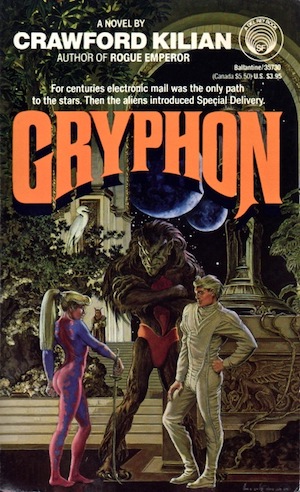
One thing that drew me to the book initially was the outstanding paperback cover by Stephen Hickman, which evokes the tale quite vividly. Hickman loves to paint opulent settings, and his style perfectly fits a world where every human is rich beyond our wildest dreams. His portrayal of Victor, the gryphon, matches the description in the text exactly. The main character, Alexander Macintosh, also looks just as I imagined him. Stephen has taken some liberties with the female character, California Moran, who is shown with iridescent scales on most of her body—something that Alex wore, not her—and she is depicted as a blonde, not dark-haired as described. But the fencing foil and her stance captures her personality. The illustration is perfectly staged and evocative; like the best of covers, it makes you want to crack open the book and get reading.
About the Author
Crawford Kilian (born 1941) is an American-born writer who now lives in Canada. He has worked as a college professor and newspaper columnist. He moved to Canada after serving in the U.S. Army as a draftee. His fiction includes tales of alternate histories and time travel, ecological disasters and fantasy. He is not hugely prolific, but I’ve always found his work entertaining and engaging.
Approaching the Singularity
Gryphon is one of a number of works that appeared in the late 20th century that addressed the concept of a technological singularity. One of the science fiction authors who first explored this concept, both in academic writing and fiction, was Vernor Vinge, and I discussed his thoughts in my review of his book A Fire Upon the Deep. As cited in the Encyclopedia of Science Fiction entry on the theme of the Singularity, in 1993, Vinge presented a paper, “The Coming Technological Singularity: How to Survive in the Post-Human Era,” which predicted humanity was nearing a point beyond which technological advancements involving biology or computer technology, or perhaps both, would render humanity unrecognizable to those who lived before the transition.
Buy the Book
The Relentless Moon
Another theme related to the Singularity is Transcendence, or what happens after the transition takes place. Of course, describing this transition and new status quo posed an immediate challenge to science fiction writers, who had to grapple with the task of describing the indescribable. Frequently, the stories present viewpoint characters who for some reason have not transformed to some sort of transhuman identity. Vinge, in some of his works, posited “Zones of Thought,” transcendence was not possible in the inner depths of galaxies, but in the outer reaches, godlike beings and capabilities were common. This allowed the author to show us transcendence while still giving us characters with whom we could identify.
In the case of Gryphon, the singularity is brought on by the connection of humanity to a massive network of the assembled knowledge of numerous intelligent races, unable to make contact in the physical world due to the insurmountable difficulties of interstellar travel. This infusion of advanced knowledge has led to the collapse of governments—indeed the collapse of human civilization—and the widespread destruction of the world’s ecology. The lucky survivors, however, due to nanotechnology (which they refer to as molmacs, or molecular machines), are rich beyond anyone’s wildest dreams, living in opulent surroundings and able to explore the solar system at a whim. People can modify their bodies as they want, but do not directly interface with computers, so other than being insufferably entitled and arrogant, they remain similar enough to their ancestors for the reader to relate to them as human.
Gryphon
Young Alexander Macintosh is steering his steamship, Wuthering Heights, toward Earth orbit to attend a party at his father’s cloudcastle. The term “steamship,” while it at first seems archaic, refers to an interplanetary ship that uses superheated water as a reaction mass. He was given the ship on his twentieth birthday, and now Alex goes to visit his father to celebrate his twenty-fifth, marking his attainment of full adulthood. The ship is large enough to accommodate an opulent estate, with not only a mansion, but even surrounding grounds and gardens. Alex is a bit apprehensive, as he is not used to large social gatherings—in this day and age, people get together very rarely, usually only for sex or ritual dueling. Moreover, his mother may be attending; she’s an intimidating and eccentric inventor who lives in an estate called Mordor near the ruins of Los Angeles.
Unlike some of his contemporaries, Alex accesses the alien Database only occasionally, avoiding the temptation to be engulfed in its vast knowledge. He is served by the artificial intelligence of his steamship, and also by a black Labrador retriever with enhanced intelligence named Heathcliff. I was somewhat put off by the protagonist’s arrogance and sense of entitlement during my first reading of the book, but this time around it felt even more blatant. Alex and the people around him have been granted riches beyond measure, yet one of the first things they do is create a new form of slavery, building servants whose whole purpose is to make their lives even easier. I began to wonder how I’d ever liked these people on my first reading of the book, but as I read on, realized there’s a good deal of growth and transformation involved in the narrative, and it was the characters they eventually became that I had admired.
Earth is only thinly populated in these days, and Alex’s very existence is owed to his father’s conservative, and even reactionary, attitudes (while the books are very different in many ways, there are echoes here of Arthur C. Clarke’s The City and the Stars, another novel that deals with the remnants of humanity in the far future). Alex arrives at his father’s home, but before the party can commence, news arrives of a planet that has materialized from nowhere, and is now located only fifty thousand kilometers from Earth. Surprisingly, the party begins as planned; these people being so self-assured that even a seemingly impossible event fails to disrupt their plans. Fortunately for the structural integrity of Earth, the new planet is encased in a force bubble that prevents its gravity from disrupting the Earth, its tectonic stability, and its tides. The planet is inhabited by a race the humans call gryphons, a warlike and aggressive species that had been cut off from the interstellar community after attacking other races with something called “thought bombs.” No one can explain how moving this planet was accomplished, as there is nothing in the vast knowledge of the Database that suggests it is possible.
An attractive young woman close to Alex’s age, California Moran, arrives at the party. They also meet the eccentric Liam McCool, who follows the religion of the Violents, whose practitioners believe that pain and shock bring epiphanies. Alex’s mother and father present him with a gift they have been preparing for years, a gift that is remarkably timed: an artificially grown gryphon named Victor, bred and trained to be Alex’s companion (I found the gift of a slave quite offensive, and the fact he is of the exact race that has just invaded the solar system a coincidence that almost shattered my suspension of belief).
The new arrivals make a pronouncement, using a human they have grown, a clone of John F. Kennedy (humans are not the only races that grow members of other species as slaves, and the characters do not enjoy seeing the shoe on the other foot). The gryphons have become advocates of something they call the Pattern, a collective philosophy that will be shared with humanity, and all other species, by forceful mental reprogramming and use of molmacs.
Disrupting the party, Alex impulsively announces that he does not trust the new arrivals, and will be taking Wuthering Heights to the outer Solar System. California impulsively decides to join him. Others at the party decide to head back to their various homes, ships, and estates. Alex, California, and Victor take his shuttle to California’s home in the Pacific in order to pick up her luggage, but the gryphons announce a blockade enforced by a euphemistically named Freedom Fleet, and the shuttle is shot down.
The party finds themselves shipwrecked, floating on a raft of invasive vegetation created from templates in the Database, and discover the “wild” molmacs of Earth have developed a collective consciousness, and are working to heal the ecology. An eagle who is a spokesman for their consciousness joins the party. While they had originally intended to travel to California’s mother’s estate, instead they find themselves kidnapped by a vehicle that transports them to Liam McCool’s estate. Liam wants to “warwire” them, using molmacs to increase their aggressiveness and enhance their abilities. They agree, and begin planning their opposition to the gryphons. At the same time, the gryphons are landing all over the Earth, and forcibly using molmacs to convert humanity into slaves of their beloved Pattern. Alex’s father resists the invaders and is killed. His mother develops a type of force bubble that can protect estates and vessels against gryphon attacks.
Alex and his diverse band of companions soon find themselves on a wild journey through the solar system, deceiving the gryphons, finding allies, and encouraging the highly individualistic remnants of mankind to work together against the invaders, whose fervent desire is to destroy everything that makes humanity what it is. Not only Alex, but all of humanity discovers that they need to do some growing up, and throw off the selfishness of immaturity. There are twists and turns, betrayals and breakthroughs, and the narrative keeps you guessing right up until the final pages.
Final Thoughts
If you are looking for a good summer read, a story that not only gives you plenty to think about, but keeps you entertained along the way, then Gryphon is the book for you. Used copies of the original Del Rey paperback are available online, and may be found in your local used bookstore, and there is a newer paperback edition published by iUniverse.com.
Now it’s your turn to chime in: Have you read Gryphon, or the other tales by Crawford Kilian? If so, what were your impressions of the work? And what other books do you recommend for enjoyable summer reading?
Alan Brown has been a science fiction fan for over five decades, especially fiction that deals with science, military matters, exploration and adventure.

Oh wow, I hadn’t thought about Crawford Kilian in a long time! A neat throwback. About twenty years ago, someone told me I might like Lifter (in which a teenage boy discovers levitation powers). The description must have piqued my interest, because I ended up going on a used-bookstore crawl looking for it. I remember thinking that the two editions I found looked remarkably different: there was a conventional pocket paperback from the American market, illustrated fairly literally, and then a later Canadian paperback put out by a small press, which I’m pretty sure was bright blue/yellow and illustrated abstractly. I don’t actually remember which edition I read, but I have a distinct sense that I enjoyed it. However, I note now that my memory of the book has faded. I should reread it, and keep a lookout for Gryphon (which it sounds as if I’d like as well). I’m pretty sure I did a search of the Internet, such as it was then, for information on the author, and found very little.
So I deliberately didn’t read all of your article, Alan. The beginning of it was enough to know I wanted to try this book, so tracked down a first-edition paperback on Abe and now just need to wait for it to arrive at my doorstep. Excited to read – thanks for this series!
Great cover, but is that skin she is wearing or a leotard?
@3 It is apparently possible and fashionable for young people to grow a kind of snake skin, and not wear clothes over it. This is frowned upon by their elders.
Fortunately for the structural integrity of Earth, the new planet is encased in a force bubble that prevents its gravity from disrupting the Earth, its tectonic stability, and its tides.
One of many moments when I would have been happier to leave my sliderule alone was when I stopped to calculate the tides raised by the asteroid orbiting Earth in Greg Bear’s Eon.
I’ve seen some CK ebooks published by Lume Books here in the UK, I don’t know if they’re available in the US. Gryphon isn’t one of them. I do recall the Del Rey original paperbacks from the 80s (imported from the US), but I don’t recall ever reading any. I suspect they didn’t appeal to me when reading the blurbs. I have read John Ringo’s Council Wars series which seems to be riffing off this idea.
Nice to see Kilian get such a sympathetic treatment – he’s really under-appreciated, in my opinion. A pity he’s no longer publishing, but I read recently that not long after his last novel (Redmagic), he couldn’t interest publishers in subsequent novels. Hard to understand – his novels were original, and he told a good story, as well as having a distinctly subversive attitude towards power and established orders. He always seems to try for a resolution in which nobody loses utterly, and never portrays the baddies as irremediably bad.
It’s worth mentioning that you find First Nations references through his works – in Gryphon, for instance, the Rocky Mountains are referred to by one of their indigenous names.
Kilian can be found writing for The Tyee still. Non-fiction, however.
@7 Unfortunately, in the 90s, a lot of publishers retrenched, and many good authors found themselves without a market. You were either a big name, or no one was interested. Today, with ebooks and publishing on demand, there is room again for what were then known as “mid-list” authors.
Thanks to Alan Brown and all the commenters for their very kind words about Gryphon. They make me want to re-read it as well: was it really that good?
Owen Lock, my editor at Del Rey, had been very supportive from my first novel, The Empire of Time. He suggested turning it into a trilogy, and when that didn’t sell as well as hoped, he suggested a space opera. So I wrote Gryphon, while thinking all the while that space opera was a crock. Who the hell was paying the taxes for all these star fleets and galactic empires?
Gryphon therefore turned into an exercise in taking the piss out of some cherished SF tropes while also exploring ideas like nanotech and the growing narcissism of North American society. I had a lot of fun writing it, and again it failed to sell.
So after a couple of fantasies that were technically interesting but commercial duds, I departed the field and went into nonfiction books and journalism. No regrets.
Yes, Lume has revived many of my old SF novels; Eyas is now on Amazon.uk and will soon be available in North America. I’m hoping they’ll pick up Gryphon next year.
@9 No regrets? Well, I’m kind of sorry. I enjoyed your novels.
Glad you’re happy with what you’re currently doing, though.
See you in The Tyee.
I enjoyed writing them, and I’ve got an unpublished novel and two or three fragments I play around with even now. But I’m too old to write on spec, especially when I can still tackle almost any subject I want to in The Tyee. And Lume has brought out most of my novels, and they seem to be doing OK with a new (or nostalgic) readership.
Just glad I never wrote a pandemic novel. Wouldn’t have come close to the luridly surreal weirdness of 2020.
@9 Thanks for joining the discussion, and giving us background on the writing of the novel. The praise for Gryphon was well deserved!
As a gryphon fan, are the gryphons just the name of an alien race or are they like Egyptian-ish gryphons (feline body, bird head, wings) you’d usually see in fantasy? Is the fuzzy alien on the cover what the gryphons are in the book?
Gryphon is a nickname the humans gave to the race that invaded, probably because their faces look gryphon-ish. The creature on the cover matches the descriptions of the gryphons in the text.