







“Singularity”
Written by Chris Black
Directed by Patrick Norris
Season 2, Episode 9
Production episode 035
Original air date: November 20, 2002
Date: August 14, 2152
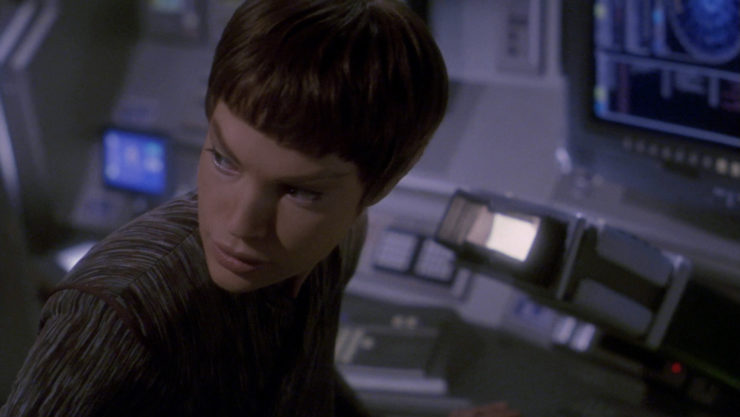
Captain’s star log. We see that everyone on Enterprise is unconscious, except for T’Pol, who dictates a log explaining what the hell happened.
Enterprise is approaching a singularity that is part of a trinary system. While the Vulcans have charted thousand of black holes, this is the first one on record to be in a trinary system, so they head toward it.
Meantime, Chef has taken ill, so Sato volunteers to run the galley until he’s better. Archer, after asking Tucker to fix the captain’s chair—it’s annoyingly uncomfortable, and he keeps feeling like he’s going to slide off it—confides in T’Pol that he’s been asked to write a one-page preface for a biography of his father, and he’s struggling with it.
Reed is dissatisfied with the tactical readiness of Enterprise, and has several ideas for how to improve it, including wanting there to be an alert klaxon and a battle-ready stage. He also wants sensitive areas of the ship to be only available to authorized personnel with a personalized command code. He explains this to T’Pol when she is confused by his asking for a code when she enters the armory. T’Pol didn’t see the e-mail about that because she is working in her quarters because Tucker is working on the captain’s chair on the bridge and it’s very noisy.
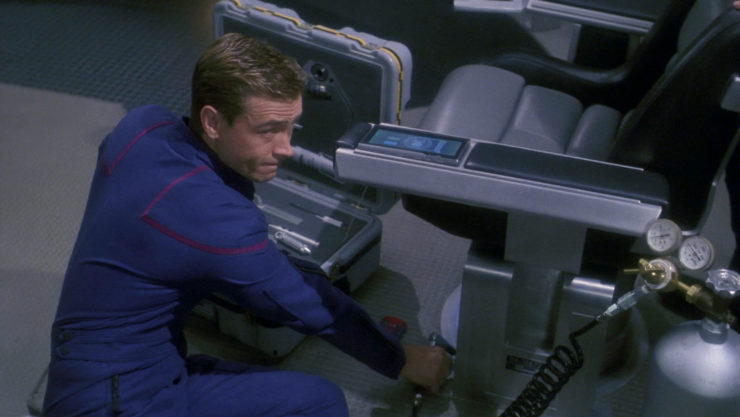
Tucker is, in fact, trying to make the perfect captain’s chair, and he keeps coming up with fancier doodads to put on it. He’s also morally offended that the design of a Starfleet command chair hasn’t changed in ten years.
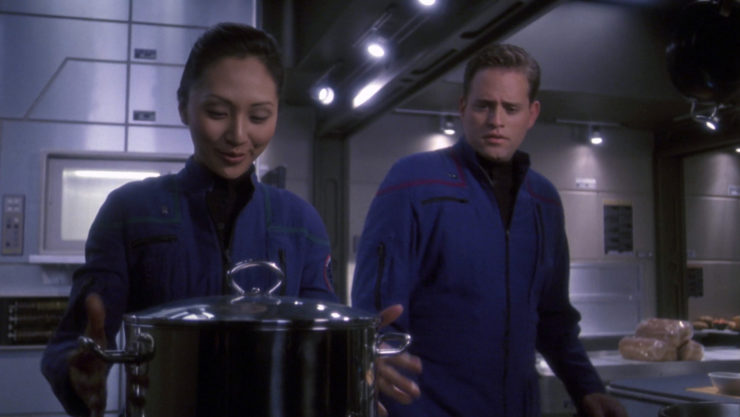
Sato prepares an old family recipe for the crew, but Reed’s complaint that it’s too salty sends Sato into a tailspin of constantly refining and retrying the recipe.
Mayweather goes to sickbay for a headache, and Phlox keeps him there for hours testing every possibility to make sure he isn’t carrying some horrible disease or other. When Mayweather gets fed up and tries to leave, Phlox offers him an analgesic for the headache, and Mayweather acquiesces, since that’s all he wanted in the first place. However, Phlox really gives him a sedative, and prepares to cut his head open to examine his brain.
T’Pol is growing concerned about the crew’s obsessive behavior, and tries to talk to Archer about it, but he’s too busy writing an eight-million-page preface about his Dad to pay attention. When T’Pol goes to sickbay, she is forced to neck-pinch Phlox before he vivisects Mayweather. She also notices the brain scan of Mayweather that Phlox took, and realizes that there’s possibly a cause for this.
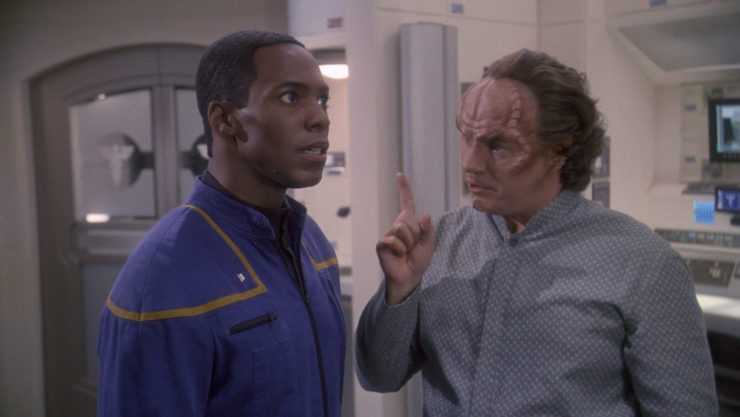
As the human crew all start to collapse from the effects of the singularity’s radiation, T’Pol determines the cause of everyone’s behavior, and is appalled to realize that just turning around won’t do the trick, as they’ll continue to be exposed as they go back. Their best bet is to fly through the trinary star system, which will get them away faster. But it’s a two-person job—one to fly, one to make course corrections—and Mayweather has been sedated by Phlox and is unavailable. She gives Archer a cold shower which makes him compos mentis enough to (barely) fly the ship through the trinary system. However, there’s an asteroid in the way, at which point Reed’s tactical alert goes off (complete with loud-ass alarm that nobody liked) and weapons are already armed without having to be charged, which enables them to destroy it.
After they get out, everyone comes back to themselves, most with no memory of what happened. Phlox is massively apologetic, especially to Mayweather, and Reed offers to remove all his adjustments, though Archer tells him to keep the tactical alert—just change the alarm. Also, Tucker starts over with the captain’s chair and fixes it to Archer’s satisfaction—by lowering it by one centimeter.
Can’t we just reverse the polarity? Apparently, the radiation emitted by a singularity in a trinary system will turn humans and Denobulans very very obsessive. It doesn’t affect Vulcans, luckily for the ship…
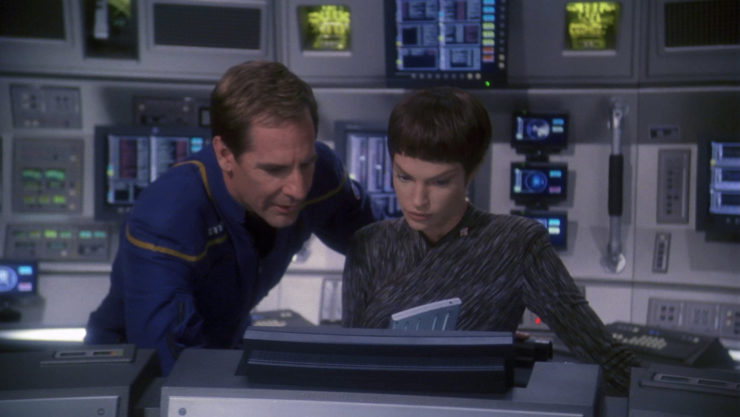
The gazelle speech. Archer has been asked to write a preface for a biography of his father. He finds it impossible to boil down his feelings about his father to one page, and says it would’ve been easier if he’d been asked to write the book. T’Pol suggests he focus on a single incident or event that exemplifies his relationship with his father.
I’ve been trained to tolerate offensive situations. T’Pol’s usual role as the ship’s only grownup is taken to its absurdist extreme in this episode, as she’s the only one unaffected by the singularity.
Florida Man. Florida Man Tries To Build A Better Captain’s Chair.
Optimism, Captain! Phlox’s obsessive desire to eliminate all possible reasons for Mayweather’s headache actually winds up saving the day, as his brain scan of the pilot enables T’Pol to figure out what’s happening. Luckily for Mayweather, T’Pol stopped him from cutting his head open…
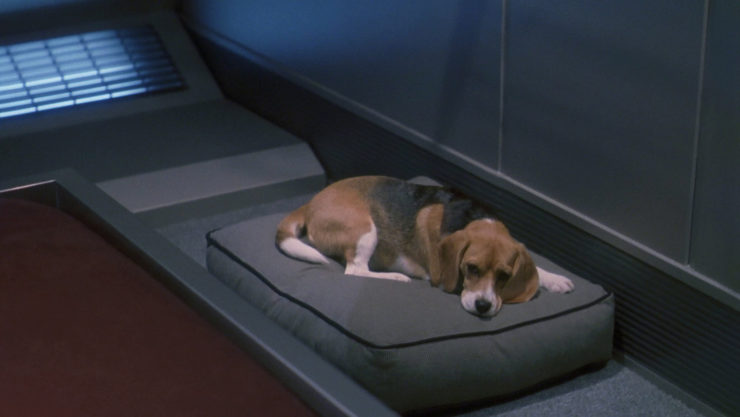
Good boy, Porthos! Archer’s writing of the preface is interrupted by Porthos barking for his food, as apparently the captain’s writing time bled into feeding time. Archer yells at Porthos, who goes to his pillow and sulks. This is the best evidence that Archer is not himself, because he would never yell at Porthos like that if he was in his right mind…
The Vulcan Science Directorate has determined… Vulcans have catalogued more than two thousand black holes.
More on this later… Both Reed’s improved tactical efficiency and Tucker’s designs for a new captain’s chair anticipate later developments in the Federation Starfleet, including weapons automatically coming online when needed and arms and a working mini-console on the command chair. Plus, Tucker suggests “Reed alert” for the name of the tactical alert, a cute play on “red alert.”
I’ve got faith…
“I thought Vulcans had all this mental focus and discipline.”
“We also have sensitive hearing.”
–Tucker giving T’Pol pushback when she complains about the noise on the bridge and T’Pol saying “Bazinga!”
Welcome aboard. The only guest in this one is Matthew Kaminsky, who makes the first of two appearances as Cunningham. He’ll be back in “The Crossing.”
Trivial matters: Phlox makes reference to a protocystian spore as a possible malady Mayweather may have contracted. This is a callback to Voyager’s “Caretaker,” where the titular being was a protocystian lifeform.
When Reed is mentioning Enterprise’s tactical weaknesses, he cites the events of the “Shockwave” two-parter, when the Suliban boarded the ship, and “Fallen Hero,” when the Mazarites did some nasty damage to the ship. He also once again expresses his discomfort with Archer’s friendliness with the crew, also seen in “Minefield.”
It’s been a long road… “You ignored a tactical alert for this?” I actually enjoyed the heck out of this episode, but I also found it disappointing in several ways. It could’ve been a great episode, and settles for being a good one—which is fine.
Buy the Book

A Prayer for the Crown-Shy
There’s only one aspect that actively annoyed me, and that’s Reed stumbling around trying to figure out ways to improve tactical efficiency, and everyone talking as if such things as “red alert,” “battle stations,” and klaxons to indicate an emergency were things that Star Trek made up in 1966. The term “red alert” goes back to World War II, the term “battle stations” goes back further than that, and people have been raising alarms to signify nasty situations for centuries. (As an example, the latter two were, in essence, combined in the old Royal Navy, when a drum beat would signify that general quarters was being signaled, which was done when the ship was getting ready for battle: beat to quarters.) Writer Chris Black and the producers show colossal ignorance in this particular aspect of military history.
Anyhow, leaving that aside, it’s fun watching the crew go slowly binky-bonkers. I’m disappointed that they contrived for Chef to be sick so it’s Sato doing the crazed cooking thing, mostly because this would’ve been a great opportunity to finally see Chef. (That’s a personal thing—I’ve never been fond of the person-always-mentioned-but-never-seen trope.) Still, Linda Park has fun with it, as does Connor Trinneer with his goofy-ass add-all-the-things mien which makes him sound—well, like an engineer, truly. Still, both of them don’t go nearly as far as they could with it. Dominic Keating’s a bit too over-the-top as the obsessive Reed, where Scott Bakula is too under-the-top with Archer’s trying so hard to do justice to his old man.
Jolene Blalock does fine trying to hold the ship together, as she really is the only grownup on board this time, but I wish we’d gotten a bit more of the sass that we often saw from Leonard Nimoy and Tim Russ when the humans were human-ing a bit too much on the original series and Voyager.
The only performance that hits the bullseye is, as usual, John Billingsley. Phlox never entirely loses his friendly affect, which makes his experimenting on Mayweather way scarier.
It’s also the fifth episode of the nine so far this season that feels like it was done on a budget. There’s a cheapness to this episode that we also saw in “Minefield,” “Dead Stop,” “A Night in Sickbay,” and “The Communicator.”
Warp factor rating: 7
Keith R.A. DeCandido is also doing his every-half-year revival of “4-Color to 35-Millimeter: The Great Superhero Movie Rewatch” here on Tor.com, having covered four older movies he missed the first time through—It’s a Bird… It’s a Plane… It’s Superman!, Mandrake, Timecop, and Timecop: The Berlin Decision—and five newer releases—Spider-Man: No Way Home, The King’s Man, The Batman, Morbius, and, coming on Wednesday, Doctor Strange in the Multiverse of Madness.

Fun episode due to the performances and people acting all goofy but I agree that it wasn’t quite what I’d call “excellent” and it did feel low budget as well.
This episode reminds me of the “Seven Saves The Day” episodes on Star Trek: Voyager, particularly Bliss, where the rest of the crew ends up similarly incapacitated.
Just wondering, are we sure that T’Pol was unaffected? Or possibly just slightly less affected? The script made sure that we saw obsessive behaviour before she did, but it took her quite some time to notice that everybody got weird.
Beating the bush around battle stations, keep in mind that Archer mentioned and then deliberately excluded that while he was still sane. The way he sees it, he is commanding an exploration vessel with guns, not a warship on exploration duty! Looking for a snappy name without battle or tactical or combat in it is tricky.
And if there was any justice in the galaxy, those auto-charging phasers should get them into trouble some day. “You fired first!” — “We had to, you charged your weapons!”
Dr. Pedant says: Are we not doing subject-verb agreement these days? /snark
@3/o.m.: While we as viewers are trained to know when our weekly hero characters are acting amiss, T’Pol may not be as quick to pick up on it because perhaps she’s not as familiar with how emotional humans (and Denobulans) can behave and so wasn’t alarmed at first.
Typo alert in the third paragraph under It’s been a long road… It should be “Bakula is too under-the-top…” not “to.”
Trivial matters note: The Caretaker and Suspiria were sporocystian life forms. It’s possible that the Enterprise writers were inspired by that word while writing this episode, though.
While I did enjoy the episode, I thought it missed a real chance at some character development. Everyone became obsessed about whatever they happened to be doing at the time. I thought it would have been more interesting if their obsessions had revealed more about their inner characters.
@@.-@, 5: Fixed, thanks!
Wow, different tastes. I hated this one. It was annoying watching the crew get so driven by such petty obsessions. I didn’t feel they revealed anything about the characters in the way that, say, “The Naked Time” did, except maybe for Archer’s thing with his father’ biography. Mostly it was just a bunch of monomaniacs sniping at each other over things that didn’t matter, and that was very uninteresting.
And the whole “Reed Alert” thing was silly. Even if they didn’t expect to go into combat, it’s implausible that they wouldn’t have had an emergency alert protocol already in place in the event of accidents, malfunctions, or dangerous space phenomena. Spacegoers can’t survive if they’re careless, because space is a far less forgiving environment than Earth. These protocols should’ve been worked out well before they left.
Keith, the Caretaker was not a protocystian life form, but a sporocystian one. A sporocystian organism is one that reproduces through spores. I’m not sure what a protocystian life form would be; it seems to be one of those Treknobabble terms coined by slamming two random roots together.
I would like to say that I fondly remember this one, but I barely remember it at all, so I can’t say it made much of an impression. I do remember Reed’s obsession with inventing Red Alert and thinking it unlikely that this was something that still needed inventing.
@10/David Pirtle: Based on what I can find online, the term “red alert” (as the highest of a series of alert levels) was first recorded in World War II, so it was newer in TOS’s time than I would have thought. No surprise that WWII veteran Roddenberry and his age-cohort writers would have incorporated it. Still, it underlines the inanity of this episode’s assumption that the term hadn’t been invented yet in 2152.
I had no problem with T’Pol acting untypical for a Vulcan as she clearly was selected for this mission for not being the typical Vulcan in the first place. Beyond that, the snottyness and arrogance of other Vulcans in this period is also very unlike Tuvok or Spock.
A nice quirk is added here in Germany because of the necessities of dubbing and lip movement in English. Tucker has to constantly call it “des Captains Stuhl”, which sounds pretty old-fashioned, like the diction of a butler in a Sherlock Holmes Story would. It gives his obsession a twist to the insane and also submissive.
Quoth Christopher: “@10/David Pirtle: Based on what I can find online, the term “red alert” (as the highest of a series of alert levels) was first recorded in World War II, so it was newer in TOS’s time than I would have thought. No surprise that WWII veteran Roddenberry and his age-cohort writers would have incorporated it. Still, it underlines the inanity of this episode’s assumption that the term hadn’t been invented yet in 2152.”
Or you could’ve just read the rewatch entry you’re commenting on, where I pretty much already said all that…..
—Keith R.A. DeCandido, who is also sorry for the protocystian confusion
@13/krad: Oops — I’d previously read that paragraph when you excerpted it on Facebook this morning, so I skimmed over it here and missed the details.
I’m afraid I found this one to be pretty mediocre. The teaser at the beginning told us how it was going to pan out, and it was a bit of a slog getting there. It really didn’t get interesting until the crew members really started to go off the rails, with the exception of Phlox, who seemed to be affected more quickly. I think it would have worked better if the situation had revealed some layers to the characters we haven’t seen before.
“The radiation affected my nervous system rather severely.”
The crew acting out of character is a plot as old as Star Trek’s second aired (and seventh filmed) episode. So this is another case of ignore the plot and its babble about trinary star systems and mysterious radiation (I’m not sure if “radiation did it” was that convincing an explanation in the 60s, let alone the 00s!), and concentrate on the characterisations. Tucker and Reed are anal enough that it’s not immediately obvious they’re acting out of character, but it’s rare to see Sato get this obsessed about something, while Phlox is downright sinister right from the off, much to his later embarrassment. (I’m not sure why the recap claims they’ve got amnesia? Aside from Mayweather being a bit confused when coming round from sedation, they all seem to remember everything.) And as for Archer, if he snapped at T’Pol that’d just be Tuesday, but you know something’s wrong when he’s mean to Porthos.
In fact, Archer and T’Pol’s friendship comes right into focus here and he doesn’t show any unreasonable behaviour to her until he’s definitely being influenced. (Actually, he seems to hold onto at least some sense of perspective longer than most, breaking up Tucker and Reed’s spat.) He asks her to look over his preface when he’s done it and she gives him some good advice as a result. And while it might be down to his piloting skills, he’s still the one she goes to for help in an emergency (as she did in “The Seventh”).
We seem to go from “crew acting oddly” to “crew all unconscious” rather abruptly. There’s a few nice moments of humour, from T’Pol getting in a zinger at Tucker (“We also have sensitive hearing”) to the final moments where Archer gives Tucker an awkward thumbs-up, then immediately gets out of his chair and asks T’Pol’s opinion on his preface. The whole “Archer doesn’t like his chair” subplot feels like a bit of a dig at Scott Bakula’s posture!
Phlox briefly wonders if Mayweather might be suffering after-effects of his experience in “Dead Stop”. The crew complement is again given as 83, as last indicated in “Minefield”.
@16/cap-mjb: “The crew acting out of character is a plot as old as Star Trek’s second aired (and seventh filmed) episode.”
I’ve seen “The Naked Time” described that way before, and I think it’s missing the entire point of the episode. They aren’t “out of character” — rather, what we’re seeing is their true character, their innermost feelings expressed without inhibition. The virus stripped away their barriers and let them say what they really felt and kept hidden — Spock’s loneliness and pain, Kirk’s craving for release from the burdens of command, Chapel’s unrequited love for Spock, Sulu’s romanticism and swashbuckling aspirations. It didn’t change who they were, it told us who they were, more openly than military discipline and personal reserve allowed them to admit.
And that’s why it’s a bad comparison with this episode, because the crew’s obsessions are mostly superficial, external things that don’t tell us much about who they are. Or at least they don’t tell us anything we didn’t already know — Archer cares a lot about his father’s legacy, Trip wants to do right by his captain, the security guy is big on security, the doctor likes to do doctoring.
This one was just OK. Sometimes it feels like the writers were out of ideas, and just went to a binder full of episodic TV tropes.
I found this episode dull as dishwater.
I think if an episode does the crew acting out of sorts and it doesn’t reveal layers to their characters such as fears and motivations and hidden desires, and instead goes in the direction of obsessive behavior (as this story does), then it really needs to be over the top. It should be hilarious/scary. Only the Phlox characterization went that route and therefore was the most successful. The other characters were more tepid and that’s why this episode isn’t as strong as it could have been nor more memorable.
Obviously Star Trek has done the ‘crew having their personalities altered by a mysterious singularity’ plot before, and plenty of times at that.
But as I was reading this, I realized something: this episode is almost identical to DS9 season 1’s Dramatis Personae, written by Joe Menosky, and which aired almost exactly a decade before this episode!
Archer’s obsessively writing pages about his father and his legacy follows pretty much the same beats as Sisko building his clock, completely aloof from the rest of the crew and the events taking place. Reed’s borderline mutinous nazi-esque behavior as he takes charge is eerily similar to O’Brien’s attempted coup against Kira. The whole episode is built upon the same premise of reinforcing the crew’s worst instincts, parts of their beings that are part of them as characters, but without the moral brakes and empathy. And T’Pol being the one to save the day also echoes Odo and Quark – the most alien members of the station – figuring out how to get them out of trouble.
Singularity as an episode isn’t really bad, and it’s always fun to see the cast stretching out of character for an episode (Enterprise always had a good handle on episodes that are character-centric like this one), but to me it retroactively loses points for being so derivative of that DS9 episode.
And while I mostly like Bakula as Archer, he really doesn’t carry a scene the way Brooks did as Sisko with his deranged call for Kira’s murder on that episode.
I’ve always really liked this episode. It has a very creepy vibe, thanks to the music, performances, and directing.
I can see why this is considered a bottle episode, but given the effects of the Enterprise going through the singularity (which I thought looked amazing), it feels like all the money for this episode went there. Given that Chris Black was a producer on SLIDERS, he probably knew exactly how to craft the episode to feel character-centric while using all the dollars where it was most needed… the ship going through the singularity.
I agree that the standout is Billingsley because he did his obsessiveness smiling the entire time. Creepy factor was definitely ramped up with him.
This is actually among my favorites of season 2. I’d give it an easy 8.
I have one thing to say on this gem of an episode: “CARROTS!” I thought Linda Park’s delivery was comedy gold.
I always took that Deep Space Nine episode to be more that the telepathic record had overwritten their personalities. It does make me wonder just how weird you have to be for someone to question orders in Star Fleet though.
@9. ChristopherLBennett: I personally found the very pettiness of those obsessions actually added to the thrill of horror running through this episode, since it adds to a building sense of lethally dangerous irrationality eating away at Our Heroes’ ability to work at all, much less work together and find a way to save themselves in the same way acid eats into flesh (But then I have a soft spot for Cosmic Horror, which I suspect may well be your least favourite possible genre, given your love of Hard Fact and clear respect for scientific rigour).
@krad: I have to say that your rating for this rather fine episode is especially perfect, since it’s strong but by no means exceptionally so – one must admit that I really liked this one, not least because this addition to T’Pol’s continuing splendid record as MVP on the NX-01 still leaves room for other characters to play a useful role in saving the Enterprise (‘Reed Alert’ is one of my favourite Dad Jokes in all of STAR TREK and works rather well as a Chekov’s Gun; honourable mention to Captain Archer for doing some useful piloting with what appears to be a Serious Hangover).
I do hope that Porthos got the benefit of some Serious Apologies from the boss man!
@25/ED: “(But then I have a soft spot for Cosmic Horror, which I suspect may well be your least favourite possible genre, given your love of Hard Fact and clear respect for scientific rigour).”
I’ve seen cosmic horror done with scientific rigor. Cosmic horror is about humans facing immensely powerful forces that we can’t comprehend and that have no concern for our existence, with the horror being the recognition that we’re effectively ants beneath their boots and can’t do anything about it. One can certainly do that with scientifically grounded fiction about advanced aliens or posthuman intelligences.
Heck, the Borg were originally cosmic horror — a vast impersonal force dangerous to humans because they weren’t interested us in the least and would hardly notice if we were trampled underfoot. But then First Contact and Voyager reinvented them as space zombies, which is a different, more personal genre of horror.
@26. ChristopherLBennett: Fair point! I must admit to being more familiar with the sort of Cosmic Horror that traffics more in the vast, alien and incomprehensible angle on the genre (Where reality warps and even the best explanations don’t necessarily stand up without a little shiver of desperation).
On a more mischievous note, I see that you’re not claiming to actually like the genre/sub-genre! (-;
@27/ED: I’m not much of a horror fan in general, no.
This episode is a good summary of my main issues with ENT in its first seasons: no original idea, just reused ones, executed worse than its predecessors with mostly boring characters. This episode in itself is pretty OK, relatively well executed, but this being the fifth series in the franchise? Meh.
The doctor is great, I was entertained by the ideas about improving the chair and by “reed alert” and upset by the idea that red alert would be something new at that time…
I have to say it’s really-really fortunate that even when there’s no android or EMH on board, there’s at least one person unaffected by the danger of the week.
It’s a bottle episode. Bottle episodes are designed to be cheap. I don’t think “Dead Stop” looked cheap at all though – it has a lot of new sets and a ton of opticals – VFX shots for exteriors and a lot of composited shots with the crew in the foreground. That’s expensive.
This is my personal favorite episode of Enterprise because of how relatable it is. People don’t need magic “radiation” to experience obsessive moods, and they can be especially disastrous to people with technical skill sets. When you have the mind for figuring out how things mechanically fit together, it’s just so easy to get carried away overthinking, over-designing, constantly adding on features without considering the actual cost to yourself (and others) in terms of time and frustration, when really it’s the simplest solutions that work the best. I personally make furniture as a hobby, and have also mucked about with some home remodeling, so this whole episode I watch Trip obsess over a chair only to finally settle on a mere centimeter adjustment, and I think “this is literally me, I’ve built this chair.” Had a good laugh at myself.
Anyway, it’s not the best episode, nor is it particularly unique. As others have said, it recycles ideas from much older episodes. But the specific depiction of obsessive behavior, as opposed to, say, space drunkenness, stood out to me.
Every Trek episode gets a “Naked Time”, and this is Enterprise’s. It’s just that everyone has Autistic-level hyperfocus instead of some people getting randy, some angry, etc. It’s not bad, and maybe it’s my mood, but I felt it dragged a bit, despite the tension it tried to build. I too thought it was silly there was any real dickering about what to call the “code” — but I liked seeing that they didn’t have one at first, since this was to be a peaceful mission.