







Until Forbidden Planet came along, most science fiction films took place on either Earth or within our solar system. But this loose adaptation of William Shakespeare’s The Tempest took sci-fi cinema into deep space—and stayed there—for the first time, introducing elements (faster-than-light travel via hyperdrive, robots, ancient interstellar civilizations) that had been mainly the purview of sci-fi literature to that point. Its plot and characters also laid the groundwork for later milestones like Star Trek, elevating filmed science fiction to a new level of maturity and sophistication and influencing the genre for decades to come.
Released on March 2, 1956, Forbidden Planet was the first major science fiction film ever undertaken by Metro-Goldwyn-Mayer, at the time the premier studio in Hollywood. Directed by Fred McLeod Wilcox and scripted by Cyril Hume (from a story by Allen Adler and Irving Block), the film cost as much as $1.9 million to make—no small change back in those days—and every penny of it appeared on the screen.
With a few exceptions—This Island Earth, The Day the Earth Stood Still, War of the Worlds—science fiction in the 1950s was relegated to low-budget, quickly-made “B” movies, often shot in black and white and set in bland Earthbound locations. Rubbery extra-terrestrial invaders or mutated, overgrown animals or insects—the latter usually explained away by radiation from atomic testing, a prevalent concern at the time—were the primary topics of most sci-fi movies of the day, ranging from quality efforts like Them to cheapies such as The Amazing Colossal Man.
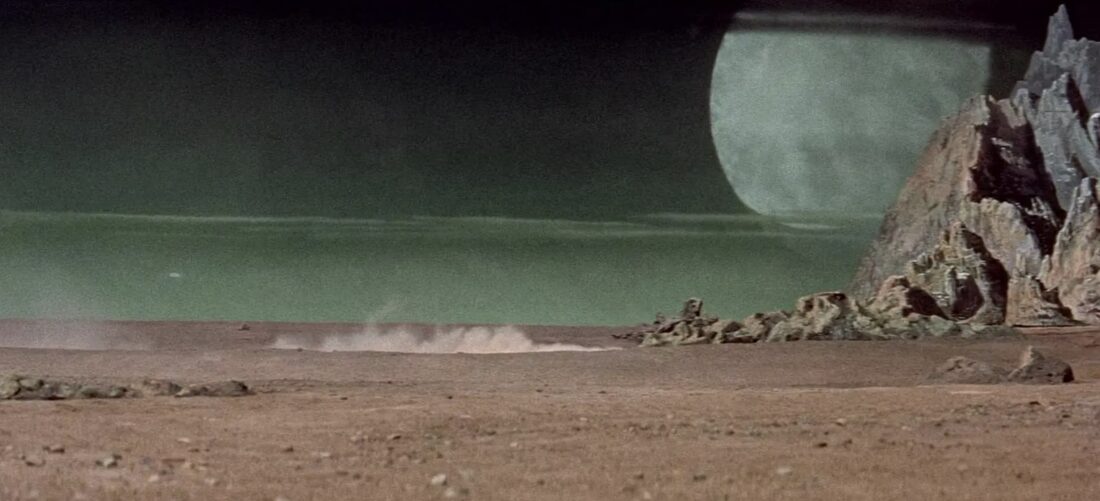
Filmed in Eastmancolor and CinemaScope, with some theaters playing it in stereophonic sound, Forbidden Planet changed all that. It was set in the far future, with the entire film taking place aboard a starship, on the surface of an alien planet, or deep below that surface in massive underground vaults. Earth never appears once—a first for sci-fi cinema. The film introduced heady concepts about psychology, technology, and robotics that had rarely been considered in previous sci-fi films. While it’s certainly dated in many ways (most notably in its acting, its weak comic relief, and its male-female relationships), it remains fascinating and compelling both thematically and—even 70 years later—visually. It’s nothing short of a genre landmark.
Forbidden Planet opens sometime in the 23rd century aboard the United Planets space vessel C-57D, on a mission to the fourth planet in the Altair star system, where an exploration ship called the Bellerophon vanished 20 years earlier. Commanding the C-57D is J.J. Adams (Leslie Nielsen), aided by executive officer Jerry Farman (Jack Kelly), chief engineer Quinn (Richard Anderson), and ship’s doctor Ostrow (Warren Stevens). Adams and his crew are shocked when their vessel is first scanned from the planet’s surface, then warned away from the planet by Dr. Edward Morbius (Walter Pidgeon), the Bellerophon’s philologist.
The C-57D lands on Altair IV despite Morbius’ warning, where the crew is greeted courteously enough by Morbius, his all-purpose robotic handyman Robby (voiced by Marvin Miller), and his young, beautiful daughter Altaira (Anne Francis). The rest of the Bellerophon crew is long dead, killed by what Morbius describes cryptically as a “planetary force.” Only Morbius and Altaira have survived on the planet—where, as Morbius makes clear, they intend to stay.
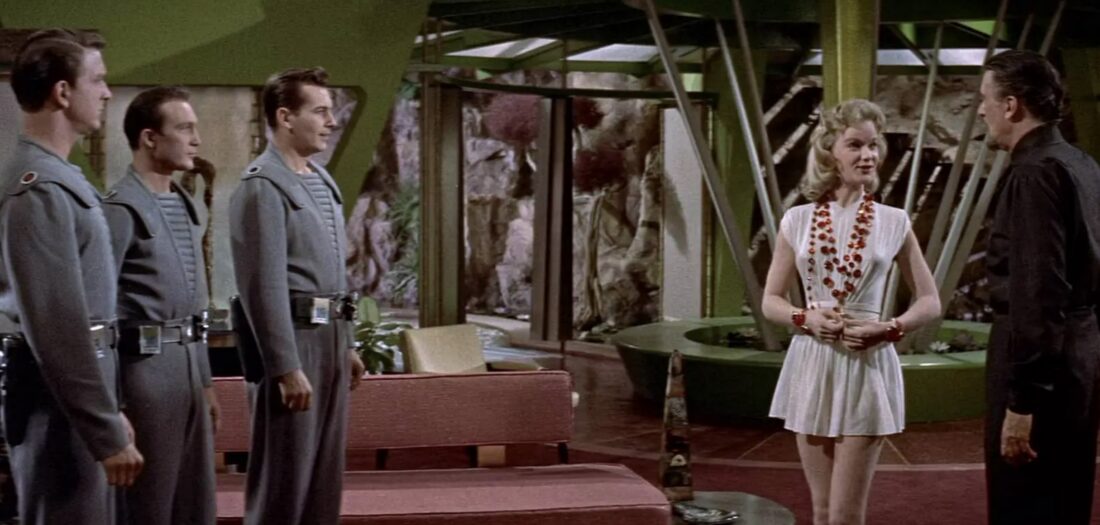
Adams and his crew, in space for over a year, are pleased to get an eyeful of Altaira; she, in turn, is quite intrigued by the sight of fit, young adult men, which she has never seen before, and quickly takes an intense (and reciprocated) liking to Adams. At the same time, an invisible entity of some kind—possibly Morbius’ “planetary force”—begins intruding into the C-57D at night, sabotaging its radio equipment and killing Quinn and other crew members.
Morbius reveals that deep below Altair IV’s surface lie the remnants of an ancient civilization called the Krell, who destroyed themselves in a single night 200,000 years earlier. Morbius has been able to master some of their still-running tech, including devices that enhance his mental capacity and allow him to create almost anything out of pure energy. But the Krell machinery is also tapping into the darker recesses of Morbius’ mind, and the invisible creature murdering Adams’ men—the same raging force that extinguished the Krell—is a “monster from the id,” summoned unconsciously by Morbius against the crew he unconsciously perceives as a threat.
The allusions to The Tempest are evident: Morbius is analogous to the play’s Prospero, a sorcerer who flees to a secluded island with his infant daughter Miranda after he’s betrayed by his own brother, Antonio. A spirit that dwells on the island and serves Prospero, Ariel, is the prototype for Robby the robot (both are gender-neutral, by the way), while another inhabitant, the half-human, half-monster Caliban, is the equivalent to Morbius’ “monster from the id.” The machinations of the plot are different, but the literary pedigree alone gives Forbidden Planet a larger sense of gravitas (especially for what was considered a “juvenile” film).
Perhaps more important is its other literary lineage: Forbidden Planet is—with the arguable exception of some early serials—the first major motion picture to truly channel the spirit, ideas, and imagery that had been prevalent in published science fiction for several decades already. The movie’s visuals themselves—the barren landscape and green sky of Altair IV, the Earth ship soaring through the stars and landing on the planet’s surface, the vast underground machinery left behind by the Krell—could have been lifted right off the covers of magazines like Astounding, Galaxy, and The Magazine of Fantasy and Science Fiction.
The same went for many concepts and ideas introduced in the film. Faster-than-light travel between the stars had not been explored on screen before; neither had the notion of an ancient, superior interstellar civilization whose members may have even walked the Earth eons ago. The Krell themselves remain offscreen, the only suggestion of their shape being the trapezoid-shaped doors that suggest a non-humanoid form. While not invoked directly in the film, Robby is subject to Isaac Asimov’s famed Three Laws of Robotics: he cannot cause harm, directly or indirectly, to a human being. No one who helped create Forbidden Planet seemed to have an official connection to the sci-fi genre—director Fred McLeod Wilcox was previously best known for 1943’s Lassie Come Home—but it certainly seems that someone involved in the production had read extensively in the genre during one of the most fruitful periods in its history.
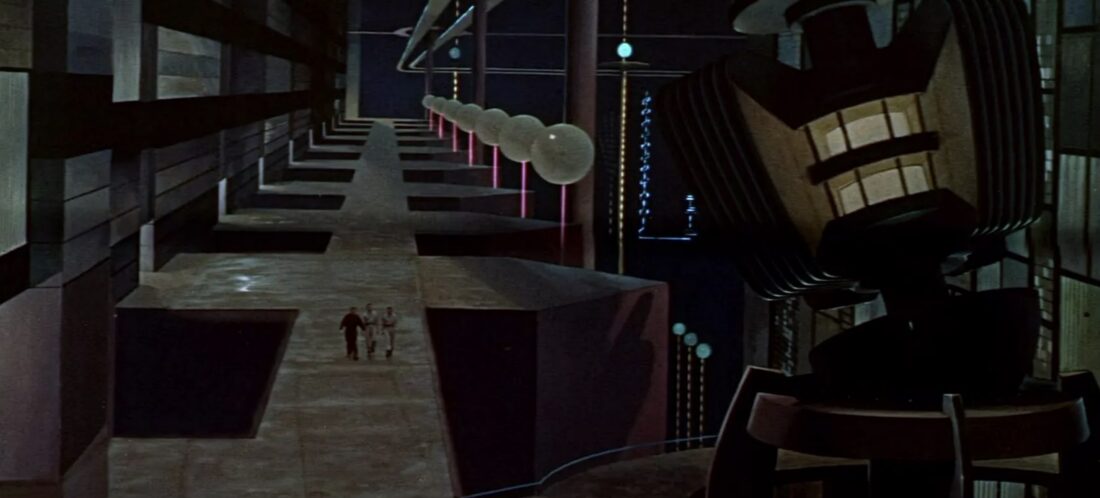
In addition to its channeling of Asimov’s laws and other sci-fi premises, Forbidden Planet at least nods to real science in several areas—even if the underpinnings are wonky. For example, this was the first film to depict faster-than-light travel in interstellar space in a serious, thoughtful fashion: As the film opens and the C-57D comes out of lightspeed, the crew step into beams that render them into energy in order to survive the massive deceleration. It’s mentioned that special shielding is needed to protect the ship’s engine when its power is needed for a transmission to Earth. Morbius explains that the machine devised by the Krell to create matter from energy is fueled by more than 9,200 nuclear reactors and “8,000 miles of klystron relays.”
None of this probably makes much sense in real life, but it gave the story at least the veneer of scientific credibility. More grounded in fact was the film’s exploration of psychology—namely, the “monster from the id” that not only wipes out the Krell civilization in a single night but nearly destroys the crew of the C-57D and Morbius himself. Interestingly, the original screen story for Forbidden Planet contained no such element—it was set in 1976 and the ship’s mission was to rescue colonists stranded on Mercury (hope they brought suntan lotion), where they are stalked by a creature native to the planet. The version that reached the screen incorporates the psychological theme, as well as commentary on the dangers of unlimited power.
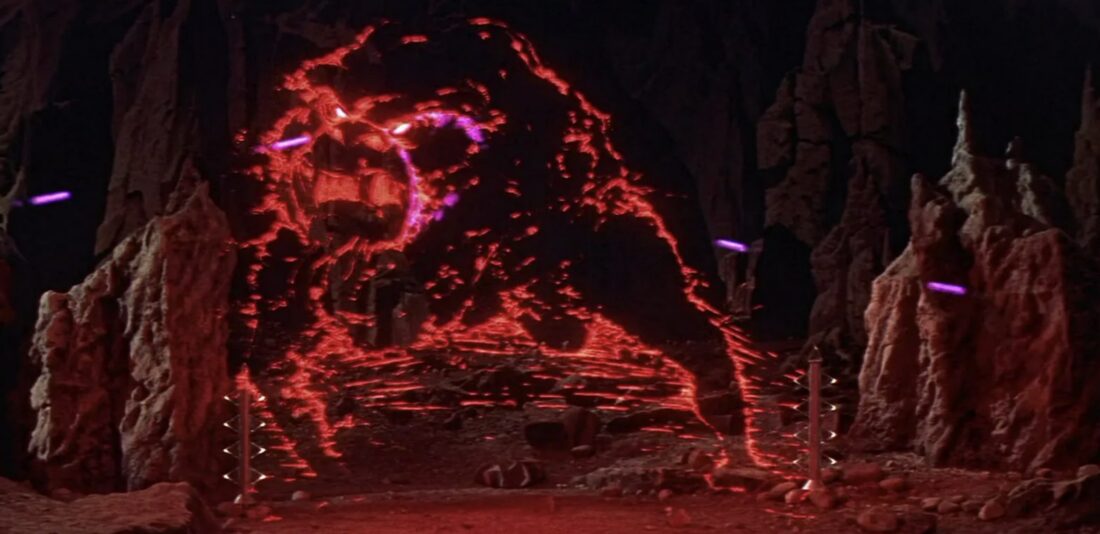
The monster from the id, introduced into the film by writer Cyril Hume, dates back to the 1920s and the psychoanalytic work of Sigmund Freud, who established the id as a collection of instinctual impulses and desires—some of them not always welcome in civilized society – held in check by the ego and superego. In this case, Morbius’ subconscious hostility toward the men of the C-57D summons up the manifestation of his id (which is invisible, but glimpsed once in the film) via the Krell machine when he’s sleeping, aiming it at the crew with murderous intent. Ironically, Morbius—who does not want to share the God-like powers of the Krell with the human race for fear of how they might be abused—brings on his own downfall by using them.
In his book Keep Watching the Skies! American Science Fiction Movies of the Fifties, author Bill Warren suggests that there’s a darker impulse at work in Morbius’ subconscious: an incestuous attraction to his daughter, Altaira. It’s not directly suggested in the film (which might have been a subtext too far for a movie made in the 1950s) and Morbius never extends anything like physical desire toward Altaira, but he’s also overprotective to an extreme. This is a young woman who’s never seen another living being aside from her father, and while she’s perhaps a bit naïve, she’s highly intelligent and quite inquisitive about the civilization her parents and their shipmates left behind. Morbius admits as much at one point, saying he’ll have to bring Altaira to Earth someday—but his reluctance might seem sinister if one looks closely enough.
Based on the men of the C-57D, we almost want to keep her away from Earth as well. A few of the all-male, all-white crew act more like drunken sailors when they first spy Altaira than the highly trained astronauts they’d need to be for a mission like the one they’re on. Their eyes and tongues practically fall out of their heads when Altaira strolls out in her minidress (the first time such a garment was worn in a Hollywood film, and Francis does wear it well).
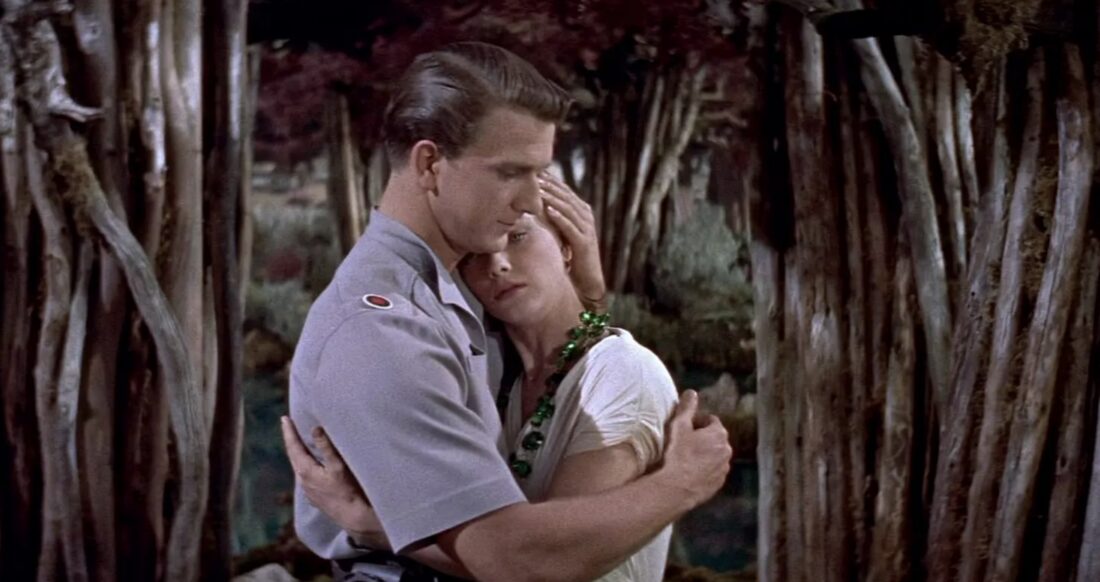
The executive officer, Farman, immediately flirts with her and later kisses her with what barely passes for consent. Commander Adams has the decency to avert his eyes when he comes upon her swimming in the nude, but in one brief yet excruciating exchange of dialogue, he implies that she might deserve her fate should some of the other men stumble upon the same scene (of course, she and Adams fall madly in love not long after that). The male-female dynamic in the film, even in context, is easily its most dated and embarrassing element.
While that and other aspects of Forbidden Planet—like its acting, which ranges in quality—haven’t aged well, the film broke new ground in other ways. Many of the visuals still look spectacular for a film that’s seven decades old. Some of the angles from which Wilcox and cinematographer George Folsey shoot the Krell machines—which burrow some 7800 levels into the planet—are stunning, providing them with a real sense of scale and depth. Other visual effects, such as the manifestation of the monster and the blaster rays, are very much of their time, although colorful and unique for the era.
The blaster rays, the beams surrounding the Earth ship as it lands, and most importantly, the monster from the id—glimpsed briefly during an attack on the C-57D’s force fields—were all created by Disney animator Joshua Meador, marking the first time that the Mouse House lent out one of its prize artisans to another studio. MGM at the time had visual and optical effects departments, but did not have a full-time animation shop, prompting execs to make the call to Disney and ask if they could loan out Meador. Arguably the studio’s premiere animator at the time, he had worked on classics like Pinocchio, Bambi, and Fantasia.
Although a stop-motion version of the id monster was considered before Meador came aboard, going with animation gave the entity a less corporeal presence. Meador went through a vast array of concepts, including a more Lovecraftian-looking apparition and one nightmarish version that was essentially Walter Pidgeon’s head on two legs. The final version, which retained its two clawed, powerful legs, but made the face more monstrous (although subtle hints of Pidgeon’s features can still be ascertained), reportedly frightened moviegoers at the time, although nowadays the animation might seem very Disneyesque.
Forbidden Planet was also the first major motion picture to feature an all-electronic score (billed as “Electronic Tonalities”), created by Louis and Bebe Barron. The Barrons were initially hired to provide sound effects for the movie, and according to Bebe Barron, the producers were so impressed that they asked the couple to score the film as well, creating an eerie, otherworldly audioscape that essentially wove the music into the overall sound design. There were “not even half a dozen” people doing electronic music at the time, according to Barron, and while the score was innovative, the Barrons were not eligible for an Oscar nomination because they did not employ traditional musicians as per Academy rules.
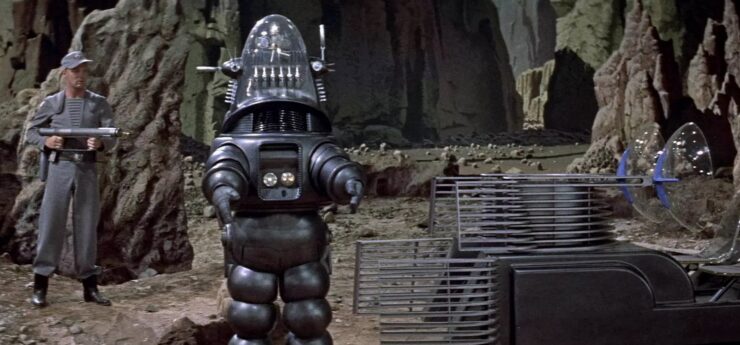
This was also the first movie in which a robot had an actual personality and character, instead of just being a novelty or a menace. As filmmaker Joe Dante notes in the documentary Amazing! Exploring the Far Reaches of Forbidden Planet, robots prior to Robby were mostly “of the somewhat clunky variety, where you got basically three metal blocks and a head.” Some exceptions, like Gort from The Day the Earth Stood Still, were more humanoid in nature but silent and implacable. Robby, on the other hand, was dryly funny and uniquely structured, with his transparent domed head allowing us to see his inner workings. Even with an operator inside the costume, the goal was to make Robby seem like a real, fully functional automaton.
MGM senior designer Robert Kinoshita and other artists working on the film went through scores of drawings and concepts for Robby, with Kinoshita eventually combining the best of them into the final model that is known and instantly recognizable to this day. Robby became not just an iconic figure (there are still Robby toys and even full-sized replicas available), but reappeared in a number of films and TV shows. He was also the forefather of later mechanisms like the Robot from Lost in Space (another Kinoshita creation), C-3P0, Johnny-5, and WALL-E, and even guest starred in a Lost in Space episode opposite his descendant.
If you can grit your teeth through some of its outmoded aspects, Forbidden Planet is still an entertaining, occasionally mind-blowing watch, and its influence on sci-fi cinema remains robust. While not a blockbuster success upon release, it proved that big-budget, well-produced science fiction could succeed both creatively and in the marketplace, paving the way for films like 2001: A Space Odyssey, Planet of the Apes, Star Wars, Alien, and scores of others that share some of Forbidden Planet’s DNA in terms of scale, universe-building, and conceptual foundations.
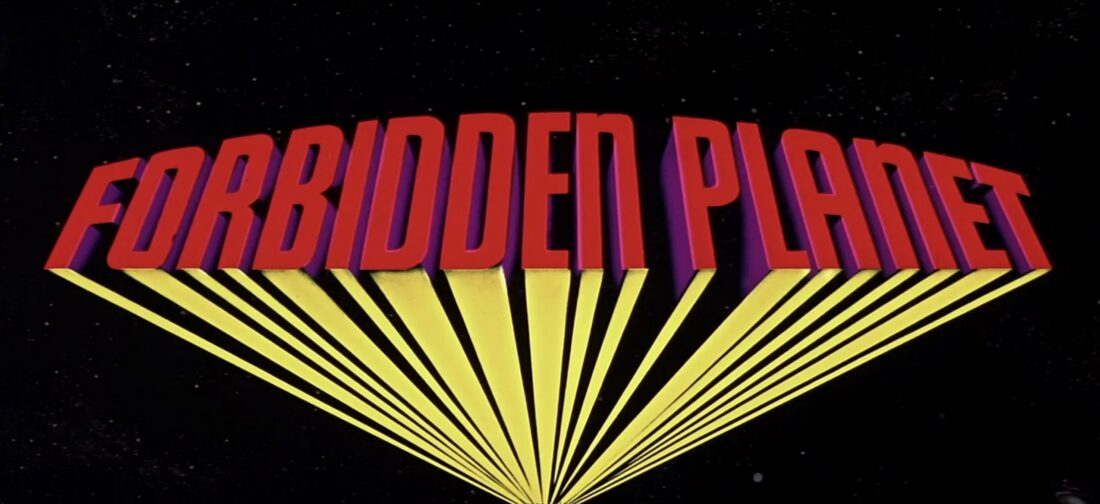
And then there’s Star Trek. According to David Alexander’s book Star Trek Creator, Gene Roddenberry acknowledged Forbidden Planet as an inspiration for his series, while “The Trouble with Tribbles” author David Gerrold notes in his book The World of Star Trek that the movie could almost be a Trek episode, with a few tweaks. Roddenberry did take the Forbidden Planet model and improve on several things, including the racial and gender makeup of the crew, the overall mission of the Enterprise, and the deeper development of the Trek universe.
Nevertheless, strands of Forbidden Planet’s plot cropped up in a number of Trek episodes, while other tenets – a deep space mission of exploration and colonization, the discovery of alien civilizations, even the camaraderie between the captain and the ship’s doctor (not to mention the captain’s way with the ladies)—were established by Fred Wilcox’s film 10 years before Star Trek premiered. Even Anne Francis’ mini-dresses can be seen as the progenitor of the miniskirts worn by the female crew members of the Enterprise—with Francis’ curious, self-liberating Altaira and the women of Trek subtly empowering themselves while still subject to the commercial whims (attracting the male gaze) of the era in which both properties were produced.
Where precisely Forbidden Planet lands in the pantheon of science fiction films is a largely subjective choice, but there’s no question that its development, production, and release marked a turning point in the genre’s history on the big (and later small) screen. It’s interesting to note that although there have been many attempts to remake it (even as late as 2024), none have reached the screen yet, perhaps because the original film is too ingrained in pop culture to “modernize” it. For a film that’s 70 years old, its vision of the future holds up remarkably well.

In accordance with the old rule of thumb that “even numbered Trek films don’t suck”, I have always considered Forbidden Planet to be Star Trek Zero.
I’m still sad that Guillermo del Toro’s remake didn’t go anywhere, because honestly, he’s the only one who could have pulled it off.
Outstanding essay, reminded me of how much smol me had his mind blown when I first saw it way back when…
My Absolute Favorite Science Fiction Movie❗
This movie was my childhood introduction to Freud.
“What’s a monster from the id, Dad?” :)
I wrote this 20 years ago for a forgotten website:
Here’s my deal with Robby. All the reviewers I’ve read equate him with Ariel, Prospero’s spritely familiar in The Tempest. And sure, he’s well spoken, sympathetic, and possesses uncommon powers. But think about it: There’s nothing ethereal about Robby. He’s completely earthbound, programmed by Morbius and held to Morbius’ rules. He’s the one who does the heavy lifting. He’s the one who takes out the trash. He sees the girl naked but is denied sexuality. Also (and this should be the giveaway), he’s the one who goes off drinking with the comic relief. He’s Caliban.
A hidden aspect of The Tempest is that both of Prospero’s mystical helpmates resent his dominion. Caliban may plot openly against him, but Ariel, outwardly loyal, serves only for the promise of eventual freedom. This interpretation tracks for the Id Monster: a creature of air and fire that carries out its master’s whims but is ultimately unknowable.
I’m spending time on this point because once one stops thinking of Robby as innately ‘friendly’ one can see how ‘he’ is just another laborsaving device and this, perhaps unintentionally, bolsters the movie’s main theme of human self-obsolescence. Were Forbidden Planet’s writers consciously making statements about the inequities and false comforts of their time? For that matter, was Shakespeare? According to Frederick S. Clarke and Steve Rubin’s landmark 1979 article in Cinefantastique (to which I am greatly indebted), scenes like Altaira’s swim in her Edenic playground, with its additional echoes of the Artemis myth, were added to satisfy a need for eye candy, not thematic complexity. And I suspect that if old Billy hadn’t concocted a drunk scene for his Low Characters the Globe’s audience would have demanded one.
I mostly agree that Robby is closer to Caliban, but I’m not sure “denied sexuality” works as a comparison to Caliban, since the reason Prospero hated Caliban is that the latter had attempted to rape Miranda. Robby is simply asexual, and would never do any harm to Altaira. I suppose he’s an amalgam of both servants.
“Faster-than-light travel between the stars had not been explored on screen before”
Incorrect. 1955’s This Island Earth, predating Forbidden Planet by 9 months, depicted an interstellar round trip to Metaluna, which Exeter explicitly described as “far beyond your solar system, in outer space.” Before that, the 1948 Superman serial had depicted baby Kal-El’s trip to Earth from what the opening narration described as “the ill-fated planet Krypton, which revolved about the brilliant sun of its own solar system,” although I’m not sure it specifies how long the journey took.
Repeating comments I made in an earlier column about FP on this site: I vaguely remember reading somewhere that the reason FP got made by the “A pictures” unit instead of the “B” unit had more to do with the vagaries of budgeting and scheduling than any kind of decision to take science fiction more seriously. I think it was written with the expectation of being a B-movie but ended up lucking into an A-level budget. And it wasn’t as if B-movies never took science fiction seriously — see It Came from Outer Space from 1953, with its thoughtful Ray Bradbury storyline. The A/B difference was more about budget and studio logistics than anything else, as I understand it.
Indeed, it’s worth noting that the writer, producer, and FX team of FP followed it up in 1957 with an indirect B-movie “sequel,” The Invisible Boy, which was specifically designed as Robbie the Robot’s second starring vehicle. The film is set in the near future relative to 1957, but the title character finds Robby disassembled in the laboratory of the late Professor Greenhill, who claimed to have built a time machine and who has a photo of Robby disembarking from a starship at Chicago Spaceport in 2309 — which is consistent with the evidence that Forbidden Planet took place sometime in the 23rd century, though the novelization of that film puts it in 2371. So implicitly, that starship was the C57-D bringing Robby back to Earth (which would put FP in 2299, since it’s a 10-year trip), and the time-traveling Professor Greenhill found Robby there and brought him back to the latter 20th century. But the title character has a line about how a time traveler bringing knowledge back from the future would change the present, so I suppose that implies that TIB is an alternate timeline that branched off of the Forbidden Planet universe.
Nitpicking perhaps, but neither the 1948 Superman nor This Island Earth explore the specific concept of FTL. They simply seem to underestimate the scale of interstellar distances. Forbidden Planet’s depiction of an extreme deceleration maneuver does seem to have been something new.
Extra credit: the FP novelization is more explicit about light-speed being the travel method, adding that due to time dilation, the crew have nobody waiting for them back “home”.
Okay, granted that there’s a difference between “depicting” and “exploring,” though it’s ambiguous phrasing at best. Maybe something more like “The mechanics of faster-than-light travel between the stars had not been specifically addressed on screen before.” Although I’d prefer to qualify that with a “probably” or something, since there may have been earlier examples we’re both unaware of.
“Extra credit: the FP novelization is more explicit about light-speed being the travel method, adding that due to time dilation, the crew have nobody waiting for them back “home”.”
Altair is nearly 17 light years away, and the film stated that the hyperspace trip from Earth takes “more than a year” (I’m not sure where I got the “10 years” I mentioned before, maybe from a line in The Invisible Boy). So if the novelization says it takes long enough that they have no family left back home, then it’s specifically saying the ship is not FTL, directly contradicting the film. (Not surprising — I’ve read the novelization, and like many novelizations from the era, it tells the story in a very different way than the movie did.)
It always bothered me that Morbius had more than two chairs.
Great file…which I’ve been loving for 70 years!
Wonderful essay on a special film, the No. 1 science fiction movie released in the fifties for me, in terms of style, story and impact. As a journalist for The Hollywood Reporter, I “broke” the story on one of those attempts at a re-make after interviewing the then rights holder at the 1991 or 1992 Cannes Film Festival. She was a woman with money and no film experience. Don’t know who got the rights next.
“Could almost be a Trek episode:” The pilot with Captain Pike borrows heavily from “Forbidden Plant” with ultra-powerful mind controlling aliens (alive, unlike the Krell) on a forbidden planet (forbidden by the UFP) feeding off emotion (the ID) rather than destroying with it and a quite similar planetary surface.
You have it spot on this was the first film to put literary science fiction on the screen. One grace note I loved was the ship’s name, United Planets space vessel C-57D, like there are hundreds of those vessels zipping around the galaxy. That was the scope I found in reading Analog magazine, Foundation and other stories as a teen in the seventies—and coming across the movie for the first time then.
“The pilot with Captain Pike borrows heavily from “Forbidden Plant” with ultra-powerful mind controlling aliens (alive, unlike the Krell) on a forbidden planet (forbidden by the UFP) feeding off emotion (the ID) rather than destroying with it and a quite similar planetary surface.”
Mostly, yeah, except the idea of the planet being “forbidden” wasn’t added until 2 years later when the pilot was incorporated into the 2-parter “The Menagerie.” So that one doesn’t count.
I would add that the phaser cannon may also have been inspired by the C-57D’s weapons. Also, the original outline for “The Cage” described the aliens (called Sirians instead of Talosians) as crab creatures with low, wide bodies and doors matching their shape, which reminds me of the Krell doorways.
Then Roddenberry remembered the “forbidden” two years later, having already borrowed the rest.
That’s reaching. He just needed a plot device to base the frame story on. Yes, he was influenced by FP in “The Cage,” but it’s way too precious to claim he based the plot of “The Menagerie” on a word in the title of the movie. After all, FP wasn’t his only influence, so trying to force everything to fit it is going overboard.
Then again, in Star Trek III, writer/producer Harve Bennett (no relation, though his son is also named Christopher) gave us the line “Genesis allowed is not! Is planet forbidden!”