







Having a part-time job or doing volunteer work has lots of upsides for teens, whether it’s making a little extra money, getting some professional experience, or contributing to their local communities. They develop their organizational, time management, and interpersonal communication skills, and hopefully wrap up their workdays with the sense of a job well done. But in Sinclair Smith’s The Waitress (1992) and R.L. Stine’s The Knife (1992), this work might just be murder for Paula McLaughlin and Laurie Masters.
In The Waitress, Paula and her mother are new in town and Paula is having some trouble getting settled in. Paula transferred schools mid-year and everyone’s friend groups are pretty well established, she keeps getting busted for daydreaming in English class instead of paying attention to the assignments, and she accidentally made an enemy of popular girl Coralynn when she talked to Coralynn’s boyfriend Garth (though Garth says she’s not really his girlfriend). When Paula has the chance to get an afterschool job at the local diner, the Dog House, she jumps at the chance—she’d love to make a little money and figures it’s a good way to get know some of the other local teens, between her fellow waitresses and kids from school who come in to eat and hang out. Paula has never waitressed before and lies to get her foot in the door. Trixie—the owner of the Dog House and a long-time waitress herself—isn’t fooled for a second, though she decides to give Paula a chance.
Paula quickly gets to know the other waitresses, who are also her classmates. Virgilia (who everyone calls Virgil for short) is an academic all-star, working on a big computer project that’s going to land her a great college scholarship. Meanwhile, Cookie has other priorities, few of which seem to revolve around showing up for class, and she’s actually contemplating dropping out of high school to start working at the diner full time. Paula’s fellow waitresses are kind, patient, and supportive, but the customers are another story. Coralynn is a major thorn in Paula’s side at work as well as school: Trixie is Coralynn’s aunt and she lets Coralynn and her friends hang out and eat for free, while Coralynn goes out of her way to make Paula’s life miserable.
When Paula’s not trying to keep up with the dinner rush or avoid Coralynn’s abuse, she has to contend with a rash of bizarre and sometimes dangerous pranks going on in the diner. Someone loosens the lids of the mustard bottle and the salt shaker, which results in Coralynn getting mustard all over her sweater and Garth accidentally burying his hamburger in a pile of salt. There are threatening notes left on napkins and order tickets, cheery messages like “Think you’re funny? YOU JUST MIGHT DIE LAUGHING!” (23, emphasis original) and “Better watch out or you’ll have a bad accident” (73, emphasis original). Someone puts a steak knife in Paula’s apron pocket and she gets hurt when she shoves her hand in looking for a pen. Paula is sent to deliver a covered dish to Coralynn’s table and when she lifts the lid to serve it, she reveals a rat, which “seemed to be in its final death throes” (69) (though in the end, the rat turns out to be clever, if disgusting, mechanical toy). It’s hard to tell which of these bizarre occurrences might be Coralynn trying to cause trouble, which are fairly harmless pranks, and which may actually be cause for concern, an uncertainty that keeps Paula on constant alert.
The Dog House isn’t an isolated site of danger, however. The terror continues even when Paula is off the clock: someone sabotages her car by putting sugar in her gas tank so that she’ll break down on an isolated stretch of road, she gets threatening anonymous calls when she’s home alone, and someone throws a rock through her kitchen window. And Paula isn’t the only target: someone steals Virgil’s computer disks from her locker at school, compromising her project and jeopardizing her scholarship. Even going out for a bite is a dangerous proposition. The diner and an ice cream place called Scoops are the only two places in town. There used to be a drive-in, but it closed when a boy died there after being poisoned. There really doesn’t seem to be anywhere that’s safe, but Paula and her friends do their best, trying to balance school work, waitressing responsibilities, and just staying alive.
There’s plenty of high school drama at the Dog House, but Trixie isn’t actually much better. When she’s giving Paula a tour of the diner, she shuts Paula in the walk-in freezer, half as a prank and half as a safety demonstration, so that Paula knows how to work the emergency release in case the door ever accidentally closes behind her. Trixie’s mood swings unpredictably, from warm and patient to aggressive and sarcastic. She has little patience for Paula’s fears and says things like “I’m sure you had better things to do over at the high school than worry about a little thing like this job” (62). Trixie started waitressing as a teenager and dropped out of both high school and cosmetology school, like a darker version of Grease’s “Beauty School Dropout.” She has worked hard and now owns the diner, but she can’t help wondering about the life she could have had, feeling jealous of the high school students who work and eat in the Dog House, with all their talk about “looking forward to having new experiences, trying new things and meeting new people—seeing what’s out there” (74).
Trixie’s convinced that all of the teenagers look down on her and think they’re better than her. She’s the one who’s been playing the pranks on Paula and the others. One night, Paula leaves her script for the high school play behind at the diner and despite all the dangerous things that have been going on there, she figures it’ll be perfectly safe to run back quick all alone in the middle of the night to grab it (it definitely isn’t). Trixie corners Paula in the empty diner and tries to kill her, telling Paula “I’m so tired, I’m so tired […] Year after year it’s the same thing. A new bunch of kids from the high school. More part-time help to train. Explaining over and over and over again how to do this and how to do that. But they still think they’re smarter than dumb old Trixie the waitress” (123). So she has decided to make them pay. Trixie is the one who poisoned the boy who died at the drive-in, by slipping a slow-acting poison into his food at the diner to avoid suspicion; she was annoyed by his constant bragging about his college scholarship and decided to shut him up for good. She is similarly intimidated by Virgil’s intelligence and bright future. And Paula just seems to rub Trixie the wrong way altogether and decides to murder her—though with some quick thinking, Paula subdues Trixie and survives. Interestingly, Trixie’s mood swings carry over into attempted murder as well: when she realizes she’s not going to get away with it, she is overwhelmed and contrite, lamenting “How could I do all those things? Oh, no, oh, no, they’ll find out now and I’ll get in trouble” (123). It seems like Trixie probably has bigger problems than low self-esteem and hopefully she’ll get some psychological support after she’s arrested.
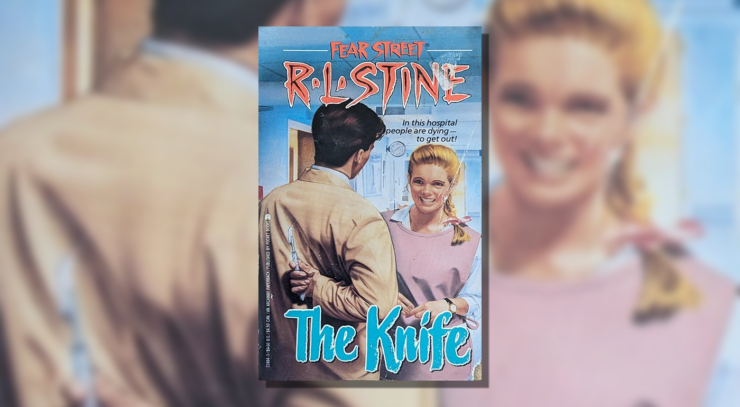
In Stine’s Fear Street book The Knife, Laurie is volunteering at Shadyside Hospital over the summer. Laurie and the other student volunteers do odd jobs, like helping with filing, running x-rays and other things to doctors, and delivering flowers and gifts to patients’ rooms. Laurie wants to be a doctor and she’s excited to get some hands-on experience in the different parts of the hospital, though her favorite place to be is in pediatrics. But it’s not all medicine and sick kids: Laurie’s best friend Skye Keely and a cute new boy, Rick Spencer, are volunteering too, so there are plenty of opportunities for fun and flirtation.
Laurie’s experience in the hospital definitely takes off any rose-colored glasses she may have regarding the medical profession. The nurse on the children’s floor, Edith Wilton, has little patience with the sick kids in her care and when she sees Laurie trying to comfort and talk with a scared little boy, Toby Deane, she tells Laurie “Don’t waste your time […] He won’t talk to you. He won’t talk to anyone. You’re only bothering him. And you’re in the way here, anyhow” (9). Later, when Laurie sees something suspicious going on in the new wing of the hospital that’s currently under construction, she goes to investigate and discovers Nurse Wilton’s dead body. Laurie goes to get help but when she comes back, the body is gone, though it gets quickly dismissed as a sick joke some of the doctors are playing on one another. Everyone dismisses Laurie’s concerns and then she is cornered by Dr. Sherman, who tells her “Do me a favor […] Don’t tell Dr. Brooks what happened. He’s just mad because I put a cadaver in his locker. If I don’t react, it’ll drive him crazy […] Just pretend nothing happened, okay?” (76), like this is completely acceptable professional behavior. Laurie keeps asking questions about Nurse Wilton’s disappearance but the official word is that she’s on a nice long vacation and all is well (at least until an ominous news report that a woman’s mutilated body was found in a crashed car nearby, who turns out to be Nurse Wilton … though this still doesn’t mean anybody believes Laurie).
Even when the patients are discharged, the danger is far from over. Laurie is worried about the young boy, Toby, who cries a lot and seems terrified of his mother. Toby says goodbye to Laurie as he is getting ready to be released from the hospital when he tells her that the woman with him isn’t his mother. When Laurie asks follow up questions about who she is, he says “I’m not supposed to say. She’ll be mad if I do […] I want to go home!” (33). Laurie is worried about Toby’s welfare and finds reasons to stop by his house (she’s selling raffle tickets for a hospital fundraiser), where she doesn’t find anything to put her mind at ease. The woman frequently yells at Toby and she physically abuses him. Sometimes Toby recognizes Laurie and is happy to see her; other times, he doesn’t seem to have any idea who she is. Laurie isn’t sure exactly what’s going on, but she knows Toby is in danger and she has to do something about it. She breaks into the house to see if she can find out more about what’s happening, is taken hostage by the woman and tied up in the basement, escapes, and then kidnaps Toby, heading straight for the hospital and (she hopes) help.
But much like Trixie in The Waitress, there’s not much help to be found from the adults in charge. Dr. Price, the director of the hospital, is more concerned with silencing Laurie than helping Toby, because it turns out that he has been running an illegal adoption ring out of the pediatric floor: his accomplices kidnap children, the adoptive parents give Dr. Price a bunch of money, and he gives them an ill-gotten child. Toby was destined for this dark fate and his twin brother (who Laurie thought was Toby all those times he didn’t recognize her) has already been sent to a new family. The cute new boy Rick also has a vested interest in this illegal adoption ring: Dr. Price kidnapped his little sister Laurie and he wants her back. Nurse Wilton found out what was going on and was blackmailing Dr. Price, so he killed her. Laurie’s aunt is doing an audit of the hospital accounts and has noticed something not quite right, so she’s on his list too. But first, Dr. Price has to get Laurie and Rick out of the way. When things get dangerous, Laurie still believes that she’ll be safe in the hospital, taking Toby there and trying to find help, which plays right into Dr. Price’s hands. He lures Paula and Rick in the under-construction wing of the hospital and tries to kill them to keep them from talking, but he’s not paying great attention to his surroundings and takes a fall down the open elevator shaft. Rick saves Laurie, grabbing her before she can tumble down the elevator shaft after Dr. Price, and presumably all of those poor traumatized children make it back home to their loving families.
Teenagers sometimes aren’t the most industrious workers and to be fair, Paula and Laurie seem to spend just as much time socializing as they do working, but they do take their jobs seriously and do them to the best of their abilities. Rather than just going through the motions and doing the bare minimum, they ask tough questions, like who’s behind the terrifying pranks at the diner and why little Toby is terrified of his “mother.” And they keep looking for answers, even when people tell them not to and the situation becomes increasingly scary and dangerous. They want to know the truth, and perhaps even more than that, they want to keep the people around them safe, and they’re willing to do the hard work and take chances to make that happen.
Both Paula and Laurie find themselves in complicated situations that are much bigger than they are, ones that pull them into the adult world, whether they’re ready or not (and they are definitely not). In The Waitress, Trixie’s violence stems from her own insecurity, a perception she projects onto the teens who work for her. As Paula laments toward the end of the book, “Poor Trixie, you wanted to get back at everybody who thought you were dumb for being a waitress—and the only one who thought that was you” (124). The girls who work for Trixie look up to her, even if they don’t want to follow in her footsteps, but Trixie can’t see their admiration, blinded by her own fear of them looking down on her. The Knife’s Dr. Price doesn’t suffer from this same insecurity: he’s an important man, he knows people look up to and trust him, and he uses that faith to get away with criminal activities, certain that no one will ever suspect him. And for the most part, he’s right. He’s surrounded by nurses who defer to him and even Laurie is happy to turn her concerns over to him to handle, and it never crosses her mind that he won’t do the right thing (at least, not until he’s about to murder her).
Trixie and Dr. Price are very different people, who have made different choices and live different lives, but as Paula and Laurie discover, neither of them are infallible and neither of them can be trusted. Whether it’s because of a sense of inferiority or greed, the adults in The Waitress and The Knife don’t seem to have things figured out any better than the kids do. They do, however, have the power to make sure that others will suffer as a result of their choices, exploiting and abusing those who are weaker and more powerless than themselves, from the boy Trixie poisons to the children Dr. Price takes from their families. And as many a Scooby-Doo villain has opined, they “would have gotten away with it too, if it weren’t for you meddling kids.” Solving mysteries definitely isn’t in either of their job descriptions, but Paula and Laurie take on the responsibility nonetheless, holding these adults accountable, and protecting themselves and others.
