





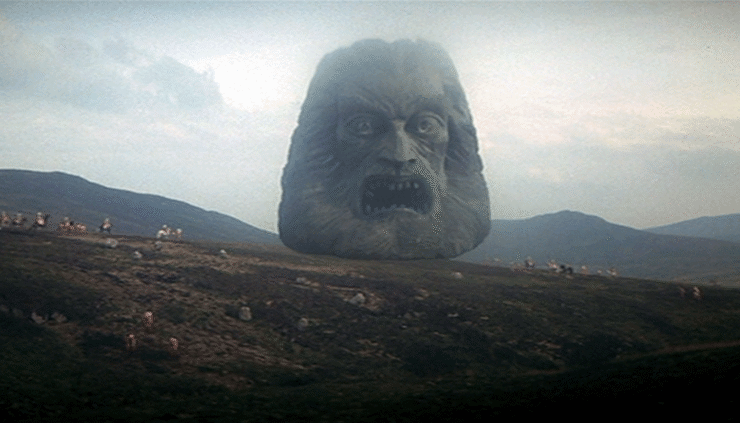
Zardoz (1974) Written and directed by John Boorman. Starring Sean Connery, Charlotte Rampling, Sara Kestelman, and John Alderton
In 1970, Warner Bros. picked up the film rights to the first novel from American poet and English professor James Dickey. Deliverance, which tells the story of four men who take an ill-fated canoe trip through the mountains of Georgia, was a surprise success, and Hollywood came knocking for the film rights.
Dickey wrote the screenplay for his own novel, and he very much wanted Sam Peckinpah to direct the movie. The feeling was mutual; Peckinpah had just released The Wild Bunch (1969) and was willing to take on Deliverance. This is one of those rare cases where The Movie That Might Have Been is actually very easy to imagine. Peckinpah would have been a great choice for Deliverance. (Add that version to the list of films we’ll watch when we can visit alternate universes!)
But Warner Bros. was unhappy with Peckinpah’s work on another film at the time (budget, schedule, etc.), so they went looking for someone else. They ended up hiring John Boorman, a British director who had gotten his start in newsrooms and documentary units at ITV and BBC, but who had more recently made an impression in Hollywood with his now-classic crime film Point Blank (1967). His next two movies, the World War II survival film Hell in the Pacific (1968) and the English drama Leo the Last (1970), weren’t terrible successful, but this was the dawn of the New Hollywood era—everybody was looking for new talent and new styles.
In spite of Boorman and Dickey clashing to the point of having at least one on-set fistfight, Boorman’s Deliverance (1972) was an unqualified success. It made a tremendous amount of money, received rave reviews and awards nominations, and almost immediately became an indelible part of the American film lexicon. Even if you haven’t seen Deliverance, you know about Deliverance, and you can probably quote at least one infamous line from Deliverance (but you probably don’t in polite company). It was the kind of success that gives a director the clout and support necessary to make just about any film he wants to make next.
What Boorman wanted to make next was a film about Arthurian legend. He had approached United Artists about the idea earlier, but the studio wasn’t interested. They gave Boorman a counteroffer: How about adapting J.R.R. Tolkien’s Lord of the Rings instead? Boorman would work on that project for a while, but it proved to be too difficult and too expensive. Boorman would finally make his Arthurian film about a decade later, with the critically divisive but unquestionably influential Excalibur (1981).
Now let’s try to imagine what type of film we would expect a director to make in the decade between releasing a gritty, violent, era-defining take on rural Americana and a lush, extravagant, literary epic starring a dozen or more highly regarded thespians. Go on. Imagine it.
If you say that the film you’d expect from such a career path is Zardoz, you’re a liar, because nobody expected Zardoz. It is not possible to expect Zardoz.
I don’t think I mean that in a bad way. I’m not entirely sure I mean it in a good way. Look, if you want me to tell you if this film is good or bad, I’m afraid I can’t do that. Is it worth watching? Absolutely. There’s nothing quite like it, it’s uncannily relevant more than fifty years later, and we should all experience ambitious, indulgent art that reminds us that the minds of others are truly unknowable. Will you enjoy it? I have no idea. That’s between you and whatever flying stone head you choose to worship today.
Boorman spoke extensively about the film’s origin and production in a 1974 interview with Sight and Sound, so we don’t have to do any speculating about where Zardoz came from. The introduction to that interview predicts that the film is “about to challenge The Exorcist for the biggest box-office draw in the States,” which is both a good illustration of the kind of hype that surrounded Boorman’s first post-Deliverance film and an excellent example of how extremely far off the mark pre-release hype can be.
(Context for numbers nerds: The Exorcist had a limited release the day after Christmas in 1973, and after it became a sensation it was given a wider release and became a box-office hit in early 1974. That makes it the highest grossest film of 1973 even though it made nearly all of its money in 1974. And, just to be clear, The Exorcist made more money in its thirty-screen post-Christmas limited release week than Zardoz made in its entire international theatrical run.)
In the Sight and Sound interview, Boorman explains that Zardoz began life as a “long story” which he then developed into a screenplay that bears little resemblance to what we see on screen. That story was about a California university professor who goes searching for a missing young woman in communes and “alternative societies.” While writing that screenplay, he visited some communes in northern California, about which he said, “…I found it mostly rather sterile; where there was a basic need, some practical sharing, it worked, but the communes based on ideology collapsed at the slightest pressure.”
As that idea became more interesting to him, he nudged the story’s time period farther into the future. He also replaced the mysterious young woman with a virile and hirsute man; he cast Burt Reynolds to play the role originally, but Reynolds had to back out for health reasons. Boorman also incorporated the mythic elements he liked about Arthurian legends, brought in the utopian façade of L. Frank Baum’s The Wonderful Wizard of Oz, and shifted the locale from northern California to post-apocalyptic County Wicklow, Ireland. That last bit was largely a matter of convenience, as Boorman lived in Ireland and made Zardoz essentially in his backyard. Sean Connery even stayed in Boorman’s house during filming. (He was a very polite houseguest who wrote poetry in his free time.)
From that strange alchemy of ideas came Zardoz, a very strange movie made on a limited budget of $1 million dollars and released by a studio that kind of seems to have been tricked into it by Boorman’s shady agent. (That agent, David Begelman, would later become infamous for embezzling and extorting money from actors Cliff Robertson and Judy Garland.) A lot of people had been eager for Boorman’s Deliverance follow-up, but nobody wanted it once they found out that follow-up would be Zardoz.
The film opens with the head of Irish actor Niall Buggy floating on a black background and saying, “I am Arthur Frayn, and I am Zardoz. I have lived three hundred years, and I long to die.” This scene was added to try to make what follows easier to understand. Boorman thought it didn’t work, but I actually disagree with him there; I think Arthur Frayn’s opening monologue contextualizes the entire film pretty succinctly. I just don’t think explaining the story does anything to make the film more accessible to an unsuspecting audience.
Even the clearest explanation in the world can’t force an audience to buy into a story if other elements are strongly alienating. Arthur Frayn’s introduction leads into a scene in which a giant, scowling stone head soars over the Irish countryside. On the hills below, men on horseback, dressed in the now-iconic red banana hammocks and thigh-high boots with matching bandoliers crisscrossing their chests, relentlessly run down and kill fleeing victims. The stone head is Zardoz, god to the men it calls the Chosen Ones, and it lands among them to proclaim, “THE GUN IS GOOD! THE PENIS IS EVIL! GO FORTH AND KILL!” The Chosen Ones shovel piles of wheat into Zardoz’s mouth, and it repays them by vomiting a cascade of firearms and ammunition into their hands before flying away again.
Sometimes in film many conflicting things can be true. This is the best movie opening ever. It’s also the worst movie opening ever. It’s completely insane. I love it. It’s terrible, but I love it. I can also understand why it repelled so many moviegoers.
(Production note: In Ireland in the ’70s importing a pile of firearms to use on set was challenging for obvious political reasons. According to Boorman, somebody on the production crew was a member of the Irish Republican Army and helped facilitate approval for bringing so many guns into the country.)
From there we move into the flying head as it soars away. One of the Chosen Ones, who are also called Exterminators, emerges from where he’s hidden in a pile of wheat. We’ll learn later that his name is Zed, and he’s played by a post-James Bond Sean Connery in a manner described by critic Pauline Kael as “a man who agreed to do something before he grasped what it was.” (I don’t agree with every part of Kael’s savage take on Zardoz, but she got that part right, and the piece is an interesting read. She pans Blazing Saddles [1974] in the same column.) While aboard the giant floating head, Zed shoots Arthur Frayn, who tumbles to the ground.
The giant floating head (actually several model heads of different sizes, filmed in perspective) brings Zed to a place called the Vortex, a sort of commune where everybody is young and insufferable and dressed like wellness influencers at their first Burning Man. The scanty, revealing clothing was designed by Christel Kruse Boorman, Boorman’s wife at the time.
In the Vortex we meet May (Sara Kestelman), who wants to experiment on Zed to find out how the so-called Brutals are different from the Vortex-dwelling Eternals. She argues with Consuella (Charlotte Rampling), who wants to kill Zed right away, but lets May keep him alive for a few weeks of study. During that time, Zed does menial work for Friend (John Alderton), which gives him a chance to learn about life in the Vortex. It’s an immortal life defined by inescapable ennui and boredom. Having a “negative aura” during their mind-melding meditation is a crime, and anybody found guilty is sentenced to being aged so they aren’t young and beautiful anymore.
Zed and the audience don’t learn how it all came about in this order, but here’s the outline of the backstory: A few hundred years before the movie’s stated year of 2293, things were getting rather bad on Earth. The people who considered themselves the elite, being richer and (they believed) smarter than everybody else, came up with a way to preserve human civilization when everything collapsed. They left all the riffraff to perish elsewhere—that’s how the so-called “Brutals” outside the Vortex came about—and collected themselves and humanity’s cultural achievements into an ark of sorts (which might have gone into space, but that’s only mentioned briefly and never brought up again). Their wealth and self-described smarts did not protect them from their own hubris, however, because they made the wholly boneheaded decision to put their lives into the hands of an artificial intelligence called Tabernacle. They give Tabernacle the task of keeping them alive forever, then they made Tabernacle indestructible.
That goes about as well as anybody who isn’t a tech CEO or a wealthy elite in a sci fi dystopia could predict, which is to say: very poorly.
None of this solves any of the problems in the world. It just creates new, worse problems. There are still hungry, angry people outside the commune, so Arthur Frayn creates the Exterminators and gives them their gun-loving fake god Zardoz to keep the numbers down, similar to culling animal herds. The so-called Eternals aren’t allowed to die, but they can and do lose the will to live, which leads to more and more of them committing crimes to be sentenced to permanent old-age senility or simply giving up and joining the listless Apathetics. That leaves fewer and fewer of them to do the minimal labor required to stay alive in their protected Vortexes (there’s more than one, but we only see one), so they realize they maybe shouldn’t be killing everybody outside and instead enslave them to grow food.
And somewhere in all of this there is the reveal that Arthur Frayn genetically engineered Zed to be a better human, with the goal of Zed being able to infiltrate the Vortex and find a way to destroy the Tabernacle. He chose the false god’s name Zardoz from shortening The Wonderful Wizard of Oz, because Arthur Frayn sees himself as the man behind the curtain. He wants to destroy the system he helped create, and Zed is the solution he came up with.
And, well. Okay. Look. Let’s not pretend otherwise.
A lot of this movie is ridiculous. And a lot of it is quite bad.
There is a lot of stuff in there about humans forgetting how to have sex when they don’t need to procreate, and it’s all got the same vibes as offensively tone-deaf ’70s soft-core porn while also being incredibly stupid. The whole sequence of Consuella descending into savagery to hunt down Zed feels silly rather than climactic. There is a scene where they put Connery in a wedding dress for some reason. After Zed successfully destroys Tabernacle, the movie ends with the Exterminators busting in and killing everybody, except for Zed and Consuella, who go to a cave to evolve a new kind of human. That’s it. That’s the actual ending.
But it’s not all bad! That’s why I find it so interesting. Even though the giant stone head and the skimpy outfits are what most people remember, there are some parts of the film that are quite beautiful. That’s largely thanks to cinematographer Geoffrey Unsworth, who had previously worked with Stanley Kubrick on 2001: A Space Odyssey (1968). The scene in which the Eternals are psychically transmitting their knowledge to Zed is portrayed in a visually arresting way, as is the house-of-mirrors showdown between Zed and Tabernacle. The visual of having the regrowing bodies of the temporarily deceased suspended in the walls around common areas might be an excuse to have naked women everywhere, but it’s also an unnerving way to reinforce the horror of Tabernacle never allowing them to die.
Zardoz is filled with pretentious literary allusions and ambitions than it doesn’t quite have the scope to handle, and it plays with some very big ideas about the nature of humanity and human civilization. I always appreciate when a story takes a big swing, but the film’s greatest strength is also its biggest weakness, and that’s the fact that it takes us on an absolutely wild ride without ever checking to find out if we’re buckled in, or even that the tracks are in good repair. Roger Ebert described the film as “an exercise in self-indulgence (if often an interesting one),” and I think that’s a fair assessment. It’s an incredibly self-indulgent film, and even Boorman would come to admit later that some of it is very silly. I just don’t particularly mind, because I like getting a glimpse into the most outlandish corners of somebody’s unrestrained imagination.
There’s a scene in Zardoz where Friend is sitting in one of the Vortex’s storage rooms full of art and artifacts from human history. He’s asking Tabernacle to analyze historical car designs for him. He’s frustrated with the result, but he doesn’t do anything about it. He doesn’t find a way to study cars himself; he isn’t tinkering or repairing; he doesn’t even interact with the archive directly. He doesn’t even seem interested. He’s just passing the time by having the machine that governs their lives do his thinking for him.
That’s what life is like for most Eternals in the Vortex. A few of them find some meaning in specific pursuits, such as Arthur Frayn and May in their scientific research, but most of them are like Friend. They are bored out of their minds and deeply unhappy. The utopia they built for themselves—the one controlled by a machine of their own creation, the one designed to eliminate aging and keep them all safe from the miseries of the outside world—is a prison.
It was always going to be a prison. There was no way to do it right. The problems of human civilizations are not solved by letting a small number of powerful people play god with everybody else’s lives.
What do you think of Zardoz and its take on life after a catastrophic civilization collapse? Do thigh-high boots and discussions about erections feature more or less prominently than you would predict based on what you know about humanity?
Next week: We have three years before Skynet sends The Terminator back to 1980s Los Angeles. Plenty of time to prepare. Find it online.


I’m pretty sure I was stoned out of my gourd when I saw this on VHS back in the 80s and my reaction was also very much Whiskey Tango Foxtrot was that?
Mine too, completely sober.
Beethoven’s 7th! Don’t forget the Beethoven! Alas it is now difficult to listen to one of his greatest and manic pieces without thinking about a giant floating head…
The evening after a TV showing of Zardoz in the UK (Channel 4 IIRC) I was part of a very interesting session in an ITV social club bar chatting with Sally Newton, the third credited actress, who at that time was working as Production Secretary on one of our programmes. From what she was saying she had enjoyed making the film, despite the Irish weather and her skimpy to non-existent costumes. She spoke well of Sean Connery, polite and courteous to everyone.
I rather doubt that Boorman’s supposed IRA associate would have been able to help obtain permission to import guns to Ireland. Quite the opposite, I’d say…
I love Point Blank but man, Boorman is an inconsistent director who has made some truly awful films with this being the prime example. My brain kind of shut off while watching this, it is so incompetent through and through. All I really remember is Sean Connery (way too flabby for his skimpy bondage outfit) licking a dude’s face and the kind of cheap, unimaginative production design made worse by the use of quintessentially seventies Vasoline-O-Vision that made me think of Season Two Space: 1999.
I’m usually an advocate for entering a movie where fools fear to tread but not in this case. Just don’t. Thirty-five years later and I still can’t unsee it.