








A certain degree of affection for Tolkien and his works is almost a geek shibboleth, so I’ve spent a fair amount of time feeling bad about my almost total indifference towards The Lord of the Rings. I enjoyed Bilbo’s eleventy-first birthday party, but absolutely could not tolerate the Mines of Moria, or whatever it was they had to trudge through for, like, ever to get to I don’t even know where because I gave up. I never even tried the rest of the trilogy. I thought the movies were OK, but kind of long. I don’t think this makes me a bad geek. I’ve read Diana Wynne Jones’s description of Tolkien as a lecturer at Oxford, and I don’t think I’m missing that much.
Out of respect for the traditions of my people, I have read The Hobbit, and read it to my children. It’s an enjoyable enough piece of light entertainment. I understand that the work has found an audience of devoted fans. But I am a reader with different priorities—and JRR Tolkien is almost unforgivably bad at horses. Tolkien will go on to do a better job with horses in later books: Samwise and Frodo named their ponies, and Frodo tries to rescue his from some trolls; Shadowfax is pretty cool; the Riders of Rohan seem like they would pass muster with the Pony Club. The Hobbit, however, is an equine abattoir.
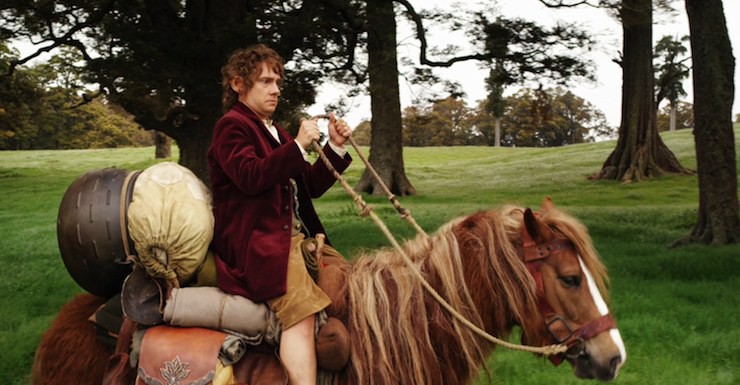
In a hole in the ground, there lived a hobbit and he didn’t own a pony. I can tell because Tolkien provided a tolerably thorough description of the hobbit’s house and the hill in which it is embedded, and he didn’t mention the paddock, the grain shed, the bales of hay, the buckets and wheelbarrows, Bilbo’s devotion to maintaining his fencing, or the faint but pervasive smell of leather and sweat. Bilbo is also averse to adventures, which his family regards as disreputable. This strongly suggests that he’s not galloping over hill and dale jumping over sheep, or traveling long distances, or routinely engaging in other activities which would make the care and maintenance of a pony a worthwhile investment. Bilbo is not entirely a Hobbit of Leisure—he does his own cooking and washing up—but he doesn’t seem to be a Hobbit farmer either, so he doesn’t need a pony to pull his plow. Hobbits usually go barefoot because, Tolkien informs us, their feet are very sturdy. I have concerns about whether or not a Hobbit’s feet are really hardy enough to withstand having their toes trodden on by a shod pony. I concede that it’s possible that Hobbits do OK with that despite my concerns. But nonetheless, Bilbo neither owns nor routinely rides a pony, and Tolkien never tried to claim that he did.
So what is he doing riding off to the Lonely Mountains on one? Ponies climb up and down mountains every day. Turning a horse (or pony) out on mountainous pasture is a decent way to build some muscle before putting an animal into training or work. However, there are some issues that need to be taken into consideration when combining ponies and long rides to (and eventually up) mountains, and the first of these is Bilbo. Our aspiring burglar undergoes a significant transformation in the opening chapters of The Hobbit, but he doesn’t have time to pack his pocket handkerchiefs, let alone take riding lessons.
Historically, riding lessons were a luxury not available—or even considered necessary—by many people who rode. But historically, one began one’s riding career with short rides in early childhood and progressed slowly from that point. One didn’t borrow a cloak and hood and then hop on a horse and ride far into the Lone-lands from May into June. Stirrups offer some further complications for hobbits. Stirrups aren’t an absolute requirement for riding. If you’re not trying to shoot arrows from horseback, you can get by without them. A substantial school of thought insists that beginning riders should not use reins or stirrups until they’ve developed a strong seat. Hobbits who don’t wear shoes might have a hard time finding stirrups that they can comfortably shove their leathery toes through. The major benefit to stirrups is that, with a little practice, they can help mitigate concussive forces. Whether he’s using stirrups or not, Bilbo would be too crippled to walk (and acutely aware of all of the seams in his trousers) by the end of the first day.
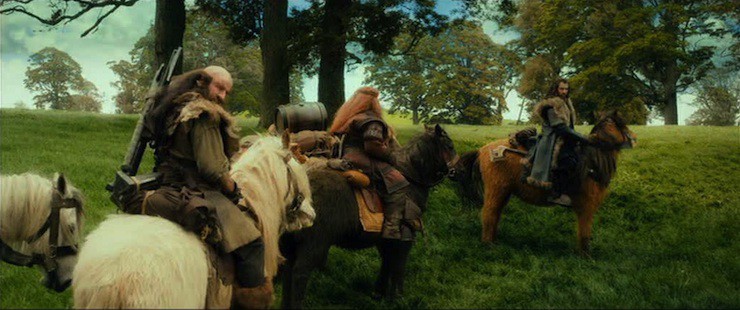
Tolkien is also unclear on the number of ponies involved in the dwarves’ treasure-retrieval project. There are thirteen dwarves, plus Bilbo and Gandalf. At their departure from the Inn in Hobbiton, the ponies are laden with “baggages, packages, parcels, and paraphernalia” as well as riders. The quantity of goods required for the journey probably requires more than 15 animals to carry. The dwarves are planning to return with more goods than they are carrying at departure, so it would make sense to bring additional pack animals. It’s a wild guess, but I feel comfortable with an estimate of no fewer than 20 ponies for the journey. These ponies are supernaturally well-behaved. They don’t do anything worthy of comment until one of them spooks, runs away and drops the packs full of food in a river on a windy night. Later that night, the entire Dwarvish party is captured by trolls. While their ponies stand around quietly on the picket line, attracting no attention whatsoever. Indeed, they’ve been very quiet for the entire journey. Tolkien pops out the fourth wall to let us know that Dwarves seem noisy to Bilbo, because Hobbits are much quieter, but the entire party—thirteen dwarves, a hobbit, sometimes Gandalf, and twenty or so ponies—could pass by a few yards away and you, the reader, wouldn’t notice. Because somehow, in this book where no one has so much as mentioned a hoof pick, the dwarves are maintaining such high standards of horse care that the ponies are not only noiseless and invisible, they also don’t smell.
Tolkien makes a nod at the difficulty of traveling with ponies when the dwarves reach Rivendell and the elves point out that the ponies need shoeing. I’m not surprised the elves have noticed; They’ve been on the road for over a month now. In general, horse shoes are good for 6-8 weeks, with some variation for intensity of work. The dwarves work with metal, so I’m willing to believe that at least one of them can shoe a horse. And the elves probably have a guy. We don’t get to hear about it, though, because somehow a party of thirteen dwarves, one Hobbit, and a wizard can ride all the way from Hobbiton to Rivendell without developing a healthy obsession with horse shoes and hoof health. They have bigger fish to fry than the care and handling of ponies. There’s a map and some trolls and a horde of fascinating treasures of dubious provenance. There’s no point in the reader forming an emotional connection to the ponies. They don’t even have names.
The ponies are a soulless, uncomplicated means of transportation until chapter four, when they are eaten by goblins. At this point, Tolkien finally acknowledges that they were really excellent ponies. They were, and they didn’t deserve to die unlamented.
The next leg of the trip involves emergency evacuation from goblin territory by giant eagles, who get far more consideration than the ponies despite being significantly less comfortable. A few days later, Gandalf finds Beorn, who replaces the ponies for the dwarves’ trek to Mirkwood. Then they have to send them back because Beorn won’t let them take ponies into the wood. Beorn has a rational understanding of the limitations of ponies, and he’s watching over them in the shape of a bear.
Once everyone escapes from the wood-elves and travels down the falls or the river or whatever in barrels, the people of Lake-town provide Thorin and his crew with two more ponies. Each. Thirteen dwarves, a Hobbit, and twenty-eight ponies are headed up the mountain to Smaug’s lair. Smaug eats six of them. Three are found later and sent riderless back to the south, which is ridiculous because ponies aren’t homing pigeons. Bilbo brings one strong pony to carry his treasure on the way home. It also goes unnamed, and what he does with it Tolkien never says. I hope he boards it at the stable three hills over where they have a lot of turnout and good access to trails. But I doubt it.
Ellen Cheeseman-Meyer teaches history and reads a lot.

Obviously, the only correct and fitting answer to this entire article is, from the wise and knowing mouth of Lucy Lawless, “A wizard did it.”
I eagerly look forward to the textiles lover’s guide to The Hobbit, covering how Tolkien doesn’t accurately describe the wear and tear the clothing of the dwarves and Bilbo during the trip, and how the whole series is just terrible because of it! :)
@1 There even was one taking an extended interest in the trip.
I understand that the article is supposed to be humorous, but isn’t this rant about hoofpicks and other realistic pony maintenance a bit far-fetched in a story that also has talking animals, orcs riding wolves, dwarves riding giant eagles (that probably eat dwarves as part of a normal food chain around the mountains), giant spiders that would collapse under the wight of their chitin if they were real, not to mention the fact that nobody goes to the toilet ever.
I would posit that adding realistic horse care would make the hobbit a more boring book. But then I’m not really an equestrian. I was more upset by the ridiculous hatred towards arthropods that Tolkien seems to harbour.
Was thinking this was on the type of horses/mounts within the LOTR Universe…slightly disappointed…alas no (maybe change the title to The Lack of Descriptive Pony-care in The Hobbit)…also while I can think of a few novels that pay more attention to mounts….on the whole many authors do not go into details on the practicalities of camp maintenance… it may have been meant to be humorous but it just seems kind of dry.
Okay, but what are your thoughts about Bill the Pony? :)
(Well, I thought it was funny. And that my Hobbit reread would have been more informative if I’d thought to ask these questions!)
(Obligatory reference to The Tough Guide of Fantasyland goes here.)
How do we know that Bilbo didn’t do just that? We have reason to believe that he did not own a pony at the start of the book – that does not prove he had never learnt to ride one.
Just posting to say that I did appreciate the dry humour here. Absolutely cracking up as I read this. And of course, the top picture of Bilbo on the pony was the perfect image to go with this article!!
Side-note to paivi @@@@@ 4…I’m not sure what spiders ever did to Tolkien, but he surely obtained a satisfactory revenge on them in his savage and merciless characterization of Ungoliant and her brood…
I think the spider phobia dates back to some incident he had ad a baby in South Africa that traumatized him for life.
@9&10
Interestingly enough, though that’s the story people (by which I mean, family and friends) always told, Tolkien himself claimed to have no recollection of such an event.
Mark Oshiro called Tolkien a “pony bigot,” though I was never sure why.
My father read The Hobbit for me as a child. He is a horseman. I remember him casually remark “It’s obvious Tolkien knows nothing about horses”, at som epoint of the read. :)
Coming from the landed gentry (or the closest equivalent in the Shire), Bilbo likely learned how to ride and possibly did so when visiting his Took and other non-local relations. He presumably would rent a pony at such times (or a pony and trap though that wouldn’t require riding), maybe from the local inn or perhaps from one of his tenant farmers (where exactly was Bilbo getting his income before his adventure since he wasn’t exactly poor). On the other hand he certainly wouldn’t be in shape for a multi day long expedition. Perhaps put it down to hobbit toughness?
Horse-lore is one of the toughest things for fantasy authors to get right, since it’s one of the most demanding topics of research for the typical author who doesn’t know anything about them, and because it’s been done wrong so many times (all the way back to Tolkien, as noted) that the need for understanding what’s involved goes unnoticed. Brian Sanderson has said you don’t find horses in his series because he knows he’d get it wrong and horse experts would call him on it, so at least one author is aware.
“I never even tried the rest of the trilogy… I don’t think this makes me a bad geek.”
Yes, it does. :D I agree with you about the movies though.
Cheers,
zdrakec
For all the people complaining that using a lot of time talking about horses would have made the books more dry: There is quite a difference between using time talking about horses and taking into account how stuff would happen if a horse/pony was on the journy, for example the ponies just standing passively by without attracting attention while the trolls capture the dwarves. For a person that knowing how horses work that is a bit like reading a book where the main charracter is shot in the leg and his companions who are just besides him just continue with their daily business while the hero does all the fighting himself.
Heh. As a lifelong horsekid from the days when kids weren’t rolled up in bubblewrap, I spent summers riding ponies barefoot and in shorts, and if we used saddles at all, we had Western saddles with well-sanded wooden stirrups, sometimes wrapped in leather. I gather the author is only familiar with English stirrups, which are metal and excruciating if you’re not wearing boots? Western stirrups are perfectly comfortable for human kid feet. Hobbit feet would have no trouble with them.
@15 You mean Brandon? :)
Yes, it does make you a bad geek, and the movies were awful!
I read a book a while back, and about all I remember about it is that the hero didn’t name his horse! And it was a western. It also reminds me of stories and movies where the dog is only a prop.
Personally I was turned off by Tolkien’s treatment of the dragon, which was totally unrealistic and not at all like any of the dragons I’ve known.
I’m a horse person who has read widely in both fantasy and Saga.
Since Tolkien was writing in an established style of Norse Saga he did what those coming before him did. Assumed you knew all that and that it would happen and you would know it would happen so why talk about it.
You would be surprised how little the Norse (superb horse people) talked about it.
I agree that this article was intended as a bit humorous. I also agree that most readers won’t care much about the reality of horseback travel.
There is one reality I do want to point out. I have ridden sag on a competative trail ride and 50 horses riding along a trail will leave many signs of their passing (I’m not just talking horse apples here, but trail damage and wear) unless this was already a very well worn passage. Where they camp overnight will be very obvious. I think authors should pay attention to those sorts of issues as they could be plot significant if stealth on the trip is part of the story. For most of the rest a simple comment saying ” so and so cared for the horses” or just assuming it must be getting done as .23 mentioned.
Nicely droll! As a young person reading Tolkien I wondered how they managed all that camping so breezily & finally decided, ‘ah, fantasy.’ I was the victim of too many US Army-surplus-tenting expeditions in the rain as a child.
As @capriole said, Western riding isn’t nearly the gear-intensive endeavor as its English counterpart & the Plains tribes’ horses were unshod & ridden unsaddled, frequently for quite long distances in 18th/19th centuries. Lastly, even now, a small horse is frequently referred to as a pony tho it technically is not (as in ‘cow pony’ or ‘that kid’s pony is trying to eat the laundry off the line again.‘)
The thing is, Tolkien did know something about horses. He was poor and was orphaned as a child, so no, he did not have “pet ponies” as upper class children did. However, while at Oxford he enlisted in King Edward’s Horse, a territorial cavalry regiment, and trained with them from November 1911 through February 1913, so he certainly learned at least the basic equestrian skills.
Oh, come on! You say you’re going to talk about horses in Tolkien and you stop with the end of The Hobbit? What about Sharp-ears, Wise-nose, Swish-tail, Bumpkin, little White-socks, and old Fatty Lumpkin? Or the eldritch steeds of the Ringwraiths? Or Shadowfax, Lord of Horses? Or the swift-footed mounts of Rivendell, who bear their riders for love? Or the horse-mad culture of the Rohirrim? Or Bill the Pony, the canonical Tenth Walker?
Jenny@27, the author is decent enough to title the article the equivalent of “Water in The Man Who Killed Liberty Valance” rather than “…in the films of John Ford”. But she was bound to get the equivalent reaction to “Has she not even seen Three Godfathers?” I do think she shouldn’t have written the article if she wasn’t prepared to read the essential minimum Tolkien, which means The Hobbit and Lord of the Rings.
That said, you are listing horses, when a better list would be owners and carers bad (Bill Ferny) and good (Tom Bombadil); grooms and equerries, such as Nob or Éothain; and stables, such as the one Pippin put off a meal to visit, just to check Shadowfax was being looked after properly.
Tolkien knew he didn’t know in detail how to care for horses, but he made sure often to mention that they needed, and got, care. The narrative is not stopped, but the question “where are the horses now?” is asked and answered whenever it needs to be. If the party gets into trouble, did the horses spook? Of course they did. What happened to them after that? They collected themselves, and were found by someone, like Bombadil or Shadowfax, who could lead them back. Until they find out what happened, at least one member in the party, like Sam, would fret about their fate for weeks after.
It’s possible to my mind that someone picked him up on it after The Hobbit was published and made him up his game, as a Jewish friend scolded Dickens about Fagin, thus making him try a little harder with Riah.
FWIW, I think Thorbjorn got it right at 17: It’s not a matter of going on and on about horses, it’s a matter of not having horse people roll their eyes.
I’ve often thought that someone who has access to horses and wide open spaces should start offering week(?)-long seminars during which would-be fantasy authors would ride & care for horses, camp using only supplies from the aforementioned horses or accompanying pack animals, and maybe learn some rudimentary sword and bow usage. All while kitted out in some manner of armor.
The Mines of Moria–yes, me too. For some reason that place disturbed me. Still does, now that you’ve brought it up again. Strange.
(On the other hand, “HighwayRidge” at lotro(dot)com loves the place.)
Give me a decent number of children who are willing to pause their riddle-telling, troll-stalling, dragon-slaying adventures so Tolkien could talk about how the horses where shod, and I’ll concede every single point you made. (Good article, very funny!)
I don’t know much about riding or horse care but I’m pretty sure Bilbo is holding the reins wrong.
Personally, I have to agree with posts #18 and #20 above. I really didn’t understand the author’s comment about hobbit feet not fitting into stirrups, as any stirrup that could handle an iron-booted dwarf foot should certainly be wide (and deep!) enough to fit a hobbit comfortably.
Also, thanks to the many posters above who pointed out that this was a humor piece, which indicates that, “Middle Earth Cage Match” was, as well. I completely missed the humor in both pieces.