






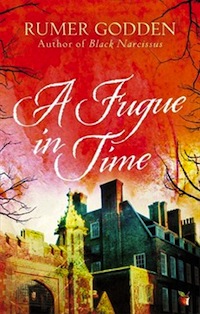
You won’t believe how delighted and astonished I am to see A Fugue in Time back in print. It’s been out of print and impossible to find for my whole lifetime. I’ve only owned it myself for a relatively short time (thank you for finding it for me, Janet!), and it’s probably the book I have most frequently read from libraries. It’s in print! And I can therefore recommend it in good conscience!
A Fugue in Time is one of those books I could easily talk about without re-reading, because I love it so much and know it so well. But as soon as I thought about doing that I realised that no, I could give myself the treat of reading it again. It’s not a very long book, after all.
It’s genuinely hard to pin down as to genre. It was published in 1945 and set in 1941, but it covers the years from 1841 to 2000. It’s arguably science fiction and contains science fictional assumptions about the future, though it was published initially and republished now as standard mainstream fiction. What makes it especially interesting is the way it is written as if all that time is taking place at the same moment—the use of tenses and of interwoven plots in different generations of the same family is really quite amazing.
Probably you’ve never heard of it, because it’s been so out of print and because Godden’s mostly popular for some children’s books that are nothing like this. When I talked about In This House of Brede there were a couple of people who had read it, but that book has been much more available than A Fugue In Time. It’s curious, because it’s the kind of book I’d expect a lot of people to enjoy. It isn’t really science fiction of course, despite the bits set in the projected future. It’s not an adventure in any way. Godden’s focus, as in the later China Court, is on a family in a house. China Court has five generations, and a better intersection of past mystery with present day resolution. But I do love the way A Fugue In Time really is a fugue, with the themes repeating in different keys.
There’s a story—a love story that unwinds through time. More than one love story, and they all come together at the end. And there’s a house and time and a family in the house and in time. It’s a sweeter book than China Court and less problematic.
The first theme is female possibility. And the most interesting thing about this theme is that Godden was writing in 1944. So she’s very aware of how much better things were than a hundred years before, how many more options Grizel has than her grandmother Griselda, but she can’t really see how Grizel is herself contained in what her time allows her to be. But we have Griselda, Selina, Lark and Grizel, all themes in the fugue of female possibility.
Secondly we have social consciousness—class consciousness. Godden was writing at a time when a new social contract was in the process of being written in the UK, and she was writing as a member of the privileged class who welcomes the change, which makes her unusual. She imagines it going even further in the projected future—Eton being for scholars rather than for the rich, and Grizel’s milkman’s son going there. This is a story about the middle class characters, but the servants are actually visible and actually people with motivations.
Thirdly we have the theme of being of use—this intertwines with the others and is central.
And then there’s continuity—the family, life, music, the house.
This is a book that can be hard to understand when you first read it, because of the way it’s written, but it’s very rewarding to come back to.
In the interests of full disclosure, I love Godden’s method of writing about everything as if it happens at the same time so much that I used it in my novel Lifelode, coming soon as an affordable e-book.
Jo Walton is a science fiction and fantasy writer. She’s published two poetry collections and nine novels, most recently the Hugo and Nebula winning Among Others. She reads a lot, and blogs about it here regularly. She comes from Wales but lives in Montreal where the food and books are more varied.

Hmmm. Now I’m trying to figure out if I’d love it or hate it. :) I may have to check it out and find out which it will be.
“Eton being for scholars rather than for the rich, and Grizel’s milkman’s son going there. ”
— boy, did she get that wrong! Nothing dates so quickly as “yesterday’s tomorrow”; that’s why I don’t do near-future stuff. You’re much safer with the Dying Earth, or an alternate timeline.
The near future is too tightly tied up with our own desires and longings and fears to think about rationally.
Plus, of course, it simply isn’t -possible- to predict, which is why “planning” never works except the same way SF occasionally gets predictions right, more or less by accident.
That particular moment (the all-for-one-in-the-Andersonville-Shelter post-Blitz radiant future IngSoc) dated -really- fast.
It has a particular and very distinctive ‘flavor’, though.
Mostly sort of like of sausages made from bread crumbs and a little Argentine bovril extract, slathered over with austerity sauce a la Stafford Crips, bless his little pursed-up priggish mouth and the home-made lemonade boiling in his veins.
One can see the Groundnut Project and Harold Wilson’s horrific tubby shape looming in the background, and the concrete horrors of the “New Towns”.
It’s sort of sad, all that hearty sub-William-Morris dreaming ending with some multiply pierced and tatooed chav puking in the gutters of Milton Keynes at 2:00 am.
I’ve always liked Godden’s work, though I haven’t read this one ; IN THIS HOUSE OF BREDE was fantastic. I read it three times one after the other when I was around… 17, I think.
Oh, I must get this! Thank you for pointing it out.
I’ve never read this so will look for it — I’ve always been a fan of Godden, and China Court is one of my favorite books. This one sounds even more interesting.
Another edition (I assume it must be, anyway) is called Take Three Tenses: A Fugue in Time.
And a seller has a used copy on Barnes & Noble US – for $370.
When, if ever, will it be available in the US? Not a little unfair to your American readers to tout a book they cannot obtain because Amazon.uk won’t sell e-books to American readers, ya know?
WOL: I doubt it will ever be available in the US and if I were you I’d buy a physical copy of the UK edition right now while you can.
Also, if you tell Amazon you’ve moved to the UK and give them a change of address with a valid postcode they’ll happily sell you as many ebooks as you want. You could “move back” when you discover how very many e-books aren’t available to people there. I don’t know if this works if you do it repeatedly. This whole situation is broken, and yet I see no way of fixing it.
Helen S: “Take Three Tenses: A Fugue In Time” is the title of the 1945 Little Brown Boston edition that I own. But A Fugue In Time is both the author’s original title and the title of the edition which it is possible to buy right now.
I immediately jumped to my university library page, even before reading the whole article, (WHAT! A Rumer Godden I haven’t read!) only to not find A Fugue in Time. Luckily, I read on to the end, and discovered the alternate title.
There are a bunch of copies on abebooks.com (both new and used) for far less than $370.
Reading away and loving it- thanks, Jo!
Although I will say that reading this book and Lifelode together will lead to severe temporal confusion. I’m not sure if it’s today or a week ago Friday!
I was lucky enough several years ago to have found an original 1945 copy of Take Three Tenses: A Fugue in Time. The book is wonderful, but my copy had a very intriguing inscription in it, which formed the basis of my novel, Neither Present Time. Little, Brown Book Group and the Rumer Godden Literary Trust were both generous enough to grant permission for my inclusion of a quote from Take Three Tenses. Ms. Godden is my absolute favorite author, ever since she wrote back to me when I was a teenager in the seventies.
I missed this post back in 2013, but I ran across a copy of Take Three Tenses — the American title of A Fugue in Time (which is given as the subtitle) — at an estate sale just a week or so ago. I started reading it and I absolutely loved it. I hadn’t heard of it, and I wondered if I was the only one who would have discovered this lovely book! Then I thought, well, I should check to see if Scott Thompson or Jo has read it! And you both have! :)
It does seem to have been a success — my copy is the 7th printing, from June 1945, the first printing having been in March. I’ll be writing a full review soon, so I’ll say more there. But I will say that I think the experimental structure (the “three tenses”) is really well done. And the prose is beautiful. And it does seem a very feminist book — Griselda’s experience in particular makes that clear. As for calling it SF — I noticed the references to the post-1945 future, but they are pretty slight on the whole, so I feel like it’s better thought of as essentially “mainstream”, with the acknowledgement of a future for Grizel and Verity and so on as an important element to make it clear that the story is just part of a longer generational story, but not really SFnal enough to claim it for our genre. (There is also a potential fantastical element too, with what seems to be Lark’s ghost conversing with Rolls.)