






Before the movies.
Before the merchandise.
Before the theme park, looming over—seriously—the local Muggle high school right across the street in Orlando.
It was just a book, starting with a sentence about people who wanted desperately, frantically, to be normal.
What a perfect start for a series about people who aren’t normal at all—and a book about wanting desperately, frantically, to belong.
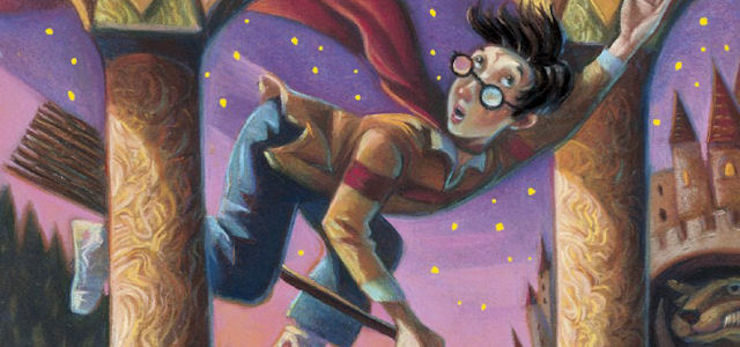
My copy of the book is the first American trade paperback edition, first printing, picked up about two weeks before the third book appeared in the U.S., after careful “translation” into American English. (The most alarming aspect of these edits was the assumption that American children would be unable to handle the concept of philosophers and would therefore need to be presented with sorcerers, but the American edition changes other small details as well, with Mrs. Weasley knitting, for example, sweaters and not jumpers. I rather wish the changes hadn’t been made; this series is intensely British, and was not improved by Americanization. But I digress.) A friend working at Barnes & Noble had told me that they were amusing, and noted that small children were already begging for the next book in the series. She thought it would turn out to be fairly popular.
That turned out to be a bit of an understatement.
By the time the fourth book arrived, the launch parties, the obsession, and the backlash had already begun, with the very popularity of the book itself inviting criticism.
But I didn’t know about any of that, or think about it when I sat down to read this first one. Instead, I found myself collapsing in laughter more than once.
That’s an odd thing to say about a book that has a brutal double murder in its opening chapter, immediately followed by a description of one of those hellish childhoods that British writers often do so well. Harry Potter, in the grand tradition of abused Roald Dahl protagonists, lives in a cupboard under the stairs, constantly terrorized by his cousin Dudley and abused by his aunt and uncle. Both, as it turns out, have reason: Uncle Vernon because he is hoping to turn Harry into someone “normal,” and Aunt Petunia for reasons that are revealed in a later book. But even this abuse is treated with humor, again in the grand Roald Dahl tradition, and although small children might be worried, adults are more likely to be grinning.
The humor and wordplay really swing into gear when Harry finally learns the truth—he’s not, as his uncle hoped would eventually happen, normal in the slightest, but rather a wizard. Of course, he’s going to have to learn how to do magic first. At Hogwarts.
Rowling’s trick of having Harry need the same introduction to magic and the wizarding world as readers do pays off remarkably well, since Harry can ask all the important questions about Quidditch, wizard money, cauldrons, wands, and so on. It helps that Harry, decidedly more of a jock than a brain, is not the best at figuring these things out on his own, needing someone—even, sometimes, his fellow Muggle-raised friend Hermione—to explain things to him, and thus, to readers. This allows Rowling’s infodumps—and I’d forgotten just how many this book has, not to mention all the sly details that become important later—to be inserted as just part of a dialogue, or conversation, adding to the friendly feel.
Rereading it now, several things struck me. First, I’m still laughing. Second, the sheer efficiency of Rowling’s prose here. Even things apparently thrown in as casual asides become desperately important later: the casual mention of Charley Weasley’s post-Hogwarts job as a dragon tamer. The phoenix feather inside Harry’s wand. Hagrid riding Sirius Black’s motorcycle. Harry’s cheerful conversation with a bored snake at the zoo. And, er, yes, the casual mention of a certain historian of magic and the way Harry swallows the Snitch in his second game—just to mention only a few of the references popping up later. Absolutely none of this seems important at the time, particularly on a first read, and yet, now that I’ve finished the entire series, I’m struck by how important it all was, and how few words are wasted here.
Third, I’m struck again by how well Rowling slyly integrated her mystery into the main book—so well, I must confess that I completely missed that the book even had a mystery until the last couple of chapters. I was reading for the jokes. After that, of course, I paid closer attention—but I’m glad I didn’t know when I first read this book; the surprise of finding a mystery was half the fun.
And more: the equally sly classical and medieval references. The immediate friendship that springs up between Harry and Ron, and the less immediate, but equally strong, friendship formed between the two of them and Hermione. (While I’m at it, kudos for showing that yes, boys and girls can be friends, even when the girl is extremely bossy, mildly annoying, and obsessive about tests.)
And, perhaps above all, just how fun this book is, even with the murders, the looming danger of He-Who-Must-Not-Be-Named, and those ominous pronouncements by certain centaurs. After all, this is also a book where the chief monster is named Fluffy, a book where, in stark contrast to the rushing around of later books, the adventuring kids can stop for a nice chess game and a logic puzzle in their quest to defeat the bad guy.
I’m also surprised to find just how shadowy and insubstantial Voldemort is here, in more than one sense: we know he’s the bad guy, but that’s about it, and the various trappings of and references to Nazism and terrorism that enrich the later books are quite absent. Here, he’s only a possible threat. The real threats, as Dumbledore notes, are the internal ones: bravery versus cowardice, dreaming versus living.
That’s part of, I suppose, what makes this a remarkably reassuring book—true, Rowling has very real ghosts in her books, with the ability to throw things and make people feel decided chills, but they remain ghosts, unable to do true harm. And in some ways, their very presence lessens the fear of death, at least here: Harry can’t quite get his parents back, but he can see pictures of them waving at him. Rowling doesn’t offer the lie that death can be altered. But she does remind us that death doesn’t mean the end of memories.
Buy the Book
In An Absent Dream
And of course, by the end of the book, Harry Potter has found a place where he belongs, something that is almost (and eventually will be) a family. Finding this place wasn’t easy—nothing worthwhile ever is, I suppose—but it’s nice to have the reassurance that even in a world of evils and terrors and isolation, lonely children can find a place to belong and have friends. Even if this takes a little bit of magic. Especially since this reassurance would be a little less secure in later books.
Philosopher’s Stone draws on a wealth of British children’s literature—the idea, from Narnia and the Nesbit books, that magic can be found just around the corner, hidden behind the most ordinary of objects—a train station, a pub. From Roald Dahl (and others), the atrocious children and family life. And, yes, from that most banal of children’s authors, Enid Blyton, who provided some of the inspiration for school stories and children’s adventures. (It’s okay, Ms. Rowling; I read Enid Blyton too.) Rowling also litters her text with various classical and medieval references, some obscure, some obvious, and she was not the first to write tales of a wizardly school. But for all of the borrowing, the book has a remarkably fresh, almost bouncy feel.
Later books in the series would be more intricate, more involved, contain more moments of sheer terror and sharper social satire. But this book still remains one of my favorites in the series, partly for its warmth, partly for its mystery, partly for some of its marvelous lines. (“There are some things you can’t share without ending up liking each other, and knocking out a twelve-foot mountain troll is one of them.”) But mostly because this was the book that introduced me to Diagon Alley, to Platform 9 3/4, to Hogwarts, to Quidditch. And because of the sheer magic that gleams from its pages, the magic that makes me want to curl up again and again at Hogwarts, with a nice glass of pumpkin juice and cauldron cakes. Not Chocolate Frogs, though. With this sort of book, I don’t want anything jumping in my stomach.
An earlier version of this article appeared in June 2011.
Mari Ness currently lives rather close to a certain large replica of Hogwarts, which allows her to sample butterbeer on occasion. Her short fiction has appeared in Clarkesworld, Lightspeed, Fireside, Apex, Daily Science Fiction, Nightmare, Shimmer and assorted other publications—including Tor.com. Her poetry novella, Through Immortal Shadows Singing, was released in 2017 by Papaveria Press. You can follow her on Twitter at mari_ness.

I still remember you handing it to me just before the fourth book came out and saying “Read this. I know it looks like a young kid’s book. Just read it.” (Not that reading young kids’ books was ever a problem.)
That first paragraph was such a shock of delight that I don’t really remember reading this book so much as swallowing it whole and knowing I needed to read EVERY LAST ONE OF THEM. So, it’s not just a “Hey, this review is pretty good,” but I have you to thank for the entire series and every midnight I spent in line at a bookstore waiting for the next book, and more than a few nights spent sitting up reading all night long.
When I first heard about Harry Potter, I thought it sounded lame, and I was one of those teens who thought there was no way something that popular could possibly be any good, so even after my mom bought the first book for my younger brother and I to read, it sat on the shelf untouched for a long time.
Then at some point I overheard my mother reading it to my brother. They’d just gotten to the scene in the zoo where Harry inadvertently lets the boa constrictor loose, and I remember actually doubling up, I was laughing so hard. At that point, I vowed to myself that I had to read that book, which I did, and never looked back.
This was not long before the fourth book was scheduled to come out, and I remember voraciously gobbling up the first three books (the second I sat down at the kitchen table to read and didn’t get up until I finished it) so I’d be ready.
These were not the books that got me into reading. I’d been a bookworm for most of my life, but as a kid who was also interested in being a writer, these were the books that clarified to me what kind of a writer I wanted to be, what kind of stories I wanted to tell. So I’ll always be thankful for that.
I know some adults who empatically dislike the way this series plays abuse for laughs.
Peppermint toads hop in the stomach. Not chocolate frogs.
“The most alarming aspect of these edits was the assumption that American children would be unable to handle the concept of philosophers and would therefore need to be presented with sorcerers […].”
Even more alarming because creating the philosopher’s stone has been the main objective of alchemy since the Middle Ages, and Nicholas Flamel was an actual person. So the novel draws on real history, something the American, uh, translators apparently didn’t find worthwhile.
@3/AeronaGreenjoy: “I know some adults who empatically dislike the way this series plays abuse for laughs.”
I guess Britishness isn’t for everyone.
I never get enough of Harry Potter. It made my eyes fighting of tears, which never happens. I had the same first reaction like @2 , as something that popular couldn’t be that good, just as I didn’t see until today Titanic the movie, as I refuse the amount of oscars and how much it earned worldwide. It was a passive silent protest. But I’m lucky I caught up with HP, also at the time when the fourth book came out, this is tied with the third one as my favorite book in the series
I feel that what JK Rowling achieved with this book is akin to what George Lucas did with the original Star Wars. In both works, it is not hard to point out flaws, or aspects that are disturbing or cringe-worthy; nor is it difficult to identify elements that other creators did first, or did better. Yet in both cases it is the combination and interactions of all the various elements, along with the quality of their execution in the aggregate, that creates an overall impression of quality and vigor. This focus on the overall experience of the audience, even at the expense of a few elements that might not hold up to close scrutiny, may be what provides the staying power many years after release.
I was between high school and college when the first book was released in the United States. I saw it, and the sequels, on shelves here and there, but took them for “kid’s books,” and generally paid no mind. My first exposure to the story was someone bringing a VHS copy of the first movie to a going away party we were having, and allowing it to play in the background throughout the evening. I was captivated enough to know I wanted to read the book, and after that first read through (I had a hard enough time hearing the movie while it had been on that my mind pronounced Hermione’s name as Her-me-own during that read) and another viewing of the movie, I never looked back. I devoured the next three books (all that were out at the time) from the library (the version of Goblet of Fire I read that time had the infamous Wand Order Error, which even in my newness to the fandom I knew was problematic), and saw most of the remaining movies within their opening weekend on the screen.
Our primary copies of the books are the hardcover Scholastic editions, although in the ensuing sixteen years, we’ve picked up a couple extras along the way: the mass produced versions of each of the “schoolbooks,” a paperback version of Philospher’s Stone that we got on a trip to Ireland, a Gryffindor themed 20th Anniversary edition of the Philosopher’s Stone (still in it’s shrinkwrap), and the first three illustrated volumes. Those illustrated editions are what we are currently reading to our kids (ages 6 and 4). They’ve seen each of the first four movies (at the current time, we fast forward through the resurrection portion of the graveyard scene in Goblet of Fire), and we’re about a third of the way through the Prisoner of Azkaban book. One thing I was intrigued to notice is that, although the illustrated editions still refer to the “Sorceror’s Stone,” it seems that the rest of the Britishisms are still in there (jumper, boot, revision, etc.). The kids are eating up every bit of Potter that they can get (I’m mildly disappointed they haven’t taken to Star Wars quite as handily), to the extent that on a planned trip to Disney World next summer, with a day at the Harry Potter park at Universal, I guarantee they are currently far more excited about the one day at Universal than the other five combined days at Disney World.
The Magic still lives, indeed!
J.K. Rowling is an artist. These books seem so simplistic at first – the typical hero’s journey nestled in a world of magical realism – but there’s so much hidden depth. The books are so layered with references and allusions that I find myself getting something new out of them each time I read them. That’s saying something because I can’t even guess how many times I’ve read them. I was hooked on Potter as soon as I got my hands on the first book back in middle school.
I think these books are so popular because, as you pointed out, there’s a lot of things that people from all over can relate to. When you combine that relatability and put it in a fantastical setting, you’ve got real magic. That she talks about such complex emotions in a simplistic way only adds to the magic. There’s a book by Alexandra Casavant coming out that looks like it will accomplish similar feats. It talks about the difficulties of communication via a series of fantasy short stories. I think that many people deal with communication problems, especially myself.
Poor communication, in my opinion, lies at the heart of some of the bigger complications Harry has to endure. If Dumbledore had been more forthcoming and open to communicating hard truths earlier on in the story, how would things have been different?
The first movie came out and I wondered what the big fuss was all about. I watched it and immediately decided to pick up the books (book 4 was already out). I discovered the books were way better (naturally). I went to the midnight release parties for books 5, 6, and 7. I have not felt anywhere as passionate for a book since then. I’m not sure if that was because of my age (I was in my late teens into my early 20s for books 5-7) but nothing has had that…magic since those books. I cherish those memories of endless debates online, the release parties, the theories, essays, etc. I was on Mugglenet all day long. It was a beautiful time.
I was in high school when Goblet of Fire was coming out, and I remember being aware of the books, but I was also one of those teenagers that was skeptical of popular things (I read ‘mature’ books like Lord of the Rings and Wheel of Time). But one of my good friends was reading the books and I trusted her judgment, so when my mom bought the first book for my baby sister, and I needed something for a spring break road trip,I took it along. I was captivated from page one and finished the book within a few days. I even tried to find the second book in rural Tennessee (we were camping in the Smokies) but to no avail :)
I agree on pretty much everything here – like Wheel of Time, there is so much set up right from the start, and so many different layers and clever references.
@10 Lisamarie, sooo, you also liked Wheel of time (funny you mention it as ‘mature’ book since Nynaeve and to some extent all the Supergirls are not so mature) {as if our ‘fandomwar’ in HP/LOTR isn’t enough now I’m starting with WOT? but no, it is really one of my beloved books, I just had to comment in the mature part ;-) }
@11 – ahahahaha :) I have to admit, I don’t love Elayne, but Nyneave actually becomes one of my favorite characters.
actually mine too after Mat (not in the first two books mind you, where he’s ughh), Egwayne becomes really the fire of Tar Valon after a while (not at the first two books mind you, where she’s ughhh, hmm deja vu) – and Rand even though he gets so dark it’s deppressing sometimes, I still favore him most (sucker for the hero). Well that’s out of topic. I haven’t decided yet if I’ll try to stick with the older reread (here in TOR) or the new read nowadays.
I am another who gets something new out of every reread. I recently became a parent, and now the first chapter drives home for me how loveless Harry’s childhood was. I cried when Hagrid kisses him goodbye, knowing that’s the last affectionate touch Harry will have for years. It was apparent when Hagrid reappears 10 years later that he still loves and remembers that baby, and I was so glad for Harry’s (and Lily’s) sake, that someone had been loving him from afar.
I have loved Harry Potter ever since my dad started reading it to me in Kindergarten, but sometimes I wish he had waited longer before introducing me to the series. I was too young to fully understand the basic lessons and the topics involved, not to mention the many layers and jokes. I feel like I missed a lot of the magic and, to use a fangirl term, the feels.
Rereading the Harry Potter series (many times) has always been a pleasure. You can’t spend too much time with any of the characters. I can’t wait to share the magic and sense of home with my children when they’re old enough to understand.
Harry Potter and the Philosopher’s stone has such an engaging story with remarkable characters! I’ve read it for the nth time already!