







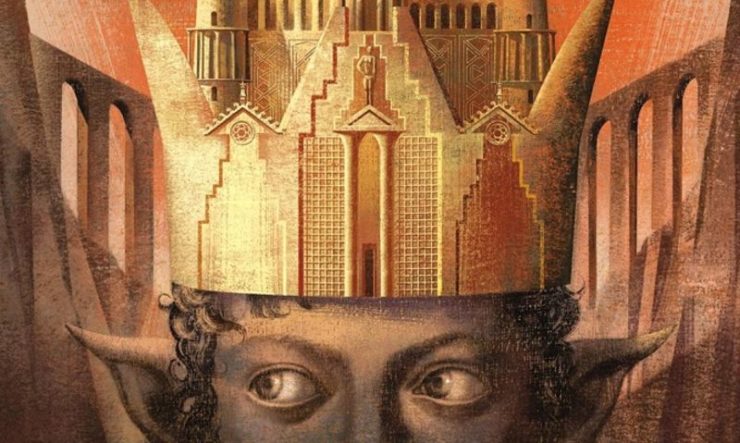
When my editor asked if I wanted to write a column about The Goblin Emperor to go along with the #TorDotReads read-along, I was absolutely delighted to be able to re-read this book that’s like reading a hug. This column is going to be a little different than previous ones, not only because it’s the first fantasy novel I’ve talked about, but also in its structure. So, come along with me as I work out how Ethuveraz titles and names work, based on the vocabulary we’re given!
At the start of the novel, pure cinnamon roll Maia Drazhar is awakened by his horrible cousin/guardian Setheris to find out that Maia’s father, the emperor of the elflands (who hates Maia), and his three older half-brothers (the most likely heirs to the throne) were killed in an airship crash. So now Maia has to go from the remote town where he’s been relegated since his goblin mother died to the capital and become emperor. He has to adjust to a lot of things, including his permanent cadre of bodyguards, valets, cooks, and other staff, while also setting about solving the mystery of who murdered his father. His secretary, Csevet Aisava, is absolutely invaluable in his quest.
The language of Ethuveraz isn’t extensively developed in the book. We have a few dozen vocabulary words, which make use of derivational morphology, plus place names, and titles of address (the equivalents of Mr. or Ms. or Mx.). We have a consistent phonology, with lots of kh and zh.
One thing I remember from a few years ago, when TGE was first published, was people saying they couldn’t follow all the names and titles—so I said to myself, “self, let’s see if we can derive the rules for titles based on what we have in the book. An exercise in field linguistics.” If the author can engineer the system, I can reverse engineer it.
I’ll also talk about the dinner party scene where the philologist nobleman gets excited about a new bit of information (#relatable), and the pronoun scheme (which is pretty cool).
Vocabulary
Buy the Book
The Angel of the Crows
-eise is used as an adjectival suffix for a place of origin. Barizhad is the noun for the neighboring goblin kingdom, and Barizheise is its adjectival form.
Meire is a word meaning temple, and it is often used in compound words, like Ulimeire, the temple of Ulis.
-theileian means hall, and Maia holds court in the Michen’theileian, the lesser hall. His smaller meetings are held in the Verven’theileian, the hall of consultation.
Maia’s jewels are the dachen (greater) and michen (lesser) mura (jewels), and the crown is the Ethuverazhid mura, the Ethuverazian jewels.
His bodyguards are the nohecharei, singular nohecharis (m), nohecharo (f). His valets (gentlemen of the chamber) are the edocharei, singular edocharis (m), presumptive feminine edocharo. This implies that -charis is a root noun referring to the chambers, and nohe- and edo- have a specifying function, but I don’t know exactly what, and I don’t believe I have enough information to comment further.
Maza (pl mazei) are the guardians of the emperor’s spirit, i.e. mages. Their temple/academy is the Athmaz’are, and a person who is associated with this academy takes Athmaza as a surname, as in Cala Athmaza, a nohecharis. The head of the Athmaz’are is the Adremaza, the master of the maza. The word maz by itself is a spell, and we have the Mazen’theileian, the hall of the mages at the court.
So, we have some morphemes. Now let’s see if we can figure out titles.
Titles
Titles fall into two main categories: nobles and commoners. How can I tell? Context. So…
Mer is equivalent to mister or master, used for a non-noble male. We see it used with Mer Aisava, Maia’s secretary, and Mer Thala Celehar (an interesting situation, because he is linked to nobility but is not noble).
Merrem is used for married women, such as Merrem Echelo Esheran, steward of the Alcethmeret, the imperial residence. Min is used for unmarried women and girls, such as Min Nedaö Vechin, the opera singer.
We see Osmer used as a title for Setheris and other noble men; thus it is used for noblemen. Osmerrem is used for married noblewomen, and Osmin for unmarried noblewomen and girls.
Then we have Dach’osmin and Dach’osmer, also used to refer to nobles. Without knowing the structure of Ethuverazid society, I’m left to guess that there are two types of nobles, and one of them gets the dach- prefix. Going back to the vocab list, we have the dachen mura, the greater jewels. Given the data set, I will assume that the dach- nobles are greater nobility, and the os- nobles are from minor houses.
Then there’s Dach’ensol Habrobar the signet maker and Dach’ensol Atterezh the tailor. -ensol isn’t used in other forms that I noted, but given the context, I assume that dach’ensol has to do with being a master craftsman or artisan.
Then there are all the suffixes. These seem only to apply to nobility, or at least only consistently so.
Drazhar is Maia’s last name. The Drazhada are the collective people in the family. His mother was Zhasan Chenelo Drazharan. Maia is Zhas Edrehasivar VII. His father’s widow is Zhasanai Csoru Drazharan. Dach’osmin Csethiro Ceredin is a young woman at court, of the Ceredada family, and her father is Marquess Ceredel. We also encounter Osmerrem Danivaran and her daughter Osmin Danivin. Which leads us to:
Surnames have a root, which is derivable by dropping the masculine or familial suffix: Drazhar < Drazh(a)- [or possibly Draz- with affrication before the derivational vowel, as in Ethuveraz > Ethuverazhid]
The suffix -(a)da refers to the entire house.
Masculine surnames end in -ar or -el.
Feminine surnames (married) are the root plus masculine suffix -ar plus feminine suffix -an. This also applies to the imperial title.
If a girl or woman is not married, her surname is the root +in.
This is a subtle addition to the worldbuilding: A married woman belongs to her husband’s family, which we know from the situation with Csoru. When a woman takes her husband’s name, she takes not the root plus a feminine, but the masculine and the feminine. A female child (or unmarried woman) doesn’t have the masculine suffix at all, just the -in suffix. This could imply some interesting cultural norms regarding the place of daughters in the family, but this isn’t a feminism in SF column ;)
(This is all given in an appendix, but I wanted to do it myself and show my work, so you can try it at home/in your next writing project. You can also check my work ;)
The Pronouns
In Ethuverazian, there are two classes of words given in English as a plural. Formal pronouns is one of them, and the regular plural is the other. Addison comments when a character means we-formal or we-plural. Formal address here means using the formal form for oneself and the person being addressed. This is similar to keigo in Japanese, but not identical to it (based on what we’re given).
As readers of fantasy, we’re accustomed to the “royal we” used by a king or queen, but not so much the “formal we” used by everybody. Modern English speakers are accustomed to “you” as the regular second-person form and think of “thou” as formal (because it’s old fashioned), but historically it’s the other way around. Thou was the second person singular, and you was second plural and the formal form. At some point, you became the only (standard) second-person pronoun, and thou was lost.
It’s interesting to see the navigation of formality via pronouns represented in a language which doesn’t use formal pronouns at all. People who read this in translation into a language with formal pronouns—how did they do it? What’s your take on its success at doing what it set out to do?
Lanthevel’s Dinner Party
Maia goes to a dinner party to try to drum up support for a project he wants the parliament to discuss. At this dinner party, Marquess Lanthevel says he studies philology, and he defines it for Maia as “the study of the origins of words.” Maia wonders if this is an elaborate prank, and Lanthevel goes into an example of a word for sky, morhath, that hasn’t been used in centuries and no one knows what it means anymore. Captain Orthema, a commoner from the region near the barbarian lands, tells him that isn’t quite right, because his people know it. The elves call the barbarians Evressai, but they call themselves the Nazhmorhathveras, which means “children of the night sky.” Lanthevel “all but [pounces] on him” and “seemed almost to have forgotten the emperor’s existence” (286). I have been Lanthevel more than once in my life, even before I studied linguistics, and this is both accurate and relatable. (I’m not even that much of a philologist, really, but I have definitely spent a lot of time at etymonline. For fun.)
Also accurate and relatable is Maia’s skepticism that philology is a real thing, and that Lanthevel isn’t playing an elaborate prank on the emperor.
Other Nice Touches
When Maia hears the Barizheise ambassador pronounce his mother’s name with the accent on the first syllable, ‘che-ne-lo, the way she always said it, he is struck by a wave of grief and memory. Presumably, the Ethuverazian pronunciation is che-’ne-lo. This tiny detail adds a lot to the worldbuilding, underscoring the differences between the goblins and elves.
We only get a couple Barizheise words in the text, but they add a lot about their culture. (See this #TorDotReads summary post!) A barchakh’kaladim is a warrior nesting doll, where each figure gets uglier and more vicious as they get smaller. Veklevezhek is staking a prisoner below the tide-line while you argue about what to do with them. This implies that the goblins take a lot of pride in their warriors’ viciousness, and they have the ability to be casually cruel to a prisoner. On the other hand, we have the nesecho, which is a shaped bead which conveys a message depending on color and design, such as the suncat Maia receives as a wish for good luck and happiness.
It’s your turn!
What did you think of the pronoun usage, especially if you read it in translation (or in English, but you happen to also speak a language with formal pronouns)? Did you also sit down and work out how the names work, or did you flip back to the glossary as you read? Do you just want to talk about how much of a precious cinnamon roll (too good, too pure) Maia is? Let’s go!
CD Covington has masters degrees in German and Linguistics, likes science fiction and roller derby, and misses having a cat. She is a graduate of Viable Paradise 17 and has published short stories in anthologies, most recently the story “Debridement” in Survivor, edited by Mary Anne Mohanraj and J.J. Pionke.

The “formal you / familiar thou” distinction felt natural to me, since my first language (Marathi) has it. So did the “formal we / informal I” distinction, though Marathi has almost lost that in the last two generations.
A few things I noted:
Maia is not titled Zhas Edrehasivar, he is specifically Edrehasivar Zhas. Similarly, Csoru Zhasanai. The imperial titles always follow the name.
‘Zhasan‘ is for a ruling emperor’s wife, Zhasanai is for an emperor’s widow (so Csoru is Zhasanai, not Zhasan, a point that Maia makes, um, emphatically). Except that if Csoru were pregnant with the emperor’s child, she would still be eligible to be titled Zhasan. I wonder if the title would last after her pregnancy ended?
The –el suffix may be reserved for the head of a house or family. Hence, Duke Tethimel, father of Dach’osmer Eshevis Tethimar. Also, Chancellor Chavar‘s brother, and the head of the Chavada, is Viscount Chavel.
Finally, ‘nazh’ (night) appears in one more place – Nazhcreis Dein, the “witch” captured by Captain Orthema. “nazhcreis” means something like “night-hunting cat”.
The footnote isn’t complete…
I also thought (without pulling out the book and checking) that michen was also used for children.
Very nice analysis and summation.
Oh, one more thing: Its Dachensol, not Dach’ensol. Dach’ itself is a contraction of Dachen (greater).
“Edre-” as in Edrehasivar is the imperial prefix. I have no idea what the “vere-” of Maia’s immediate predecessors means.
I found the formal/informal signalling to be quite effective. In the Twitter read along, someone noted that Idra uses only uses formal pronouns with his mother. Ouch.
Along with the language, I loved all of the expressive ears. My personal theory is that’s why goblins and elves rather than humans- we can’t wiggle our ears!
@1 “Except that if Csoru were pregnant with the emperor’s child, she would still be eligible to be titled Zhasan. I wonder if the title would last after her pregnancy ended?”
It’s possible (probable?) there’s a separate word denoting a dowager empress who is mother of the Emperor and not merely widow of the previous Emperor. We never see it because it never comes to pass, despite Csoru’s efforts, nor do we see a word for “regent.”
”Idra only uses formal pronouns with his mother” — so does Hamlet.
theres a point I only caught on my second or third reread where Cala switches from “I” to”we” and Maia is taken aback by it. There are lots of subtleties that you really have to pay attention to.
@@.-@: There was more than one nominal prefix for the Emperors’ names. It was “Edre” for the longest time, beginning with Edrevenivar, who united the realm (which itself would have been a good reason for the change). Before that it seems to have been “Bel”. The change to “Vare” was with Maia’s great-great-great-grandfather Varenechibel I, who wanted to mark a significant departure in policies from his predecessors.
It was clear Maia knew that he did not want to follow in the footsteps of his immediate predecessors even before he had gotten his bearings:
“He dipped his pen again and wrote with pointed legibility across the bottom of the page, Edrehasivar VII Drazhar. Edrehasivar VI had had a long, peaceful, and prosperous reign some five hundred years ago.”
Thus he restored a very long tradition. In this case I suppose it’s one of the few positive things Setheris had done, making sure his charge was well versed in the history of his family.
@8 But why did Varenechibel choose “Vare” as a prefix?
That seems to have been normal in 19th century Germany.
In Japanese you use formal forms when talking to your parents (o-kā-san お母さん/o-kā-sama お母様), but informal when talking about them to someone outside the family (haha 母). Some too-literal old subtitles for anime had ridiculous translations like honored father sir for o-tō-san お父さん instead of dad.
@10 Maia and Setheris use familiar pronouns and Maia switches to familiar terms with Idra and the girls fairly quickly. I think family usually addresses each other informally, though we don’t have enough evidence to be sure.
Yum, yum, more catnip! Thanks for this article.
what amitkowal said about title placement. Everyone’s honorific precedes their name except for the emperor and empress.
@@@@@ Noblehunter
there’s a lovely bit implying that all emperors from Edrevenivar used the “Edre” or “Bel” prefix, until Maia’s great-great-grandfather, who called himself the first Varenechibel, and the “Varedeise” emperors seem to have been distinguished by incompetence and/or corruption. By choosing to differentiate himself from his father by returning to an “Edre” name, Maia starts to show a return to competence, honesty and peace.
While I had little trouble with names and terms (it’s fun, for example to look at the repeated use of “reveth”), I did struggle on where to place the emphasis in names and words. I finally found that, the longer the word, the later the stress, seemed to work pretty well: I.e. revethVORan, VareNEchibel.
Having picked up the clue from the stresses on Chenelo, however, I still wonder how to stress the shorter names, and mentally stress the first syllable in, for example, Cala, Kiru, and even Beshelar. I’d welcome comments on this!
Thinking about nohecharei meaning “bodyguards” got me wondering whether -charis is related to “body”, rather than “chambers” – edocharei could then translate to “body servant”.
Barizhad — Barizhan, actually. You may be thinking of the barzhad, “the old warrior’s alphabet” of which Csethiro is fond. The name of the goblin language is Barizhin, and that of the elves, Ethuverazhin (rather than “Ethuverazian”).
This implies that -charis is a root noun referring to the chambers — The edocharei are the valets, who are strictly servants of the chamber, whereas the nohecharei go wherever the emperor goes. Most likely, -charis means “servant,” edo- means “chamber” or “toilette,” and nohe- means “life,” “safety,” or something equally crucial.
..because [Celehar] is linked to nobility but is not noble. He is of noble birth, but since he relinquished any claim to noble privilege when he took holy orders, he is addressed as “Mer.”
Given the data set, I will assume that the dach- nobles are greater nobility, and the os- nobles are from minor houses. Per the Handbook for Travelers in the Elflands included at the back of the book, os means “honorable.” Thus, osmer = honorable nobleman; dach’osmer = great honorable gentleman, and you can extrapolate this distinction to noblewomen.
“Drazhar < Drazh(a)- [or possibly Draz- with affrication before the derivational vowel”— Per the Handbook, “The Elflands have been ruled by the family Drazh for more than two thousand years.” However, since no similar house name is given, we can guess that the uninflected form Drazh is archaic.
The suffix -(a)da refers to the entire house. No parentheses needed. Again per the Handbook, “The suffix -ada signifies ‘many,’ and is used to denote the family—or ‘house’ as the elves call it—as a collective body.”
My guess is that the city name Cairado uses the feminine version of the inflection; since we already know from the name of Maia’s patron goddess that cair- refers to stars, Cairado likely means “[the city of] many stars.”
Masculine surnames end in -ar or -el. Feminine surnames (married) are the root plus masculine suffix -ar plus feminine suffix -an. This also applies to the imperial title. Actually, there is a wide variety of surnames for both men and women:
* Some end in -va, such as Aisava and Orseva. (Presumably, the corresponding feminine surnames end in -vo.)
* People who descend from “the herders of the western plains” (I am quoting the Handbook again) use the suffixes -ezh (e.g., Telimezh), -ezho, and -ezhen for men, married women, and unmarried women/girls, respectively.
* Along the border with Barizhan the suffixes are respectively -a, -o, and -eth.
* As Amitkotwal says, the suffix -el is reserved for noblemen who hold the title to their family estate. Thus, Dach’osmer Tethimar, but Duke Tethimel. Had Eshevis Tethimar survived and his father later died, he would have become Eshevis Tethimel.
Pneumatic, the entire point of this exercise was to do it without looking at the Handbook in the back of the book to see how much I could reverse-engineer from the data I had.
Until I got to the pronunciation of Maia’s mother’s name, I actually pronounced it the first way. It’s similar to my brother’s name, Chinelo which also has the accent on the first syllable.
I haven’t read this book as yet, though. I am still contemplating whether or not to read it.