







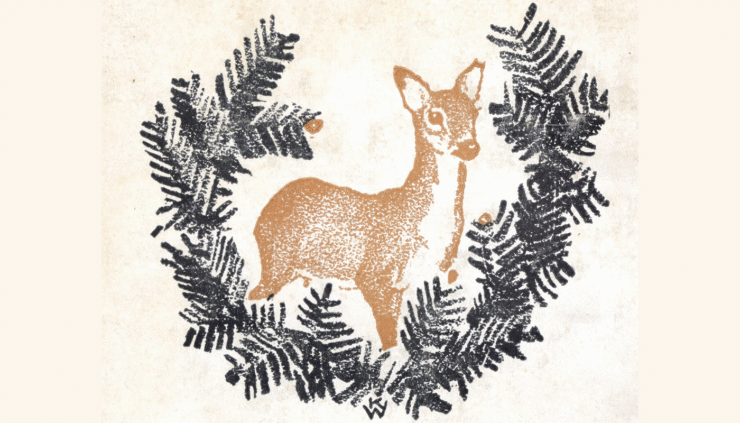
Walt Disney’s beloved children’s film, Bambi, is based on a novel that was published in German in 1923. Its author, Felix Salten, was a well-known journalist, novelist, and poet. His biography of a deer was not intended for children. It’s a meditation on the transformation of child into adult, on life in the wild, on the relationship between humans and animals.
It is not a gentle book. Even Disney’s film, with its primary colors and its adorable animals and its saccharine songs, takes a dark turn. Salten’s book is considerably darker.
The broad strokes are similar. We begin with Bambi’s birth, heralded by a chorus of birds and animals. He grows and learns, first from his mother, then from other deer including his ancient and powerful father, along with friends and not-friends of other species that he meets along the way. He experiences the changes of the seasons, the stark contrast between summer’s abundance and winter’s scarcity. He falls in love. He suffers great loss.
His best non-deer friend is a hare, but it’s not cute fluffy Thumper. This is a more realistic example of his species, with his own thoughts and feelings and a rather pessimistic outlook on life.
Bambi has an owl friend, too, who is as close to cute as anybody gets in this book. They have an ongoing thing, in which the owl creeps up on Bambi and lets go with a blood-curdling screech. Bambi is always careful to assure the owl that yes, it’s terrifying, he’s totally shocked. Bambi is a kind person and a good friend.
Fans of the film will recognize the lovely Faline, but here her mother has a name, Ena, and she’s Bambi’s aunt. Faline also has a twin brother, Gobo, who is not as healthy or as vigorous as his sister. Bambi and Faline look after him and protect him as much as they can.
The novel’s portrayal of the stags explains a few things about the remote and incalculable creatures in the film. The book calls them the princes, and talks about their crowns, which grow anew every year and are shed in the winter. Bambi meets and comes to know some of them as both friends and rivals, and he’s watched over by the one called the elder, the oldest deer in the forest.
The elder is a semi-mythical figure. The younger deer are in awe of him. He passes among them like a shadow. He never speaks.
And yet, when Bambi meets him, he has plenty to say. He has lessons to teach. Sometimes a rebuke, sometimes a warning or a bit of moral guidance.
From Bambi’s perspective, he’s rather terrifying, and he seems to be judging Bambi harshly. Yet late in the novel, we get a glimpse of what he’s actually thinking. He cares about how he’s coming across. He worries that he’s coming down a little too hard on the kid.
He loves his son and wants him to do well. He saves Bambi’s life more than once. He’s a strong father figure, picking up where Bambi’s mother leaves off—both in the natural way of teaching a child to be independent, and in the devastating fact of her death.
The film seriously cuts back on the body count. The novel is an ongoing saga of nature red in tooth and claw. Predators hunt and kill characters we’ve come to know. Winter freezes and starves the creatures of the forest. Bambi’s mother is far from the only deer to succumb to a bullet.
And there is the darkest heart of the story. In the film, he’s named. He’s Man. In the book, he’s simply HIM.
Everyone in the forest is terrified of Him. They spend their lives hiding from Him, running from Him, being hunted and killed by Him. Instead of a forest fire late in the story, there’s a mass slaughter, with hunters gunning down anything that moves.
The animals try to understand Him. They talk about what he looks like, how he walks on two legs, that the other two are different—like the squirrel’s front legs when he sits upright. They debate the question of a third leg or arm, the one that makes a noise like thunder, and kills from a great distance.
It’s Gobo who finds out what He actually is. Gobo is caught in the mass exodus from a hunt, and everybody think he has died, but a few years later he reappears. He has the marks of a collar on his neck, and a completely different take on Him than anyone in the forest. He is good, he is kind, he feeds Gobo wonderful things and keeps him warm and sheltered in winter and in wet weather.
He is, effectively, a god. He’s all-seeing, all-knowing, all-powerful. He’s benevolent, Gobo insists. Gobo goes so far as to try to prove it, approaching Him in the meadow in which so much of the action happens—and he pays for it with his life.
Later Bambi and the elder will discover something profound about Him. He has great power and a deadly weapon, and he kills anything that moves. But he is not a god. He’s as mortal as any other animal.
And yet, Bambi and the elder agree, there is something beyond Him, some force that shapes the universe. That’s the force that drives everything, that makes the world, that controls the seasons.
Bambi and the elder are part of that. When the elder’s life draws to an end, Bambi takes his place in the forest. Just as the elder met him as a young fawn crying for his mother, Bambi meets two fawns who are crying for their mother. The girl fawn, he thinks, looks very much like Faline. And so we circle back to the beginning, but multiplied by two.
There’s a lot here, but Salten’s own history adds a whole new layer. Salten was Jewish. His books were banned by the Nazis in 1936 and he fled with his family to Zurich in 1939; he died there in 1945.
(Sidebar: That’s sort of the plot of The Sound of Music, though the Von Trapps were not Jewish. Real-life Captain von Trapp was a dumpy little man, very disappointing if you’ve grown up with Christopher Plummer in the role. Now look at Felix Salten. I want an alternate timeline in which we get a biopic of Salten that includes his escape from Austria, starring 1960s Christopher Plummer.)
It’s been proposed that Bambi is to some degree an allegory of the life of a Jewish person in Austria at the time the book was written. What’s also notable is that Salten was an avid hunter. When he writes about Him, he’s writing about himself.
Supposedly Salten loved to hunt, but as a writer he couldn’t help but see the other side. He put himself into the mind and heart of the animals he hunted. He took their point of view. He tried to understand how they felt about humans, about hunters, about surviving in a world that could be gentle and kind and nurturing, but it could also destroy you.
I wonder how Salten reconciled the two sides. He survived the Nazis, but he was only allowed to leave if he promised to shut down his career as a journalist. He was exiled and silenced.
But his work survives. Disney made it famous, however simplified and sanitized. The core of it is still there, the darkness at the heart of the forest, and the ray of hope that shines at the end.

I have a first English edition of this book, and I was surprised at how bloody it was when I first read it. Salten describes in visceral detail the death and dismemberment of so many forest creatures. I thought then that it was an anti-hunting screed, which was at odds with Salten being a hunter himself. Perhaps he could relate more to the animal victims when he himself, and others of his acquaintance, began to be actively hunted by the Nazis. But it is indeed a very dark book, and I have often wondered what prompted Disney to adapt it. But then he also chose the equally dark Pinnochio; so perhaps Bambi also had some moral underpinning that appealed to him.
I read the book very young (around 11-ish?) and I’m pretty sure it made me an anti-hunter for life.