







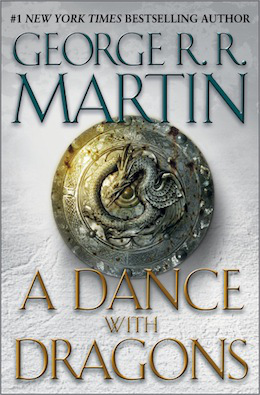
Welcome back to A Read of Ice and Fire! Please join me as I read and react, for the very first time, to George R.R. Martin’s epic fantasy series A Song of Ice and Fire.
Today’s entry is Part 28 of A Dance With Dragons, in which we cover Chapter 48 (“Jaime”).
Previous entries are located in the Index. The only spoilers in the post itself will be for the actual chapters covered and for the chapters previous to them. As for the comments, please note that the Powers That Be have provided you a lovely spoiler thread here on Tor.com. Any spoileriffic discussion should go there, where I won’t see it. Non-spoiler comments go below, in the comments to the post itself.
And now, the post!
Chapter 48: Jaime
What Happens
Jaime and his company arrive at Raventree, home of the last of Robb Stark’s loyal holdouts the Blackwoods, which Lord Jonos Bracken has been besieging in desultory fashion for the past six months. Jaime thinks of Cersei’s letter begging for his aid, and tells himself that even if he had gone back for her, he would not have been able to save her, but knows he will have to face her eventually. He goes to see Lord Bracken and interrupts him mid-coitus with a “war prize” named Hildy, who seems shy at first, but also brazenly propositions Jaime before Bracken kicks her out.
Jaime tells Bracken he means to offer Lord Tytos Blackwood terms for peace. Bracken warns him that all Blackwoods are turncoats, and suggests Jaime take Blackwood’s only daughter as hostage, and campaigns for the lands he was promised by Tywin Lannister for subduing Raventree. Jaime points out that Bracken has only partially subdued the place, and promises only partial rewards in return, which Bracken accepts. Jaime thinks that perhaps Blackwood’s staunch opposition was more admirable than Bracken’s capitulation to the Lannisters even in the face of the wrongs done to him (by Gregor Clegane and at the Red Wedding).
Jaime’s parley with Lord Blackwood goes without incident, and he enters the keep to discuss terms without forcing the man to kneel to him in public or private. Blackwood will not say whether Brynden Tully is sheltering in his walls, and Jaime lets it go. Blackwood is stricken when Jaime brings up taking his daughter Bethany as hostage, and Jaime accepts his second-oldest son Hoster instead. Blackwood advises Jaime to take a hostage from among Lord Bracken’s progeny as well. Jaime warns Blackwood, though, in front of Hoster, that if he finds that Blackwood is aiding or hosting any of the rebels in the area (Lord Beric Dondarrion, Thoros of Myr, Sandor Clegane, Brynden Tully, the woman Stoneheart), that he will send him his son’s head. Lord Bracken is dismayed by Jaime’s order to send one of his daughters to King’s Landing, but Jaime ignores his protests, and leaves.
As they travel by a different route in hopes of luring out Dondarrion or the Blackfish, Jaime talks with Hoster Blackwood about the thousands of years of feuding between his family and the Brackens. Jaime comments that you’d think someone would have made a peace by now, and Hoster says they have, over and over again, but something eventually always happens to rekindle the feud. Jaime tells him the way to prevent that is to make sure there’s no one left to carry it on. Hoster asks if that’s why he killed all the Starks, and Jaime tells him the daughters still live, and wonders where Brienne is and whether she’s found Sansa.
They go to a village named Pennytree, where Jaime declines to roust out or molest the villagers hiding from them. Near midnight, the sentries bring him a woman who they say rode up and demanded to see him.
Jaime scrambled to his feet. “My lady. I had not thought to see you again so soon.” Gods be good, she looks ten years older than when I saw her last. And what’s happened to her face? “That bandage… you’ve been wounded…”
“A bite.” She touched the hilt of her sword, the sword that he had given her. Oathkeeper. “My lord, you gave me a quest.”
“The girl. Have you found her?”
“I have,” said Brienne, Maid of Tarth.
“Where is she?”
“A day’s ride. I can take you to her, ser… but you will need to come alone. Elsewise, the Hound will kill her.”
Commentary
OMG, Brienne! OMG OMG *jumps up and down*
Oh, but wait. I’m not supposed to be excited about this. Because Brienne is lying about Sansa, because she is supposed to kill Jaime, because Catelyn is all undead and has no happy feelings anymore and Brienne is all disfigured and everything is awful. Right. Sorry, no joy here, my bad!
…Eh, fuck that. I can hope that she’s not going to do it anyway, because I wanna. I know that’s just WILD-EYED OPTIMISM on my part, but whatever, I’mma gonna hope that Brienne will be all “Screw you, undead no-feelings lady!” and join up with Jaime and not kill him, unless and until such time as I am rudely disillusioned of that hope, and you can’t stop me. SO THERE… even though I don’t know that this is even the correct thing to hope for.
“Perhaps it is time we talked of terms.”
“Is this where I get down on my knees?”
“If it please you. Or we can say you did.”
It’s sort of both heartening and depressing, the way Jaime continues to comport himself in general. Heartening because he is one of the very few characters in ASOIAF who consistently shows actual compassion and leniency towards his adversaries, and depressing because of how he’s never ever going to get any recognition for that fact because of his past actions – and maybe because of how he shouldn’t.
It’s the eternal question, I suppose. Can a projected lifetime of attempted good deeds atone for one (or two) acts of atrocity? Or are some things unforgivable? Does it make sense for me to want Jaime to escape Catelyn’s vengeance, even while acknowledging that I myself, were I Catelyn, would probably be hard-pressed to put what he did to Bran aside even if I weren’t in an undead semi-deranged rage-spiral of revenge?
Because some things, you know, you don’t have to be undead or deranged to rightly want justice for.
And yet, there’s the unavoidable truth that on balance, even with all the bad things he’s done, Jaime seems to be more of a force for good in the world than the opposite – or, if “good” is too strong a term, at least a force for order rather than chaos. And in ASOIAF especially, there’s not so many of those around that it seems like a good idea to get rid of even one of them.
So, in conclusion, I dunno. I don’t really feel it is right for me to root for Jaime over Catelyn, and yet I do anyway.
Ethics suck, sometimes.
Maybe I can just root for Brienne instead, who really has done no wrong and really doesn’t deserve Catelyn’s vengeance in any way. And if Brienne’s success happens to also involve Jaime’s success as well, then that’s just wacky coincidence, right? Right!
*jazz hands*
In other lady-oriented news, I have to say the whole thing with Hildy was… weird and distasteful. I’m not sure why this particular objectification of a female character bothered me so much more than, well, most of the many (many) other times that’s happened in this series, but it did.
Maybe because, with the others, there seemed to be a tacit recognition of the essential grossness factor of the objectification – by the text if not actually by the POV character – but that awareness seemed to be missing from this scene. Also, the overtones of that whole schizo impossible-standards thing about wanting women to be simultaneously sleazy and demure were pretty off-putting as well.
*shrug* It gave me the creeps, make of it what you will.
“For a thousand years it has not shown a leaf. In another thousand it will have turned to stone, the maesters say. Weirwoods never rot.”
“And the ravens?” asked Jaime. “Where are they?”
“They come at dusk and roost all night. Hundreds of them. They cover the tree like black leaves, every limb and every branch. They have been coming for thousands of years. How or why, no man can say, yet the tree draws them every night.”
Damn but that’s creepy. I wonder if maybe the ravens come because the tree is dead, and so the greenseers need the ravens to see the weirwood in its stead?
Or, you know, the ravens could just be huge Hitchcock fans. One of the two.
Hoster’s tale of the millennia(s)-long feud between the Brackens and the Blackwoods makes me shake my head in unflattering but not skeptical wonder. Because yes, it seems, as Jaime points out, completely absurd to maintain a rivalry so old that no one even remembers when it began, but on the other hand that is absolutely a thing that has happened and continues to happen in the real world. (Technically, for example, Rome and Carthage were at war for 2,100 years.)
I am reminded of my own astonishment as a student to learn that England and France had fought with and generally loathed each other for the vast majority of their history as sovereign nations, when my overwhelming association with them up to that point had been as staunch allies with us (and, by extension, each other) in World War I and II, and basically ever since then as well. Cognitive dissonance, yo. And yet, one has to wonder, given their history, how temporary this latest peace might end up being as well. I can’t personally picture the circumstances under which it might be broken – Western Europe, at least, seems to be pretty thoroughly sick of internecine war at this point – but then again, what do I know?
And blarg, I was going to do two chapters I swear, but my brain has officially thrown in the towel for now, so come back next Thursday for more! Cheers!

I love this Jaime chapter. I’ve missed my Kingslayer snark! I especially like the way this chapter reads after having read the Dunk and Egg stories, both for the knowledge of Bloodraven being a Blackwood, and especially for the knowledge that Dunk squired for Ser Arlan of Pennytree, from the town where Jaime spends the night at the end of this chapter.
We don’t know what Brienne will do, it’s hard to predict, but remember that if she doesn’t bring Jaime to the Brotherhood Without Banners they’ll kill Pod, and I doubt Brienne would just leave Pod to be killed.
I really hope we get 2 chapters next week, cause the 2nd one is a DOOZY!
I’m not sure “staunch” is descriptive of our or the British alliance with France. “Convenient” (for the French) or even “Troubled” would be more accurate. They screwed up the Treaty of Versailles bad enough to make WWII inevitable, appeased Hitler until too late, fought on both sides of WWII, then were nice enough to invite us into a war in Vietnam.
It’s the eternal question, I suppose. Can a projected lifetime of attempted good deeds atone for one (or two) acts of atrocity?
The good cannot wash out the bad, nor the bad the good, as Stannis would say. But the guy he said it to was just a smuggler, not a kingslayer, so he only lost a few of his metacarpals rather than the entire hand.
I’m willing to say that Undead!Catleyn is in the wrong here. If not in intention, then very much in the execution. She’s holding an innocent boy hostage to get revenge for what someone did to her innocent boy. While she has no way of knowing that Jamie has pretty sincerely reformed, her quest for revenge is waaaaaay out of hand. She’s not even looking for her daughters anymore. There’s no love left in her, only hate :(
I love this chapter. I love Jaime’s final few chapters of AFFC and this chapter. Now that Jaime is alone, and on his own (devoid of major characters) he is really thriving. He is perhaps the best leader left in Westeros. He is stern, but compassionate. He is beloved by his own. He is not as universally hated by others as originally meant to be believed–Lord Blackwood is more than willing to treat with him. He would make a serviceable regent or hand if he ever allowed himself to take the position. This of course means he will be put in immediate mortal danger…sigh.
I honestly don’t know how atonement works sometimes; there are things that can never be undone (at least in this life). But then it all seems kind of pointless anyway, even non-forgiveness or revenge, because that doesn’t undo it either..how much of ‘atonement’ is about making amends, or about becoming a better person, etc?
@3 A King who deserved slaying, though.
Leigh brings up an interesting point. She says “Because some things, you know, you don’t have to be undead or deranged to rightly want justice for.”
But Lady Stoneheart doesn’t want justice. She wants vengeance. Justice and vengeance are not identical, which is pretty much the raison d’etre for these books. The world of ASOIAF is terrible, because these people are trapped within a neverending cycle of vengeance, as Jaime pointed out to Hoster Blackwood.
Justice would be Jaime publicly forced to acknowledge his crimes. Vengeance is quietly hanging him in the woods where no one will ever know what he’s done. Justice was Robb Stark losing the loyalty of his sworn bannerman when he broke his treaty with them. Vengeance was the Red Wedding. Justice was stopping the Mad King before he burnt Kings Landing down. Vengeance was the rape and massacre of Elia Martell and Rhaenys and Aegon Targaryen.
Now the people of Westeros BELIEVE this is justice. The very first act by a major character in this book was a summary execution of a haunted man with no agency who fled from an unknown terror, an act which was called “justice”.
Vengeance is slowly killing this land, evidenced mainly by the “villains” of this book, the White Walkers, supernatural creatures seeking the extermination of humanity for some 10,000 year old infraction.
Now go back in time and tell your younger self (the one that has just read AGOT) that, I dare you. :P
This was another SO MUCH TALKING chapter, I’m definitely surprised you didn’t do two.
About the ravens, maybe they use the weirwood trees to communicate/navigate. I don’t recall seeing anything about how the ravens navigate to send letters, but I don’t think its like homing pigeons. I think they pick a raven from the cage and tell it where to fly, vice just telling it to go home. That, to me, says that the ravens are smarter than you think. (maybe not explaining it quite right, but I just don’t buy that every Maester has a raven that specifically “homes” to a specific place, especially when there are dozens of possible destinations to send letters to)
Aeryl, *slow clap*!
@7: That’s a concise excellent description, not just of this series, but of the concept and importance of Justice vs. Vengeance in general. Well done!
@10: I thought that a previous chapter mentioned that people used to know how to communicate with the ravens but lost the ability/knowledge. The ravens apparently still have the intelligence, it’s just that the people don’t know how to “talk” to them anymore. Maybe the ravens understand place names in human speech.
I liked the descriptions of Raventree and the surrounding lands and its history. You really get the sense that people have been there for a long time. However, there was something that I found very annoying about this chapter: when last we saw her, Brienne was being hanged/hung/whatever, and she uttered a word. What word? I don’t know. This is the first we’ve seen of her since her “cliffhanger” moment. What happened with her since then? I don’t know. Will we ever know? I don’t know, but I’ve got a feeling we’re not going to find out. And that sucks because the Brienne and Pod travelogue was a large part of what made AFfC readable. (Disclosure: I am only a chapter ahead of Leigh in reading this book so I am not in any way divulging what happens in the rest of the book because… I don’t know.)
@7 Aeryl, while I agree with you, I’m going to nitpick the last part:
I don’t think this fits the motif. Is it not justice to carry out the law of the land? Ned had no malice or negative intent in the execution, he was simply performing his duty as lord of the land. The Night’s Watchmen know very well what the penalty for desertion is.
Now, you can say this is an unjust punishment itself, inasmuch that the law should be changed, though I would say the punishment isn’t really that. Desertion even today is held as a pretty serious crime (which I think the punishment for during a time of war is also death). But either way, I don’t think Ned was in any way being vengeful by carrying out the execution.
@naupathia
Is it not justice to carry out the law of the land?
This is what I’m talking about why the people of Westeros don’t understand justice. Rendering a death sentence, summarily, with no trial, for a minor crime, is NOT justice.
Denying same sex couples the right to marry was law of the land, but it was also unjust. While I see where you think I’m comparing Ned’s act to vengeance because of my comment, I’m just using it as an example to demonstrate the lack of justice in Westeros.
Desertion may be a more serious crime, but not when you didn’t volunteer to join, IMO. The action of the NW brother Ned killed is more akin to an escaped slave
@10
I think the ravens are smarter than we think, but according to the asoiaf wiki most of the ravens are trained to only fly to one castle, the ones that can remember more than one place are highly trained. I don’t know how this squares with the lost ability to talk with ravens, unless that ability was really some kind of warging or related to greenseeing.
Toss my neighbors’ kid out of a tower, I would seek justice. Do it to my kid, I will have vengeance – or be too emotional about it to perceive a difference.
@17, That’s why we allow unbiased third parties to seek justice.
I believe Jamie is truly repentant and is a better person than he was at the beginning. But I also think that Stannis is right that good and bad don’t “wash” each other out. If Jamie’s alive when the series ends and if the Wall is still standing, it would be just for Jamie to be sent there for attempted murder and his relationship with Cersei, which was treasonous and helped spark this whole disaster. Of course, I’d also be OK with it if he were pardoned instead.
Aeryl, I think your comment is otherwise brilliance. But for the execution issue. It is justice to get a great lord to execute you for an crime you are obviously guilty of. This system does not have the separation of legislature, executive and judiciary powers like we do but this was still an execution based on the laws of the land that had been written down, known by all and executed in public by a lawful highest local authority so it was hardly horribly insufficient. The deserted should have reported about the White Walkers as was his duty to the Night’s Watch instead of feeling hundreds of miles to inland. So while Westeros legal system is not perfect by our standards this was not still unjust by their laws or really bad with our standards.
And as fro same-sex couples marrying, it depends on the country’s understanding of morality if the denying marriage is unjust like all laws. Law is reflection on public morality on all issues not something that everyone agree about everything. There are always laws that someone in the country could consider unlawful. So some societies could say to you that denying sibling marriage and polygamy is also unjust by the same argument same-sex marriage is. Laws are made in modern societies based on public’s opinion of morality and only recently there has been a change what is unjust regarding marriage in public. In this society law is not made by the public the same way but the public opinion does influence the lawmakers. But all societies agree that desertion is illegal and the deserter did not try to defend himself (it was obvious he was a deserter but he did not offer reasons for his desertion). So while some could say that they personally think that law that does not allow same-sex marriage or a law that allows death sentence is unjust you can not argue that they are not truly laws if they are made and upheld properly. Like I said there are always laws in every country someone disagrees with. But if you could disobey laws based on your personal moral standards there would be anarchy. Laws should be changed if majority people do not wish then to be laws but majority would not wish to change this law in Westeros so this law would not be changes even if there was a democracy.
I wrote this in a hurry and English is not my first language so I hope this was coherent.
@15,
I don’t remember the circumstances of Gared’s joining the NW. But if he was there involuntarily, it’s because he was a convicted criminal. You can’t have a functioning justice system if the criminals have to consent to being locked up. Those two guys who escaped from Dannemora didn’t have the right to bust out just because they were there involuntarily.
@20, No, in America whether laws change has nothing to do with the will of the majority. That easily leads to tyranny. That’s why we use the Constitution.
And you are confusing legality with justice, which is what the books are trying to separate here.
@21, IIRC, he was a poor man accused of a crime he didn’t commit with no recourse except to flee to the Wall because he didn’t have the clout to “prove” his innocence.
@22 – In the US justice system, a defendant can make an Alford plea. The gist of it is, “I’m really innocent, but I’m pretty sure that I will lose at trial, so I’m pleading guilty. Even though I’m not.” If you make that decision and get locked up, you don’t get to let yourself out of jail. Same thing for criminals who decide to go to the Wall. Taking the black is a proto-plea bargain. Once you’re imprisoned, you don’t get special rules.
“They come at dusk and roost all night. Hundreds of them. They cover the tree like black leaves, every limb and every branch. They have been coming for thousands of years. How or why, no man can say, yet the tree draws them every night.”
BIRDEMIC 3!
@Aeryl @21 Tyler Soze – Per the wiki, Gared joined the Watch as a boy and has been a ranger more than forty years. He is over fifty at the time of the story.
@7 Aeryl – Justice would be Jaime publicly forced to acknowledge his crimes. Vengeance is quietly hanging him in the woods where no one will ever know what he’s done. Justice was Robb Stark losing the loyalty of his sworn bannerman when he broke his treaty with them. Vengeance was the Red Wedding. Justice was stopping the Mad King before he burnt Kings Landing down. Vengeance was the rape and massacre of Elia Martell and Rhaenys and Aegon Targaryen.
This is well-stated. As always, justice and vengeance are defined by the beholder and rarely do two sides agree. Nor do two sides often agree on when enough justice/vengeance has been had. And that does not only apply to these books, as we know all too well.
@25, Yeah I confused him with the guy used in the show. However, him being a child when he took the Black makes a better point. He isn’t really obligated to a vow made prior to the age of consent, IMO.
@23 That’s unjust as well, so it doesn’t really take away from my point.
@22
This Constitution that takes no account of the will of the majority – would that be the same Constituition that was suddenly found to legalise gay marriage when the polls showed 60% of Americans in favour of legalising gay marriage? And which had not been found to legalise gay marriage during the time when most Americans opposed the legalisation of gay marriage?
The world does not have an empirically determined True Theory of Justice. There is no way of proving any such theory right or wrong. All partisans of rival Theories of Justice can do is shout “I’m right and you’re EVIL!” at each other. So which theory people follow is mostly a matter of politics. That is just as true here as in Westeros.
Folks, we’re going way off topic here in the last few comments about same-sex marriage. Can we nudge this back towards a discussion about Westeros justice (or lack thereof) and leave current real-world political issues out of it?
You were right, Leigh. Brienne is not dead (LALALA) and has encountered Jaime. Time may tell whether he’ll consequently get literally and/or figuratively kicked in the teeth. Or maybe “have his fictional nuts torn off and fed to the fictional crows in lieu of (fictional) corn. FICTIONALLY. WHILE HE WATCHES.” Won’t you like that? Oh, you won’t? *evil grin*
The scene with Hildy skeeved me, too, due partly to the men ogling and discussing her and partly to her squeezing his cock as she went out. Unsolicited private-part grabbing is violation, even if the grabbee is attracted to the grabber, but treated more lightly when a woman does it to a man. In Westeros, a man can generally get away with groping a woman (unless she’s of higher social rank), but still be considered a creepy lech by readers and possibly some of his peers. And same-sex groping is probably considered Not OK more of the time, for better or worse. So why the casual dynamic here? Maybe it’s just the power imbalance between lord and servant, but I also suspect the belief that any non-homosexual man always welcomes sexual attentions from any woman.
The hills around Pennytree being called the Teats made me think nostalgically (as if I weren’t always) of Acadia National Park, where I used to work. A pair of its mountains are similarly called “the Bubbles.” When asked their name origin by tourists’ I just said it was a “censored reference to their shape.” At least it’s an accurate moniker, unlike the sharply jagged Grand Tetons (French for “big tits”).
#21: The point of the Night’s Watch is that the circumstances of how you joined officially don’t matter. The oath is equally binding on everyone.
That’s the only way it can work. The lords of Westeros can use the Night’s Watch as a merciful alternative to death only because they know it’s as final as death. It must bind for life, completely disinherit the person, and have no exceptions. If the Watch starts letting people weasel out of their oaths because they swore under duress, or as children, or for any other reason, then the next Aemon Targaryen or Samwell Tarly will just be executed.
@31, I am aware of that. None of the excuses the fact that it’s an unjust institution. I am not arguing that by Westerosi standards, his desertion is not viewed as a crime by their laws.
The entire point of my comment is that there is no perception of what justice actually is, within Westeros. Of course they will have and rely on unjust institutions.
I feel that the underlying argument here, is that this world, as presented, is too cruel for justice. But you have it backward. The reason why this world is so cruel, is it’s lack of justice.
@6 – I appreciate your question about atonement. Can a person make amends for a horrible crime? Let’s say it’s a murder. If the killer is given a sentence, serves his or her time, and then works every day to help other people, is that atonement? Of course, it doesn’t take away from what was done. It doesn’t bring back the person who was murdered, but if the killer does NOT try to atone, two lives are lost. It makes me feel like Jamie’s actions post-Bran could have the effect of approaching redemption for him. Again, it’s not enough. He should be prosecuted for what he did to Bran (among other things). But somehow it does mean SOMEthing. Heck, he even is winning over Leigh, which she said would never happen. I don’t know the answer, but Martin raises important questions.
I tend to be pretty judgmental on stuff like this (ask Aeryl), but Jaime is nowhere near to winning me over. Other than saving Brienne in the bear pit, his list of actual good deeds is pretty short. All he’s really succeeded in doing is stop being an asshole; his internal dialogue, not surprisingly, paints all of his actions in the most favorable light.
“(My son) Lucas was murdered at the Red Wedding. Lord Walder’s fourth wife was a Blackwood, but kinship counts for no more than guest right at the Twins.” — Tytos
Yep. And one of Alyssa Blackwood’s five children by Old Walder was Lame Lothar, credited with largely engineering the Red Wedding. They also have twelve grandchildren, including Big Walder and Robert Brax; the latter is currently a page at Casterly Rock, but apparently nobody in the book cares.
“Dead men don’t claim vengeance.” You know nothing, Jaime Lannister.
It was his child (Edmure) feared for. He knew whose son I was, better than mine own aunt. — Jaime’s thoughts. He evidently hasn’t forgotten Genna’s comment, or taken it to heart.
@9: SO MUCH TALKING chapters can be the hardest to summarize concisely.
@34 Good point about Jamie. I hadn’t thought of it that way.
@34 believe it can be done, I agree with you. Jamie is being not bad in this chapter, but isn’t doing anything particularly morally good.
@33. In my opinion, general good deeds are not enough to atone for a crime. You need to have remorse for what you did, and try to do something to’fix’ it specifically. In Jamie’s case we have not seen him regretting attacking Bran. The action that haunts him is killing Aerys because that comprised his oath. And now he is trying to help Sansa because of a promise he made to Catelyn- not because she is an innocent child, not because helping her is a substitute for helping Bran.
Heh, think of us as siblings, and don’t forget that Britain has been at war at pretty much every country at some point. France equally has probably been at war with a not inconsiderable number of countries as well, it’s just the way of nations.
Give the USA another five hundred years or so and you’ll understand ;)
@34 – Since meeting Brienne, Jaime has:
-saved Brienne from rape
-saved Brienne from being killed by a bear
-saved Brienne from being killed by Loras Tyrell
-saved an innocent man (Tyrion) from being killed for a crime he didn’t commit
-rescued a young woman from a situation where she was being constantly raped and gave her a position within his service where she would be safe
-counseled his squire on how to treat women with love and gentleness
-ended seiges with no loss of life on either side
-showed kindness and respect for a grieving Jeyne Westerling
-installed a decent man to end the horrible situation at Harrenhal
-ordered the Freys to give up prisoners and/or bones to their victim’s families
-protected Tommen from Cersei when he was able
-changed the Kingsguards orders from “obey the king” to “obey the king, unless he orders you to do something terrible, then protect the king from himself” – basically ending this idea that the Kingsguard should stand aside or participate in terrible deeds
The list goes on and on. Since we’ve been in his head, Jaime has basically been the most decent character in Westeros this side of Brienne and Davos.
If Jaime wants to redeem himself – really, truly redeem himself – he not only has to confess to his attempted child murder, but also to the fact that he’s been having an affair with the Queen for the last twenty years, and that all three of Cersei’s children are his, and not Robert’s.
@41
Says who? Those are your arbitrary terms for redemption, not mine. In any case, Jaime did confess about Bran. To Catelyn. Who responded by letting him go try to get her daughter’s back.
I don’t understand how confessing about Tommen and Myrcella would redeem Jaime. It would redeem Jaime to ruin his children’s lives?
I don’t think the terms for redemption have to be so specific. Want to be redeemed? Do good. Confessions don’t erase the past.
Who is granting the redemption? Does Jamie even want it , much less deserve it? He seems to feel bad in a vague way about stuff he’s done. Not nearly as bad as a man should feel about Bran’s defenestration or Tyrion’s wife. Still a selfish prick in my book.
Redemption, atonement, and absolution are religious and personal ideas. Judging by his reaction to Lancel, I doubt he’ll look for it in the Seven.
Without checking dictionary.com, I’m going to venture that redemption, by definition, is in the eye of the beholder. It’s not like when a bad person does enough good that there’s a specific moment when angels sing and the redemption fairy comes down from the sky and we all universally agree that the bad person has been redeemed. So we all get to have our own personal arbitrary prerequisites for redemption, and there is no arguing the validity of another persons personal prerequisite because they are personal, and I’m pretty sure that’s what the definition of personal is, too, but again, I’m not checking the dictionary, so I could be wrong.
To me, the big trick that GRRM is pulling here isn’t one of redemption at all. It’s discovering that Jaime never needed redemption in the first place. He was never a bad person. Oh he had bad traits, but he wasn’t evil. He didn’t take any pleasure in pushing Bran out of a window, and if he had seen any alternative at all that didn’t mean death for him and all he loved, I believe he would have taken it. When Bran saw him with Cersei, he might as well have held a knife to Jaime’s throat. Bran was an innocent, sure, and wasn’t putting Jaime in this position on purpose, but neither did Jaime go up into that tower with Cersei so that he could kill Bran. Circumstances conspired to put them into a situation where one or the other was going to die. I’m not saying pushing Bran out of the window was the right thing to do. It’s not what I would have done. But I can see it as more a selfish act of self-preservation (and preservation of loved ones) than an act of evil.
And more unambiguously, the whole kingslayer thing: oooh, he killed the king he was sworn to protect. Bad person. Oh, what? He did it to stop a madman from killing everyone in the city? Ok, not so bad after all. That’s not redemption; that’s finding out the rest of the story.
@40 – Great list, very helpful. I had forgotten that he changed the Kingsguard’s vows. No more standing by while the king commits atrocities that could end up getting the king killed, etc.
@42 – You’re right, Jamie did confess to Catelyn and, I believe, show remorse.
@44 – I find what you have written to be very interesting, especially about Martin’s big trick. Those nuances are why I love this work.
@44 – Wow, no. It’s not okay to kill a kid to hide your own crimes even if you don’t enjoy it. Killing a man who tried to stop you from robbing a bank is murder, even if you feel real bad about it. Any kind of decent person wouldn’t have been screwing his married sister. Any kind of half-decent person would have tried anything except hurting the kid. Jamie just makes a joke and chucks him off the tower.
As Leigh said, he’s: “A fucking incestuous murdering ASSHOLE BASTARD of a fictional character who deserves to have his fictional nuts torn off and fed to the fictional crows instead of (fictional) corn. WHILE HE WATCHES. FICTIONALLY.”
He’s a horrible self-centered piece of shit who is just now coming to grips on how bad he is. His first baby-step towards self-improvement is to keep as much of his oath to Catelyn Stark as possible. He basically goes around the Riverlands doing mutual-gains negotiations like a corporate HR Director. Big deal, he and his family probably benefited more this way than if he had used violence.
He hasn’t asked anyone living, dead, or divine for forgiveness – the first step towards redemption and atonement. He hasn’t even acknowledged what he did to Tyrion. He admitted what he did to Bran without a hint of guilt.
@41, 42 – I personally could never consider a person redeemed if s/he is still reaping the benefits of the crime s/he committed. In Jaime’s case, this is complicated by the fact that his benefits (indirect power through association with the throne, his position in the Kingsguard which he would certainly have lost if Bran had told anyone what he’d seen) are closely linked with the lives and wellbeing of innocent children (Tommen, Myrcella).
But that said, I don’t think Jaime’s looking for redemption as we’d see it. He just wants to be remembered for good things he’s done, and he wants to regain his self-respect and self-worth (he’d say “honor”). I think he’s basically drawn a line to separate himself from the things he’s done in the past, and is focusing on doing better now – making up for the past isn’t the issue in his mind as much as doing the right thing from here on. He’s compartmentalizing.
Or so I see him, anyway.
@47 – Yes – he is trying to “go forth and sin no more”, without ever doing the confession or penance part.
Not really an apt analogy for the defenestration. A more accurate one would be “killing a man who was going to kill you, while you happened to be robbing a bank.”
More like “killing a child who happened to see you commit the crime”. Sheesh, did nobody here see the movie Witness?
@49 – Exactly. If Security or the Police show up while you are committing armed robbery, they will probably use deadly force. That doesn’t mean you can claim self-defense for shooting them.
A kid stumbles across you (in his family’s castle) committing incestuous adultery and treason, you can’t kill him and claim self-defense. You have just added to your crimes, nothing you did was justified or honorable.
There was a great joke in Yes Minister (a BBC comedy from the 80s) about how the British Foreign Office was still wary of France because they’d been enemies for the better part of 2000 years and a relative period of peace was no reason to trust them.
Re: Jaime’s “redemption”: I don’t personally think there has to be as much of a confession/remorse as you all seem to. First of all, he has confessed to all his crimes to various people, admittedly none of whom are actually arbiters of “justice” but he has confessed.Regarding Bran, I recall a scene where he’s talking about it (maybe to Brienne?) and says something along the lines of “Yeah I probably shouldn’t have pushed the kid out the window but I knew it was what Cersei wanted”. That shows he knows that attempting to kill Bran was “evil” but he did it to protect his loved ones.
My point being that he clearly recognizes what he has done, knows what a bastard he is, and he is accepting of it. No where does he ask anyone to think of him as a saint. No where does he believe that he is a better person than anyone else.
And honestly to me that’s more important than wallowing in self pity and remorse over actions you can’t undo. He has accepted the reality of his situation and is seeking to atone for it in his own way–by trying to keep his word, by trying to resolve these disputes with as little loss of life as possible, etc. I just personally don’t think it benefits anyone to have a guilty man beg forgiveness from some supposed higher power, or to sit and mope and self-flagellate just so other people can get some schadenfreude out of it.
Also I think a lot of you are being unfair to @44, no where did s/he say that what Jamie did was okay in any sense. He was only pointing out Jamie’s mindset of “protect loved ones at all costs” and how his intention was not to “do evil”. Basically pointing out how GRRM is a master of writing nuanced characters, i.e. villains that aren’t just EEVEEL.
I recently read a fanfic (by GRRM, of all people) about how a fight between Jaime Lannister and Rand al’Thor would go. And it was pretty interesting. Not only because the result was surprising, but that it gave me another window into how GRRM views his own creation.
Martin is definitely a “crueler god” than Jordan.
All this talk about redemption makes me think about one of my favorite Buffy episodes, Amends, in which Angel is haunted by ghosts of his past. If I remember well, Angel himself didn’t believe in his own redemption. Until the end of the episode, at least. Were it not for that Deus Ex Machina he would’ve committed suicide. Which would be a shame, because I loved the spinoff.
@7: I wish we could upvote comments here. This was one of the greats.
@13: Keep reading. Maybe Brienne and Jaime meet Lady Stoneheart later in the book, who knows? It’s nebulous. That said, I didn’t like Brienne’s cliffhanger in AFFC either.
@29
Sorry. I was only trying to point out that you cannot divorce justice from politics, because politics decides whose ideas about justice get enforced.
Just want to point out that Martin himself a few times told in his interviews that what Jaime did with Bran does not make him evil and that he was asking people around about what would they do in Jaime’s situation, where the choice is the life of a random kid vs the lives of the love of your life and your children. I am not saying that everyone should agree with him but that’s how he himself views the situation.
Also, Jaime would gladly confess his every crime if it would not put the lives of his loved ones into serious danger. He already did so once when told everything to Cat without hiding a thing when it did not endanger his family. He himself is not afraid of justice.
Martin’s views of the morality don’t count for any more than mine (or yours). He wrote the scene, but he doesn’t get to control our evaluation of the morality.
And Martin’s argument is special pleading. There’s not the slightest bit of evidence in that scene that Jaime considered his children before trying to murder Bran. He did consider Cersei, but of course in that case he’s trying to murder an innocent child in order to conceal the two perpetrators of a crime. That’s not high on my list of noble deeds.
As for confessing, Jaime had at least 17 years to do that, during at least some of which he had no children. He and/or Cersei could even have run away (with kids, if necessary) and confessed from afar. It’s speculation anyway to claim that he might act differently than the way he actually has acted. Besides, “not confessing to save his loved ones”, even if it were true, doesn’t qualify as “noble” — it’s how any wrongdoer would behave.
@29
Which is why I have said that I am not telling that you should agree with him.
Cersei told about saving the kids to Ned, Martin flat out said so not once in the interview. And I think we can say for sure that Martin knows about his own characters a great deal more than any of us. And why would Jaime not think about them? Does the fact that he didn’t have fatherly feelings towards them suddenly mean that he would not care who would die – Bran or Joffrey, Myrcella and Tommen – a random kid or the children of his body and the children of the woman that means for him more than anything else, who also deeply cares about the children?
Jaime would have gladly done all that but for him it was not up to him to decide.
Yes, Cersei talked about the kids. For all her faults, she loves the kids. Jaime didn’t.
As for Martin “knowing more”, no he doesn’t. He knows what he wrote, just as we all do. He doesn’t get to rely on secret thoughts never communicated to the reader.
If Jaime wanted to protect his kids, the surest way to do that was to stop having sex with Cersei. Murdering an innocent boy isn’t a substitute for gratifying his own passion (which itself isn’t exactly noble). It was never up to anyone else BUT him to make that decision.
@56
“Also, Jaime would gladly confess his every crime if it would not put the lives of his loved ones into serious danger. He already did so once when told everything to Cat without hiding a thing when it did not endanger his family. He himself is not afraid of justice.”
I think that’s overstating it. Jaime wouldn’t gladly confess to everything, because then people would look at him (and treat him) as the lowest of the low, and Jaime doesn’t want that. Yes, he confessed to Catelyn – when he’d been locked in a cage for a long time, she was looming over him with an armed guard, and she seemed to already know (or at least suspect). At that point, he didn’t have much to lose. It’s not at all the same as telling the whole world when he’s free and has everything to lose. (If we take Cersei and the kids out of the equation, there’s still his position and reputation. He’s hated being called Kingslayer – do you imagine he’d be happy to add Childkiller and Sisterfucker to that?) It’s not justice as such he’s afraid of, just like he’s not afraid of battle or pain. It’s living with the consequences in how people think of him. He wants to be Goldenhand the Just. Goldenhand the Just doesn’t push kids out windows, sleep with his sister, or commit treason by secretly putting his own kids on the throne.
He might confess if there was a trial, if someone asked him outright in a small closed environment, with Brienne looking at him to see whether he’d tell the truth or lie… there are a number of such situations where I can picture him confessing. But not to the whole world, and not gladly.
@59
I completely disagree with you about Martin.
Let’s spin it another way. Jaime was endangering Cersei by sleeping with her. Using the same logic does it mean that he doesn’t care about her and wouldn’t blink an eye if she died?
I do not think that it was not up to him to decide. But Jaime thought so.
@60
But Jaime flat out asked Cersei many times to reveal everyone about them. And is now planning to reveal his fatherhood of Tommen and Myrcella. He surely does not mind to be called Sisterfucker at all. And, while he completely dislikes being called Kingslayer, he used his reputation to his advantage to secure Riverrun and Raventree, basically ensuring that people continue to despise him. Jaime, also, notoriously does not want to tell people about his good deeds. Him still refuses to tell anyone about wildfire aside, when he had written about himself in the White Book, he painted himself in the most pathetic light possible and when he parleyed with Blackfish, he refused to tell him anything about Sansa, Brienne, Oathkeeper and how he tried to keep his vow. While Jaime does want to be remembered as Goldenhand the Just, it is his highest priority.
There’s plenty of evidence in the book and even in the scene with Bran that Jaime loves Cersei: “the things I do for love”. So sure, he’s protecting her.
The thing is, though, that nobody sees this as morally acceptable. It’s not ok to try to murder an innocent child for the purpose of saving the 2 perpetrators of a crime. That’s why I mentioned the movie Witness. That movie works because everybody — and here I mean “everybody” quite literally — understands that the criminals don’t have any moral justification to murder a child who happened to witness their crime. That’s the same situation Jaime is in.
It seems to me that Jaime’s defenders do him no benefit by trying to defend the indefensible. If Jaime were truly on a path to redemption, the first thing we’d see is some remorse over Bran. He hasn’t shown any yet. Then he could focus on how to help the Stark family as a way of making up for his crime. In his copious free time, he might perform some actual good deeds. As things stand now, he’s just an arrogant thug who lately has behaved less thuggishly.
Just wanted to fix the mistake in my previous post. I meant that Jaime’s reputation is not his highest priority.
Throwing a child out of a window (even if its done to protect the life of your lover and children) is an act of evil, there is no way one can defend that. But I think Martin’s point is that you don’t have to be an evil monster like Gregor Clegane to commit terrible crimes. “Normal”, “grey” people can do horrible things too, under right circumstances. Jaime certainly changed for the better during ASOS & AFFC, but it is a transformation from dark grey to light grey, not from black to white.
I think as a teenager Jaime was a romantic like Sansa from the first book. He believed in the ideal of knighthood, and wanted to become a great knight. He was also deluded about his relationship with Cercei, probably believing that it is “one true love” that transcends stuff like social taboos, etc. Then he joined the Kingsguard which was considered an ideal of chivalry, and quickly became disillusioned. Right on the first day he realized that Aeris agreed to put him in the Kingsguard not because he was such a great knight, but only to hurt Tywin, “stealing his heir”. But that was only the first hit, then he learns that Aerys is mad and evil, he tortures his wife regularly and all the great and noble knights like Arthur Dayne and Barristan Selmy just stand aside and do nothing. Then Robert’s rebellion happens, he saves the city from the mad king, but is hated since then by everyone for his “finest act”. So at this point I think he decides that the world is stupid and hypocritical, the ideal of knighthood is false and empty, and the only person worth caring for is Cercei. Consider also that Cercei married Robert against her will (or at least Jaime probably believed that), and he knew that Robert abused and raped Cercei, so that probably makes the adultery part less horrible.
Jaime changes after he meets Brienne, the person who is a true knight in all but name. Her honor and devotion makes him look back at his life and realize how wrong he was when he decided that those were just empty words. Then another turning point is when he learns the truth about Cercei, which means that he now has to find his own place in life, independent of her. And his attitude for throwing Bran also changes with time. At first in the beginning of ASOS when Brienne accuses him of throwing an innocent boy from a window his thoughts are “Innocent? He was spying on us!”. He doesn’t feel guilt, or at least tries to rationalize his actions. Then later when talking to Cercei he admits that he feels ashamed of what he had to do. Finally in AFFC when he is at the castle where the incident with Arya and Joffrey happened he feels genuine remorse when remembers what he wanted to do to her if the Lannisters found her (at Cercei’s instigation).
I think 64 is a much more reasonable take on Jaime. No, he’s not evil in the way, say, Ramsey Bolton or Gregor Clegane are. I’m not sure exactly where on that curve I’d put him, but dark grey is probably fair. And I agree that he improves over time (though I’m cautious about this because much of what we see as “improvement” comes from his own internal thoughts, which are probably not entirely reliable).
My view is that Jaime is not yet “on the road” to redemption. He’s struggling with how to get on that road. Since I like Buffy analogies, I’d say he’s Spike before Intervention.
Leigh, I agree with your summation of Jaime. No matter how much I want him to succeed over his enemies, deep down, I still know that he was the guy who threw Bran out of a window. There’s nothing much that can redeem something like that. Killing a man on the battlefield, I can understand. Killing a king who was crazy and wanted to burn a city – I can get behind that, too. But killing an innocent child whose only crime was witnessing something that you shouldn’t have been doing in the first place…*le sigh*
@sophist: I agree with you that Jaime’s (any character’s, really)internal monologue can be somewhat misleading. But GRRM is a clever enough writer that he does sneak in gems that allow us to see more. Case in point, when Jaime first meets Aunt Genna, she chides him for thinking about his lost hand more than his lost father – it shows us that Jaime is a little more self-absorbed than he realizes.
@66: And of course, I should have said “trying to kill a child” in that last post, cuz he didn’t really succeed in killing Bran.
Agreed.
@62
Yes, we all know that he deeply cares about Cersei hence the logic that him sleeping with her means that he doesn’t care about safety of those who he endangers by doing it is wrong.
@64
I think George’s point is that this horrible action does not mean than the one who did it is horrible himself. He told how he asked his friend, what he would do in Jaime’s situation and how the friend answered that he would do the same as Jaime. And George than said the he considers this friend a moral man. This George’s position is further seen in the way he once wrote how Ned, out of all people. considered that he might do the same as Jaime.
Regarding your analysis of Jaime, I pretty much agree.
I’m not following the logic here. Assuming I’ve understood you, there is no evidence at all in that scene that Jaime thought about the children or cared about them. There is, in stark (heh) contrast, evidence that he loves Cersei. The logic, then, is that he was motivated by the person whom the evidence shows he loved.
Well, I’ll have to disagree on that. Trying to murder a child for no good reason is precisely something that would make one a horrible person.
@62
Sorry for not being clear. I am not actually trying to prove anything, just saying that the fact that he endangers the kids by sleeping with Cersei does not mean that he doesn’t care about the kids’ safety.
And absolutely disagree with the fact that he did had no good reason to do what he did. Martin’s own words: ‘ But then you understand, if you understand the situation, if Bran goes back and tells what the saw, and is believed, Jaime will be put to death, his sister will be put to death, and there’s an excellent chance that his own children will be put to death.’
This is a point of fundamental disagreement. I don’t think Martin’s words are worth anything at all. He got to write the books. We know what’s in them and can argue about it. He doesn’t get to add stuff later on; if he wanted us to believe that Jaime considered his children in that moment, he should have written it.
Mind you, I don’t consider that an excuse either.
I think that GRRM absolutely gets to add stuff later on. It is his work and I think he knows the characters and their motivations more than anyone else. GRRM knows a lot of stuff, backgrounds and histories just to name a couple, that will never be written about in the books themselves. Does that mean that those things aren’t correct or can be challenged just because they are not written in the books?
@71-73 Certainly Martin can say things later on regarding the books. But it’s not something that readers of the books must take into consideration in their view of events, unless they choose to do so. Once a book is released into the wild, everyone who reads it will interpret it their own way, and those interpretations are no less valid than what Martin intended. (Well, within reason – anyone claiming that Planetos is a wonderful magical place of noble knights and fair maidens and loyal dragons can fairly be told they’re missing the point…) We can’t read his thoughts, only his words. And nobody else can take our experience away from us.
@72
If you are in disagreement with the author himself about a certain character, maybe you are wrongly interpreting the said character?
There is absolutely nothing that says in the books that he didn’t care about the lives of his kids. And, imo, it’s just a common sense that he did. We know that he did not have fatherly feelings towards them but to claim from that that he doesn’t care if they die is just wrong.
But if you want some evidence from the books, sure: after finding out about Joffrey’s death, Jaime knew right away that Cersei would be absolutely devastated. So there you have one reason for him to think about the safety of his kids. Than there is another example: again after finding out about Joffrey’s death Jaime is actually surprised at his lack of feelings and thinks that he might actually be a monster everyone claims him to be because of that. That means that he is absolutely conscious that he is their father and that they are of his blood. He doesn’t actually treat them as some random kids that just happened to be born from his sperm. So there is another reason for him to prioritize their lives over Bran’s.
Thus there actually is information in the books that points that Jaime actually did care about them. Not as their father, but as a man who is absolutely in love with their mother, and as their relative.
The fact that GRRM is the author is irrelevant. The books are published and the text is open to all of us. He has no privileged position in that circumstance. If he thinks differently, he should have written differently. As it is, I’m not in disagreement with GRRM, I’m in disagreement with how to interpret what he wrote.
I’ll try an example to make it easier to understand my point. Let’s suppose you write a will or a contract. Later on there’s a dispute about what you meant. You don’t get to come into court and say “I had this secret view of the issue, which I never wrote down, but that’s what I meant”. The legal system expressly forbids this. Instead, what it says is “we’ll interpret the meaning of the will or contract as a hypothetical reasonable person would understand the actual words used”. When it comes to books, it’s the same principle: we’re debating how reasonable people might interpret the actual words written.
I see this as evidence for my view, not yours. It demonstrates that Jaime didn’t care about the kids (at least not Joffrey). He did care about Cersei, and that was what motivated his crime.
But as I said above, even if he had cared about the kids, whether directly or because of their effect on Cersei, that wouldn’t be an excuse in my book anyway. He had a number of ways to deal with that other than trying to murder an innocent child, and he had many years to prepare for that situation. He deserves no sympathy.
Finally, think about what your argument really means. If Jaime were justified in trying to murder Bran — that is, he had something we all agree would be a legitimate reason — then he wouldn’t need redemption. His whole story since meeting Brienne would be meaningless.
It’s interesting that you used that analogy, because your point of view can be described as “Death Of The Author” (anyone interested should check Wikipedia for more info – sorry, I don’t know how to link here). However, it’s not the only way to interpret fiction. As in, not everybody agrees with it.
I actually adhere to that theory, to be honest. The work should stand for itself, and I hate it when authors try to explain their intentions. If people had wildly different views, it just shows that the author couldn’t transmit his message clearly. This happens frequently with satire. If nobody got the joke, it’s probably the comedian’s fault.
I think Death of the Author overstates my view by a little, because I’m willing to consider the author’s personal views (that is, views in general, not on specific plot points) and the social context in the process of interpretation. The legal system considers the context of the transaction too. And yeah, not everybody agrees with DotA or with me (me undoubtedly less :)). I actually got there via the legal system — I’m a lawyer, as you probably guessed — and when I learned about the issue in literature I just went “of course” because it’s so similar to legal principles that are hundreds of years old.
@72
I completely disagree with your point and think that your analogy is wrong. It’s simple – what Martin said does not contradict the actual books. There are actually moments in the books that support what Martin had said. If you interpret these moments differently, well, you are then simply wrong because they were not supposed to be interpreted some other way. It’s not the simple matter of opinion, but a matter of facts. You are free to disagree with Martin about his opinion of pushing Bran because that’s just it – his opinion, nothing more. Jaime thinking about his kids while pushing Bran is fact that Martin had confirmed. You may argue about in what degree did Jaime think about them and whether it justifies him or not, but the fact that he did think about them is simply indisputable. The books imply this, Martin said so.
I see this as evidence for my view, not yours. It demonstrates that Jaime didn’t care about the kids (at least not Joffrey). He did care about Cersei, and that was what motivated his crime.
I am not seeing how this shows that Jaime didn’t care about his kids’ survival. About the fact that he didn’t care about them as a father? Sure. Nothing indicates there that he would not care if they die. Other way around, actually.
But as I said above, even if he had cared about the kids, whether directly or because of their effect on Cersei, that wouldn’t be an excuse in my book anyway. He had a number of ways to deal with that other than trying to murder an innocent child, and he had many years to prepare for that situation. He deserves no sympathy.
I am not arguing about whether he was justified and whether he deserves any sympathy. That’s your opinion and I respect it.
Finally, think about what your argument really means. If Jaime were justified in trying to murder Bran — that is, he had something we all agree would be a legitimate reason — then he wouldn’t need redemption. His whole story since meeting Brienne would be meaningless.
Ironically enough, on of the major parts of his ‘redemption’ consists of revealing that one of the acts that he is called a monster for is actually an act that makes him a hero. Jaime’s arc is not a simple ‘a bad guy turns good’. And Bran is not part of this arc. He is mentioned like 2 or 3 times probably.
Anyway, if you still think that Jaime did not care if his kids would die then whatever, let’s agree to disagree.
@72, he wrote the scene from Bran’s POV. Do you think Martin should have had Jaime think out loud, or turn to Cersei, and say “As you know, Bob, I mean, Cersei, if we let the boy go, they’ll probably kill us and our children…”
He wrote the scene so that Jaime turned to Cersei and said, “the things I do for love”. He surely could have said, “not for us, but for the kids”. And, of course, he could also have written a later dialogue in which Jaime told Cersei that was his reason. But he never has.
But I’ll repeat: if you think this was a good reason, you can’t believe that Jaime needs redemption or is on a redemption path or has been changed by Brienne. While some might be willing to follow that logic, that’s contrary to the usual view of Jaime and his arc.
That would make sense if the situation with Bran was part of Jaime’s redemption arc. It’s not. Jaime’s arc is not about what he did to Bran. And like I said previously, Jaime’s arc can’t be a simple ‘bad guy becomes good’ if a huge part of Jaime’s ‘turn’ is justifying of one of his ‘evil’ acts. The entire wildfire plot exist solely to whitewash Jaime, it doesn’t have any other plot significance for now. Jaime did change in SoS (though I would argue that Brienne’s role was not that big in that as you are making it out to be, the crucial and most important part the loss of his hand) from a hard cynic who cares about nothing but fulfilling Cersei’s wishes to a guy who rejects cynicism and tries to act right and just. But not from a bad guy to good guy.
I guess I don’t get the appeal of “acting right and just” without remorse for previous crimes. Sure, it’s better than continuing on the path of cynical evil, but it’s not an example of character as far as I’m concerned.
@60, 61: Not only did Jamie ask Cersei to reveal everything about them, he even asked Cersei to marry him in ASOS. (Saying: “I’m not ashamed of loving you, only of the things I’ve done to conceal it. That boy in Winterfell…”) So, yeah, I think it’s undeniable that he would have no problem admitting it himself!
But it actually shows how unrealistic Jamie’s thinking can be. He imagined they would be able to live happily and be above the law and tradition of Westeros, just as the Targaryens were, and that they would only lose their positions and that Tommen would not get to be the King; when it’s far more likely that they would both be executed and that their children would at best have their lives ruined, and at worst be killed as “abominations”.
@64 Jamie STILL had the same naive romantic illusions about his relationship with Cersei as one true love that transcends taboos right until he got disillusioned with her in the latter part of ASOS and in AFFC. And he still has a lot of that romantic mindset in general with the way that ideas of honor and chivalry still secretly shape his life and drive his actions, behind all the cynicism.
I don’t know why you thought you needed to add “or at least Jaime probably believed that”. We know that Cersei never chose to marry Robert, that she describes her marriage as “being sold to a stranger as a horse to be ridden at will”, we know that Tywin wasn’t even willing to give her a choice about who and whether she gets to marry when she was an adult woman and Queen Regent (his attitude was summed up with: “You are my daughter and you will do as I say!”), we know she never liked Robert and that in addition to this she resented him for killing Rhaegar, and we know that the only short glimpse of happiness on her wedding day was when she saw the crowd cheering her, but that even this quickly ended when she saw Jamie’s face. So why would you doubt that Cersei did not want to marry Robert? Cersei herself makes that clear in both what she says and her internal thoughts and memories, and there’s absolutely nothing anywhere in the books to contradict that.
@66 No, I think it simply demonstrates that Jaime didn’t love Tywin. None of Tywin’s children loved their father (I can’t blame them), and he never loved any of them. Jaime was his prized possession as an able bodied male and his designed heir, and he really hated having him taken away, either by Aerys or by the will of Jamie himself, but he didn’t love Jaime as a person any more than he loved Tyrion. We know that Jamie loved Cersei and Tyrion a lot, and he clearly is not too “self-absorbed” to care about Brienne, either, but his lack of grief over his father, just like his lack of grief over Joffrey, surprised him, because he believed he was supposed to love some people simply because of their blood connection; but that, as it is often the case, does not have to be true. The difference between Jamie’s relationship with Tywin and Tyrion’s and Cersei’s is that Jamie was far less influenced by Tywin and that his life never centered around him and his approval.
@72: How? We did not have Jaime’s POV at the time. He never expressly says or thinks later that he did it for this and this reason. So how the books show Martin writing something different?
Aeryl@15:
I agree with the spirit of what you are saying here, but like others, I think this part is pretty far off. Either a) the NW that Ned executed had voluntarily sworn an oath, for which he knew the penalty, a penalty that would still be enforced today in a time of war, or b) the NW had been convicted of a crime and had already been sentenced to death, and had that sentence commuted by taking the Black. In either case, its not remotely like hanging an escaped slave.
EDIT: AAAAND, after reading through all the comments I see this was already well covered.
@46:
Jamie didn’t try to kill Bran to hide his crimes. He did it for the same reason Cersei had Ned killed arrested… discovery means death for her children. Discovery meant Robert would have Cersei, for sure, put to death. And most likely all three children as well. He said it flippantly, but it wasn’t a lie “The things I do for love…”
Sophist@57:
Um, that’s because we weren’t in Jaime’s head. What other evidence could there be without ridiculous, unbelievable speechifying? And the only one who could be in Jaime’s head at that moment is GRRM. He’s the only one who can know. And he’s telling you this was Jaime’s reasoning.
And again @59:
I don’t even have words for this. Yeah, he kinda does. Many authors will even write scenes from multiple viewpoints to better understand the actions and motivations of the characters in that scene. The reader will never see these. Even in a story the size of ASOIAF, the author will tell about 10-20% of what they actually come up with for the story. And this includes the internal thoughts and motivations of non POV characters.
@86: Nitpick: Cersei didn’t have Ned killed, she had him arrested and the prospect of him confessing to “treason” and being sent to the Wall was politically better, and Cersei was still relatively sane, or at least not quite as stupid and incompetent as Joffrey, to kill Ned and make a war with the North inevitable.
Sophist@76:
Who in this thread is trying to JUSTIFY Jaime’s actions? We’re trying to understand them, from his point of view, as a way of informing whether or not he is an evil, selfish prick or a person who made the wrong choice to protect something he loves, or if he’s somewhere in between or both, or neither. We’re not trying to convict or absolve him in a legal sense. Its not about justifying throwing Bran out a window as a moral choice or not. Its about deciding whether we as individuals believe it is an irredeemable choice. Part of that is understanding the circumstances behind the decision. Did he do it to protect himself, because he was scared to die, or of what people would think if they found out, or for some self-centered motivation? Or did he do it to protect someone (or several someones) that he loved? Its not about whether he was right to do it. He wasn’t. Its about whether we can understand why he did it, right or wrong.
@88:
True. My mistake. Its why she moved against him when she did. But she wasn’t trying to have him killed, you are correct.
@86, 87, 89: I think all but one of these points have been covered in this thread, so I’m going to let the thread stand as is.
The one possible new point is your statement that people aren’t trying to “justify” Jaime’s attempt to murder an innocent child. I don’t find that very plausible. They’re offering a reason for his action — defense of others. That’s exactly what a defendant would do in a courtroom to prove justifiable homicide. So arguing that he was “protecting someone” is ipso facto a justification.
@91, But we’re not in a courtroom, and NONE of us are arguing that he should escape justice(having established the difference between justice and vengeance).
I know we’re not in a courtroom. I’m making a point about the logic of the argument: if one argues that Jaime was defending other people when he tried to murder Bran, then one is perforce arguing that he was justified. It’s almost impossible to separate the moral argument and the legal one.
As for whether people think he should escape justice, I sure read 44, 53, 56 that way. And lots of other comments are trying to evaluate him morally, but as I said, you can’t really “justify” him morally without doing so legally at the same time.
@93:
Lets try to frame this a different way. For you personally. Can a convicted, guilty, criminal still be guilty, and convicted, but somehow still be morally redeemed in your eyes int he future?
Or is there ever a point where you can look at someone and say: I understand what you did. It was wrong, illegal, and you should be punished for it, but I can understand it. I can see you as a human and not an evil monster. I can see that there is room for you to grow and receive forgiveness under the right circumstances.
@93, well, personally I think that you, and perhaps others, have over-sharpened the point I was trying to make. And that’s fine because you’ve taken the discussion in interesting directions, but I’ve looked back at my post @44, and I don’t see how a reasonable person would say that it suggests that I think Jaime should escape justice. Justice is a even more concrete concept than the one I was talking about, which was: Is Jaime evil?
When we first meet Jaime, he’s a cardboard cut-out villain. He’s cocky, self-absorbed, famous for having killed the king he was sworn to protect, boinking his sister, and when discovered, he pushes Bran out a window. He must be evil, right?
We see the scene from Bran’s point of view, and there’s all kinds of things we don’t know at that point. We don’t know he’s hopelessly in love with his sister. We don’t know that he is the father of his sister’s children. We don’t know he killed a mad, torture-loving king to save all the innocent lives in a city.
In @44, I’m not talking about justice. When good people commit crimes, they have to face the same justice as evil people who commit crimes. I’m just talking about the superficial side of Jaime we first meet, and whom most Westerosi see, vs. the actual character that we gradually get to know, and know more about. Certainly a lot of readers who blog and comment on blogs have expressed feeling conflicted about Jaime by this point in the story. I guess if I had to put a finer point on my post, I’d say it was asking if Jaime is sympathetic. Can his actions, now knowing what we know, be understood as those of a character who isn’t simply evil, but who was faced with difficult choices?
A good judge doesn’t let sympathy interfere with the meting of justice, but the sympathy can be there nonetheless.
Sure, at least theoretically (there are practical limits such as life being short, etc.). As I said far above in this thread, Jaime isn’t on that track yet, though he seems to be struggling to find his way on to it. But what he did is pretty far up the scale of awful, so he’s got lots of remorse and redeeming to do.
Ok, I’ll accept that. I read your post as talking about justice, but as I said, it’s hard to separate the two on this point.
Let me begin by saying that I’m not a big fan of labeling people “evil”. I mean sure, extreme cases like Gregor and Ramsey can safely go in that box. More often, “evil” isn’t an intrinsic characteristic. People do good deeds and they do evil deeds. What Jaime did with Bran was evil.
As I said above, Jaime has pretty much stopped doing evil deeds (he is a Lannister, and they’re wrong, but I’m trying to keep that separate). I wouldn’t translate that to mean “he’s not evil” in some intrinsic sense, so I’m not sure how to answer your question other than to repeat that he seems to be struggling with how to do good and may yet get there.
I think that initial impression is pretty accurate. One of the interesting things about his journey, to me, is that he’s come to recognize that about himself as a result of his contact with Brienne.
You mean trying to murder Bran? No. It was an evil deed — he should have walked away from Omelas.
Hm. I can’t agree with this. First, the law does try to incorporate social intuitions of justice into its rules. For example, we allow a defense of justifiable homicide because our intuition tells us that we shouldn’t punish people under certain circumstances. Second, sympathy comes into play via jury nullification, at sentencing, and via executive clemency.
I think there’s plenty of room for sympathy in meting out justice. I just don’t think Jaime deserves any in the particular case of Bran.
So I was just wondering if Leigh was reading all these comments and whether it was coloring her opinion of Jaime in any way at this point in the read, and it led me to wonder whether she sees some of us as the Good Jaime hovering just behind her right shoulder, and others as Evil Jaime hovering just behind her left. And I smirked.
Sophist@96:
Again, my post was in no way questioning whether the deed was evil, so I’m not sure why you responded with this. The question is whether the deed itself should make Jaime unredeemable. That is not really a question for a legal system, nor is it a question with a firm, absolute answer, like “Did Jaime lose a hand?” Its a question that each reader gets to decide for themselves. The gathering of other opinions on the subject is a way of refining our own thoughts, and seeing how they align with others, testing them, so to speak. But, ultimately, with no defined meaning or measure of the word “redeemed” such as you would find in evangelical christianity, it falls to the reader to make the call.
What I’ve tried to do is lay out the framework around which I’m thinking about this. I’m not sure he HAS redeemed himself yet, in my eyes, but I’ve definitely come to the conclusion that he could redeem himself, because I’m able to understand the reasoning behind his decision. I still think its wrong. But I can at least understand the motive.
Unlike, say, Jeffery Dahmer, who kidnapped boys and cut them up and stored them in the freezer and ATE them. That’s an extreme example of something I just don’t have the capacity to understand. Its not only an evil act, but an evil person. Unredeemable, in my eyes. No matter what he did later in life.
But lets contrast that with, say, a practitioner of ritual cannabalism and human sacrifice amongst the tribes of South America 800 years ago. Is this an evil deed? Of course it is. But it was supported by the majority of that society. It was not viewed as evil. In many cases, the practitioner was told by their culture that they were doing a GOOD and necessary thing. So, that person, while committing an evil act, could, in my eyes, not be irredeemably evil, because I can think of similar, perhaps less extreme situations in my own culture, where an evil practice doesn’t make the person performing it evil.
Jaime attempted to kill a small child. It was an evil choice. But the motivations behind it can go a long ways towards figuring out if I can accept that person in the future as a good, redeemed person. Jaime hasn’t gotten there yet, but he’s on the path and I think he’s capable.
I think I answered this a couple of times.
@23 But the very existence of the Alford plea is a failure of the judicial system, which is supposed to only convict the guilty. It is the result of defendants realizing that the system is stacked against them and agreeing to skip the sham trial in in order to spend a bit less time imprisoned for a crime they didn’t commit. It’s the sort of thing that almost makes one wish trial by combat was still an option, as it would allow them at least a chance to avoid the prison sentence altogether.
In those circumstances, I couldn’t really blame someone for breaking out of prison. It breaks the promise they made to serve their sentence, but they wouldn’t have had to make that promise if the legal system had kept it’s promise to make fair judgments. So why should the legal system get a free pass on its promise-breaking, and not the convicted person?
I know how I want Jaime and Brienne’s story to end. I want them to kill everybody in their way, go home to Tarth and raise a dozen or so tall, strong sons and daughters all with Jaime’s golden hair and Brienne’s beautiful eyes.
And that totally is NOT going to happen.