







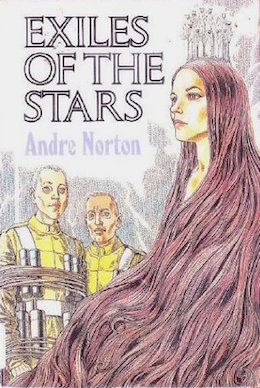
After the pure heart-love of Moon of Three Rings, which blurs out the critical faculty and leaves me flailing happily if helplessly whenever I reread the book, I find I can read its sequel, Exiles of the Stars with a much colder and clearer eye. It’s not a heart book, but it’s grand fun.
Krip and Maelen, each in a different body than he or she was born with, voyage as crew on the Free Trader Lydis. Krip is still assistant cargomaster as he was before his adventure on Yiktor. Maelen as essentially his pet, since for her sins against her people’s Standing Words she’s been exiled to the body of a small, lemur-like Yiktorian quadruped called a glassia.
Maelen still has some of her mind powers and all of her humanoid intelligence. Krip starts off believing he’s still his old self, though he now looks like Maelen’s Thassa relative: pale, attenuated, with silver hair and slanting eyebrows, i.e., more than a little bit elvish. In the course of the novel he’s forcibly awakened to the fact that his mind powers, which in Norton’s spacer universe are called esper, have increased exponentially. Apparently the Thassa body has retained at least some of its original owner’s psi abilities. (The corresponding worry is that Maelen will lose her humanoid-ness and revert to glassia, but so far she’s managed to keep her personality intact.)
As the story begins, the Lydis is making a routine trading run to a familiar planet. The system’s original discoverer named the system Amen-Re and the five planets after other Egyptian gods. The Lydis arrives on Thoth during a political crisis and is strongly persuaded by the local priesthood to haul several shiploads of valuable, ancient, pre-human (or Forerunner) artifacts to safety on neighboring planet Ptah.
En route however, the ship is sabotaged and crashes on a different planet in the five-world system, a cold and stony wasteland called Sekhmet. The Lydis, stranded and without resources to repair the ship, calls for help from the Patrol, which is essentially the galactic Coast Guard.
What the Free Traders don’t realize is that Sekhmet is home to a vast and incalculably rich trove of Forerunner artifacts—and actual, cryogenically preserved Forerunners. To further complicate the situation, the Thieves’ Guild has discovered the treasure and is systematically looting it.
And that’s not all they have to deal with. The Forerunner army appears to be mostly long dead, but not only is there a physically defunct but still powerful esper in a box out in the open where it manages to attract Krip and Maelen’s attention, there are four ancient psi masters in the underground tomb/storage facility/treasury, and they share the Thassa predilection for body-swapping–or perhaps a form of demonic possession.
The males set about possessing the minds and wills of the Free Traders and their Patrol allies–keeping their (perfect) bodies in reserve and using the humans as disposable meat suits. One tries to possess Krip, but his Thassa mind powers save him. The fourth, a female, tempts Maelen almost irresistibly with her gorgeous humanoid body, but Maelen, like Krip, manages to resist. It’s clear the aliens’ goal is to take over all three factions of humans who have invaded their resting place, seize their ships, and foray off the planet, with catastrophic results.
After many alarums and dangerous excursions, Krip helps his crewmates and the Patrol overcome the male aliens and capture the thieves, and Maelen fights a pitched psychic battle with the female alien. The Forerunner tricked her glassia body into a fatal fall, and she fights for possession of the alien (but humanoid and gorgeous) body. Eventually she wins.
She and Krip are now impossibly wealthy, more than enough so to buy their own ship. Krip has realized that he’s no longer a Free Trader; his chief loyalty has shifted to Maelen. But he’s not a Thassa either, and neither is Maelen. They’re both exiles, and they’re both estranged from their original people. They sail off into the sunset together.
This is not a romance, except in a very subtle, understated way. There’s almost nothing physical about the relationship between the protagonists, though Krip clearly has a thing for Maelen’s original Thassa incarnation. It’s a literal meeting of two minds, and Maelen is the stronger of the two, though Krip more than holds up his end of the support network. He saves her before her glassia body can die and manages to get it into stasis, and backs her up so that she can fight the Forerunner and win the day—and the shiny new body.
This book has a lovely quantity of my favorite things. Archaeological mystery. Body-swapping. Psi powers. The Egyptian connection—not just the names of the planets, but the alien psi masters take the form and aspects of Egyptian gods, and seem to have had something to do with the Great Pyramid. That’s claptrap of course; but fun claptrap.
When I reread this, I started to wonder about Stargate. This novel predates the film by over a decade, and ancient aliens, alien mind parasites, and ancient Egypt are all tropes of the genre, but…maybe…?
This is quite a retro-minimalist spacer universe. By 1971 when the book was published, Star Trek Classic had come and gone, with its depictions of artificial gravity, spacious ships, replicators, teleportation devices, and many another fine amenity. Yet Norton’s characters are still boldly going in Stubby the Rocket, complete with fins. There’s antigravity on a small scale, for moving cargo, but artificial gravity isn’t happening, at least for Free Traders (and the idea that a ship in planetary orbit has gravity…uh, no).
Free Trader ships are submarines of the stars. Tiny, cramped, apparently devoid of open spaces, with little or no redundancy. The Lydis has one flitter for planetary travel, so if that’s lost, that’s it. Food is basically MRE’s—no sign of a galley. I have no idea how life support can work, or what they’re using to generate water and oxygen.
And the fact that spacers have deep tans—I guess because of cosmic rays? Which means no shielding? But their ships are making it through atmosphere for landing on planets, and not cooking everything inside?
Humans must have mutated or evolved to the point that they can tolerate radiation without becoming masses of cancer. Krip wouldn’t know; it’s clear a lot has been lost in (only) a thousand years since Earth developed space travel. But how does his Thassa body manage, with that white-white skin? Is he a cancer diagnosis waiting to happen?
Information is on tape—that’s truly quaint, though at the time, tape was high tech. It’s interesting to think that our information technology has advanced so much in under fifty years that this future is really only possible if there’s a massive technological collapse—and then how do people get into space? Forerunner artifacts?
The focus here is not on the science but on the characters and the adventure. Spaceships are a means to get the characters to the planet, then they have their adventure, discover things about themselves and each other, and get it together in the end, chastely (even the kiss is described obliquely).
The one “science” that does get a detailed examination is psi. In the John Campbell era, that was an accepted component of science fiction, though it’s sunk into disrepute since. This novel runs on esper; the main antagonists are masters of it, and so is Maelen and to a lesser degree Krip. It’s esper that helps to crash the Lydis, and esper that gets the crew into deep trouble but also gets them out again.
My worldbuilding sense kept stuttering and sputtering during the reread, and this is a truly dire universe for women (unless they’re drop-dead-gorgeous alien sorceresses), but as a reader I am still twelve. And there’s enough adventure and excitement, and just enough subtle romance, to keep my inner twelve-year-old reading happily through to the end and daydreaming about where Krip and Maelen will go next.
Actually I know where they went—Flight in Yiktor—but that’s a read rather than a reread, and I’ll come back to it later. My next venture into Norton’s worlds will be the one originally promised: Witch World and its array of sequels. Meet me there?
Judith Tarr forayed into the Witch World with a novella, “Falcon Law,” in Four from the Witch World. Her first novel, The Isle of Glass, appeared in 1985. Her new short novel, Dragons in the Earth, a contemporary fantasy set in Arizona, was published last fall by Book View Cafe. In between, she’s written historicals and historical fantasies and epic fantasies and space operas, some of which have been published as ebooks from Book View Café. She has won the Crawford Award, and been a finalist for the World Fantasy Award and the Locus Award. She lives in Arizona with an assortment of cats, a blue-eyed spirit dog, and a herd of Lipizzan horses.

Not having been big on the forerunner books but:
Witch World! Witch World! Party Time! Excellent!
Norton’s genre-changing transition from hard SF to fantasy was one of my favorite reads as a kid. Looking forward to your take on it!
Thanks for the heart=love reminder for Moon of Three Rings. Added to the reread list. Alongside Forerunner Foray, another Norton classic.
Cheers — Pete Tillman
When Norton started writing, I think the effects of radiation were far less understood (if you ever want true-life horror stories, read some accounts of the Downwinders whose communities were exposed to radiation from bomb testing. People would actually go out to watch the bombs explode because they thought it was safe). Also, she presented a universe where one of the major signs of being from the more technologically advanced society was having dark skin.
But, when Norton creates a sexist society, like the Traders, it’s not without comment. IIRC, in her book Dread Companion, the heroine is an orphan with few prospects. The Traders are already developing into a male dominated society. It’s hinted this is the result of women in their society suffering especially heavy casualties in recent wars. They responded by isolating the surviving Trader women and overprotecting them. The heroine knows she could have a future with them, but it’s one she finds appalling.
In other words, while we see the Traders in this story mainly through the eyes of a man who accepts the way things are, it doesn’t mean Norton approved or didn’t have some opinions that she allowed other characters to voice.
The alien, by the way, may be beautiful, but Norton’s heroines often aren’t. Many are either plain or racially different from the people they live among, physical appearance creating a barrier. Of course, that means I’m putting one, beautiful alien (who may have stolen the body from someone else because it was beautiful) in context of a bunch of other stories instead of just judging it on its own, which may not be fair.
I remember reading at least one book (can’t recall if it was 50s/60s or more recent) where people had a “spacer tan” that was basically just your head from being in a pressure suit with a bubble helmet.
For an example of a book that just Didn’t Understand Radiation, try Assignment in Space with Rip Foster (a.k.a. Rip Foster Rides the Gray Planet), in which Rip and a bunch of other clean-cut young men ride a thorium asteroid from the Belt into Earth orbit.
And I didn’t realize the Forerunners were so widespread in Norton’s fiction — I mostly remembered them from Forerunner Foray.
Andre Norton did not do romance well. In Dark Piper, one of her all-round best IMHO, there is a relationship of sorts between Vere Collis and Annet Ahren, a relationship of mutual trust and help. Then after the story’s effectively finished with the children being the only humans still alive on the planet, we learn the two have married and have a child. In the Janus pair of books Naill/Iyyar and Ashla/Illylle are perhaps the closest of the working set but they are friends, and sometimes not even that.
Ironically the only one which I have been sure she has a “romance”, though she works overtime to obfuscate it for the sensitivities of the average reader, is Catseye. Troy Horan notices Hunter Rerne and studies him on their first meeting. Then they have an encounter swimming by a small lake that has always struck me as being more intimate that robust. And Rerne regularly turns up in person afterwards. It strikes me as it did when I first read the book, that Troy and Rerne had found each other and were just waiting for the other to calm down …
And Forerunners – nobody does Forerunners like the Strugatsky Brothers. The Forerunners of the Halo series are nothing compared to the full enigma wrapped in a mystery of the Strugatsky Forerunners. It should come as no surprise that Andre Norton’s Forerunners tend to be somewhat pale intimations of mystery as well.
(To add an additional note; since the Thassa are “elvish”, “of faerie”, I’d always retconned the pale elvish light surrounding the Tolkien Elves as being the result of quantum foam spitting out electron-positron pairs around them, with the positron being instantly annihilated and emitting its due quantum of energy, downgraded into visible light by the Elvish (instinctive) control of space and time. As such, a being with that Elvish pale skin and such local space-time control would be in no danger of radiation sickness or poisoning. FWVLIW, though, all folk/fairy tales about beings that have such pale skins have their basis in the unpleasant fact that the dead have paler skins than the living, and the spirits of the dead, have a closer relationship to nature spirits than they do to their former compatriots. FWVLIW. :)
I never thought about Norton’s Patrol being like the Coast Guard, but looking back, it is true. I wonder if a steady diet of her books during my youth was one of the factors that inspired me to join the Coast Guard?
Aladdin_Sane now that you mention it about Catseye… I originally read Andre’s Star Hunter after reading Forerunner Foray and Dread Companion where the women protagonists spent most of the story wary of/fleeing from the men they eventually found themselves falling in love with, so I got the feeling that Vye Lansor & Ras Hume rode off into the sunset together as a gay couple at the end. Why else would Vye decide to stay with someone who had him mind-wiped, personalty imprinted to be a sleeper agent, and thrown into a potentially fatal situation against his informed consent, unless he fell in love with Ras? It’s a weirdly Stockholm Syndrome type story. Their age difference is uncomfortable, but after surviving the mean streets (and the perils of the story), teenage Vye lost his innocence pretty quickly and Ras doesn’t strike me as a parental type to put it mildly…! It’s interesting how Andre’s characters can be very practical and make peace with what life has handed them and move forward from there instead of railing against it like so many other protagonists tend to. Anyway, so what do you think, were these Andre’s coded-gay protagonists? She was a very progressive author when it came to having non-caucasian/non-mainstream main characters and casts. Did she quietly find a place in her universe for gay folk too?
After you read Flight in Yiktor and Dare to Go A-Hunting… Andre wrote a short story that takes place after those. It was never published but you can read it here with a number of other unpublished short works: http://andre-norton-books.com/index.php/witch-world-saga/78-andre-s-book-of-shadows/801-07-the-legend-of-the-fairie-stone