






Young people nowadays have been trained by dystopian YA fiction to see the worst in every situation. They focus on the downsides of climate disruption, increasing socioeconomic stratification, and the ongoing collapse of civil liberties, and ignore any potential upsides.
Consider what a privilege it is to be among the last humans to see many species soon extinct! Imagine the tales young people of our time will be able to tell their grandchildren (were not for the fact many of them won’t have children and prospects of grandkids are even more dismal)! Why, one can even take comfort from the fact that in a million years the sum total of all human accomplishment may be recorded in an aesthetically pleasing discoloration between adjacent layers of sedimentary rock. Natural artistry!
But pessimism is nothing new, of course. Olden time SF authors were enormously pessimistic, producing works every bit as sour and gloomy as the most morose works penned by today’s authors. Don’t believe me? Here are five intensely depressing SF novels from the long, long ago. I recommend each and every one of them, if only to cast your current circumstances in a more favourable light.
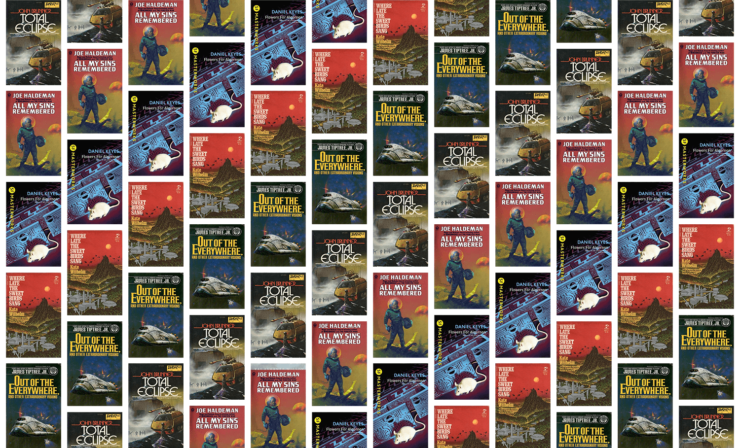
Flowers for Algernon by Daniel Keyes (1966)
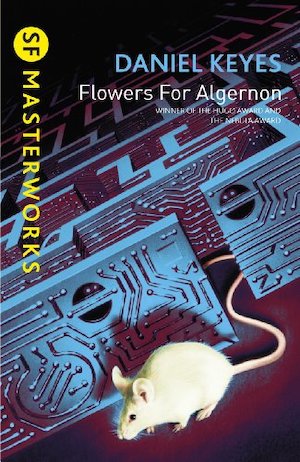
Told in a series of diary entries, Flowers depicts Charlie Gordon’s intellectual journey. Born intellectually disabled, Charlie is subjected to innovative medical treatments that raise his IQ of 68. He meticulously documents his experiences as his enhanced cognitive functions reach the average, then soar far beyond. Once pitied and mocked by those around him, now Charlie is a respected genius.
The downside to all this? Many downsides. For example, until his intelligence was amplified, Charlie had no idea how much those around him had been making fun of him. Were that not bad enough, he discovers that exceptional intelligence can be as socially isolating as a lower IQ score. Worst of all, the uplift process proves temporary and ultimately fatal. His cognitive decline is swift and brutal. Thanks to the diary, the suffering reader must follow Charlie’s every step towards oblivion.
Total Eclipse by John Brunner (1974)
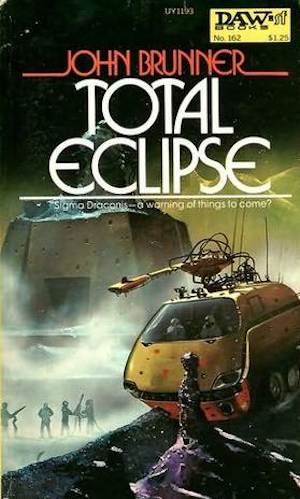
The stellar systems Proxima, Epsilon Eridani, and Tau Ceti were bitter disappointments to early interstellar explorers. Undaunted, humans pressed on as far as Sigma Draconis, which turned out to possess a terrestrial world that is very nearly a second Earth. Indeed, the new-found world is so Earth-like as to have its own native civilization. Rather, to have once had such a civilization, a hundred thousand years earlier.
The fossil record is quite clear about the duration of Draconian civilization: three thousand years between rise and fall. The fossil record is silent as how a culture as technologically advanced as any on Earth could simply vanish. One of the tasks facing the 2028 expedition is to determine what happened to the Draconians. A far more pressing question, one whose answer is quite displeasing, is whether the Draconian fall was unique to their species or if divided, strife-torn, foolish humanity is even now marching resolutely towards its own final doom.
Where Late the Sweet Birds Sang by Kate Wilhelm (1976)
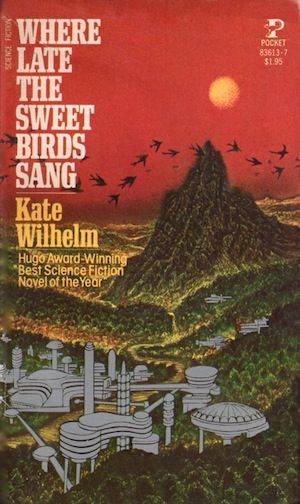
Humanity has industriously worked glorious transformation on the Earth, the equal of the End Permian and the End Cretaceous, perhaps even the Great Oxidization Event. It’s an achievement in which to take pride, save for the pesky detail that humanity itself is among the species being quickly ushered towards mass extinction by pollution and radiation-induced infertility. Personal doom can be such a downer on an otherwise momentous occasion.
Fortuitously for the Sumner clan, not only are they largely indifferent to the fate of people with the poor taste not to be Sumners, and not only are their vast Shenandoah Valley holdings an ideal redoubt in which to wait out the collapse of civilization, their great wealth has provided them with the means to circumvent infertility and thus extinction: cloning. A succession of perfect genetic replicas will ensure the Sumner legacy survives. Or so it appears, before certain previously undocumented features inherent in cloning manifest…
All My Sins Remembered by Joe Haldeman (1977)
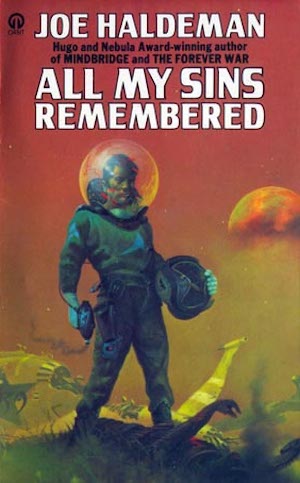
The TBII serves the Confederación’s best interests, as defined by the TBII. To this end the TBII is always searching for promising recruits. Fit, bright Otto McGavin would be perfect, if only the Anglo-Buddhist were not an idealistic pacifist adamantly opposed to the ethical compromises the TBII believes are necessary to protect the Confederación. If asked, McGavin would refuse the roles of spy, thief, and assassin in the name of the greater good. Happily for the Confederación, the TBII isn’t asking.
If one’s chosen tool is unsuitable for the task at hand, reforge the tool. McGavin’s fundamental personality is contrary to needs. Therefore, TBII applies conditioning and hypnosis to scour away McGavin’s inconvenient ethics, transforming him into the deadly, ruthless agent the TBII requires. And if there’s some tiny sliver of McGavin still aware as his brainwashed body is dispatched on bizarre, dangerous missions? There’s always another conditioning session waiting for McGavin at the end of the assignment.
The Screwfly Solution by James Tiptree, Jr. (1977)
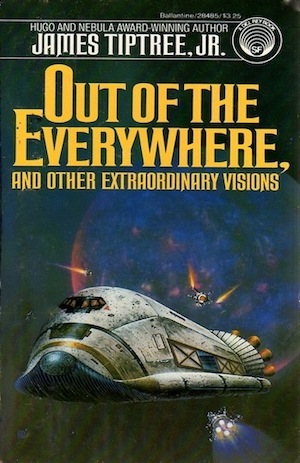
Earth is promising real estate, save for the minor detail that it is overrun by humans who insist on claiming the planet as their own. A hypothetical galactic real estate agent might pale at the cost of removing humanity militarily. Humans are, after all, as heavily armed as they are numerous. Obliterating humans directly could be expensive and might do untold damage to the environment.
There is no need for direct measures. Among humans’ many fundamental characteristics: a tension between men and women. Amplifying ongoing low-level hostility into homicidal fury could be as easy as a minor tweak in brain chemistry. No doubt even as they turned on human women, human men would tell themselves some convincing lie explaining why mass murder was necessary. Then, all our hypothetical aliens need do is wait for human nature to solve the problem of humanity.
***
These are, of course, only the tip of a very large iceberg. No doubt many of you have your own bleak favourites from this era. Feel free to name them in the comments.
In the words of Wikipedia editor TexasAndroid, prolific book reviewer and perennial Darwin Award nominee James Davis Nicoll is of “questionable notability.” His work has appeared in Publishers Weekly and Romantic Times as well as on his own websites, James Nicoll Reviews and the Aurora finalist Young People Read Old SFF (where he is assisted by editor Karen Lofstrom and web person Adrienne L. Travis). He is a four-time finalist for the Best Fan Writer Hugo Award and is surprisingly flammable.

On the Beach man. ON THE BEACH.
Brunner “The Sheep Look Up”. The way things got worse and worse and worse… most depressing I ever read.
#2: I think James could very easily have made this a list of “Twenty Extremely Pessimistic John Brunner Classics”!
The Crucible of Time ended fairly well for those who were still alive.
Not all Brunner is pessimistic. Some of his early to mid-career space operas are upbeat…ish. Of course, they also aren’t as good as his pessimistic, New Wave stuff.
The Haldeman was an interesting read, as it’s a set of short stories with connecting passages written for the book, and it’s the connecting passages that tell us that everything good that got done was either undone or suppressed with heavy-handed authoritarianism. The individual stories are relatively (in that there’s some hope at the end) upbeat.
I wonder if this was Haldeman looking back on his earlier work and deciding not to rewrite them, but to add codas that describe how he really felt about outside intervention.
@1,
You beat me to it!
Surprisingly, a lot of the Heinlein juveniles were set in rather grim dystopias. Red Planet had a corrupt colonial bureau running things. Between Planets had a fascistic and militaristic Federation. Citizen of the Galaxy raised its main character in a slum. Farmer in the Sky had the Earth in a losing battle to produce enough food to head off a Malthusian disaster (and calorie rationing is mentioned in some of the other books).
The Infinitive of Go was another optimistic Brunner. The Shockwave Rider had an optimistic ending.
Childhood’s End is ambiguous. Did we transcend or were we eaten?
“Murphy’s Hall” by Poul Anderson.
@8 In “Time for the Stars,” Earth is severely overpopulated and the narrator’s family is penalized because his mother unexpectedly had twins instead of a single birth. In “Starman Jones,” society is rigidly stratified, with hereditary guilds controlling the best professions (especially those involving space travel) with little or no chance for anyone outside those families for advancing. In “Space Cadet,” world peace is maintained by a supranational militaristic “Patrol” with control over orbiting nuclear arsenals, apparently answerable to no civilian authority.
James Blish, Black Easter.
Sure, the sequels improve things, but as a standalone it’s super pessimistic.
Has one of those wham final lines. “The War is over. God is dead.”
For a somewhat newer, but still depressing work, Kaleidoscope Century by John Barnes. (The whole series is dystopian, of course)
Not to forget “The Humanoids,” by Williamson.
I’m glad you mentioned “Total Eclipse” – or I would have had to mentioned it.
Brunner’s Shockwave Rider is positively gleeful compared to Sheep and Stand.
Hoom. Stand on Zanzibar has, if not a happy, at least a hopeful ending.
Anyway, doom, gloom, and room 101… Nineteen Eighty-Four is pretty devastating, even if Orwell wasn’t technically an SF writer…
And I’m certainly not going to pass up the opportunity to hype Bunch’s Moderan, a perfect example of a dystopia whose inhabitants all think it is a utopia.
Re: Optimistic works by John Brunner.
”The Wrong End of Time” is reasonably optimistic about humanity in general.
Greg Bear, Forge of God. Earth is destroyed by alien griefers. Most depressing sci-if novel I ever read. A few surviving children get revenge in the sequel, but overall the books are bleak.
@9 / @15 : Shockwave was my immediate reaction to James’s claim; it’s a USian version of Stone, which means it depends on the incredible abilities of one person rather than some ordinary people making sensible decisions — but it does end with a plebiscite whose probable outcome is bleak only to hardcore libertarians. I would also note that The Jagged Orbit ends hopefully — unlike (contra @16) Stand on Zanzibar, where we realize that the one person who could have fixed things is dead. I’d amplify @5, arguing that most of the works up to SoZ are optimistic. The bleak gets serious (if not outright starting) the year before SoZ (1968) with Quicksand (1967) , but there are other later works in which but the people we want to see come out ahead do so in a number of later works: Black is the Color and Timescoop (1969), The Gaudy Shadows (1970), the abovementioned The Infinitive of Go (1980), etc. It may be telling that most of the pessimistic works are doorstops (and vice versa), where paperbacks of the more-hopeful works would actually fit in a pocket.
wrt Heinlein juveniles, what one thinks of the various worlds depends on where one stands — but ISTM that none of the ones named actually have downer endings; the lead character is sometimes sadder-but-wiser, but usually he’s not even sad. (Yes, “he”; Heinlein, like Norton at that time, had a one-sex target audience.) The universe may not be fixed yet, but it’s getting better — typically through the agency of the lead character.
Consider Phlebas. Saddest scifi book I’ve read.
Fiat Homo. Fiat Lux. Fiat Voluntas Tua.
Philip Wylie’s The End of the Dream does a fairly good job of having us suffer the environmental consequences of our follies. Published in 1972, it’s his last novel, but it’s contemporary with the selections highlighted here.
The milieu of FM Busby’s Rissa Kerguelen/Bran Tregare novels includes an Earth largely populated by marginal ghetto dwellers living on welfare, which is maintained by a fascistic corporate oligarchy. It’s an environment most people would like to, and fail to, escape from. Which, as I recall, is why very little if any of the action of the novels takes place on Earth.
@16, while Nineteen Eighty-Four was pessimistic on the character scale, the ambiguity in the text itself means the setting itself may not be as bleak. Smith believes there’s three world-spanning empires, he believes there’s war going on all the time with shifting alliances, but note that his job is to change what everyone believes true.
As far as the reader knows, Airstrip One might be an isolated totalitarian dystopia, an English version of North Korea, and the majority of the rest of the world is enjoying peace and prosperity with widespread democracies whose only major conflict is making sure those English nutcases stay contained.
@10 – to rephrase a statement by Richard Pratt on education for native Americans:
“Kill the human, save the cell of the collective super-brain.”
@21
I dunno, that always seemed a hopeful ending to me, what with the spaceship lifting off for a New World at the end
@11 I believe you’re thinking of Tunnel in the Sky, which is an overpopulation dystopia, not Time for the Stars.
Time for the Stars belongs in a discussion of Science Fiction That Isn’t as Cool as You Might Expect.
Time is about one twin going into space for an experiment in ftl communication. He didn’t want to go. The twins (and one set of triplets) are very valuable. They don’t get to have adventures.
I didn’t like it as much as a lot of other Heinlein, and I didn’t realize why until I reread it as an adult.
THE SHEEP LOOK UP, for sure. I read it when it was first published & it has stayed with me for decades.
Also STAND ON ZANZIBAR, THE GLASS HAMMER.
@25
A spaceship rescuing a few people off earth because we’d launched ANOTHER nuclear holocaust on earth? To me, that seem not so much hopeful, but more an SFnal interpretation of the rapture.
@23: And indeed the very fact that the appendix exists at all says that, at least somewhere in the world and sometime in the future, things were better.
@26: Time for the Stars does include indications of population pressure (quotes copied from JDN’s helpful review of the book).
So it’s something like “Ender’s Game” in a way – extra children are a social disability, but some of them turn out to be highly valuable.
@23: This interpretation of Airstrip One seems to be the one that Alan Moore used in The League of Extraordinary Gentlemen. Most pertinently in _Black Dossier_.
A Canticle For Leibowitz must surely qualify.
Pretty sure “Screwfly Solution” was published under the Racoona Sheldon pseudonym – I have the original issue of Analog somewhere.
The Genocides makes these all seem like idle romps.
Blindsight by Peter Watts. (I mean, anything by Watts, but especially Blindsight). On a personal level, every member of the crew tormented and monstrous. Oh, and also consciousness is an aberration in species, unnecessary at best and detrimental at worst. And also, everyone loses and civilization is eaten. Par for the course with Watts really.
@22 I always wanted Busby to do a trilogy covering the time period that showed how Earth got there. Some of the decisions made, such as taking those who can’t support themselves and putting them into a place where they can get food and shelter, must surely have started from a compassionate place that turned to greed, I would think. It would have been interesting to trace.
I would have picked Joe Haldeman’s time twisty “The Forever War” instead. His “Mindbridge” is pretty out there too! How about “The Ophiuchi Hotline” by John Varley? A very heavy Zelazney short, “The Keys to December” is incredibly thought provoking. William Gibson’s breakthrough genre icon short “Hinterlands” is impressively bleak and twisty, as is “Neuromancer” of course. “Beyond the Aquila Rift” is an excellently written, seriously heavy short by Alastair Reynolds. Another short by Bruce Sterling, “Taklamakan” is as bleak as the Chinese desert it’s set in. I could go on forever…