






In this bi-weekly series reviewing classic science fiction and fantasy books, Alan Brown looks at the front lines and frontiers of the field; books about soldiers and spacers, scientists and engineers, explorers and adventurers. Stories full of what Shakespeare used to refer to as “alarums and excursions”: battles, chases, clashes, and the stuff of excitement.
Variety is the spice of life, and sometimes even a hard science fiction fan like me looks toward the world of fantasy for something different. And if you’re going to dabble in another genre, you might as well start with the best. So today we’re visiting Neverwhere, a seminal novel by Neil Gaiman, one of the best fantasy writers in the world, whose work has been delighting readers for decades. The book takes us to the mysterious world of London Below, a community that exists unknown to the inhabitants of the mundane city above it.
When you fall in love at first sight, you always remember that moment. Though in this case, it was love at first listen: It was 2004, and I was in Boston at Noreascon 4, the 62nd World Science Fiction Convention. It was one of the first conventions I attended after my dad died, and I was with my son and his wife. We were in the huckster room, and I was looking at copies of scripts from Babylon 5. I said to my son, “Here’s one script, ‘Day of the Dead,’ by that Neil Gaiman guy you like.” And he told me they were going to a reading by Gaiman, and even though I wasn’t familiar with his work, I should go along. So I did, and from the moment Gaiman opened his mouth, I was mesmerized. He was reading from the book Anansi Boys—at the time, a work in progress. He was witty, charming, and the hour flew by in what seemed like a moment. I started seeking out his work, and was amazed to find that the poetry of his voice came through even when I was reading the words on a page.
When I first thought of reviewing Neverwhere, I thought it might be a departure from my normal choices for this column. But looking back at previous reviews, I find that we’ve visited a world beneath our feet with Tarzan, fought eldritch threats with Conan and Northwest Smith, and sat amongst wit and whimsy at Callahan’s Bar—all elements that you find in Neverwhere. And Gaiman is a skillful writer whose work has rigor to compare with the best of science fiction. When he sets up the rules for magic in his fantasy worlds, he sticks with them. In picking this work, I was also concerned that Gaiman is a younger writer, and that his work might be a bit recent for the purposes of rereading, but the revised edition of Neverwhere that I got for Christmas turns out to be a 20th anniversary edition. The author I think of as a young voice has actually been writing for quite a while.
About the Author

Neil Gaiman, born in 1960, was a voracious reader from an early age, and started writing in his teens. His first professional writing experience was for a variety of British magazines, and included both factual articles and fiction. His first work of note was in DC’s comic books, where he initially pitched a revival of the mid-‘70s series The Sandman, eventually creating an entirely new character who shares a name with the earlier superhero; Gaiman’s Sandman, Morpheus, is a mystical being quite unlike the superheroes that normally appeared in comics. Gaiman worked threads of myth, horror, and epic fantasy into the tale, and soon the Sandman was one of a whole pantheon of god-like beings, with his older sister, Death, becoming a fan favorite. The series became wildly popular, both within and outside the traditional comic book community, and many appeared in the form of graphic novels, powering an explosion of growth for this new, more durable form of illustrated works. Gaiman also wrote adventures for more traditional DC comic characters, and for Marvel comics.
Gaiman’s first novel was a collaboration with Terry Pratchett, Good Omens. His second was Neverwhere, an expansion of a teleplay he had written for a BBC mini-series. Then followed Stardust, a tale of a young man finding his destiny in the land of faerie, later adapted as a feature film. Next, Gaiman produced the work he probably is best known for, American Gods, an epic adventure involving ancient gods brought to the New World by travelers and immigrants, whose power is derived from the fervency of their followers’ belief. American Gods has since been adapted as a television series, with a second season currently in the works. A direct sequel, Anansi Boys, was set in the world of American Gods, and follows the adventures of the sons of Mr. Nancy. Gaiman’s most recent solo novel for adults is 2013’s The Ocean at the End of the Lane, a story of a man returning to his childhood home.
Gaiman has produced many works for younger readers, including short picture books and longer works. Notable among these works are Coraline, about a young girl transported to a menacing alternate world, which has been adapted into a stop-motion animated film, and the Graveyard Book, which followed the adventures of a boy raised among the ghosts and other inhabitants of a cemetery. (And because I have left out so many works, here’s a link to a more complete bibliography.)
Even after moving from comics to prose, illustrations have remained an important part of Gaiman’s work. His collaborators include Dave McKean, Charles Vess, P. Craig Russell, Daniel Egnéus, and Chris Riddell, among many other notable artists.
I have long known that Gaiman’s work has been recognized by many literary awards, but in researching this article was stunned to see just how many awards he has garnered over the years. He has received six Hugos, two Nebulas, three Harveys, fifteen Eisner Awards, four British Fantasy Awards, and both the Newbery and Carnegie medals. A more complete list can be found here.
The World of London Below
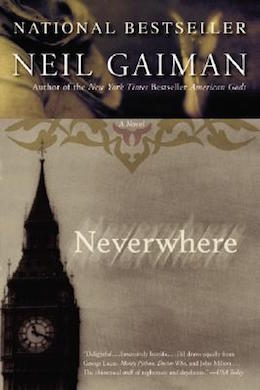 Gaiman’s London Below seems to have grown out of wondering what happens to the city’s less fortunate—those who because of disease, mental illness, or just bad luck, drop through the cracks of modern life, those who most people try to ignore as they move through their daily lives. It draws on the fascination we all have with subways, sewers, and dark alleys, mysterious openings to places we are not allowed to go. And like all Gaiman’s work, it weaves together threads from myth, fables, fiction, and urban legends in a way that makes those elements part of Gaiman’s own unique world.
The central conceit of the novel is that all the names of tube stations should be taken literally. There are actually black friars at Blackfriars, an Earl holds court at Earl’s Court, and a shepherd leads a flock at Shepherd’s Bush. And ruling loosely over this fractious world is the family of the Lord Portico, who have the power of opening any door…and even making doors where none previously existed.
One of the few organized activities in London Below is the Floating Market, an event held regularly at random locations. All manners of goods and services are available at the market, and custom requires everyone attending to adhere to a rigidly enforced truce. It is at the market that the people of London Below come together in peace to trade, eat, and to gossip.
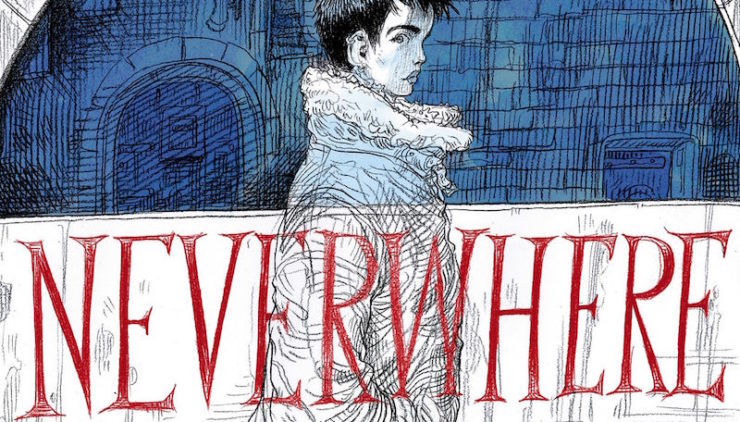
The edition I read for this review is the latest, issued just this year, with another reworking of the text that draws on all previous versions of the novel, and gorgeous illustrations by Chris Riddell. There are some full-page plates, but many of the illustrations twine through the margins, and even the text itself, in a wonderfully evocative manner. The volume also includes the related short story “How the Marquis Got His Coat Back.”
Neverwhere
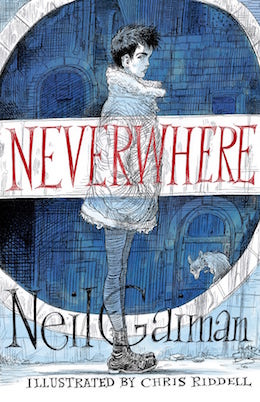 The protagonist of Neverwhere is Richard Mayhew, a young Scot whose life in London is wholly unremarkable. He works at a seemingly dead-end job of a vaguely financial nature in a cubical that’s unique only because of his collection of toy trolls. He goes out in the evenings with friends from work, and is engaged to Jessica, a beautiful woman he thinks is too good for him, but who we come to recognize as vain and more than a bit self-absorbed.
Richard’s one notable characteristic is his empathy. When he and Jessica are going to a dinner with one of her clients, they come upon a tired, wounded, and raggedy girl. Despite Jessica’s insistence that their dinner must come first, and her warning that if he helps the girl she will break off the engagement, he picks the girl up and brings her to his apartment. She introduces herself by the strange name of Door, he treats her wounds as best he can, and soon receives a visit from the menacingly evil pair, Croup and Vandemar, who claim to be relatives concerned for Door’s safety. Door escapes capture, mysteriously disappearing from the apartment.
Door sends a rat to summon the Marquis De Carabas, and sends Richard to negotiate with him. Richard finds De Carabas to be flamboyant, untrustworthy, and apparently a Marquis under nothing but his own authority, and accompanies him on a dizzying visit to Old Bailey, a bird lover who lives in the high places of London. Richard sees an entire side of London, and new ways of traveling, that are completely unknown to those of London Above. The Marquis comes and collects Door, but after they leave, Richard finds himself invisible to everyone from his former life. So he sets out to find Door and figure out what happened. With the assistance of a beggar, he finds his way to London Below, where a powerful rat assigns him a rat-speaker named Anaesthesia as a guide. They set out for the next Floating Market, but must cross Night’s Bridge to do it. Before crossing, they meet a leather-clad woman, who warns them that there are not knights on the bridge (a nod to the tube station’s name “Knightsbridge”), but instead they must face the terrors and darkness of the night. Richard is distraught when Anaesthesia disappears during the fearful crossing of the bridge. Richard and the leather-clad woman find their way to the Floating Market, this one being held in Harrods (the famous department store). Door and De Carabas are auditioning bodyguards through trials of combat, and Richard learns that the woman he’s traveled over Night’s Bridge with is the legendary Hunter, and when she vanquishes all, Door hires her. Richard finds that because he intervened in the affairs of London Below, he is no longer able to interact with the surface world. Door takes pity on his situation, promises she will do what she can to restore his safe and dependable former life, and invites Richard to join their quest.
During their travels, they will face the continuing threat of Croup and Vandemar, the Great Beast of London, a seductive and mysterious woman known as a “Velvet,” the challenge of a horrifying ordeal, a dangerous encounter with an ex-fiancée, treachery from within their band, and even death itself. They also encounter wonders: an Earl who holds court on a subway train, a sad and powerful angel, an order of monks guarding a powerful secret, and the mysterious Serpentine of the Seven Sisters. Through it all, the companions slowly unravel the mystery surrounding the death of Door’s family, and find that things are never quite what they seem.
Throughout these adventures, while it shows us a world that is cruel both below and above, the book itself has a warm heart and a generous spirit. There are horrors, betrayals, and suffering along the way, but it turns out that empathy, compassion, self-sacrifice, and the courage to do the right thing are the most important qualities of a hero.
Lagniappe (aka, A Little Something Extra)
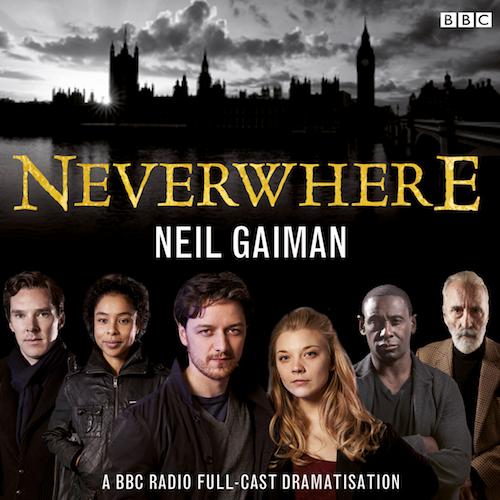
Fans of Neverwhere had to wait long time for a chance to revisit its world. There was an international edition that expanded the tale to make it more comprehensible to those unfamiliar with the London Underground, and then an “Author’s Preferred Text” version, but no additional forays into the world of London Below. Then in 2013, BBC Radio adapted the book as a radio play, a first-rate production featuring James McAvoy, Natalie Dormer, David Harewood, Sophie Okonedo, Bernard Cribbins, and Benedict Cumberbatch.
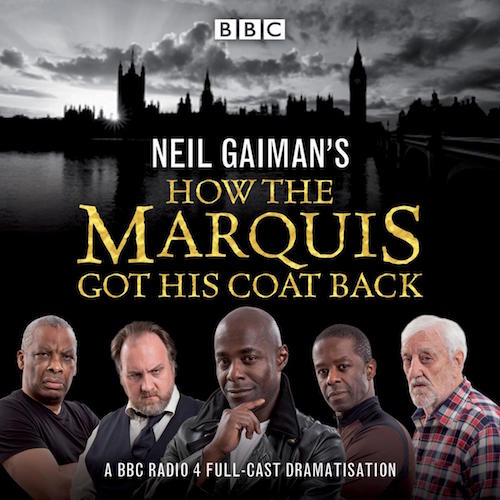
Gaiman was so pleased with the results that he pulled out some notes he had made for a follow-up adventure, and finished a new tale that explained how the Marquis de Carabas regained the coat he lost in Neverwhere, aptly titled “How the Marquis Got His Coat Back.” This was also produced by BBC Radio as a shorter radio drama of the same high quality as Neverwhere. David Harewood was apparently unavailable to reprise the role of the Marquis, so it was voiced by Paterson Joseph, the actor from the original TV production. This change was amusingly explained by the character as an unavoidable consequence of having his throat cut during his previous adventures.
BBC Radio has also done good work with audio dramas of other Gaiman works over the years, including Stardust and Good Omens.
Recently, to the delight of fans, Gaiman has announced that he is working on a sequel to Neverwhere, to be called The Seven Sisters—a reference to the briefly mentioned and rather mysterious women who assist Door, Richard, and Hunter during their quest.
Final Thoughts
Neil Gaiman is a treasure, and his work continues to delight fans the world around. He takes elements and allusions from myth, legend, and literature, and melds them into something that is uniquely his own. His prose often feels like poetry, with a keen sense of wit and irony throughout. Neverwhere, an early work, shows that he had mastered those qualities right from the start of his career, and is brimming with energy and filled with fascinating characters in unique settings.
And now, I turn the floor over to you. What are your thoughts on Neverwhere? Is it your favorite work by Gaiman, or are there other tales you prefer? Which adaptations of his work in other media have you enjoyed? What do you look forward to seeing from him in the future?
[P.S.: The Christmas after Noreascon 4, my son gave me a copy of the Babylon 5 script we were looking at, which he had gotten signed by Gaiman later during the convention. Do I have a good son or what?]
Alan Brown has been a science fiction fan for over five decades, especially fiction that deals with science, military matters, exploration and adventure.

I don’t think I could pick a favourite Gaiman but Good Omens may have been the most important to me. He is one of the few speculative fiction authors whose books I have taken to consistently buying in hardcover. In terms of adaptations, I listened to the Anansi Boys and Good Omens radio dramas last Christmas and I have also seen the film version of Coraline; I enjoyed all three. I am looking forward to The Seven Sisters: Gaiman’s latest Tumblr update is that he is 1/5th of the way through, though he won’t return to it until he finishes the Good Omens television series (which is also eagerly anticipated).
Aside from all that, I suspect this entire article may have been a stealthy way of softening us up for a review of Babylon 5…
All I can think is, it’s been too long since I’ve read this book.
‘How the Marquis got his coat back’ also featured comedian and expert comic songster Mitch Benn [in the photo above].
There was also a TV adaptation of ‘Neverwhere’ :-
http://www.imdb.com/title/tt0115288/fullcredits
[With Paterson Joseph as the Marquis of Carabas!]
I like that you talk about where you were when you encountered this. The first time I read Neverwhere was on a flight from Australia to France. I finished it and wanted to just turn back to the first page and start again. There’s something very refreshing about Neverwhere that makes me come back to it over and over again. This is probably my favourite Gaiman book.
In Neverwhere I think Neil Gaiman really marvellously captures the practicality of outsider cultures. In our own little sub-communities everyone is normal. I really enjoyed how when Richard goes from what he thought was the ‘normal world’ to London Below, everyone treats him like the outsider and the freak. I think it’s a very heart warming point that there is no ‘normal world’, or I guess rather we are all living in our own little bubbles of normality.
I tried to watch the old BBC tv version of Neverwhere, but I already had the characters too well developed in my mind, so I turned it off.
@3 Other way around – the novel Neverwhere is the expanded adaptation of the screenplay Gaiman wrote for the series, partly with the mindset of trying to remedy some of the hokier special effects the budget left them with.
The TV series is generally quite good, especially for the time it was done, but the book is far richer, and the radio adaptation even better still, bringing everything to life.
Neverwhere will probably always be my first true Gaiman and very fond memories because of that – Good Omens is my favourite overall but too much a blend of both authors. I think in general though I moat praise his short stories they have that same twist of the eerie and the macabre as Roald Dahl’s adult tales.
I’ve been teaching Neverwhere for a couple years now in a class on fantasy depictions of doubled Londons, mostly because I love it. It’s consistently their favorite (though I also put it first, so that might affect things). They usually note Richard’s distinguishing feature not as empathy per se but as noticing or seeing. He sees the lady outside the pub in the prologue; he sees Door; he sees the rat…he doesn’t always react well, or understand things, but he sees what’s in front of his eyes and doesn’t deny it. That’s what makes him ultimately a hero–and what makes him dissatisfied in London Above when he comes back.
I love this book and just reread it. Its not about the story or the setting, although those are good. It’s about the tone and authorial voice. I just enjoy the feeling that I’m sitting around a campfire listening to him spin a yarn.
Most people don’t notice any difference between the US version and the “Author’s Preferred Text.” I sure didn’t. The author’s version of American Gods was easy to notice; it was longer, slower paced, and had more flashbacks.
Gaiman said the main new things in the “Author’s Preferred Text” of Neverwhere are some jokes. Has anybody ever listed all the new text in the Author’s Preferred version?
@1 Reviewing B5 would be a departure from my normal scope, but then again, if there are bodies of work deserving to remain in our collective memory, that series is certainly one of them. Hmmm…
@@.-@ Thanks for the kind words. I always like to put the works I review into some sort of context; the times they were written in, or the times in which I encountered them.
@6 Seeing. I had never looked at it that way, but it is a good way of describing what makes him special.
@7 I don’t know of anyone who has identified exactly what the changes were…the results sure would be interesting from a scholarly perspective.
@7: The “Author’s Preferred Text” is a hybrid of the earlier British and American versions with additional explanations and alterations (including a different introduction for Croup and Vandemar) from the American edition and jokes from the British edition (taken out because Gaiman’s US editor thought “American readers would not be able to cope with jokes in a book that wasn’t meant solely to be funny”). In total, 12,000 words were added to the US edition and several thousand words were cut, so the difference would be more noticeable for readers of the original UK edition. I only have the APT so I wouldn’t be sure.
I first discovered Gaiman through American Gods when it first released and immediately went back and found Neverwhere. I have read each multiple times, but I still can’t decide which of the two I would say is my favorite. Even as I am typing I thought, well this one had a richer world and then instantly changed my mind. Suffice it to say, Gaiman is a master.
Al mentioned the ‘poetry of his voice’, I can’t help but echo that sentiment. Listening to Gaiman is magical and you become absorbed in his words. Many authors should never, ever read their own work, he is the exception. Listening to his rhythm and intonation and the emotion he adds enhances his clever, witty, and emotional characters so much so that I almost prefer listening to his books.
I also agree with Al regarding Gaiman’s wit and charm, although I have not had the privilege of seeing Gaiman in person I have listened to ‘An Evening with Neil Gaiman & Amanda Palmer’ (https://goo.gl/C8zbiP) and I highly recommend it, it is fantastic and entertaining, humorous and thoughtful. He reads some of his work, shares personal anecdotes and even sings with Palmer.
Of course, now all I want to do is reread Neverwhere! I have not yet read the newest edition.
The story goes that Gaiman was approached (by Lenny Henry) to write something for the BBC about homelessness, in order to raise awareness (and money), and Neverwhere is what resulted.
The TV series was my second contact with Gaiman’s work after Good Omens, and for me the on screen characters will be forever who I see in my head when reading the book.
For those who didn’t recognize him, Paterson Joseph can also be seen in tv series “Timeless”.
@6 What was the syllabus for your London assignment, Comfect? I can think of several possible titles, and I’m curious which books you chose.
I saw the BBC mini-series back in the 90s, before the novelization. Love both.
@11: Further to that, taken from the “making of” special for the mini-series, is the fact that Gaiman initially refused to do it on the grounds that he could make it look really awesome to be homeless (it was initially supposed to be less fantasy and more ‘set among London’s homeless’) and he didn’t want to have to hear about kids running away from home to live on the streets of London after watching the show. So he was given freer rein and this is what he came up with.
This is one of my favourite Gaiman books, second only to Good Omens because how can you go past Gaiman and Pratchett together? I saw the TV series first, and loved it, but the book is always going to be deeper and more nuanced just because more time can be devoted to character development and internal growth.
Oh, and if you watch the series, you get to see the 12th Doctor as the world’s second-creepiest angel. (He’d be first, except I’ve seen Christopher Walken as Gabriel…)
@15/Seona13 – given what Richard overhears, I think the Angel Islington has designs on being the first-creepiest angel. :)
I have NEVERWHERE on 4 CDs its a marvellous story Sir Christopher lee is not on it to long but its great to hear his voice, i recommend this story has its selling pretty fast, i was told it will not be re issued again on CD, so i was pretty dammed i got it. Thank you Christopher as this will go with my other CDs Christopher has done like Sherlock Holmes stories on CDs.