





In Which the Noldor Regroup (Mostly), War is Renewed, Dwarves Join the Fray, Dragons Are Unleashed, Men Prove to Be Faithful and/or Faithless, and Húrin Wears a Very Special Coat of Arms
Well, we’re way past the middle of The Silmarillion. If there was a line chart that showed the fortunes of the Elves in the First Age, we’ve been seeing the data points starting to tank. The first big drop was the Battle of Sudden Flame, but now we’ve come to Chapter 20, “Of the Fifth Battle: Nirnaeth Arnoediad,” and this is when things really go south.
Literally, as well as figuratively: As the Noldor try to rally and regroup and gather what allies they can for a retaliation against Morgoth, the Dark Lord proves that he’s been thinking about war a lot more than they have and still has untold strength. And in this chapter, his arm grows long indeed, reaching out of Thangorodrim to the far ends of Beleriand. And, oh, yeah: the father of dragons is back for more.
Dramatis personæ of note:
- Maedhros – Noldo, eldest and most upstanding son of Fëanor
- Fingon – Noldo, High King of the Noldor, son of Fingolfin
- Glaurung – Urulókë, daddy dragon
- Húrin – Man-in-arms, chieftain of the House of Hador
- Turgon – Noldo, King of Gondolin, leaguer-opener
- Morgoth – Dark Lord, shockingly immense asshole
Of the Fifth Battle: Nirnaeth Arnoediad
The chapter begins by wrapping up the fates of Beren and Lúthien…mostly. They are both allowed to return to Middle-earth as a living and mortal man and woman. Lúthien might still look like an Elf, smell like an Elf, and possibly still possess the power of a half-Maia, but as far as the afterlife is concerned, she is of the race of Men now. Ilúvatar’s gift of death is upon her.
And by the way, at no point is Beren given a new epithet, such as whatever the Sindarin is for “Re-handed,” so it’s very likely he’s still got just the one. In fact, the book’s narrator continues to use Erchamion (“One-handed”). Thus history records Beren by this name, which would seem a silly thing if he only went one-handed for just a few weeks in his life. I guess what I’m saying is, during his retirement, he probably wears a shirt that says, “I reclaimed a Silmaril, was slain by Carcharoth, tarried in the Halls of Mandos, and was re-embodied on Middle-earth, and all I got was this stupid t-shirt (in lieu of a new hand).”
Lúthien is given a chance to say her goodbyes to her parents in Doriath. Thingol is cheered to see her alive again, yet he must let her go…for good, this time. Her mother, Melian, can’t even manage it, for her sorrow is greater than anyone’s in this whole affair. Though she is Maiar, even she has no idea where mortals go after death—she may never meet her daughter again. Only Ilúvatar knows.
Then it’s off to the woodlands of southeast Beleriand, in Ossiriand, where Beren and Luthien retire on a river-island called Tol Galen. That name is Sindarin for “Green Isle,” but later the Eldar actually name the whole region around it the Land of the Dead That Live, which is totally badass.
“Spoiler” Alert: We’re told no Man ever sees Beren ever again—which does mean that non-Men just might—and that the Silmarillion’s most famous power couple have a kid there on the Green Isle. They give their son the name Dior, and he’s the first of a new hybrid of the Children of Ilúvatar: the Half-elven. Dior is just a baby now, but he’ll carry the legacy of his parents back into the threads of history when he grows up and continues the bloodline.
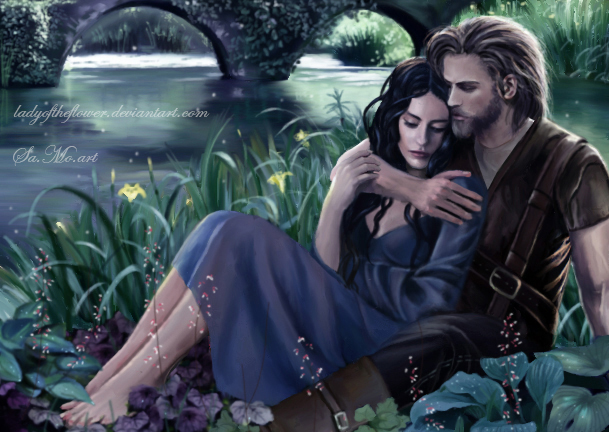
Now we zoom back out to the state of Beleriand as a whole. The narrator doesn’t just pick up where we left off before Beren, though. His reclaiming of a Silmaril wasn’t just a side-quest in history. Nope. Everything he and Lúthien went through, as well as the deeds of all those they met, has a rippling effect that starts now.
The news of those accomplishments travels far. A Silmaril has been lifted from Morgoth by an Elf-girl, her beau, and a dog—and now it’s with Thingol in Doriath. Maybe Angband is “not unassailable,” after all? This has given Maedhros, the most upstanding and responsible of the sons of Fëanor, ideas. To his credit, he’s the most proactive among his siblings in terms of keeping the oath they’d made—disastrous though that usually is. The others, particularly the C-brothers, hem and haw about the Silmarils, but never actually try and go after them. At least Maedhros is trying, though waging war with Morgoth merely for those gems isn’t necessarily his point. Morgoth is everyone’s enemy, and the Noldor seem to be as strong as they’re going to get, given the circumstances.
So perhaps it’s time to renew the siege of Angband. Maedhros has got two great houses of Men behind him: the peoples of Bór and Ulfang, who are now headed by the sons of those original chieftains. And this time, the Naugrim—that is, the Dwarves—are in his corner as well. Not only will the Stunted People (the Elves are still using that name…awkward) bring an armed force to the field, they’re also bringing tons of weapons and armor. The Dwarves are a naturally warlike people, so they’re especially well-equipped for this endeavor. Finally, Maedhros’s good friend Fingon, now High King of the Noldor, who single-handedly rescued him from his mountainside captivity, is definitely standing with him. And because Fingon’s in, so too are the Elves of the Falas, i.e. the Havens by the sea—Círdan’s crew.
Divided, the races of Beleriand are going to be easy prey for Morgoth. United, they’ve got a chance! So Maedhros has got Men, Dwarves, and the Noldor of Hithlum in his camp. Who else is with him?
Well…
Nargothrond isn’t. The Elves there are still pissed about the death of their king, Finrod Felagund, for which they rightly accuse Celegorm and Curufin. Orodreth, Finrod’s little brother and now standing king, won’t go forth with any force of Elves to help the sons of Fëanor with anything. It was those two C-brothers who really screwed Nargothrond over.
Doriath isn’t in, either. For one, leaving the Girdle security fence provided by Queen Melian isn’t exactly King Thingol’s policy. But also, he’s got a Silmaril now, though Melian advised him to give it up to the the sons of Fëanor to avoid further inter-Elven conflicts. Sh’yeah…like Thingol’s going to listen to her now. Well, because of the Oath of Fëanor, his sons had sent messengers to him to demand it after he’d first acquired. Thingol held, took, and is now keeping a Silmaril; that’s three counts of a big no-no. Even if they don’t personally care about it—as Maedhros probably doesn’t—they’re constrained by that damned Oath. They swore it in Valinor, and then again when their father was dying. So Maedhros’s hand is tied. And it doesn’t help that Thingol has been sneaking gazes at the Silmaril, desiring to keep it forever no matter what…
Almost like it’s become…precious to him.
So the team-up to take on Morgoth isn’t going swimmingly, but there’s still some progress. It’s sort of like this:
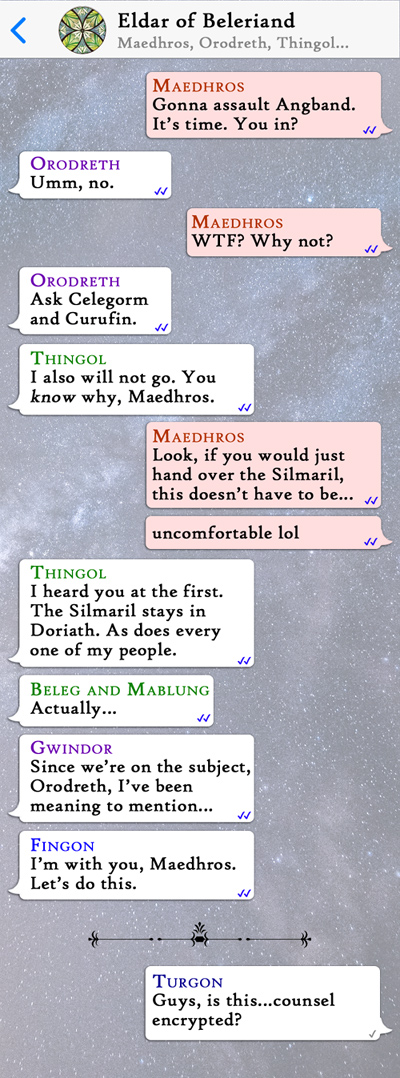
That’s right, two parties do leave their respective and otherwise uninvolved realms to join up.
In Nargothrond, a Noldor prince named Gwindor (not to be confused with Gwildor) defies Orodreth, heading out to oppose Morgoth with a small company of Elves. Gwindor’s own brother, Gelmir, was taken captive by Morgoth during the Battle of Sudden Flame some twenty years before and Gwindor wants payback for that. This mustering is a fine excuse to settle that score.
Meanwhile, in Doriath, out go Beleg Strongbow and unsubtle Mablung of the Heavy Hand, who helped with the hunt of Carcharoth in the last chapter. They “were unwilling to have no part in these great deeds,” aka they’re too involved now, having faced the Wolf of Angband and seen the jewel Morgoth had stolen. And they witnessed the death of both Beren and Huan. They can’t just stay at home now. Thingol doesn’t try to stop them from going, only gives them one condition: do not serve the sons of Fëanor.
These “rogue” Elves all therefore join up with Fingolfin’s house, not Maedhros’s, so they’ll be marching under Fingon’s banners.
In Brethil (that forest of Doriath not protected by the Girdle of Melian), the Men of the House of Haleth, also throw their figurative hats in the ring. These Haladin are now led by Haldir (not to be confused with the Third Age Elf with the same name), who’s three generations down from that badass Haleth herself. Haldir marches up to stand with the Men of the House of Hador for the coming fight. And leading the House of Hador are Húrin and Huor, those two young men who visited Gondolin via Eagle quite a few years back. Fully grown and then some, now they’re better, stronger…faster.
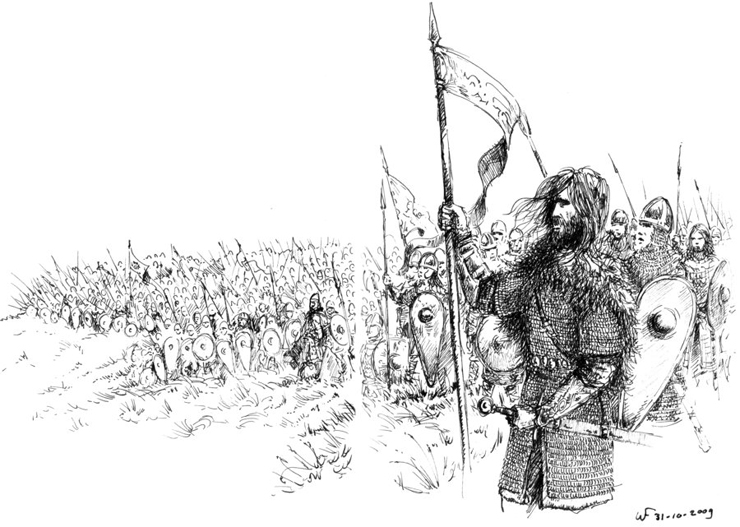
All the participants get themselves sorted and prepped. They gather up and train for war, even ousting all the free-roaming Orcs in the northern parts of Beleriand as part of that program. But because of this, Morgoth is made aware of these preparations. Thus he renews his espionage, his “spies and workers of treason,” among Men. Three chapters ago, Tolkien told us betrayal was in the cards concerning mortal Men. It’s time to brace ourselves for that.
So Maedhros and Fingon, the leaders of this siege, pick their day. The idea is for Maedhros to march out onto Morgoth’s parched front yard, Anfauglith, with banners flying, to draw out his forces.
But when he had drawn forth, as he hoped, the armies of Morgoth in answer, then Fingon should issue forth from the passes of Hithlum; and thus they thought to take the might of Morgoth as between anvil and hammer, and break it to pieces. And the signal for this was to be the firing of a great beacon in Dorthonion.
It’s sure to work! It’s got to.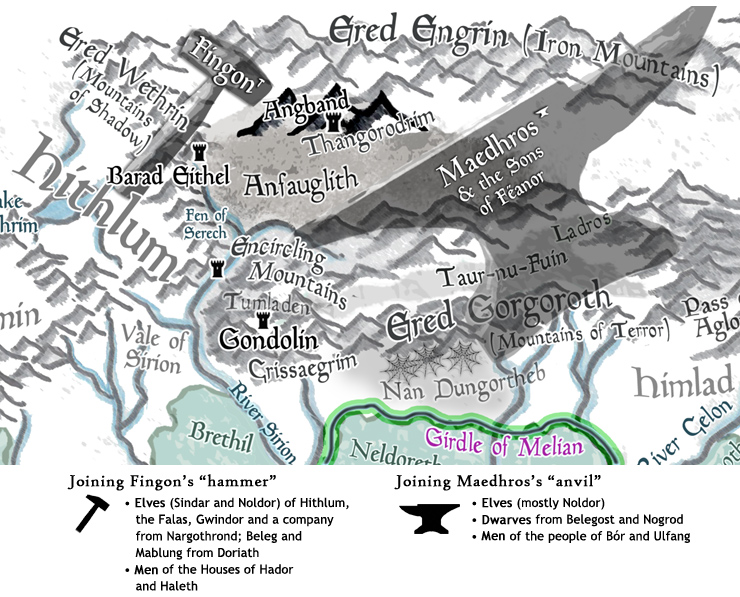
So on the appointed day, at dawn, everyone’s gathered. Fingon with all his forces and his allies of both Men and Elves stand ready and quiet on the western front, “well hid from the eyes of the Enemy.” Black smoke hangs over Thangorodrim, so he’s pretty sure Morgoth is aware of something—which isn’t great, but whatever. The High King of the Noldor looks to the east across the plain, hoping to see with “elven-sight” any sign of Maedhros and his armies. Or maybe that beacon to southeast. Nothing yet. What’s the hold up? Fingon is troubled, but his doubt evaporates when he hears the unexpected arrival of his hide-and-don’t-seek little brother, Turgon! Turgon has, at last, “opened the leaguer of Gondolin,” i.e. come forth out of hiding, and he does so with “ten thousand strong, with bright mail and long swords and spears like a forest.”
We so rarely get hard numbers in The Silmarillion that it’s always nice to have something to hang our sense of scale on. For a little comparison, note that the total number of combatants on the side of Gondor in the Battle of Pelennor Fields is probably somewhere between ten and fourteen thousand—yet here in this one corner of the field, Gondolin alone has brought ten thousand Elves. This battle is going to be big. Voices are lifted, trumpets are blown, and Fingon calls out:
‘Utúlie’n aurë! Aiya Eldalië ar Atanatári, utúlie’n aurë! The day has come! Behold, people of the Eldar and Fathers of Men, the day has come!’ And all those who heard his great voice echo in the hills answered crying: ‘Auta i lómë! The night is passing!‘
Well, right at that moment of elation, Morgoth sends out a suspiciously underwhelming force of Orcs towards Hithlum. When they’re close enough for the Noldor to see, it’s Húrin who tells his allies to not run out and just attack—a fascinating moment of maturity for a Man among immortals. He knows that Morgoth is tricksy, and that his “strength was always greater than it seemed.” But since the Orcs were ordered to draw out Fingon and his Elves, they march in closer and start throwing out taunts. Truth is, they are daunted by the hidden threat of the Noldor hiding just out of sight, but they’ve got their orders, and they’re much more afraid of their boss. So it’s time for plan B, wherein they trundle out a captive Elf, who they’d already blinded.
The Noldor can see this, and unfortunately Gwindor of Nargothrond has an excellent view, because the hostage is none other than his brother, Gelmir, the one he’d thought lost for years now. Morgoth’s heralds call out that there’re plenty more tormented Elves where this one came from, which riles up the Noldor.
And they hewed off Gelmir’s hands and feet, and his head last, within sight of the Elves, and left him.
And it so works. The Noldor were already steaming, but now Gwindor rides out on his horse, incensed, jumping the gun. And others follow, so that all “the host of the Noldor was set on fire.” The Orc heralds are all cut down, and Gwindor’s riders press on to attack the rest of the amassed army. There’s nothing to do now but to follow or else lose all of them, too, so Fingon orders all his Hithlum forces out into the field. Gone is their strategic defense, and gone is the hammer-and-anvil strike they’d be hoping for. Only Turgon holds back to guard the Pass of Sirion, not giving in to passion.
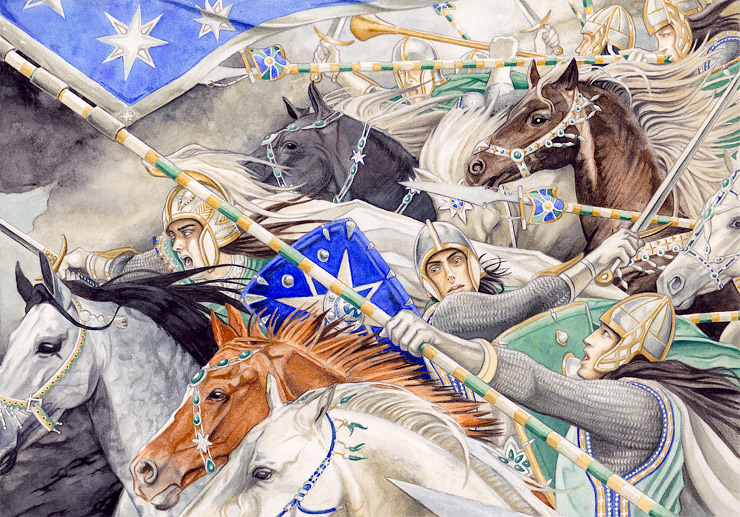
Yet Gwindor and the Elves of Nargothrond cut their way right to the Gate of Angband—where Fingolfin had come to die, and where Beren and Lúthien had bypassed Carcharoth. And even though this is exactly what Morgoth had been baiting them to do, he himself—he who still has “Melkor: He who arises in Might” engraved on his stationary, and who was once called “the mightiest of all the dwellers in Eä”—has a moment of real fear. The Dark Lord trembles even as he sits on his throne far below. That’s how scary the Noldor of the First Age are when they gather in force and kick down your door.
But there at Angband’s own open doors, Gwindor is taken alive while all in his retinue are killed—as Morgoth’s “main host” spills out from the holes and secret doors all around the gate. Fingon couldn’t catch up to prevent it, either. In fact, the Noldorin king is actually driven back by this enormous army.
Now it’s the fourth day since this started. Everyone—at least everyone on the western front—is out in the open, fighting on the plain of Anfauglith. And thus begins the fifth of the counted Battles of Beleriand, which is called Nirnaeth Arnoediad (near-NYE-eth arr-NOY-dee-add), the Battle of Unnumbered Tears “for no song or tale can contain all its grief.” Fingon is pushed back again, and in his retreat Haldir of the Haladin is killed along with most of his people.
On the fifth day, the Elves of Hithlum are surrounded, but Turgon and the Elves of Gondolin reach him, cutting their way through with their very well-equipped force. It is worth remembering that the weapons and armor of the Gondolindrim were made “stronger and more keen” due to the smithing ingenuity of Maeglin, son of Eöl. This is one of those moments where it’s helpful to flip back to the very end of the “Of Maeglin” chapter and reread the last two paragraphs. Heck, there’re a lot of places where flipping back is almost required, due to Tolkien’s proclivity for forecasting later events in each chapter.
Fingon and Turgon finally meet up again—like Aragorn and Éomer upon the Pelennor after being separated by all the hosts of Mordor—but these two are actual brothers and have not seen each other for more than three-hundred fifty years. Not since one of them went and built a hidden city on the advice of some watery Vala. Even to an Elf, that’s quite a while apart. Neither have they shared in the mourning of their father, Fingolfin. So it cheers their people to see the brothers reunited, a much-needed boost to morale in such a dire time.
And this is when Maedhros finally arrives with his forces from the east, where he…umm…“assailed the enemy in the rear.” Not something anyone wants, but it’s effective. And it spooks the hell out of the Orcs. The Elves might even have won this latest battle, had Maedhros arrived to assail their rear earlier. Speaking of which, where the hell had Maedhros been? Turns out he had a Man problem. More on that later.
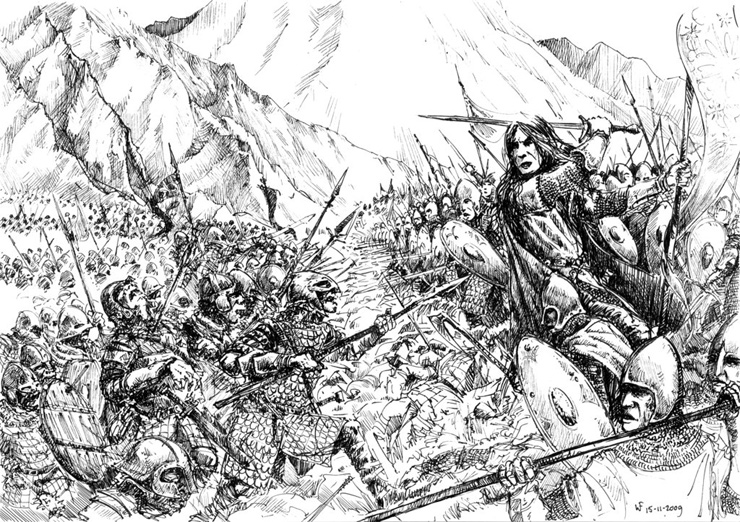
But first, things get worse. Morgoth now unleashes his full force; Angband is “emptied.” Which, taken literally, means every last Orc from the kitchen staff to the troll tasked with slinging dragon patties. This is the true unspooling of Morgoth’s military might, as all his monsters run, slither, march, and crawl across the plain of Gasping Dust:
There came wolves, and wolfriders, and there came Balrogs, and dragons, and Glaurung father of dragons. The strength and terror of the Great Worm were now great indeed, and Elves and Men withered before him; he came between the hosts of Maedhros and Fingon and swept them apart.
No one’s ever seen an army of monsters like this—this whole time they’ve been breeding and mustering underground in and around Angband. And once again, we’ve got Balrogs plural, and dragons plural. Not just daddy Glaurung but who knows how many of his kids and grandkids are now rampaging across the plain. These Urulóki, or fire-drakes, aren’t winged, but they’re deadly enough.
Oh yeah, trolls also seem to show up for the first time, as we’re told there is a “troll-guard” with Gothmog the Lord of Balrogs. There’s no detail on them, here; we’re told in The Lord of the Rings appendices that they’re creatures “of a dull and lumpish nature” who Treebeard surmises to be made in mockery of Ents (meaning Morgoth knows about Ents!), so they’re at least big and strong.
So great is the sum of the Noldor’s armies that they might still have withstood and driven back these all monstrous foes…were it not for the deceit of Men! Ugh, we’re the worst! Now, the leaders of this treachery are the three sons of Ulfang the Black—and it was they who had delayed Maedhros from reaching Anfauglith at the proper time earlier. They’d fed him some false reports of Angband’s forces that had stalled his approach. The bastards.
They’re turncoats, hopping on over to Morgoth’s side, as was long schemed, and now they and their army immediately attack the sons of Fëanor “upon the rear.” (Again with the rear aggression!) This really throws a monkey wrench into the works of Maedhros’s great assault against Morgoth. Ulfang’s three sons even come close to getting to Maedhros himself, but his brother (and warrior-minstrel) Maglor intercedes and slays one, while the other two are killed by the sons of Bór.
That’s right! The Easterlings of Bór stayed true to Maedhros even though Morgoth had tried to make double-crossers out of them, too.
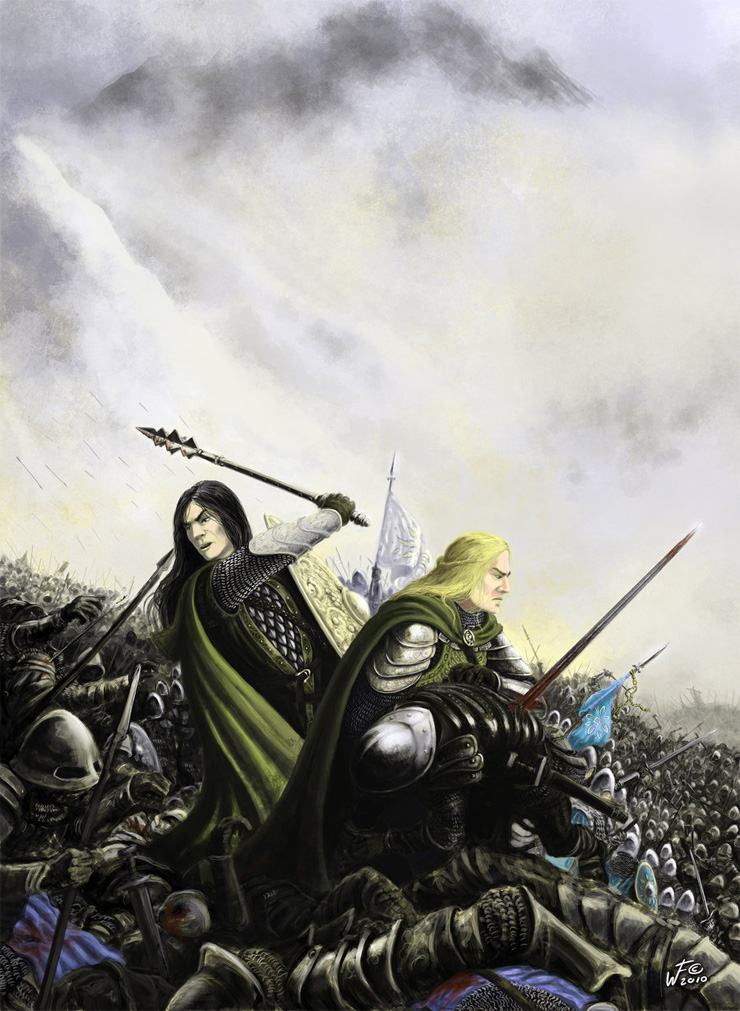
In your face, Morgoth! Not all mortal Men are corruptible, and certainly not all Easterlings are bad. Sadly, the sons of Bór give up their lives in the process, but they have their own army of faithful. What’s interesting is that even though Morgoth does turn the tide in his favor with the use of treacherous Men, it was supposed to have been an easier, swifter, and more complete victory, as far as he’s concerned. If only those obstinant Men of Bór had done what they were told! Corey Olsen, the Tolkien Professor, says this in one of his Silmarillion Seminars:
Look at the whole Bór disaster. Right? You can’t trust these people. Never send humans in to do Orcs’ work.
They are a disappointment to Morgoth, and so we’ll see his way of dealing with Men after the war. But even so, still more treacherous Secondborn pour in from the eastern hills where Ulfang’s sons had hidden them. The eastern front of the Battle of Unnumbered Tears is essentially lost now, and so the sons of Fëanor have little choice but to retreat. But who steps up and makes that possible for them?
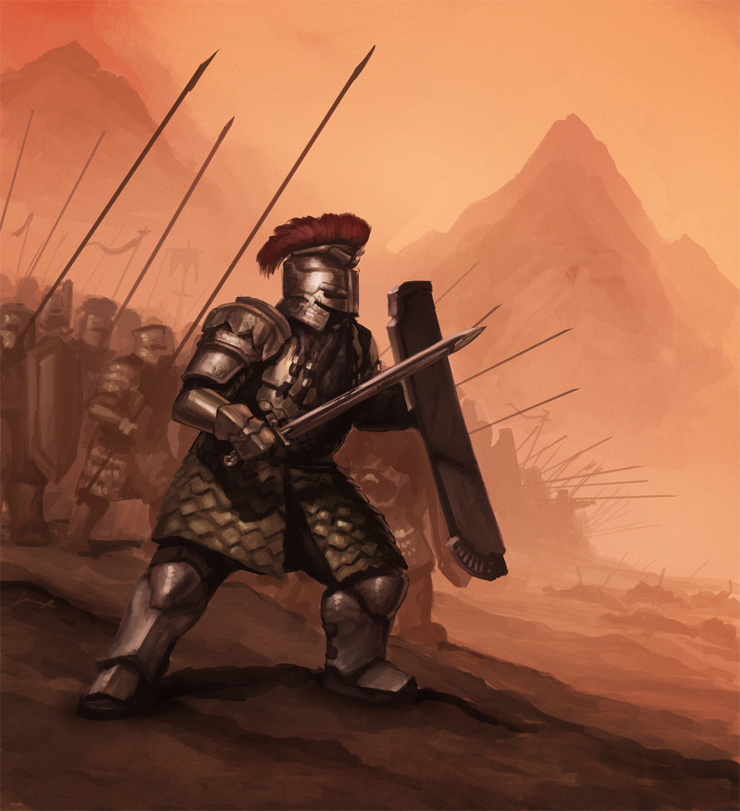
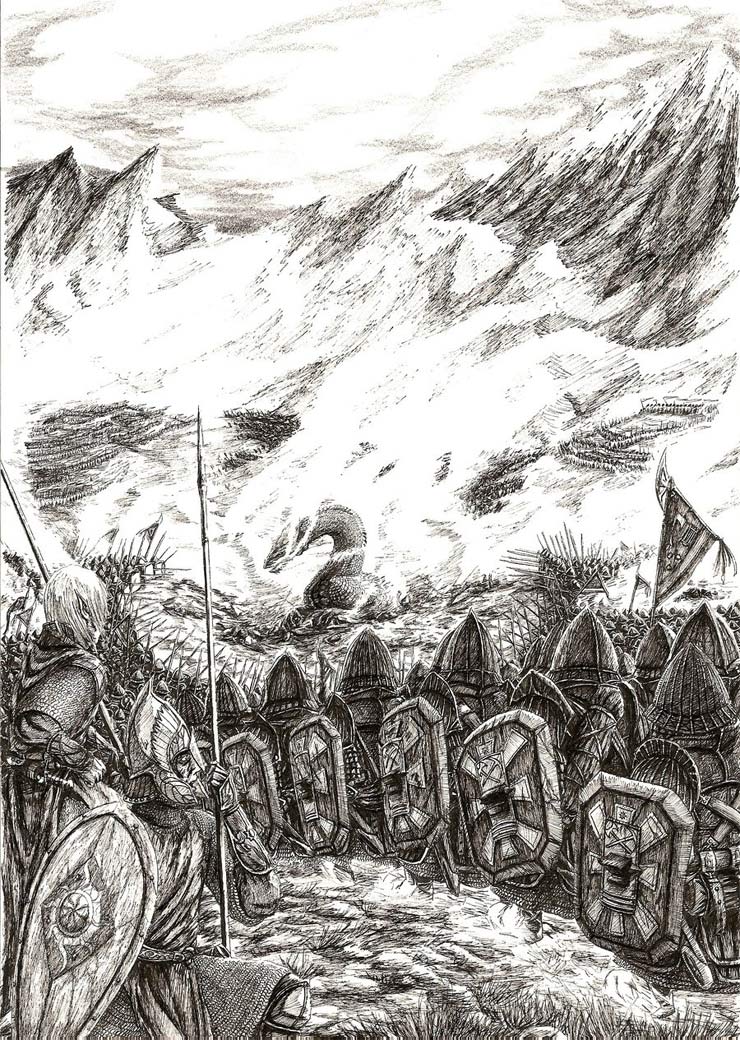
Why, the Stunted People!—the Naugrim, who don’t back down yet. The Dwarves have battled Orcs before, and even their own kind, way off to the east beyond the Blue Mountains. And sure, this is a greater force than they’ve never seen, but these are First Age sons of Durin, for crying out loud. Led by Azaghâl, the Lord of Belegost, these Dwarves are some seriously badass warriors! Aulë made them so:
For the Naugrim withstood fire more hardily than either Elves or Men, and it was their custom moreover to wear great masks in battle hideous to look upon; and those stood them in good stead against the dragons.
If you can’t stand the heat, as they say, get out of the Urulóki kitchen. And so the Elves have! But the Dwarves can withstand it, at least enough to actually engage Glaurung up close, him and his scaly, fire-breathing offspring. Everyone else “withers” before them—immolated, burned, or sent running. The Dwarves, though, fight back and do damage, probably slaying some of the lesser drakes and actually wounding Glaurung himself, for “even his mighty armour was not full proof against the blows of their axes.” Their weapons are second to none. They can pierce Glaurung’s hide, something the Elves don’t even get close enough to try. It’s not expressly stated, but I’m thinking that at his age, arrows won’t cut it anymore. Dragons just get more dangerous over time.
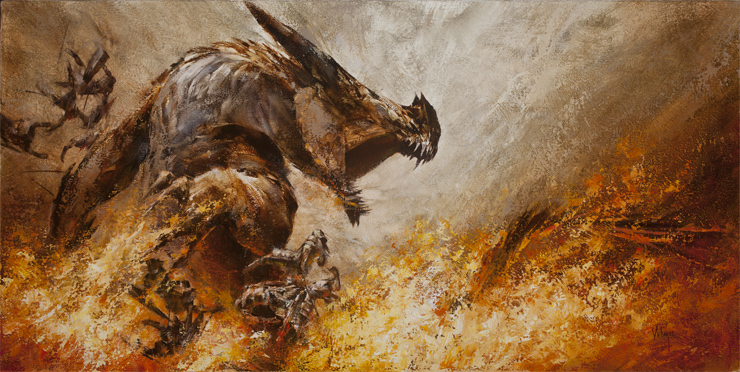
Eventually, Glaurung strikes down Azaghâl and it’s a mortal blow. But even as he’s dying, the Dwarf-lord pulls a Fingolfin. He stabs Glaurung in the belly with a knife and it hurts so much that Glaurung flees! (Hey, maybe that’s the last we’ll see of him…) Seeing the father of all dragons hightail it away unnerves the other monsters who came out with him, so they scram as well. This gives the Dwarves the opportunity to pick up Azaghâl’s body and carry it away in an impromptu funeral procession.
and with slow steps they walked behind singing a dirge in deep voices, as it were a funeral pomp in their country, and gave no heed more to their foes; and none dares to stay them.
Fascinatingly, no Orc or Easterling, or troll, or dragon takes a swing at them. Not a single Elf raises a hand in protest. The Dwarves have sacrificed their lord for this great ill-prepared war, so they’re done now. No excuses, no apologies. They’ve played their part, and they’re calling it quits. Although this is the last we’ll hear of Azaghâl in this book, here’s a bit of trivia featured in Unfinished Tales: A helm was made for him by Telchar, that master Dwarf-smith of Nogrod who also made the sword Narsil and the knife Angrist. It was then given to Maedhros, then regifted a second time to Fingon, and so it became an heirloom of the House of Hador. It will end up in the hands of the titular Man of the next chapter.
Digression: For some of us, one of the “frustrations” in reading The Silmarillion is not getting more details. It’s a book of synopses, I know, but there are parts that cry out for more! (*cough* Thuringwethil *cough*) Now if ever there was a chapter that calls for digging into the nitty-gritty, down-in-the-trenches perspectives, it’s one like this. If you’ve ever listened to Dan Carlin’s Hardcore History podcast, that’s the sort of immersive treatment that many would be delighted to have. To be fair, this kind of dissection has a way of stripping away the mythic qualities of a story—qualities Tolkien excels at crafting. But Tolkien himself was there, physically down in the actual trenches of Europe’s own twentieth-century Nirnaeth Arnoediad. He knew just what it was like to be inside such tragic and deadly conflicts; just trade machine guns and artillery bombardments with arrows and dragonfire. More importantly, it’s not just the fog of war one can appreciate with a historical magnifying lens, it’s the nuances of the conflict itself. The doubt of its soldiers and commanders. Not only would the valor of both Men and Elves be tested, but even the dread an Orc-captain lives with would make for a memorable listen, for the Orcs hate and fear Morgoth themselves, as has been written. Imagine the possibilities! Alas, The Silmarillion is ultimately more of a book of tales handed down through generations rather than a true history in the modern sense, replete with firsthand accounts from primary sources. And that’s largely for the better. But one can still dream…. End digression.
Well, the Battle of Unnumbered Tears isn’t done with us, or the Noldor, yet. Back in the west, the two remaining sons of Fingolfin are greatly outnumbered. Gothmog himself shows up with his own force of Balrogs, trolls, and Orcs. He shoves Turgon’s and Húrin’s forces aside—and as a result, Turgon and Fingon are separated again…this time for the last time. And now the High King of the Noldor is in serious trouble, as he soon finds himself the last Elf standing in his company. All his guards lie dead around him, which is a forbidding and recurring motif in Tolkien’s showdowns.
Now Fingon stands alone against the Lord of Balrogs, the demons of terror. The scourges of fire.
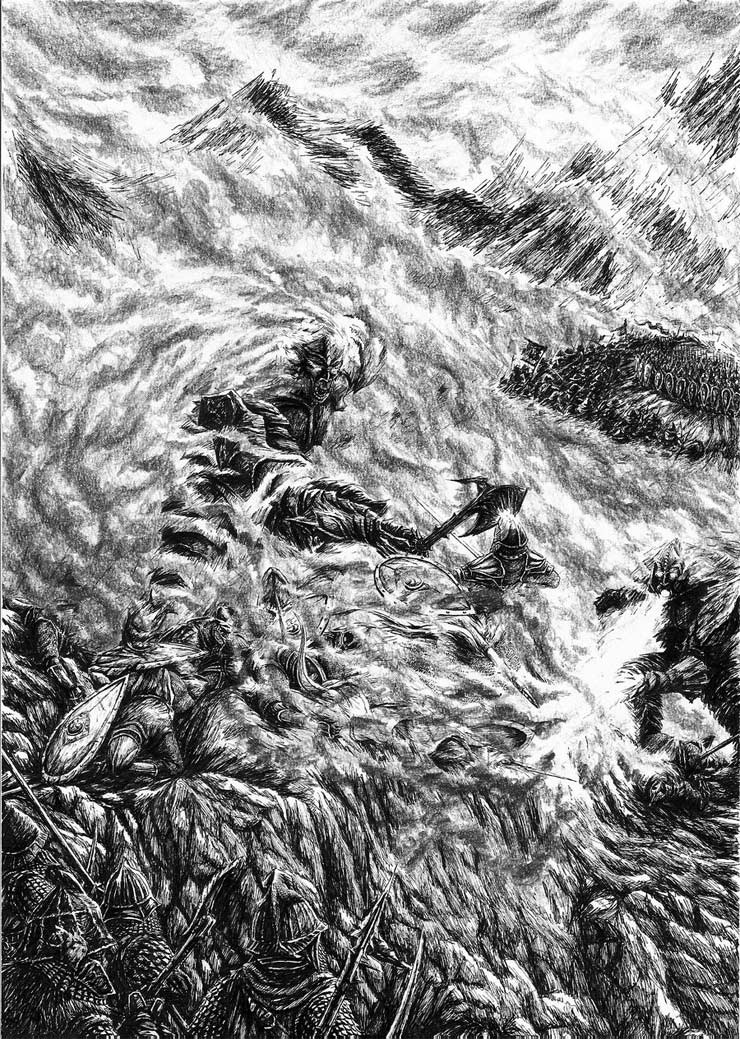
Not only is the High King of the Noldor in way over his head, but no one in Angband’s armies fights fair, nor with honor. Even Morgoth himself, when facing Fingolfin alone, consented to single combat only because the Elf-king had called him out, had challenged him at his front door in view of his lieutenants. Morgoth would have been proven weak in their eyes if he’d had Orc snipers fight his battle for him.
Balrogs, too, will fight dirty. While Fingon does hold off Gothmog on his own for a little while, a second Balrog comes in from behind and trips him up with a whip. (Those thongs of fire are a Balrog’s best friend.) Fingon is compromised. Down comes Gothmog’s axe, splitting open the Elf-king’s helm in a spray of spiritual white fire…and quite obviously his skull. And down falls Fingon, at which point the other Balrogs come in to “beat him into the dust with their maces.” No Eagle comes swooping in this time to bear the king’s remains away. Instead, his banner and his blood are now just part of the ruin of this field of battle.
Never again in Middle-earth will we see Fingon the valiant, who once ventured alone to Thangorodrim seeking his lost friend and cousin. And it was Fingon who Maedhros first thought of when Fëanor made the call to burn the Teleri ships, to abandon the rest of the Noldor and condemn them to the land of the Grinding Ice.
No time to grieve. Turgon’s Elves and Húrin’s Men are now all that’s keeping Morgoth’s tide of evil from pouring south through the Pass of Sirion and into the rest of Beleriand. That’s a bottleneck that’s been fought over before. The Pass of Sirion was the strategic importance of the late Finrod’s watchtower of Minas Tirith, which became Tol-in-Gaurhoth during Sauron’s tenure. But holding it against the forces of evil is not a good prospect for anyone right now; they’re still vastly outnumbered. Húrin turns to Turgon, who was like a father figure to him back when he and his brother stayed in Gondolin. Húrin then offers a dose of wisdom we’re not used to hearing from Men:
Go now, lord, while time is! For in you lives the last hope of the Eldar, and while Gondolin stands Morgoth shall still know fear in his heart.
Now we see that Men can be given to moments of foresight as well. Such prescience often prefaces being slain. And in this way, Húrin’s little brother, Huor, knows what’s up. He chimes in, too.
This I say to you, lord, with the eyes of death: though we part here for ever, and I shall not look on your white walls again, from you and from me a new star shall arise. Farewell!
Buy the Book
The Armored Saint
Huor doesn’t necessarily know who or what form that hope shall take, but he’s on to something. Unbeknownst to him, the seeds have already been planted for this so-called “new star,” through Huor’s bloodline, through Turgon’s bloodline, and through Beren and Lúthien. Remember them? Standing there in that moment of dramatic parting is also the emo-Elf, Maeglin (son of the old goth Eöl), who listens with his trademark silence. But he sure doesn’t forget it. He’s got a master’s in Listening Quietly and a doctorate in Not Forgetting, this guy.
Well, Turgon does withdraw with his army of Gondolindrim at Húrin’s insistence, and then he and his people return back through the Pass of Sirion, living to fight another day. Guarding that retreat, and surviving, are two notable Elf-captains of Gondolin: Ecthelion and Glorfindel. The former name is one also taken by the Stewards of Gondor in the late Third Age (Boromir’s granddad is Ecthelion II), while the latter is the actual Elf that Frodo and the hobbits meet on the road to Rivendell. Same dude, different age. Oh, we’ll come back to Glorfindel in three chapters.
In the wake of Turgon’s retreat, Húrin and his brother, Huor, plus the last of the warriors of Dor-lómin (where the House of Hador is based in Hithlum) rally against all the odds stacked against them. The narrator, and therefore history, records this last stand as redressing the treachery of the Easterlings. One group of underhanded Men (Ulfang’s) cheated this whole endeavor to defeat Morgoth, so another group of Men (Hador’s) will redeem it by staving off the ruin of the House of Fingolfin.
Now “all the hosts of Angband” are on them, utterly surrounding them. It’s now the sixth day of the Battle of Unnumbered Tears, but even as the night descends, Huor is slain “with a venomed arrow in his eye” (ugh, overkill) and the rest of the blond-haired fighting Men of Hador are finished off and fall around Húrin in a grisly pile. The Orcs take the time to actually cut off their heads and stack them up “as a mound of gold in the sunset.”
Now it’s just Húrin, who is short for his people but strong and even more tenacious. He insists on going down fighting, taking every enemy he can along with him. Húrin throws down his shield so he can wield his axe in two hands. Which is the perfect symbol of Húrin’s strategic shift—a shield would only just slow down his Orc-slaughter. He’s all about DPS at this point.
With each of the seventy foes he slays two-handed, he shouts a reprise to Fingon’s earlier cry:
Aurë entuluva! Day shall come again!
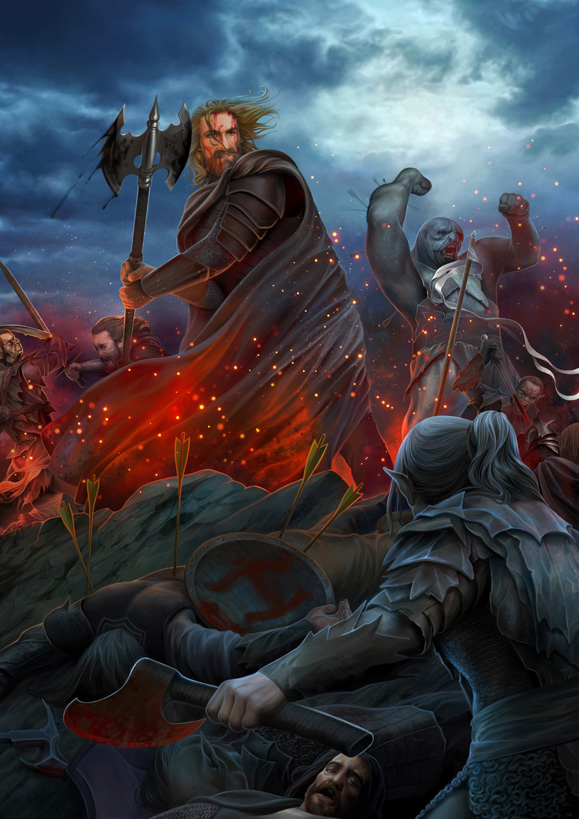
The body count is bananas. It takes an army to get this Man to stop fighting, but the sheer numbers overtake him. See, orders have come down from the top to not kill Húrin—for a very particular reason Morgoth has in mind. Even as the Orcs grapple with him he hacks off their arms, which cling to him even as he keeps fighting. (Why Húrin isn’t given a name for this moment, Tolkien fashion, is beyond me. Húrin the Disarmer of Orcs? Húrin the Arm-coated?) But eventually they get him, and Gothmog, Lord of the Balrogs, has Húrin wrapped up in chains and dragged back to Angband “in mockery.”
The capture of Húrin marks the end of the Battle of Unnumbered Tears, and it’s a marked victory for Morgoth. The aftermath of this war is grim indeed, because it’s more than just the thousands and thousands of lives that have been lost. It’s also the doubt and mistrust that’s been sown between Elves and Men. Sure, the remnants of the Edain, the Elf-friends, still have have a place of honor, but they are not numerous.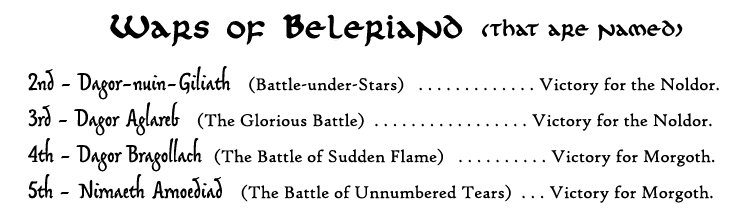
The descendants of Finwë really have thinned out now, though at least more of his great-grandkids have sprung up (Gil-galad, Idril, Maeglin, and Celebrimbor are the ones who’ve been named for us). Of Fingolfin’s kids, there’s only Turgon now, and of Finarfin’s there’s only Orodreth and Galadriel.
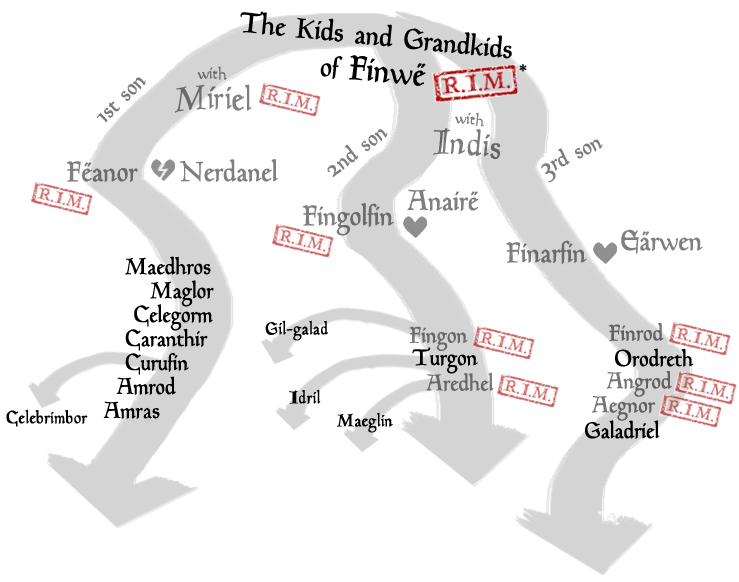
The sons of Fëanor are all still alive, but they’re scattered “as leaves before the wind,” and have been reduced to skulking in the woods of Ossiriand with the Green-elves. The Elves of Hithlum are utterly swept away. None make it home. The few that survived the battle either become slaves in Morgoth’s mines or escape in small numbers into the wild. The Haladin in Brethil still exist but in small numbers. The Men of Hithlum are no more, for Húrin was the last of the warriors of the House of Hador, which means only the noncombatants remain at home—and those never get news of what became of their husbands, fathers, and sons.
Speaking of Men, in the wake of the battle the time comes to “reward” the Easterlings for the role they played in duping those exasperating Elves—whose mere existence, it’s worth remembering, so vexes Morgoth simply for being the beautiful Firstborn Children of Ilúvatar that they are (and which he had nothing to do with). Oh, how he hates them for that.
So…how to reward these backstabbing Men? Well, the people of Bór let the Dark Lord down, so it’s not like all the Easterlings delivered. And also, Morgoth is the asshole who invented assholery. Therefore, although he earlier promised them “the rich lands of Beleriand which they coveted,” Morgoth reneges like a crooked businessman turned politician and shunts them all over to Hithlum. And they’re not allowed to go anywhere else. This is a cold and barren corner of Middle-earth compared to the lush realms to the south.
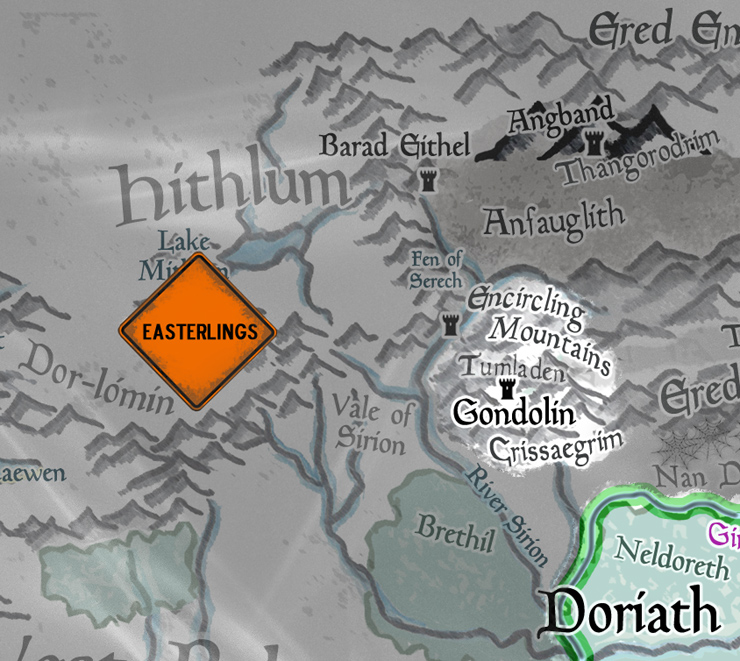
Meanwhile he gives his Orcs and wolves free reign of Beleriand. This has the additional—and maybe intentional—effect of embittering the Easterlings further and inspiring in them greater evil and pettiness. They now occupy the lands formerly inhabited by the Men of Hador, where only the women, the children, and the aged of that people remain to be bullied.
In due time, Morgoth sends out armies again beyond Hithlum, down through Nevrast and then to the Havens themselves, Brithombar and Eglarest. Círdan’s mariners sail up and down the coastline, harassing the Orcs where they can, but it’s never enough. The cities of the Falathrim are besieged and laid to ruin. Most of Círdan’s people are killed or taken as captives, but some do escape on ships to the Isle of Balar. Among them is Gil-galad, son of Fingon and now the closest thing to a High King the Noldor as a people have.
Turgon, hearing of all this, sends out some of his Gondolindrim to make contact with Círdan. When they reach him, the Elf-lord helps to build seven fast ships to once again go West, seeking help. C’mon, Ulmo! This would be a great time for that “true hope” to show up. You know, the one that “lieth in the West” and “cometh from the Sea.” Props to Turgon for trying again to seek out that hope, whatever it may be.
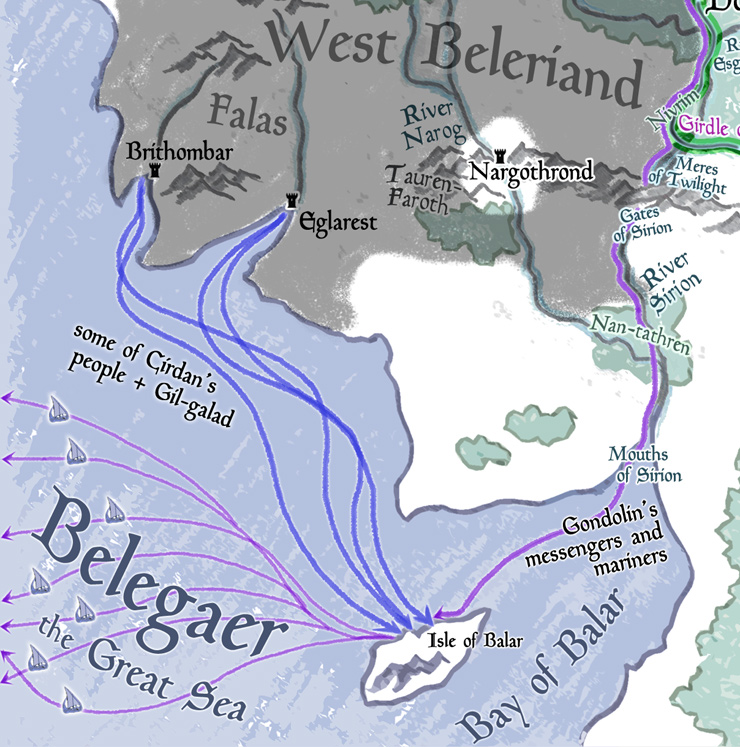
But of those seven swift ships only one kind of, sort of makes it back—and only just barely, as it’s wracked by a great storm made by ornery Ossë. Remember him? He’s the tempestuous, coast-loving Maia who serves Ulmo and in the early days of Arda almost went over to Melkor’s service. But this time Ulmo actually does intervene; he knows what Turgon is trying to do. So Ulmo uses his waves to save the captain from that shipwreck….
That Elf’s name is Voronwë. For now, it’s enough to note that he was sent by Turgon to seek aid from the Valar. This is one of Tolkien’s little set-ups, so having met him, we can set him aside for a later chapter.
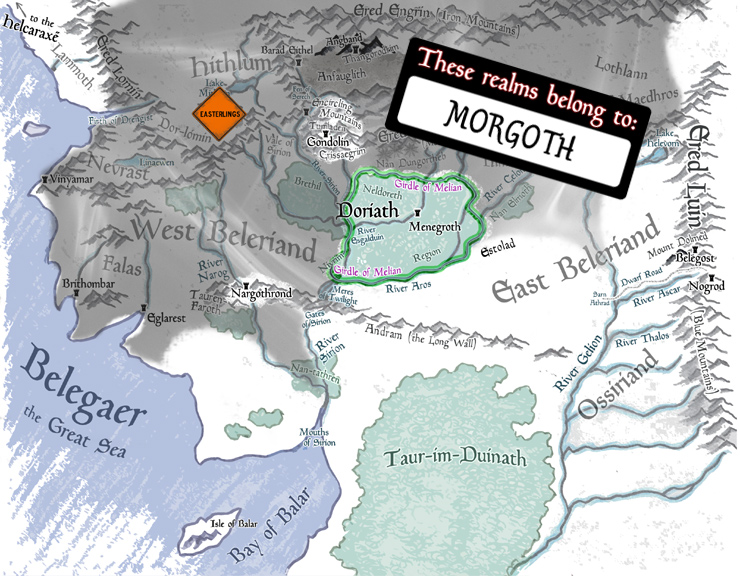
In any case, now only three Elf-kingdoms still elude Morgoth’s reach, and these are, for the time being, the only true places of refuge in Beleriand: Doriath, Gondolin, and Nargothrond. And yeah, that he can’t seem to root them out really grinds his gears—especially that Hidden City of Turgon’s.
We’re told that “Morgoth feared and hated the house of Fingolfin, because they had the friendship of Ulmo his foe,” and because it was Fingolfin who’d wounded him after the Battle of Sudden Flame, and gave him his forever limp. Now Morgoth strongly dislikes a lot of things, but those he markedly hates, as called out in the text, have their own special list. Time to jot this one down.
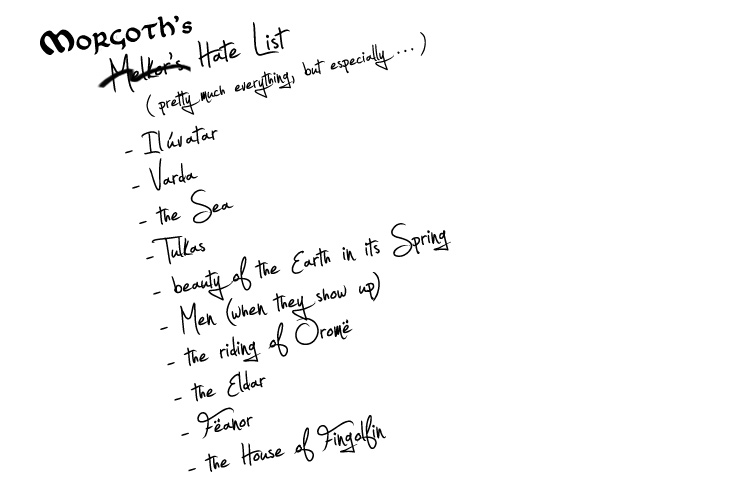
Then we get a wonderful little flashback to Valinor before the exile of the Noldor, before even the death of the Two Trees:
And most of all his kin Morgoth feared Turgon; for of old in Valinor his eye had lighted upon him, and whenever he drew near a shadow had fallen on his spirit, foreboding that in some time that yet lay hidden, from Turgon ruin should come to him.
Ah, those were the early days after his discharge from Mandos Penitentiary, when he became somewhat well regarded, walking freely among the Noldor, and every now and then he’d cross paths with Tulkas, who would give that sidelong look that said, Someday, punk, I’m going to wrap you in your own headband. Just you wait. And now it turns out that Turgon—Turgon, just one of the mere grandsons of Finwë—was giving him the creeps. It’s delightful that Turgon bothers Morgoth so much.
But the Dark Enemy of the World still has one card to play in finding Turgon: the Húrin card. Recall that after the Battle of Sudden Flame, after Húrin and Huor returned to Hithlum after having spent one year in Gondolin, they kept their promises and observed the first rule about Gondolin (not to talk about Gondolin). But their own people guessed well enough where they might have gone, and that reached Morgoth’s spies in due time. So Húrin is his key to finding Gondolin.
And now Morgoth has Húrin fully in his power. Well, Húrin effectively spits in his face and mocks him, displaying the same obstinance he showed to all the Orcs whose arms he displaced in battle. This is insolence that Morgoth’s ego cannot abide, so he curses Húrin, “setting a doom upon him of darkness and sorrow.” And boy are we going to see this doom unfold. Morgoth has Húrin placed on a special stone chair somewhere high up on Thangorodrim, open to the sky. This is probably more physically manageable than the torment Maedhros endured hanging from one arm somewhere up there, but Húrin’s sorrow is going to be arguably worse.
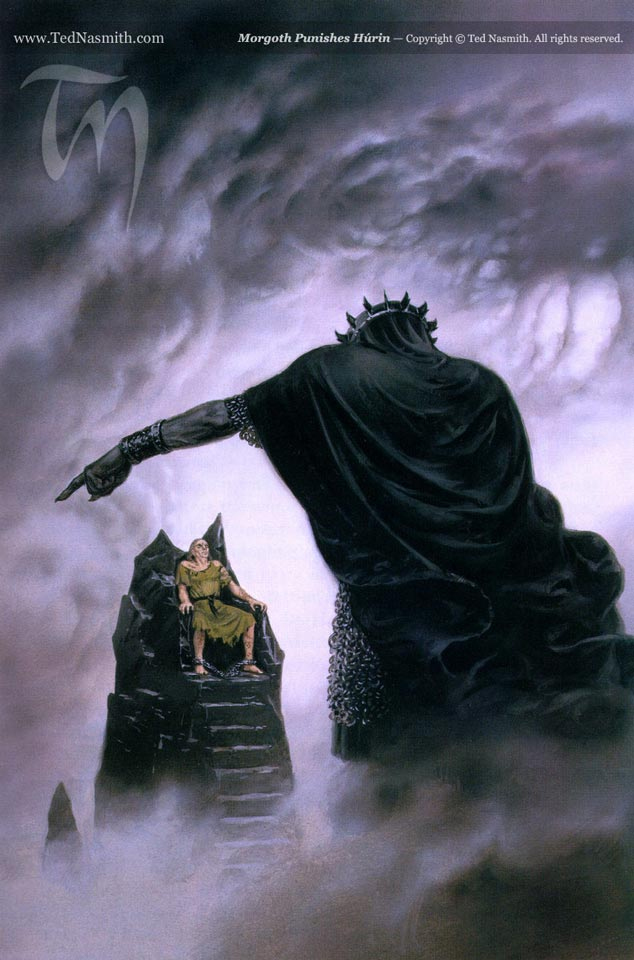
Sit now there; and look out upon the lands where evil and despair shall come upon those whom thou lovest. Thou has dared to mock me, and to question the power of Melkor, Master of the fates of Arda. Therefore with my eyes thou shalt see, and with my ears thou shalt hear; and never shalt thou move from this place until all is fulfilled unto its bitter end.
Yeesh. Morgoth is basically going after Húrin’s family with all the supernatural, reality-altering malice of a fallen Vala. And yet this man, whose ancestry comes from both the House of Hador and the House of Haleth, remains defiant. He asks for neither pity nor death, not even for his next of kin. And very sadly, as we’ll see in the next chapter, Húrin does indeed have some of those.
The dust has fully settled, and Morgoth sits triumphant. Never does he venture forth to survey the realms he’s won. He’s a real homebody in his Dark Lord body, even though he’s the self-styled master of the fates of Arda. Previously he called himself the King of the World, when he first sat down on his throne with his tri-Sil metal hat. Oh, wait, now he’s down to just two Silmarils! But as Morgoth’s sphere of influence widens, his own personal might diminishes: He’s stuck in his body, he can be wounded, and he can definitely be robbed. Just ask Beren and Lúthien.
But that doesn’t mean Morgoth can’t continue to spite Ilúvatar and trouble his Children. Starting with all those corpses of Men and Elves outside his doorstep, for which he is utterly responsible. So he has his Orcs gather them all up from across the vast fields of battle, and damn it, there are so many. Piling them in the middle of Anfauglith with all their gear, they’re just left to rot there. No burning, no dramatic finality. Just…heaped and left out for the carrion birds. Somewhere in there is Fingon, and Huor, and thousands more. So big is this mound of the dead that it can be seen from afar. It is named the Hill of Slain, or Haudh-en-Nirnaeth, the Hill of Tears.
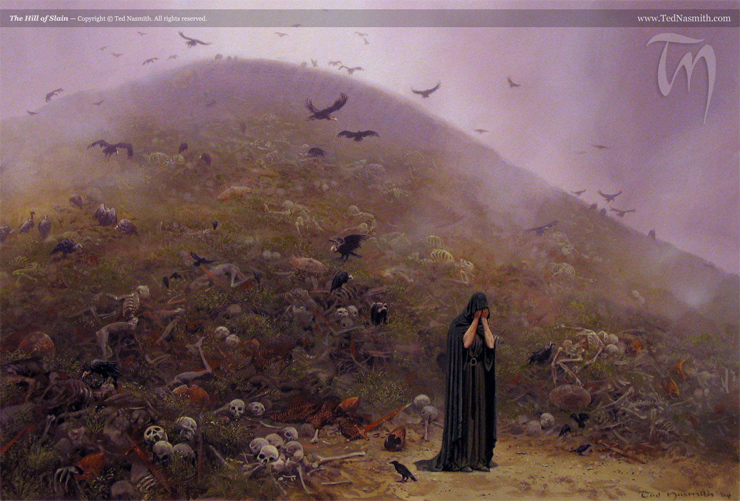
And yet the earth, as time goes by, subsumes it, and grass grows upon it—and Morgoth’s monsters eventually shun it. This is still the substance of Arda, which all the Valar had once shaped and made fair even as the wayward Melkor smacked it around. But the real point is, as gruesome and dreary as things have gotten, this is still Tolkien. Even after so much ruin and pain, life springs anew. Hope is kindled, if barely.
Day will come again.
In the next installment, we’ll pour over Chapter 21, “Of Túrin Turambar,” and see if we can figure out why bad things happen to good people. Or at least, people with good intentions.
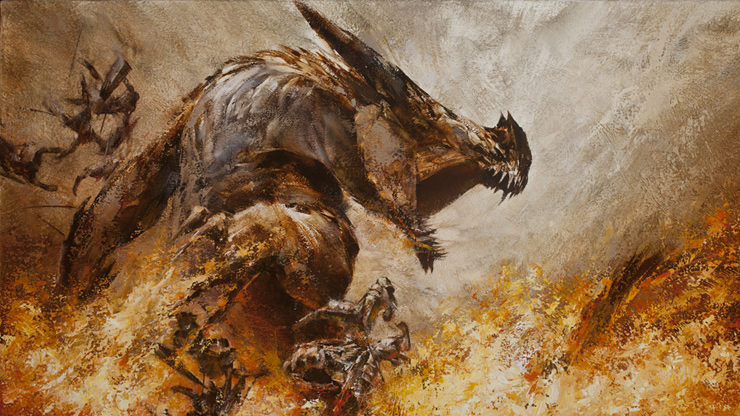
Top image from “Glaurung at Nirnaeth Arnoediad” by Eric Velhagen
Jeff LaSala would also like to hear a Hardcore History podcast episode of the Battle of Sudden Flame just to hear Darn Carlin describe in vivid detail the rivers of fire spewing out of Thangorodrim, and of the Balrogs first marching in the “train” of Glaurung. Tolkien geekdom aside, Jeff wrote a Scribe Award–nominated D&D novel, produced some cyberpunk stories, and now works for Tor Books. He is sometimes on Twitter.


Jeff:
I just checked, it was Huor who said the words about the star to Turgon, not Hurin. Which makes sense since Tuor is his son. Otherwise, great as always.
Omigosh! Thanks for catching that. Yes, of course. In my last go-through, the names trip me up, too. :) Amended.
Such a sad chapter and GOT cribbed the display and killing of the hostage shamelessly for the Battle of the Bastards.
While reading this I was thinking of the story of the human woman (of Hurin’s house?) who loved either Angrod or Agenor ( I can never remember which one) and was haunted her whole life by the belief that she was unworthy and unloved by him. Finrod tells her late in life that his brother couldn’t be with her as he forsaw his purpose in this battle. I thought it was in Unfinished Tales, but I can’t find it.
Tolkien certainly had a thing for the human male/Elven female pairing, but not much interest in going the other way. Even Eowyn gets turned down.
I can’t read the Silmarillon too often because it’s just too heartbreaking.
Noldor, for Eru’s sake listen to Men, we know war. You might say it’s our hat. We’ve been fighting our entire history – unlike you guys. Sindar and other Dark Elves of course have a similar history. You don’t read of them falling into obvious traps.
Hurin Thalion is made of Awesome. His son not so much. Basically you can count on Turin Turambar to always make the worst possible decision.
The Tragedy of Hurin and his family, which we see the start of here, is the best of JRRT’s writing, in my opinion. It is also different tragedy than say the tragedies of Feanor, his sons, Thingol, Maeglin, etc, all of whom bring the tragedy down on their own heads, like a Shakespearian tragic protagonist. Hurin and Family are tragic in the Greek way, whereas they did nothing knowingly wrong to bring on their fate, nonetheless like Hector and Achilles and Oedipus, someone or something is out to get them and they cannot avoid the tragedy that envelops their lives. There are few things in books about fictional characters that bring me to tears, but the last meeting of Hurin and Morwen does every time.
This time through, I was struck by how much the few paragraphs describing the Dwarves’ involvement set up what we learn of them later, not just regarding Smaug and Erebor but even the stories about their involvement with the Seven Rings.
Anyone else have trouble wrapping the mind around the concept of the Hithlum Elves as slaves in the mines? Imprisoned, tortured, and killed individually or in small groups, sure. But mass enslavement? I mean, like the debate over their agricultural needs a few posts back, I totally appreciate that it needs to be a possibility—Tolkien tended to play fair with his legendarium and not grant game-breaking capabilities to individuals or groups. But the High Elves seem like the ultimate live-free-or-die kind of people.
@@.-@ Well, as you see here, the line of Hurin is legitimately accursed, and that acquired honestly. A Maiar spent some of his immortal yet limited mojo to bad cess every hour of their every day and all the itti-bitti things contained therein.
@7, Was it a curse that made Turin an angsty, emo, mama’s boy with no impulse control? Morgoth’s curse seems to work by encouraging the subjects worst nature. It should be beatable through thought and self control, free will and all that. But if you don’t even try….
Sheesh. You guys love talking in depth about the story covered in whatever the next installment is. :) Maybe wait until then?
(Which, admittedly, will be three weeks this time, instead of two due to holiday shenanigans.)
@3 the woman was Andreth of House of Beor. Beren’s great-aunt, or some such relative. Beren was the son of the younger brother. There’s densely philosophical essay in … Morgoth Ring, I think… between her and Finrod.
Ah Turin… never misses the opportunity to make the wrong decision. given curses in Tolkien’s world have force, I would guess that Morgoth’s curse on Hurin’s line causes the encouragement of all their worst impulses. He’s one of the oldest characters Tolkien invented, too, IIRC.
yes, Ian @6, I too, have problems with the High Elves as slaves. Seems wrong. Which, I guess, is the point. They thought they could challenge a (weakened) Vala. And he still outmatches them. I wonder how long many spend in Mandos dealing with that: I couldn’t resist him.. The prisoners who survive by yielding problem.
@9 PLEASE TELL ME that you meant “two weeks instead of one”…
Is there anything Dwarves like better than killing Orcs/ Given they’ve just eliminated the biggest threat on the field at the cost of their King I’d say the Naugrim have a right to say ‘We’re finished now.’
What holiday?
@11, alas no. Normally these installments drop every two weeks. But July 4th’s placement means we’ll be going three weeks instead of two.
@6 & @10: Regarding the Noldor as slaves, I disagree. The Noldor are valiant and stubborn as all get-out. Not the sort to off themselves before they become captives. They seem to me to be the sort who will endure torment so they can live to fight another day. Sometimes too much, and it leads to the sort of self-destructive stubbornness and wrath of Fingolfin and his end. I will admit that their anger can overtake even their defiance.
But yeah, the Noldor are defiant, perhaps more than the other kindreds of the Eldar. Also, they’re the most crafty. Some actually “escaped in truth” from Angband—it’s not an inescapable prison, just a horrible one. Sure, some Morgoth lets go, but some actually do manage to give him the slip. The Noldor are cunning and willful. It’s no shocker that some would be able to Dufresne their way out of Angband; they studied with Aulë, for God’s sake.
But yeah, defiant. When the Valar said “Don’t go!” the Nolder were either (a) “No way, Manwë, we’re outta here, you’re not the boss of me” or (b) they were “Well my friends are going and I don’t want to be separated from them, so I’m going, too.” Either way, they’re defiant. If they’re defiant of the good Valar, then it’s no surprise to me that they’re defiant of one bad Vala, allowing themselves to be captured and tormented, if it means persisting. Yeah, some are broken by their torment, and made into fearful spies for Morgoth. But most hold their heads up as long as they can.
Look at Turgon. He was told point-blank by Ulmo that the Noldor cannot succeed against Morgoth, yet he marches off to war when he deemed it right because he friends and family were doing so. Stubborn Noldor!
@13: Fair points. I wasn’t suggesting a mass suicide on the part of the Noldor; it’s more that even the women, children, and various non-soldiers behind the battle front would try to fight until death before capture, and that the few who might be captured seem more likely to spend their time hewing at their chains and plotting revolts instead of hacking at rocks for useful ore. Morgoth was very mistaken if he thought that an attempt to enslave them would break the spirits of any but a few, and simply imprisoning them in forgotten dungeons would seem to require his forces to expend less effort than trying to extract any useful labor. To my mind, the key difference between a prisoner and a slave is that the latter has at some level accepted (if not consented to) the notion that his or her labor will in some way benefit the master; I have trouble seeing how any of the Noldor could ever quite get to that point.
Anyone else have a problem with all the violence going on here? Because I don’t!
“God help me, I love it so.” (Patton)
1) Whenever I read the opening of this chapter, where Maedros, hearing of the deeds of Beren and Luthien, is inspired to strike against the Enemy. Was he inspired by the part where the hand got bit off, the part where they both died, or the part where they both died, came back, and died again?
2) Remember where the Big M talks to Hurin and describes himself as Master of the Fates of Arda. The title Master of Fate (or Master of Doom, if you will) will come back to haunt Hurin (at least by proxy) in the near future…
3) Did Fingon or the sonsofafeanor not notice that the men they were trusting were the sons of Ulfang the Black? Sure sounds like trustworthy people, doesn’t it?
I’m guessing that Maedhros didn’t get the full story of Beren and Lúthien as neatly packaged as we did, certainly not all that Halls of Mandos intel. Clearly it’s learned that both B and L did get to return to live again, but it’s murky stuff in these first few years, I’d say.
And your point number 3 strays into a chicken-or-the-egg territory. Sort of like Mablung the Heavy-handed. Did his parents name him that, foresighted? Or does history simply record him as Mablung after the incident with the Silmaril, but at the time he was just, like, Terrancë or something. :) Was Ulfang the Black actually called that at the time, or does history now give him that name because of his betrayal?
@16: I’m thinking the Easterlings were renamed by the Elves after this event. Most probably they had names in their own tongues that were not so on the nose, but most of the Eldar didn’t know them, so they names one group “faithful” and one group “scheming bastards” when they were writing everything down later.
I also wonder what the conversation between Maedhros and Celegorm / Curufin went like. “What were you thinking? Couldn’t you recognize a Great Doom when it walked through the front door?! You should have befriended the mortal, or at least waited to betray him until after he got a Silmaril! Do you know how far back you’ve set our international relations? And you lost your dog.” Basically facepalming and lecturing like only
the world’s most pissed off older brother can.
@18 Oh heck yes. Knowing a thing or two about sibling relations, I sure would love the Tolkien Estate to discover the professor’s secret tale, Athrabeth Maedhros ah Maglor ah Celegorm ah Caranthir ah Curufin ah Amrod ah Amras, wherein we get to read about the squabbles between the Sons of Fëanor.
So now Morgoth thinks he’s all that. Well, we know what the likely consequence of that is going to be, don’t we?
“We came from Caladan – a Paradise World for our form of life. There existed no need on Caladan to build a physical paradise or a paradise of the mind – we could see the actuality all around us. And the price we paid was the price men have always paid for achieving a paradise in this life – we went soft, we lost our edge.”
– Duke Leto
@19: Yes! They seem to present a unified front to the world, but you just know there were lots of behind the scene arguments, with Incidents from childhood brought up again, and Caranthir spurring on one side of the argument and then the other, while Amrod and Amras, on the principle that nobody ever listens to them anyway, try to nope out of it as quickly as possible.
Possibly my favourite chapter in the Sil (along with the next couple): rage-filled elves, Glaurung, troll-smashing men, hack-happy orcs, an army of the Sons of Durin in their prime, and a whole lot of fall-out that sets up the last act of the First Age. I’ve found myself strangely compelled to read and re-read the passage about Gelmir and Gwindor – we know orcs are brutal, but this is action under a magnifying glass. Anyone who says Tolkien is a gentle spirit compared to contemporary fantasy authors isn’t paying enough attention.
So, yes, orcs are pretty brutal – but a pissed-off First Age elf is something to behold. Gwindor is in there boots and all and it’s such a brilliant passage showing how the best laid plans of mice and elves can unravel with a bit of sibling butchery. I know we get to see a few more elves who’ve been thralls of Morgoth, but (like most things in the Sil), I wish there was more to learn and know.
That this battle sets up The Children Of Hurin is yet another things that I love about this chapter. Can’t wait to see your blog about that utterly soul-crushing tragedy cheery slice of sunshiney goodness.
—
Also, want to give a huge, huge thanks for introducing me to so much good Tolkien art! My walls (and bank balance) may never be the same again.
About those young Dragons. Just when do they “come of age/flame” so to speak? Like, do they reach puberty or something?
keleborn @23, if you are interested in possible dragon life cycles and evolution, find yourself a copy of Peter Dickinson’s “The Flight of Dragons” (1981). Dickinson does a great job of speculating on dragons and their evolutionary niche. How could they have flown? And breathed fire? Why did they hoard gold and jewels? Why are they associated with both mountain caves and pools of water? Why did they prefer dining on royal virgins?
Dickinson does all this with a perfectly straight face. He also uses Tolkien (also Ursula LeGuin and Rudyard Kipling) as reference sources. It is a great read.
And now, a moment of silence.
*moment of silence*
*wipes tear off cheek* Oh, Fingon, you were too good for this Middle-earth .
Oh joy, we’re up to my least-favorite part, The Endless Tragedy of Emo McMurderpants.
@24, Thank you! Sounds interesting!
Hey there, minor autocorrect error: Previously he called himself the King of the World, when he first sat down on his thrown with his tri-Sil metal hat. Oh, wait, now he’s down to just two Silmarils!
I mean, yeah, he was thrown from his throne, but I don’t think he sat down on the throwing thing. ;-)
Meanwhile: oh my heart this chapter. These poor babies just trying to live free. I cannot.
@27 – Fixed, thank you!
@JLaSala,
I’m surprised you didn’t bring back the ever-lengthening “List of things that Morgoth Hates” to add on Turgon! :P
@13 I think the surprise is simply that they were defiant to the point of living, rather than defiant to the point of death. The first one is more difficult, and maybe more worthy of first-age elves, but the second is more what you would expect of “bloody stubborn elves”, not to be turned against their cause for any reason whatsoever.
I think something is missing between the words “displaced battle.”
@30 and @31, you guys are sharp. Amended.
Andrew, I initially thought of the list but at first it says Morgoth is troubled by Turgon so I too quickly dismissed the idea. But looking again, yeah, it goes on to use that classic phrase, “hated and feared,” and that’s perfect for The List. Thank you. I’ve added it in now. :)
I like the image of Morgoth keeping this list in some notebook, and every now and then he goes back and stews again over the “riding of Oromë” or shakes his fist at “the beauty of the Spring of Arda,” even though it’s long past now. He knows the Valar, like Yavanna, still thinks fondly of it and it bothers him that she enjoys that memory. :)
There’s another reason Melkor may be unfriends with Yavannah.
We were speculating last week in the Mythgard Academy chatroom about various random spirits that seem to be loose in Middle-Earth including Bombadil, Goldberry, etc. It was concluded that at some point Yavannah has to have sent wooden Balrogs over to contest with Gothmog and company. Surely Melkor would get hacked off about this…
Dickinson does a great job of speculating on dragons and their evolutionary niche. How could they have flown? And breathed fire? Why did they hoard gold and jewels?
My theory on the last one: they don’t actively hoard gold. They just have, as a result of their weird body chemistry (breathing fire etc), extremely powerful stomach acids, which can digest everything except precious metals (gold is highly unreactive). And they have unhygienic habits.
So, when they eat a dwarf, they digest everything except his rings, jewellery and pocket change, which they pass out (or possibly cough up, like an owl pellet), and leave lying around their cave. After a while, this builds up and acts as a valuable lure to further dwarfs, and so the cycle goes on.
Excellent recap! One small thing, I believe the dwarves in the battle are not directly of Durin’s line, that is the dwarves of Moria, far to the east. The dwarves of Belegost are not, as far as I know, of Durin’s line. True, after the the destruction at the end of the First Age, many of the dwarves of Belgost & Nogrod fled to Moria to swell its ranks, but they were originally of a different house.
Man how I love these rereads. You do a really good job of writing these. One thought that came to me while reading this – there are many things Lord of the Rings Online does wrong so many I stopped playing it almost immediately after its first expansion but one thing it did very right was in the power difference between First age and later age elves. I do not remember the elf involved but in one of the early raids/dungeons you come across a first age elf after fighting many many hard enemies. In what could be interpreted as first age elf dickisness – but is really just first age elf lack of social skills – he basically looks at you and asks what took you so long. This is after you see around him literally piles of dead orcs – killed by this one elf. He then goes on to help you kill a big bad using what suspiciously looks like “magic” that Tolkien despised. One of the many problems with the game – but that first meeting still resonated.
How I wish someone would do a good Lord of The Rings MMO – but there likely isn’t enough interest and I don’t have the money to support it. Sigh..
@35, hm, right. I was meaning to use it in an identifying hyperbole and less for actual lineage.
@36: Thanks!
I actually really like LOTRO a lot. It’s been years since I played, and I do get that they’ve allowed a certain amount of fantastical video-gamey stuff into the game (nowhere near as extreme as other MMOs), but I always thought they handled the lore very well. I’m trying to recall what First Age Elf quest you’re talking about. If it was truly a raid, then I guess I wouldn’t have seen that; I could never find time to join big organized events like that.
I really liked the flashback quests that allow you visit certain important moments in history, like when you take the role of some miner Dwarf beside Durin VI in Khazad-dûm and are there to witness the unfortunate release of the Balrog.
If I am not mistaken, as far as First Time Age goes, the score is Noldor 3 – Morgoth 2
Although none are locals :)
This always makes me think that this is the time we see the future of Men in Middle-Earth. While certainly the greatest warriors the world had or ever will see, the Elves are truly flawed when it come to leadership. Elves are by nature ruled by their passions. Also slow to react and even slower to deal with problem elves. While Men are for more practical, or fatalistic, when faced with horror. And are swifter to deal with treason. Here is the first real example of the leadership qualities of men. I wonder if that was planned? Seeing as how they are destined to take over Middle-Earth in the 4th age.
Larger-picture question: is the Nirnaeth actually the real Last Alliance? (At least until the fall of Sauron?) Unless my memory completely fails me, the Last Alliance was the Last Alliance of Men and Elves–no Dwarves mentioned. Certainly there are no Dwarf ghosts/images/whatever in the Dead Marshes. But did the Dwarves fight in the War of Wrath, or were they already too badly estranged from the Elves by Events That Happen Several Chapters Later? I can’t remember.
In contrast, during the fall of Sauron, if you count the Northern front of the war mentioned in the Appendices, you again have an alliance of Edain, Lesser Men (the Rohirrim, and arguably also the Druedain if we’re counting non-combatant material aid), at least some combatant Elves, and the Dwarves of Erebor. That seems like a thematically similar genuine alliance of all the Free Peoples.
P.S. Love the image “Brothers in Arms”. Great corrective to more simplistic assumptions about Tolkien and race to see a completely canonical fanart depicting a blond Elf and a Mongol-looking Man fighting side by side.
For me, this chapter is tragic in the best way; it’s as moving as the best work of Shakespeare or the Greek tragedians. It also has what are, in my opinion, three of the most beautiful passages of writing in all of Tolkien’s work. The fall of Fingon, the last stand of Hurin, and the description of the Hill of the Slain at the very end of the chapter. To me, that last passage in particular epitomizes that perfect blend of beauty and tragedy, hope and sorrow, that is the hallmark of so much of Tolkien’s work.
@40 – The Last Alliance was primarily Men and Elves, but there’s a passage somewhere, I think in the Appendices to LotR, that says that all peoples except the Elves, even birds and beasts, were divided in that war, but the Dwarves of Khazad-dum fought on the side of Elendil and Gil-galad. I don’t think that the War of the Ring counts as a full-blown Alliance of the Free Peoples. There’s no formal league made as there was in earlier wars and except at Dale, where Men and Dwarves fight together, all the Free Peoples fight separately. The main force of Sauron is fought entirely by Men, except for the members of the Fellowship, and the Elves of Lothlorien and Mirkwood fight only in defense of their realms when those are under attack.
FWIW, I dug out the Children of Hurin standalone book and found “the torment that he devised for Hurin was ‘to see with MOrgoth’s eyes’. My father gave a definition of what this meant: if one were forced to look into Morgoth’s eye he would ‘see’ (or receive in his mind from Morgoth’s mind) a compellingly credible picture of events, distorted by Morgoth’s bottomless malice; and if indeed any could refuse Morgoth’s command, Hurin did not.
Hurin’s only epithet/name seems to be Steadfast. Which suits.
Those who accuse Tolkien of “stereotypical, two-dimensional characters” and “happy endings where everyone survives” have never read The Silmarillion.
Eat your heart out, George R.R. Martin.
@43,
Don’t give GRRM any new ideas for things to do to his characters…
PS Tell the cats Tevildo says “Meow”
Am I the only one who spends a disproportionate amount of time wondering what Melkor’s time in Tirion was like? I suspect it was not known, possibly even by the other Valar, about making Orcs before his imprisonment, or else his fair disguise probably wouldn’t have worked. But I wonder how many encounters and conversations he may have head, face to face, with Fingolfin, Finarfin, etc.
@40, I love “Brothers In Arms,” too, but to be fair to the artist, that’s supposed to be Beleg and Mablung (he gave Mablung the mace) and took some guesswork about their hair color. That wasn’t meant to be an Easterling depiction.
Turner Mohan, over on DeviantArt, has some amazing sketches, including some Easterlings. And I love his Dwarvish armor and mask designs. (Or Haleth and her female guards, so great!) Many very original works there. But sadly was I was never able to get a response from him in seeking permission to include his art.
I had an elf character in Shadowrun named Glorfindel. He hated it, said his parents were weirdo hippy types, and went by Finn instead.
@43, Actually they have. I’ve met them. They’re running the country now.
@43 Beruthiel: hehe whenever someone tries to compare the Tolkien to George Martin and say latter is more realistic/darker than the former, well then I like to point out some things. Even The Hobbit has dark themes, greed, politics, slaughter. Is there lack of brutality in Middle-earth, or this nowadays admired ‘grey morality’? Oh hell no :). So we have example of truly cruel things did to people, like dismemberment as mentioned with Gelmir. Slaughter at a feast? Not a problem, not quite the Red Wedding but still :).
“Not first will I die here!” he cried. And he seized Brodda, and with the strength of his great anguish and wrath he lifted him on high and shook him, as if he were a dog. “Morwen of the thrall-folk, did you say? You son of bastards, thief, slave of slaves!” Thereupon he flung Brodda head foremost across his own table, full in the face of an Easterling that rose to assail Túrin.
In that fall Brodda’s neck was broken; and Túrin leapt after his cast and slew three more that cowered there, for they were caught weaponless. There was tumult in the hall. The Easterlings that sat there would have come against Túrin, but many others were gathered there of the elder people of Dor-lómin; long had they been tame servants, but now they rose with shouts in rebellion. Soon there was great fighting in the hall, and though the thralls had but meat-knives and such things as they could snatch up against daggers and sword; many were quickly slain on either hand, before Túrin leapt down among them and slew the last of the Easterlings that remained in the hall.” There you have it :). Alright jokes aside. It’s not like Tolkien was building this idealized world, no there was much darkness in hearts of men in his stories, even Elves did awful or morally questionable things, if not outright cruel atrocities.
Also one doesn’t have to go far to even find such things as rapists:
“Then one day Túrin missed Forweg, and also Andróg his friend; and he asked where they were, but his companions laughed.
“Away on business of their own, I guess,” said Ulrad. “They will be back before long, and then we shall move. In haste, maybe; for we shall be lucky if they do not bring the hive-bees after them.”
The sun shone and the young leaves were green; and Túrin was irked by the squalid camp of the outlaws, and he wandered away alone far into the forest. Against his will he remembered the Hidden Kingdom, and he seemed to hear the names of the flowers of Doriath as echoes of an old tongue almost forgotten. But on a sudden he heard cries, and from a hazel-thicket a young woman ran out; her clothes were rent by thorns, and she was in great fear, and stumbling she fell gasping to the ground. Then Túrin springing towards the thicket with drawn sword hewed down a man that burst from the hazels in pursuit; and he saw only in the very stroke that it was Forweg.
But as he stood looking down in amaze at the blood upon the grass, Andróg came out, and halted also astounded. “Evil work, Neithan!” he cried, and drew his sword; but Túrin’s mood ran cold, and he said to Andróg: “Where are the Orcs, then? Have you outrun them to help her?”
“Orcs?” said Andróg. “Fool! You call yourself an outlaw. Outlaws know no law but their needs. Look to your own, Neithan, and leave us to mind ours.”
…
“No,” said Túrin. “One sting was enough. I slew him. But I spared Andróg, and he will soon return.” Then he told all that was done, rebuking those that did such deeds; and while he yet spoke Andróg returned bearing Forweg’s weapons. “See Neithan!” he cried. “No alarm has been raised. Maybe she hopes to meet you again.”
“If you jest with me,” said Túrin, “I shall regret that I grudged her your head. Now tell your tale, and be brief.”
The curse Morgoth puts on Hurin and his family really is something rather spectacular:
“The curse of such a being, who can claim that ‘the shadow of my purpose lies upon Arda[the Earth], and all that is in it bends slowly and surely to my will’, is unlike the curses or imprecations of beings of far less power. Morgoth is not ‘invoking’ evil or calamity on Hurin and his children, he is not ‘calling on’ a higher power to be the agent: for he,
‘Master of the fates of Arda’ as he named himself to Hurin, intends to bring about the ruin of his enemy by the force of his own gigantic will. Thus he ‘designs’ the future of those whom he hates, and so he says to Hurin: ‘Upon all whom you love my thought shall weigh as a cloud of Doom, and it shall bring them down into darkness and despair.'”
For what it’s worth, the woman in that quote has her clothes torn by the thorns, not the guy. I for one like that Túrin immediately punishes whoever it is that’s chasing her. He’s more of an executioner than a judge or jury, and that leads to trouble, but his impulse, however heavy-handed, tends to mean well. I’ll get to that soon enough.
But sheesh. I assume in the Túrin articles you guys will be discussing the fall of Gondolin, and when we get to Gondolin you’ll talk about Eärendil? ;)
@49/JLaSala: yeah that is clear from the quote, but the purpose of the two chasing after her is all too obvious. Forweg and Andróg certainly were not trying to be give her flowers :), also on even darker note, Andróg was “hunted from Dor-lómin for the slaying of a woman” (not to mention some subtle talks of other outlaws or Andróg himself about ‘need’, and ‘pleasures’, or ‘seeking honey from the hive’, it was a case of ‘attempted rape’). Unfortunately when talking about Tolkien’s world, when you talk of one piece it leads to another and another, and you know soon you’ll discuss the New Shadow and possible course of Dagor Dagorath :). Besides it’s not as if Tolkien himself didn’t spoil future events ;).
@@@@@??? I really enjoy the version of dragon biology put forward in The Last Hero by Terry Pratchett, but I have to admit that it’s not really relevant to these particular fire drakes.
@40/mutantalbinocrocodile: just like Gaius Maximus said there is a single reference to Dwarves fighting in War of the Last Alliance:
“All living things were divided in that day, and some of every kind, even of beasts and birds, were found in either host, save the Elves only. They alone were undivided and followed Gil-galad. Of the Dwarves few fought upon either side; but the kindred of Durin of Moria fought against Sauron.” (Of the Rings of Power and the Third Age)
So outside of the Dunedain, men of Numenorean blood, there were Noldor Elves and other elf kindreds, other ethnicities of Men (there is a reference in The Unfinished Tales that Men of the Vales of Anduin were part of the alliance: “… Sauron was vanquished, and the people of Vales had been [Isildur’s] allies in victory.”
Unfinished Tales, Part 3, Ch 1, The Disaster of the Gladden Fields), not to mention that Men of the Mountains swore to Isildur to fight for him in war, and these same people broke the oath and fled to be later known as Dead of Dunharrow.
@52
I remember that quote about how everyone but the Elvsies had representatives on both sides. We talk about the Men and Dwarves who fought for Sauron (let us not be hasty about thinking about other living things that fought for him) but let’s look at the flip side:
Where’s the discussion of the Orcsies and Trolls who fought against Sauron?
@53,
Sauron, literally a no-body! Sad!
– Trolls against Sauron
@48, if Morgoth’s Curse/Doom on Hurin and his family is that bad, and active, what about that Doom of the Noldor, pronounced at Araman? It’s labeled the Prophecy of the North as well. I think it’s as active a curse as Morgoth’s and more effective as it was laid by an undiminished Vala (or more than one).
@45, I think Melkor in Tirion had a lot of encounters with the Noldor. He taught them a lot, so he likely ran into the royals often. Feanor never gave him the time of day, but nothing is said about the others in the family. The omission is striking once one starts thinking about this. Feanor even slammed the door in his face and “Melkor departed in shame, for he was himself in peril…”
Hurin was a good man, Turin, even from what’s in the Silmarillion wasn’t what his father was. Hurin’s wife is very interesting – in a not always having good judgement way – and I suspect Turin took after her.
Plenty on Túrin coming. Just you wait.
The œ of Arnœdiad is not a diphthong, it’s a rounded front vowel which, in later Sindarin, merged with e or y depending on context.
JLaSala (19): I suspect that ought to be Athrabeth Vaedhros a Vaglor a Chelegorm a Charanthir a Churufin ah Amrod ah Amras: in ‘of’ constructions, the initial consonant of the second noun mutates if there is one. (mh = v as in Welsh; the f of Finrod doesn’t mutate because it’s already equivalent to ph.)
ajay (34): I like it!
This thread has been a very interesting and thought-provoking read :)
With that in mind:
Hypothesis/informed guess:
Presumably, the Curses of Morgoth on Hurin and of Mandos on the Noldor are explicable as “manifestations” of the character & being of those who utter them. Mandos, like all the other Valar, is limited, so, not all-wise or all-knowing; but, crucially, he is not evil, but good. Morgoth’s expresses the nihilism and malice and pettiness of Morgoth; the Curse of Mandos is in effect a description of the evils that the Noldor are bringing upon themselves; the evils described are a health warning (“If you people do X, for reason Y, then in the nature of things Z is what will happen”). Those evils are not inflicted by Mandos – they arise naturally from what the Noldor are in process of doing. The Noldor don’t want the protection of the Valar – very well, they will have to accept the consequences of being free of it. And in a world that is partly Morgothified, those consequences will be ugly.
Morgoth’s curse is an attempt to create (or rather, miscreate) the future of Hurin and his family – Morgoth is playing at being Eru Iluvatar, but in his own, Morgothified, Morgoth-centric way. His curse is interesting because it marks a further stage in his degradation and corruption: the Vala who was too proud to play his proper part in the Music of the Ainur, is now reduced to doing his pettiest to ruin the lives of mere Men. He is essentially a black hole of all-devouring nihilism, so what eventually happens to him is very appropriate.
The curse of Mandos attempts to prevent the Noldor behaving with suicidal rashness, and from falling into despair & slavery. But Feanor’s heart and mind have been so poisoned by a combination of possessiveness, grief, hatred, paranoia, despair, wrath and pride, that he is incapable of listening, let alone taking heed or being persuaded. He is capable only of doing Morgoth’s work for him. Hurin’s obstinate silence as Morgoth’s captive is a foil to the noisy obstinacy of Feanor after Mandos delivers his Doom. It seem to be implied that Hurin’s demeanour in captivity was morally neutral – the evil that followed his release was the fault of Morgoth, not of Hurin.
The two curses are opposed to each other. That of Mandos is constructive, and respects the freedom of the Noldor – even if they turn their freedom to self-destruction. That of Morgoth is destructive, and tries (with incomplete but devastating success) to ruin Hurin, his family, and all whom they have dealings with. Morgoth is destroying himself, so everything else in Arda must be forced to be equally miserable.
@58 thinks the Doom or Curse of Mandos is simply a forecast and a warning of predictable consequences. Is it?
In The Silmarillion evidence is mixed. Forex just before it is all spelled out: “all heard the curse that was uttered upon those that would not stay nor seek the doom and pardon of the Valar.” It reads as if the Valar are punishing by this ‘curse’ those who aren’t stopping to listen to them.
I have to point out that the Valar have been amazingly quiet during this whole disaster, which by this point has been going on for years (of the Sun, if not the Trees). Someone has calculated that it would have taken Feanor two months to travel to or from Formenos, alone, even with light. It’s seven years after the death of the Trees that Feanor lands in Middle-Earth. All the Valar have done is ask Feanor for the Silmarils and sit in the Council Ring. What they haven’t been doing is anything to help those they brought to Aman with the promise of light and safety, to deal with the sudden loss of both. (Feanor’s speech in Tirion is lit by torches, remember? Everything is dark.) The Noldor strike me a the problem solvers of the three tribes. Those higher than they are aren’t acting, and are not showing signs of doing anything anytime soon. Feanor turns up with an idea, something to do. Something that will even get Light back in the Silmarils. I’m not surprised they listened to him.
If Aule had turned up saying I need your help to start a space program so we can light all the world with the Sun and Moon, I bet a lot would have stayed for that. He didn’t since Yavanna hadn’t sung them up yet.
Anyway… Manwe advises they stay put, but says they won’t hinder. Feanor, probably due to personal history where the promises of bliss, etc never panned out for him, is dismissive. Time passes, Kinslaying happens, they head North on ship and afoot. Mandos adds his piece. Some of it does read as simplying laying out predictable consequences. Some of it reads like a hissy fit. “Valar will fence Vanlinor against you and shut you out” forex (HoME shows us the Teleri were probably behind that. They were understandably frantic.) And it also takes no thought for those of Middle-Earth who are not involved at all, but also about to suffer greatly from Morgoth. The Noldor landing helped them. Yet, because they follow the Noldor who are under the Curse/Doom, it all goes bad.
Anyway… On they hit Middle-Earth, Melian sees a shadow of the wrath of the Valar on the Feanorians, and the shadow of Mandos on the Finarfinians. And then Thingol says his piece to Beren, and even though he’s not following Feanorians, he’s caught in the Doom “ensnared in within the curse of Mandos.” Is that the effect of simply predictable consequences? I don’t think so.
Meanwhile, Ulmo tells Turgon he has no power to remove the Doom of Mandos. That doesn’t sound like a forecast of consequences, either. It sounds like someone discussing a curse that has been laid and can be lifted or removed. Later, with Tuor “And he gave warning to Turgon that the Curse of Mandos now hastened to its fulfilment, when all the works of the Noldor should perish;” That perishing doesn’t necessarily follow from what the Noldor have been doing all along.
Somewhat later than the first conversation with Ulmo we see in Nargathrond, after the Sons of Feanor Curufin and Celegorm have set the city against its King, that the Silmarillion says “But the curse of Mandos came upon the brothers, and dark thoughts arose in their hearts, thinking to send forth Felagund alone to his death, and to usurp, it might be, the throne of Nargothrond;” That’s a curse that’s acting on the brothers, probably as much as Morgoth’s on Hurin’s family, making everything worse as it can.
Now, Huan. The Silmarillion says he “followed Celegorm into exile, and was faithful; and thus he too came under the doom of woe set upon the Noldor, and it was decreed that he should meet death,”. I notice it took a decree, someone thought about it, and decided Huan would die – not just suffer general woe – for being a good dog and following his master. It’s a curse.
Those last two examples are the strongest pointing to active ill will towards the Noldor and anyone who claims a Silmaril in teh Silmarillion. There’s more in HoME. Most pertinently, the bit in Unfinished Tales between Ulmo and Tuor: “’Go now,’ said Ulmo, ‘lest the Sea devour thee! For Osse obeys the will of Mandos, and he is wroth, being a servant of the Doom’.”
Some of it is the playing out of predictable consequences. Some of it is Mandos and those who agree with him working hard to make things go bad.
While Tolkien didn’t go much for magic, it seems as if when Mandos utters his doom, he takes what are predictable consequences and…mainfests it in a way that it becomes binding, especially to Elves who are also bound to this world.
@58 – that is a good insight about Melkor basically being reduced to orchestrating the life/tragedy of one group of men when once his ambitions were to control the whole Music.
Also, JRRT gives GRRM a run for his money, here in terms of tragedy and violence. And as it turns out I also recently got into a discussion countering the idea of LotR being ‘black and white’. Compared to Harry Potter, as it turns out :) Aaaaah!
@61/ LisaMarie,
One key difference (among many) between JRRT and GRRM is that when reading Tolkien I find myself rooting for Elves, Men, Dwarves, Hobbits, and Ents; when reading Martin I find myself rooting for the Night King.
Harry Potter seems like a whole ‘nother genre.
@61, @62: Yeah, what booksellers want to file under the single term ‘fantasy’ does span quite the range. Tolkien and Rowling definitely wrote stories in which there was a side that the reader is led to believe should win, even if it was populated by characters who were sometimes mistaken, flawed, or downright unlikeable from time to time; I’m not quite as familiar with Martin, but from what I’ve read and seen he seems to be aiming for a deconstruction of the entire concept of a ‘deserving’ side.
However, these late chapters of Quenta Silmarillion seem to be drawing more upon the traditions of Greco-Roman, Norse, and othe similar mythologies: that one cannot escape the consequences of previous poor decisions, and desert often means nothing in the face of Fate or sheer power (of nature, divine will, or the like). Within that context, wherein the Noldor and their allies suffer the consequences of decisions that run afoul of rules that only the Valar can truly comprehend, it does not seem necessary to infer active meddling on the part of the Ainur (save Morgoth and Sauron, obviously). Perhaps the Doom of Mandos is more about the active refusal to intervene on behalf of those who have willfully gone beyond acceptable boundaries.
@63 et al,
Somewhere between Romanticism and Nihilism lies Tragedy:
“I used to think that (adventures) were things the wonderful folk of the stories went out and looked for, because they wanted them, because life was a bit dull, a kind of a sport, as you might say. But that’s not the way of it with the tales that really mattered, or the ones that stay in the mind. Folk seem to have been just landed in them, usually – their paths were laid that way, as you put it. But I expect they had lots of chances, like us, of turning back, only they didn’t. And if they had, we shouldn’t know, because they’d have been forgotten. We hear about those as just went on – and not all to a good end, mind you; at least not to what folk inside a story and not outside it call a good end.”
And what Sam says about Gollum might be equally applied to Morgoth:
“Why, even Gollum might be good in a tale, better than he is to have by you, anyway.”
; – )
Is the Turin one up yet? Because it comes up when I search for Silmarillion, but not on anything else on Tor, and when I click it it says page not found.
Hey, Tom. It’s not up just yet. It’s for next Wednesday. The 4th of July pushed things offone week. Glad you’re looking!
I am heartily looking forward to the Turin chapters, but more still for Earendil, Ancalagon, the war of wrath, and the akallabeth-the last of which is my favorite part of the silmarillion.
@JLaSala
https://imgur.com/H22xCFm
[img [/img]
The chapter title of 21 made me almost spit out my dinner. :-)
mild spoilers
@59 – Great analysis, especially the last quote from Unfinished Tales:
If Ossë is trying to cause the sea to devour Tuor, and his motivation is to serve the Doom of Mandos, then it’s hard not to conclude that the Valar and their servants are actively punishing the Noldor. What’s really mind boggling is that the curse was extended to include the Sindar, who were kin to the elves of Alqualondë. As I understand it, the whole point of the curse was to redress the harm done to the Teleri. But the Teleri in Middle-earth suffered from the curse just as much (or more) than the Noldor.
Incidentally, does anyone have an opinion as to how much the Nirnaeth cost the Noldor? Was it just a massacre, or was it something closer to genocide? The Silmarillion says that no one in Fingon’s host returned home, while the sons of Fëanor wandered “as leaves before the wind.” Apparently they mingled with the Green-elves of Ossiriand, which must have been galling to proud elves like Caranthir. Is it possible that the Noldor were almost wiped out in this battle, except for non-combatants and the residents of Gondolin and Nargothrond?
@70 – Thanks!
Yeah, I really wonder about some of the Valar, and all who apparently ignored everyone in ME after they brought those Eldar who were willing to come over the Sea. Ulmos doesn’t seem to have, but he’s the only one we have evidence for. And what about the feeling of those left behind? you can’t tell me Nerdanel, Finarfin, his sisters, and all the others who stayed behind didn’t worry about what was going on with their loved ones. But No, the Curse says ‘no word will come.” That, plus the lack of concern for the Sindar – and dwarves, and Men – who were going to be dealing with the Noldor, seriously drags down my opinion of the Valar.
On the Nirnaeth…. I think most of the males who were there died. Nargathrond survives as well as it did because it didn’t send an official force, but I think it’s fall is now guaranteed. Gondolin seems to be enormous – that must be a huge valley it’s in – and still location unknown, so it survives, too. Not quite a genocide, but close.
Deciding whether the Doom of Mandos is a curse that causes active punishment of the Noldor, or merely a public declaration committing the Valar to passive-aggressive indifference to their plight, seems inseparable from one’s view of the degree to which Team Angband has cornered the market for malice and vindictiveness among the Ainur. Most or all of the evidence seems maddeningly ambiguous, so it’s one of those things that you probably need to choose for yourself rather than expect to find in the text.
Another factor to consider is that, between Morgoth’s active aggression and the inherent impermanence of everything in Middle-earth, the Elves could never realistically hope for their works to endure without some active assistance from the Ainur (e.g. the Girdle of Melian). In that light, inaction on the part of the Valar could be just as damaging to the Noldor’s efforts as active attempts to thwart them.
@70/deanfrobischer: “…it’s hard not to conclude…” I disagree. The Elves considered Ossë capricious and dangerous from the time they first encountered the Sea:
The Doom could be a mandate for him to harass the Noldor…or it could just as easily be a mandate simply to never let their presence affect when or where he does the stuff he’s been doing since the beginning of days.
@71/Elaine T: Cases can be made to justify the Valar’s punishment of the Noldor and their general hands-off approach to the other peoples of Middle-earth. But their utter failure to even attempt to warn anyone of the Doom upon the Noldor, and the consequences of allying with them, does seem very scorn-worthy: it seems a complete abdication of their responsibility to guide and protect Arda.
I see the Valar as traumatized rather than malicious but they are abdicating their responsibility to ME, the Moriquendi and the Second Children.
Basically the Valar have lost faith in themselves and their judgement. Their efforts at nurturing the Elves have gone horribly wrong and they don’t know how much their good intentions contributed to this mess. They are literally scared to do anything for fear of making things worse.
@59,@70,@71,@72: lot of people like to criticize the Valar, but look at this from their perspective, they showed much kindness and gave aid to the Elves, invited them to live in their realm to protect them, and yet the Noldor prove ungrateful (with significant help of Melkor’s influence), not only that the Elves through lies they (or at least some of them) start to view this more like imprisonment, but then go and commit mass murder, rebel against Valar, in truth denying their authority, (even though the Valar were never really trying to rule over them simply guiding, establishing rules in their own domain but leaving them free, they could judge criminal offenses for instance).
Consider now the nature of Valar, the eternal immortal divine beings that participated in creation of the world and yet are not omnipotent, they can err, make mistakes, they have some LEVELS of omniscience…only when they put attention to things, but their perception and knowledge has also boundaries, their vigilance can be evaded, they are not all knowing, some things are hidden from them and some powers can hide from their sight (including Melkor and his ilk). Also what they don’t see or hear their emissaries provide sometimes (Eagles of Manwe that bring news to him) but also those emissaries can be evaded, the world as it is is vast and universe vaster still.
Their minds operate on different scale, they are higher beings but they have rules and boundaries set on them by the One, their immense power is enough to break the world without even meaning to, massive destruction follows whenever they fight even when they try to limit the damage dealt. They are benevolent, have good intentions but also know they must allow a good measure of free will of the inhabitants of the world. The children of Iluvatar are a mystery to them, they had nothing to do with their creation so for Valar they are beings they have to discover and explore on their own. Their role is to guard and to some extent govern the world, but also know they do it not for themselves but for the Iluvatar’s children. Each of them comprehends only part of the One’s thoughts and mind, they don’t know the full plan as it is. Elves first contact with the Powers, led them to become wiser and more powerful, they gained great knowledge and skill from the Valar. The Powers in effort to protect them against one of their own (who remember was most powerful of all Ainur, surpassing them in sheer might) invited them to live in their realm, but the Valar themselves were not in total agreement on this decision, some wanted the Elves to remain in the places of their birth (like Ulmo, who incidentally is also sort of an outsider in his group). The Valar created conditions suitable for sustaining life on Arda, yet Melkor always destroyed their works and for eons he was not only holding his own against all the other Valar, but succeeding, dominating in their struggles. Melkor of course lost much of his former power, spreading it into the world, so he was diminished from his first demiurgic state, but the Valar themselves were not fully aware of his operations and this weakening of his personal power, the full consequences of him tainting the very matter and fabric of reality with his power. Any direct fight with him would still lead to total ruin, even in diminished state, when Valar fight they must restrain themselves, be careful not to unleash too much of their might.
In fact the claims that Valar don’t care for Men or other creatures in Middle-earth are pretty much false considering the number of interventions and things the Valar did. Much is said of Ulmo actions, but Eagles of Manwe also saved Huor nad Hurin and took them to Gondolin, Manwe’s eagle helped rescue Fingon, Manwe’s eagle took Fingolfin’s body, saved Beren and Luthien and carried them to safety (Huan passed the news but if the Valar wouldn’t allow eagles to act they would not do so). As for Men, the Valar left them in Hildorien (though it’s actually unclear whether they even knew they appeared back there, after all they didn’t find Elves in Cuivienen immediately, only Morgoth spies detected them and he held dominion over majority of the world then), but this followed their ‘failure’ with Elves and they knew that Men would be even more frail, the Men would also have true death and they the Valar were immortal. Valar actually restrained themselves from action against Morgoth immediately following the Darkening of Valinor knowing that they could destroy Men (and they didn’t know WHERE they would appear).
“These things the Valar did, recalling in their twilight the darkness of the lands of Arda; and they resolved now to illumine Middle-earth and with light to hinder the deeds of Melkor. For they remembered the Avari that remained by the waters of their awakening, and they did not utterly forsake the Noldor in exile; and Manwë knew also that the hour of the coming of Men was drawn nigh. And it is said indeed that, even as the Valar made war upon Melkor for the sake of the Quendi, so now for that time they forbore for the sake of the Hildor, the Aftercomers, the younger Children of Ilúvatar. For so grievous had been the hurts of Middle-earth in the war upon Utumno that the Valar feared lest even worse should now befall; whereas the Hildor should be mortal, and weaker than the Quendi to withstand fear and tumult. Moreover it was not revealed to Manwë where the beginning of Men should be, north, south, or east. Therefore the Valar sent forth light, but made strong the land of their dwelling.”
The Valar’s dilemmas, the ‘should we or should we not’ are constant in their decision making. They know that each action has consequences, often unforseen and even with all their knowledge of the music, foresight and power of perception, much of the future is left unknown by the design of Iluvatar. Valar chose hands off approach with Men first because they were aware of their mistakes with Elves and second because Men in their very nature have: “a virtue to shape their life, amid the powers and chances of the world, beyond the Music of the Ainur, which is as fate to all things else; and of their operation everything should be, in form and deed, completed, and the world fulfilled unto the last and smallest.” Elves in their own way also have their freedom, and Valar first felt they had to punish the evil deeds they did, but also leave them be as they themselves wanted to be free, so we could say the Valar thought ‘if you’re going to act like that, then you must live with consequences, we warned you but you didn’t listen, so we’re not going to lead you by hand from now on’. As for Osse I don’t think he really worked the curse actively, more like he was working on ‘shut Valinor against you’ part. Also Voronwe for all we know is half-noldor (his mother was Teleri, but father was Noldor Aranwe), other elf-kindreds are simply caught in the consequences of the Noldor’s actions. Interventions of the Valar are often also very subtle, so sometimes it may well be that we would not recognize their hand at work. The pronouncement of this doom WAS a warning to the Elves. Also what’s important is that while Morgoth is in Middle-earth, he dominates it completely and he is still powerful beyond imagining. He is still powerful enough to pose a challenge to the Valar, it’s even mentioned in The Unfinished Tales by Ulmo himself, how his power is withdrawn from rivers as Morgoth’s expansion proceeds.
@74 good comment. I am aware of all that, but the Valar still bug me. That’s very little done, and a whole lot of nothing for a great many. Even with the major intervention problem. Why is Melian the only one spending time in ME for the whole time of the Trees? Are they all really hanging out in Aman, ignoring the rest of the world? (With exceptions in Ulmo and the other watery Vala). Orome hunted in ME before the Three clans of the Eldar went West. Has he stopped? Even after Morgoth kills the Trees, and is clearly going to be a problem again? Does anyone care about the people who went east, not west from Cuivenen? Does Aule want to meet his people, the Dwarves? could some Valar or Maiar have set up in ME offering teaching to any interested? Could they figure out how to get some of the Light to reach across the Sea? (After all, the Lamps originally lit the whole world. and there are vats of the Treelight to use.) Or is it all, well, y’all said ‘no’ to moving to our home, so good luck in life. Don’t expect us to put ourselves out for you.
The Eagles are free, as portrayed in the stuff JRRT published during his lifetime. I think they acted on their own. They certainly aren’t slaves, and I don’t think Manwe keeps that close an eye on them or that they check with him before doing anything.
If the Valar can judge criminal actions – Feanor’s attack on Fingolfin, I assume you’re thinking? – What power do the Kings of the Eldar have? Somewhere on the net there’s an analysis that it wasn’t for them to judge, and it made things worse. It seems to me they might have overstepped, there. It’s an Eldar crime, Eldar should have dealt with it.
Lastly As for Osse I don’t think he really worked the curse actively, more like he was working on ‘shut Valinor against you’ part. Nope. The line is And as Ulmo said these things the mutter of the storm rose to a great cry, and the wind mounted, and the sky grew black; and the mantle of the Lord of Waters streamed out like a flying cloud. ‘Go now,’ said Ulmo, ‘lest the Sea devour thee! For Ossë obeys the will of Mandos, and he is wroth, being a servant of the Doom.’ Ulmo seems to think Osse doesn’t want Ulmo and Tuor’s effort to succeed for Osse is working up to have a sneaker wave grab Tuor. (or something like that.)
I do agree that Morgoth putting so much of himself into ME was a problem – do you think it affected Aman, too? – but .. If I can think of alternatives for the Powers to have done, it’s hard to wonder why they didn’t do more.
I think it is also plausible that the Valar just have a different timescale for decisions and actions. The time lapse between the darkening of Valinor and the War of Wrath is quite short compared to the time between the destruction of the two lamps and the War of the Powers.
I quite agree. I give the Valar the benefit of the doubt because there’s just much not included in the Silmarillion. Stuff from their POV that we don’t get.
And that very time scale is what makes the low points of the First Age more…acceptable. The rising of the Sun and Moon is the Valar sharing their light with Middle-earth, even if only as a faint memory of the Trees, and it was to hinder Morgoth. Think of the Wars of Beleriand and how much worse they’d been in perpetual night, which favors Morgoth. Then Morgoth gets “free reign” for nearly 600 solar years—and even then some Valar intervened via water, Eagle, etc. in smaller ways. That seems like a super long time for Men but not everyone else, certainly not to those in Valinor. Then Morgoth is wrapped up and finally taken away, and a significantly safer Middle-earth remains. Sure, problems continue but Men and Elves are both able to take those on with better chance of success (vs. the hopelessness of the Noldor vs. Morgoth wars), and then for the Third Age the Istari are sent.
But then, I also don’t doubt everything the narrator says. ;)
@77/ JLaSala,
Ouch! :)
Well, if its any consolation I never doubt anything that *you* say. :)
The standard term ‘unreliable narrator’ has some unfortunate connotations, but the way the concept applies to The Silmarillion is not so much a matter of whether to trust or doubt the narrator(s); but rather in acknowledging that, between the various aspects of the in-universe cosmology and the way in which the book was compiled in the real world, one must keep in mind that the narration is far more selective and incomplete than might be typical for a work of its length. I see no contradiction in considering everything in the book to be true (in the sense of accurate as far as the narrators could know) while at the same time considering some things might not be True (at face value) in the sense that Manwë or Eru would understand the concept, particularly with anything involving the Valar and their motivations. In that gap lies the need for some interpretation…and thus much of the fun!
By my reading, the Nirnaeth Arnoediad is the event that breaks Maedhros. Up until this moment he’s been consistently the best of the sons of Feanor – opposing the burning of the ships, giving up the kingship in order to make peace, taking responsibility for the area that’s hardest to defend, and restraining his brothers insofar as possible.
In the Fifth Battle, he’s seeking to do something good, to unite Elves, Men, and Dwarves to take the fight to Morgoth. And absolutely everything goes wrong. A large part of the Men betray them, the kingdoms of the Eldar and Edain are destroyed and their people scattered, and worst of all, his closest friend Fingon is killed.
It’s the Doom of Mandos in action, more clearly than any other moment in the Silmarillion: “To evil end shall all things turn that they begin well; and by treason of kin unto kin [the treason of the Easterlings, in this case] shall this come to pass.” The name by which the battle becomes known is even given specifically in the first line of the Doom: “Tears unnumbered ye shall shed.”
I expect Maedhros realizes this, and the combination of that with the knowledge that his well-intentioned actions caused the death of his friend and the destruction of most of his people breaks his willingness to do the right thing. He realizes that, because of the Oath, he no longer has the ability to do the right thing – any action he takes is ultimately doomed to produce evil. (Note: this is not the fault of Mandos; it is a consequence of the previous actions of Feanor and his sons. The Doom is a prophecy, not a curse.) And when we see him in later chapters, he’s a much darker figure and Maglor takes the role of the “least bad” son of Feanor.
Maybe, however if he’d really thoroughly given up, I think he’d have simply attacked Doriath, instead of first asking Dior to hand over the Silmaril. So he still made an attempt.
@75: Only Melian during Years of Trees? Besides Ulmo other Valar also appeared in Middle-earth, Aule set the Seven Fathers to sleep in deep caverns beneath various mountains (in additional texts we learn that Durin was set under Mount Gundabad, other of the Seven Fathers were scattered in mountains like north of Ered Luin or Orocarni far to the east) during Years of the Trees, we also know that he actually worked on their ‘creation’ IN Middle-earth so to keep it secret from other Valar:
“And Aulë made the Dwarves even as they still are, because the forms of the Children who were to come were unclear to his mind, and because the power of Melkor was yet over the Earth; and he wished therefore that they should be strong and unyielding. But fearing that the other Valar might blame his work, he wrought in secret: and he made first the Seven Fathers of the Dwarves in a hall under the mountains in Middle-earth.”
The Dwarves experienced a brief period of awareness before being put to sleep and after receiving true will and souls from Iluvatar. So the Seven Fathers of Dwarves (and whatever other Dwarves there were) personally beheld Aule their maker and learned the language of khuzdul from him. And since in that time the world was under domination of Melkor who controlled most of the Arda, he took a risk coming there, we know that already at that time monsters and dark creatures, and other servants of Melkor were roaming the world. And also Orome, and even his followers of Maiar and some trained beasts were wandering in the world doing the Wild Hunt routine of slaying monsters :). Yavanna also was wandering Middle-earth, after destruction of the lamps she put all plant life under Sleep of Yavanna and she saved as much as she could from dying. Manwe’s messengers and “spirits in shapes of hawks and eagles” brought him news, he ordered specifically his Eagles to spy on Melkor, hell he ordered them to dwell at Thangorodrim to keep watch on Melkor and his doings! Also after the Noldor rebellion Manwe heard the prayer of Fingon and send an Eagle to aid in rescue of Maedhros (Fingon prayed to Manwe directly and he received help). In fact Eagles in First Age seem to be very directly under orders of the Powers, in Third Age the descendants of the original eagles were becoming a bit more independent and their relation to Valar was probably looser, but still they at times must have received some guidance or orders from them. In fact it seems that besides sending the Istari, Valar did some subtle interventions in later times (it might be that prophetic dreams of Frodo, Faramir and Boromir were send by the Irmo Lorien master of visions and of dreams, or that the wind that dispersed Sauron’s darkness of Dawnless Day was Manwe’s work whose domain is air and wind and weather). Varda who was always concerned more with stars did the intervention in the way she knew by enhancing light of stars for the sake of Elves at Cuivienen. Manwe being king of Arda, the Elder King would naturally be concerned with governance and as Tolkien put it:
“He, like Melkor, practically never is seen or heard of outside or far away from his own halls and permanent residence. Why is this? For no very profound reason. The Government is always in Whitehall. King Arthur is usually in Camelot or Caerleon, and news and adventures come there and arise there. The is obviously not going to be finally defeated or destroyed, at least not before some ultimate — which even for us is still in the future, so he can have no real . But, if you keep him at home, the issue of any particular event (since it cannot then result in a final ) can remain in literary suspense.”
There’s also practical reason, when Manwe and Varda stay at Holy Mountain of Taniquetil they can fully utilize their powers of sight and hearing: “Their halls are above the everlasting snow, upon Oiolossë, the uttermost tower of Taniquetil, tallest of all the mountains upon Earth. When Manwë there ascends his throne and looks forth, if Varda is beside him, he sees further than all other eyes, through mist, and through darkness, and over the leagues of the sea. And if Manwë is with her, Varda hears more clearly than all other ears the sound of voices that cry from east to west, from the hills and the valleys, and from the dark places that Melkor has made upon Earth.” But Manwe does intervene using his powers, both in ways beneficient and devastating:
“Now aforetime in the isle of Númenor the weather was ever apt to the needs and liking of Men: rain in due season and ever in measure; and sunshine, now warmer, now cooler, and winds from the sea. And when the wind was in the west, it seemed to many that it was filled with a fragrance, fleeting but sweet, heart-stirring, as of flowers that bloom for ever in undying meads and have no names on mortal shores.“
And when Numenoreans became corrupted he send storms with clouds in shapes of eagles as a warning. There are also various ambiguous situations, possibilities of more subtle works of Valar, interventions that are not easily attributed to them but might be their work regardless:
“But now in the dell beneath the Orcs were aroused, and all the camp was in a tumult; for they feared the thunder that came out of the west, believing that it was sent against them by the great Enemies beyond the Sea.”
And who knows how many other subtler actions. As for judgment of the Valar, it was their full right to set up laws in their domain and when they invited Elves to live in it is natural to expect of them to follow or at least respect those laws. Mahanaxar the Ring of Doom the place where the councils of Valar were held is the highest authority in the land. All the moots, from Folkmoot of Brethil to Entmoot may well have taken inspiration from that. In fact there is curious passage in Wanderings of Hurin, where we see legal proceedings of Edain, the moot which is to judge criminal cases is held and the place of proceedings is hallowed by invoking names of Manwe and Mandos.Elder King as the representative of power of governance from whom all power is derived and Mandos as judge, representative of justice of Valar.
“Then he stood facing the assembly and hallowed the Moot according to custom. First he named Manwe and Mandos, after the manner which the Edain had learned from the Eldar, and then, speaking the old tongue of the Folk which was now out of daily use, he declared that the Moot was duly set, being the three hundred and first Moot of Brethil, called to give judgement in a grave matter.”
The Elvenkings Ingwe, Finwe and Olwe certainly held full power leading their respective peoples and governing their affairs and managing daily matters (Valar certainly left the Elves to govern themselves and take care of their own matters with full freedom of choice) they certainly had power to judge, but it may well be that they deferred to the Valar’s authority on this matter after all Feanor was son of king Finwe it may well be that Elves would have thought his judgment in the matter as biased, or simply because of respect to Valar and their rules the Elves would view themselves as answerable to the justice of Valar. After the Darkening there was no longer any ‘vats of light’ Ungoliant drained them, even the powers of Yavanna and Nienna could not revive Two Trees but they did what they could to actually illuminate the world with Sun and Moon. Also we know that Osse often stayed with Teleri on shores of Middle-earth and he taught them what knowledge he could give. Maia Eonwe was personally teaching Edain in Numenor wisdom and knowledge. AS for others like Melian, it is highly likely that there might have been, who knows maybe the River-woman of Whitywindle was one hehe, and that would make Goldberry her daughter ;). Besides there were other spirits of other kind, not Ainur, those “spirits from afar” that thought of Yavann and Manwe called (the origin of Ent and Eagle race are explained somewhat in this way), but there is reference to the spirits being send among kelvar and olvar, animals and plants, so this could also explain existence of various talking birds and beasts and other miscellaneous creatures including Stone Giants etc. (ravens of Erebor, magical thrushes of Dale?), Huan possibly was one of those (in Lay of Leithian it is said he was born and raised in Valinor, while Maiar spirits are not born), various lesser Ainur were said also to take minor forms of lesser things and if they would breed they could have given rise to new kinds of beings (Ungoliant if she was one of Ainur, also procreated and started race of demonic giant spiders) or simply there were animals or creatures raised to higher level and enhanced by Valar :), but thing is those are marks of the active role of the Powers in the world (Kine of Araw and mearas were said to be brought to Middle-earth by Orome, mearas were certainly one of those enhanced creatures, longlived intelligent horses understanding human speech? Well yeah! Mearas turn out to be important in future events just like a horn of a certain hunted ox :) joking aside this is actually example of Valar’s effect upon Middle-earth). Osse workings, well the ‘shut Valinor against you’ is part of the Doom, and Tuor is after this meeting involved with a Noldor under the ban of return who was shipwrecked because of that policy of preventing entry to Undying Lands.
@79: ‘literary agent hypothesis’ is apparently one of favoured methods of Tolkien to give his writings this historical feeling. After all Lotr is supposed to be a written down account from Red Book of Westmarch, and the Silmarillion is based on Bilbo’s book Translations from Elvish. But I don’t think that this means that narrator is unreliable, there is some limitation of knowledge and scope, but most of what exists is gathered from records and oral accounts of eye witnesses, taken from various sources (Bilbo used all available records books of lore and living people remembering those things in Rivendell), stories were composed after the fact when all consequences of various actions were known in full.
@82 Yes, Aule was in ME, in secret. And then left and as far as we know never came back. Orome hunted before the Eldar came west. We never (IIRC, and certainly not in Sil) hear of him hunting after that in ME, except maybe in pursuit of Morgoth and Ungoliant after the Treeslaying. There’s no effort to use the vats of Tree light for anything to light ME, before Ungoliant drank it all. They had Ages of the world to do stuff, and JRRT doesn’t mention much going on. That’s my point, and your points about later examples don’t speak to that.
Apparently no one was even looking for the second comers. They brought the Eldar who’d come and left everything else to their own devices is what it looks like. HIghly likely isn’t supported textually in anything I recall reading, although all the stuff in HoME is a LOT to keep track of and I admit to not tracking all of it.
Still,, on the judgement of the Valar, against Feanor… Silmarillion makes it clear that this was a consequence of Morgoth’s lies which had been going on for years with no one of the Valar noticing. They punish Feanor, although their judgement is clearly in question since they misjudged Morgoth so badly. They don’t acknowledge this (no textev of it, anyway). Nor is there mention of them going to Finwe and asking if he wanted them to deal with Feanor in his place or Finwe asking their input or intervention in this matter. In all other things as far as there is evidence, the Valar have left the Eldar to their own judgements. Now, suddenly, they stomp in and take over. It’s vaguely like the President (or Royal) intervening in a state or county-level matter. Yes the Eldar are supposed to respect laws, and the laws were enforced by Eldar. Until now. They undermine Finwe, humiliate Feanor and essentially complete the destruction of peace in that House. I can’t even argue that they intervened because they knew it was on them, their forgiveness of Morgoth that the seeds of trouble arrived, sprouted and grew because it’s pretty clear they were clueless until the evidence came in. So they take over, don’t consult with Finwe about anything, sentence his son without consult or leave, further dividing the Noldor and generally making things worse.
It’s amazing Feanor was quiet, actually, think what he could have said about the Valar letting the source of all evil loose to run wild, why are they bothering with him, just an Eldar. Can’t they handle any one bigger..? Well maybe not quite that bad at that point. … And I wonder if Finwe joined his exile to make sure he’d go.
And Osse, according to Ulmo was threatening to off Tuor, not the Noldor Voronwe under the Doom. It’s a curse and a doom, both. Tuor, at this point, was innocent of much contact with the Noldo, although he’d dwelt with Sindar. There’s no reason – per the terms of the Doom – for Osse to have taken against him, yet, Ulmo says Tuor is in danger “Go now lest the Sea devour thee.” Tuor’s answer includes “if I escape the Doom…[in this moment ] what words shall I say to Turgon”
@82/fantasywind: Yes, I haven’t used the specific term but I’ve definitely pushed the idea in several comments in these threads that ‘literary agent hypothesis’ should frequently be invoked. While the conceit is invoked explicitly for in LotR, I actually think it is more useful for weaving the various stories in The Silmarillion into an internally consistent narrative.
Yet, unless one is claiming that the Ainur had some of these agents on retainer, or directly dictated some of the texts, there’s still some room for narrators to be slightly ‘unreliable’ due to the simple fact that no Elf, Dwarf, Man, or Hobbit is likely to fully comprehend any of the Ainur or their motivations. One can dutifully record the exact words one heard from Mandos, Ulmo, or whomever and yet still have an incomplete understanding of what they truly mean. That seems to me a fairly important distinction given how much of The Silmarillion depends upon the direct involvement of Ainur, in addition to all the (presumably) first- or second-hand accounts of battles and other adventures.
@83: the point with the Two Trees is that they were weaker sources of light than the destroyed Two Lamps. The ‘vats of light’ or rather Wells of Varda were used by Varda to enhance the stars for the awakened Elves at Cuivienen. While Aman was lit the rest of the world was not exactly under perpetual darkness but in a sort of twilight the light of Two Trees went out for some distance from the Blessed Realm but did not illuminate whole world. The whole point of the fact that rest of the world was in such state is that Valar basically lost to Melkor and could not defeat him this time, he was too powerful. The world was under his domination:
“Then Tulkas slept, being weary and content, and Melkor deemed that his hour had come. And he passed therefore over the Walls of the Night with his host, and came to Middle-earth far in the north; and the Valar were not aware of him.
Now Melkor began the delving and building of a vast fortress, deep under Earth, beneath dark mountains where the beams of Illuin were cold and dim. That stronghold was named Utumno. And though the Valar knew naught of it as yet, nonetheless the evil of Melkor and the blight of his hatred flowed out thence, and the Spring of Arda was marred. Green things fell sick and rotted, and rivers were choked with weeds and slime, and fens were made, rank and poisonous, the breeding place of flies; and forests grew dark and perilous, the haunts of fear; and beasts became monsters of horn and ivory and dyed the earth with blood. Then the Valar knew indeed that Melkor was at work again, and they sought for his hiding place. But Melkor, trusting in the strength of Utumno and the might of his servants, came forth suddenly to war, and struck the first blow, ere the Valar were prepared; and he assailed the lights of Illuin and Ormal, and cast down their pillars and broke their lamps. In the overthrow of the mighty pillars lands were broken and seas arose in tumult; and when the lamps were spilled destroying flame was poured out over the Earth. And the shape of Arda and the symmetry of its waters and its lands was marred in that time, so that the first designs of the Valar were never after restored.
In the confusion and the darkness Melkor escaped, though fear fell upon him; for above the roaring of the seas he heard the voice of Manwë as a mighty wind, and the earth trembled beneath the feet of Tulkas. But he came to Utumno ere Tulkas could overtake him; and there he lay hid. And the Valar could not at that time overcome him, for the greater part of their strength was needed to restrain the tumults of the Earth, and to save from ruin all that could be saved of their labour; and afterwards they feared to rend the Earth again, until they knew where the Children of Ilúvatar were dwelling, who were yet to come in a time that was hidden from the Valar.
Thus ended the Spring of Arda. The dwelling of the Valar upon Almaren was utterly destroyed, and they had no abiding place upon the face of the Earth. Therefore they departed from Middle-earth and went to the Land of Aman, the westernmost of all lands upon the borders of the world; for its west shores looked upon the Outer Sea, that is called by the Elves Ekkaia, encircling the Kingdom of Arda. How wide is that sea none know but the Valar; and beyond it are the Walls of the Night. But the east shores of Aman were the uttermost end of Belegaer, the Great Sea at the West; and since Melkor was returned to Middle-earth and they could not yet overcome him, the Valar fortified their dwelling, and upon the shores of the sea they raised the Pelóri, the Mountains of Aman, highest upon Earth.”
The Valar later made war for the sake of Elves but they then knew where they were, before they spread into the world and they set up watch on them. Still that Battle of the Powers caused another round of incredible damage to the world. As for searching for the Children, Valar didn’t search for Elves either, Orome found them by accident…or fate! They didn’t know WHERE they are to appear and WHEN. The same thing was with Men but the quote I’ve given earlier explains why they didn’t send their emissaries (besides from metaphysical/philosophical standpoint the Men, the Secondborn are entirely outside the Valar’s jurisdiction, the Elves are more like Ainur so they are more relatable to the Powers, but still not full understood too). The Valar didn’t know that Men arose in Hildorien, if Orome wasn’t traveling at the specific time period, he wouldn’t find Elves either or when they would be found it would far too late to influence them, Manwe or Varda may have heard/saw them in time if they were looking in that direction, but they too could possibly miss things if their attention was elsewhere (just like with Eye of Sauron, we are told that he can see at vast distances “his eye is all round but it attends to some places more than others” Gollum says in Lotr).
“‘Has it never entered into your thought, Andreth, that out there in ages long past ye may have put yourselves out of their care, and beyond the reach of their help? Or even that ye, the Children of Men, were not a matter that they could govern? For ye were too great. Yea, I mean this, and do not only flatter your pride: too great. Sole masters of yourselves within Arda, under the hand of the One.”
After destruction of Lamps Valar for a time were busy with attending to make their abode in Aman, that certainly would take time:
“Behind the walls of the Pelóri the Valar established their domain in that region which is called Valinor, and there were their houses, their gardens, and their towers. In that guarded land the Valar gathered great store of light and an the fairest things that were saved from the ruin; and many others yet fairer they made anew, and Valinor became more beautiful even than Middle-earth in the Spring of Arda; and it was blessed, for the Deathless dwelt there, and there naught faded nor withered, neither was there any stain upon flower or leaf in that land, nor any corruption or sickness in anything that lived; for the very stones and waters were hallowed.”
And to confirm what I wrote earlier:
“But Manwë Súlimo, highest and holiest of the Valar, sat upon the borders of Aman, forsaking not in his thought the Outer Lands. For his throne was set in majesty upon the pinnacle of Taniquetil, the highest of the mountains of the world, standing upon the margin of the sea. Spirits in the shape of hawks and eagles flew ever to and from his halls; and their eyes could see to the depths of the seas, and pierce the hidden caverns beneath the world. Thus they brought word to him of well nigh all that passed in Arda; yet some things were hidden even from the eyes of Manwë and the servants of Manwë, for where Melkor sat in his dark thought impenetrable shadows lay.”
…
“And in that time of dark Yavanna also was unwilling utterly to forsake the Outer Lands; for all things teat grow are dear to her, and she mourned for the works that she had begun in Middle-earth but Melkor had marred. Therefore leaving the house of Aulë and the flowering meads of Valinor she would come at times and heal the hurts of Melkor; and returning she would ever urge the Valar to that war with his evil dominion that they must surely wage ere the coming of die Firstborn. And Oromë tamer of beasts would ride too at whiles in the darkness of the unlit forests; as a mighty hunter he came with spear and bow, pursuing to the death the monsters and fell creatures of the kingdom of Melkor, and his white horse Nahar shone like silver in the shadows. Then the sleeping earth trembled at the beat of his golden hooves, and in the twilight of the world Oromë would sound the Valaróma his great horn upon the plains of Arda; whereat the mountains echoed, and the shadows of evil fled away, and Melkor himself quailed in Utumno, foreboding the wrath to come. But even as Oromë passed the servants of Melkor would gather again; and the lands were filled with shadows and deceit.”
Of course even Tolkien notes that perhaps the Valar may have erred here and there, so they are not infallible but the criticism of the is far too harsh in my opinion. There is this fragment that states that maybe they were putting too much love for that specific patch of land the Aman, Valinor, while not doing enough for the rest. But when Melkor was active and still stronger then them they had no means to do as much. Tolkien writes:
“Even the ‘good’ Valar as inhabiting the World could at least err; as did the Great Valar did in their dealings with the Elves…”
…
“The last major effort, of this demiurgic kind, made by the Valar was the lifting up of the range of the Pelóri to a great height. It is possible to view this as, if not an actually bad action, at least as a mistaken one. Ulmo disapproved of it. It had one good, and legitimate object: the preservation incorrupt of at least part of Arda. But it seemed to have a selfish or neglectful (or dispairing) motive also; for the effort to preserve the Elves incorrupt there had proved a failure if they were to be left free: many had refused to come to the Blessed Realm, many had revolted and left it. Whereas, with regard to Men, Manwë and all the Valar knew quite well that they could not come to Aman at all; and the longevity (co-extensive with the life of Arda) of Valar and Eldar was expressly not permitted to Men. Thus the ‘Hiding of Valinor’ came near to countering Morgoth’s possessiveness by a rival possessiveness, setting up a private domain of light and bliss against one of darkness and domination: a palace and a pleasaunce (well-fenced) against a fortress and a dungeon.
This appearance of selfish fainéance in the Valar in the mythology as told is (though I have not explained it or commented on it) I think only an ‘appearance’, and one which we are apt to accept as truth, since we are all in some degree affected by the shadow and lies of their Enemy, the Calumniator.”
As for release of Melkor here Tolkien also gives thoughts and here I am inclined to agree with him :).
“‘If we speak last of the “folly” of Manwe and the weakness and unwariness of the Valar, let us beware how we judge. In the histories, indeed, we may be amazed and grieved to read how (seemingly) Melkor deceived and cozened others, and how even Manwe appears at times almost a simpleton compared with him: as if a kind but unwise father were treating a wayward child who would assuredly in time perceive the error of his ways. Whereas we, looking on and knowing the outcome, see now that Melkor knew well the error of his ways, but was fixed in them by hate and pride beyond return. He could read the mind of Manwe, for the door was open; but his own mind was false and even if the door seemed open, there were doors of iron within closed for ever.’
‘How otherwise would you have it? Should Manwe and the Valar meet secrecy with subterfuge, treachery with falsehood, lies with more lies? If Melkor would usurp their rights, should they deny his? Can hate overcome hate? Nay, Manwe was wiser; or being ever open to Eru he did His will, which is more than wisdom. He was ever open because he had nothing to conceal, no thought that it was harmful for any to know, if they could comprehend it. Indeed Melkor knew his will without questioning it; and he knew that Manwe was bound by the commands and injunctions of Eru, and would do this or abstain from that in accordance with them, always, even knowing that Melkor would break them as it suited his purpose. Thus the merciless will ever count on mercy, and the liars make use of truth; for if mercy and truth are withheld from the cruel and the lying, they have ceased to be honoured.'” There’s more but it would not fit here :). As for Osse and Tuor, while he indeed had no contact with Noldor (except Arminas and Gelmir) he enters the path of Ulmo’s messangers in that very conversation so he becomes embroiled in Noldor struggles, besides there’s always the case of collateral damage, since storm conjured by Osse to sunk ship of Voronwe happened a short time before. Besides Feanor was responsible for his own actions disregarding lies of Melkor, the first Dark Lord did not force him to do this.
@JLaSala I love the group chat exchange between the Eldar! Super random question: What font did you use? It looks like the one from the book, and I keep trying to figure out what font was used in The Silmarillion