






Writers tell stories for many different reasons. Some write out of heartache, others, joy. Sometimes, they’ve run out of booze money. But often writers notice a troubling issue that they just can’t ignore, and they want to try to dramatize it in a story. But how can they be sure that their readers will see the issue? This is where an anthropomorphized animal comes in handy! Suddenly political history, racial allegories, class tensions, and environmental warnings spring to life because an animal that most humans take for granted, like a pig or a housecat, is suddenly transformed into, oh, say, Leon Trotsky, or a heartsick sniper fighting an endless war.
And these types of stories take an extra leap of faith by using tropes normally found in children’s literature to say something meaningful to an adult audience. That’s not to knock Charlotte’s Web or Mrs. Frisby and the Rats of NIMH, of course—those stories can be just as challenging and resonant as anything in the adult fiction section, but it takes a certain genius to transcend the “talking animals are for kids” bias. With that in mind, I’ve corralled some of the best animal fiction I could find—but I’m sure I left a few off the list. Let me know your favorites in the comments!
The Builders, by Daniel Polansky
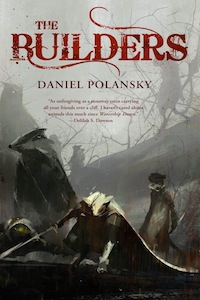 A missing eye… a broken wing… a stolen country.
Yeah, the last job didn’t end well.
The Captain’s company has kept a low profile since then, eking out an existence in the shadow of the war they lost. But that doesn’t mean the memories have faded, or even that the wounds have scarred. It’s all still fresh to the Captain. He finally sees a shot at vengeance, but how many of his old company are left? And how many will join the old mouse on one last tour? Opossum sniper Boudica, stoat assassin Bonsoir, and the sinister salamander named Cinnabar all answer his call, but will they be enough to settle the score? The Builders are out in the world raising all kinds of hell right now, plus you can read an excerpt here!
The “War with No Name” Series by Robert Repino
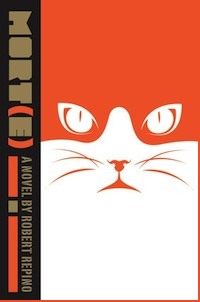 One day, Morte is an ordinary housecat. He has a crush on a neighbor dog named Sheba, and he loves lying in the sun. But then things start to change. He begins to think more complex thoughts, and chafe against the restraints of life as a cat. Something terrible happens to Sheba’s puppies, and the dog disappears. Suddenly a new world is revealed, one ruled by the Colony, hyper-intelligent ants who want to eradicate the human race. Morte takes on a new role as a warrior, and seems to be dedicated to this new animal-friendly world. But his true motivations are more complicated than that, and when a human claims to know where Sheba is, Morte has to decide what he’s willing to risk for his friend. The book skillfully weaves a post-apocalyptic narrative into an allegory about human society, along with a dash of Unstoppable-Virus-That-Must-Be-Contained. The first two books in the series, Morte and D’Arc, find their true heart in the story of Morte’s unwavering interspecies love for Sheba, while the third Culdesac, follows the adventures of a murderous Bobcat.
Vic and Blood, by Harlan Ellison
 Harlan Ellison’s story cycle featuring Vic (the Boy) and Blood (the Dog) isn’t so much an allegory as it is a bleak postwar dystopia, but there is enough satire in the plot, and enough acidic running commentary from Blood, that we felt like it needed to be here. Vic is the child of scavengers, with no education and little sense of morality. He does what he needs to survive, and since puberty has recently struck, he also does whatever he needs to find women, whether they’re willing or not. He and Blood develop a symbiotic relationship—Blood smells out women, and Vic steals food to share. L.Q. Jones’ 1975 movie adapts the second story in the cycle. Now, you’re going to be shocked by this, but Harlan Ellison voiced some disagreements that he had with the film adaptation, particularly calling out the “moronic, hateful, chauvinist” final line.
The Jungle Book, by Rudyard Kipling
 Rudyard Kipling’s stories of survival in the jungles of India have inspired several live-action movies (including the upcoming one that stars Scarlett Johansson as Kaa, which, frankly, terrifies me) the classic Disney cartoon and, wonderfully, Neil Gaiman’s The Graveyard Book. At the heart of the stories is a man-cub named Mowgli who has to learn to live among various slightly anthropomorphized beasts, including Bagheera the regal panther, Baloo the slacker bear, and Shere Khan, the kick-ass tiger who is vilified for acting like a tiger. The book also includes the tale of Rikki-Tikki-Taavi, so if you want to weep for a few straight hours, Kipling has you covered.
Saga, by Brian K. Vaughan and Fiona Staples
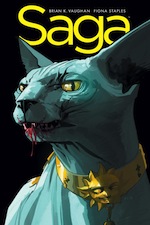 The world of Saga includes plenty of magical beings, robots, and talking animals, but the one we truly love is Lying Cat. The character starts as dark comic relief, punctuating tense situations by loudly announcing LYING whenever someone was trying to evade the truth. And she won our hearts by providing comfort to Sophie, a young girl rescued from a particularly creepy pleasure planet. But, because this is Saga, no one can be content to remain comic relief forever, and we get a single, terrible panel of backstory that throws all of Lying Cat’s life into stark relief.
La Planète des Singes, by Pierre Boulle
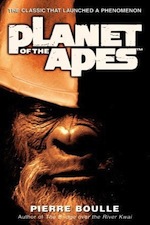 La Planète des Singes has been adapted into three different film universes now. The classic 1960s series starred Charlton Heston and Roddy McDowell, and lent themselves easily to discussion of racial discrimination. The attempted reboot from Tim Burton didn’t really lend itself to anything, but did try to comment on gun control issues by having NRA enthusiast Heston show up as an ape who’s worried about guns getting into the wrong damn dirty paws. Finally, the newest iteration has met with critical acclaim, but shifts the focus over to animal rights, as well as a classic, what makes us all human, narrative. The original novel is more about class than anything else, with a far-future couple happening upon the journal of a human journalist Ulysse Mérou, who ends up trapped in an of-planet ape society and documents his time there with other humans. The book dwells on the way the ape society stratifies itself between Gorilla, Orangutan, and Chimp.
Watership Down, by Richard Adams
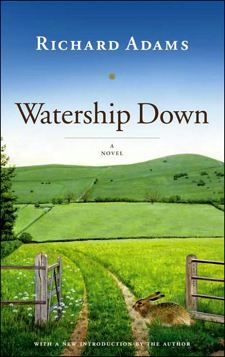
Possibly the most traumatic single book on a list of traumatic books, this is an epic adventure starring rabbits. Rabbits, you say? Well yes, rabbits have an extremely complex social life in the wild, living in warrens that can stretch over miles of territory. Watership Down began life as a story Richard Adams told to his daughters, but after he did some rabbit research he expanded into an epic the echoes the stories of Ulysses and Aeneas. Fiver, a psychic rabbit, has a vision that his warren is going to be destroyed. Only a few rabbits, including his brother Hazel, believe him, so they escape and go on a quest to find a new home, facing many dangers along the way. Finally, they reach the Watership Down of the title, set up camp, and begin exploring the possibilities of liberating some does from a nearby hutch. The only problem is, the powerful warren next door might try to take it from them… hence horrifying RABBIT WARFARE. Richard Adams rejects the idea that the story is an allegory, but it does act as a commentary on political and military struggles, and the ways a society that focuses on military might to the exclusion of all else might not be the best society.
Maus, by Art Spiegelman
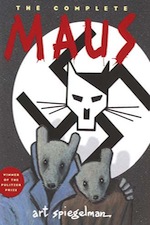 OK, did I suggest that Watership Down was the most traumatic book on this list? My mistake. In Maus, Art Spiegelman took his father’s stories of the Holocaust and recast them with cute talking animals: Jews = mice, Germans = cats, and Americans = dogs. This manages to both make the story more immediately readable, and somehow even more horrific, especially when you realize that Spiegelman was drawing on real Nazi imagery that cast Jews as a plague of rats, and that Zyklon B was a pesticide. This book more than any other convinced a generation of non-comics readers that maybe the medium was something they should take seriously, and paved the way for Fun Home, Black Hole, and Persepolis. None of which have talking animals.
Animal Farm, by George Orwell
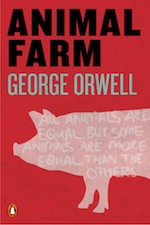 Obviously, this one holds a place of honor on any list of talking animals. This book, which comprises all of what most U.S, citizens know about the Bolshevik Revolution, casts pigs as different members of the communist party, while a hardworking horse gets to stand in for the peasant class, exploited first by feudalism and then by the Party itself, and the farmdogs switch loyalty from the humans to become the pigs’ military. Also, I’m pretty sure the donkey is supposed to be Walter Benjamin? Anyway, never trust anything that walks on two legs! And never give a pig liquor. It turns out that doesn’t end well.
The Island of Dr. Moreau, by H.G. Wells
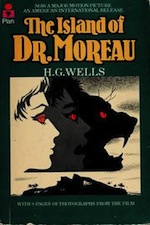 Speaking of never trusting anything with two legs… poor Dr. Moreau just wants to be left in peace on his island, where he can genetically modify every animal he can get his hands on. Is it so wrong to want an army of Beast Folk? Unfortunately, the rest of the world isn’t so keen on the Beast Folk plan, so Moreau must pursue perfection alone. His latest experiment, a, um, a Puma-Man, also turns out not to be wholly onboard with his uplifting, and things go a bit pear-shaped. Did I mention that giving transformed animals liquor is a bad idea? Did that come through? Wells used this horrific tale as an attack on the practice of vivisection, as well as pointing out that humans seemed to be slipping a bit in their civilized-ness.
Barsk: The Elephants’ Graveyard, by Lawrence M. Schoen
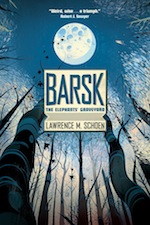 On the densely forested planet Barsk, rain falls almost constantly, and one rarely sees the sun or any of the seven moons. One strange boy, Pizlo, has voices that guide him to the “chimneys”—breaks in the trees that give a view of the sky. In this way he’s seen three of the moons so far. A fatherless boy named Pizlo is a member of the Fant—the race of anthropomorphic elephants that have been banished to Barsk, considered a backwater by the rest of the uplifted animals of the galaxy. Humans are a distant memory, but the various animal descendants have proved adept at populating space without our interference. Now an offworld group is trying to break into the Fant’s control of their one resource, a medicine called koph. While his voices push him toward an uncertain future, his father’s best friend, the Fant’s Speaker With the Dead, is using the spirits’ answers to uncover secrets that those in power would prefer to keep hidden. Here anthropomorphic animals and far-future sci-fi combine to tell a heartbreaking story of the elusiveness of truth, and the prison of memory.
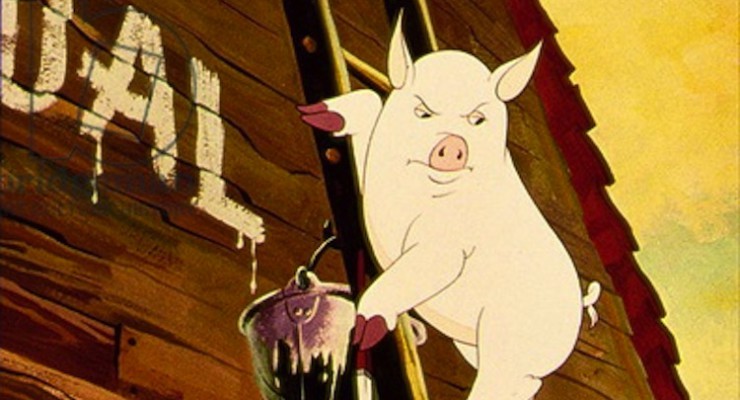
Top image from Halas and Batchelor’s adaptation of Animal Farm, 1954.
Leah Schnelbach has spent entirely too much time trying to decide which animal she’d like to be in an allegory. An otter, maybe? No, a dragon! Can she be a dragon, or does that stretch the allegory too far? Come help her choose on Twitter!

Two pure animal tales and two hybrids come to mind at once:
Tailchaser’s Song by Tad Williams – This worked very well for me as “epic fantasy, only with cats”, and came across as compelling despite the inevitable comparisons to Watership Down (which is the wrong comparison anyway; in a sense one might argue that Williams’ and Adams’ novels complement one another in roughly the same way the worlds of Middle-Earth and Narnia do, although I don’t want to take that idea any farther in terms of actual book-to-book comparisons).
One for Sorrow, Two for Joy – And somehow, most (though certainly not all) of the nifty animal-based fantasy epics seem to come from the British Isles. This one from Clive Woodall takes birds as its viewpoint creatures of choice, and I thought it worked very well for what it was. I am also not remotely surprised that Disney hasn’t managed to make a movie out of it despite taking out an option when the book initially appeared; there is a lot of emphatically non-Disney violence and characterization along the way.
Fool on the Hill – This one is a rarity, a novel with both human and animal protagonists…and one that I’ve always found immensely readable despite some of its kitchen-sink qualities. I like Matt Ruff’s dogs and cats here, and I think he does astonishingly well at creating the animal characters and setting them in the context of the book’s overall landscape (specifically, Cornell University and environs).
The Book of Night With Moon – And then there’s Diane Duane, this being the first book in her “Cats of Grand Central” sequence featuring feline wizards, who also wander in and out of her “Young Wizards” YA fantasy series. Some of Duane’s attempts to make her cats cat-like work better than others, but overall I enjoy both the idea and the execution. (One should also look carefully at the character of Ponch, Kit’s dog, in the mainline “Young Wizards” novels, who is one of the best-written dogs in modern fantasy, but I can’t say too much more about that without getting into a major plot point in one of the later books.)
Surely just about anything from Brian Jacques’ Redwall series counts. Rape, kidnap, slavery, murder, treason, treachery, redemption in death … they can be pretty weighty for kids books.
Richard Adams also wrote The Plague Dogs and Shardik and both are much harder going than Watership Down.
There is a lot of darkness there, especially the animal testing in The Plague Dogs, and not much hope of a happy ending.
William Horwood’s Duncton Wood series, based around sentient moles, combining the stone circles of Britain with paganism, the rise of Christianity and the onset of fascism.
Tad Williams did a Tolkein homage with cats – Tailchaser’s Song. It also features slavery, kidnapping and what it means to be a hero.
David Peterson’s Mouse Guard, a beautifully drawn graphic novel series about mice who serve in the titular Mouse Guard, with politics, swordplay, and a wonderful sense of scale. Support the author/artist by visiting his site, http://www.mouseguard.net to purchase the books.
The Fantastic Mr. Fox
Monkey wars by Richard Kurti.
Strange you should mention Saga, if I were picking a Vaughan I would definitely have gone with Pride of Baghdad.
POGO.
Let us not forget the late, great Terry Pratchett and his typically twisted take on the Pied Piper story: “The Amazing Maurice and His Educated Rodents”.
I really enjoyed “Family Tree” by Sheri S Tepper.
There’s a name for this genre of fiction — it’s called furry fiction, and there’s a rapidly growing community around it.
Don’t forget Traveller, also by Richard Adams…
Bojack Horseman. Seriously.
Ok, so they aren’t strictly animals, but half-human/half-animal hybrids. But the story is dark and serious and delves pretty deep into the psyche, but is able to get away with stuff a live-action show couldn’t, I think, because of its use of these animalistic characters.
http://www.amazon.com/Wildings-Nilanjana-Roy/dp/0345812611/ref=sr_1_1?ie=UTF8&qid=1447362842&sr=8-1&keywords=nilanjana+roy Fits the bill though it’s not out yet in the US
There are some short stories in this sector of the library that are well worth a look. “Bufo Rex” by Erik Amundsen, a deliciously sardonic fairytale of revenge (unfortunately gone offline with the Wierd Tales site); Fritz Leiber’s “Space-Time for Springers”, the tale of an unsung feline intellectual; David Sandner’s Old Foss Is The Name Of His Cat, a melancholy fantasy on Edward Lear and his lifelong companion.
I haven’t read it yet, but Ken Greenhall’s “Hellhound”, covered in Summers of Sleaze last year, sounds like a very interesting dark take on the genre.
And on graphic novels, I’m going to be utterly unprincipled and shill for my spouse’s work: Thomas K Dye’s Newshounds / Infinity Refugees cycle, following its anthropomorphic casts as they try to get by and make their mark in the human-dominated world.
I have to voice my support here for Beasts of Burden, a graphic novel about the dogs and cats of the small town of Burden Hill from the supernatural horrors their human owners cannot sense.
Both “Cat House” and “Catamount” by Michael Peak were fun reads about a colony of feral cats and a few wild animals in suburban Southern California.
I’m surprised I didn’t see The Mistmantle Chronicles anywhere in the comments. Mistmantle is a chronological series, primarily about a squirrel named Urchin who lives in an island kingdom surrounded by mist. It’s more mature but less bloodthirsty than Redwall in that it does not oversimplify good and evil with species, and it typically revolves around protecting the kingdom from enemies both foreign and domestic. There are some thematic elements that may as well have been pulled directly from the mind of Frederich Nietsche, and there are quite a few references to culling, murder, and insane behavior. It is my #1 favorite anthropomorphic fiction series now.
There are five books to this series, but the last one is pretty hard to get a hold of unless you get it in E-book format.