





“A desolate, dry planet with vast deserts… The planet is Arrakis. Also known as Dune.” – Princess Irulan, Dune
I’ve been reading science fiction and fantasy almost as long as I’ve been able to read, and I’m normally very good at suspending my disbelief. Unfortunately, seven years of university schooling and two degrees have now placed some suspension limits on certain areas—namely geology, landforms, and maps. I tend to notice little things like mountain ranges having ninety degree corners or rivers that flow uphill or maps that don’t have a scale bar.
So I want to talk about some things, which on-a-geological-scale are very small details that make me tilt my head like a dog hearing a high-pitched noise. Not because I hate, but because there is no more honorable nerd past-time than dismantling something we love into its finest details, ruminating endlessly on the bark of a single tree while there’s an entire forest planet surrounding us.
Which is what I’d like to talk about today, incidentally. Single-environment planets. The other stuff, including scale bars, will come later.
I like desert planets, and it’s the combined fault of Dune and a semester of examining lithified sand dunes that are now absolutely gorgeous rock formations.
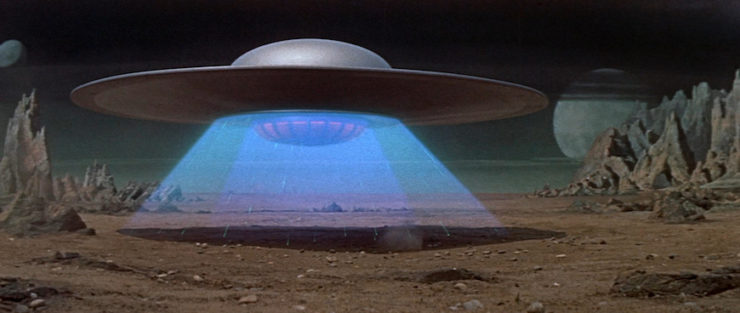
Arrakis wasn’t the first desert planet of science fiction—at the very least, Altair IV as seen on Forbidden Planet has it beat, and I’m sure there’s some pulpy goodness even earlier that involves desert planet adventures. But Arrakis and its direct descendant Tatooine are definitely the most iconic desert worlds of our genre.
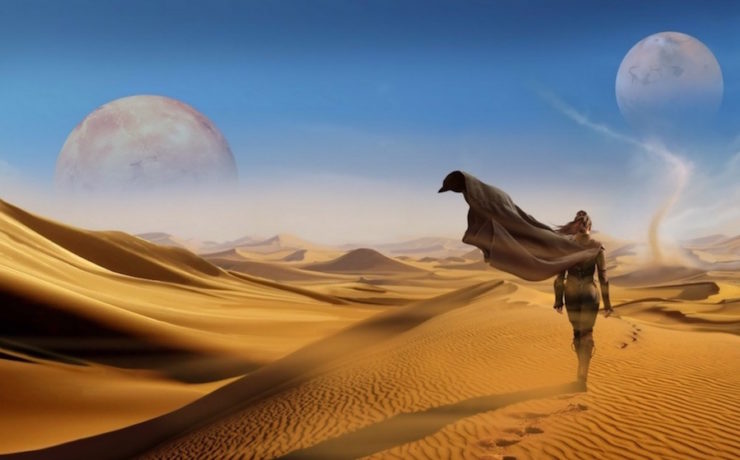
As a geologist, I have a particular love of the desert and its landforms, ones that are normally more shaped by wind than water. (The descriptor for those is eolian, which is a particularly lovely word to say.) I did a lot of undergraduate field study out in Moab, and I grew up in Colorado, which has a lot of near-desert and desert environments. The dry hot-and-cold of the desert shapes you, in ways beyond an appreciation for chapstick and a healthy respect for static electricity.
There’s an inherent magic to the desert, whether you’ve ever been in one or not, a grown-in mysticism that comes with the unfamiliar. It’s a landscape that’s entirely alien to most of us, unimaginable for its lack of water, its alternating burning and freezing temperatures, its weird or absent plant life. The horizon in a desert extends on forever, because there’s no humidity to get in the way of your vision. The only real limit is the curvature of the planet, elevated land features, or particulates in the air. Even the sunsets look different, if you haven’t lived your entire life where it’s incredibly dry. (Let me tell you, the first sunset I saw in a place with humidity actually scared me because it looked so different, with the Sun hovering massive on the horizon like a blood-filled Eye of Sauron.)
There’s a quiet to the desert that sinks in through your skin, a hush that’s only the sound of the wind. Rodents or insects moving around sand grains or pebbles sounds shockingly loud. Birds startle you. And the sky at night? You’ve never seen so many stars in your life, if you’ve never been to the desert. Being out in the middle of nowhere cuts out all the urban light pollution, but beyond that, there’s few clouds, no humidity to blur and hide the sky.
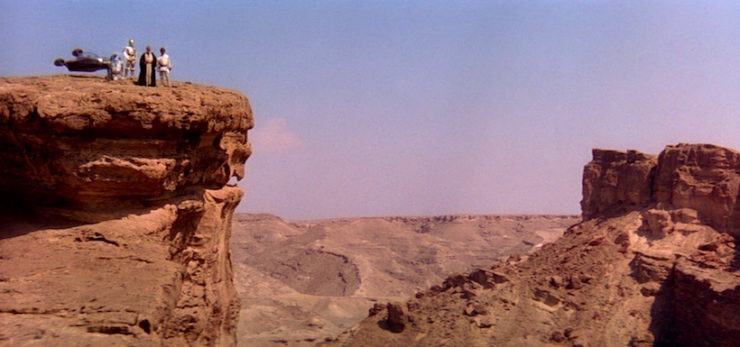
Of course, there’s this common conception that deserts are like very specific portions of the Sahara, with undulating dune seas that go to the horizon. Arrakis and Tatooine both have a lot to answer for on that front, but I will admit that barchanoid (crescent) and transverse (linear, if wavy) dunes are particularly photogenic. And while those are what capture the imagination, both Dune and Star Wars admit there’s more to their desert worlds than just endless draas. Arrakis has extensive salt flats (sometimes called “saltpan” colloquially in America) that are the skeletons of extinct oceans and lakes. There are rocks and mesas that poke their heads above the sand. In Star Wars: Episode IV, we get a brief look at Sluuce Canyon—which might also mean there was once a fast-moving river there, or it could be a tectonic artifact. But either way, it’s a change from the dunes.
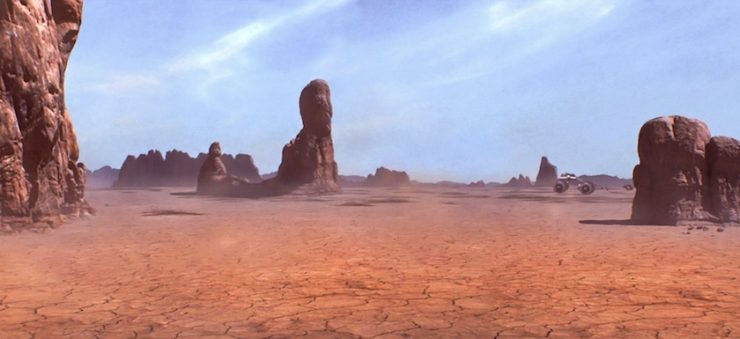
And let me tell you, there are a lot more landforms in the desert beyond those. There’s hardpan (basically rock-hard clay surfacing) and desert pavements of packed stone, with or without desert varnish. There are deflation hollows (where sand has been blown away from rock outcrops, leaving a hollow), dry steppes, and an assortment of strange rock forms shaped by wind and blown sand (yardangs). For all its many faults, Star Wars: Episode I got one thing right—we get to see a scene during the pod races with a hardpan plain riddled with mud cracks and darted with wind-shaped yardangs.
Deserts can be as hot as you imagine or impossibly cold. This is because the factor that determines if something is a desert is precipitation. That’s it—everything comes down to how much water falls from the sky. Latitude doesn’t matter, sand or lack thereof doesn’t matter, just that it’s really, really, really dry.
This is why as a geologist, I don’t have to suspend my disbelief very far to journey to a world that’s all desert. I’d like to see more than just sand dunes, but I can tell myself that for some reason, all the people want to just hang out in the sand and ignore the other areas. They’re believable—they even exist in our very own solar system. Just look at Mars! (Mars is a desert whether it has water hiding under its surface or not; what matters in this case is that it certainly hasn’t rained there in recent geological time.) If you look through many pictures of the red planet, you see all that variation in local land forms I mentioned, from classic sandy dune seas, to dry mountains, to empty canyons, to rocky landscapes of what might be equivalent to pavements. All you need to get an entire planet that’s a desert is reverse that ubiquitous direction for ready-made products—just remove the water. Voilà, instant desert!
Then, of course, you have to address how the hell anyone actually survives on that world, but that’s your problem. I just deal in rocks.
Mono-environment invented planets don’t work for much else, though, with the possible exception of the ice ball world. (Even then, depending on your land masses, there might be more than just glaciers out there. But I’ll give the benefit of the doubt on that one.) The real issue is that worlds are spherical-ish (“oblate spheroids,” if you’re nasty), and they tend to get their input of light and heat via orbiting a star. The unforgiving realities of geometry—sphere versus what is effectively a uni-directional point source—dictate that the distribution of heat is never going to be even, which means you’re going to get atmospheric currents, and those mean that the distribution of precipitation is never going to be even, and as soon as you add that plus your unevenly distributed landscape and unevenly distributed bodies of water, you have environmental trouble. If your entire world is so hot that there are tropical rain forests at the poles, what the heck is happening at the equators? How is your rainfall and temperature being so regulated that there’s jungle everywhere? Have you never heard of mountain rain shadow effects?
This is why, once we leave Tatooine, the world-building in the Star Wars universe generally loses me. Having an entire planet that’s made up of rainforest-covered archipelagos as far as the eye can see looks very pretty on the screen with a starship zooming in, but it awakens a lot of deep and worrying questions in me, including (but not limited to) just what is happening with the plate tectonics?
Please don’t think I want a deep, loving, exhaustive description of how the plate tectonics on your planet work. I don’t, and I say this as a geologist—I’m sure no one else does, either. But there needs to be a reason, a level of believability, and if it ain’t a desert, it ain’t going to work. And remember even then, you’re still not going to have an Arrakis that is one massive dune sea that’s all the same temperature. The landscape varies, and that variation provides a certain amount of character and realism—it’s a similar principle to when directors in movies want sets to look “lived in.” The variation in landscape makes the planet alive, even in a world that seems as sterile and dead as one giant desert—because trust me, deserts are neither sterile, nor dead.
They never stop moving, as long as the wind blows.
Alex Acks is a writer, geologist, Twitter fiend, and dapper AF. Their sweary biker space witch debut novel, Hunger Makes the Wolf, is out now from Angry Robot Books.



I grew up in the Sonoran desert, down in Arizona. PREACH IT, MY FRIEND!
Bravo!
I am also a geologist and big fan of fantasy. And I agree that it can be very difficult at times to ignore the issues of bad geology in worldbuilding. With Star Wars I long ago learned to ignore things because so much is problematic when looked at in any depth.
One relatively recent example of a huge failure in geology (and I won’t name the book, since it was otherwise pretty good): a small, desert island in the middle of the ocean. However, there was an extensive and very deep cave system complete with lots of underground rivers rushing with fresh water and full of very large monsters that apparently find plenty to eat on a small, barren, desert island. Ugghh…. Where does that fresh water come from? How is there so much fresh water and no issues of salt water intrusion? How is the extensive cave system not flooded below sea level? etc.I had a lot of trouble suspending my belief with that set-up.
Oh, and I share the love of the desert. I live in the mountains above the Sonoran Desert and spend a lot time down there. If you want to read some fantasy that truly captures the magic of the desert (note: not epic fantasy), I highly recommend Medicine Road by Charles de Lint and The Wood Wife by Terri Windling. And I’ll have to check out your book since it’s great to see a geologist writing fantasy.
I suppose it’s possible that Endor is not completely covered in forest; that’s just the part we see. I can’t remember if the Ewok movies ever show some hint of other ecosystems.
But thank you for the interesting/informative article :)
I can’t think about the issue of single-environment planets without getting flashes of the College Humor sketch “Swamp Planet”. Look it up. :)
Water planets are the ones that scare me, the ones that only have a few islands here and there. The way the wind blows and waves pile up down around Antartica in the “Roaring Fourties,” because the fetch goes entirely around the world is, by all accounts, something to behold. Imagine a whole world the winds and seas can swirl around, and it boggles the mind.
@3. The Ewok movies do indeed show a wider range of geology (considering that the characters are traveling on foot); including rolling hills and grasslands, a desert, and a mountain range inhabited by condor dragons, giants, and cave spiders. The Ewoks cartoon adds a swamp (where the Dulok tribes make their home), and McQuarrie’s RotJ concept art includes an Ewok lake village surrounded by snow-capped mountains.
Have I got a couple of links for you! Chris Wayan has worked out geologically plausible desert and ocean planets, and a bunch of other interesting imaginary worlds, here:
http://www.worlddreambank.org/P/PLANETS.HTM
Fialleril, beginning with the premise that Tatooine running on slavery shouldn’t have been a throwaway bit of set dressing, has made a lot of intriguing posts about life on Tatooine here:
http://fialleril.tumblr.com/tagged/tatooine-slave-culture
Among other things, she has made the observation that Tatooine works as a desert planet if you assume that it was a semidesert planet until offworld interests moved in and mucked it up.
The simplest answer to the frustration of “mono-environment worlds” (so far as blood pressure goes) is to assume that the narrator or speaker is being non-literal in some way. After all, we call Earth “the blue planet” even if that describes only 75% of the surface (I suppose it counts as a form of synecdoche, in which the part describes the whole). In the Imperium, Arrakis was called “Dune” even though it had non-dune landforms. And in the E.T. tie-in novel Book of the Green Planet, E.T.’s titular homeworld was named for the reputation of its people as herbological engineers.
For “it was raining on Mongo that morning” situations you can … umm … resort to synecdoche again. The weather report in the vicinity of the space-potentate is self-evidently the only weather report that matters. Yeah, that’s the ticket.
As for visual SF, how the world looks like from space isn’t necessarily representative of its surface — green areas wash out to brown when viewed through a few miles of air, an effect which is apparent even from an airliner, let alone a satellite.
Interesting analysis, but where does a breathable atmosphere come from? You need a robust ecology and biogeochemical cycles, amongst other things, to maintain free, molecular oxygen in the atmosphere on a geologic timescale. Few single-environment planets seem remotely capable of doing that
Yes, Mars is a desert world, but it is a (mostly) dead one that barely has an atmosphere, and certainly not one that ever supported oxygen in any quantity without life and a more diverse planetary environment.
Tatooine seems to have some native megafauna, but there appears to be no environment that could even begin to support them. What do they eat? Rocks? What is the source of the atmospheric oxygen?
My reaction is the opposite, I don’t think a desert planet, or an ice planet, or whatever has much believability. At best, there might be some single-celled organisms living in an anoxic atmosphere — but that would make for rather dull books and movies.
With Star Wars specifically, I like to think that the explanation for mono-biome planets is the same as the one for space physics in other areas (sound, flight mechanics, ship handling, etc.).
I posit that the Galaxy Far Far Away (GFFA) is not like our galaxy. Rather, it has what amounts to an aether or some other kind of thin atmosphere that permeates the entire space between stars and planets. Just as it would allow for the transmission of sound through space, and just as it would allow for ships and fighters to handle like they do, so too would it perhaps allow for single-biome planets. Perhaps heat from the local star diffuses throughout the aether, causing planets to be nearly uniform in the heat transfer they receive from their suns. There would still be night/day differentiation, and planets closer to their stars would still be warmer than those farther away, but such a solution would allow them to have far more uniform climates than we are used to.
How do you have an entire article about desert planets without a single mention of Vulcan? Where’s the love?
I’m a physicist. It’s very hard finding genre books that don’t violate several laws of physics somewhere. Very occasionally you’ll find a guy like Greg Benford who tries to couch almost everything in real physics AND write a story, but it’s a very hard thing to do. Even the more modern “hard SF” like The Expanse only sparingly cares about real science. The trick to it is to realize that we don’t actually know that much about science. My job as a professional physicist is literally to do things every day that I was taught were impossible while in school. If in the course of a few decades, there are major aspects of science that move from “impossible” to “routine,” suspension of disbelief is pretty easy.
Dune is a desert planet mostly due to the native fauna (sic) which I believe is extensively explained trhoughout the main title
The varied landscapes of Tatooine certainly provided some fantastic visuals; but despite showing some geological variations absent in most other SF desert-planet settings, the Star Wars films unfortunately used that terrain in exactly the same way: merely as backdrop. Yes, it is notable that Anakin and Luke Skywalker both started their lives on a harsh backwater planet, but the fact that their home is a dry desert has no real bearing on the story.
The contrast with Dune makes Herbert’s efforts a bit more impressive than just writing an iconic SF epic. Establishing that Arrakis was not completely desert but in fact had some regions of temperate (or at least steppe/taiga-like) vegetation was a good nod towards scientific plausibility, and the Fremen’s centuries-long project to reclaim a sustainable vegetation-and-surface-water cycle from those sands is a subtle bit of environmentalist commentary and can-do optimism (especially for a story with lots of dark threads). But most importantly, the impact that such a unique environment had on its people and their culture—as well as the impact of (finally) transforming that environment to be less harsh—is an essential element of the story. I wouldn’t go so far as to say Arrakis was another character, but its importance makes one aware of the physical setting perhaps more so than in most stories.
Similarly to the OP, my knowledge of astronomy and planetary science does sometimes make me look askance at single-environment planets in SF stories. But I think more often than not, the problems with such settings are really more the result of sloppy writing (or lazy editing) than about plausibility per se. Authors, leave it to your audience to fill in their own details for those parts of a planet that your characters never visit and don’t affect the plot!
Arrakis also has a polar cap, if I’m remembering the map at the front of the book correctly.
Regarding Tatooine’s atmosphere, the (no-longer-canon) EU established that Tatooine was not always a desert planet, but a lush jungle world that had been “glassed” a few thousand years ago by the Rakata (a precursor civilization that collapsed before humans took to the stars).
It clearly still has a strong magnetic field and a thick, water-filled atmosphere (clouds), and we do see some straggly plant life in some shots, though I have no idea if they would be enough to sustain a breathable atmosphere. It’s possible that the human colonists (who arrived long after the apocalypse) could’ve brought some terraforming technology with them.
Cherryh has some interesting desert worlds in her Faded Sun trilogy, with Kesrith as the archetypal Arrakis style desert world, and Kutath as the ancient homeworld, desertified due to being inhabited for countless millennia.
I always had a soft spot though for Alan Dean Foster’s single biome planets. Midworld the jungle world, Cachalot the ocean world, Horseeye of the giant river canyon and Tran-Ky-Ky, the frozen planet. From memory the AAnn worlds are mostly desert based as well.
Mostly because he actually thought through the biology of each world, and had fairly plausible geography and ecosystems.
The life cycle of the sapients on Tran-ky-ky was particularly well thought out, with a brief hot summer and a millenia long winter – forget Martin’s ten thousand year medieval stasis, this is true evolution in action.
@14 – “Yes, it is notable that Anakin and Luke Skywalker both started their lives on a harsh backwater planet, but the fact that their home is a dry desert has no real bearing on the story.” – um, hello, did you not hear Anakin talk about how he DOES NOT LIKE SAND ;) Obviously a crucial part of the story ;)
I did appreciate that in The Phantom Menace they showed Anakin shivering and mentioned that space seemed colder to him than others because he grew up on such a warm planet, but nothing ever comes of that. They pay some lip service to Jar Jar (an aquatic being) suffering under the harsh light of the sun there, but really he probably should have been more incapacitated.
But on a more serious note, I think that – with Luke, especially – the harsh/desert-ness of the planet wasn’t what they emphasized, but more that it was a backwater (and in TPM, basically overlooked and therefore run by criminals). Although perhaps you could make a case for the Tusken Raiders being a part of (and formed by) the ‘harshness’, which in turn has an impact on Anakin.
But in general, yes I agree with you – but perhaps the Tatooinians had just enough technology to stave off most of the harsh part. Beru certainly seemed to have access to some type of vegetables and they don’t live as nomads.
Interestingly, I just started to read White Sand, and in the foreword, Sanderson mentions that his first attempt at writing it was basically just an Arakkis/Tatooine hybrid and so when he went back to it he put more into developing the world and the kind of culture and life that would be a part of it. Which made me think of this article :)
@9 – my initial background is in microbiology (I work in computers and have for nearly a decade now), so I think about this too (this is actually why I took the midichlorian revelation without blinking an eye). I also wonder about how bacteria and microorganisms travel between worlds; people are always planet hopping and so one wonders if the microbial flora have basically all intermingled. Nobody ever seems to be concerned about picking up some microbe they have no immunity to, or introducing their own invasive microbes that could wreak havoc on the ecosystem (or health). On earth, we have this concept of 16S ribosomal DNA that can be used to trace how all living things relate (animals, plants, bacteria, Archaea, etc) and point to some common ancestor, and so I wonder if there is some galactic equivalent, or did life arise indepdently on all these planets – and could you identify that based on a DNA analysis (even if it showed up on another planet). How does horizontal gene transfer work? This is of course assuming everybody is using DNA, since even on earth there are viruses with RNA based genetic systems.
Anyway, yeah. You could probably write a very interesting microbiology based fantasy/science fiction story. Honestly, that’s why I actually love the midichlorians, I don’t care how many other people hate them. If anything, I wish they had done more with the concept – it doesn’t have to nullify the mysticism just becuase there’s also science behind it. There was an episode in the sixth season of the Clone Wars where one of the minor characters was some kind of Jedi-doctor-neurologist-scientist and I was like – that sounds like the coolest job ever. I guess if I had to pick my dream Star Wars job it would be some kid of Jedi-microbiologist-researcher ;)
But speaking of desert planets there could be all sorts of bacteria and extremophiles that could be contributing the ecosystem. Enough to produce a breatheable atmosphere..*shrugs*. But I suppose it’s possible that some alternative to chlorophyll would have evolved.
@CyberSnark the EU is and always will be the true canon.
I wonder if that meaning of “eolian” was in Patrick Rothfuss’s head when he named the inn Kvothe liked so much.
I took Environmental Science as a major, I used to torture my writing group in college with lectures on how you get a desert, where your rivers should be going etc. A few single-ecosystem planets I’ve found believable with the old “this is just what the part the plot is set in looks like,” but for so many other stories it’s a symptom of treating an entire planet like it is, at best, a small town with a single ecology, culture, and available location for landing a spaceship.
… Or a symptom, from before CGI, of every space themed show having to use the same rock feature for their outdoor shoots. :)
Great essay, thanks!
Growing up on the central Oregon coast, I was delighted to learn that Frank Herbert was inspired to write Dune after visiting our own ecosystem, which of course was not a desert at all. Here’s a little article on the topic: https://www.pdxmonthly.com/articles/2015/7/20/how-the-oregon-dunes-inspired-sci-fi-classic-dune
Of course, Arrakis lacked our 40″ of annual rainfall and adjacent ocean.
@19, if you want to read good microbiology-based science fiction, I recommend the novels of Joan Slonczewski, especially The Children Star.
Slightly off tangent…
Stephen Briggs on presenting the first draft of the Discworld map to Sir Terry Pratchett:
“I showed draft #1 to Terry, who looked at it for some time and said ‘Do you know what a rain shadow is?’ This was new to me, who took Raffia instead of Geography. I was given a short lecture on mountain ranges and prevailing rain-bearing winds, which gently led up to the fact that I´d put the Great Nef, the driest place in the world, in what would have been a very large swamp.”
I must admit, I’ve never quite worked out rainshadows and swamps myself. Why are some deserts hidden in the interior and some coastal? Terry was a wiser person than I am, in so very many areas.
My other favorite desert planet (and maybe the earliest example?): Barsoom from Edgar Rice Burroughs’ John Carter of Mars books.
@@@@@ random22, no. 26: In a nutshell, the Earth has a vast system of circulating winds that always blow in a particular direction unless something blocks them. Local weather may deviate from these winds briefly and seasonal changes in heat may cause them to shift, but the worldwide pattern always prevails in the end. (Do an image search on “atmospheric circulation Earth” to see how they work.) If the local prevailing wind blows from the ocean toward the land, but there’s a tall enough mountain range at the edge of the sea, the mountains will stop the wind. They will catch all of the rainclouds created by evaporating ocean water, and the other side of the range will be arid. However, if the local prevailing wind blows away from the land and local mountains are too short, or too far inland, to accumulate enough snowpack to feed streams that go all the way to the sea, the ocean side of the mountains will be arid: the wind sucks up whatever evaporates off the land and dumps it in the ocean.
@10: That reminds me of Phillip Reeve’s glorious Larklight books, where space is a semi-breathable “aetheric” ocean teeming with fish, giant moths, and other creatures. Those books break every applicable rule of science, but in all the best ways.
@29: I love Larklight!
How could you possibly have forgotten VULCAN?!
“It’s clean.”
More than a bit of T. E. Lawrence in Paul Muad’Dib.