






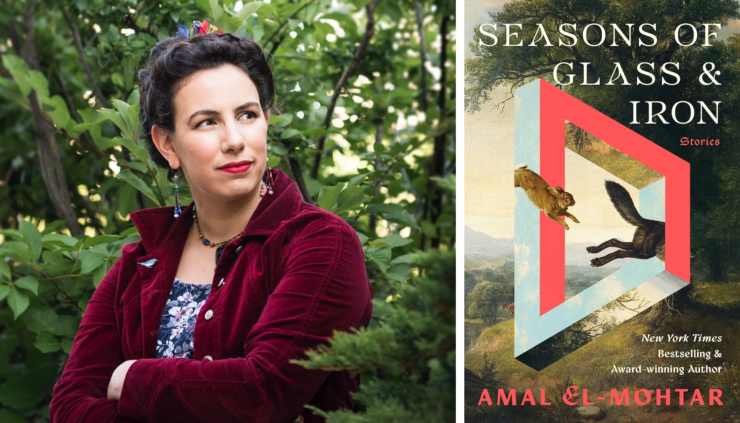
Amal El-Mohtar’s debut short story collection brings together some of her most well-known and beloved works of fiction and poetry over the last fifteen years of her career. El-Mohtar co-wrote the phenomenal Hugo and Nebula award-winning novella This is How You Lose the Time War (along with Max Gladstone), and her recent novella The River Has Roots has garnered an extraordinary amount of love—but she first impressed herself on the clay of the industry through shorter, poetic works with roots in myth, fables, and folklore.
A long-time admirer of her work, I jumped at the chance to talk with Amal about Seasons of Glass & Iron, what it was like collecting and examining these works, and what it meant to look back on them.
Buy the Book

Seasons of Glass & Iron
Martin Cahill: Hi Amal! Thanks so much for chatting with me about your collection, Seasons of Glass and Iron.
Amal El-Mohtar: It’s my pleasure!
Martin: I’ve had the joy of reading the majority of these stories across the years, but there were some that were brand new to me which I now cherish. Is there a particular story in here that you felt similar towards? One of those pieces you see in a new light that you hope a reader receives with their whole heart?
Amal: I think what has happened is that I’m seeing all of them by each other’s light, if that makes sense? That by putting these stories together I’ve extracted them from the contexts that produced them, and given them the new context of being organized into this collection as a record of how I spent 15 years of writing. It’s the difference between seeing a flower in a meadow or garden and then putting it in a bouquet.
Martin: When it came to the progression of stories and poems, did you and your editor have any guiding principles about what should appear when, and in conversation with other works? Are you someone who reads collections in order, or do you ascribe to a more magpie like enjoyment of collected works?
Amal: As much as I love magpies, I 100% always read a short story collection from start to finish, because I want to know what the editorial intention is. That’s something you can’t know unless you read it in order, and I want to know all the things all the time. So I absolutely will read a collection from start to finish, in order to access that secret knowledge.
In terms of how my editor, Ali Fisher, and I talked about organizing the collection, I think we took a mixtape approach, ultimately—wanting to give a reader a journey of textures and variety, paying attention to rhythm and length and key, shifts in affect and mood, but with a recognizable unity to it. Opting for a blend of familiarity and surprise so that as soon as you feel like you have fallen into a groove, something will startle you into a different one.
Martin: I really enjoyed your introduction to this collection, and how you both actively engage with and combat the idea of how one, especially an AFAB individual, must comport themself in looking back at older work; it casts the entire collection as unapologetic and unapologetically yours, which I love. What other spaces in the industry and community do you see the opportunity for marginalized writers to reclaim for themselves and for their work?
Amal: The nature of being marginalized is that you are definitionally not in the centre of things, so my glib answer is: I think marginalized people should be everywhere, in all of the spaces, doing everything they want.
But within writing and publishing specifically, it’s difficult to separate where I want marginalized people to be thriving from the places that I think are already stressed or in need of support. I would love to see more marginalized people in criticism, for instance, being able to comment on and help guide popular conversation and meditations on taste and genre. But at the same time, criticism as a whole is embattled, as arts coverage gets slashed and news media more broadly gets sabotaged. Meanwhile everyone’s trying to figure out how to enable people to discover new work at all before getting into the whys and hows of saying anything interesting about it.
Martin: In revisiting these stories, you see a deep love of women throughout your work. It gave great context to these tales of romantic love, platonic love, familial and spiritual and communal love between women throughout. Do you feel there’s one story in particular that resonates the most with this love?
Amal: “Seasons of Glass and Iron”, the title story. It’s very easy for us to fall into having narratives about ourselves that are painful and punishing, in which we see ourselves in the harshest, most damning light, and it’s important to have people who will look at those stories and say: that’s bullshit. People who will read our stories about ourselves against their grain in order to show us how mistaken or incomplete or unfair they are.
And the fact that friends will provide this service for us is a sort of constant miracle that we should all, I think, be grateful for and strive to have more of in our lives. And “Seasons” is the story in which I felt that I gave that belief its best expression.
Martin: I noticed also a deep love of place in almost every story, and especially every poem. (I love that you made sure to include some works of poetry!). A city of the sun, Glasgow, Neptune, a hill of glass, place informs so much of your work and I would love to know when place enters your fictional equation, and how you shape it around the story at hand.
Amal: This is one of those “it varies” answers that can be really boring, but is simply true. I write so much from a place of sensory affect, and that sensory affect very naturally comes out of wherever I am. And so there are definitely stories where I’m writing about a place that I was not necessarily physically in, but nevertheless, the things that I was looking at or touching or the things that were surrounding me made their way into the setting.
Something like “Madeleine” is full of memories that have very strong sensory components, but I wasn’t in the places where I had those experiences while I was writing it. I was using them as material for the story. In other cases, especially the stories set in Glasgow, I was living in Glasgow at the time, and thinking about the city a lot. So, to me it feels like the city is gently observing the story taking place within it.
So, it varies. Place can be the catalyst that sparks a story, but other times it will make its way in atmospherically because it’s so entwined with the way that I’m inhabiting space myself as I’m writing. It can come in at any point, but then it’s there to stay.
Martin: Many of these stories also share mythic DNA with classic fairy tales, each of course evolving into their own tale informed by your perspective and life. Can you talk about when you first felt moved to retell one of these fairy tales or fables? And what is your process for striking upon the needed alchemy to transform the known, but retain enough of the old tale to be recognizable by a reader?
Amal: Often when I’m engaging with a fairy tale I’m doing one of two things. Either I want to inhabit the feeling that I get from reading fairy tales, and from that feeling, find my way into other stories in that space—or I’ve felt provoked into correcting some record that feels insufficiently true or satisfying to me. So those two impulses generate a lot of the interest that I have in doing this.
The first mode is where “Seasons of Glass and Iron” happens. There’s a logic to the way things happen in fairy tales, an alchemy that can take place between two stories that feel like they could meet each other in an interesting way. I liked the idea of iron shoes helping someone climb a glass hill, even though iron shoes are supposed to be a curse, and a glass hill is supposed to be a test you can only pass with the help of a specific kind of blessing. So I wanted to see what new thing could emerge from crossing the paths of these two old things.
The second, more spiteful mode, though? That’s “Florilegia.” I just love the mythic character of Blodeuwedd so much, and I want her to win. I just think that everything about her life has been wildly unfair and it pisses me off. The idea of her being a villain or being punished for trying to change or escape her circumstances is very irritating to me, and I would much rather that she simply get everything that she wants, and be happy.
Martin: The River Has Roots was your beautiful debut novella of last year, and you can see throughout that book so many elements that you explore and investigate in your short fiction. In what ways does Seasons of Glass and Iron stand apart from your longer work, and in what ways do you feel they rhyme?
Amal: It’s really interesting to think of people encountering these stories after having read Time War and The River Has Roots, because those longer works are the culmination of all of the interests and paths that I chase down in these stories. I wrote most of these pieces before I wrote Time War with Max Gladstone. Apart from “Florilegia,” “John Hollowback and the Witch,” and “Qahr,” the pieces in Seasons all precede my longer work.
So in “Madeleine,” for instance, I talk about settler colonial theory, which I was just beginning to read when I wrote that story. But then it also comes up in Time War. So it’s funny to think that Patrick Wolfe’s “invasion is a structure, not an event,” is in both.
Ultimately I think that they rhyme in the sense that they are full of the same interests and curiosities and affirmations. And the vast majority of all of my stories involve two women talking to each other, so I guess you could see my longer work as a sort of experiment in how long I can sustain that sort of thing.
Martin: Thank you again for your time, Amal! Can you tell us a little about what’s next for you on the horizon?
Amal: Currently Max and I are working on a screenplay adaptation of Time War, which we’re very excited about and has been a wonderful learning process.
I’m beginning to outline my first novel, which is going to be set in the same world as “The Green Book”, one of the short stories in this collection. There’s also a secret, as yet unannounced project that is in the revision stage right now.
But one of the things I’m most looking forward to sharing within the next six months is that for the past year or so, I’ve been taking part in developing an actual play D&D podcast with some friends. It’s called The Library at World’s End and it’s the kind of thing that, if I could tell my 12 year old self I was doing, would really impress her. You can sign up to be notified as it emerges from its cocoon, and we’re hoping to launch it this summer.
Seasons of Glass and Iron is published by Tordotcom Publishing.

I just finished listening to the audiobook of Seasons of Glass and Iron yesterday, and it was truly an amazing experience. A great writer.