








“Endgame”
Written by J. Michael Straczynski
Directed by John Copeland
Season 4, Episode 20
Production episode 420
Original air date: October 13, 1997
It was the dawn of the third age… The Army of Light fleet—which now includes most of the White Star fleet, a mess of EarthForce ships that have defected, and a bunch of support form the Minbari, the Narn, the Centauri, and various League of Non-Aligned Worlds nations—is in hyperspace, getting ready to jump to Mars. Delenn convinces Cole to leave Ivanova’s bedside and assume his post in command of one of the White Stars and allow Ivanova to be sent back to B5 where she can be better cared for in her final days than she can be aboard a Minbari warship. Cole is reluctant—he insists she’d want to be part of the battle, even passively—but eventually gives in.
With the help of a supply officer who is sympathetic to their cause, the Mars Resistance has worked out getting the various altered telepaths onto the EarthForce ships in orbit of Mars, who are waiting for Sheridan’s fleet to show up. Said supply officer is taken aback by smuggling people—she thought it was weapons being smuggled on. Franklin allows as how they are weapons…
On the surface of Mars, Garibaldi coordinates attacks on various ground bases, aided by sympathetic EarthForce personnel on the inside. They take over the ground bases after the supply ships with the telepaths have already taken off. Franklin then puts a headset on Alexander.

On the Agamemnon, Sheridan gives an inspirational speech to the fleet before they start their attack. The plan is to neutralize Mars, then head for Earth. The attacks will be carried out by the White Stars, which all have human captains, and the EarthForce defectors. The non-human ships are to hang back and provide support and rescue—and also to defend themselves if necessary.
On the Apollo, General Lefcourt explains to Captain Mitchell why he’s been given command of the fleet over Mitchell himself: he knows Sheridan, having trained him. Lefcourt is also old-school, believing in the chain of command, regardless of who’s in command.
On Mars, Garibaldi sends exact coordinates of everything on the surface to Cole, who then jumps his White Star inside Mars’ atmosphere and starts attacking targets on Mars. Lefcourt, however, refuses to take the bait, not letting anyone break formation to defend Mars—the general knows that this is a feint.
At Sheridan’s signal, Alexander goes out onto the surface of Mars and awakens the telepaths. They awaken and immediately start taking over the ships’ computers. This disables twenty of the thirty ships—including the Apollo—and five more are badly messed up. Of the five remaining, the fleet is able to make short work, with Sheridan ordering his people to minimize the damage done.
Sheridan has Delenn and the other non-human ships stay behind to render aid to the now-devastated Earth fleet. The White Stars and EarthForce vessels move on to Earth.

Cole takes the opportunity of the transit time from Mars to Earth to investigate ways to save Ivanova, because he apparently knows that he’s a character in a TV show, which means that deus ex machinae are just right around the corner…
He comes across Franklin’s log entries about the Great Hit Point Rearranger that was being used in the clinic in downbelow, and which Franklin and Sheridan used to save Garibaldi after the latter was shot in the back.
He then sends Lennier off to Delenn’s ship to distract him while he buggers back to B5. Lennier not being stupid, he figures out what Cole’s up to pretty quickly. Delenn shares this with Sheridan, but there’s no way to go after him without jeopardizing the mission.
The fleet arrives at Earth. Sheridan sends out a communiqué saying that they’re there to arrest Clark, disband Nightwatch, and return EarthGov to the people. Even as he delivers those terms, Senator Crosby, joined by a bunch of EarthForce Marines, goes to Clark’s office. However, by the time they arrive, Clark—having written a suicide note—has shot himself in the head. His last act before taking his own life was to turn Earth’s planetary defenses onto the planet itself, causing incalculable damage and loss of life.
The fleet does its best to stop the orbital platforms from doing what Clark has programmed them to do—aided by the Apollo, which shows up at the last minute, having monitored the situation. Lefcourt is apparently now okay with helping Sheridan, with Clark (a) dead and (b) having pointed some very large guns at Earth itself.
Sheridan’s presence has been requested on Earth. Meanwhile, Franklin is taking a White Star back to B5 in the hopes of stopping Cole.
On B5, Cole has hooked himself and Ivanova up to the Great Hit Point Rearranger and declares his love for her.
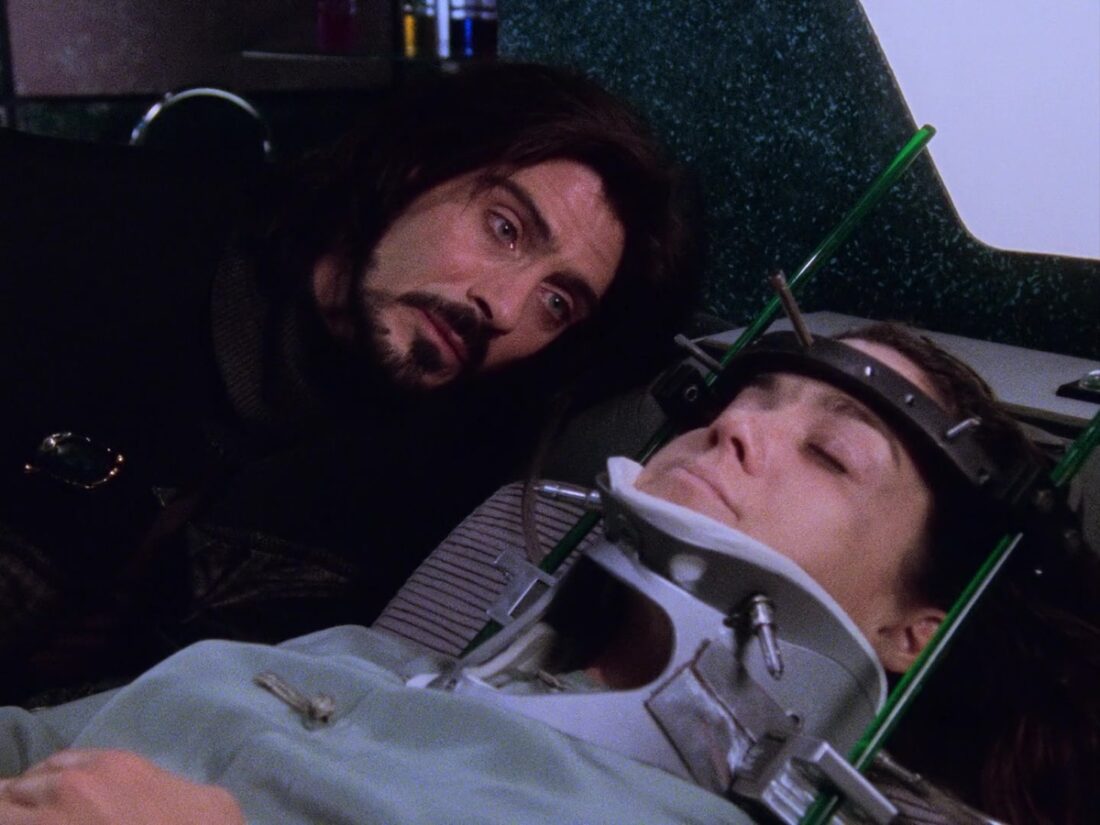
Get the hell out of our galaxy! Sheridan is remarkably fit and confident and commanding even though he was tortured and drugged for several days. Impressive!
Ivanova is God. Ivanova spends the entire episode comatose. Exciting stuff.
The household god of frustration. Garibaldi has gone from persona non grata and people wanting him shot on sight to being trusted with running an important war op in just one episode! Impressive!
If you value your lives, be somewhere else. Delenn is pretty much pointless in the episode, as she spends it as a glorified background extra.
The Corps is mother, the Corps is father. Alexander is able to work her magic controlling the Shadow-altered telepaths. The Marine at the ground base castigates our heroes for using the telepaths this way, but Franklin and Garibaldi are able to justify it. And it’s fitting that they’re used against Clark’s forces, since they were given to the Shadows by the Clark Administration in the first place.
We live for the one, we die for the one. Apparently Cole’s Ranger-osity is powerful enough to convince an entire ship full of Minbari to take him back to B5 in the middle of a war. Impressive!
No sex, please, we’re EarthForce. Cole’s dying words are declaring his love for Ivanova. It’s almost sweet.
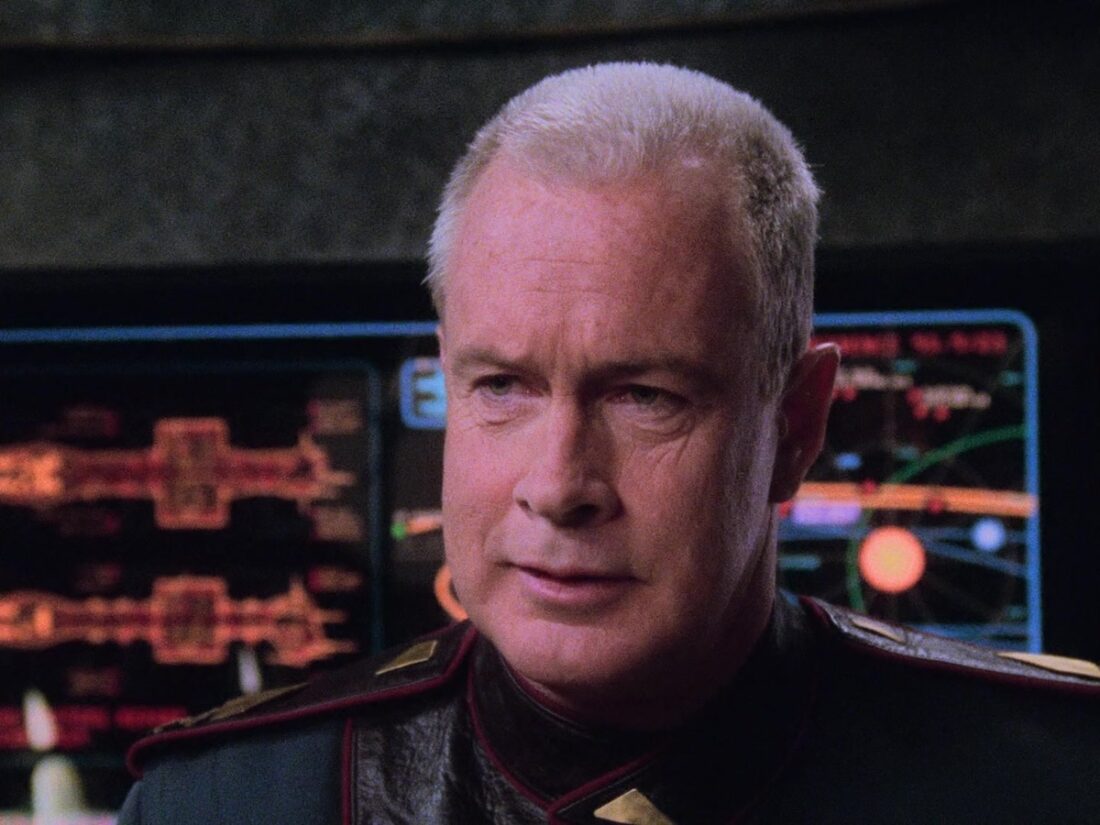
Welcome aboard. J. Patrick McCormack makes the first of two appearances as Lefcourt; he’ll be back in an earlier timeframe in In the Beginning. The great Carolyn Seymour plays Crosby, Julian Stone plays Mitchell, and Ungela Brockman plays the never-named Marine who helps secure the ground station.
And we have a mess of recurring regulars: Marjorie Monaghan and David Purdham are back from “Between the Darkness and the Light” as, respectively, Number One and James, Gary McGurk is back from “Voices of Authority” as Clark, and Maggie Egan makes a triumphant return from “Severed Dreams” as Jane the ISN anchor. Monaghan will return in “Objects in Motion” while Egan will return in the very next episode, “Rising Star.”
Trivial matters. The Shadow-altered telepaths were first seen trying to take over B5’s computer systems in “Ship of Tears.” Alexander showed that she could activate and, to a degree, control those telepaths in “The Exercise of Vital Powers.” The Great Hit Point Rearranger was first seen in “The Quality of Mercy,” and Sheridan and Franklin used it to heal Garibaldi in “Revelations.”
Amusingly, this is the only time Clark appears directly in a scene and not over a viewscreen or in footage.
One of the log entries Cole watches is Franklin declaring the death of Cailyn James, the singer he met in “Walkabout,” which is the first on-screen confirmation that she finally succumbed to her illness.
Finally, for something really trivial, this is the third thing I’ve rewatched for this site that has the title “Endgame,” the other two being the Avengers movie and the Star Trek: Voyager series finale. I guess my next thing would be to rewatch the Highlander movies?
The echoes of all of our conversations. “We know that many in the government have wanted to act but have been intimidated by threats of retaliation against your families, your friends. You are not alone anymore. We call upon you to rise up and do what’s right. We have drawn their forces away from Earth and disabled them. The time to act is now! This is not the voice of treason. These are your sons, your daughters, whose loyalties have never wavered, whose beliefs in this alliance has forced us to take extraordinary means. For justice, for peace, for the future.”
Sheridan being all inspirational and stuff.
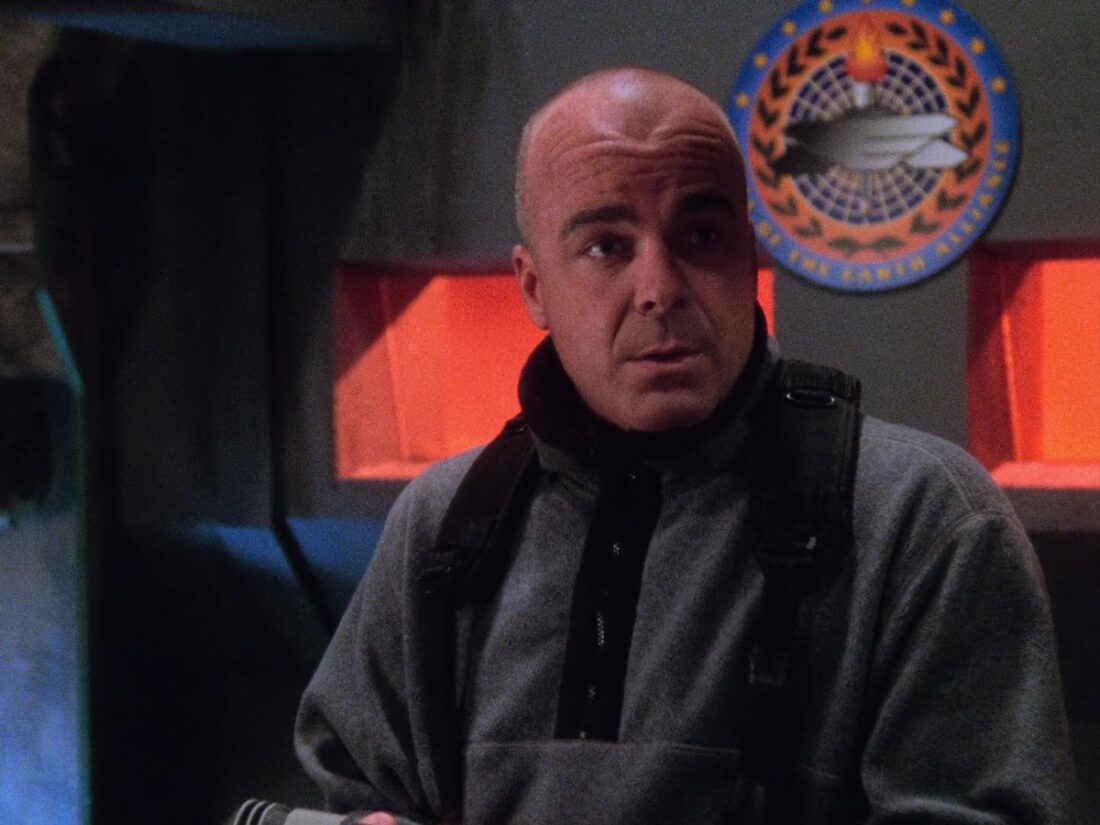
The name of the place is Babylon 5. “Welcome home, John.” You know, I was really looking forward to rewatching this episode, and when I actually sat down and watched it, I found myself overwhelmed by how incredibly unimpressed I was with it.
There’s the problem I expected to have with the episode, which is how completely unmoved I was by Clark’s death. The biggest flaw in the entire Earth-goes-fascist storyline is that we saw very little of Clark and what we did see was a nondescript bald white guy. Here’s the thing: while the acts of fascism are carried out by ordinary people, the leaders of fascism usually have someone with significant charisma at the top. While there is very good reason for us to think of Adolf Hitler as a near-caricature of the evil dictator, that makes it easy to forget that he was one of the greatest public speakers of the twentieth century. That’s how he rose to power, his spectacular ability to work a crowd.
Gary McGurk is basically nowhere as an actor and it makes Clark nowhere as a character, which takes a lot of the wind out of the sails of the plotline. Most of the time, it isn’t an issue, but when we first see Clark in his office writing his suicide note, I wasn’t even sure who it was.
But even if we grant that Clark isn’t nearly the point so much as the results of his efforts, the episode itself just doesn’t work for me.
We start with Sheridan, who spent most of the last three episodes being beaten, tortured, and drugged. Yet here he is on the bridge of the Agamemnon, showing absolutely no signs of any of that, proudly leading his fleet into battle. No physical injuries, no psychological injuries, just right back in the forefront. Now, B5 was a forerunner of the current trend toward serialization and stronger inter-episode continuity, something that made it stand out from most of the TV that was aired around it at the time. That means, however, that viewers in 1997 were used to people suffering injuries of all kinds and being all better by the next episode. But B5 was predicated on being better than that—and yet we have this.
On top of that, there’s Garibaldi. Just three episodes ago, Ivanova was refusing communications from Garibaldi and ordering him to be shot on sight. Just one episode ago, he almost got a PPG to his head, and only didn’t due to a telepathic magic trick. And yet, here he is at the forefront of ground operations on Mars, and what the hell? Yes, fine, they know that Bester fucked with his head, and that’s why he betrayed Sheridan, and that can, possibly be forgiven, but also, Bester fucked with his head!!!!! There is no way you ever trust this guy with anything important after this because you don’t know what else Bester might have done. We only have Bester’s word for it that he’s done with Garibaldi and that he has no more use for him, and that’s not exactly a trustworthy source. And even if you believe Bester, he also said that he didn’t change the essence of who Garibaldi is, just made some small adjustments, but kept his distrust of authority and general personality intact. Which means you don’t trust this guy with your lunch order, much less running your super-important rebel ground operations.
Even if you buy that Sheridan and Franklin and Alexander have forgiven and forgotten, why is the Mars Resistance just going along with everything? Sure, Sheridan promised them independence, but why would they trust Garibaldi? Why would they trust Alexander, given what the Psi Corps has done to them?
And then we have the character assassination of Marcus Cole. He’s a dedicated enough Ranger that he’s willing to let Neroon beat the living shit out of him to save Delenn, but not so dedicated that he won’t leave his post in the middle of a critical battle, taking a very powerful ship with him, in search of a deus ex machina to save the woman he loves. Some may find that romantic. I find it ridiculous, and, again, out of character. Cole’s attitude at the top of the episode—when he doesn’t want her sent back to B5 because she should be present for the final battle that she was primarily responsible for getting that far—made much more sense. Ivanova deserved to be there for Earth’s liberation. (More on this particular plotline next week.)
And then we have Lefcourt, played by the aggressively dull J. Patrick McCormack. We’re introduced to him when he awkwardly explains why he’s in command of the fleet to Mitchell, a bit of dialogue that manages to be incredibly clumsy exposition and incredibly clumsy foreshadowing, all at the same time. Because he’s self-described “old school” who believes in the chain of command—as opposed to a Clark toady like Captain Hall—we’re set up for him riding to Earth’s rescue at the end. It’s supposed to be a heroic moment, but it just shows up Lefcourt as a borderline sociopath. “I’ll obey these incredibly illegal and morally repugnant orders as long as the president’s alive, but now that he’s dead, I can ignore his orders,” which isn’t really how that works….
The episode does end on a high note. After getting the vapid propaganda from ISN ever since it went back on the air in “Ship of Tears,” seeing Maggie Egan back in the anchor chair for the first time since troops attacked ISN’s studio in “Severed Dreams” is a joyous and wonderful sight. Egan plays it beautifully too, as you get the impression she went straight from her jail cell to the studio to go on the air. More than anything else in the episode, it’s a moment of hope and optimism.
Next week: “Rising Star.”

“I guess my next thing would be to rewatch the Highlander movies?”
You hate yourself that much? Although, TBF, I only watched the first sequel, and that only once.
There WAS no sequel! So says my wife, a huge “Highlander” fan! I, sorry to say, watched that abomination, too, and it turns out my wife was correct.
This B5 episode wasn’t that bad. I do wonder, though; how much of this (and sevealo eps) were a product of the uncertainty of a Season Five and the rush to get “the important sufff” out there and covered.
But I DO feel as if Cole was just destroyed. He *wouldn’t do that*! But he did. (it was good to see Maggie Egan back in the saddle, so thwerewas SOME good here.)
I heard they did a recut of Highlander 2 some years ago that fans considered a great improvement, but I’ve never been curious enough to see it. I mean, I’d have to see the original again to compare it, and once was enough.
I will maintain to my dying day that (like a lot of the movies in Keith’s superhero rewatch) there’s the seeds of an actually decent movie in HL2, but the execution of it is sloppy, the continuity is terrible and it is an absolutely MISERABLE HL movie.
That said, it’s actually quite frightening how accurately it nailed the future. Granted, our technology hasn’t gone as backwards as it suggested, but boy have other things.
And it does give Sean Connery one of the best lines in cinema history (well it amused me, anyway): I shall leave you to converse with your skull.
All that said, a Keith-rewatch of HL:TS could be entertaining…
I love Highlander: the series.
What first sequel? There was only one Highlander movie.
Something that really gets glossed over is the impact Sheridan’s presence with the fleet should have had on both EarthGov forces and the people in the streets when he makes his big broadcast. His capture was a huge propaganda boost for Clark; there’s no way his escape ever got mentioned publicly. Lefcourt and his command staff might be expected to have been told on a need to know basis, but nobody else.
Suddenly, Sheridan is making a speech. That must have kicked the props out from under a lot of people. “The told us they had this guy. What else are they lying to us about?”
Keith said pretty much everything I had to say that was important, so here are some trivial-ish whoopsies:
I never noticed this before (guess I was always reading the opening credits): Garibaldi’s team on Mars captures the Earthforce bunker, bundles the troops out the door, then welds the airlock door shut.
After a few more lines of dialog, Garibaldi orders someone to check the outer door, and the guy promptly exits through the door that was just welded shut. And it’s a good thing they didn’t re-weld it: Lyta goes out through it a few minutes after that.
Also, when Marcus decides to go AWOL to use June Lockhart’s agonizing but magical plot device, he says “prepare a shuttle,” then just takes a whole White Star.
More evidence these were being rushed out the door at a breakneck pace, I suppose.
Endgame script:
”…there’s an EXPLOSION from the door that BLOWS it open (but not off the hinges).” And a little later “They shut the door, using a hand-welder to fix the damage.”
So the intent is they repaired the door and didn’t weld it shut.
That doesn’t come across on screen. There isn’t any visible damage to the door and it definitely looks like they are welding it shut. I noticed that on this watch as well.
Wasn’t the shuttle for Lennier? That’s the one he took to go meet with Delenn in person. At least, that’s always been my assumption.
That makes more sense. I cheerfully retract my second whoopsie.
They still didn.t know the status of the 5th season when they filmed this, correct? Aside from the casting of Clark and Lefcourt being whiffs, aren’t a lot of your problems with the episode due to JMS having to rearrange and tie everything up in a rush, since he didn’t know if he would ever get to finish the story otherwise?
Maybe it would have been better if this season had been the last one.
It would have saved me (I say me because I don’t presume to speak for others, although I doubt I am alone here) having to watch the whole telepath conflict and especially Byron. On rewatches I skip season 5. I did watch the first time because you never knew what would come next.
Although it would have detracted from Sheridan’s “Hero’s Journey”, I would have loved for the Telepath War actually been explored (they distraced from Sheridan anyway, with the setup – Byron, Lyta’s love for him, the teeps as outcasts, Bester ejecting that “normal” into hyperspace… And by the time “Crusade” came upon us, the TW was history past.
JMS always seemed to punt on the Telepath War. Season 5 sets it up, Crusade was poised to explore its implications and consequences, but that’s about it. Even the Psi Corps trilogy of novels intentionally skips past it. The long-standing rumor was that JMS held back on it for a possible TV-movie or film, but if so, it never materialized. (I often wonder if Crusade would have continued to tell pieces of it in flashback, but alas, we will probably never know.)
Sadly, I think we are well past the point where we will ever see it.
According to JMS, “What’s in Endgame, and most of Between… was always going to be there, with or without a 5th season. I made my trims in the period PRIOR TO these episodes, for the most part.”
I believe JMS was told before Season 4 started writing, let alone shooting, that the collapse of PTEN meant that a Season 5 renewal was unlikely, so he planned from the off to finish the story within Season 4 (otherwise Intersections in Real Time would have been the season finale). Obviously rearranging the story to finish early did cause some issues, but that was long established by the time came to write the script for Endgame.
The reasons why they were problems don’t change the fact that they were problems. Being rushed isn’t a guarantee of a lack of quality. To give a personal example, one of the best short stories I’ve ever written was one I wrote in three hours back in 2009. To give another space opera TV show example, one of Star Trek: The Next Generation‘s best episodes (“Yesterday’s Enterprise“) was written over a weekend.
Being rushed is a reason It’s not an excuse.
—Keith R.A. DeCandido
“Yesterday’s Enterprise” may have been cranked out in a weekend, but it still had five writers behind it: Behr, Beimler, Manning, Moore and an uncredited Michael Piller. JMS was cranking these out by himself week after week for almost 2 years nonstop, over an uncertain state of reneweal, and the prospect of having to wrap the entire series and satisfy viewer expectations over the final two episodes: “Rising Star” and “Sleeping in Light”.
We all know that proofreading your own work, especially under stress, isn’t ideal.
I know very little about the television episode production pipeline. Would there normally be a person officially charged with checking for continuity errors like this minor door thing? Or is that part of the editing process itself?
I think that B5 did extraordinarily well with the budget they had, but they must have fewer people with eyes on the final product, right?
Yes, B5 had a smaller production team, especially compared to the Trek shows. Checking continuity errors is part of the script supervisor’s job. But ultimately, it’s the showrunner’s call. It’s possible they spotted the mistake, but had no time nor budget to correct it. JMS was a one-man army when it came to his job as the show’s EP, having to juggle everything, from casting, to writing, to filming, to editing, to mixing, to studio and network affairs, to promotion. The real surprise is that the show didn’t get more accidents like that.
But even bigger shows aren’t immune to hiccups like that. TNG famously retconned Guinan and Picard’s relationship over time, where the writers either failed to remember Guinan’s line about not knowing the captain before she joined the ship or choosing to ignore it.
By JMS’ account, they did not. They were still negotiating for one but it was still a longshot when these were written and filmed.
IIRC from the script books, they were just on the tail end of production for “In the Beginning” when they actually sealed the deal.
This is one of those episodes I want to like more than I do. I like the reveal for what Sheridan planned for the Shadow-modified telepaths. I like Sheridan’s speech. I like the return of our familiar ISN reporter.
What annoys me, every single time, is so much of the final act. You’re telling me that none of the defense grid actually managed to get a shot off, in all that time? And the whole thing about Sheridan’s ship being the only one close enough to ram the very last platform, getting the last minute save, and the “fake out” with the explosion…it just comes across as very contrived.
Had these episodes been at the beginning of the fifth season, as intended, I wonder if they would have felt so rushed. I don’t subscribe to the popular theory that the entire fifth season would have been the resolution to the Earth civil war, but I do think another episode or two might have smoothed over some of the rougher edges.
The grid’s constantly firing missiles. It’s the heavy particle beams which don’t fire. We see them repositioning in the episode. The mistake was in not having them fire once at the start of the fight to establish how dangerous they are, followed by a “we have X minutes before those big guns finish recharging.”
And that platform had some kind of power plant as well as thousands of missiles. I’m willing to accept it might explode; the explosion isn’t dangerous but the suspense should be “did they blow up the satellite before impact;” it just doesn’t read that way.
Short of halting the story to explain physics to the audience, how could one fix this (aside from avoiding the “ramming speed” dramatic point, which is definitely a character point for Sheridan but only proving something to Earth, not to viewers.
Yeah, my point was mainly that there is more than enough time between the retasking of the grid and the platforms being destroyed that at least some of the platforms should have gotten a shot off at the surface. Even a line, like you suggest, to say they have just enough time before the onslaught begins, might have been enough to cover it.
There was such a line. The senator said to Sheridan, “We can’t override the systems here. If you don’t stop them, they’ll fire in ten minutes.”
Ah. Not sure how I’ve missed that. Thanks for pointing it out.
I’m not sure the sequence can be fixed in a physically plausible way, since weapons in space have no range limit and can just keep moving until they reach a target. A beam weapon would dissipate over distance and could be dodged by a distant enough target, but a missile wouldn’t have those problems. So more distant ships should have been able to shoot down that defense platform if the Agamemnon couldn’t — unless the issue was just that their missiles would take too long to reach.
In any case, the fakeout with the ship hidden by the explosion would never work. Not only would the blast dissipate in a split second, but the ship would presumably be moving far faster than shown and would’ve thus been further away when the platform blew up. The only way to fix that part would be to eliminate the corny fakeout altogether.
Particularly since explosions in the vacuum of space wouldn’t be big lingering fireballs that could conceal a ship, but would dissipate almost instantly.
“This has gone just far enough!” – General Lefcourt
https://imgur.com/a/nGmoREQ
It’s a minor point, but: I had to chuckle when a search for Bab5’s records “searching key words dealing with terminal illness, death and extreme measures,” only returned six results. There should be way more than that based just on what we’ve seen off-screen, let alone everything we haven’t seen…
Well, it was an “and” search rather than an “or” search, so that would narrow the results. At least, if B5’s computer has a search engine that actually works sensibly, instead of something like what Google has become, where you’re lucky if the search results even include most of the words you entered.
JMS didn’t predict sponsored search results!
Oh was that the intent? It picked up Garabaldi getting shot, which seems more of a traumatic injury or maybe a fatal wound than a “terminal illness” and Franklin doesn’t actually say terminal illness in the log (though it may have been meta-tagged, I guess). Still, I guess that must be what they were going for.
President Clark didn’t rise to power as a charismatic leader, like Hitler or Mussolini. He was the VP who rode Santiago’s coattails and then had him assassinated. So I can excuse him not having much of a presence, because he seemed to be much more of an opportunist than anything else.
Also, J. Patrick McCormack will forever be seared into my memory as Kramer’s boss at Brand-Leland in Seinfeld.
“Well, I don’t even really work here!”
“That’s what makes this so difficult.”
How charismatic was Franco?
I don’t know, but I hear that he’s still dead…
Yeah. He’s not Hitler — he’s Vance.
I thought it was mostly pretty effective, but I hadn’t really considered the contrivance of Sheridan and Garibaldi being so centrally involved. I do agree that Marcus’s defection was out of character. I could buy him finding out about the Hit Point Rearranger and wanting to sacrifice himself to use it, but not during the battle. He’d wait until afterward to look into it.
I don’t agree that Ivanova should’ve stayed with the fleet, though. Spaceships have finite resources, and a comatose patient would be a drain on those resources without contributing anything to the battle. The best thing Ivanova could do for the fleet at that point would be to leave it.
It was pretty rich for Lefcourt to say that Sheridan would be the one facing a board of inquiry, when Lefcourt was the one “only following orders” given by a criminal regime. I sincerely hope that everyone who obeyed the regime’s criminal orders is held fully accountable for that collusion rather than forgiven in the name of “healing,” or else the fascists will just try again in a few years, as we know all too well from history — and the present.
I wonder if any of the telepath “weapons” survived, or if they were all shot by the destroyers’ security teams, as seems likely. And I wonder if Bester’s girlfriend was one of them.
The very next episode features a scene between Sheridan and Bester where they talk about the telepaths as a whole and Carolyn specifically.
Sheridan mentions how many out of the total were used, but I don’t think he mentioned the fate of the deployed telepaths. I assumed that they were all killed.
Two things I forgot to mention in my other comment:
I really like the score for this episode. I have the CD somewhere…
While the graphics for this show often get criticized, this episode highlights just how far things have come. Just compare the way missiles are depicted in this episode to the way they are shown in “A Voice in the Wilderness”, back in the first season.
I wonder if the original plan was to deal with the Earth Civil War before ending the Shadow War; as it is, it feels like an anticlimax.
The original plan was always for the Shadow War to come first, then retake Earth.
This aspect of the show just completely astounds me. First time watcher, and this organization of the conflicts has been incredibly deflating. After decades of not watching the show, reading these rewatches and learning about the Shadow War is what finally pushed me to give it a chance. The oncoming Shadow War was also so central to the worldbuilding and epicness of the show. I was quite a bit put off when it ended so early, and took with it so many of elements of the show that I had been enjoying (Shadows, Vorlons, First Ones, etc)
The Earth Civil War arc has been all right, but I’m half way through S5 and have completely stalled out. I gather JMS was trying to go for a Scouring of the Shire type story, but even without the accelerated S4 when he thought he wasn’t going to get S5, I really have to wonder at the odd devaluing of the Shadow War in the original overall series arc plan. I’m on the verge of just watching Sleeping In Light and calling it a day, but I think I might wait until these rewatches catch up to me. Don’t know.
If you do decide to skip parts of season 5, I recommend watching “Day of the Dead” and the final three episodes “Objects in Motion,” “Objects at Rest,” and of course “Sleeping in Light.”
Well, the standalone, “Day of the Dead” was kind of cool, and it is memorable for one line that Capt. Lochley has – the password to her personal files – and Tracy Scoggins nails it.
Unfortunately, a combination of scripting, budget, acting, and directing takes the wind out of the sails of what should have been a rousing climax.
Lefcourt looks and sounds exactly like he’s backing up a truck to deliver exposition, except with slightly less motivation. There are no scenes of anything that’s happening on Earth during the battle with the exception of a corridor and an office. There are a lot of dramatic pause moments for making decisions where that sort of delay should have cost our heroes. I guess time stopped while waiting for Sheridan to choose which dialog option to pick. And why is deciding whether to turn around to go after Marcus even a decision, anyway?
And then, the big one: Clark’s suicide note. This has always bumped me. Apparently, the note as scripted was supposed to contain “scorched earth”, but it was the director Copeland who turned it into a Dr. Strangelove homage. In Dr. Strangelove, we know up front that General Ripper is not, as one might say, a member of the reality-based community, and his particular over-the-topness matches the tone of the movie. We don’t know enough about Clark to say one way or the other, but in his very minor appearances he seemed like an ordinary power-grabber, not a gibbering loon. I fully buy that he would take his own life rather than be arrested, and I fully buy that he would decide that if he couldn’t have the world, then no one could. But adding the layer of crazy on top diminishes both him and the message of the show by turning him into a cartoon. (I am steadfastly not making a contemporary comparison here, both because I don’t want that to be the topic of discussion, and because, for all that this show is sadly very relevant right now, this particular situation is not the same.) To now, unlike our gracious host, I have not minded that Clark has remained a faceless threat, since we’ve seen his actions through his subordinates. His suicide note makes me mind.
Besides, we’ve already had Emperor Cartagia, and President Clark is no Emperor Cartagia.
That’s not to say there weren’t good parts of the episode, but it’s a lot weaker than it could or should be.
“Severed Dreams” this is not. That one was a downright perfect reset of the show’s status quo. “Endgame” should have been the perfect coda to the Earth arc. It’s messier, and a more rushed conclusion – but understandable, given the precarious behind the scenes status at that point. It has its moments, but it’s nowhere near as effective as the episode that began all of this.
To me, the glue that holds all of this together is Sheridan’s final speech. Not surprisingly, it’s Krad’s quoted line just above. “These are your sons, your daughters, whose loyalties have never wavered.” That line always hits me hard in the stomach, even more so these days. How do you cope with living under a fascist regime, especially in an organization where you’ve been conditioned to follow orders, regardless of the morality of those orders and whoever is in charge? With that speech, Sheridan gives voice to every EA official who’s been silenced over the past three years. And we get the payoff for this with that gut-wrenching ISN broadcast at the very end. Having seen a fascist leader being put behind bars fairly recently back here, I know this feeling all too well.
On the other hand, Lefcourt may just be the worst EA character by far. He’s the clichéd “I taught him everything I know and I know I’m right” type of hardliner military character. Which makes his last-minute rescue of Sheridan less effective than it could have been. This is the kind of story that would have really benefitted from someone like TNG’s Jellico, who could still be in that position, but back it up with reasonable arguments and points of view. Lefcourt’s one-note simplistic stance makes a lot more sense when you watch in the events of In the Beginning. Given how that turned out, it’s kind of depressing to see he hasn’t learned one measly lesson from that mistake over the past 15 years.
It may be visually and scientifically implausible, but the visual of the Agamemnon surviving the orbital station’s explosion is a keeper and a perfect visual metaphor for Sheridan’s willingness to sacrifice himself for Earth’s freedom. Terrific VFX. Visually striking enough to make it to the season 5 opening titles.
Regarding Clark’s near non-presence in the story, I never had much of a problem with it, and I imagine JMS made a conscious choice back then to not give that character and that position much of a spotlight, possibly in relation to his family’s Russian ancestry, not wanting to give a face to the evils that forced them out of Europe. Though I imagine if the supposed B5 reboot were to ever get off the ground, he might take a different approach nowadays.
I do get a kick out of the Scorched Earth visual gag. I didn’t get to see Dr. Strangelove until well after the show ended. Even though it was Copeland who came up with it, it makes sense that JMS would let him go off-script like that, with him already being the show’s line producer. No other TV director would be allowed this kind of freedom, other than maybe Vejar.
Lastly, Marcus. Yes, him taking the whole ship and crew with him on a personal errand just feels wrong. I think JMS confused himself by mixing up Marcus’s occasional eccentric, erratic, non-regulation behavior, not realizing he was still a committed ranger, willing to follow orders. It could have easily been fixed by having him steal a shuttle instead, leaving that White Star to join the battle at Earth. That issue aside, I do buy the notion that he might be so emotionally affected by her inevitable demise, he would in fact break from the battle to have a shot at curing her. And one can’t deny just how great Jason Carter is as an actor. That shot of him rushing back home to Ivanova, with a look of resigned defeat, fully aware this is death sentence, is just heartbreaking.
“but understandable, given the precarious behind the scenes status at that point.”
As I mentioned before, JMS insisted that all the cuts he made to the storyline were before this point, and this was how he always planned it to resolve; it just would’ve done so early in season 5 instead. Though maybe that means we would’ve gotten a little more time to deal with Garibaldi’s redemption and Sheridan’s recovery.
As for Lefcourt, I felt that McCormack’s performance made him fairly sympathetic, if a little bland.
“It could have easily been fixed by having him steal a shuttle instead, leaving that White Star to join the battle at Earth.”
Except shuttles can’t make their own jump points, and would probably need hours to reach the Solar jumpgate near Io. If he’d been willing to wait that long, he wouldn’t have abandoned the battle in the first place.
” Though maybe that means we would’ve gotten a little more time to deal with Garibaldi’s redemption and Sheridan’s recovery.”
That was my thought. Not so much that the resolution would change, but that given a little more time to breathe and consider the story, he might have given those areas a bit more attention.
Except shuttles can’t make their own jump points, and would probably need hours to reach the Solar jumpgate near Io.
A good point. It would have taken even longer than the battle. It’s a tough dilemma. As much as I agree Marcus was irresponsible (and even contradictory to his ranger oath) to take the ship away from battle, I have a hard time assuming he’d able to sit still and put thoughts of Ivanova aside for the entire duration of their campaign. After not listening to his brother William and not being able to save him until it was too late, I can forgive Marcus not willing to repeat that same mistake with someone he loved as much as Susan.
“I have a hard time assuming he’d able to sit still and put thoughts of Ivanova aside for the entire duration of their campaign.”
He should be more than capable of that if he’s a trained, disciplined soldier. I mean, anyone trained as a soldier or warrior would be expected to have to deal with the deaths of people close to them, so teaching them how to compartmentalize those feelings and focus on the mission would be an integral part of the training, surely.
I’m not sure if “disciplined” is a word I would use to describe Marcus. That is, I agree with you that he should be capable of doing that, but it doesn’t seem entirely out of place that he doesn’t. His fight with Neroon, for example, seems to be as much an act of passion as of discipline. Arguably he’s been looking for an opportunity to sacrifice himself for something to atone for what he views as past failures.
There’s also a bit of a pattern in the show of characters not always living up to their own ideals when emotional stresses get extreme.
It’s still a dumb decision on his part. According to what the Minbari doctors said, there was time to wait until the battle was over and the very first thing he learns about the Great Hit Point Rearranger is that you can use more than one donor to make it non-fatal. Does he really think that the Sheridan who volunteered to use the machine to save Garibaldi wouldn’t have agreed to use it (or to authorize its use) to save Ivanova? But then somebody might have had a chance to stop his grand gesture.
But I don’t really agree with Keith that this is a character assassination, because I think this *is* Marcus’ character. Which is why I never liked him that much.
Marcus’s fight with Neroon is basically what I was thinking of. He was motivated by his loyalty to the One, to the Rangers’ cause, above all else. That’s what he was trained for, to achieve the mission even if it means the death of himself or his compatriots. I could buy him sacrificing himself to save Ivanova, but not if it meant abandoning his duty to Sheridan, Delenn, and his fellow Rangers who were also fighting in the battle.
Seeing the saga of INS falling to an interfering totalitarian government and then being restored gives me hope this might happen to CBS News.
I think Clark as non-entity was the right move. He’s almost faceless in his appearance here: the point is that fascism can thrive without a charismatic leader, that it isn’t a cult of personality built around one ambitious person who tricks others into joining, but rather a tendency or desire common to enough people to sustain itself and skilled at drawing others in. We’ve had multiple characters as villain-faces for factions in B5. Clark is a cipher and stuffed suit, ambition coupled with no morality and used by people from the megacorp CEOs to Psi Corps to the Shadows to the black ops people in Earthforce.
I agree we needed more time between episodes to pass; frankly, Garibaldi is back in charge because Jerry Doyle is getting a paycheck, and we do see Sheridan recovering from other traumas, so I’m willing to accept Minbari medicine plus Lorien’s nanomachines fixed him up physically. He’s recovered almost as quickly from being dead.
I think the big weakness of this episode is that it’s exciting to watch once. Past that point, there’s a few good, brief character moments (Maggie Egan’s anchor; Delenn’s “We are there”; Sheridan right before he orders ramming speed), but it’s mostly plot and the plot isn’t that compelling. It says something, I think, that the aftermath of this episode matters more than the episode itself.
To pick up on your last sentence: that doesn’t seem like an accident. From his comments, JMS seems to enjoy and be proud of the big battle episodes, but I think his interest and skills really do lie more in exploring the consequences of big events rather than the events themselves.
I’m not sure the idea of a soldier refusing to take arms against whoever happens to be in charge can be fairly described as “old school.” Throughout history, when governments are toppled, it’s often enough the military that does the toppling. Lefcourt might have eventually done the right thing, but he doesn’t deserve to be romanticized.
We finally got that BIG SHOCKING REVEAL, and at least it was appropriately shocking. This isn’t the kind of thing you’d see on a show like Star Trek (in fact, one of the JJ Abrams films does the opposite). I do think it would have worked better if the scene revealing the whole implications of the scheme were better performed.
I agree that putting Garibaldi in charge of any aspect of this operation makes zero sense, except for the fact that he’s a series regular. I’m more forgiving of Sheridan being large and in charge after weeks of torture because, as the review says, that’ s just how TV was thirty years ago, but Garibaldi should have spent the rest of the season under lock and key, at least until everyone was satisfied that his brains had been unscrambled.
I also agree that Clark’s being a nonentity is a big problem, though I think it only became a really big problem in this episode. I can live with the face of this fascist regime being unimportant, since it’s been framed as being perpetrated at least in part by the Psi Corps, but that’s incompatible with a guy who is both capable of and willing to burn the Earth if he can’t control it.
But the part that really annoys me is Marcus gallivanting off in the middle of the battle to save Ivanova. Sure, time was of the essence, since she was hovering on death’s door, but the whole reason she continued the fight after Sheridan was taken was her belief that the struggle was more important than any one person.
Admittedly, a part of my objection has to do with the fact that I found out she isn’t in Season 5. What was the point of doing this to save her if you’re just going to write her out of the show? Better to have let her die for her principles than have Marcus betray them in order to save her. I hope she’s pissed about it when she wakes up.
At the time the episode was written, Ivanova was supposed to be prominent in Season 5. Her departure was after the fact. JMS is on record stating that if he had any clue that she wouldn’t be around in the fifth season, he wouldn’t have had Marcus sacrifice himself to save her.
I mean, if I had to pick one or the other, I know who I’d have kept, but at least the decision makes more sense now that I understand the context. I’ve been avoiding googling too much about this show for fear of spoilers (which just goes to show how invested I’ve become, since I normally don’t care about being spoiled).
“What was the point of doing this to save her if you’re just going to write her out of the show?”
At the time this episode was filmed, Claudia Christian was still expected to be in season 5. Her departure was sudden and unexpected, and reports differ on whether she chose to leave to do movies or was fired for requesting time off.
http://www.midwinter.com/lurk/misc/cc-leave.html
Well that was a mess of a read, but thanks for the context. Going by her IMDB page, I guess they worked it out.
Claudia Christian and JMS were both up on stage at the Babylon 5 20th anniversary reunion at Phoenix Comicon in 2013. They were friendly, everything seemed to have been worked out, and I think they might have even talked a little about what actually happened, but I don’t recall. (I have a vague memory sloshing around about her agent screwing things up bigtime, but don’t quote me on that.) There is a video of the event on Youtube, so I might watch that to refresh my memory if I get some free time.