





“The Deconstruction of Falling Stars”
Written by J. Michael Straczynski
Directed by Stephen Furst
Season 4, Episode 22
Production episode 501
Original air date: October 27, 1997
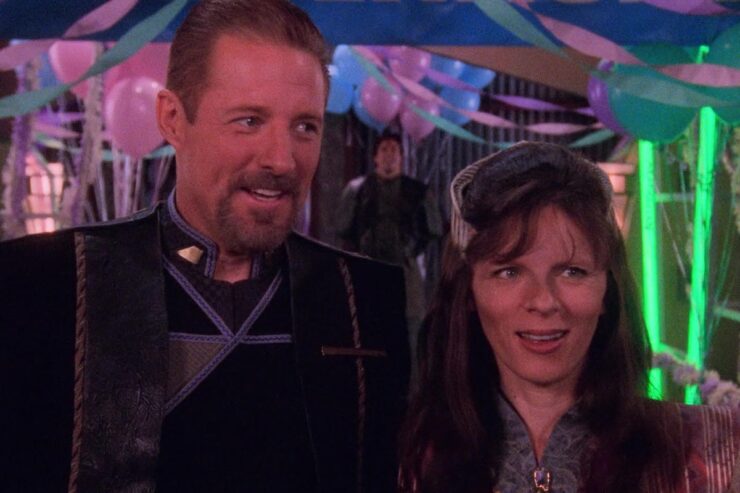
It was the dawn of the third age… Sheridan and Delenn arrive at B5 with “JUST MARRIED” stencilled on their shuttle. Upon arrival, Franklin and Garibaldi meet them with confetti and a crowd of dozens looking to celebrate. The happy couple had been hoping to keep things low-key, but the doctor and erstwhile security chief were never going to let that happen.
They are, of course, met by press, and we see the ISN feed of this occasion, which then futzes out a bit, and an unseen user has to adjust the stored record of this image and re-set things.
Someone is watching a history of the Interstellar Alliance from far in the future.
2262: We get an episode of ISN Nightside. First the anchor, Derek Mitchell talks about how, after the crazy-ass events of the end of the previous year, it’s good to pause and reflect. A reporter, Jim Bitterbane, reports from B5 discussing Sheridan’s backstory. Then Mitchell turns to a panel of experts: EarthDome Senator Elizabeth Metarie, Mars-based journalist Leif Tanner, and political operative Henry Ellis. Metarie is guardedly optimistic about Sheridan and the ISA; Tanner is willing to give them a shot; Ellis is completely against the whole idea.
2362: The next record is from a hundred years later, an educational stellarcast featuring faculty from the University of York, NYU, and the University of Japan discussing the first century of the ISA. The focus is on deconstructing the myths that have grown up around Sheridan and Delenn, saying that their role in the ISA has been overblown, and also that they’ve made their share of mistakes. They mention a colony of telepaths that Sheridan gave sanctuary to on B5 and how that ended in disaster (they show security footage from B5 at the point of the ending-in-disaster bit).
The discussion turns to Delenn, and speculating as to whether or not she’s even still alive, since she hasn’t been seen in ages, and then an elderly Delenn herself enters the studio, telling them that John Sheridan was a great man and that they’re close-minded twerps.

2762: The next record is from Earth five centuries after the founding of the ISA. The planet is divided between two factions, one of which supports the ISA, the other of which is more isolationist. We meet Daniel, working in a holographic chamber that has re-created a conference room on B5. Daniel is working to create propaganda that will support the isolationist side. He has re-created sophisticated versions of Sheridan, Delenn, Garibaldi, and Franklin, ones that have those characters’ personalities and memories. Indeed, the holographic versions are such accurate re-creations that they’re completely appalled by what Daniel wants to do. He adjusts Sheridan first, making him a despotic loony, inspiring the troops to kill the hell out of their enemies. As she, Franklin, and Garibaldi watch, Delenn laments that they should be able to do something.
Daniel then has Franklin giving a log report about all the fun vivisections and genetic experiments he plans. Garibaldi then approaches Daniel, saying that he’s figured out that this is all just a prelude to a military strategy, yes? Daniel admits that this is true, and Garibaldi points out that they’ve just re-created a really really good tactical specialist in himself. He might be able to give him some useful advice. Daniel then provides the entire battle plan.
Garibaldi, however, has been busy digging into the source code of this little lab and has taken over the communications and broadcast his entire battle plan to their opponents. Which means they’ll probably make a preemptive strike. A horrified Daniel runs for the metaphorical hills. Just before this installation is destroyed, Garibaldi tells the images of Sheridan, Delenn, and Franklin to rest easy.
3262: The next record is on Earth after the second Earth Alliance Civil War resulted in the Great Burn, which wiped out most of the technology on Earth. The world is now completely isolated and virtually medieval. This monastery—which has not been recognized by Rome—has tasked itself with preserving Earth’s history, mostly through illuminated manuscripts. Brother Alwyn is in the midst of making a recording when he’s interrupted by Brother Michael, who is having a conflict of faith. He wonders if all the stuff he’s recording about the great Sheridan and Delenn is true. He also wonders if the prophecy that the Rangers will return to save humanity is true, when there’s been no sign of them. Brother Alwyn encourages him. When Michael leaves, we find out that Brother Alwyn is, in fact, a Ranger here to help save humanity—but they’re doing it slowly and subtly. The recording he started at the top of the scene is, in fact, a message to his fellow Rangers.

A million years hence: These records are all being gathered by the last human on Earth shortly before its sun goes nova. Said human turns to energy and enters a very Vorlon-ish encounter suit before buggering off to “New Earth.”
2262: We cut back to Sheridan and Delenn in their quarters on B5, Sheridan musing on whether or not anyone will even remember them a hundred or a thousand years from now, and Delenn saying that all they can do is the best they can and history will take care of itself.
Get the hell out of our galaxy! Sheridan will become a revered, and sometimes controversial, figure in the future.
The household god of frustration. Garibaldi’s personality is so strong that a hologram created based on him is able to foil an evil plot to take over the Earth. Because he’s just that awesome.
If you value your lives, be somewhere else. Delenn will apparently live to at least the age of 160.
In the glorious days of the Centauri Republic… Mollari is confused by the celebration on B5 in 2262, thinking it to be funereal. On Centauri Prime, wedding celebrations are solemn affairs, whereas funerals are usually big parties like this.
Though it take a thousand years, we shall be free. G’Kar is of the considered opinion that Mollari is a big poopy-head.
We live for the one, we die for the one. The Rangers will apparently continue to be in operation in some form or other for the next million years. We see them working covertly on Earth doing what they always do in 3262, and the ship that the last human on Earth takes off Earth before it goes boom has a Ranger logo on it.
The Corps is mother, the Corps is father. More mentions of the Telepath War that we never got to see, as well as foreshadowing of a major telepath plotline that will run through season five.
The Shadowy Vorlons. A million years hence, humans will be just like Vorlons, apparently…
Looking ahead. The scene in medlab with Garibaldi being held hostage and Sheridan on the comms saying they wouldn’t negotiate with terrorists will be seen in full in “Phoenix Rising.” That scene has the first mention of Captain Lochley, played by Tracey Scoggins, who will join the cast at the top of season five.
The discussion of Sheridan’s mysterious death 80 years ago in the 2362 segment, the reference to B5’s destruction in the 2762 segment, and the mention of Sheridan by Brother Alwyn in the 3262 segment all refer to events that will play out in “Sleeping in Light.”

Welcome aboard. Tons of guests in this one…
For the 2262 segment, we have Rob Elk, Bennet Guillory, Doug Hale, Kathleen Lloyd, and Kenneth Taylor. For the 2362 segment, we’ve got genre veteran Alastair Duncan (among other things, one of the go-to voices for Alfred Pennyworth in various DC animated productions), Nick Toth, and Joanne Takahashi.
The only guest in the 2762 segment is another genre veteran Eric Pierpoint (Alien Nation, five different roles on Star Trek) as Daniel, while the 3262 has another genre veteran in Roy Brocksmith (Total Recall, a couple of Star Trek roles) teamed with Neil Roberts. And then, in the final jump forward a million years, we’ve got David Anthony Smith as the future human watching all these old records.
Trivial matters. By 1996, PTEN had completely fallen apart. Its only actual successes were B5 and Kung Fu: The Legend Continues, and both shows were no longer going to be distributed to syndicated markets by PTEN after their fourth seasons were complete. The latter show was unable to find a taker, and simply ceased production. B5, knowing that the end may well have been nigh, was rejiggered by J. Michael Straczysnki so that it could end with season four if necessary. To that end, “Rising Star” was written as a series finale, with “Sleeping in Light” filmed as the coda. Then in 1997, TNT picked up the show, agreeing to not only air the fifth and final season, but also produce several TV movies and air a spinoff series, Crusade (all of which this rewatch will cover once we’re done with season five). This episode then became the coda to season four and was the first episode produced on season five’s budget (hence the 501 production number), but slotted in at the end of PTEN’s run of season four, with “Sleeping in Light” (produced with the rest of season four) held for the end of season five. Cha cha cha.
All the opening-credits actors’ contracts had to be re-done once TNT picked up the series (except for Jason Carter, who wasn’t returning, obviously), and the only one who couldn’t come to terms was Claudia Christian, which is why Ivanova doesn’t appear in this episode. Christian also isn’t in the opening credits: she appeared in “Sleeping in Light,” and that was the episode that was part of her contract to be on the show; this one wasn’t.
The similarities between the names of Henry Ellis, an intemperate gadfly who dominates the panel discussion in the 2262 segment, and Harlan Ellison, the show’s creative consultant, who was an intemperate gadly who always dominated any panel discussion he was on, is totally coincidental. (It’s not at all coincidental…)
One of the still shots of Sheridan from earlier in his EarthForce career in the 2262 segment is a publicity shot from the movie In the Beginning.
The medical experiments Daniel has Franklin claim to be conducting are similar to the ones the Clark Administration claimed B5 was doing in “Face of the Enemy.”
The echoes of all of our conversations.
“Faith and reason are the shoes on your feet. You can travel further with both than you can with just one.”
—Brother Alwyn postulating that science and religion are symbiotic rather than opposing.

The name of the place is Babylon 5. “Rest easy.” This episode is pretty much exactly what it says on the tin, as it were: the coda to the season written hastily to fill in for the series finale that they could now put off for a year. And it’s fine. Like any episode that’s broken into distinct bits, some are better than others.
Sadly, the weakest parts are the first two. The news program in 2262 is fairly standard stuff, and the panel discussion in 2362 is more of the same, truly. The smug self-righteousness of so many of the commenters in both segments gets very tiresome very quickly. Even the lovely moment when the elderly Delenn stumbles into the studio is kind of ridiculous. How’d she know this was even happening? And to just come in at that moment? It was a little too pat. Though Mira Furlan killed it as usual.
The 2762 segment is elevated by two things. One is the always-reliable Eric Pierpoint as Daniel. Pierpoint has a remarkable ability to provide just the right tone with his resonant voice to perfectly embody the character he’s playing, whether it’s George Francisco’s winsomeness or Captain Sanders’ friendliness or Harris’ nastiness.
The other is that Garibaldi can save the Earth even from beyond the grave. And yeah, it’s even more contrived than Delenn just happening to show up at a dramatic moment during the 2362 segment, but dammit, it works. I love the idea that they did such a good job of re-creating Garibaldi that they sowed the seeds of their own downfall. And it’s fun to see the Orwellian fascist get his…
Unfortunately, the presence of Garibaldi in that scene is a little problematic. If Daniel wants to re-create the early days of the ISA, why is Garibaldi there? Franklin, you can barely make a case for, since his medical experiments are part of what they want to use in their propaganda machine, but what’s a civilian private investigator going to do to help them? Garibaldi stopped being part of the B5 command structure long before the ISA formed, and he’s not part of its infrastructure.
The best part is the 3262 segment, and three decades on, I think that’s the part that resonates the most. It’s very A Canticle for Leibowitz, with monks working to preserve humanity’s history after an apocalypse. A big part of what makes it work is Roy Brocksmith’s magnificent combination of exhausted and earnest, which works particularly well in contrast to Neil Roberts’ youthful panic.
It’s at once a filler episode and a very important episode. It’s a very cynical episode of what it, ultimately, a very cynical show. It focuses significantly on the negatives of B5’s future—from minor negatives like snotty pundits to the more aggressive negative of Daniel’s side of Earth’s divide to humanity plunged into medievalism by civil war to humanity having to abandon the Earth because it’s going nova way way sooner than it should.
But the seeds of hope are contained in each segment, from the optimistic members of the panel to Delenn’s grand entrance to Garibaldi’s sabotage to Brother Alwyn’s covert mission to New Earth.
Next week: Fourth season overview.


“The 2762 segment is elevated by two things… Unfortunately, the presence of Garibaldi in that scene is a little problematic.”
It’s 500 years after the founding of the ISA; fine details about who did what have undoubtedly been lost, and it’s a safe bet Daniel is (presumably) not a historian. How many non-historians know who was involved in negotiating the Treaty of Madrid, or fought at the First Battle of Panipat (to pull two random entries from Wikipedia’s 1526 article)?
For something that had to slapped together fairly quickly, it’s not bad. And as Keith says, it has its moments.
If you watch carefully, you can see Sheridan putting on his public face as he realizes there’s a reception waiting for him and Delenn. It’s a subtle bit of acting, and even though it’s something that recognizable actors have to do all the time, I don’t know how many would have thought to incorporate it into that moment.
The problem with the first two future segments is that they’re the same indictment of talking head TV of the 90s. Confrontational panel discussions had been around for a couple of decades, going back at least to Point/Counterpoint on 60 Minutes (satirized both on SNL and in Airplane!), but The McLaughlin Group had really ramped things up over the previous decade and other shows were jumping on the bandwagon. Anyway, one of those segments needed a different theme.
The 2762 segment laid things on a little thick. Daniel has what is basically an SS symbol on his uniform and the Orwellian Newspeak isn’t subtle. It’s also easy to forget that Garibaldi was established as a great hacker. Even at the accelerated pace of this rewatch, it’s been ages since we’ve seen him hack anything; on first run, it had been a couple of years. It was never a huge part of his character, just something he pulled out when he needed it, so I can see the resolution of that segment puzzling a lot of viewers.
I’m not sure I’d agree about the first two panels being the same. The first was a talking-heads news panel, but the second was an online university’s historical discussion panel. And the two historians were both advancing the same conventional wisdom and deconstructions about the IA’s leaders, rather than debating with each other. Although I agree that the two segments are similar enough to feel repetitive despite their differences.
We know the Rangers continue to operate well into the future. I can see them keeping track of announcements of media presentations, especially those involving B5. They may well have alerted whoever is currently Ranger One, and they would have alerted Delenn out of courtesy. Since the panel consisted of people with negative views of Sheridan and Delenn, Delenn would have been pissed. She’s not quite up to another “He is behind me, you are in front of me” moment, but she is going to defend her man to the end.
Yes, the Canticle for Lebowitz segment is the strongest.
All in all, for having to be done so quickly, after so many main story lines had been wrapped up, this is surprisingly goodish.
My favorite episode. The whole theme of how will we be remembered in the future resonates with me a lot. I’ve explored it in my own fiction.
— Michael A. Burstein
My biggest problem with the episode is also its strongest segment: the monastery recording.
Mostly, because it’s not “very Canticle for Leibowitz.” It IS Canticle for Leibowitz.
The homage was so blatant and obvious that Miller should get story credit.
(BTW, the idea that humans would eventually become the new Vorlons was seeded in Into the Fire, IIRC.)
I recall reading JMS claim that he’d never read Canticle for Leibowitz before writing this episode. I find this difficult to credit, given his seemingly pretty extensive knowledge of classic science fiction.
From a quote on the Lurker’s Guide page for this episode:
As an SF fan back when the tail end of “classic” SF was still being written, I knew of Canticle‘s general concept and ideas because it was one of the Significant Works. Still, it was decades later before I actually got around to reading it myself.
So I’m not surprised at the Lurker’s quote – I’d imagine that JMS would also have been familiar with the concept even if he’d not read the story recently, or at all.
Ah that sounds more plausible
This episode was…”not great, not terrible…3.6 roentgens”. :)
This one feels undercooked, because, well, it is undercooked. But I must say that, as someone who studies history and is generally critical of “great man” theory, the 2362 segment really hacks me off. It feels like a strawman argument directed at me personally.
Also it annoys me that one of President Clark’s political advisors is being included on a mainstream news panel a year after the regime was overthrown, rather than being (for example) convicted of treason and shot. But that’s probably contemporary politics colouring my opinion again.
Keith misquoted Delenn. She says John Sheridan was a “good man,” not that he was a great one. Whether he was a Great Man of History or an interchangeable cog isn’t an important question, just like “Comes the Inquisitor establishes that Delenn being the Great One of Prophecy wasn’t important: another would step forward, and another. What mattered was she was “good.”
But yes, it’s a bad segment because instead of skewering a segment of academia, it goes after the entirety.
It would’ve been better if there’d been a scholar defending Sheridan debating with one deconstructing his “myth,” but then it would’ve felt too much like the talking-heads argument in the previous act.
The latter doesn’t bother me too much because it’s the sort of thing that’s happened in real life, even though it only leads to problems later.
But the more I think about the academic segment, the more I think it’s puerile and mean-spirited. It’s the kind of triumphant bad writing that shows up in the Left Behind books where the author imagines that by sticking it to caricatures of their opponents in fiction that they’ve won some sort of argument in real life. Unsurprisingly, I think the academic segment is the weakest of all the segments, including the framing story.
The Garibaldi part and the Canticle part were the only parts I remembered, and in a year they will probably be the only parts I remember.
By the time the Burn happens there will probably be more humans living off Earth than on it.
You mean the Great Burn; the Burn is from Star Trek. It’s interesting that both franchises have far-future cataclysms with “Burn” in their names that end up isolating Earth from the rest of the galaxy, but ironic that the one called “the Great Burn” happened only on Earth while the one just called “the Burn” happened galaxywide, on a far greater scale.
For an episode hastily slapped together as a substitute, this feels… very much like an episode hastily slapped together as a substitute. It’s ambitious in concept, but contrived and rather stilted in execution. For one thing, while I can buy the 2362 panel airing on the 100th anniversary, it’s utterly contrived that the key moment in the 2762 war happens exactly 500 years to the day after the opening, and so forth. And since the scenes are so brief, they have to be pretty heavy-handed in making their points.
The news panel discussion just reminded me of why I stopped watching TV news, since it was just as annoying as the real thing. As for the centenary panel, the implausibility of Delenn barging into the studio could’ve been fixed so easily, because they said at the opening of the scene that millions of people were logged into the session. I mean, I remembered that the scene ended with Delenn showing up to set them straight, but I thought she just called in over the net, which would’ve made much more sense than her showing up in person. And they could’ve easily enough had her materialize as a hologram so that Furlan could still play the scene onstage.
As for the Daniel scene, my first thought was that his propagandistic “goodfact” scenes for Sheridan and Franklin were way too exaggerated and unbelievable for anyone to fall for, but I realized it’s actually understated compared to the kind of nonsense propaganda we’ve seen in reality lately, like “They’re eating the dogs!”
JMS said in his online comments that the Sun was going “nova” prematurely because some aliens were opening jump points inside it and reducing its mass, which he believed would cause it to blow up sooner. In fact, this is exactly backward. Lower-mass stars have lower temperatures and longer lifespans (the light that burns brightest burns fastest, as they say). There’s actually a proposed stellar engineering technique called star-lifting that would prolong a star’s lifespan by removing part of its atmosphere to relieve the pressure on its core and cool it down. (To my annoyance, Stargate SG-1 made the same backward assumption, that removing any amount of atmosphere from a star would cause it to explode instantly, even though stars are constantly shedding atmosphere through their stellar wind.) Also, in modern usage, the term “nova” refers to something that happens with binary stars when atmosphere from one component concentrates on the other (a white dwarf or neutron star) enough to undergo explosive fusion. The term for a star blowing up is supernova, but the Sun is way too low-mass to be capable of that, and reducing its mass further wouldn’t help.
Speaking of JMS’s perennial failures of research, he continues his pattern of inventing nonexistent Japanese character names, in this case the panelist Tashaki. The closest real equivalent would be Tasaki, or Takashi, though I think that’s usually a masculine given name. The frustrating thing is that the actress’s name is Takahashi! Why not just go with that?
The reason why Delenn had to show in person instead of holographic was to show she is still alive and not deep fake AI imitation (what we will call it now) but real deal and have her denial strike harder at talking heads “analysts”
While Keith may like the 2762 and 3262 segments, I had several issues with them.
2762: First off, since when is Garibaldi a hacker? Unless I am forgetting, I don’t recall him being a high-powered computer geek who can hack into other systems in mere minutes and this hologram is able to get into Daniel’s systems that quick and spark the disaster that happens. And why isn’t Daniel’s systems closed to hackers getting in (and seeing what he is up to), let alone Garibaldi hologram getting out. And breaking one source code is all he needs to hack everything else? And there were no computer geeks working on the show to explain this nonsense to JMS?
Also, I would imagine that by the year 2762, humanity would have spread all over the galaxy, living in large numbers on countless planets. (I would imagine that humans are living on Centauri Prime, Minbar and Narn.) At this point, the number of humans living on Earth would only be a small fraction of the total population. So even if there was a war, it should not be the near end of humanity or something that sends it backwards several centuries.
Also, considering the weapons we have now (in the year 2026) and the kind of weapons we see during the series, Earth should be a cinder after the attacks/war starts, with the only living creatures surviving are cockroaches (nothing could kill them) and the creatures that live all the way down at the bottom of the oceans.
3262: Sorry, but I find it hard to believe that no one came to Earth’s rescue after the War and instead everyone all across the galaxy left those survivors to have to rebuild from scratch. And why, one thousand years later, is Brother Michael concerned about the legacies of Sheridan and Delenn and the others? Is he supposed to worship Sheridan somehow and be grateful he started the Alliance? And why would anyone be waiting for The Rangers to come? The Rangers, IMHO, are like the Marines and are involved in military operations and possible immediate rescue operations when disaster strikes. Not for guiding the survivors and their descendants to…something that involves being good little boys and girls that they determine.
And finally, why is the last human on Earth watching just these segments, as if nothing interesting or important happens in the year 10,000 or 25,000 or 50,000 or 100,000 or 500,000 or 750,000. No, just these moments are the most significant to him just before leaving Earth for the last time. (Did he remember to turn off the lights?)
I think Garibaldi’s computer skills were established years earlier. I have a bigger problem with the idea that an AI could be conscious of its own substrate and programming. I seem to remember from Godel, Escher, Bach by Douglas Hofstadter that there are reasons why a neural network can’t be aware of its own underlying processes, because they’re running several layers of organization down from the layer of conscious cognition, and something to do with Godel’s Incompleteness Theorem too, I think, that a system cannot completely describe itself.
They never said the war endangered all of humanity, and Daniel specifically said that they’d be targeting offworld colonies as well as other Earth nations. And apparently post-Great Burn Earth cut itself off from space because its people blamed high technology for the catastrophe. Anyone who came to help was turned away, which is why the Rangers had to infiltrate as monks and help more subtly. And yes, the fact that Brother Alwyn was a Ranger proves that there are still humans out there in space.
And the light turned itself out at the end there, or rather, blew out. That’s why they had to leave.
I don’t know if this is part of what you are saying, but I was wondering how an AI inside a system can hack the system itself. We never see Garibaldi near a terminal, so he must have accomplished this feat by accessing the code “mentally,” which never made sense to me.
Normally it wouldn’t make sense, no. But come to think of it, fascist regimes tend to be run by pretty stupid, incompetent people, so maybe the code used to run the simulated characters, or the historical data downloaded into them, accidentally included access codes to some other part of the system. An AI couldn’t be conscious of the workings of its own inner processes, but it could observe and influence the activity of another computer it was connected to.
The guy is recording a report he plans on sending to his superiors while running the simulation; he’s running his Word processor and his phone software simultaneously with the simulated personas and the system isn’t internally sandboxed or firewalled, apparently. Garibaldi hacks the recording and transmission systems, which would logically be separate programs from the simulations themselves; I assumed that his not hacking his fellow constructs is because he is unable to do that.
Or simply because he knows the other constructs aren’t real and thus he has no reason to concern himself with them. They don’t exist outside the simulation lab and have no relevance outside the lab; the most he could do by restoring their original personalities is to slightly inconvenience Daniel, whereupon Daniel could just reset the simulation and start again. So Holo-Garibaldi focuses on what he can do to affect the outside world.
What I want to know is why the makeup crew, after spending so much time aging Delenn, couldn’t change the wig at the bottom of the bone. Perfectly white hair on top and her normal brown on the bottom was distracting and a big fail on someone’s part.
The 2362 segment nagged me a little because the panel are such straw people, and it comes across as if JMS is dismissing any critique at all of the government he fashioned. It’s not at all weird that these people who were born decades after Sheridan died do not have a personal relationship with or veneration of him, and poke at the pros and cons of the current order, as have all people in every time and place explored the pros and cons of the status quo. It just felt like the scene was saying any criticism of the Alliance must be shallow and in bad faith. A more nuanced set of panelist could have been both a credit to the society Delenn and Sheridan fought to create while also foreshadowing the problems that would go into overdrive in the next sequence.
The scene just reads to me as that one of the problems the Alliance will face is that dumb dumbs don’t realize how cool it or Sheridan is. Delenn doesn’t actually refute their broader points, she just insists that Sheridan was a nice guy. And again, how would they know that for certain? He’s been dead for 80ish years. And the scene clearly wants us to think it’s cool that a really old Delenn showed up just to say this, but if she thinks it’s this important that people know who Sheridan the man was, wouldn’t absenting herself from politics for a century create the problem she’s criticizing now? If it is important we know Sheridan was a noble man (and sure, he is, which I know because I watched the show and can confirm that, which these admittedly tedious academics have not had the benefit of doing), then wouldn’t having a Sheridan contemporary present and constantly reminding everyone more often be more effective than crashing a symposium? And again, stipulating that Sheridan is a good man, so what? The question the panel is exploring (in an admittedly tedious fashion) is how well the Alliance serves the interests of its members now. How does Sheridan being a good and kind man answer that question?
I get that JMS, at least as far as the show is concerned, subscribes to the Great Man theory of history, but this millennia long history of the Alliance shows that it’s supposed to both be formed and sustained by the direct belief in how great John Sheridan was. The more I think about it, the more shallow it gets. Like two thousand years later, I do know who Julius Caesar is and he undeniably helped shape in fundamental ways the Roman Empire that would exist for the next several centuries and by association many facets of the modern world (see: the month of July), but even then, it’s not just about him. He was shaped by his time and he helped shape his time and a history of the Roman Empire that begins and ends with Julius Caesar would be a pretty crappy history.This episode is largely a misfire for me, just because you can see the seams so obviously.
The idea of the Alliance didn’t get enough lead up or fleshing out for me to really be invested in its far future history on such short notice. Roy Brocksmith remains a gem, though. God bless all the character actors.
I would argue that all of S5, as well as this segment, refutes the Great Man theory and that in fact part of why S5 is disliked by fans is connected with Sheridan’s cascading failures in the season.
This is jumping ahead, but the last dialogue and shot of the finale renders this episode impossible.
Also I didn’t like the length of the time jumps. The first one only being a hundred years is fine that’s a good age for historical analysis. But at 500 years out saying a founder was an SOB might be true, but as minimal impact on starting a war. Putting that at 200 years would have worked better. Then the monastery at two or three hundred after that. This was failure of scale. Which is a common failure in science fiction especially on television. Where there is a decadency for big round numbers instead of reasonable ones.
That this episode violates one of the last big twists/conceits of the series is one reason why I rarely bother to rewatch it. That, and as others have said, it feels like the slapped together episode that it was. During first run, it helped to whet the appetite for the fifth season a bit, but on the rewatch, it feels out of place. Especially as a season finale.
While I like the concept of this episode, I don’t particularly enjoy the final product. JMS did what he could, I suppose, but it feels like it was thrown together, because it was. I think it would have struggled as a regular episode, but as a season finale, it just doesn’t work for me. As it is, during a rewatch, I either skip it entirely or reframe it in my head that the real season finale was “Rising Star” and this is a weird little interlude. The first two segments try to fit the function of segueing into the fifth season, I suppose, but I feel like there were better ways to do that. The other two segments feel a little rushed by comparison.
It’s perhaps a small thing in the scheme of things, but
Anyway, I’m curious to see if this rewatch will go directly into the fifth season, or jump to “In the Beginning”, since that aired on TNT before the fifth season began.
Keith said in the above column that he’ll cover the movies and Crusade “once we’re done with season five.”
Great, thank you for pointing that out.
I thought this one was alright. Admittedly, I enjoyed the second half a lot more than the first. The newscast was depressing, partly because it feels incredibly likely that Space Hitler’s speech writer would become a TV pundit, and partly because it seemed much more polite than cable news panels generally are today, whereas the university broadcast just felt silly, though I agree Mira Furlan killed it.
The segment with Eric Pierpoint was also kind of silly, but it’s always fun to see the leads playing baddies, like one of the Mirror Universe episodes of Star Trek, and I loved hologram Garibaldi’s last words, as if stopping the isolationists’ preemptive strike was secondary to making sure his friends could “rest easy.” However, the last segment was my favorite. I’ll never complain about the late Roy Brocksmith popping up on my screen, and he’s terrific in his role as a mentoring monk/secret ranger.
I was less confused by the fact that the sun was going nova early than the idea that it would go nova at all rather than just fizzling out after slowly consuming the inner solar system. But that’s TV sci-fi for you. The idea of a star blowing itself up is much more exciting.
I have always liked the episode, even if it is hardly a high point of the series.
Having the Clark Admin speechwriter on the panel is sadly all too realistic, and how the series deals with, or rather doesn’t deal with, the aftermath of the overthrow of the fascist Clark regime in season five is one of the sore points of my latest rewatch.
The round table in the second segment brings to mind something a historian I follow on social media said a while back, that historians can get a little too enthusiastic in their denouncing of Great Man Theory, in part because media is so biased in favour of it. To wit, nobody is going to make a blockbuster movie with a budget of nine figures about the socioeconomic conditions of late eighteenth century France, but will happily hand over the cash for a Napoleon movie.
Regarding Garibaldi being in the 2762 segment, he spends the majority of season five as the Head of Covert Intelligence for the ISA. He belongs.
Though you do have Les Miserables, which while it has characters with a throughline is also a book/play/film about the socioeconomic conditions of early-mid nineteenth century France.
(Though of course the book also does have an extremely long digression on the subject of Napoleon. :-) )
I found that digression to be the most interesting part of the book.
It was mixed, for sure, but I do agree with krad that Brother Alwyn’s vignette was the best of the flashby segments. And I did enjoy Garibaldi’s holo-image taking down Daniel! Ooopsie…!
The million years in the future segment was made more memorable by the fact that, as it is, and will be, the Sun cannot go nova. So, apparently, someone has been “monkeying around” with our star. And speculation is that “New Earth” was actually the Vorlon Homeworld, so the encounter suit would work in reverse of Kosh’s?
For an episode that had to have been thrown together, it wasn’t bad, really, and I enjoyed the teasers.
JMS confirmed that New Earth was the Vorlon homeworld, but no, the encounter suit was just containing the incorporeal evolved human the same way Vorlon suits did. Kosh’s suit was never an actual environment suit; that was just the pretense for using it to hide his true form. Though why posthumans would feel a need to use equivalent suits raises many questions.
Unrelated to anything else, the human encounter suit at the end always reminded me of a very tall Twiki from Buck Rogers.
For an episode that was crafted in such a rush to give a sense of conclusion to season 4, “Deconstruction” does all right. At the very least, it has a unique approach. B5 has dealt with prophecies and portents before, and even that one brief future Centauri incursion in season 3, but a full-blown time jump forward centuries and millenia? There is a reason sci-fi stories like these have staying power. Reminds me ST VOY’s “Living Witness” (which aired mere months after this one, coincidentally).
Some stories work better than others. The 2362 college class is sadly the weak link. I can see what JMS was trying to do here with the notion that the longer you’re farther away from an historic event, the more you begin to question and blur the line between reality and myth. But a century is still too close for that to work – which they more or less had to in order to shorehorn 160 year old Delenn to the final scene. It would have worked better had the story taken place 500 years out or more. They’d have to lose flesh and blood Delenn, obviously, unless they found a workaround with an old hologram recording of sorts to make the point.
The 2262 segment is slightly better. I hate Fox News as much as any normal person, but I do get a kick out of Henry Ellis trying to derail the conversation. In 1998, I considered the whole thing unrealistic. Sadly, it’s become the norm in real-world media. A media that enables fascist supporters still trying to keep that particular flame alive after the fact. The conversation is otherwise forgettable, but I do like the glimpse into the events of “Phoenix Rising” and the name drop of Lochley. I spent half of season 5 trying to figure out who messed up Garibaldi like that and who fired that PPG shot.
3262 is one I didn’t originally enjoy. That changed drastically over the past 25+ years. More and more I’m drawn to stories about faith-based people finding themselves at a spiritual crisis. Brother Michael’s arc plays out beautifully, even without realizing the truth is closer than he imagines.
That line about faith and reason being both shoes required is just beautiful poetry. That the line was written by an openly candid atheist like JMS – it really speaks to the strength and inner passion of writers in general. You should study, you should research, but you do not have to literally live a different world in order to embody it in your characters. He didn’t have to become a priest or embrace faith in order to create poignant moments out of it. B5’s portrayal of religion has been exemplary from start to finish.
But my favorite section was definitely 2762. I recall some people were outraged back in the 1990s over the idea that Earth would bomb itself back to the stone age, undoing centuries of Sheridan’s and everyone else’s hard work. It’s actually quite in line with sci-fi storytelling in general. But my favorite part isn’t the idiot Daniel trying to clumsily implement the plan, and then panicking and yelling ‘computer’ over and over after losing control, or AI Garibaldi’s brilliant strategy and solution, ruining Daniel’s plans. No, the real star of this act is the personality recreation of both Sheridan and Franklin.
Franklin’s Mengele-esque account of mistreating patients is quite fun to watch – and Biggs clearly had a blast playing annoyed nazi doctor. But Sheridan? Oh, man…
Bruce Boxleitner was already an excellent actor playing the typical hero of the story, complete with honor, integrity and passion. But let’s be real: he’s downright brilliant playing Mirror Sheridan (seriously, B5 should have had a Mirror Universe!).
The way his voice snorts at the hostages when he says “Mercy for the weak“, or his histrionic “WE WILL BLAZE A PATH ACROSS THE GALAXY!!!!!” (large emphasis on ‘across’) I rewatch that scene a lot. Seriously, Babylon 5 should have had six seasons, with an extra season spent on this alternate universe with warmonger Sheridan. Boxleitner is way better at playing the villain. It’s not unlike Bryan Cranston spending decades as an actor playing docile characters to suddenly getting to redefine his entire persona playing a psychotic self-absorbed drug kingpin.
Lastly, I really dig the idea that the Centauri celebrate their deaths with boisterous parties, while weddings get the somber treatment. Presumably inspired by at least some real-world cultures, clearly not anglo-saxon ones.
I didn’t really connect with the segments because they mostly didn’t feature any of the main characters — and holographic recreations don’t really count. The difference is that “Living Witness” had the Doctor (or an offshoot of him) as the viewpoint character, so there was an emotional identification.
And I didn’t find the “evil” Sheridan and Franklin fun to watch, since they were just too cartoonishly evil to allow any nuance of performance.
Also, isn’t it kind of a contradiction that historians just a century after the fact were so off-base in their interpretations, but a computer reconstruction based on historical records 500 years later was able to recreate their real personalities exactly?
And I thought Londo’s monologue was clumsily written, because he started out asking “Who died?” as if he genuinely didn’t know it was a wedding, and then, without anyone explaining it to him, he went into a monologue about how Centauri weddings and funerals were reversed compared to humans’. It just felt like going through the motions of a token Londo monologue as an excuse to give Peter Jurasik something to say.
I don’t think it was inspired by any Earth culture — it was just continuing the stock joke of Londo lamenting his marriages, which is in turn descended from a common comedy trope as exemplified by performers like Jackie Gleason (as Ralph Kramden) and Rodney Dangerfield (“Take my wife — please”).
Also, regarding Sheridan’s over the top performance. It’s literally not meant to be nuanced. Daniel designed the AI to serve his agenda. It makes sense that he would warp their behavior to be over the top in order to deceive the common folk. Let’s not forget a lot of Earth citizens truly believed Sheridan was in cahoots with aliens out to enslave them following years of ISN propaganda.
Of course Sheridan’s performance wasn’t nuanced — that’s my point, that it was too broad and cartoonish to show Boxleitner’s talent in any real way. Any ham can do a mwa-ha-ha villain turn like that.
Also, isn’t it kind of a contradiction that historians just a century after the fact were so off-base in their interpretations, but a computer reconstruction based on historical records 500 years later was able to recreate their real personalities exactly?
That’s why I’ve said 100 years was too soon for them to do a myth vs. fact debate. It would have worked better with a few more centuries of reflection. I fully believe technology and scientists in 500 years would be able to recreate their personalities very accurately. But for consistency’s sake, I think both issues could have been fixed by pushing them both forward an extra 1000 years or so (obviously, they couldn’t place the college class segment after the Great Burn).
As for Londo, I was more into the concept itself rather than his exposition and how he delivered it. As we’ve seen with the Centauri religious feast way back in season 1 (based on the Centauri/Xon conflict), death being a motive for partying fits perfecty with that aspect of Centauri culture.
I believe the opposite. A hundred years is more than enough time for alternative historical theories and deconstructions to arise — I know that from my own history major in college. There have been competing theories and deconstructionist movements about things far more recent than that, like the Partition of India or the Iranian Revolution. Debate is a large part of what historians do. It probably wouldn’t even take twenty years for dissenting schools of thought to arise among historians.
But the reconstructions 500 years later would presumably be based on the way the preceding generations of historians and scholars had interpreted and reinterpreted and re-reinterpreted the records of those times — and there’s no guarantee that all the original records would have survived, so the reconstructions might be based on a biased sample as records deemed “more important” by various people’s standards were preserved preferentially over others. Technology isn’t magic. A program can only work with the data it’s given, and my point is that there’s no plausible way that data would be 100% accurate and unfiltered.
“As for Londo, I was more into the concept itself rather than his exposition and how he delivered it.”
That’s my point — that the concept would have been better served if the script had been polished more to correct the flaw in the delivery. JMS really, really needed a script editor.