







“The Gathering”
Written by J. Michael Straczynski
Directed by Richard Compton
Season 1, Episode 0
Production episode 0
Original air date: February 22, 1993
It was the dawn of the third age… We open with Ambassador Londo Mollari’s voiceover setting the stage: the dawn of the third age of mankind, whatever that means, and how the last of the Babylon stations, Babylon 5, was the last best hope for peace. A station in neutral space constructed by the Earth Alliance and administered by their military, EarthForce, it is home to dozens of species, with the five major powers in this area of the galaxy represented: Earth Alliance, the Minbari Federation, the Centauri Republic, the Narn Regime, and the Vorlons. Tensions are high, as the Earth-Minbari War wasn’t that long ago, and the Narn used to be a subject species of the Centauri, but now are the ascendant power while the Centauri are a shadow of their former selves.
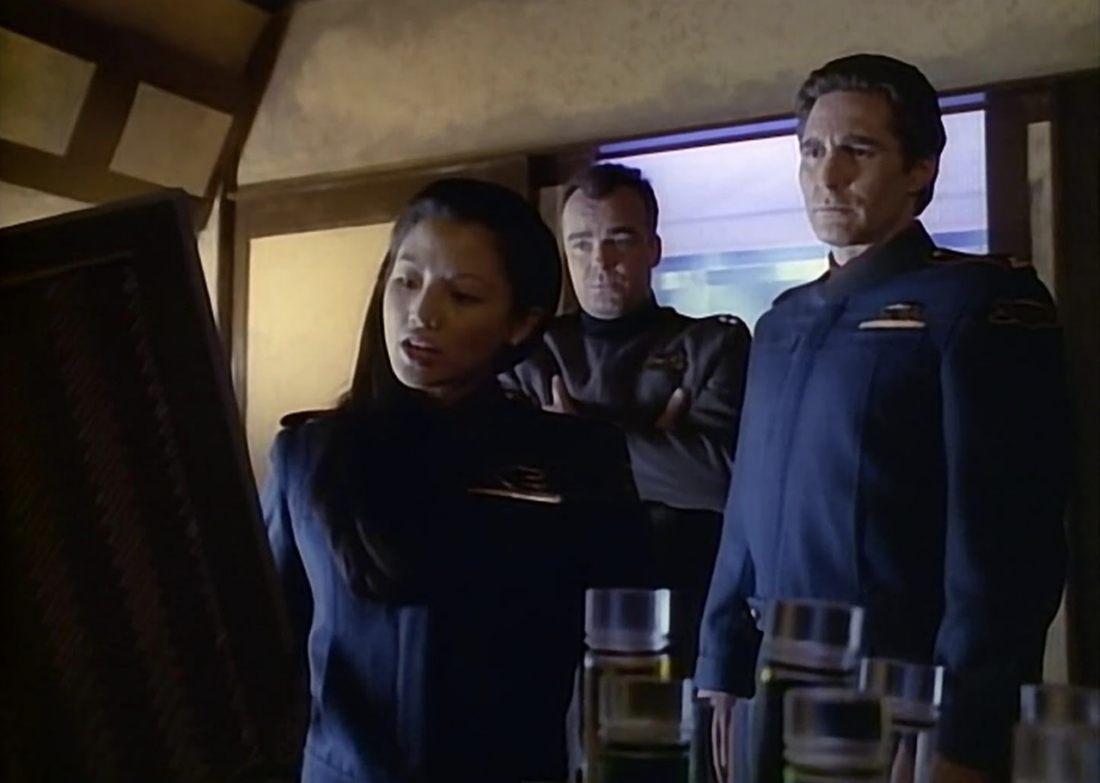
Lt. Commander Laurel Takashima, the first officer, is in Command & Control, overseeing a ship docking at the station. The security chief, Michael Garibaldi, calls C&C saying that the station commander is needed to greet a new arrival. Takashima says that he’s already on his way.
Sure enough, Commander Jeffrey Sinclair greets Lyta Alexander, a telepath from Psi Corps who will be working on the station, available to be hired. Sinclair tells her a bit about the station, taking her through the alien sector, where those species who require something other than Earth-normal atmosphere and/or gravity hang out.
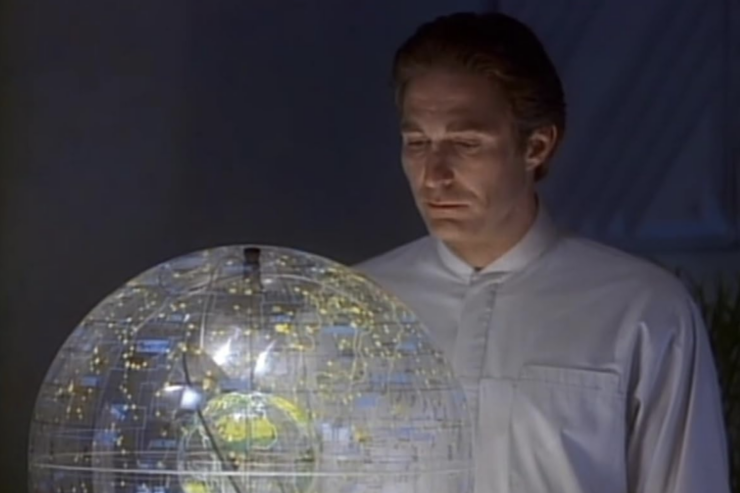
Another person who arrived on the transport is a human named Del Varner. In fact, we saw him initially during Mollari’s voiceover, so we know he’ll be important….
Four of the five representatives are on the station: Delenn representing Minbar, Mollari representing the Centauri, G’Kar representing the Narn, and Sinclair reprsenting Earth. The fifth is en route: Kosh from the mysterious Vorlons, about whom very little is known. At one point, Sinclair joins Delenn in the Chinese garden, and she, to his surprise, provides all the intelligence the Minbari have on the Vorlons. It’s not much, but it’s more than Earth has…
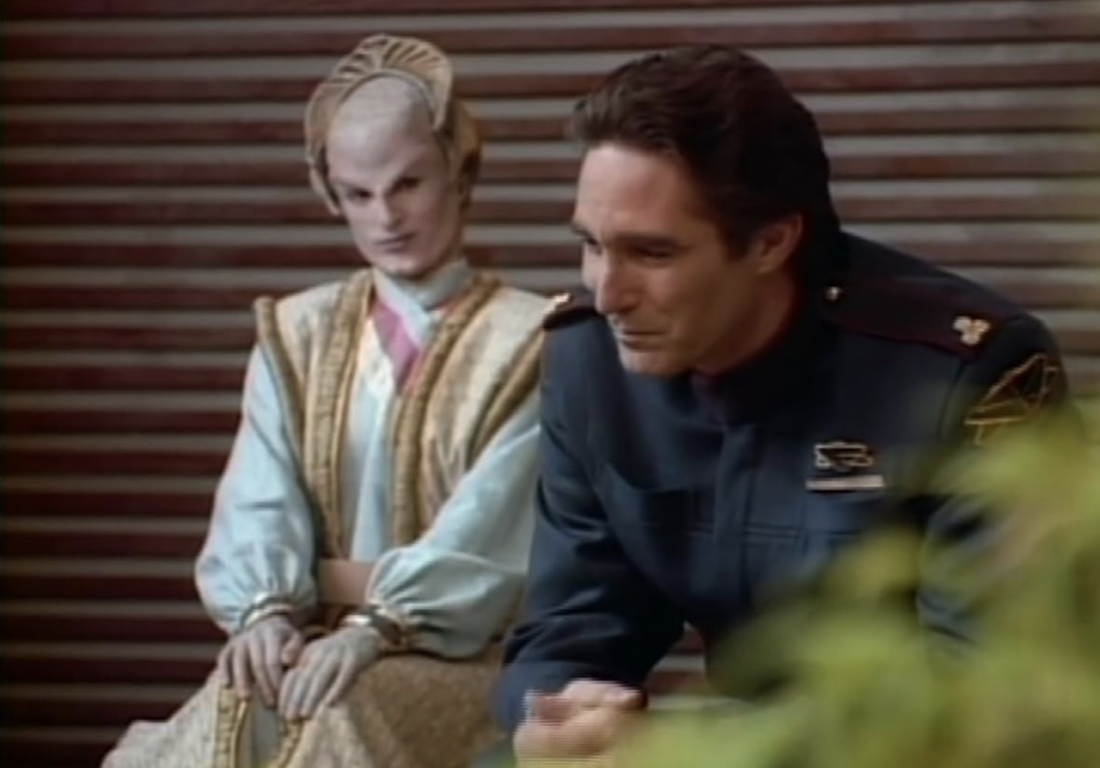
G’Kar complains to Takashima about a Narn supply ship that is being denied docking. Takashima explains that the shipmaster has refused to consent to a weapons scan, and they can’t let the ship dock without that. G’Kar leaves in a huff. In fact, he leaves in a minute-and-a-huff.
Kosh’s ship arrives two days early. Also en route is the ship belonging to Sinclair’s girlfriend, a trader named Carolyn Sykes. Garibaldi asks G’Kar and Delenn to be at the docking bay to meet Kosh, but he’s having trouble tracking down Mollari—eventually finding him in the casino, losing a lot. Mollari asks Garibaldi for a loan (obviously not the first time he’s made that request), which Garibaldi refuses (obviously not the first time he’s said no). However, Varner offers to stake him.
G’Kar changes his mind, and tells Takashima to go ahead and do the weapons scan on the supply ship.
En route to meet Kosh, Sinclair’s elevator stalls out. By the time he makes it to the docking bay and meets Garibaldi, they find Kosh unconscious on the deck. Vorlons have to wear full-body encounter suits in order to interact with other species for reasons that nobody’s too clear on (which is par for the course with the Vorlons). Takashima reports that the Vorlons have stated in no uncertain terms that Kosh’s encounter suit is not to be removed. Dr. Benjamin Kyle is not happy, as he can’t treat his patient without removing the suit.
Sinclair instructs Kyle to open the suit, but to do it alone, with all monitors turned off. Kyle is bound by doctor-patient confidentiality not to reveal what he sees. Kyle’s subsequent examination reveals that Kosh was poisoned. But Kyle can’t determine where the poison was applied, nor what the poison is.
Sinclair locks down the station, and Garibaldi conducts an investigation. One of his prime suspects is Mollari, who wasn’t at the reception with Delenn and G’Kar.
G’Kar approaches Alexander after she finishes a job. The Narn have no telepaths, and they wish to produce some. G’Kar makes her an offer to help them do so, either by G’Kar and Alexander mating, or by cloning, which would be a much more complicated process. G’Kar will pay her more if they just mate.
Sinclair finally gets to have some mad, passionate nookie-nookie with Sykes. He also tells Sykes a bit of his personal history that he’d been avoiding telling her before: that he was part of the Battle of the Line, the final battle in the Earth-Minbari War, of which he was one of the few survivors. He was doing a kamikaze run at one Minbari ship, then he blacked out, and the next thing he knew, it was twenty-four hours later and the Minbari had inexplicably surrendered, ending the war.
Takashima and Kyle convince Alexander to perform a mind-scan on Kosh. She reluctantly does so, only to discover that Sinclair is the one who poisoned the ambassador by putting a skin tag on Kosh’s hand.
Garibaldi’s investigation leads to Varner, but checking his quarters reveals Varner’s dead body. Confusing the issue is that he’s been dead for days, even though he’s been sighted more recently.
Sinclair is temporarily removed from B5’s council, replaced by Takashima. After the council questions several witnesses, including Kyle, G’Kar moves that they turn Sinclair over to the Vorlons. Takashima votes no, Delenn abstains, while Mollari and G’Kar vote yes. But that tie is broken by the proxy vote the Vorlons provided to G’Kar, making it a majority yes vote.
The Vorlons will arrive in twelve hours. Mollari apologetically explains to Garibaldi that G’Kar blackmailed him into the yes vote. He had information about one of Mollari’s ancestors that would prove politically embarrassing to him.
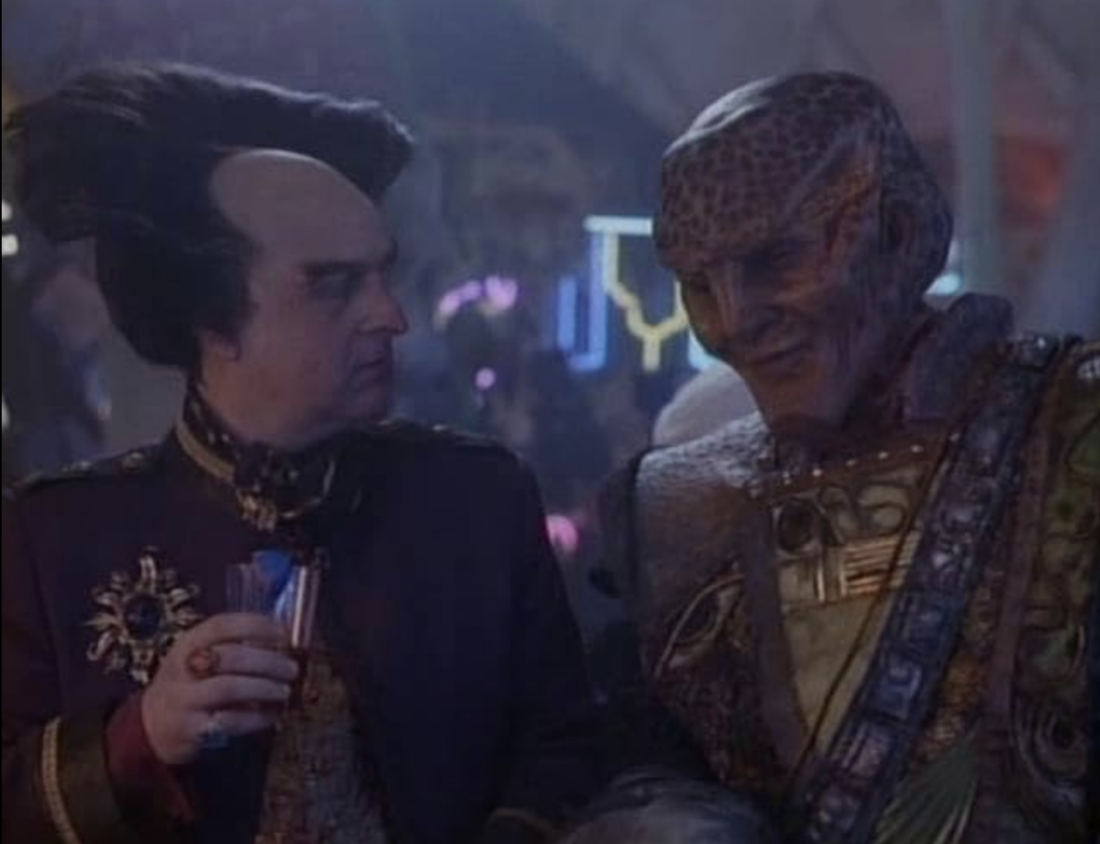
G’Kar approaches Delenn about the possibility of a Minbari-Narn alliance. But when he mentions a rumored shadowy organization in the Minbari Federation called the Grey Council, Delenn immediately attacks G’Kar, nearly killing him, and making it clear that she’ll do worse if he ever even mentions the Grey Council again.
Another body is found, that of a technician who has been seen since his time of death. Kyle is working in the medical bay, having found an antidote to the poison, when he sees Alexander enter, and she starts sabotaging the medical equipment—and tossing Kyle across the medical bay when he tries to stop her. But then the real Alexander walks in, and the duplicate runs away.
It’s now clear what’s going on: Garibaldi has learned that Varner was a smuggler dealing in black-market tech. His most recent trip had him acquiring a changeling net, which would enable its wearer to look like anyone. The net would give off a lot of energy, so Sinclair has Takashima do a scan of major energy sources, and then blank out anything they know about—life support, lights, and so on—and the only one that isn’t accounted for is small and moving through a remote part of the station. Sinclair and Garibaldi suit up and go after it. At Takashima’s suggestion, they take a recorder that will document everything, so they have proof for the Vorlons.
Garibaldi is injured, but Sinclair manages to stop the assassin, after he has cycled through several different disguises (including Sinclair himself). Eventually, he’s revealed to be a Minbari, a member of their Warrior Caste. Before blowing himself up, he says that Sinclair has a hole in his mind. Later, Sinclair queries Delenn about that, but Delenn blows it off as a standard Minbari insult. The nervous look Delenn gets before saying that makes it obvious to the viewer (but, for some reason, not to Sinclair) that she’s lying.
Sinclair shares a drink with G’Kar, revealing that he knows that the changeling net was brought on the delayed Narn supply ship, which was why Varner had to come to the station to pick it up, and then provide it to the assassin. G’Kar says Sinclair has no proof; Sinclair counters that he put a nanotech tracker in the drink they just shared, so now Sinclair will always be able to follow G’Kar. Outraged, G’Kar once again leaves in a huff. Sinclair then reveals to Garibaldi that he was lying, but that’ll it’ll be fun watching G’Kar try to find the tracker that isn’t there in his intestinal tract.
The big hole made by the assassin is being fixed, Ambassador Kosh is up and about, Sinclair has been cleared, and the station is, as Takashima says, open for business.
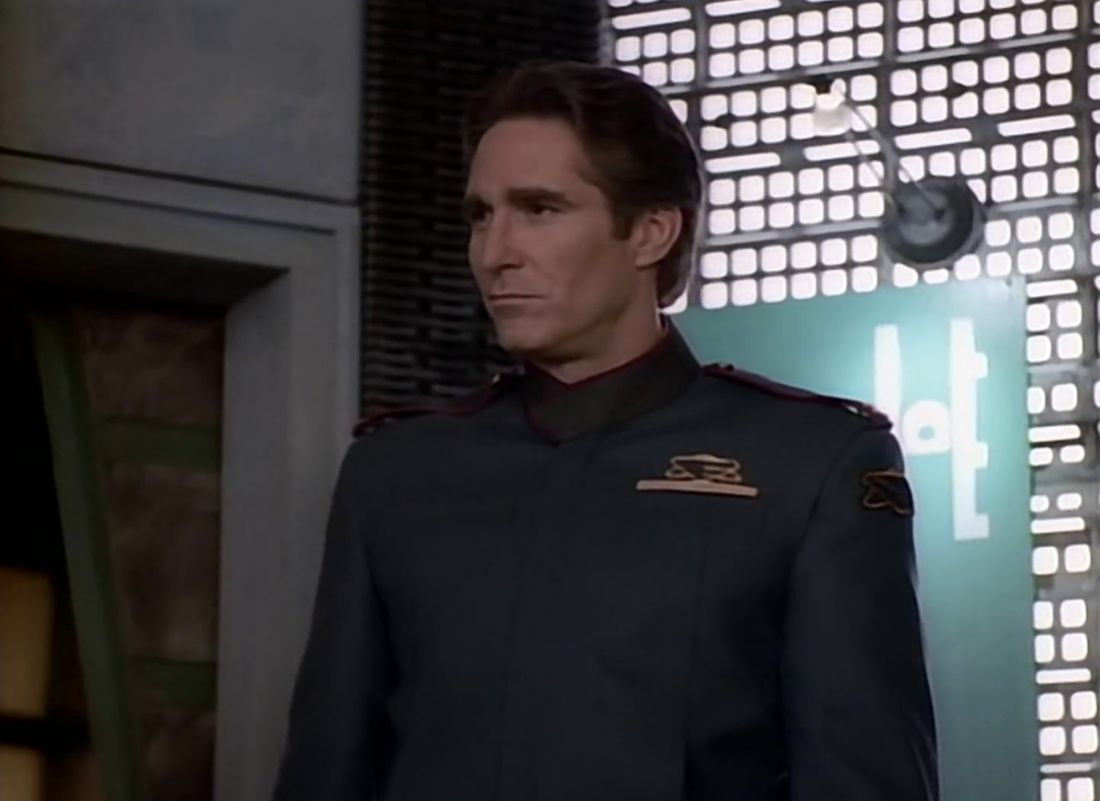
Nothing’s the same anymore. Sinclair gets to hit several rough-and-tumble leader clichés, including the close friend whom he hires even though nobody else wants him, being accused of a crime he didn’t commit, and insisting on stopping the bad guy himself despite having an entire frickin staff under his command.
The household god of frustration. Garibaldi is established as difficult, having bounced from assignment to assignment. He also doesn’t exactly light the world on fire with his investigation, as most of the work is done by Kyle and by the assassin being seen disguised as Alexander when Alexander walked into the room.
If you value your lives, be somewhere else. Delenn is surprisingly friendly to Sinclair, which he doesn’t expect, given the history between Earth and Minbar.
In the glorious days of the Centauri Republic… Mollari is pretty broken, reduced to gambling and drinking and lamenting the days when the Centauri Republic was a super-power instead of a has-been power.
Though it take a thousand years, we will be free. G’Kar is a manipulative bad guy in this one, showing an impressive ruthlessness and a tiresome nastiness.
The Corps is mother, the Corps is father. We learn that humans have developed telepathy, and there’s a Psi-Corps that supervises and adminstrates telepathic activity. The rules regarding telepaths are very strict, including no unauthorized mind-scans.
The Shadowy Vorlons. Vorlons wear encounter suits at all times and “for security reasons” don’t allow them to be removed. Very little is known about them by anyone else on the station.
Looking ahead. The hole in Sinclair’s mind will become extremely important down the line.
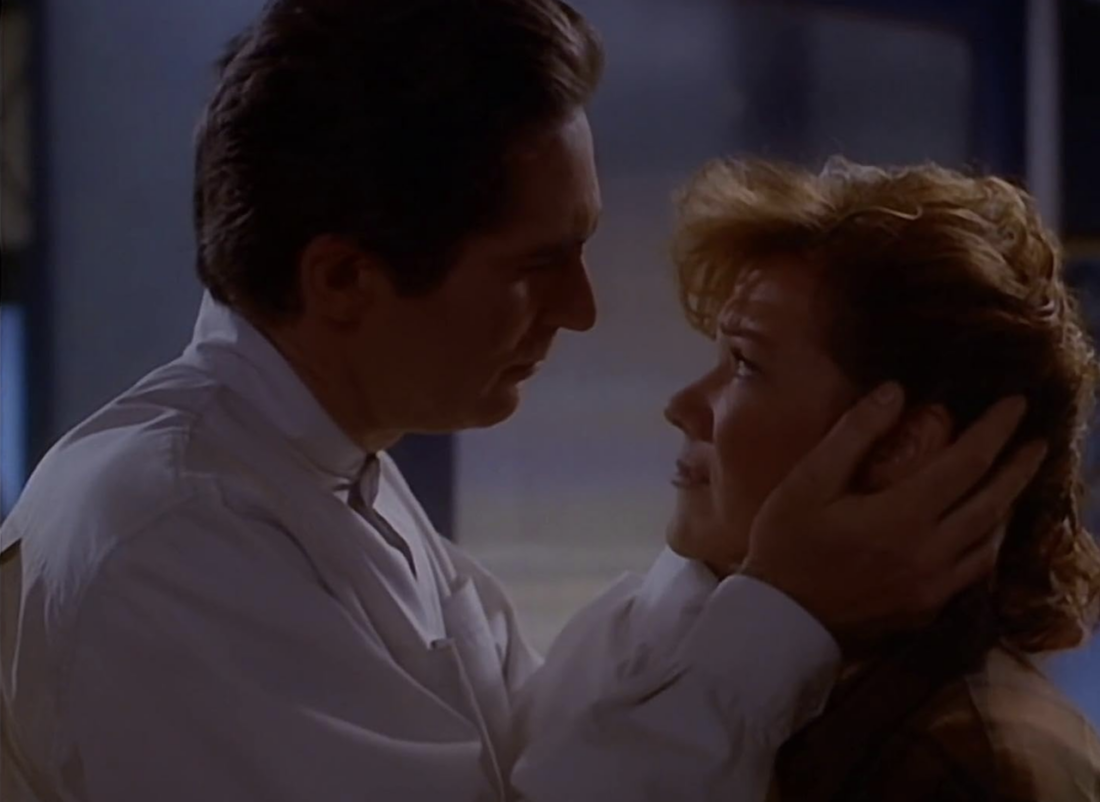
No sex, please, we’re EarthForce. Sinclair and Sykes are in a nice relationship; at one point Sykes tries to convince him to resign his commission and go off adventuring with her. He says he’ll think about it.
Also G’Kar tries to mate with Alexander in a scene that is eye-rolling and creepy all at the same time.
Welcome aboard. In this pilot movie, the only stars are Michael O’Hare (Sinclair), Tamlyn Tomita (Takashima), Jerry Doyle (Garibaldi), and Mira Furlan (Delenn). Peter Jurasik and Andreas Katsulas are listed as guest stars, as are Blaire Baron (Sykes), Johnny Sekka (Kyle), and Patricia Tallman (Alexander), even though all were intended to be regular characters. In addition, John Fleck plays Varner and Paul Hampton plays the senator.
Hampton will return next time in “Midnight on the Firing Line.” Tallman will return in “Divided Loyalties” in season two.
Also Ed Wasser plays one of the C&C officers; he’ll return in the recurring role of Mr. Morden starting in “Signs and Portents” later in the first season.
Trivial matters. Two different versions of this exist in the world: the original as aired in 1993 and a re-edit that was released when the show moved to TNT in 1998. Some of those changes were to fix things that later became continuity errors, including G’Kar’s reference to his wife and Mollari’s referring to Sinclair as the last commander of the station in his opening voiceover. Others were simply tightening some scenes and including some scenes that were cut, including a confrontation Sinclair has with a smuggler and Sykes meeting with Delenn. Sinclair and Alexander’s trip through the alien sector was cut down, as there were (legitimate) complaints that it looked too much like a zoo. The music by Stewart Copeland was redone by Christopher Franke, who was the composer for the series. In the original, Tamlyn Tomita’s dialogue was redone and looped in when Warner Bros. complained that she sounded too harsh; the new version restores Tomita’s original performance. Finally, the biggest change was Kosh referring to the assassin disguised as Sinclair as “Entil’Zha Valen,” a reference that will pay off in the “War Without End” two-parter in season three.
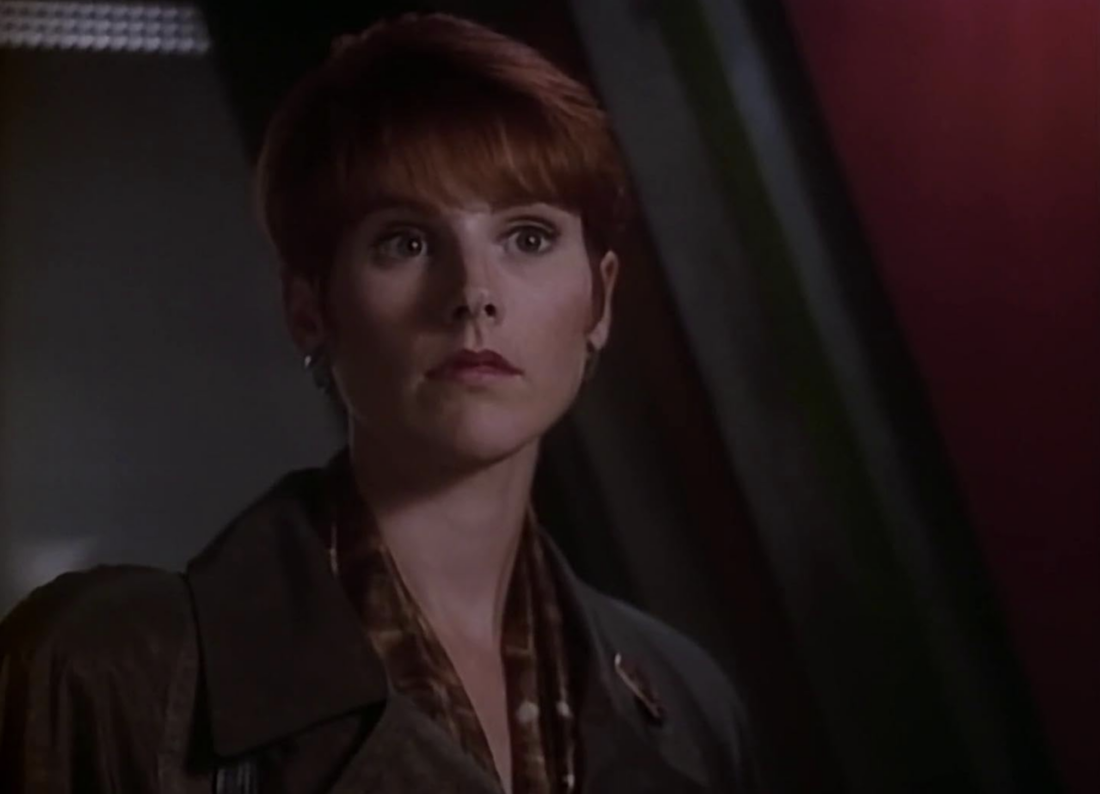
Tomita, Blaire Baron, Johnny Sekka, and Patricia Tallman were all intended to be regulars, but they did not continue on the series for various reasons. Tomita was replaced by Claudia Christian’s Susan Ivanova, Baron by Julia Nickson-Soul’s Catherine Sakai, Sekka by Richard Biggs’ Dr. Franklin, and Tallman by Andrea Thompson’s Talia Winters. Tallman’s Alexander would, however, return to the show as a guest in seasons two and three and become a regular for seasons four and five. Plotlines originally intended for Takashima were transferred either to Ivanova or to Winters.
Delenn was originally intended to start out as a man, but would emerge from the chrysalis at the top of season two as a woman. But they couldn’t make Mira Furlan masculine enough, apparently, so they abandoned it and just had her be female all along.
Furlan’s and Andreas Katsulas’ makeup were both changed when the show went to series, as were the EarthForce uniforms.
“The Gathering” was nominated for a Hugo Award for Best Dramatic Presentation. The award went to Jurassic Park.
The echoes of all of our conversations.
“There was a time when this whole quadrant belonged to us! What are we now? Twelve worlds and a thousand monuments to past glories—living off memories and stories, and selling trinkets. My God, man—we’ve become a tourist attraction. ‘See the great Centauri Republic, open 9 to 5, Earth time.’”
—Mollari, lamenting to Garibaldi

The name of the place is Babylon 5. “Babylon 5 is open for business.” There are three things a pilot needs to introduce: the characters, the types of stories that will be told, and the setting. The latter is more challenging in the science fiction/fantasy genre because it’s the only genre in which the setting isn’t real. So in addition to everything else, you’ve got to build a world and make it convincing.
Whatever the flaws of “The Gathering”—and they are legion—it did that part of it beautifully. Creator/writer/co-executive producer J. Michael Straczynski gives us a fully realized future history. We get an Earth that’s a power, but not the biggest power. We get the ugly history between the Centauri and the Narn, with the latter having burst onto the scene after being subjugated by the former, while the Centauri themselves are much less than once they were. And there’s the history of the Earth-Minbari War, which left scars on both sides—as well as the complete confusion as to why the Minbari surrendered.
Surrounding this world-building is a story that’s a pretty straightforward whodunnit with tech and a script that can generously be called awkward. The moment where Alexander asked Sinclair why the station was called Babylon 5, I groaned. Thirty-one years later, that conversation remains the tin standard for awkward exposition, not aided by the fact that I kept thinking of the Swamp Castle litany in Monty Python and the Holy Grail. (To this day, I always refer to Babylon 4 as having fallen into the swamp.)
That clunkiness of dialogue runs throughout, alas, not aided by performances that range from mediocre to uneven. Jerry Doyle’s Garibaldi is a walking, talking cliché of the maverick cop, Andreas Katsulas’ G’Kar is a mustache-twirling villain of the most ludicrous type (the scene where he proposes mating with Alexander is embarrassing), and Patricia Tallman’s Alexander ranges from stilted (her accusation of Sinclair comes across as a teenager throwing a tantrum) to excellent (her body language when she’s the disguised assassin is completely different, making it clear from jump that this isn’t really Alexander). All three characters will, of course, get better, but that just makes watching the early versions of them even more painful to watch. G’Kar especially—Katsulas was one of the finest actors of his time, always able to bring menace and nuance to his roles (which were almost always villainous to some degree or other), and G’Kar would certainly become a complex and tragic character as the show went on. But the G’Kar of “The Gathering” has muted menace and absolutely no nuance, and feels like an utter waste of Katsulas’ talent.
The leader of an ensemble needs to have a certain charisma in order for the ensemble to work, and sadly Michael O’Hare doesn’t quite have it. O’Hare is the type of actor who’s better off playing the sidekick or the helpmeet or the bad guy. (He played Colonel Jessup in the theatrical version of A Few Good Men on Broadway, and he was amazing. It was a hundred and eighty degrees from Jack Nicholson’s performance of the same role in the movie version, instead bringing a quiet, solid intensity.) He would’ve been perfect to play Garibaldi, truly.
Besides the world-building, the other way in which the pilot absolutely shines is in the character of Londo Mollari, brilliantly played by the great Peter Jurasik. In 1993, he was best known for his role of the squirrelly and slimy Sid the Snitch on Hill Street Blues and its short-lived spinoff Beverly Hills Buntz, which in no way prepared anyone for this. He magnificently brings the broken-down Centauri ambassador to life. The bit I quoted in “The echoes of all our conversations” above is a masterpiece, showing us how far the Centauri Republic in general and Mollari in particular have fallen.
Finally, there’s the CGI visual effects, which were groundbreaking at the time, and which I was dreading on this rewatch, as I feared they wouldn’t have aged well. And, well, they haven’t, but it wasn’t as bad as I was expecting. Mostly the biggest problem with the VFX is the same problem CGI continued to have up until 2010 or so: too bright and shiny and completely unable to convey mass. But it’s not fatal, and the CGI is well integrated.
Next week: “Midnight on the Firing Line.”

Looking forward to this rewatch. Babylon 5 has its flaws, but I remember it quite fondly. Thanks for doing this KRAD.
I see what you did there.
Interesting that the strengths and weaknesses of Babylon 5 are so present in the pilot. Some of it is just early instalment weirdness and people settling into their roles but not all of it.
I’m all about the subtle puns.
Also the unsubtle ones…..
—Keith R.A. DeCandido
I don’t know why, but about all I remember of the beginning was someone in a sled doing something—-making me think this was going to be kiddie fare…until…
Your’e about the Hole spectrum. I like that. Just hole d up so we can catch up with your punnery
Cool review, but i’m really missing the rating at the end. :D I know, i know, i’m just used to it. :)
And wow, many of the dialogues are really embarrassingly bad in this episode. :D I did not remember them to be that weird. And in my memory Sinclair seemed like a reasonable and good commander, but agree that O’Hare is not very good in this episode – i’ll be curious to see how he will be throughout the season. :)
I didn’t watch B5 until years after it ended, and I’m pretty sure I never saw this. From the review, it’s probably good I didn’t, I likely would have bounced off of it then. Looking forward to this!
Not sure about that (of course, ymmv); *something* in the pilot grabbed people enough to invest their time and energy is watching B5 come to truition – and talk incessantly about it!
That’s more or less what happened to me. I watched this when it first aired. I didn’t hate it, but I wasn’t that impressed. When the first season eventually ran, it was in the same time slot as Seaquest DSV. While I flip-flopped between them a bit, I mostly watched Seaquest.
Then I moved and no longer had cable, but I could get B5 over the air. This coincided with the start of Season 2, and I got hooked.
I’m so delighted to hear more Babylon 5 chatter. I found it so much more compelling than my attempts to watch Star Trek, as wild as that may sound.
I’ve never watched Babylon 5 before (I’ve always meant to get around to it) so this was all new to me. I have to admit that I thought the beginning was pretty rough. I didn’t perk up until Delenn’s first scene. After that I started to enjoy it more. I could tell that this was a world that the writer had spent time to put together, even if the actual plot of the episode wasn’t particularly original.
My overall impression of the characters was that the aliens were a lot more interesting than the humans. Mollari was the obvious standout, but I also found Delenn intriguing, and even if G’Kar wasn’t a particularly subtle villain, it’s always nice to see Andreas Katsulas. By comparison, the human characters were pretty dull. I kind of liked Takashima (in spite of the fact that some of her line readings were a bit awkward, which I now understand to be the result of the actor being made to dub over her dialogue), so it kind of sucks to learn she’s not coming back.
As for the production, well, the sets, props, and costumes weren’t spectacular, but the mood lighting helped to sell them. I’ve been led to believe that the rest of the series is lit more brightly, so it will be interesting to see how they hold up. I liked the makeup and the puppets. The music wasn’t awful, but I understand why it was replaced, because it does sound like it’s straight out of the 1980s. Finally, while the CGI didn’t really bother me, it does look its age. I have read that it gets better over time, though.
One thing I went in expecting to notice was where people got the idea that Deep Space Nine ripped off this show (or vice versa, I’m not really clear on the details of the controversy). Aside from the fact that they are both set on space stations, they seem nothing alike.
JMS pitched the idea of a SF series set on a space station well before DS9. WB didn’t take his pitch, but, lo and behold an SF series set on a space station (DS9) showed up in the Star Trek universe later – before B5 aired “The Gathering”.
Read into it what you will. It was more of a controversy to B5 fans, than it appears to have been to Joe, but the timing IS suspect.
strueb: Also you said that “WB didn’t take his pitch,” and, well, yeah, they did. Warner Bros. produced B5. I think you meant that Paramount didn’t take his pitch.
Anyhow, what Christopher said. Also, I really don’t want to spend the next two years reliving the tiresome B5/DS9 war that raged during the 1990s, as I lived through it the first time, it was stupid, and my interest in reviving it is somewhere between “slim” and “hell, no.” We got through the entire DS9 Rewatch without hardly ever mentioning B5, I’d like to give B5 the same courtesy and talk about it, not another show.
—Keith R.A. DeCandido
But were they as stupid as the Joel vs Mike Flame Wars?
Ooooohhhhhhh, that’s a toughie……….
—Keith R.A. DeCandido
Why, why, why does anyone think “set on a space station” is evidence of imitation???? That makes no sense. What defines a story isn’t where it takes place, it’s what happens there. Nobody ever accused anyone of a ripoff because two different shows were set at a hospital or a school or a law firm or a small town, or even a starship or an alien planet or an ancient magical kingdom. So what’s so special about space stations?
I mean, Mystery Science Theater 3000 was set on a space station and it premiered in 1988. So does that mean B5 “ripped off” MST3K?
And as I already pointed out last week, DS9 wasn’t even conceived as a space station series. The original plan was to set it on the surface of the planet Bajor. They changed it to a space station because studio sets were cheaper than regular location filming.
I am now envisioning Delenn, Londo, and G’Kar attempting to make sense of terrible, terrible movies.
Delenn: Why would Earthers name a film after fish mandibles?
Londo: They were already running out of ideas.
G’Kar-silent from eating Swedish Meatballs
Next week, Delenn will be attempting to make sense of Duck Dodgers in the 24th and a Half Century.
As much as I adore Babylon 5…and I often consider it my favorite television series/franchise in all my 50 years…I consider “The Gathering” to be a rough start, for all the reasons you mentioned. Many of those issues, thankfully, are addressed, at least to my general satisfaction. For example, I find much of Sinclair’s portrayal by O’Hare to be informed by revelations in the first season, particularly his penchant for putting himself in the line of fire unnecessarily. And of course, G’Kar gains gravitas to spare.
When I think about the potential for a Babylon 5 reboot, I don’t try to think about how JMS might manage to match the high points of the series to come. Rather, I wonder how much better a beginning he could craft, with many more years of experience under his belt. Because in some respects, he was running while still learning to walk when he wrote/produced this pilot, never mind much of the first season…
They don’t have this on Tubi, but fortunately, my 31-year-old taped-from-TV VHS copy proved to be in pretty good shape — aside from a few moments of static in the casino scene, it still looks surprisingly good, though it sounds like the whole thing is set in a public restroom. (The sound only came from the left speaker, but had an echo for some reason. Maybe I had the audio settings wrong on the player, which I rarely use.)
And yes, that means I watched the original version, but I prefer that one, mainly because of Stewart Copeland’s score. I wasn’t fond of it originally, because I believed at the time that science fiction needed grand orchestral music instead of electric guitars and synth, but in retrospect I find Copeland’s main theme much livelier and more enjoyable than the bland droning and irritatingly repetitive “ping-ping”s of Christopher Franke’s scores. Although the only other memorable part of Copeland’s score is the motif he used for Kosh’s examinations.
Anyway, the opening act or so was very awkward and full of stilted exposition delivered with mediocre acting, but then Delenn showed up and both writing and acting rose to a new level. I always felt that the actors playing the main alien characters were on a higher level of talent than the ones playing the human leads, as much in the series to follow as in the pilot. Furlan and Jurasik were great, and while Katsulas may not have been on his later level, he certainly gave a more charismatic performance than the “humans” did. And the scenes establishing the alien governments’ backgrounds and worldbuilding were among the most successful.
Well, aside from the G’Kar/Lyta scene, of course. That was cringeworthy. Aside from the creepiness and the implausibility of the idea of interspecies mating, I think what bugs me most is that the scene just fizzles out without resolution. We just see Lyta looking uncomfortable as hell and then that’s the end of it. Which makes it seem doubly pointless to subject her to that at all.
Despite my feelings about the uneven acting, I kind of regret the cast changes after the pilot. Tamlyn Tomita was an even more exquisite beauty at that age than I remembered. Apparently this was only the second thing I saw her in, Quantum Leap being the first, and I was definitely smitten with her and disappointed that I didn’t get to see her more often, or listen to that lovely dulcet voice. As for Johnny Sekka, he was an interesting presence, and it would’ve been nice to have at least one non-American actor in the core “human” cast (Sekka was from Senegal and moved to England at 18). I felt he had a quality that reminded me of doctor characters from 1960s productions, like Dr. Boyce in “The Cage” or Dr. Bergstrom in Space: 1999. He just kind of fit that old-style grizzled voice of authority role.
One detail I’d add about Delenn is that they initially planned to deepen her voice to make her sound masculine, and the reason they dropped the gender-swap thing, reportedly, was because they couldn’t get the alteration to sound convincing. Since they didn’t change their minds until post-production, that’s why Delenn has a more masculine/androgynous makeup in the pilot. Note that the only line referring to Delenn as “she” is spoken by an offscreen character, no doubt dubbed in later.
Watching this again may be a different experience for me than it would be for a new viewer today, because it brings back just how impressive the CGI was at the time. Whatever the limitations on its resolution, for 1993 it was extraordinary to see FX shots where you could go from a full-length shot of the station to an extreme close-up or vice-versa in the same continuous shot with no loss of detail, or to be able to rotate around a ship 360 degrees, or to have dozens of ships in the same shot. The Video Toaster system and the software descending from it was really revolutionary in what it made possible on a TV budget. Although I always found it disappointing that the interior sets were so cheap-looking in comparison. Most of the rooms were just the same wall flats rearranged in different configurations. And the old-style standard-def CRTs passing off as futuristic display screens have not aged well. And let’s not forget that Dr. Kyle’s medical equipment consisted largely of familiar sci-fi props rented from Modern Props, many of which had been seen in Star Trek and elsewhere. The light fixture behind G’Kar when Delenn tortures him is a standard prop that showed up in TNG too.
One thing I’d take issue with is the bit in the climax where the explosion in the hull causes the whole station to swing off-axis so that they have to scramble to stabilize. That was really exaggerated. I tried using a similar plot point in an early draft of Only Superhuman, and when I did the research, I determined that a hull breach and atmosphere escape wouldn’t be remotely powerful enough to push something so massive off its axis against its gyroscopic inertia. (I foolishly wrote the scene before I did my homework, so once I found it wouldn’t work, I had to rewrite the whole thing.)
Incidentally, since B5 was distributed by the syndicated PTEN, it needed local sponsors to underwrite the broadcast, and it was interesting to see on my videotape that the pilot was sponsored mostly by comic book shops, including one I remember visiting frequently, though I’m not sure if it was at the time or later, since I hadn’t yet moved to the side of town it was on. There were also a couple of commercials for Playmates ST:TNG action figures.
I’m glad you solved your problem, but: For anybody else coming to this rewatch late who doesn’t happen to have a copy of this on VHS, the special edition is indeed on Tubi (as of the writing of this comment), it’s just listed as a “bonus” at the end of season 1. Presumably a bit of social engineering is going on here; they want people to watch, after all, and figure that the much better first regular episode is more likely to keep people watching than the plodding pilot. Then if they make it to the end of season 1, they can get a “flashback” to the event they’ve heard about a few times. Probably a good decision, TBH.
Weirdly, it’s a lot easier to watch this episode for free (with ads) than it is to buy it; Amazon has everything else in the Babylon 5 universe, but not this.
I think it’s probably more that Tubi counts it as a bonus to the season; I haven’t looked, but I would suspect that other shows that have bonus episodes put them at the end. It seems more likely that they just arrange various shows according to a standard format, rather than micromanaging the order for each one.
And yes, as discussed further on in the comments, I did find and watch the special edition of the pilot on Tubi.
I first saw Tamlyn, of course, in the Joy Luck Club, and was really looking forward to her being a series regular. I have this vague memory of JMS saying something about her inclusion to a certain extent being a gesture towards positive representation which would have completely backfired with her planned betrayal. No idea if the positive representation thing was smoke screen or ???
Interesting what you and KRAD are saying about Delenn’s transition plans because I remember (faultily?) that JMS said that Mira passionately hated the male thing so much so that they caved and let it go.
IIRC it was the prospect of getting overdubbed that really upset her.
Also, why would you overdub someone with as fabulous a voice as Mira Furlan?????
—Keith R.A. DeCandido
” standard-def CRTs passing off as futuristic display screens have not aged well. ”
Eh, pretty much any movie or TV show of that era that used live video on the screens used CRTs because, well, that’s what they had. IIRC, the flatscreens on ST:TNG were all painted and backlit glass.
One of the fun details on BSG was the Galactica having CRTs, and the newer, more advanced, Pegasus being equipped with flatscreens.
“Eh, pretty much any movie or TV show of that era that used live video on the screens used CRTs because, well, that’s what they had.”
Except it wasn’t the only thing they had. In 2001 and Star Trek: The Motion Picture, for instance, the “video screens” were actually rear-projection screens showing film footage. Otherwise, most “video screen” images in older shows and films were matte shots created optically in post-production, even when they were just showing people watching TV in a present-day show, because TV and film had different frame rates so TV images strobed badly when filmed directly.
By the ’80s, they’d developed a way to sync video with 24-frames-per-second film, so it became practical to use actual video screens in the set. But of course, film is intrinsically high-def and standard video is not, so while it was technically easier and less expensive to use live video screens in-set, it always looked so much worse than traditional methods, even by the standards of the day. Compare B5’s use of actual low-def video screens to TNG’s contemporary use of matte shots to superimpose higher-quality images into fake screens, and TNG’s looked so much better. Same with the difference between ST:TMP’s use of film-loop bridge monitors and TWOK’s use of live video three years later — the video was less expensive, but looked worse. It looked like something using present-day technology instead of futuristic technology. Even at the time, I always found it disappointing.
I’m re-watching “Flash Gordon Conquers the Universe”, and it has matte effect for television viewing. It has to warm up like a CRT though, but faster.
“Doctor Who” since the 1960s, mostly on videotape, has had a super-advanced time travel machine stuck with ordinary television screens for information displays. When they had Matt Smith on in about 2010, it was a deliberate retro feature.
I managed to find “The Gathering” on Tubi. It’s at the end of season 1 listed as a bonus.
They do not have this on tubi, but it is free on amazon prime video. I watched it for the first time yesterday and I am glad I was already into Bablyon 5 before yesterday.
The original version is streaming for free on Amazon Prime (just the pilot though, not the series – you have to pay extra for that). I’m debating whether or not it’s worth it to shell out the cash to buy the rest of the show just so I don’t have to watch it with commercials.
Nothing to add to this, but wanted to say that I really liked Sekka in this episode, even though there was not much to the role here, but i could easily believe that he’s a competent doctor treating a member of a totally alien species without any prior knowledge about them, so i’ll miss him… :)
The original cut of The Gathering was so bad that even as a 13 year old sci-fi fan who gobbled up SeaQuest, Super Force and the OG BSG, I didn’t go back to B5 until late in the first season when my favorite local DJs went to LA to play bit roles in an episode. Luckily they were in A Voice in the Wilderness and not TKO.
The “special edition” version of The Gathering is available on Tubi, hidden as a bonus 23rd episode of season 1: https://tubitv.com/tv-shows/716628/s01-e23-the-gathering-bonus
Thanks!
I had heard that Babylon 5 (for some reason I want to spell it Babylon V) was an incredible sci-fi, and since I was looking for a new sci-fi show I decided to give it a go. So I watched The Gathering knowing almost nothing about the show except that it was either the inspiration for or a rip-off of DS9. I thought it was…not good. The plot was generic, I almost immediately got lost in the names, faces, and races of the aliens, the effects were off-putting and (being an entrenched believer in the symphonic score) couldn’t stand the soundtrack. My favorite characters were Lt. Cmd. Takashima and Dr. Kyle. After browsing the Wikipedia page for the show (avoiding spoilers, except for the fact that Sinclair leaves after season 1) and learning that both characters disappear on the series proper, I lost all interest in continuing through the series. Given this review series I might give it another go and try and experience the first season with a fresh mind.
@ecthelion of Greg – agree about Takashima and Kyle. I’d still suggest to give the series a chance – i re-watched the Midnight on the Firing Line now a bit ahead of @krad’s rewatch and it’s a significant improvement over the pilot – the story is OK, the characters are slightly better and I think O’Hare is much better already as Sinclair. And the music is not annoying anymore. :D
It’s just the first season, i think it’s normal that there are struggles – DS9 also improved a lot , AFAIR its first season wasn’t amazing either.
“So I watched The Gathering knowing almost nothing about the show except that it was either the inspiration for or a rip-off of DS9.”
Which is not knowledge, just hearsay, because neither of those is true. It makes as much sense as assuming that Night Court is a ripoff of Perry Mason because they’re both set in courtrooms. The only reason people ever thought that was because space station shows weren’t as common as courtroom shows.
Read “Becoming Superman” – JMS’s autobiography. I don’t think you can find any of the old usenet posts.
I really hope this doesn’t come up on every single article.
It certainly won’t be by me…..
—Keith R.A. DeCandido
Hearsay, but hearsay spread by JMS himself based upon flimsy evidence, which has led to it being repeated as proven fact for the last thirty years.
As embarrassing as the scene where G’Kar offers Lyta a bit of the (extremely) strange is, you have to give him credit for being concerned about how high her “pleasure threshold” might be. That line cracked me up. (It must have made an impression on the actress as well, given that she’d later write Pleasure Thresholds: Patricia Tallman’s Babylon 5 Memoir. lol)
A line that left me feeling more intrigued than amused was Dr. Kyle’s “I have looked upon the face of a Vorlon, Laurel, and nothing is the same anymore.” I wonder what kind of effect the experience might have on him in the long run.
And a small quibble, if I may. I believe that the stone garden is Japanese, not Chinese.
On to “Midnight on the Firing Line”!
That “pleasure threshhold” is a piece of foreshadowing. Not gonna spoil it by saying anythjng more.
Yes, it is. And you’re quite right not to spoil it! :)
Yes, it’s a Japanese rock garden, aka a Zen garden. https://en.wikipedia.org/wiki/Japanese_dry_garden
And so it begins…
I love this series. Looking forward to the rewatch.
Bobby
You said it before me. I knew someone would.
I have to wonder if Tomita would have come back for the series if that overdub hadn’t made her look like just the worst, flattest least charismatic actor ever. The first time I saw The Gathering, I dreaded it every time she entered a scene, and was relieved to see that she got replaced for the series. Then later I saw the Special Edition, and she’s absolutely fine. What a butcher job. I wouldn’t have wanted to come back either after that.
Which is a shame, because if she had been the one to do the thing in the Season 1 finale after being a regular all season, that would have hit like a ton of bricks.
Rewatching the pilot movie, it’s interesting seeing how many things JMS seeded in for future plots on the show. At one point Dr. Kyle has an offhand mention that he’s taking stims to stay awake through the long hours he’s putting in. In retrospect that’s an obvious setup for what became a significant subplot for his replacement Dr. Franklin down the line.
One of the things that occurs to me is that the Delenn gender switch could probably be done today. The technology is better, for one. We have trans actors, although casting a trans woman as Delenn might have been too big a tip off. Casting a non binary actor would make it work as well.
I saw this when it was first on, and I didn’t hate it? It caught me enough to watch the series when it finally aired and it remains one of my favorite series of all time. I’m really glad to be reliving it here.
In just 4 years they did a great job in “Earth: Final Conflict” – according to the internet with budget about half of Star Trek shows, but still significantly larger then B5.
I know the actresses playing Taelons in E:FC were made up to look androgynous and their characters were referred to by male pronouns, but they always seemed quite feminine to me in face and voice, and it always threw me a little when I heard them called “he” or “him.”
With Delenn, one way to convey maleness would’ve been the one used with the Talosians in ST: “The Cage” — just dub a male voice actor over Mira Furlan’s lines. But then we wouldn’t have been hearing her peformance, and I guess they didn’t want that.
I vividly remember renting the original pilot on VHS exactly 30 years ago while on a beach trip. Back then, I had no idea what a pilot movie even was. I was a TV newbie at the time. It would take another 2 full years for the rest of the first season to reach my shores. I spent much of that time not knowing it was even supposed to be a long-running TV show. I just thought it was this oddball sci-fi production with groundbreaking VFX. Had no idea who Straczynski was or that B5 would become the legend it became.
I remember both versions of the pilot quite well. While I lean more towards Chris Franke’s work on the soundtrack side of things, I still appreciate Copeland’s work here.
The pilot itself is very much a first draft of the show. Obviously sloppy at times, but I enjoy Straczynski’s choice to start things up with an assassination plot. Given the size and scope of B5, a whodunit scenario is an easy way to introduce us to the key players of a greater arc that we don’t have a clue it even exists at this point.
One scene in the 2nd version of the pilot that I feel works poorly is the Sinclair/Marianne Robertson hostage sequence early on. It’s briefly mentioned in the original version, but never actually seen, and it’s easy to see why it was cut. Too over-the-top, and with a pretty wooden performance by O’Hare. And the only point of that scene is to set up Varner sneaking in.
I could spend a whole episode of Londo going from boasting his “thousands of starships clouding the skies” to be sober regrets over the Centauri’s current state of affairs. Jurasik is a treasure of an actor, with that unmistakable voice. While G’Kar would improve tremendously by “Midnight on the Firing Line”, Katsulas already commands every scene with his presence.
One thing about “The Gathering” that I don’t recall anyone ever bringing up – and it’s such a glaring example of the show not being fully formed: Delenn’s torture ring. By the time we get to season 1’s “Soul Hunter”, one wonders why she didn’t just use the thing on the aforementioned character if he was such a threat to the Minbari. Crush his throat – problem solved. And I guess I just answered my own question as to why Straczynski dropped that little character detail.
I love your description of Lyta Alexander being a teenager throwing a tantrum. I was always taken aback by the vicious way she accuses Sinclair of poisoning Kosh, as if he somehow defiled her honor. I still remember her lines (HE DID IT! I SAW IT! I SAW IT!). And good catch on her assassin”body language. Given her experience as a stunt double on multiple productions (including DS9), it’s probably natural for her to create this physical performance disparity between characters.
I don’t see the issue with Lyta’s accusation of Sinclair. She’d just been in Kosh’s mind, seeing and feeling herself in his place, experiencing the assault as if it had happened to her. We saw how shaken she was afterward. It’s entirely natural that she’d react fiercely to seeing Sinclair’s face at that moment.
Which is perhaps my one complaint about the re-edit, aside from the score. They shouldn’t have added that Vorlon-like glow to Lyta’s hand, after she’d explicitly told us that she’d be seeing Kosh as herself. They probably shouldn’t have dubbed in Kosh’s voice either.
That’s a good point. Deep telepathic scans could really emotionally shake Lyta, Talia or any other telepath, even trained ones.
Once I learned thanks to jclarson that the Special Edition was on Tubi after all, I decided to go ahead and watch it, and I’m glad I did, since it has more restored or extended scenes in it than I realized. There’s a lot of new content, most of it worthwhile. Certainly giving Sinclair and Garibaldi more business near the beginning, dealing with the smuggler, helped establish them and improve the pacing of the story. And a lot of the restored stuff was good for building character.
The cuts were mostly improvements too, or at least fit the series continuity better. But in the G’Kar/Lyta “Indecent Proposal” scene, they cut out the only parts I liked. I liked the theatrical lighting effect used in the original cut to represent a privacy barrier being raised around their table. And while cutting the reference to G’Kar’s mate endorsing the deal was necessary for continuity, it means losing the part where Lyta questioned the ethics of G’Kar’s proposal, so that she’s left wordless and passive in the final cut of the scene, making it even worse.
I do wish they’d cut the term “Alien Sector,” which seems a problematical term on a station with dozens of different species onboard, and inaccurate given how many aliens inhabit the rest of the station. They should’ve redubbed it as “Special Environment Sector” or something. I also wish they’d cut the line about varying the rotation to adjust the gravity. Okay, maybe that was needed to convey the idea of rotational gravity to the audience, but it doesn’t make sense, since the gravity would be higher or lower in proportion to your distance from the axis, so if someone needed different gravity, you could just move them up or down a few levels.
A second watch let me notice some things aside from the changes. While some of the foreshadowing, especially with Delenn, was rather heavy-handed, there’s a much more subtle and effective one. When Londo is apologizing to Garibaldi for voting to extradite Sinclair, Londo is played as a very sympathetic figure, feeling sincere regret for letting his friend down. But in the midst of it, he admits he knew his grandfather committed atrocities against the Narn and shrugged it off as unimportant. Which is a very important bit of foreshadowing that was hidden very effectively in plain sight.
Speaking of that vote, how did Delenn’s abstention get counted along with Laurel’s no vote? If it’s two yes, one no, and one abstension, that should mean that yes wins, right? The whole point of an abstension is that it doesn’t count either way. Unless the rule is that something has to get at least three votes to pass, in which case they should’ve established as much.
One other thing doesn’t make sense. After Sinclair claims to have slipped a nanotransmitter into G’Kar’s drink, G’Kar storms out and Garibaldi arrives in the lift outside with Londo. Then Sinclair emerges and meets Garibaldi, and Garibaldi knows about the alleged transmitter but is surprised to learn it’s just a bluff. How does that work? If he was talking in the lift with Londo, he can’t have overheard the conversation in Sinclair’s quarters, but if Sinclair told Garibaldi in advance what he planned, why wouldn’t he have told him the transmitter was fake?
Also… if JMS’s plan at the time was that Takashima was the spy who abetted the assassin by sabotaging Sinclair’s lift and erasing the evidence of it, then why did Takashima prevent the Narn ship from docking and getting the changeling net from Varner as planned?
I went ahead and checked out the TNT version as well after that comment told me where to find it on Tubi. I agree that the edits were mostly improvements (except for the G’Kar-Alexander scene, where they cut out the cool and funny bits but left in the creepy bits). Takashima’s even more impressive in this version with her original line readings restored (so it sucks even more that she’s not coming back). I also liked Kyle more this time, though I don’t know if that has anything to do with the edit.
My biggest complaint is that it’s cropped to change the aspect ratio, though I don’t know if that was a TNT thing or a Tubi thing.
As far as I can tell, the Special Edition was in 4:3 aspect ratio, so the cropping is probably Tubi’s doing.
I assumed Sinclair told Garibaldi the part about the transmitter so he could reinforce the idea it actually existed when he saw G’Kar later. It’s possible Sinclair originally planned on actually using one, but then changed his mind, or just thought it would be more convincing if he didn’t tell Garibaldi about the fake-out until after Garibaldi ran into G’Kar. Regardless, it never bothered me much.
Regarding Takashima, it was meant to be the implanted Control personality that was abetting the sabotage, and even if it wasn’t, you can’t be part of a secret conspiracy if you are openly violating regulations in broad daylight in the Command centre with the rest of the command staff as witnesses. Also, the issue with Narn ship wasn’t the changeling net, it was the Minbari assassin. They were supposed to get the net prior to coming to B5 because a Minbari warrior coming off a Narn transport would be too conspicuous. That’s why they used the little spider probe thingie that bored a hole into the station to sneak the Minbari in, who then went to Varner and got the net. This also means that if the plan went off properly and they got the net prior to coming to B5, they could have scanned the ship for weapons and not seen a Minbari warrior on board, so Takashima (or the Control personality) wouldn’t have had any idea that the scan would be a problem unless she also knew that part of the plan had failed to go as originally expected.
Yes, I got all that about the net and the reasons for the spider probe. The point is, they only needed to use the probe because Laurel refused to let the Narn ship dock as planned. So her actions worked against the plan she was supposed to be abetting. If she was an unknowing co-conspirator, that could explain it.
“I assumed Sinclair told Garibaldi the part about the transmitter so he could reinforce the idea it actually existed when he saw G’Kar later.”
Except he told Garibaldi the truth immediately, before he had a chance to say more than “Beep-beep” to G’Kar. And why would Garibaldi have to believe the transmitter existed in order to convince G’Kar? Surely he’s not that terrible a liar.
I don’t like the “changed his mind” explanation either. Not only is it awkward, but if the only way to explain a plot hole is with an ad hoc conjecture after the fact, that’s what makes it a plot hole. It’s the writer’s job to make the story hold together, not the audience’s.
Only if the plan was “get the assassin on board ASAP”. In forcing a delay that G’Kar was raising into a diplomatic incident, Takashima was stalling for the time necessary for their co-conspirators to plan and execute an alternative way to get the assassin positioned on the station to receive the changeling net. Her actions thus furthered the actual larger plan, regardless of whether she was consciously doing so.
I initially found the shouty overacting between Tomita and Katsulas rather jarring in their first scene in C&C, since I knew both actors were better than that. But it makes more sense if, in-universe, Takeshima and G’Kar were trying to draw attention while others worked to get things back on track.
Okay, I may have misunderstood. I though they were saying that Varner missed connecting with the Narn transport because Laurel ordered the inspection. You’re saying they missed the intended connection earlier and thus had to arrange an alternate meeting on the station. That was kind of unclear.
Correct. I am pretty sure Sinclair even lays this out when ‘implanting’ G’Kar. And Takashima couldn’t bypass the regular security screening for docking ships without raising more red flags. It would be like a supervisor coming down to the TSA and saying that guy with the trench coat complaining about being searched should just be allowed to walk on to the plane without having to go through the scanners or having their bags x-rayed. Everyone would note it as highly irregular, and particularly so for Takashima given her conversation with Kyle later about how she has “officially” been holding very strictly to the rules these days.
I don’t know if you’ve noticed this. When Varner meets with the Minbari assassin on his quarters just as he’s about to be shot, he uses Takashima’s access code to open the door. It’s a blink-or-you’ll miss freeze-frame moment. I needed to pause the DVD to catch it.
There were three “Yes” votes — Londo’s, GKar’s and the Vorlon proxy vote that G’Kar was given permission to cast.
Yes, that part is obvious, since it was clearly stated in dialogue in the episode I watched twice. I’m talking about before then, when it was 2 yes, 1 no, 1 abstention. If that were all there was to it, then yes should have carried even without the third vote, because counting an abstention as a no vote invalidates the whole purpose of an abstention. So there would have to be an additional rule that two votes are never enough, even if they outnumber the opposing votes. It’s logical that a 5-person council might have a “minimum 3 votes to carry” rule, but if that was the case, they should’ve said so, otherwise there’s a logic gap in the scene.
I’m glad I wasn’t the only one who found this confusing. Not the way things work according to Robert’s Rules of Order.
While I see your point (and you certainly have more experience than me in constructing such scenes), for me Takashima’s explanation right in the moment (basically “two votes for, two against or abstaining; motion fails”) was sufficient in the moment—I never worried about the exact reason why it was that way. Now, if it had been a plot point later in the series, then maybe it would have been good to reveal the reason now, but I’m almost certain the voting structure of the council never comes up again.
Except it isn’t really sufficient by the scene’s own logic, because if Delenn knew that abstaining would cause the motion to fail, that makes it indistinguishable from voting no, so it doesn’t really represent a neutral position at all. And that invalidates the later scene (in the Special Edition) with Carolyn yelling at Delenn for not helping Sinclair, because her abstention had the exact same effect as a no vote, so it would have helped Sinclair if not for the fifth vote, so what was Carolyn complaining about? The whole thing just doesn’t add up, literally, because the only way it could’ve had the desired story significance is if the vote tally had been different so that her abstention actually would’ve made a difference to the results.
That I will have to disagree with. Regardless of its actual effect, there is a definite difference between putting yourself on record as being opposed to something versus just recording a “present” vote to save yourself from having to take an actual stance. Futile or not, the stand itself matters, and I don’t blame Carolyn for being pissed at Delenn for failing to take one.
I watched The Gathering a couple times after Krad announced this rewatch (I even might have skipped ahead an episode or two!). I was on GEnie back in the day and followed the conversations about the show there on a daily basis.
Once the show found its it’s footing it became “can’ miss TV for me. That, coupled with the behind the scenes stuff on GEnie, put B5 in my favorite TV show pantheon, where it remains to this day.
This pilot is the main reason that it took me until 2019 to get around to watching the series. Even now, the only thing that I can consistently remember about it is the clunky exposition about the first four Babylon stations. As for the acting, my rule of thumb is that the alien characters are all consistently well-played but the humans are weaker. I will say, though, that I actually thought that Michael O’Hare was better than I remembered, except in that Battle of the Line reminiscence sequence.
One thing that is only just now occurring to me is that it seems weird that all of the other powers send dedicated ambassadors to B5 but the humans send an active-duty military guy who needs to split his time with administering the station. I get that this is a matter of parsimony for storyteling, but when it’s laid out like that, it sounds ridiculous.
Looking from the outside, it is rather strange, isn’t it? Why would Earthforce send a former pilot to be the diplomat of a space station?
I forget when it gets established, but the Minbari chose Sinclair.
I remember watching this when it originally aired and thinking it was okay, though I was hardly blown away by it. I was then unable to watch much of the series itself until they moved to TNT and they replayed the first four seasons and did the recut of the pilot. Even then, I didn’t become a big fan until I was watching repeats on Space in the early 2000’s. I went through something of a political awakening at that time, and the storylines of B5, particularly in seasons two and three, took on a whole new relevance to me as a result. That I am still finding new revelations about some of those storylines even now continues to surprise me, and I am very much looking forward to seeing them explored and reviewed here to share what insights others have learned and gained.
I watched Babylon 5 from the beginning to end and enjoyed it very much. (When our humble rewatcher reviews “The Face of the Enemy” I have a special memory to post but … we’ll get there.)
Unfortunately, while watching “The Gathering” I fell asleep. It was somewhere before the changeling net was discovered. I woke up to see Sinclair no longer accused of anything. Also unfortunately I hadn’t had the presence of mind to record it on my VCR.
Fortunately, the channel I watched it on (WXXA Channel 23 Albany, NY) ran it again the following week so I watched it again, and unfortunately I fell asleep again at almost exactly the same place and woke up at the same place! But fortunately I recorded it this time so I was able to go back and watch the scenes I had missed.
I remember a friend of mine and I getting into a screaming match at a panel at MediaWest*Con with two others regarding the pilot. We hated it for so many reasons and the other two loved it (primarily because of all of the potential story that was set up). I remember hating mostly because I thought Michael O’Hare was terrible as a lead, not to mention “the zoo,” some of the costuming and the characters (like G’Kar as mentioned above). I didn’t care about the backstory or potential story. All I cared about was the two hours that aired. But the main reason I disliked the pilot was because of JMS himself. What I remember the most from his posts on GEnie was his promoting B5 as something that will be done right. Well, I didn’t see that. I still don’t after 30 years, even though I have friends who still think it was one of the best SF series. In fact, I saw more wrong than right. If it wasn’t for JMS’s comments on GEnie about “done right” I might have had a more favorable opinion of the pilot. But it was some of the promotion that after seeing the pilot turned me off. However, I will admit there were many improvements on many levels as the show went on.
Something that I noticed was not mentioned here so far: at the end, when a fully healed Kosh appears before everyone, notice that Delenn took a step forward and bowed. Two comments: in hindsight, it reminded me of the scene in The Two Towers when Legolas did the same when Gandalf The White first appeared. Which means Delenn knew a lot more about the Kosh and the Vorlons than she let on earlier.
Something else that bothered me about the entire concept of the Babylon stations: do you know how much money, resources, time, work force, etc, it takes to build a space station like this? A lot more than most of us can imagine. I just cannot see any kind of TPTB watching Babylon 4 disappear 24 hours after it was up and running and then saying “let’s build a fifth station.” And this was after the first three were sabotaged and destroyed. Sorry, but after Babylon 4 vanished, any other TPTB would cancel and end the Babylon project.
I think the timeline is too short, even with the handwavium technologies of the future. It’s been ten years since the war ended and five stations have been built to varying degrees of completion. That is a hell of a lot of personnel and materials, not to mention designing the things. Also, we are told they are so far out, you can’t get a decent bag of coffee beans shipped in. Those ideas seem mutually exclusive.
The station will later be established as orbiting Epsilon Eridani, which is only about ten and a half light years from Earth and is the ninth-closest star system to us (eleventh if you count known brown dwarfs), so it’s not that far out.
Materials should not be an issue for a spacefaring power, as I mentioned. The asteroids and comets in a planetary system would have hundreds of times as many mineral resources than you could get if you stripmined the entire crust of the Earth, and minerals in small asteroids are far easier to reach than minerals buried deep underground. And energy is limitless as long as you have solar collectors.
The only constraints would be time and personnel, and both could be less of an issue depending on the extent to which robots are used. In a lot of science fiction, including mine, self-replicating construction robots enable monumental constructs like space habitats to be built quickly because the robots increase their numbers exponentially, but I don’t think B5 ever showed anything of the kind.
Actually, the station disappearing and Earth force not having enough resources or money is a plot point. The Minbari helped pay and get resources for B5. They were sponsors and their only stipulation was who got to be the commander of the station: Jeffrey Sinclair
I dunno… This is a point in history when Earth is in political ascendance and flexing its muscle as a superpower. It’s important to Earth to establish itself as a force to be reckoned with, and a benevolent one that other civilizations would seek to ally with and depend on, since it would be bad to invite further conflicts with great powers like the Minbari or Vorlons. So I can see them believing there’s an urgent astropolitical need for a Babylon station, no matter the cost.
Also, though I don’t think B5 addressed this, an interstellar society would pretty much have to be a post-scarcity society, since you’ve got limitless solar power and access to many asteroid and cometary belts with immensely more abundant and easily obtained mineral resources than the surface of any planet. Heck, just inventing and utilizing an interstellar drive would require an application of resources far greater than anything we’re capable of today, so the capacity of such a society to undertake other monumental efforts would be commensurately greater as well. Building five space stations would be a trivial expense for a society able to harness the resources of dozens of star systems.
Babylon 5 is most definitely not a post-scarcity economy. Whether or not they have the technology to create one may be an interesting discussion point, but the show is very explicit in being pretty much a capitalist system regarding resource allocation. Budget issues and the cost of items are recurring and sometimes major plot points throughout the series, including people having to pay for medical care.
The main reason for Earth’s willingness to expend the resources they do on the Babylon project is motivation. After just dodging the bullet of being wiped out by the Minbari, they were extremely motivated to ensure that didn’t happen again and are thus willing to spend quite a bit to ensure it doesn’t. But as with the real world, that motivation starts to wane as time passes and the costs start to mount. After Babylon 4 is lost, they still go ahead with B5, but the station is smaller, lacks engines and is thus required to remain in orbit of Epsilon 3, and has several sections still unfinished years after completion. And as noted above, we will be hearing about budget issues and cost-cutting measures going forward, as well as meeting characters who openly question the money being spent to continue operating the station. To make a current world issue parallel, willingness to support Ukraine in North America was overwhelmingly high when Russia initially invaded. Two years plus down the road, support still remains high, but measurably lower and considerably more muted, and the drumbeat of criticizing the ongoing costs of that support and looking for excuses to end or seriously curtail it have been growing louder and louder. The realism in B5 is not exactly prescient, but sadly fairly accurate.
See below. I’m not saying B5 portrays a post-scarcity society, just that it’s logical that an interstellar society should be one, at least compared to our level, since it would have a vastly greater amount of resources to draw on. Building five space stations seems a trivial construction feat compared to colonizing a whole planet or building a fleet of a thousand battleships.
A post-scarcity society with slums and labour unions?
I think that’s quite possible. After all, most scarcity is artificial. We have enough resources today to give everyone on Earth a comfortable standard of living, but a rich minority hoards most of the wealth so that the masses starve and struggle unnecessarily. So it stands to reason that a civilization with enough resources to become a post-scarcity utopia wouldn’t automatically become one — or at least that it wouldn’t be uniformly distributed. Governments, militaries, and powerful corporations could function on a post-scarcity level while still denying adequate standards of living to the rank-and-file population.
They actually addressed this in the season 3 finale of The Orville, when a character from a society at the level of present-day Earth asked why the Planetary Union didn’t share their synthesizer technology with less advanced worlds and end scarcity and hunger. It was pointed out that the technology alone wouldn’t achieve that until the society’s values evolved enough that the resources wouldn’t be hoarded by a powerful few, or used as an excuse to go to war.
I agree with the line of thought, but wouldn’t have called that post-scarcity. In B5’s case, at least, the show doesn’t go into a lot of detail about the economics, but does make it clear that the Earth Alliance economy is class-based and monetary. Pretty much every human we encounter has to work for a living and resource allocation is an on-going plot driver throughout the show.
But that’s my point — the same society can have two different economies for different populations, if there’s a built-in inequality. It’s an oversimplification to assume that the same economic conditions would automatically be shared by the entire civilization, since that’s never been the case throughout history. Governments and militaries have historically had far more resources to bring to bear for their priorities than anyone else. What I’m saying is that an interstellar society would automatically have access to immensely greater resources than we have on Earth, so what they could achieve would be automatically far greater. The only thing that would keep them from being a post-scarcity society would be the same thing that’s always created scarcity — an economic and sociopolitical system that funnels resources to the top and institutionalizes inequality. In which case the few at the top would have the potential to achieve vastly greater things than we can today, like colonizing the stars, terraforming planets, and building as many surplus space stations as they’d need to achieve an important astropolitical goal.
Yeah, Michael O’Hare tried his best, but he just wasn’t that good, unfortunately. Jurasik, Katsulas and Furlan definitely carried the day. Although I kind of wish they could have kept Delenn’s original makeup, as it did look quite a bit more androgynous (if somewhat Trill-like). It’s always bugged me to see “aliens” wearing bright red lipstick, and at least that was toned down a bit in this version.
I went in to this Babylon 5 pilot movie not sure what to expect after so many years away from the series, and I was not disappointed. Clunky exposition and moments of cringe aside, this was pretty solid to me. If 13-year-old me has seen this in 1993, I would have come back every week (I honestly don’t remember if I did see this). Honestly, I would have come back for Lt. Commander Takashima; I was as smitten with her as you were, CLB. Alas, I had to remind myself that Babylon 5’s XO in the series is Susan Ivanova, who is awesome, of course, but still…
It dawned on me slowly that Tamilyn Tomita would play Commodore Oh in season 1 of Star Trek: Picard 27 years hence…
I also really liked Dr. Kyle; always nice getting a complex and interesting human character who doesn’t have an American accent. Alas…
I found the overall story and worldbuilding engrossing; I watched in rapt attention from start to finish, ad breaks and all.
I think Sinclair’s best moment is when he’s telling Sykes about the final moments of the Battle of the Line; Michael O’Hare does a really good job conveying Sinclair’s PTSD and Survivor’s Guilt.
Garibaldi, however, always felt to me like a Dollar Store Will Riker: the same swagger without the charisma.
The one character who surprised me with how much I was invested in them was Londo. I only vaguely remembered Londo as not particularly interesting, but here Londo showed me I was wrong. Londo’s monologue about the Centauri Republic being a tourist attraction was really well done by Peter Jurasik. You even feel bad for Londo after he’s sold Sinclair out. Kudos. Ditto for Delenn (I almost want to call Delenn “they” because Delenn’s makeup is very androgynous here). Delenn is clearly keeping her cards close to the vest, and I’m intrigued.
“Babylon 5 is open for business”, and I’m ready to walk on in.
I remember going out of my way to watch this when it was shown on Channel 4 in the UK as a teen, I’m pretty sure I watched some more, drifted out and then drifted back in again towards the end of the first season. I remember thinking the performances were a bit hokey (except Londo who I loved immediately), although at the time I felt the same could be said for TNG if the actor wasn’t Patrick Stewart, and the dialogue a bit too written. But I found myself sticking with it after that and I was videotaping the final season because it was on in the night.
I rewatched a few years ago and I was surprised by the change in Delenn’s make up between the pilot and the proper show and thought it must have been to do with cost, but knowing the plan was for her to be male at first makes a lot of sense to that. Furlan plays the character a lot more masculine in the pilot.
Peter Jurasik being so firmly fixed, in my mind at least, as Sid the Snitch lined up really well with Londo the buffoon. Gambling, drinking, womanizing, all things Sid would have done with money. It really helped to hide the other Londo, made it easy to see him dismissively, as so many of the people on the station did. His transformation over the series was all the more impressive for that.
O’Hare, on the other hand, is stiff and wooden and seemingly really not suitable for the role. I certainly welcomed Bruce Boxleitner in season 2. But when Mark Oshiro watched B5 a few years ago, someone in the comments suggested that O’Hare was portraying a man with severe PTSD. It’s a plausible reading, I suppose, and might be worth considering as we go along. (I still prefer Sheridan to Sinclair.)
Sinclair’s “survivor guilt” (if you will) and hiw it shapes his actions becomes obvious in subsequent episodes, very noriceable even to Garibaldi.
I did very much enjoy Bruce Boxleitner as John Sheridan; Looking forward to seeing his run on the show again.
I definitely preferred Sinclair to Sheridan during the original airing, though I gradually grew used to Sheridan.
Sinclair was a type we didn’t see enough of, especially in TV SF – cool-headed and competent, not given to overreaction, and thoughtful. I liked that. Sheridan was in the mold of a typical TV SF lead – brash, somewhat arrogant, loud, confrontational.
Cool-headed? He has a terrible tendency to hurl himself into dangerous situations and the thick of the action. We’ve already seen it here. Fairly early in the first season, Garibaldi takes him to task for it, friend to friend, not as Security Chief, pointing out that he’s too important to be running around chasing bad guys.
Sheridan always came across to me as a big ol’ puppy dog. He’s too smart to be a Labrador Retriever, but something like that.
He was much less likely to lose his temper, and when he did, it was a cold rage. Only time I can remember him punching someone in anger was during “And the Sky Full of Stars”, and that was while drugged. Keeping your cool is pretty important for a diplomatic position, I’d say.
Sheridan often lost his temper and reacted emotionally, and was a big shouter – see his initial reaction to having the rent raised on command quarters (“I’ll be damned if I’ll pay!”).
To extend your metaphor – a lot of people don’t like having dogs jumping up on you and getting in your face. ^^;;
I was a big fan of Boxleitner’s going back to his days on The Scarecrow and Mrs. King, so I was very happy when his casting was announced.
—Keith R.A. DeCandido
I never watched B5 when it was originally airing, and didn’t see it until I was given the DVD set as a gift. I was somewhat daunted by all the people who said, “You just have to get through the first season, and then it’s good” (that’s hardly an encouragement). That said, while I did find a lot of “The Gathering” to be awkward, I could still see that it had “good bones” and managed to stay with it. I think part of the problem, early on, was also budgetary — a lot of the props looked like cheap, off-the-shelf items, and it was kind of funny that Garibaldi’s security team seemed to be just the same four or five guys every episode.
Looking forward to rewatching B5 – will only be my second time through, after my college roommate and best man at my wedding loaned me his VHS copies in the early 2000s, shipping me boxes via USPS because he said, “Since you love Star Trek, you’ve got to watch this!” It didn’t grab my imagination the same way the Star Trek universe has (mainly because a lot of it seemed derivative – but, then again, Trek’s future society and paramilitary setting are derivative of sci-fi I just didn’t know about at the time, like Forbidden Planet), but I enjoyed it, and appreciated a lot about it, especially the extended serialized narrative, which was still quite novel on sci-fi TV.
Rewatching “The Gathering,” I am so glad they got the cast they finally did, as I don’t find any of the unfamiliar actors’ performances very compelling, except Patricia Tallman’s. Then again, that could just be a function of having gotten used to Claudia Christian, Richard Biggs, and all the rest. Also, trivial point, but so glad they changed Furlan’s makeup.
On my first viewing, I was impressed that B5 had an “alien sector” with variable atmosphere and gravity – a nice bit of worldbuilding we never saw on the Enterprise over in Trek. (Although I think Diane Duane and maybe some other Trek authors tried something similar in Trek novels.) Watching it last night, though, I chuckled at the idea that any one section could accommodate all non-human life. Sinclair says something to the effect of “whatever life forms we may need to accommodate,” and I thought, wow, pretty bold claim. But, limitations of TV, so it’s all good.
Not a particularly compelling story, but Londo is engrossing from the get-go, and while KRAD is right that G’Kar is more villainous here than he often is, he’s also fun to watch.
Since several comments have discussed O’Hare’s performance, it’s worth pointing out that during the show, he was diagnosed with some fairly serious mental health issues, including hallucnations and paranoid delusions. At his request, JMS kept this secret until after O’Hare died. It’s unclear when these problems started or the degree to which they affected his performance, but I do wonder whether he was already suffering from these problems at least a touch when first cast. It lends him an aspect that would fit Sinclair’s memory issues and PTSD. Or that could just be good acting.
iIn any event, over time it obviously affected not just his performances but his relationships with cast and crew; it would have been a very different set with a lead performer who came across as stand-offish and paranoid, as compared to the reports of how Boxleitner behaved on set. Separating the “off-ness” of Sinclair’s performance between acting choices, O’Hare’s actual issues, and things resulting from those issues in terms of rehearsing or shooting scenes is probably impossible.
A couple of points I don’t think have been brought up yet. When Kosh’s ship exits the jumpgate, it’s performing (to use Expanse terminology) a flip and burn. Apparently it was later decided that seeing a ship moving backwards looked silly, and ships in the series proper would be shown employing forward-mounted deceleration thrusters. Also, it appears that the concept where a sufficiently large vessel can be equipped to create a jumppoint without a jumpgate hadn’t been developed yet. Else why would the Vorlon fleet that arrives during the climax bother to use the jumpgate?
Else why would the Vorlon fleet that arrives during the climax bother to use the jumpgate?
Maybe they just didn’t want to reveal the existence of the technology, or if it’s already known to be theoretically possible, that they have it. They know the Shadows are coming soon, but haven’t made themselves apparent yet. It’s not a bad idea to keep an ace in the hole they can reveal to those civilizations that are definitely on their side when the crisis comes.
That was a plot point later on for the White Star. At this point it hasn’t yet been established that it is common for capital ships to have that capability. I have no idea whether it was already in JMS’ mind; but even if it was, there are other good reasons to use the gate. Aside from the energy costs whatever that actually is, there are diplomatic considerations.
Opening a jump point in somebody else’s space without invitation or permission is considered a hostile act. The Vorlons don’t want a shooting war; they want compliance. So they are presumably limiting their response to something that forces the station and the council to pay attention without escalating farther than they have to.
Why expend your own energy to open a jump point when there’s a jumpgate right there?
While it is possible they were still working through the details of hyperspace access at this point, the Vorlons’ choice here is in keeping with the notion that opening jump points is a non-trivial task that a capital ship performs only when necessary. That limitation, and the resulting diplomatically protected status of jumpgates, is a story point at multiple times during the series.
Access to effectively unlimited energy seems a prerequisite to interstellar travel at the speed of television, but B5 was consistent in holding that all its civilizations, even the mighty Vorlons, faced resource constraints.
So many comments about O’Hare that i have to mention that when i first saw a bunch of episodes of B5 back in the 90s, i really liked Sinclair a lot – OK, i saw the episodes with dubbing at that time, so hard to say if the dubbing actually improved his performance or not, but overall I remembered him as a cool guy fitting the role – he seemed to be able to keep it cool and play the politics well. I was really surprised now how terrible he was in the pilot and i’m very curious how he will be doing throughout the season.
I remember this being more or less my impression of Sinclair on my first watch, too. I knew nothing of the real life backstory and was kind of sad to see him go at the end of the season.
It strikes me that, like Jeffrey Hunter’s Pike vs. William Shatner’s Kirk, Sinclair comes across — again, if memory serves — as the seasoned and somewhat weary space veteran, vs. an equally strong leaders who has retained more enthusiasm for being out there on the final frontier. (Yes, Trek fans, I am painting in broad strokes here, nor am I taking any of the other Pikes or JT Kirks into account for the moment.)
That said, I also agree w/you that Sinclair is pretty vanilla in “The Gathering.” But, again, I bet most of that is due to O’Hare’s personal struggles.
O’Hare playing Sinclair always struck me as a stage actor who nobody told to dial it down because now he was on TV and he wasn’t playing to the back row of a theater any more.
“insisting on stopping the bad guy himself despite having an entire frickin staff under his command.”
To be fair, this was addressed in canon a few episodes later, after a few more such incidents.
Have you thought about adding a “Babylon Rating” to these rewatch posts? Unlike Warp Factor Ratings which go from 1 to 10, these could be B1 to B5.
To quote myself in the introduction post for this rewatch:
So no, no ratings system, because I absolutely hate the ratings system.
—Keith R.A. DeCandido
It’d never work. The B4 rating would disappear 24 hours after it was posted.
And someone would sabotage ratings B1-B3.
I watched B5 during its original run and stuck with it through the “awkward” times, as I think of them. I even put up with the local station that ran it not having the best broadcast signal. Never having heard of JMS at the time, I still got the impression that the person behind the show was a “real” SF person. The design of the station, the nature of the aliens, and even some of the tech dialogue told me that this was someone who had a knowledge of the field and was determined to work on a higher level than most SF series.
JMS published an autobiography recently called Becoming Superman. I really liked it. He has had a life that is difficult for most of us to imagine. He grew up with comic books leading him into science fiction.
I found B5 frustrating, because at times it had better science than most SFTV — the use of rotational gravity, the realistic approach to how ships move in space — yet at other times was completely fanciful, like embracing old-school telepathy tropes in a big way, treating interspecies procreation as a thing that could happen, and having an utterly ridiculous approach to “life energy” as some kind of finite resource whose level determined one’s health as if people were video game characters. It’s one thing to put up with bad science in a production that’s nothing but bad science, but when something makes an effort to include good science, but only for some things, it throws the remaining bad science into sharp relief.
I must confess to being a big fan of those old-school telepathy tropes, so I was more willing to forgive that, but your point is well taken. And honestly, the fact that B5 took some liberties, at least a few of which (like humanoid aliens) was a necessary compromise due to it being a TV show on a budget made by human beings, wouldn’t be so bad if it weren’t for Straczynski and the hardcore fan base repeatedly talking about how this show had real science, dagnabbit! Except it didn’t, entirely, as you say.
—Keith R.A. DeCandido
Yes — and the problem was that B5’s science was like the little girl in Longfellow’s nursery rhyme: When it was good, it was very, very good, and when it was bad, it was horrid.
Granted, Star Trek has usually had much the same problem, but as you say, it was kind of disingenuous for B5 to sell itself as an improvement when that improvement was basically limited to the use of rotational gravity and realistic spaceship movement.
Other than Delenn and Sheridan (who were a special case due to Vorlon intervention) was there any actual procreation, or just sex?
G’kar in general. He has a taste for humans, apparently, as there’s one episode where someone enters his room and three or four human women come out of it. His aide also hints that his taste for human women is well known. There is also an implication that Narn and Centauri can also apparently do it, as it is implied that a female centauri has sex with,again: G’kar. How that works when we know the antaomty of Centauri females is i don’t know.
The question was about interspecies procreation, though, not recreation. I don’t remember whether the show featured any interspecies hybrids, but the G’Kar-Lyta scene in the pilot certainly presumed that different species could interbreed without difficulty.
Another bit of stock bad science that annoyed me was the existence of humanoid aliens. Granted, that couldn’t be helped in a live-action TV show, but at least Star Trek occasionally made some token efforts to handwave why so many aliens looked humanlike. B5 just presented it without explanation. That was hardly uncommon in sci-fi productions, but that’s exactly why it disappointed me — as I said before, the efforts B5 made to be more realistic in some respects just threw it into relief when it fell back on the usual fanciful cliches.
As I remember, they did try to have non-humanoids such as the praying mantis crimelord, but it didn’t look at all realistic.
It’s what happens when you get most of your aliens from Central Casting. With better CGI I think we are seeing better, less human, aliens.
Yeah, it’s good that they made the attempt, but they didn’t have the budget to make it work on an ongoing basis. The only reason Farscape was able to feature as many nonhumanoid aliens as it did was because Henson Studios was producing it at a loss to use it as an advertisement for their creature FX capabilities, so they could get gigs doing other productions, commercials, etc.
But my point is, I can live with the necessity of having humanoid aliens, but I prefer it when there’s at least a token explanation for why they’re humanoid. I recall there’s an episode where Londo mentions a theory that humans are a lost Centauri colony, but it’s never followed up on, and of course it doesn’t make sense given the fossil and genetic evidence proving humans evolved on Earth.
That’s in “Midnight on the Firing Line”.
Part of the problem I have with analyzing these early episodes is that I started watching the series in the middle of Season 3 and got to see the earlier episodes when TNT started showing them from the beginning. So my first viewings of the first two seasons are colored by foreknowledge of what’s to come and its hard for me to imagine how I would have reacted if I had seen them without the later context.
Other than Sheridan and Delenn’s son (and, I guess, technically Delenn herself after the chrysalis), I don’t believe there’s any mention of hybrids in the series, and them having a child came as a huge shock to everyone. Now I realize when the pilot first aired no one could possibly have known that was the case in the universe, but certainly with hindsight it’s pretty clear G’Kar is just an interspecies womanizer who’s using a flimsy (elaborate and specifically tailored to the situation, but still flimsy) pretext to try to get into Lyta’s pants.
But even without hindsight/foresight from later episodes, I don’t think Londo ever intended his explanation to be taken seriously. It’s the type of excuse a big government makes after taking advantage of a more primitive culture even though no one really believes it.
Yeah, interspecies sexytimes is definitely a thing (we even have an official list!), but there is nothing outside of noted horndog G’Kar, who has a known thing for human women, wanting to acquire Lyta’s genetic material through a ‘direct mating’, that implies interspecies procreation is possible. The only actual interspecies procreation we know about is the result of a significant prior modification of one of the participants to make them genetically compatible.
I loved the show at the time, but one thing that loomed over my enjoyment was JMS’s often combative relationship with the fans. He went online to promote viewership and wound up engaging with people who commented on “The Gathering.” In my case, I argued on some CompuServe forum that one of the plot holes in the movie was that much was made of the Vorlons wearing encounter suits to isolate them from the environment, but it was never addressed how the poison patch was applied to Kosh. JMS himself angrily replied that it was a deliberate “plot point,” not a plot hole. To which I replied something to the effect that you can only sell that sort of thing if it’s acknowledged in the narrative in some way.
Years later the show addressed the issue in passing (though it still makes little sense given Kosh’s true nature), and if you Google the debate you’ll find many fans raised the same question and you’ll find JMS snapping back on this point and other fan-raised points for another decade, rather than admitting that maybe the story wasn’t completely worked out at launch.
Kosh referring to the assassin disguised as Sinclair as “Entil’Zha Valen,” a reference that will pay off in the “War Without End” two-parter in season three.
I missed that in this rewatch, though I know it’s there. Maybe this will become apparent when we get there, but if the person Kosh saw when he arrived was, in fact, an impostor, how is it that Kosh sensed Valen’s spirit (am I remembering it rightly?) inside “Sinclair”? Was this a change made simply because they could? It doesn’t add much in the moment either way, imo.
There was no indication Kosh was sensing Sinclair’s soul, just his appearance. The soul thing was something the Minbari discovered and that was just that they believed he had a Minbari soul, not some specific one. The real plot hole here is, given Kosh and presumably the rest of the Vorlons know who Sinclair is, why they sent an entire fleet to take him away and potentially kill him. Obviously this was because that storyline wasn’t the original plan, and it only becomes an issue once O’Hare’s health issues required a change in his storyline, but it does seem weird more people don’t note it as an issue.
Ok, thanks! It’s been a while since my only other watch of the show, so I had forgotten what the exact significance of the added line was.
Which version did you see? Kosh’s voiceover was only added in the 1998 Special Edition.
I watched the special edition. I’ve seen that edition twice, and heard the “Valen” line that was added the second time – just missed it on my viewing last week and forgot it was supposed to be there until reading the comments here.
As I mentioned earlier, I have a special fondness for B5, having had the privilege of seeing the first public performance of The Gathering at WishCon II in Springfield, MA in Nov 1992. I was only there for Majel Barrett ( I am 90% certain I am correct in recalling this was hers and Eugene’s first public appearance since Gene’s funeral), George Takei and Wil Wheaton. However, while I was there there started to be a lot of crowd whisper about this new show that was going to be showing in the main ballroom before ( or after? )Wil’s Q&A session. By the time I got to the ballroom, it was standing room only. I LOVED it, even though it had no backing tracks, no/rudimentary VFX, but was SO DIFFERENT from anything we’d seen in SF-oriented TV before. I was hooked. The crowd went nuts. So much so that when B5 wound up only being shown at 2 or 3am for like season 4 in Norfolk, Va, I took overnight shifts so I’d have an excuse to be up at 3 on my days off :-)
Excited to watch for the first time. Didn’t mind the CGI and loved the cheesy 90s guitar soundtrack on my version. World building is top notch. Excited for the conflicts (Minbari/Earth, Narn/Centauri) being set up. Also here for the subpar hair and costumes. Everything I love about 80/90s space opera!
I was thinking, too, how very 90s everything looked. But I liked a lot about 90s fashions. Dress shirts with the bands for collars, for example. I wish those had stuck around. And denim shirts with necktie as a look – I liked that. I forget if we ever see any of those on the Zocolo or not :)
All you say (imho, of course) is true, but –
There was *something* there that hooked many people (myself included, obviously).
Perhaps it was ALL the questions raised (why was Sinclair, a Commander, put in charge of Babylon 5? What did Lyta see when she “opened” Kosh’s encounter suit? It obviously touched her). Why does SInclair insert himself into these situations? Does he secretly have a death wish?
How are all the main characters (including Alexander, G’Kar, Mollari) tied togehter? It’s obvious that they are – somehow. Why did the Minbari surrender? Is that “hole” in Sinclair’s mind related to his “missing” 24 hours?
The “revised” pilot was far tighter and still left us with those questions, but it wsa still fun looking back that the original.
Does anyone remember why JMS set up the cringe-worthy scene between Gkar and Lyta? It brought up an important plot point: the Gnar race has not had telepaths for a very long time, and this lack was significant in light of the Shadow War. At least JMS thought he needed the scene to leave a breadcrumb trail here.
Sounds like you answered your own question. Yes, the goal of establishing that the Narn had no telepaths was blatant, but there were better ways of doing it, not only to make it less “cringe-worthy” but to avoid the hackneyed and absurd trope of interspecies mating. It might’ve been better to have it just be a conversation about acquiring her genetic material for engineering into the Narn genome, or even just to hire her permanently away from Psi Corps to work for the Narn Regime.
I remember getting The Gathering on DVD years ago and watching it for the first time. This was after I had already seen all of season 3 and already knew Sinclair’s fate. So in The Gathering when “Sinclair” greets Kosh and and the Vorlon says “Entil’zha Valen”, I almost lost my mind. “Has this always been there?” Didn’t take long to discover it was one of the details that was tweaked for the DVD release, but still, it really had me going for a strong minute there.
Babylon 5 is the only thing that I ever saw Michael O’Hare in, and I want to like him here and in all of season 1. I really do. But he comes across so wooden and stiff almost all the time. I always found it difficult to watch and enjoy his scenes. I remember thinking there were a couple of episodes here and there that worked better for him, but I was always more drawn to Katsulas and Jurasik as they start putting on master classes in great character work.
Wows lots of good discussion here on the pilot. I thought I’d put in some references for people to get a taste of what was happening online at the time.
For an archive of JMS posts, visit http://www.jmsnews.com
For the original lurkers guide: http://www.midwinter.com/lurk/
For my original posts of t he Babylon 5 Frequently Asked Questions, here’s an early one from google groups posted around the time the pilot aired on the usenet group rec.arts.sf.tv : https://groups.google.com/g/rec.arts.sf.tv/c/AGDfI71-vvs/m/kbrheeykOEMJ
I loved reading the Lurker’s Guide my first time through! An online friend put me on to it, and I am sure it is one of the reasons I kept watching the series.
Thanks for that, Lee. Just as with the Trek Rewatches I had Memory Alpha (the Trek wiki on Fandom.com) open in a tab on my browser permanently, I now have the Lurker’s Guide as well as The Babylon Project (the B5 wiki on Fandom.com) open in a tab now.
—Keith R.A. DeCandido
There is a lot to say about The Gathering. the acting is stiff, questions that do not make sense for the show later on(How does Kosh get poisoned?) and plot threads that just do not go anywhere but that’s the consequence o a pilot. We now know that things will get so much better from now on
I don’t know if there’s a character limit on these replies or if for some reason my posts are being detected as spam, but I’ve tried several times over two days to post this comment. I guess I’ll just try breaking it into smaller pieces and multi-posting and see if that solves the problem.
First of all, even though I realize that threaded comments are really nice for conversations, I actually prefer the old way. When you have 92 comments, some of which you’ve read before and some which you haven’t, it was a lot easier in the old days to just find the last one you’d read and catch up. Now you have to scroll through everything, unless there’s some navigational tool I’m missing. Ah, well. I’ll adjust. (Especially since I was more of a lurker in the old posts and am likely going to be more active in this one.)
KRAD’s review was less positive than I hoped, but that’s OK—he’s always fair, and different people like different things. (And as much as I love the series, this episode was definitely a bit rough.) As long as KRAD doesn’t quit after S4E6 like the last reviewer I was following, I’ll be happy to keep reading.
It was interesting to me how viscerally I reacted to KRAD referring to “Mollari” throughout the review; I finally figured out it’s because with the exception of G’Kar, the entire main cast (as far as I can remember) refers to him as “Londo” in informal situations, so that’s how I think of him. I realize that “Mollari” is the proper journalistic way to refer to him, so I’ll adjust, but it was an interesting insight for how we think of characters based on their portrayals on screen.
KRAD, one comment: in your description of the episode, you describe all of the Sinclair/Sykes interactions in a single paragraph, whereas they took place over three scenes with other scenes interspersed. (Was it a single scene in the original version? I’ve never actually seen the original, only the TNT version.) I don’t know that it really matters much in this case, but the flow of information in the TNT episode was definitely different.
We learn later that “Minbari do not lie”, so it could be argued that Sinclair buys into that and never even considers the possibility she’s lying. (Yeah, that’s a stretch.)
Minor quibbles aside, I’m really looking forward to this re-watch.
As Christopher indicated, sometimes it’s easier to summarize a subplot all at once. The plot summaries don’t always slavishly follow the scene by scene order.
—Keith R.A. DeCandido
Well, that appears to have worked. Maybe the original was just too long?
Also, I can’t edit it for some reason but the blockquote function doesn’t seem to be displaying correctly in my post that this is in reply to.
OK, final edit: it looks like once something is replied to, you can’t edit it? That would make a certain amount of sense, I guess. Also, how does one flag a comment for the moderators? I can’t figure out any way to do so.
There is a tool for finding new comments: https://reactormag.com/all-discussion/
Unfortunately, it doesn’t work that well, since in any longer comment thread, it goes to the chosen comment for a split-second and then jumps to the top, so you have to scroll through anyway. One other option is to toggle from “Oldest” to “Newest” on the right side of the menu at the top of the comments list, to display the newest ones first. But it usually only works for new un-nested comments. I often just use page search to look for “minutes” to find the most recent posts, but you have to scroll down first because it doesn’t display the entire comment list by default. This new software is just terrible in so many ways.
And no, the Sinclair/Sykes scenes were separate scenes in both versions. Sometimes in a plot summary it’s just simpler to condense a subplot together instead of slavishly following scene order.
As others have already expressed most of my thoughts, I will not repeat. I will just say that I consider Londo’s character arc across the five seasons as the high point of the entire series. One of the things that the Gathering does well is set that up. For those of you coming to B5 for the first time, watch that closely. G’Kar’s character arc is also nicely done, but the setup in The Gathering is more heavy handed as noted in the summary.
Loved Londo’s story. A buffoon who becomes a hero, who becomes a villain who redeems himself, only to become an even bigger villain. Except no one can know he is under extreme duress until his final redemption. He is a tragic figure.
I am a big fan of Babylon 5, but i always thought the attack on Kosh was a huge logical disconnect. How can you poison with a handshake when your victim has no hand? Also, your intended victim is a being of non-corporeal energy with telepathic power. How do you fool a Vorlon with a changeling device?
Waves non-corporeal hand… I think that at this stage, the Vorlons weren’t non-corporeal, just very privacy oriented. Maybe being corporeal is a sometimes thing, like Odo in “Star Trek: Deep Space Nine” is sometimes a liquid. Maybe Kosh grew a hand for the purpose of shaking. Maybe the “changeling” thing here is also a no-telepathy device; they exist, later anyway.
Temporary mind-wipe…innocence is the deadliest blind.
My favorite scene, unmentioned so far, is when they ask Lyta if there’s a way to increase her telepathic connection to Kosh. She pauses, reluctantly says yes, and removes her gloves. It’s a nice but of character work and an efficient bit of exposition.
Regarding the ‘indecent proposal’ scene, JMS has said (or at least joked) that G’kar mating with Lyta wasn’t really a valid option for creating Narn TPs. He was just trying to get into her pants.
I started watching Babylon 5 when it was airing daily on TNT, with a random episode in the second season, I think. So, neither this pilot, or the first episode of the first season, was my first introduction to the show. This one is kind of like the B5 movies to me, as side tale from the B5 universe.
I can’t believe Johnny Sekka was on a space station and didn’t bring his flying robo– oh, never mind.
“That clunkiness of dialogue runs throughout, alas, not aided by performances that range from mediocre to uneven.”
Yep. Such was my reaction when I saw it a few months ago where it (well, the version that originally aired; I played the rejiggered one on Tubi) fit in with my DS9 rewatch per chronological release, which mirrored my recollections from seeing it on TV back in 1993.
Sekka was very good here. If he and Tamlyn Tomita had continued on in the series I’d probably be more likely to give it a go as with Ecthelion of Greg above.
One scene that stuck with me over the decades was the mention of “frictionless sheets” — I recall that exchange popping up in reviews of the day too and was surprised that nobody’s yet mentioned the dodgy concept here.
Yeah, that seemed odd to me too, suggesting that sex on a frictionless surface would somehow be exceptional. Seems to me it would be entirely counterproductive, unless you’re holding onto the bedposts or something.
This convinced me to buy the new BluRay purely so I can get something to follow along with in which the CGI doesn’t instantly leap out as extra-low-quality because they tried to resize it to widescreen, leading to something like a 350-line image. :)
The early installment weirdness has largely been covered, but one things that’s shocking but in hindsight foreshadowing (hindshadowing?) of terrible things is Delenn being pushed over the edge and suddenly flashing into murderous rage. That gun doesn’t go off until _In The Beginning_…
I saw The Gathering when it first aired and was so blown away by the world building and the characters, I knew I wanted to watch more. I even wrote a letter to the local television station that aired it begging them to be sure to carry the entire show. I had never before, and have never again, written to a television station about a show. My memory is that the pilot aired and then we had to wait months and months before finding out if the whole show (at that point just one season) would be broadcast.
Close. The pilot movie aired 11 months before the first season. Since it was an actual pilot — a standalone demo episode attempting to sell a unsold series — we didn’t know at the time if there would be a series at all.
Once it was picked up for a full season, though, there was no question that the entire season would be aired. Unlike network TV, where a show could be cancelled midseason with episodes left unshown, the stations that aired syndicated shows purchased full seasons at a time and were contractually obligated to air every episode. I think that’s part of the reason first-run syndication proved to be such a fertile medium for SFTV — because guaranteed full seasons gave shows more time to find their audience. (At worst, if a show tanked in the ratings, a local station might bury its further episodes in late night or early morning on weekends, but it still had to show them.)
“The Gathering “
“🎶 Who are you? Who are you? Who are you? Who, who is this kid? What’s he gonna do? 🎶” #Ham4B5