





“The Long Dark”
Written by Scott Frost
Directed by Mario DiLeo
Season 2, Episode 5
Production episode 205
Original air date: November 30, 1994
It was the dawn of the third age… A very old ship, sending out an unfamiliar signal, is tumbling through space toward B5. It identifies itself as the USS Copernicus, which indicates that it’s a very old human ship, as Earth ships these days have the EAS prefix.
Even as the signal comes in, a lurker in downbelow named Amis starts going completely batshit, desperately uttering the Lord’s Prayer, then running screaming down the corridor. He winds up in the Zocalo, screaming about armies of darkness and soldiers of the devil and so forth until he’s taken into custody by Garibaldi.
Maintenance bots are dispatched to the Copernicus. Sheridan recognizes it as an old sleeper ship of a type used before the Centauri sold jumpgate tech to Earth. There’s one lifesign on board. A boarding party finds two capsules, one with a corpse, one with a living woman, who is rushed to medlab.
Garibaldi checks on Amis, who is having nightmares that indicate that he fought in the Earth-Minbari War—mostly because, as Garibaldi explains to his subordinate, he himself has the exact same nightmares from his time as a GROPO (ground-pounder) in the war.
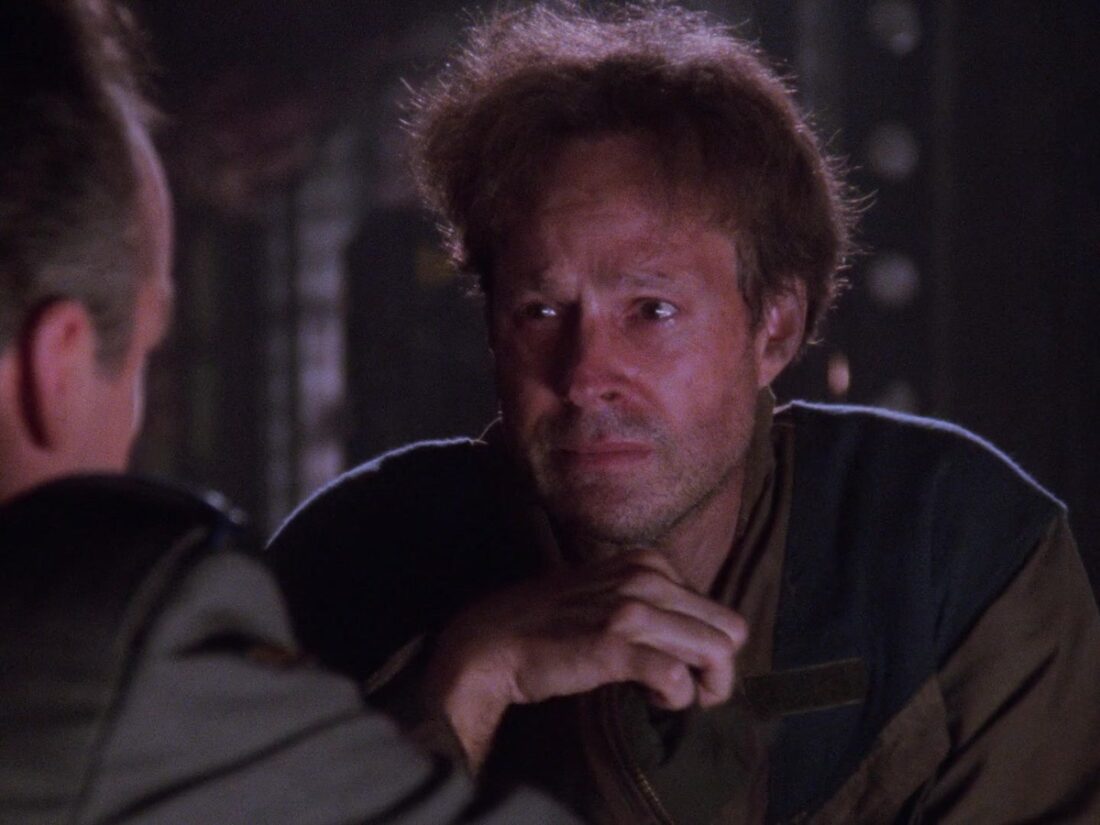
When Amis wakes up, he’s much more rational—but he has no memory of the incident, which he says is not unusual. Garibaldi lets him go, offering a counselor.
Franklin saves the woman and does an autopsy on the corpse. The organs have been removed, which indicates that he was murdered. The woman wakes up, identifying herself as Mariah Cirrus. Her husband is Will Cirrus, and they volunteered for this mission. She’s stunned to learn that a century has passed since they launched, and even more stunned to learn that her husband is dead.
Amis finds himself wandering to the Copernicus, until security chases him out of the loading bay.
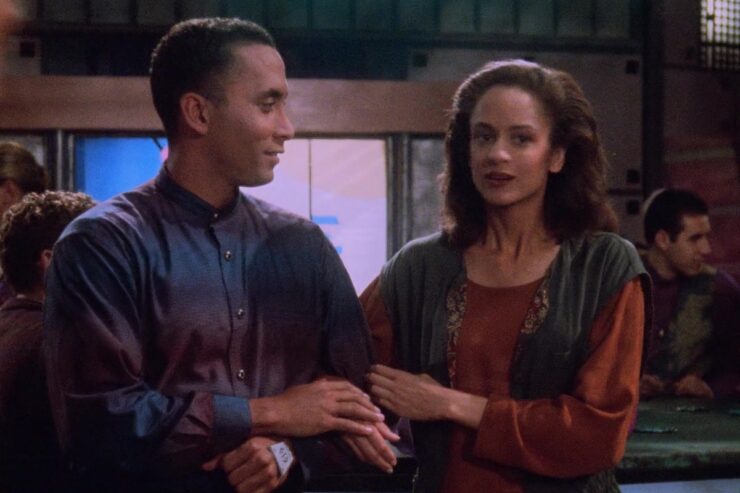
Franklin shows Mariah around the station, filling her in on the high points of the last hundred years, including the successful war against the Dilgar and the inconclusive war against the Minbari. He introduces her to G’Kar, who informs Mariah that she’d be better off back where she started a century ago. This prompts a hallucination, as Mariah sees images of herself in her tube with something looming over her. She passes out, and wakes up in Franklin’s quarters, because, he says, they were closest. Uh huh. The two of them almost kiss, which is howlingly inappropriate, with Mariah suddenly announcing that she and her husband were having problems. Franklin awkwardly says she needs rest and she lays down on the couch.
Amis once again starts ranting in the Zocalo, saying that the Copernicus brought a “soldier of darkness” to the station, one he’s faced before. Amis was with a unit that was wiped out on a small moon during the war, with Amis the only survivor. Even as Garibaldi tries to calm Amis down, a lurker in downbelow is attacked and killed.
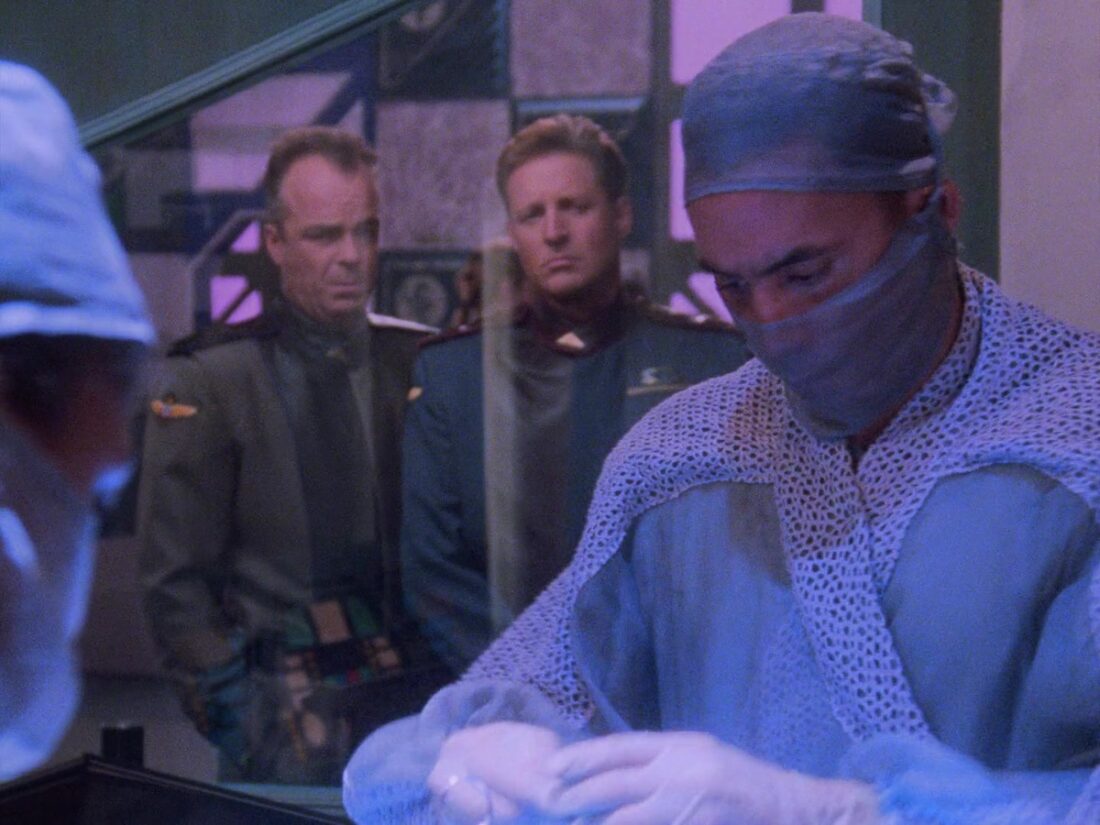
Franklin’s autopsy reveals that the lurker was killed the exact same way as Will. Meanwhile, Garibaldi has determined that the Copernicus passed within the gravitational pull of the very same moon where Amis’ unit was attacked. Franklin has an alibi for Mariah’s whereabouts when the lurker was attacked, which amazingly doesn’t get him reprimanded, but Sheridan insists on a 24-hour watch on her, just to be sure.
A council meeting is called, and the Markab ambassador explains that they think a soldier of darkness has been brought by the Copernicus. A great darkness was defeated long ago, and it is now marshaling its forces for a return. Mollari dismisses the entire notion; G’Kar is genuinely interested in what the Markab have to say; Sheridan doesn’t know what to think, but promises to do everything he can to make sure there are no more murders.
Garibaldi decides to use Amis to lure the creature. Amis explains that the creature left him alive to torment and feed off him. Amis runs away from Garibaldi, hoping to lure the creature where it can’t hurt anyone.
Mariah says that whatever she’s been hallucinating is something that fed off her—and now is feeding off the people on B5. Garibaldi then asks her to do what he wanted to do with Amis before he buggered off, and she agrees to try to find it for him, with Franklin tagging along.
There’s weapons fire in Brown Sector, and our heroes are able to stop the creature—who is tormenting Amis some more—by a crossfire of PPGs.
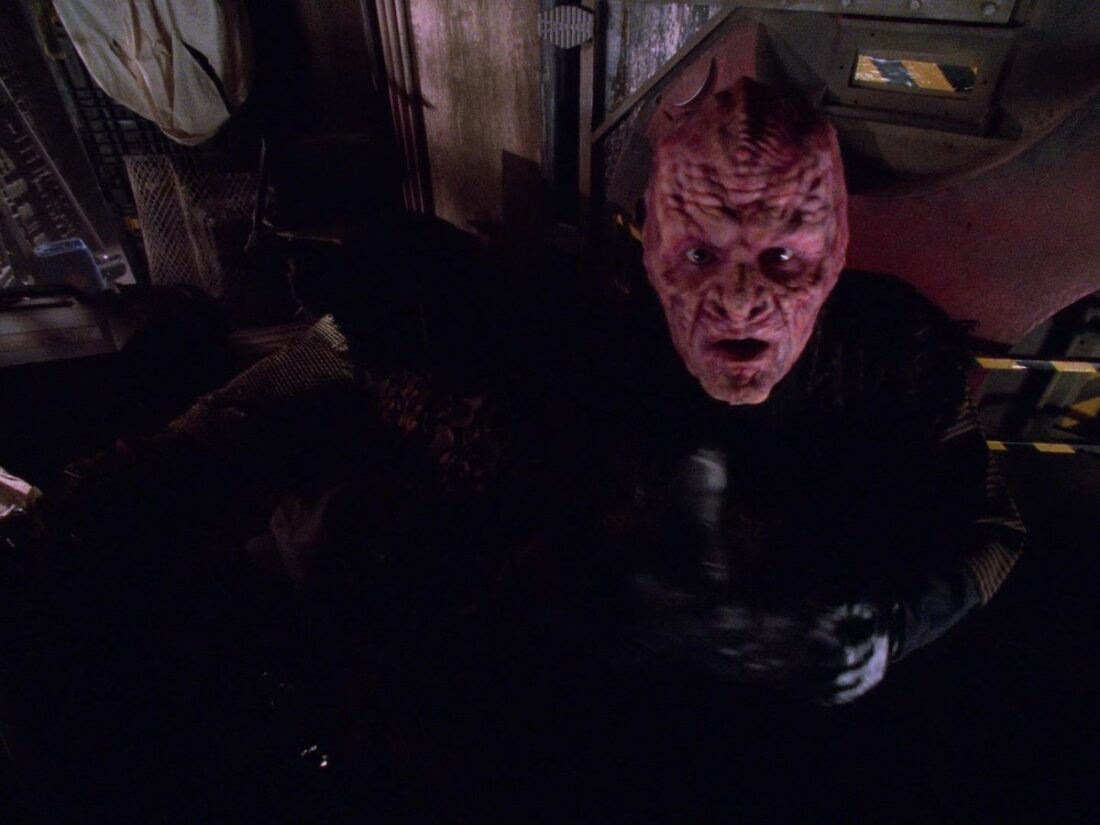
Amis survives, being treated in medlab. Mariah decides to return to Earth to grieve and get her life back together. Ivanova investigates and discovers that the soldier of darkness changed Copernicus’s course to Z’ha’dum. However, when it came proximate to B5, the ship’s automatic programming took over and changed course to a human facility.
We close on G’Kar looking at a passage in the Book of G’Quan, which includes an image of the soldier of darkness.
Get the hell out of our galaxy! Sheridan, dork that he is, recognizes the hundred-year-old ship for what it is.
The household god of frustration. Apparently Garibaldi fought in the Earth-Minbari War as a ground troop, a fact that has somehow managed not to come up at any point prior to this.
In the glorious days of the Centauri Republic… Mollari’s entire attitude toward both Amis’ rants and the Markab claims is disgusted disbelief, which is disingenuous, to say the least…
Though it take a thousand years, we will be free. G’Kar is sure that he’s starting to get a line on the ancient foe that’s coming back. He’s also spectacularly rude to Mariah, and he quotes Yogi Berra while being so. (“The future isn’t what it used to be.”)
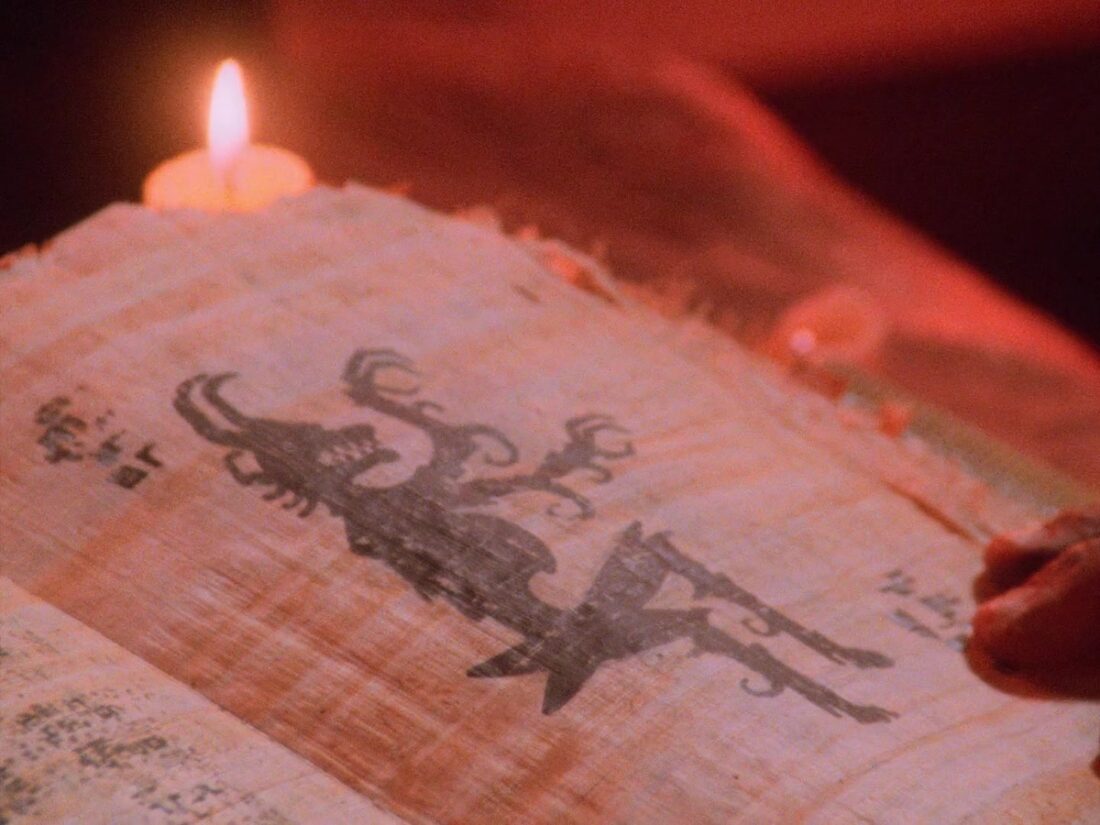
The Shadowy Vorlons. Apparently, the Shadows have helpers who’ve been just hanging out waiting for the call home…
No sex, please, we’re EarthForce. Franklin is creepily lusting after Mariah from jump, starting with his stroking her hair in a manner that is not medical before she even wakes up.
Welcome aboard. Anne-Marie Johnson is blandness personified as Mariah, but the big guest here is the great Dwight Schultz—best known for his roles as “Howling Mad” Murdock on The A-Team and as Reg Barclay on various Star Trek productions, and who lately has been doing a ton of voice acting work—giving us his usual fine job of portraying a complex crazy as Amis.
Trivial matters. G’Kar has been concerned that an ancient enemy mentioned in the Book of G’Quan is returning, as seen in “Revelations.”
This is the first mention of Garibaldi’s past military service.
This is the only script for B5 by Scott Frost.
We see a Drazi in the Zocalo, but he is not wearing a purple sash for some reason, as per the events of “The Geometry of Shadows.”
The echoes of all of our conversations.
“I have walked in the valley of—”
“Good! Keep on walking!”
—Amis trying to preach to G’Kar and G’Kar refusing delivery of same.
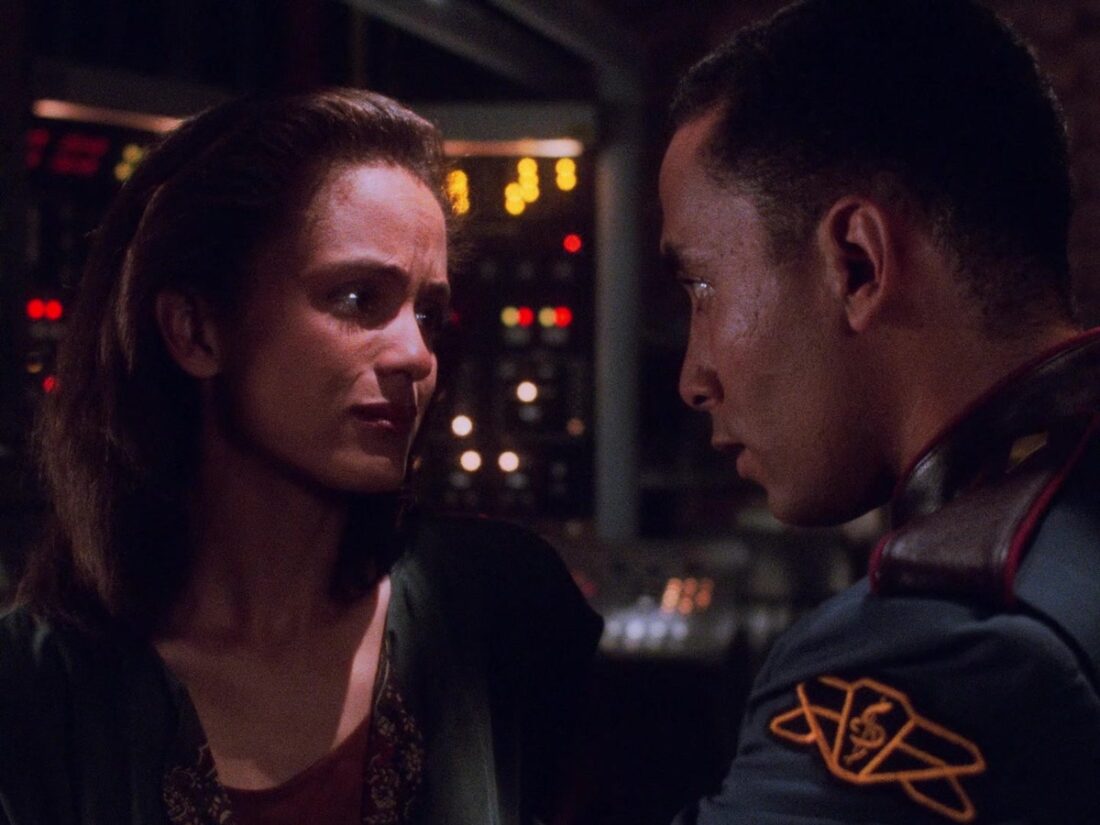
The name of the place is Babylon 5. “Evil sometimes wears a pleasant face.” I’ll take “Episodes That Have Aged Really Badly” for $1000, Alex…
Seriously, I felt like I needed a shower after watching the episode. It started with Franklin stroking Mariah’s hair while she was unconscious in medlab, and it just got worse and worse, from him taking her to his quarters while she was unconscious when there’s a perfectly good medlab to bring her to, to the kiss and then letting her stay overnight in his quarters. There is nothing ethical in any nanosecond of Franklin’s behavior, and a lot that is creepy and oogy, and I found myself for the second time in this rewatch (after “Believers”) wishing that someone would report Franklin to the EarthGov equivalent of the AMA. Not aiding this disaster is a remarkably charisma-free performance from Anne-Marie Johnson.
Also at this point I’m suffering from some serious foreshadowing fatigue. This is the sixth episode since we started getting warnings about a coming darkness in “Chrysalis,” and I find myself feeling like I’m in a Monty Python sketch where they cut to a crowd that shouts, “GET ON WITH IT!” The Markab ambassador this episode is just the latest, after Delenn, Lennier, G’Kar, and Elric—everyone’s just so sure there’s this nasty-ass thing coming, so you’d think we’d have more information. I know that J. Michael Straczynski is never happier than when he’s fulfilling prophecies, but I find myself growing incredibly weary of the portentous dialogue promising awful things at some vague future point.
Luckily, the episode is redeemed by a typically brilliant performance by Dwight Schultz as Amis. Schultz has always been able to manage a perfect combination of subtle and over-the-top and somehow making it work, and Amis is a particularly strong example of Schultz’s strong suit. Amis is at once ridiculous and tragic, and Schultz absolutely nails it.
Next week: “A Spider in the Web.”


I feel like the warnings about the gathering darkness are particularly silly in this episode, because the entity is being summoned Z’ha’dum and apparently it’s best strategy is to hijack a sublight spacecraft. Do they ever even address how the ship got all the way to Babylon 5 within a hundred years?
The ship passing near a moon the creature was hiding (the same place Amis was posted during the war). Then the creature got on the ship somehow and reprogramed the ship to take it to Z’ha’dum. It got redirected to Babylon 5 because the ship had been preprogramed to change course if it picked up any type of signal that could be from intelligent life.
Basically the ship had been coursing through the galaxy hoping to come into contact with alien life,
Great point. Even assuming the entity won’t die of old age, it’s kind of funny to imagine what would have happened if it had “succeeded.” “Okay guys, it took me hundreds of thousands of years, but I’m finally here at Z’Ha’Dum, let’s do this thing!!!” *looks around* “Where is everybody?”
B5’s location will eventually be established as the Epsilon Eridani system, which is only ten and a half light-years from Earth. That makes it kind of implausible that it’s in neutral territory, but it makes it very easy to explain how a sublight interstellar ship from Earth could’ve drifted there in 100-plus years.
I think having humans pop up in the middle of contested space where all the local powers grind up against each other fits with what we know of their contacts and conflicts in the relatively recent past. It also helps explain the other species buy in for Babylon 5’s use as a convenient collective bargaining table.
One of the things that’s kept vague in B5 cosmology is whether hyperspace maps exactly onto regular space or not. If the relationships are variable it’s possible that something ten and a half light years from Earth is “farther away” (in terms of hyperspace travel time) than something fifty or a hundred light years away.
If it mapped exactly, it wouldn’t be so hard to navigate in it. But I think it’s just a case of not working out the astronomy consistently, something Star Trek has also frequently been guilty of.
As somebody who has only recently tried to puzzle out which star of the Constellation Pegasus makes the best anchor for a ‘Pegasus Sector’ (Allowing for the fact that, according to the rules of Imperial sectors in the WARHAMMER 40,000* setting, any star within 200 light years of Earth falls within the ‘Sector Solar’ instead) I can only sympathise with fellow filthy casuals trying to make sense of Interstellar Directions.
*Before you ask, NO, I most certainly was not brave enough to try puzzling out how 38,000 additional years of life history would affect the constellations, for I am a HISTORY nerd and not a mathematics/astronomy nerd (Also, did I mention being a Filthy Casual?).
Franklin is just so skeevy here. It’s been 30 years, but I’m pretty sure I thought so then, too. The way their relationship develops after Mariah wakes up is problematic, but you can see how it could happen. That hair stroking, though. Yikes. And the camera lingering on it makes it even worse.
But Dwight Schultz is great, though I’d like to have seen him in a role that would let him come back. There are really only two actors who do what he does better: Brad Dourif (who we’ll see later) and Bruce Dern. That’s excellent company to be in. Also, since JMS loves his Easter eggs, I wouldn’t be surprised if Amis is a reference to Kingsley Amis, whose New Maps of Hell was one of the first critical examinations of science fiction in the mainstream.
On another note, I’ve been noticing Ivanova’s hair. In the first season, she kept it in a tight braid whenever she was on duty and let it down on the rare occasions we saw her in civvies. In the first four episodes this season, she’s worn it loose at all times, though combed back when she was on duty. This time, she had it pulled back fairly severely while in uniform, but gathered loosely in a sort of ponytail tied up into sections (despite having three daughters, I have no idea what to call it). I don’t know if this is telling us something about the character, but she does seem more at ease with herself and her position, not so tightly buttoned down.
The Script Book version of this script does not include the hair foldle. Franklin comforts and holds but never tries to initiate a kiss. So I suspect the director (who did come back twice next season) was responsible.
Writer Scott Frost does claim the mystery works (including the possibility Mariah is a salt vampire or something) still works, which doesn’t match my experience of the episode: Amis and his experiences in no way support the suggestion Mariah is the killer (even as a possessed/disguised killer), the actress is having enough trouble without also playing up “I might be an alien killer seducing Franklin,” and if she’s after Franklin why kill random people? Add in the “seeing something else on the ship” and how that’s handled (credibly, not as invention) and there’s not much mystery here unless for some reason “invisible alien” never enters your mind.
Franklin’s arrogance and interest in women might almost make this story work, but not quite, even upon first airing. One might just maybe excuse it all as Franklin in the early stages of addiction and having reduced self-control, but the script has no inkling that plot is going to happen.
Also possibly more at ease with Sheridan (with whom she has more history) than Sinclair.
—Keith R.A. DeCandido
As an aside, Ivanova did wear her hair loose at the Centauri festivities in “The Parliament of Dreams” even though she was in uniform.
What never made any sense to me with this episode is how the ship got where it was without Gate technology.
‘Very, very slowly’ seems the obvious answer.
The bit that bugged me was how the Copernicus was investigated solely by the opening credits characters. At the very least, they should have brought along a couple of orderlies to help bring in any potential patients and maybe a redshirt or two in case matters turned violent.
No “Ivanova is God” snippet? I’ll supply one by noting her successful use of Percussive Maintenance.
Personally, I would consider Londo dismissiveness about the soldier of darkness being more ironic than disingenuous.
A couple of riffable moments:
“An army of the dark, soldiers of the devil. Something like that.”
Dogs and cats living together, mass hysteria!
Garibaldi: How did you survive?
Amis: I didn’t!
You see dead people.
(As an aside, when I introduced my brother to B5, he thought at first that Garibaldi was being portrayed by Bruce Willis)
AGH! I forgot the percussive maintenance! I blame fatigue from New York Comic-Con…..
—Keith R.A. DeCandido
There’s an episode of Moonlighting near the end of its run where Bruce’s character is imprisoned so the show opens with ABC trying to find a replacement and there in line to audition is Jerry Doyle. It made me laugh when I rewatched the series when it came to Hulu.
Bobby
I always smile when I see the effect of shooting the soldier of darkness looks so much like shooting the invisible creature in Forbidden Planet. I assume that’s an intentional homage. Always steal from the best :-)
Of course, it’s not the only B5 nod to that movie – like the design of the Great Machine down on Epsilon III.
What is it with SF stories and Epsilon Eridani III anyway?
The Power of Alliteration, my dear fan!
Epsilon Eridani is a nearby star that’s a somewhat plausible candidate for having planets, so it gets used a lot in fiction, the same as Alpha Centauri, Tau Ceti, 40 Eridani, and the like. And it’s no surprise that multiple fiction writers would gravitate toward assuming a star’s third planet would be the inhabited one, by analogy with our own system (since most of them wrote before exoplanet discoveries showed how unusual our system’s arrangement is).
Also, did we mention the alliteration?
That would be easier to buy if B5 ever actually called it Epsilon Eridani instead of just “the Epsilon system,” which makes about as much sense as referring to New Mexico as “the New state.” I’m pretty sure the star system’s full name was never specified in onscreen dialogue, only in behind-the-scenes materials.
I wonder if that’s because “Eridani” is a damn hard name to pronounce? I hardly know anyone who gets it right (though admittedly, it’s not a terribly common thing for people to try to pronounce). “Eriadni”, like Ariadne, seems the most common error.
The most common error in my experience is people pronouncing it “Air-a-donny,” when it’s actually more like “Eh-riddany.” I don’t think it’s hard to pronounce at all; seven letters, three syllables, commonplace sounds. It’s just that most people don’t learn the pronunciation and make the wrong guess.
Part of me was anticipating today’s rewatch just to see people’s reactions to Franklin’s story. If there is one thing I’ve learned from the Trek rewatches over the past decade is that stuff like Geordi/Leah Brahms has aged spectacularly poorly, and I knew “The Long Dark” would be the candidate for picking B5 apart over social, professional and gender politics.
Season 2’s first and possibly only real misfire. The whole plot of the soldier of darkness feeding off of lurkers feels like a rehash from last season’s “Grail”. In fact, this feels like a warmed over season 1 episode through and through. And bringing in a former Twin Peaks writer for this one didn’t seem to make a difference either. You can barely call this a murder mystery and there is none of that weirdness and surrealism that permeates that show, which could have helped to make this one stand out more. Then again, he probably didn’t have much room to work with and make more of a contribution, depending on how Straczynski’s outline and guidelines were.
And while it is kind of a crucial piece of the arc – setting up that the Shadows have outside helpers (like the Drakh later on) – it definitely feels like the show is spinning on its wheels with this one, reiterating stuff we already knew from past episodes.
I like the concept of pre-jumpgate ships getting lost out there and even figuring into being hijacked for places like Z’ha’dum. But as pointed out, Mariah is such an uninteresting character played so blandly by the actor that this the one episode that could potentially put me to sleep. And Biggs doesn’t come off any better either. Franklin’s behavior aside, it also looks like Biggs phoned it in this week, even though it’s supposed to be his episode. And I don’t buy their “chemistry” for one nanosecond (at least LaForge and Brahms had some – Franklin and Mariah feel more like TNG’s “Aquiel”).
There are redeeming factors in this one, thankfully. Amis is a memorable one-time character who you truly buy as a mentally broken war veteran turned lurker. Schultz really makes him come alive and you once you get past the shouting in public, you understand just how much pain and suffering he’s been through (I thought for sure he was going to die – I’m glad he didn’t). This in turn makes Garibaldi useful in the story, given he is the one Earthforce official who’s been on the dumps and who’s capable of identifying with both the broken ones and the common working folk, bonding with them.
I’m also a big fan of the council scene where things start to get ugly with the Markab ambassador making outright threats and Sheridan biting right back at him, condemning any such attitude. This would have probably played a little differently, had this occured with Sinclair in charge. Sheridan is a lot less diplomatic and unwilling to put up with histrionics.
Biggs had a severe hearing impairment and has a lot of scenes with Mariah’s actor this episode. It’s possible she wasn’t available (or interested) in a lot of rehearsal so that he wasn’t as comfortable as he might have been; hard to say. It’s possible Biggs didn’t much like creeper Franklin and it’s obvious the “romance” exists as a red herring for the mystery so it isn’t even about Franklin. The focus is on two side characters and a monster, not the regular cast, and that makes this a clunker of an episode.
In addition to Grail, it also reminds me of Infection. Actually when I come back to the series after several years, I have to ask myself “Is the one with David McCallum as the unethical scientist and a soldier of darkness? Or is this the one with Dwight Schultz being crazy and Dr. Franklin being creepy and a soldier of darkness.” for both episodes. Yes, this is a low point for season 2 and would be down the list for season 1.
This one is probably the worst episode yet. Even just a few minutes in, I was thinking “This is terrible.” I don’t share Keith’s high opinion of Dwight Schultz’s acting; I’ve always found him far too broad and artificial a performer (I find his performance style and mannerisms to be uncannily similar to William Shatner’s, except his normal mode aligns with Shatner at his most stagey and exaggerated), and this script played into his worst excesses, making it come off as more farcical than ominous. It didn’t make the rather insubstantial and silly monster story any better.
As for Franklin and Mariah, it was common enough back then to do stories about doctor-patient romances, but Richard Biggs and/or the director make it incredibly creepy with Franklin pawing at Mariah from the get-go. If you pay attention to the scene in his quarters, the dialogue gives the impression that Mariah’s the one who initiates the near-kiss; Franklin pulls back and says it’s inappropriate. But as performed, Franklin’s the one being disturbingly physically forward toward Mariah and initiating the move toward a kiss, which makes his line about its inappropriateness come off as deeply hypocritical. So I think the performance and directing made it worse than it was in the script. It just reinforces my opinion that Richard Biggs was not a good actor.
As for Anne-Marie Johnson, I always found her rather attractive, but I agree she was rather bland beyond that — except for her really hammy overacting when Mariah learned her husband was dead.
Also — space is big. Really, really big. As I mentioned in an above comment, B5’s star system is only ten-odd light years from Earth, so it’s reasonable that an Earth sleeper ship could make it there, but what are the odds that, out of 360 degrees of sky in every direction, its course from wherever it was to Z’ha’dum just happened to come within broadcast range of B5? (And a correction to Keith — it wasn’t programmed to home in on an Earth facility, but on any signal source it detected, which its builders presumably hoped would be alien.)
Not only that, but why couldn’t they find the ship in their historical databanks? You’d think an interstellar sleeper ship being launched before FTL would’ve been huge news, a quest for the ages. Heck, you’d think someone a hundred years ago would’ve used a jump-capable ship to try to track them down.
*sigh*… There’s a lot of potential in a story about sublight explorers finding that technology has passed them by and they’ve been beaten to the stars by FTL ships. Sadly, this episode doesn’t do much with that potential.
Incidentally, I am really sick of the cliche of cryogenic chambers that have big transparent covers so that actors can wipe off the frost and see the frozen people inside (at least one of whom will inevitably be a mummified corpse). Thin, transparent covers are a terrible idea, because heat can get through them easily. There’s a reason why, outside of supermarkets where customers need to be able to see the products, most refrigerators and freezers have thick, opaque walls and doors. A chamber meant to keep people frozen for centuries should really be the same. The only time I’ve seen this done right was in Nolan’s Interstellar.
Also, why the hell are the doors, consoles, etc. of this hundred-year-old ship interior designed with gravity in mind when Earth doesn’t have artificial gravity even in the series present? The ship’s too small for spin gravity.
“…I find his performance style and mannerisms to be uncannily similar to William Shatner’s, except his normal mode aligns with Shatner at his most stagey and exaggerated…”
This never occurred to me before, but now that you mention it it’s all I can see. Thanks.
Wouldn’t a ship docked inside the station be subject to the station’s own gravity? I could be wrong, but I don’t recall if Franklin and Garibaldi step inside the ship while it’s outside the station rather than inside. But I’m assuming Mariah and her husband were placed inside the tubes before the ship took off, and wouldn’t come out until the ship landed at a planet.
About Johnson’s overacting, not only it’s hammy at that particular scene, but I’ve always assumed that Franklin’s line about her not being able to produce tears due to her being frozen for so long was a last-minute rewrite to compensate for the actress not being able to shed a normal tear over her character’s trauma.
The “can’t cry” bit is in the script in the Script Book and I assume is meant to heighten her trauma and guilt.
Can also confirm that Franklin does NOT initiate the kiss and the script specifies she leans into him for it, so given how unenthusiastic Biggs is here I’m going to guess the director is to blame. His other episodes are “All Alone in the Night” and “And Now For A Word,” so I’m guessing he was brought in for the technical scenes and cinematography (he has more credits for the latter); three episodes and out seems to match the talent on display here, which is OK to good with effects and creepy lighting and not so much on good performances from actors.
“Wouldn’t a ship docked inside the station be subject to the station’s own gravity?”
That’s exactly the point. The ship wasn’t meant to be inside the station, it was meant to be in deep space. So its interior spaces and equipment should have been defined with free fall in mind, and the fact that the set designers approached it just like an ordinary set under gravity was an oversight.
Yeah, that makes more sense. The question then is whether the set designers were following the script, or were working under a deadline, or maybe the episode’s director determined how the set would be arranged. I noticed Mario DiLeo didn’t make it past season 2, which makes me guess that Straczynski wasn’t pleased with his work.
This is one I usually want to skip during my rewatches. While I don’t find the reinforcement of the foreshadowing to be as egregious as Keith does – and it does serve to emphasize that the Shadows have followers that gather to them, a concept important later on – I prefer a version of B5 where the subplot with Franklin and Mariah never happened. It never should have happened in the first place.
Also, I could have sworn that we already knew about the fact that Garibaldi was a veteran of the Earth-Minbari War. Not the specific role he played, perhaps, but that he was involved in some way.
“Survivors” established that Garibaldi was 37, so he would have been in his mid-twenties when the war began, a prime candidate for enlisting or being drafted.
You are correct. When Sinclair and Garabaldi have a heart to heart at the end of Infection, Garabaldi says, “We were both in Earthforce during the war. I wasn’t on the line, but I did my share. I know a lot of guys who came out of the war changed. Some came out better, some came out worse,” which ties in pretty well with his empathy here. Only the fact that he was a ground pounder is new information.
Thanks. That scene from “Infection” was what I had in mind. I just wasn’t sure of the episode.
Why are the sleepers always humans in these stories? Surely other civilizations might have tried the same gambit. It might have played better if, say, we had some century old Narn and G’Kar had to catch them up on current events.
This is also, I believe, the first appearance of the euphemism that somebody “missed” the war, uttered by Garabaldi’s subordinate who looks old enough to have been military age a decade ago. It was a conflict that represented an existential threat to the human race and there was even a planetary draft; presumably by that, he means that he worked pretty hard to not be part of the conflict, because he surely could have chipped in if he wanted to. People who sat out the war, why they did so, the implications to their lives, etc., is kind of a fascinating line of questions given the sheer stakes of the conflict. Alas, this won’t really be explored.
I seem to recall Malcolm saying roughly the same thing during “The War Prayer”. It always comes across as super-disingenuous and a way to make certain characters look bad.
“Missed” is pretty ambiguous. Maybe he worked in a data center on Earth, or a shipyard. I had an uncle who spent WW2 watching a radar screen in San Francisco. He had a lot of conflicted feelings about that.
“Why are the sleepers always humans in these stories? Surely other civilizations might have tried the same gambit.”
By coincidence, I saw an episode that did that just yesterday, episode 4 of Blake’s 7, where the crew recovers an alien capsule with sleepers who turn out to be intractably violent and attack the crew. That one also used the standard cliches — wiping the frost off the glass, seeing that one of the occupants is dead and mummified — but I forgot that the tubes actually had opaque covers over the clear walls, which makes their design more plausible than usual.
Come to think of it, the movie Lifeforce had frozen aliens too, though they were space vampires. I’m sure I’ve seen examples where the frozen aliens aren’t murderous monsters, but I can’t think of one offhand.
As for the guard who missed the war, maybe he came from a distant colony that wasn’t involved in the fighting.
“I’m sure I’ve seen examples where the frozen aliens aren’t murderous monsters, but I can’t think of one offhand.”
Space 1999., the episode Earthbound. The guest characters were benign, enlightened space travellers. They also travel in clear pods, although that is a design choice on the part of the Anderson’s to emphasis the ‘memorability’ of that final scene.
My suspicion is that the resemblance between being placed in cryogenic suspension and being entombed tickles some part of the brain that says ‘Horror Movie’ (Despite there also being Fairy Tale parallels that one could reasonably tap into).
Hmm, yeah, I guess that could be a factor behind the Inevitable Mummified Corpse Under Glass, though that’s mainly an exposition device to illustrate that the sleepers are centuries old.
In Hitchhiker’s Guide, most of the occupants of the Golgafrincham B Ark were in cryogenic sleep during the voyage, but it’s questionable whether they should be counted as aliens or humans, given how that story turned out. Certainly they qualify as another civilization, at least.
In the original script, novelization, and comic adaptation of the 1988 movie Alien Nation, the Newcomer occupants of the alien slave ship that crashlanded on Earth 3 years before the film’s events were in cryogenic suspension during transit, though this was not mentioned in the final cut of the film, and the subsequent TV series (set in a distinct continuity) depicted them as awake and active aboard the ship.
I found Dr. Franklin’s behavior towards Mariah creepy. The woman just woke up from a hundred year sleep and just found out her husband is dead. I’m like why are you hitting on her? I had to make my self set through the episode.
In real life, there is no way in hell any of the senior command staff would led an investigation if an unknown spacecraft showed up at there doorstep. That job is for your suburbanites. I know it’s a tv show. And the show had a limited budget. So yeah the main characters are going to everything.
My favorite part of the of episode was Sheridan telling the ambassador he wasn’t going tolerate them harming Mariah just because they believe she brought some great evil with her to station.
And Garibaldi treating Amis with compassion was another part I liked about the episode.
“Dr. Franklin makes some ethically questionable decisions.”
In other news, outer space is cold.
Loved me some Richard Biggs but wow is Dr. Franklin the king of ethically questionable decisions.
Someone mentioned this feeling like a Season 1 story, which was exactly my reaction. After four pretty good episodes, we’re right back in B-movie territory. The only thing about the monster plot that I thought was fun to watch was Dwight Shultz. I wouldn’t call his performance “brilliant,” but at least he’s never dull. Unfortunately, the same cant’ be said of the “romance” plot. It goes without saying that it’s offensive. But even worse, it’s boring. I remember liking Anne-Marie Johnson on the TV series In the Heat of the Night, but she doesn’t have any chemistry at all with Richard Biggs, which just makes their scenes together feel all the more uncomfortable to watch.
I think a lot of the repeated foreshadowing was because this was a serialized show in the pre-streaming era when if you missed an episode you couldn’t just download it later. Maybe you could catch it several months later, in reruns, if you were lucky. So if there was Important Information it had to be repeated over a few episodes for the people who missed one.
I wonder how many people had VCRs by that time? But even then the casual viewers might miss an episode or two.
There was nothing worse, especially in later seasons, than having a major episode pre-empted in your region and having no idea when (or if) it would air instead. I missed “Messages from Earth” during first-run for that very reason, for example.
They also aired episodes in blocks. So “Revelations” wasn’t just a couple weeks earlier; it was a few *months* earlier. Which meant that the reinforcement of the foreshadowing in “The Long Dark” was very useful in that context.
You’re both right. B5 got kicked around to any random time slot, but VHS was all over the ’80s and ’90s.
Well, in the ’80s it was a toss-up between VHS and Beta, which was actually superior in quality but lost the marketing war.
“Superior in quality” in some respects yes, but a VHS tape could hold more programming. Most betamax tapes could only hold an hour – which meant most movies were two or three tapes which got really impractical.
Not so. There were Beta cassettes that could hold as much as 5 hours on extended play:
https://en.wikipedia.org/wiki/Betamax#Tape_lengths
I actually still have an L-750 Beta cassette (maximum 4 1/2 hours). I once taped a marathon of both Kirk Alyn Superman serials, but it was over 8 hours, too long for one VHS tape, and I think it was on overnight, so I wouldn’t have been up to switch tapes in the middle. So I recorded roughly the first 4 hours on our Beta VCR and the rest on our VHS with some overlap, and I always planned to dub the Beta half onto a VHS tape, but I never got around to it for some reason, yet kept the tape for some other equally unremembered reason.
Wow, how quickly people forget. VCRs came into common use in the 1980s. By the ’90s they were pretty much ubiquitous.
@ChristopherLBennett, We don’t have to like, but we’ll just have to accept we’re getting to the point where our fictionalised counterparts would be wearing comically-oversized spectacles and dropping the word “new-fangled” into serious conversations (At least for the purposes of TV comedy).
Heck, I’ll bet half our fellow commentators probably can’t even remember the days when you had to tear those perforated strips off your print-outs!
Yes, VCRs were in common use, but the show’s syndication schedule meant it didn’t air consistently in local markets and was sometimes pre-empted, so it was still plausible even a big fan might miss a few episodes if they lived in the wrong place.
Syndicated shows usually did stick to a consistent schedule within a given market. There were occasional exceptions, just as there were for network shows, but there were several ways for viewers to find out about them. TV schedules were published in newspapers every day and in Sunday inserts for the week ahead, and of course the weekly TV Guide magazine was available at every supermarket and newsstand. Also, TV stations would air commercials promoting upcoming episodes and announcing their airtimes.
If a syndicated show was pre-empted from its usual time slot, the station would still be obligated to air it within its release week (I think they had to pay a fine if they didn’t), so it would simply be moved to a temporary slot that week, either late at night or maybe on a weekend afternoon, and the move would be announced in advance. If people tuned in at the expected time and found the regular show pre-empted, there would usually be an announcement or caption at the start of the time slot letting them know when it would air instead, so they could program their VCRs or arrange their viewing schedules in advance.
So you’re really exaggerating the likelihood that people would miss an episode. That would’ve been the case in the ’50s-’60s, sure, when reruns and syndication were less common and home video wasn’t a thing yet, but it’s not a valid argument to apply to the ’80s-’90s. My recollection is that I rarely missed an episode of any of my prime-time shows back then. Even if my local station in Cincinnati pre-empted an episode for some reason (for instance, a particularly racy episode of War of the Worlds: The Series that my local station refused to air), I could just tune in a fuzzy broadcast signal from Dayton 50 miles away. Heck, for years that was my only way of watching Deep Space Nine and Voyager when we didn’t have a local station that carried them; there were a ton of episodes I never saw clearly until syndication years later.
I would say it depended very much on the market. I was at college during the majority of B5’s run, living in rural southwest Virginia, and communication about the shifting of pre-empted shows was poor. It was very easy to miss a show that was moved because of sports or something similar. And while it rarely happened to a show like, say, DS9…the PTEN block that included B5 was treated with much less care.
When I would be back home during breaks, in the Philly broadcast area, it was far more reliable.
I missed episodes of shows fairly often, even with VHS. Sometimes I forgot to set up to tape it, sometimes it conflicted with a show someone else wanted to tape, sometimes the power went out and erased the settings. Also, while TV Gude was available, we almost never bought it
We never bought TV Guide either, but we didn’t need to, since the Sunday paper had a TV-listings insert with the same information, and there were nightly schedules in the daily papers’ art and entertainment sections.
One of the few times I remember missing an episode, it wasn’t a syndicated show, it was CBS’s The Flash, the episode “Good Night, Central City.” At exactly the wost possible moment, after a gun had gone off between two fighting characters and before we found out who had survived (it was easy to predict, but still), there was a cutaway to a special report about President Bush being hospitalized for what turned out to be a minor heart issue, and even though it was clear right away that Bush was in no danger, Rather still spent nearly the rest of the hour talking about it. And I think the show was pulled from the air before they reran that one, so I didn’t see it in full until it was syndicated on The Sci-Fi Channel.
One other time I missed an episode was Batman: The Animated Series: “Shadow of the Bat, Part 1,” which I missed because I was out with my best friend and lost track of time. But my father, who wasn’t a regular viewer of the show, very considerately watched it and summarized it for me when I got home. (I don’t recall why he didn’t tape it.)
I’m not going to lie, any C/O with the name ‘Sheridan’ who misses the coffin-sized ‘GOTHIC HORROR’ warning sign on this whole scenario (Even if Sheridan, rather than ‘Le Fanu’ is his surname) deserves to be dope-slapped by the closest occultist.
On a more serious note, Doctors Seward and Van Helsing, despite being an unreconstructed Victorian madhouse owner-proprietor and slightly-looney Renaissance Man respectively, show a keener sense of medical ethics than the Science Fiction CMO in this episode – if nothing else, Doctor Seward asked his patient to marry him BEFORE Miss Lucy got sick!
Also, it’s a little sad that such a Halloween-appropriate episode shows up in your schedule this week, rather than next: ah well, such is life!👻
On a genuinely-serious note, while Garibaldi’s war service as a grunt in the Earth-Minbari War has never previously been mentioned, it does make sense that an EarthForce security chief would have a military record … and if any wartime experience is likely to drive you to drink, it’s serving as a Ground Pounder in the sort of war that involves Death from the High Orbitals.
This is the first mention of Garibaldi’s past military service.
Garibaldi’s actively serving in the military right now. (He’ll give his rank as a Chief Warrant Officer later, I believe, and I think it’s either explicit or implicit that he wears a brown uniform because he’s in the EarthForce Marine Corps as opposed to the EarthForce Navy like Sheridan and Ivanova.) I know what you mean, but still.
the EarthGov equivalent of the AMA
Ironically I believe that at some point Franklin threatens to report someone else to the “EMA.” Presumably Earth Medical Association.
Garibaldi wears a gray uniform, like the rest of B5 security. When he was a GROPO he would have been an EarthForce marine, but he still wouldn’t have a brown uniform because he was enlisted.
I thought I had forgotten this episode, but after reading the summary, I think my mind was actively suppressing my memories of it. Franklin was completely out of line, and out of character.
I got to watching this episode only today and at the scene when the girl wakes up in Franklin’s quarters I came here to check if the rewatch is also freaking out about Franklin’s terrible behaviour. Also, Sheridan told him that he wants to talk to her when she’s OK…and instead, he takes her to some bar to meet aliens? I mean seriously WTF?
I’ve liked Franklin up to this point (i still prefer the doc from the pilot though), but this steps over so many boundaries, that it’s a 200 on the LaForge creepiness scale where LaForge was 100 or something.
I liked Dwight Schultz in TNG, but here it felt he’s bringing a very similar character to the more confused or crazy Broccoli, I mean Barclay guy and he was a bit too much. The rest of the episode was just BAAAAD, like reaaaaaallly baaad. :D
This character is far, far closer to Schultz’s “Howling Mad” Murdock from The A-Team than he is to Barclay. Either way, he did tend to get typecast as characters with mental health issues.