




Growing up, The Last Unicorn was a movie that only existed at one small video store near my dad’s house. Every other Friday, as if it were a hot date I couldn’t miss, I would run to the children’s section to see if the tape was waiting behind the display box. If some other kid hadn’t gotten to it first, and the movie was in—well, there was my weekend, all planned out.
I finally saw The Last Unicorn on the big screen almost 40 years later, when a local revival theater got hold of a 35mm reel of the movie. By then, I had kids of my own: two daughters, two little unicorns. It almost felt like a pilgrimage, showing them something that was so sacred to me as a child. My younger one wore a unicorn horn to the show. She wasn’t the only one.
When it came out in the ’80s, the movie largely flew under the radar—at least, I seemed to be the only kid at school who knew what it was—but these days, it’s hard to find a fantasy fan who hasn’t seen it. Based on the novel by Peter S. Beagle, The Last Unicorn follows the journey of a unicorn, voiced by Mia Farrow, who finds out that all the rest of her kind have vanished. As she leaves the safety of her lilac wood to find out what happened to them, she picks up some allies, falls in love, and becomes the first unicorn in the world to feel regret.
When you’re a kid, you might identify pretty hard with the unicorn. After all, a lot of kids feel an urgent need, ever-present in the back of their little psyches, to become a unicorn, or at least be best friends with one. I myself had spent many an afternoon prancing around with a torn piece of my She-Ra costume tied around my waist as a tail. Imagine my surprise, then, when I took my girls to the 35mm screening and was moved to tears by another character: Molly Grue.
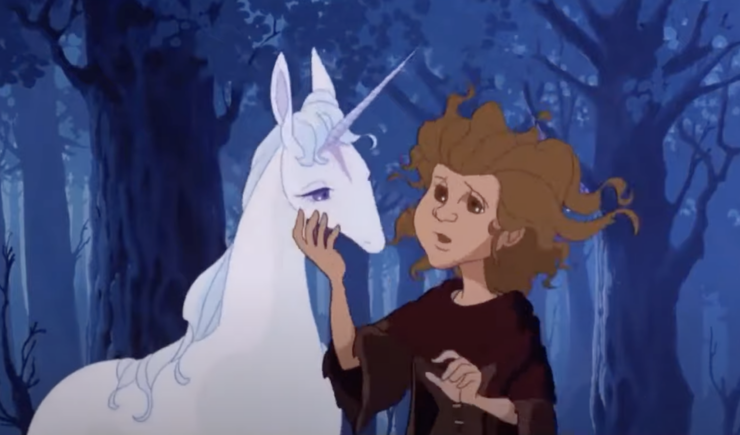
When we meet Molly, she’s a barefoot woman in a ragged dress living with the bandit Captain Cully, who fancies himself a kind of Robin Hood. Molly is middle-aged and sour-tempered. Her hair is uncombed and her soup is watery. While the unicorn has never felt regret, Molly is steeped in it, spending her days taking care of a gaggle of men who take her for granted.
Everything changes, though, when Molly meets the unicorn.
Can you recite that scene from memory? I can. Molly is following Schmendrick the Magician out of Cully’s camp when she first sees the unicorn, flashing in the wood beside him. Molly stops. She gasps. Then she lets the unicorn have it. “Where have you been?” she demands, her voice breaking. “Where were you twenty years ago, ten years ago? Where were you when I was new? When I was one of those innocent young maidens you always come to? How dare you come to me now, when I am this!” Schmendrick rebukes her, but the unicorn immediately understands where Molly is coming from. Unicorns are associated with virgins and princesses. They don’t usually show up for a woman with, as Beagle writes in the book, a “barren face, desert eyes, and yellowing heart.” If you don’t get in on the unicorn scene when you’re young, you lose your chance forever. Or so they say.
But the scene gets even more heartbreaking from there. Schmendrick fills Molly in on the situation—that this unicorn is the last and she’s searching for her kind. Molly, drying her tears on the unicorn’s mane, doesn’t seem surprised. “It would be the last unicorn in the world that came to Molly Grue,” she says. Whatever ugly things Cully has told Molly about herself, at least part of her believes him.
The scene in the book is poignant, but what makes it truly unforgettable is Tammy Grimes’ performance as Molly in the movie. In the book, we learn that Molly used to weave and sew and do other interesting things before she gave up trying to be happy; in Grimes’ voice, you hear all the pain and loss that she thought she had tamped down for good. You hear her almost wishing—almost—that the unicorn hadn’t come at all. After all, despair is easier to deal with when you can shove it to the back of your mind. When something good finally happens to you, all that hurt comes flooding back.
Ask me how I know.
Let me be clear: the life I’ve lived has been perfectly fine. I’ve spent 44 years on this earth with plenty of food, stable shelter, and all the comfort a human being needs. Yet, having been born in 1981, I got to live the full millennial experience—a disintegrating economy, disappearing opportunities, skyrocketing housing costs, and quietly fading dreams—right from the start. (I mean the very start. I was born on New Year’s Day.)
I had high hopes for myself in high school and college: I was going to be a famous novelist and teach creative writing at a university. The teaching dream was the first to go, when I discovered that all the professor jobs were being replaced by part-time adjunct lecturers. After a few years on the lecturer circuit, watching even those jobs disappear thanks to the Great Recession, I tried to find something else, but it seemed that every job I touched promptly vanished. I was excited about an AmeriCorps job in a local school district until they told applicants that the program had been canceled. My parents kept scratching their heads over why I hadn’t bought a house yet. As I write this, the average home where I live costs around a million dollars.
The writing dream withered on the vine, too, but that’s what happens to most writers. What made it sting, though, was the relentless fetishization of youth in the publishing industry. There’s the National Book Foundation’s annual 5 Under 35 list, Granta’s list of authors under 40, Penguin’s list of 15 writers under 35, and countless others—with no corresponding set of lists, that I know of, of debut authors over 35. People love young writers. People love youth, period. Meanwhile, as I missed the cutoff for list after list, my face began changing in the mirror: my eyes sinking into my face, crows’ feet and jowls forming, gray hairs multiplying. When I had kids, my writing time disappeared along with my pelvic floor.
So when I watched Molly speak those lines with my daughters sitting next to me, I had to hold my breath to keep from embarrassing myself by crying out loud. God, that scene hurt. You don’t have to experience newsworthy trauma in order to feel the pain of regret, the countless little hurts of days wasted and hopes dashed, the feeling that you’ve missed your chance at finding your unicorn.
I wondered if I was being solipsistic until I poked around the internet to find other people’s reactions to Molly. In 2024, Beagle posted an image of Molly and the unicorn on Facebook with the caption, “If you had been waiting to see a unicorn as long as I have…” The comments are filled with people sharing how much the scene touched them, how hard it hits when you realize your life is half over.
It hits even harder when your country has been taken over by fascists and the planet you live on is being cooked to death. If you’re lucky enough to spot a unicorn, it’ll probably be the last one in the world.
In 2004, Beagle published a sequel to The Last Unicorn: a novella called Two Hearts. In 2024, he wrote another novella, Sooz, that takes place in the same world, and published them two together in a book called The Way Home. In The Last Unicorn, Molly rides off with Schmendrick, and in Two Hearts, we finally catch up with them.
Buy the Book

The Way Home
It turns out that Molly’s doing pretty well. She and Schmendrick have made a life together. She’s old now—truly old, with gray hair and everything—and wise, and impossibly warm and kind. She’s the same kind of old as a venerable tree, burnished and strong because of all that she’s weathered, not despite it.
But in Sooz, we learn something unbearably sad about Molly. The young heroine Sooz, after being raped, reflects that “such things, and worse, had been done to Molly in the greenwood when she was younger than I” (that is, younger than 17). That one line changes everything we know about Molly. Her hardness in The Last Unicorn isn’t just a product of disappointment after disappointment. She’s carrying profound wounds inside of her. If anyone deserves to finally get her unicorn, it’s her.
But that’s not to say that you have to experience that level of suffering in order to identify with Molly (and remember that Beagle himself didn’t reveal that bit of information for decades). The Last Unicorn is, at its core, a story about mortality. The unicorn herself is immortal, but she’s forced, over and over again, to learn what mortality means—through her interactions with mortals and her own brush with being human. In the book, visitors to Mommy Fortuna’s Midnight Carnival pass one more creature after marveling at the unicorn: Elli, or Old Age. When Elli is revealed, the spectators back away in terror as she sings to herself, and later in the book, Schmendrick overhears Molly singing the same song:
Who has choices need not choose.
We must, who have none.
We can love but what we lose—
What is gone is gone.
But as it explores the concept of mortality, The Last Unicorn also subverts our ideas of aging—not to mention our idea of unicorns. “Unicorns are for beginnings,” Schmendrick scolds Molly in the book, “for innocence and purity, for newness. Unicorns are for young girls.”
“You don’t know much about unicorns,” replies Molly, who knows all too well that youth doesn’t guarantee innocence. Meeting the unicorn revitalizes her, and she begins to look physically younger in the way that deep healing sometimes does, until Schmendrick finds out she’s only in her late 30s. It turns out there actually is a kernel of truth in Schemdrick’s words. Unicorns are for beginnings, but those beginnings don’t have to happen when you’re young. Molly never lost her chance to see a unicorn at all. Instead, she earned it, and met her unicorn at exactly the right time. After all, if Molly had still been young, without the wisdom gained from age, she would never have been able to guide the unicorn on her quest.
Years after I’d given up on becoming a real writer, I eventually did get my unicorn: a book contract with a small press. In fact, since I had a pile of unpublished manuscripts ready to go, I got two at the same time—a feeling not unlike Molly witnessing the literal ocean of unicorns that floods the beach when the Red Bull is defeated. For weeks after I signed each contract, though, I felt nothing but fear. Was it all an elaborate scam? Was there a huge misunderstanding? Would it blow up in my face like everything else did? How could I possibly get what I wanted now, when I was this? I’m still on high alert for the other shoe to drop—especially with the current political climate, and a pointless trade war that may upend the publishing industry—but I’m slowly getting used to the idea that unicorns can show up even in barren lands.
“Times change,” says one of the hunters who enter the unicorn’s wood at the beginning of the book. “Would you call this age a good one for unicorns?” No, I would definitely not. But no age feels like an age of unicorns, and yet unicorns persist. Growing older, even in an era that’s especially hostile to hope, isn’t a slow ending or the monotone buzz of stasis. It’s the realization, over and over again, that change is constant. The moment we think we’re going to spend the rest of our lives cooking rat stew for Captain Cully—or, conversely, that we’ll be nibbling clover safe in our wood, free of attachment or regret, until the stars burn out—our lives are upended.
So, dazed and hurting, we reinvent ourselves. We shed old forms and don new guises. We steal bits of time to make our art, embark on whatever quests we’re given, and figure out how to fight back against the people who are ruining our world. We stitch up our wounds and keep going, yellowing hearts and all.

I saw The Last Unicorn in the theaters, back in the day, when I was around Molly’s age. I have quoted her “Where have you been?” speech a number of times, whenever I want to discuss age in Fantasy, or just to quote my favorite lines from TLU.
This is a lovely piece of writing about a gentle, genuinely haunting scene in a gem of a movie that has finally started to find its audience. That scene actually took my breath away when I first watched the film and is the part of the film that lingers in my memory to this day.
Ageism remains the one form of bigotry tolerated by most people in American society and I regret to inform you it only hurts more with age but the solace of true self-awareness that only age can bestow upon us is often compensation enough.
Well done.
I first read the book The Last Unicorn in the mid to late ’80s, and it immediately became one of my favorite books. At the time, I had no idea that it had been made into a movie only a few years before; I learned about the movie only many years later. I first saw the movie in early 2000s (I think) on an old black-and-white television, and then saw it in color several years later. The book still holds first place in my heart, but I agree that Tammy Grimes’ performance as Molly is very powerful.
Reading this essay brought tears to my eyes. As a man, I do not think that I can fully grasp what Molly (and so many real-life women) have experienced, but as someone now reaching their early ’50s, who has much to be thankful for, but who fears that life has passed them by (and who dreamed of writing a book someday – something that I still have not achieved), I can identify with the feeling of regret.
At the same time, the lesson of the story seems to be to not give up hope; it is not too late for each of us to see our very own unicorn.
Lovely piece … kind of like that “Best New Writers Over BLANK” idea, as well. ;)
*wipes tears from eyes* Damn, that’s good. And timely. Thank you.
Wonderful article. I saw the movie as a kid, and recently read the book for the first (!) time. Absolutely adored Molly in this rediscovery. Still have to get my hands on the follow-up stories but now I’m even more inclined to do so.
Just absolutely lovely.
I hope you don’t mind, but I sent your article to Peter Beagle 🤗
I enjoyed this piece a good bit, always having had a soft spot for Molly Grue. FYI: Poets & Writers publishes an annual 5 Over 50 list of debut authors.
Tammy Grimes’ interpretation of Molly Grue in this scene is the most soul-searing moment in the film. I watched it for the first time with my young daughter and was floored at the power and emotion in it, neither of which a child would have picked up on but was there for women. I remember having to do some hard swallowing to prevent tears as I’m not sure I would have been able to put into words why the scene affected me the way it did.
Wonderful essay. I watched The Last Unicorn when my children were young and I think I liked it more than they did. Having something that was lost return struck to the center of my heart. It remains a favorite of mine as I enter my seventh decade.
Absolutely 💯 love everything about this. I started calling it my “Molly Grue era” when I turned 40, and worked up a costume as well. It felt right having been Amalthea as a little girl. You hit it in one.
On a dark and drizzly day, you’ve got me crying into my beard. Thanks, sometimes you forget what unicorns are all about, as you go about your way. I guess I gotta start stitching up those wounds, and keep going.
Thank you 😊. The Last Unicorn was always my favorite as a little girl and now as someone older than Molly Grue.
I loved reading this. I am 53. I identify strongly with Molly Grue. And thank you for validating that we don’t have to have newsworthy suffering to be suffering. I saw the movie when it came out – I was ten. I remember jumping up and down on the bed and belting out the “I’m alive” theme song – I was 100% a fan from the beginning. I read the book later when I saw someone post a comment about the prophecy… an element missing from the film. So I read it… and it is a deep essay on time. On feeling valued. On when, finding – or being found by – that thing you really loved but never dared to want – we bloom. We bloom every step and every moment we are in the presence of the beloved. I f-ing love Molly’s tears, her messy hair, her bare feet. I feel every stone with her as she walks along… daring comfortably to touch the unicorn as they walk along. I finally dared to ask for what I want, to demand it of the universe, and I got it. I’m a mom. But there is more… I will sit with this and be brave. Thank you for this fine piece of writing. “You stayed. You stayed.”
As someone in her late fifties, I’ve spent the last two or so years writing fantasy stories from the viewpoint of an old woman, and it has been a very different experience than if the main character was a teenager, trust me on that!
This article was beautiful. Made me teary-eyed.