






I don’t want to make you jealous or anything, but at least once a year I get to teach Beowulf.
I know, I know. You probably skimmed it once in some first-year literature survey class and you didn’t like it and … friends, you’re missing out. Beowulf is amazing. There’s a damn good reason that J.R.R. Tolkien was fascinated with it his whole life.
(True story: I spent days in the Tolkien Archives poring over his handwritten translations of the poem, annotations, and lecture notes. The recent Beowulf volume put out by the Tolkien Estate does not do the professor’s work justice.)
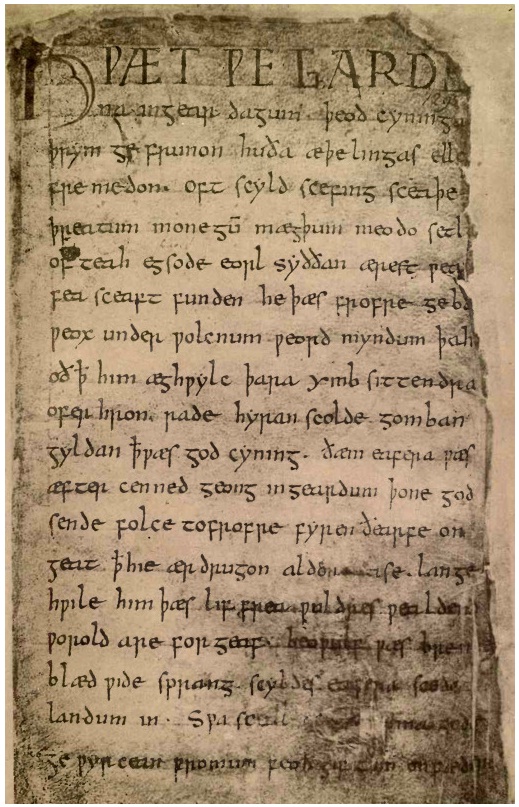
The thing is, though, that most people don’t really get how deeply and powerfully resonant Beowulf remains—over a thousand years since monks wrote our sole surviving copy of it. Unless you had a great teacher who could bring the culture alive—political and social nuances intact with the astonishing power of its verses—it’s likely that you viewed this great English epic as more of a class speed bump more than an extraordinary masterpiece.
Alas, I wish I could say that Hollywood has stepped up to fill in the gaps. Some of my colleagues might hate-mail me for this, but there are some great works of literature that are actively helped by having terrific film adaptations: the immediacy of visual presentation, along with its unpacking of action and character development, can at times serve as a bridge for people to access the text. I’m thinking at the moment of Ang Lee’s 1996 adaptation of Jane Austen’s Sense and Sensibility (starring Emma Thompson and Kate Winslet) or Oliver Parker’s 1995 adaptation of William Shakespeare’s Othello (starring Laurence Fishburne and Kenneth Branagh)—movies that are equal to the task of representing the magnificent words from which they were fashioned.
For Beowulf, no such film exists. What do we have instead? Well, below I’m going to give you a list of my top five Beowulf movies (sorry, TV, I’m looking at the big-screen here).
First, though, a Beowulf primer:
Act 1. A monster named Grendel nightly terrorizes the hall of Hrothgar, king of the Danes. Beowulf, a young hero from the land of the Geats (in modern-day Sweden), comes to Daneland and rips off Grendel’s arm. The people party.
Act 2. Grendel’s Mother crashes the party, and Beowulf goes into the mere after her. When he finds her he kills her, too. The people party.
Act 3. Fifty years later, Beowulf has risen to become king of the Geats back home, and a dragon in Geatland is awoken from its slumber when a thief steals a cup from its horde (cough, The Hobbit). Beowulf fights the dragon alone at first, then with the help of a single loyal companion defeats the beast. Alas, Beowulf has been wounded; he dies, his body is burned upon a pyre. The people mourn.
Or, to put it another way, here’s the gist from Maurice Sagoff’s Shrinklit:
Monster Grendel’s tastes are plainish.
Breakfast? Just a couple Danish.King of Danes is frantic, very.
Wait! Here comes the Malmö ferryBringing Beowulf, his neighbor,
Mighty swinger with a saber!Hrothgar’s warriors hail the Swede,
Knocking back a lot of mead;Then, when night engulfs the Hall
And the Monster makes his call,Beowulf, with body-slam
Wrenches off his arm, Shazam!Monster’s mother finds him slain,
Grabs and eats another Dane!Down her lair our hero jumps,
Gives old Grendel’s dam her lumps.Later on, as king of Geats
He performed prodigious featsTill he met a foe too tough
(Non-Beodegradable stuff)And that scaly-armored dragon
Scooped him up and fixed his wagon.Sorrow-stricken, half the nation
Flocked to Beowulf’s cremation;Round his pyre, with drums a-muffle
Did a Nordic soft-shoe shuffle.
I’m skipping whole rafts or nuance and intricacy, but this is good enough to get us started.
So, on to the film versions:
5. Beowulf (1999; dir. Graham Baker)
One of the things that screenwriters seem desperate to do is explain Grendel. This was true before John Gardner’s novel Grendel hit the shelves in 1971, and it’s only gotten worse since. Why does Grendel attack Hrothgar’s hall?
The poem, of course, makes no answer. Grendel is the wilderness, the terror of the black night, the lurking danger of what’s just beyond the reach of civilization’s light. It needs no explanation because it cannot be explained. The original audience understood this, but Hollywood folks seem altogether wary of trusting that modern audiences will. (Not just Hollywood, I should say, since Grendel was a huge turning point for what my friend John Sutton has called Beowulfiana; for more on this, check out the article we wrote together on the subject.)
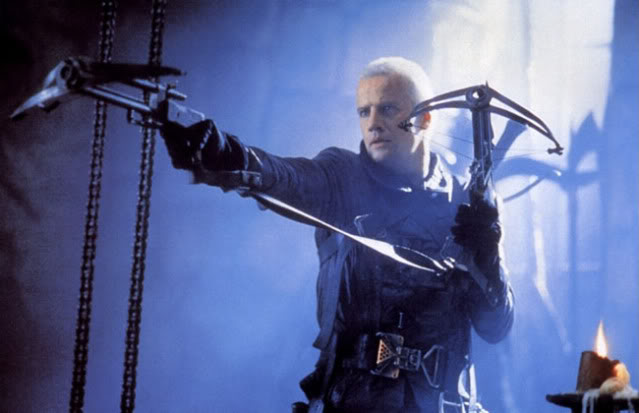
Anyway, in this post-apocalyptic retelling of Beowulf, starring Christopher Lambert as the leading man, we are given a rather inventive backstory for Grendel: he is the unwanted son of Hrothgar, who slept with Grendel’s Mother, who happens to be an ancient demoness whose lands Hrothgar subsequently took from her. Oh, and Hrothgar’s wife committed suicide when she found out about the affair, which totally removes the insightful political dynamics centered on Queen Wealhtheow in the poem.
Also, Beowulf gets a love interest in the form of Hrothgar’s daughter who is remarkably good-looking despite living in a post-apocalyptic hellscape … which the director emphasizes with several unsubtle cleavage shots.
Classy it is not.
Also, the movie completely omits the entire third act of the poem with the dragon. I’d be more mad about this if it wasn’t common to most of the adaptations.
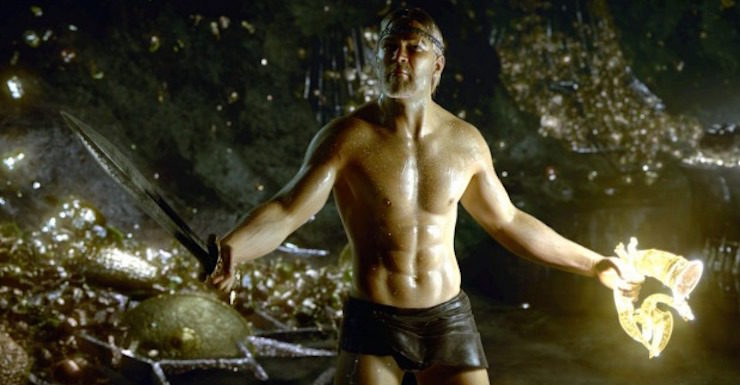
4. Beowulf (2007; dir. Robert Zemeckis)
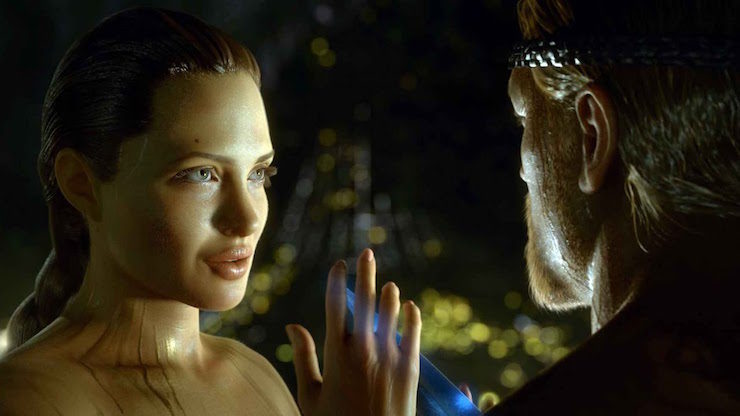
This should have been so good. The script was written by Roger Avary (Trainspotting) and Neil Gaiman (the man, the myth, the legend), the director is great, and the cast is terrific. Why doesn’t it work? Part of it is the motion-capture CGI that Zemeckis was working with (here and in Polar Express): it makes a character that is simultaneously too real and too fake, making it a go-to example for defining the “uncanny valley.”
The movie also takes huge liberties with the text. As with our previous entry, the filmmakers couldn’t go without providing some kind of explanation for why Grendel does what he does. In this case, it turns out that Grendel’s Mother is a gilded naked Angelina Jolie who is some kind of semi-draconian shapeshifter that lives in a cave. Hrothgar has sex with her (what’s up with this?) and promised to make their son his heir. Alas, Grendel turned out sorta troll-like. When Hrothgar held back on his promise, as a result, the terror began.
And that’s just the start of the textual violence. When Beowulf goes to fight Grendel’s Mother, he doesn’t kill her; instead, repeating history, he, too, has sex with Golden Angie. Yeah, it’s true that in the poem Beowulf brings no “proof” of the killing back with him, but it’s quite a stretch indeed to suggest they had sex and thus Beowulf became the dad of the dragon that plagues Hrothgar’s Kingdom fifty years later when Beowulf takes the throne. Yes, to make this work they had to collapse all the geography and thus nuke the political dynamic of the poem. Ugh.
Unfortunately, this seems to be the go-to movie for students who inexplicably don’t want to read the poem—probably because it has, as noted, a gilded naked Angelina Jolie. It’s only classroom usefulness, though, is as a good answer to students who question whether the sword can really be a phallic symbol.
(Also, you can be sure that I write test questions to deliberately trip-up students who watched this poem-in-a-blender.)
3. Outlander (2008; dir. Howard McCain)
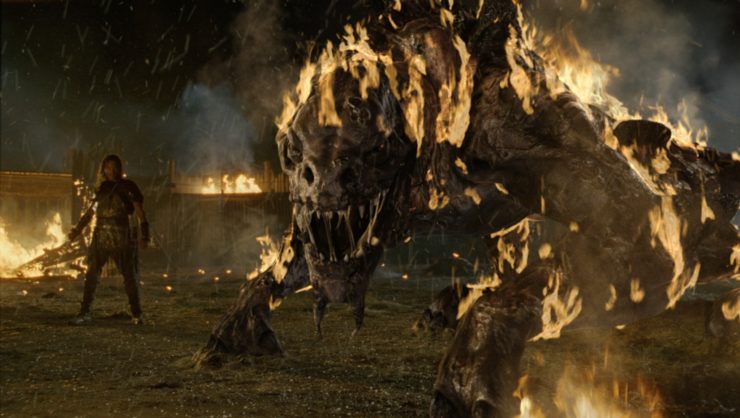
Another science fiction version, billed on the poster as “Beowulf Meets Predator”! This one stars James Caviezel as a space-farer named Kainan who crashlands his alien spaceship in a Norwegian Lake in the Iron Age. His ship, it turns out, was boarded by a creature called the Moorwen, which is the last of a species that space-faring humans tried to wipe out when they were colonizing another planet. The Moorwen caused Kainan’s ship to crash—conveniently waiting to do so after it reaches Earth, which is a past “seed” colony, too, we’re told.
Escaping from the wreckage, Kainan runs into a Viking named Wulfgar (this is the name of the coastal watchman that Beowulf first encounters in the poem), who in turn takes Kainan to Rothgar, a stand-in for the poem’s King Hrothgar—played by the always wonderful John Hurt. Kainan tells them the Moorwen is a dragon, which allows the film to combine that pesky third act of the poem into the first two acts. This collapsing of the poem is furthered when the Moorwen has offspring partway through the movie: Grendel’s Mother is the Moorwen, Grendel its child, and the dragon essentially both.
To top it all off, the movie wraps a kind of quasi-Arthurian spin on the whole thing, as Kainan needs to forge an Excalibur-ish sword out of spaceship scrap metal in order to defeat the Moorwen. It’s sorta insane.
I can’t say that this is a particularly good film—shocker with that synopsis, amiright?—but this bizarre take on Beowulf is so crazy that I find it oddly endearing.
2. Beowulf & Grendel (2005; dir. Sturla Gunnarsson)
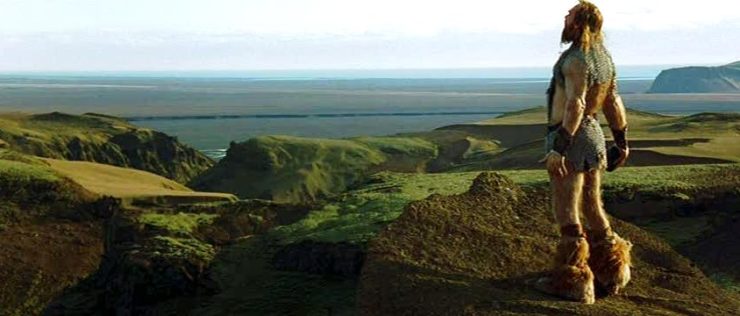
If you’re looking for a Beowulf film that feels accurate to the tone and plot of the original poem—though it omits the dragon episode—this is the best bet. It takes some significant detours from the poem by giving Grendel a backstory, Beowulf a love interest, and adding in a subplot about Christian missionaries converting the pagan world … but it nevertheless gets things more right than wrong.
Grendel’s backstory? He and his father are some of the last of a massive race of blond cromagnon-y folks that the Danes believe to be trolls. Hrothgar and his men hunt them down, and a hiding child Grendel watches his father slain by them. Years later he grows to a massive size and begins exacting his revenge.
Gerard Butler makes for an excellent Beowulf, and the first we see of the character is him trudging ashore after his swimming match with Breca—a lovely side-story in the poem that pretty much tells you everything you need to know about Beowulf’s character. He comes across the sea to help Hrothgar, just as in the poem, and he ends up becoming the lover of a local witch named Selma who has been raped by Grendel (though she isn’t sure that Grendel, who is shown as simple-minded, knows what he’s done). Beowulf fights Grendel and kills him, then fights a sea-creature that turns out to be Grendel’s Mother.
Aside from keeping a bit closer to the poem, one of the great strengths of this film is that it was shot in Iceland. The scenery is stark but beautiful, and it feels remarkably true to the cultural memory behind Beowulf.
1. The 13th Warrior (1999; dir. John McTiernan)
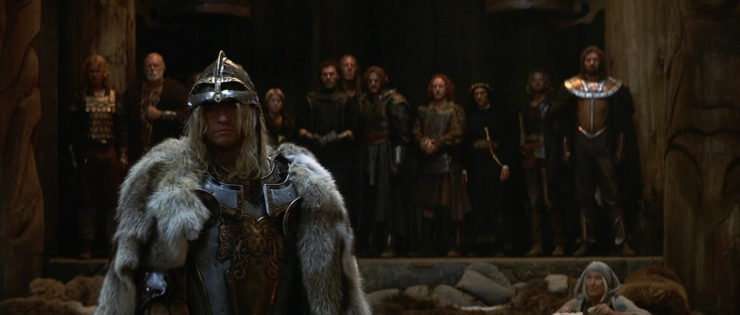
I’ve already written one article proclaiming my high regard for this film, and there’s no question that it’s my favorite Beowulf adaptation. We get all three acts of the poem here—Grendel, Mother, and dragon—through the eyes of the very real Arab traveler, Ibn Fadlan (played by Antonio Banderas), who didn’t do much of what’s depicted after the first few minutes of the film. Based on Eaters of the Dead, a novel by Michael Crichton, 13th Warrior does a great job of building a historically plausible look at something that might explain the development of the Beowulf legend.
Well, plausible except that the timeline is broken, the armor ranges from the 5th to the 18th centuries, the herd at the end is untenable, and … ah, shoot, it’s a damn good movie despite all that!
So there you go. Five adaptations of one of the greatest epics in English literature … each of them in some way flawed. The moral of the story, I believe, is that Hollywood needs to do another to try to get Beowulf right.
My agent is waiting by the phone, producers. Let’s do this.
 Michael Livingston is a Professor of Medieval Culture at The Citadel who has written extensively both on medieval history and on modern medievalism. His historical fantasy trilogy set in Ancient Rome, The Shards of Heaven, The Gates of Hell, and the newly released The Realms of God, is available from Tor Books.


I’m with you on the 13th Warrior – a criminally underappreciated film.
I still love Herger’s comment when being informed that the fireworm is actually cavalry with flaming torches: “I rather prefer a dragon!”
The book it’s based on, Eaters of the Dead by Michael Crichton, is thoroughly enjoyable as well.
Why does Grendel have to be explained? Why can’t he just be a monster out of the darkness like in the poem? He isn’t without a certain sympathy, he eats people because hey, that’s what they’re for, right? And his Momma loves him.
5. Beowulf (1999) The cleavage shots made the movie semi-bearable.
4. Tried to watch this one, got about 10 minutes in and couldn’t take the animation/live/wtf style.
3. I actually liked Outlander. Never really made the Beowulf connection. Now I have to watch it again.
2. Never saw this one.
1. 13th Warrior is a great movie when it works, but there is apparently a lot missing from the cut we get to see. We need a Director’s Cut!
@1,
Herger was my favorite. The shield duel is a great scene.
That Sagoff poem is a thing of beauty.
Actually, the poem explains Grendel’s nature and motive quite plainly (quotes from the Seamus Heaney translation):
Both Zemeckis’ Beowulf and Polar Express are actually horror movies — those cold, dead, soulless CGI eyes just staring and staring …
@6: Quoting text for the win! (Though I’ll note that the Heaneywulf has some flaws as a translation for Anglo-Saxon cultural matters.) For the medieval audience, the “din” of civilization and the general existence of evil were indeed more than sufficient to justify a predatory dangerous dark. But I’d say this hardly constitutes motivation to the modern expectation — as I see every time I teach the poem to students (next week!), and as we see every time Hollywood tries to invent something sufficient.
I wonder if the need to give Grendel a backstory or at least a reason for attacking Hrothgar’s hall comes from the strong Greco-Roman influence on our culture. There, any time some city is being ravaged by a monster, we get told all about how the king offended the gods and brought down this punishment. Grendel seems to fit that pattern, so we expect an explanation of Hrothgar’s sins.
Haven’t seen the movies, but I loved Beowulf’s appearance in John Myers Myers’ Silverlock. (and Golias telling us the story of the Alamo)
Problem with this article is that the way you explain the story it is essentially: warrior fights monster and wins, warrior fights another monster and wins, warrior fights a third monster and they both die. But what made it a great story? Why did it become a classic? That´s hard to understand if you haven´t read the poem.
ragnarredbeard @3 basically already said pretty much everything that I wanted to say, but repeating never does any (serious) harm.
I already expressed my love for the “13th Warrior” when the linked article dedicated to the film was published, and I am always willing to do it again. I can watch it again and again and again. And yes to ragnarredbeard and Emma, Herger is awesome!
I don’t believe I ever made the connection between “Outlander” and “Beowulf” (or if I did, I have forgotten it), but I quite enjoyed the movie, enough to have seen it twice or thrice.
The 2007 version was … awkward, but I think I want to see the 2005 version now. Sorry, Beowulf 1999, no intention of ever checking you out.
(PS I totally believe the benefit of being able to read the original. Already the visual is stunning)
Grendel was an environmentalist fighting against noise pollution. Isn’t that an explanation that fits our time?
12, ach, my heart, thou hast slainest me with thine words! My curse upon thee! Let my suffering demise by thine own!
But anyway, sometimes I wonder if there wasn’t a contemporary going to whatever monk wrote down this story and said “Well, that’s alright, I guess, but you really should have heard the version from…”
13, Or something else. I don’t know if the movie made from it was ever shown in theaters.
@11, Professor Tolkien is cutting about WHY a story about monster killing is immortal in his ‘The Monster and the Critics’. The essay reads like Gandalf at his most snarky.
It’s a pity that your no-TV rule excludes the best (and, not coincidentally, most faithful) version yet: the animation starring the voice of Joseph Fiennes. (Your students could probably crib pretty well from that one, and very easily as it’s only 30 minutes long.)
I love its take on Grendel and his mother: not only are they unexplained, they seem to be made of swamp matter, and their exact shapes are… flexible when we can even see them properly. And whenever they or the dragon are around, everything is a little bit weird and trippy and OFF, as if evil distorts reality
Re “Outlander,” one could make a case that Beowulf has been arguably the ultimate inspiration for countless “base under siege by unknown killer(s)” stories in science fiction prose, movies and TV shows (how many Doctor Who serials have just this trope?)
I’m Ray Winstone and I’ve come to kill your monstah.
When I read “Beowulf,” my first question was, “Why the heck would this bunch of idiots get drunk every night so the monster can swagger in and chow down with no resistance?” I decided they got what they deserved for being that dumb, and it should be required reading in every frat house on campus.
The modern obsession with backstory and understandable monsters really doesn’t apply in the world of Beowulf. Those people understood that evil sometimes just is, and the world is darker and scarier than we can conceive of.
After a day in the Dark Ages North one desperately needed to get drunk.
Goodness, I didn’t realise there were so many versions. You mentioned the John Gardner novel, but not the wonderful animated film based on it. That was great! Peter Ustinov voiced Grendel, as I recall. I can’t help recalling the theme song: “Grendel! Your mother loves you, Grendel!” and the court skald singing a song about the recent battle: “A man stuck a sword in our Wiglaf, he did!”
Parke Godwin wrote a novel too. In his version, Grendel’s mother is the daughter of Loki, who supplies her with a mirror that doesn’t show her how ugly she is. She seduces a king and gives birth to Grendel, who is technically the rightful king of that place. It was an interesting novel.
And yes, I have read the poem and I have the Tolkien translation in ebook. I don’t have any problem with people playing with the theme. It’s a wonderful story that can be used to inspire others without being called Beowulf.
Not a movie, but one of my favorite filks about Beowulf, or rather, Grendel:
http://lyrics.wikia.com/wiki/Leslie_Fish:Grendel
(The audio in the clip provided isn’t very good – it sounds like it was speeded up a bit from the original, but it gives the idea.)
@8 “(Though I’ll note that the Heaneywulf has some flaws as a translation for Anglo-Saxon cultural matters.)” Could you give me a pointer to these issues? I do love the Heaney translation as poetry. I have the Norton Critical edition and I didn’t get that impression from it. Thanks!
I love me a good Beowulf adaptation. Not a movie but I highly recommend
“The Tower of Beowulf” by Parke Godwin.
I think that the 3rd section of the poem is the most affecting part, dealing with the tragedy of the Hero’s destiny (aka ‘doom’). An older Beowulf tries to beg off being sent out to face the dragon, but ultimately cannot refuse. There is no retirement plan for a Hero, just a nice burial policy.
@14, Hahaa!
Cruel indeed be thy wish as ill will and vengeance pour forth. Alas! I harken it not, but bid it farewell as my trusty keyboard gives birth to yet another comment.
My first exposure to Beowulf was in 7th grade, when I was 12. A librarian handed me a copy of Gardner’s “Grendel” which was a very adult novel for a 12 year old boy in 1977.
I’ve seen 4 out of 5 of these and I completely agree with your rankings.
(5) Beowulf (1999) is hot garbage, but as you say, Rhona Mitra is hot.
(4) Beowulf (2007) is weird. The animation completely takes me out of it.
(3) I remember loving Outlander when I saw it as I’m a sucker for a weird Sci-fi story.
(2) Beowulf & Grendal I have, sadly, not seen this. I will have to check it out.
(1) The 13th Warrior is probably as close to cinematic perfection as one can achieve without breaking the space-time continuum.
Special mention goes to the Star Trek Voyager episode, Heroes and Demons. Proof that this story will never die.
The recent Beowulf volume put out by the Tolkien Estate does not do the professor’s work justice. – I am actually kind of glad to know this, because I found the book surprisingly and disappointing underwhelming (especially after I enjoyed The Fall of Arthur so much).
@29/Jason – Agreed, that is one of Voyager‘s true standout episodes!
Even though what little I’ve seen of the Zemekis Beowulf was, as someone said above, pretty “wtf” – and I didn’t even make it to gilded, naked Angelina Jolie – I have a stubborn fondness for Alan Silvestri’s score, which I’ve listened to many, many times. The “radio version” of the theme song is cheesy, but that theme is used to good effect in the score, and there is a nice, warrior-bombastic atmosphere over the whole thing. Silvestri does good stuff!
There’s part of me that’d like to see a version of Zemeckis’ film that just replaced the CGI with actual human actors, but that would probably only highlight the other problems with the script, etc.
Ha. You remind me of my niece, a grad student in English Literature. To hear her tell it, getting to lead an undergraduate section on Beowulf was the highlight of her year.
I’m sad to hear that all these odd-sounding movies omit the part with the dragon. That’s the best part.
You forgot my favorite salute to Beowulf, the first 3 alien movies. Ripley is Beowulf, the first movie is alien is Grendel. The queen in Aliens is Grendel’s mother, while the 3rd movie, while not very good, clearly has Ripley die as she kills the “dragon”.
thanks for this great article. I’m a big fan of the novel Grendel and the 13th Warrior, and I loved the Heaneywulf so much I read the whole thing out loud. Will have to get it out again …
A couple of folks mentioned Parke Godwin’s retelling. It’s indeed great, and it’s on my top-5 writing adaptations of the story, which I’ll eventually get to posting (we’ll see if I can avoid including my own, haha). For more on Godwin:
https://www.tor.com/2016/10/06/parke-godwin-and-the-historical-fantasy-of-king-arthur/
@24, the Heaneywulf is a tough thing for many Anglo-Saxonists: it brought welcome attention to this amazing poem, and it is largely quite readable (huzzah!). At the same time, Heaney is often partial to idiom and analogy that fits his own life rather than the life of the poem… which is the reason for the term ‘Heaneywulf’ — his translation is at times more Heaney than Beowulf. For a good overview of some of the issues at stake, Chickering put together an excellent piece for Kenyon Review. [Hey! It’s online: http://people.umass.edu/sharris/in/e505s/ChickeringHeaneywulf.pdf
For accuracy, my personal favorite is the translation of Liuzza. There are some slip-ups in it (by my subjective reading, obviously), but they are far outweighed by an overall readable connection to the original text
26, 32 I’m glad to see I’m not the only one who thinks the third part is the best. I read the first two parts in high school, but couldn’t really connect with them emotionally. I didn’t get to the third part until after I’d grown up and begun to take on adult responsibilities, including caring for my grandparents. So the theme of a generational passing on of the torch really resonated with me. I was never sure, though, whether the third part actually was more profound than the first two parts, or whether I got more out of it because I brought more life experience to it. Some of both, most likely.
It seems to me that Tolkien borrowed mostly from the third part–not just the obvious homage in the Hobbit, but also the scene of old warrior and young relative facing down a monster together on the Pellenor Fields. Although I suppose Shelob in her cave bears a certain claustrophobic resemblance to Grendel’s mother in her watery den.
13 Babylonian mythology claims the reason for the Flood was that people were making too much noise and keeping the gods awake at night.
@36 Thank you for the followup. I’ll be sure to read the cited paper.
I just came across Tony Benard’s Beowulf comic. While this may mean I can no longer hold my head up in civilized society, I have to confess to liking it. The story takes lots of liberties. It’s is set in a post-apocalyptic future where the king has sent men to find the legendary (literally) warrior, Beowulf.
Beowulf, as it turns out, is a genetically engineered super-warrior still obeying his orders to protect a long abandoned base. He’s not entirely without a conscience, but it’s a conscience that has no problem killing the king’s messengers before they can explain their mission because all he sees are warriors getting too near his base.
Grendel is another genetically engineered monster, and Grendel’s “mother” is the scientist who made him. The war that destroyed civilization was between people like her, who had decided the world didn’t need normal humans anymore, and normal humans, who didn’t agree.
So, Grendel and his mother basically have the same motivation they did in the poem. They kill humans because that’s what they do with humans. She doesn’t sleep with Beowulf, although she does try to get him to join her side (as a genetically engineered super-soldier, she points out he he had to have been made by her side).
No dragon.
A gilded, naked Angelina Jolie is a reason to watch about 45 seconds of that movie. Rather bizarrely, it was the version of Beowulf shown to the English classes in my daughter’s high school. She’s still somewhat confused about that, and the teacher didn’t even have tenure ;)
@41 Link please? That sounds interesting and a quick Google search did not turn anything up.
It was in the graphic novel collection, Sword of Sorcery, vol. 1: Amethyst (I’m not sure why it’s vollume 1 when they didn’t seem to print any other volumes). It collects three comic stories, Amethyst, Beowulf, and Stalker.
44, most likely, they prepared it before the word on the cancellation of the monthly comic got out, or perhaps they just followed the standard procedure. Or maybe they had material for a second volume in the pipeline, but haven’t bothered to publish it.
Of course, Sword of Sorcery was itself on Comic Book-ese Volume 2, with 5 issues of the Volume 1 back in the 1970s, so maybe they were going to republish those?
Oh, and it’s Tony Bedard. That might be why searches were fruitless.
So, I taught it last year and used this short film. A little cheesy, but tells the story .
https://youtu.be/QKjcoFZmKuA
Michael Livingston, I completely agree with your 1 and 2 choices, which I would certainly put in that order, but I have to disagree with your 3 and 5 picks. The one time I saw Outlander I thought it was truly, completely dreadful and I never saw the 1999 version, thought the Zemeckis version is probably still too awkward to watch to be 4th…
Interesting article!
I completely agree with this, I would add that they aren’t only helped by adaptations, some literature is only translated and imported in different countries because someone decide to make a film of it. I have found out several authors and books because I watched the film and then I realised it was based on a film.
Considering that Hollywood cannot get right the very real human emotions involved in the Love Triangle at the heart of the Iliad, it doesn’t surprise me they cannot figure out the motivations of Grendel.
I’m trying to imagine a film of ‘The Tale of Genji’……
50, there are some in Japanese, I don’t know if they’ve been released in subtitled form, and I know there’s a Manga.
Really? I assume they are very long and very slow but extremely beautiful to look at. I love ToG but action packed it is not.
I was fortunate enough to have an Oxford trained English teacher who also just happen to excavate Sutton Hoo, a period burial.
Her stories and personal photos really brought Beowulf and Sir Gawain and the Green Knight to life!
Have me a life long appreciation of the works of that time period.
You lucky devil!
Here’s the problem with transferring this epic to the screen, it will never match the machinations of the minds of those that truly love this poem. I’ve read several versions of the poem, read Gardner’s work too, and even like the idea presented in the Grendel comics that Grendel is roving malevolent spirit/demon.
With all of the Viking lore type shows currently enjoying success, Beowulf could make a great TV/Cable mini-series.
Later on, as king of Geats
He performed prodigious feats
Works if “feats” is pronounced “fay-ats,” I guess :-)
I have a soft spot for Ray Winston’s portrayal of Beowulf. I love how they gave the Geats London accents. It makes Beowulf’s arrive so much more memorable when he growls the line “Oi’m ‘ere to kill yer Monstah!”
:)
You can also see why Winston signed up for it. It’s still recognisably Ray, yet one from a parallel universe where he’s a WWE wrestler. You can’t really blame Grendel’s Mother for lookinng at those abs and deciding she’d rather make love not war…
It’s not really surprising Hollywood (and filmmakers in general) shy away from the third act. It resonates with a lot of people (myself included). It has themes about aging, the hero triumphing despite his weaknesses, and the protagonist dying at the end. As rule (with the obvious caveat that there are exceptions) Hollywood is obsessed with youth, strength, and happily ever after.
I’m surprised you missed the 1981 animated film GRENDEL GRENDEL GRENDEL by Alexander Stitt. .
.
Sure it was actually an adaptation of John Gardner’s novel of the same name but it is a dang sight closer than most of the examples cited above. Plus you get Peter Ustinov as the monster and a Brecht-like title song that is bizarrely catchy..
I favor the lute retelling by Benjamin Bagby (short exerpt on the site linked). Very dramatic (but short on CGi for monsters).
Makes me appreciate what a D&D Bard is supposed to be…
http://www.bagbybeowulf.com/dvd/index.html
I teach Beowulf to 9th graders and get them to enjoy the political and social aspects. I’m particularly fond of pointing out that most of the women don’t have names, including Grendel’s mother! We follow it by reading Gardner’s Grendel and then for our amusement, we watch the shiny gold Angelina Jolie movie. All students at my school, after being in my class, will sometimes burst out at random times, “I’ve come to kill your MONSTAH!”
“It’s only classroom usefulness, though, is as a good answer to students who question whether the sword can really be a phallic symbol.”
Yes. This is pretty entertaining stuff for my 9th graders. They get REAL quiet.
@62 – <snigger>. :)
45, I blame autocorrect. And my long history of spelling erorrs.
I just realized that the Grinch is Grendel, and Whoville is Hrothgar’s Hall — even the alliteration works! Cindy Lou Who as the King’s daughter — I don’t know about Max, though. The sleigh ride down the mountain could work for a dragon ride, and the stolen gifts match the stolen cup. Mixed, but lots there!
The Seamus Heaney translation has one of my favorite Viking jokes. Grendel visits Hrothgar’s hall for a snack. He finds himself in the fight of his life. Beowulf is pounding him stupid, tearing off his arm, beating him over the head with it. The poet comments, “It was the worst visit to Heorot he’d ever taken.”
I love the 13th Warrior which we watch in English class along with Beowulf 2007 with Golden Angie. But my favorite retellings are Outlander and the Star Trek Voyager one.
@68/Carol: That’s one of my favourite Voyager episodes. All hail Schweitzer!
I’m late to the party, but I actually like the Zemeckis movie. In my defense, it is the only one I saw, and I have never studied the poem. I will now, though.
friends always raves about The 13th Warrior.
further, I’m so used to expressionless faces on the screen from overuse of Botox and plastic surgery, that I’m kind of used to the waxy blank faces…
just sayin’
Decades ago I read a book that said place-names like Grendel’s Mere are common in England. The author asserted that Grendel wasn’t a personal name. It was a class of water-monster.
@71/Fernhunter – maybe Michael Livingston can judge with more certainty (he *is* the expert), but my understanding is that Beowulf was written very early, long before the dust had completely settled on the various ethno-linguistic “negotiations” that determined place names which finished around the time the Doomsday book was written. At a guess, I’d say it was more likely that the people that new the traditional names of those places were killed or moved on, and when the new inhabitants of the area needed a name, they opted for something form one of the cultural stories. I suspect that’s also why there are so many places that reference Arthurian legend as well, but no one (to my knowledge) is suggesting Arthur or Merlin (or any of the others) were a race of mythical beings, not individuals.
I have in my collection the “Outlander” Viking battle flags used in movie.
@@@@@ 72, WillMayBeWise:
@@@@@71/Fernhunter – maybe Michael Livingston can judge with more certainty (he *is* the expert), but my understanding is that Beowulf was written very early, long before the dust had completely settled on the various ethno-linguistic “negotiations” that determined place names which finished around the time the Doomsday book was written. At a guess, I’d say it was more likely that the people that new the traditional names of those places were killed or moved on, and when the new inhabitants of the area needed a name, they opted for something form one of the cultural stories. I suspect that’s also why there are so many places that reference Arthurian legend as well, but no one (to my knowledge) is suggesting Arthur or Merlin (or any of the others) were a race of mythical beings, not individuals.
That’s not a bad guess. Mythologists call it Land Taking. Move into a new area, give it’s features names from tribal history or mythology. Like Krishna’s Butterball, from a different myth complex.
But that tells us nothing about what they thought the names meant. It might be that some version of the Beowulf story was widespread. So they named lakes for his Grendel.
It might be that everybody knew Grendel-monsters lived in lakes. Many of them may have just lived underwater, seldom troubling the land-folk. Or the Beowulf song we know might be the lone survival of a widespread class of Grendel-slaying stories.
Unless we discover a trove of manuscripts—or a time machine—there is no way to know.
my favorite movie is the CGI version but i have not seen the others and will def do so moving forward. great piece about a great poem. getting a tatoo – my first – of the Beowulf dragon.
Love the way you write! reminds me of my father both in your takes and your writing style. Dad used to read Beowulf (kid renditions initially) to me and my siblings and it inspired me from a young age. I wish that a more proper Beowulf movie had ever been made. The 2007 Beowulf had so much potential. I really don’t think it improved the story at all to sexualize it and turn Beowulf into this Samson-like broken hero. He’s supposed to be the coolest hero ever, but Hollywood just despises that.