





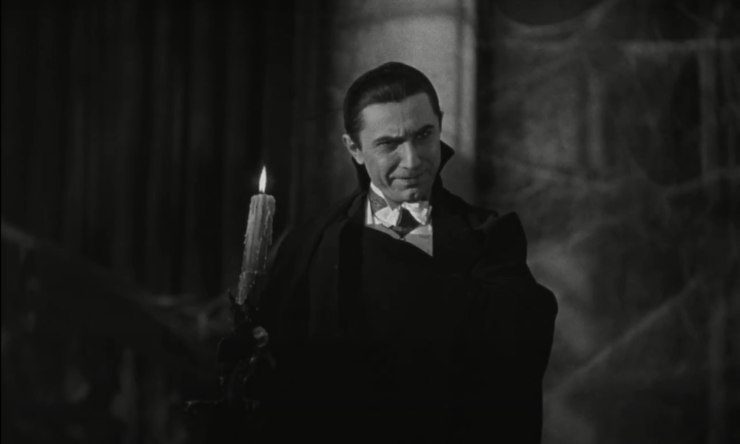
I enjoy studying folklore, looking into all the various versions of specific stories that get told and retold. This October, I’ve found myself drawn irresistibly to darker lore, poring over tales of the vampire, the nosferatu, the shadowy lords of the night. These fanged and ferocious creatures lure us in, lulling the senses until the fateful moment when they bite us and drain us of our blood. (Or maybe just snack on some of our blood. Depends on the story—and the vamp!)
That’s the thing about vampires—there’s quite a bit of variety when it comes to their abilities, their behavior and motivations, and the rules by which they operate. You may argue that vampires and their many mysteries might be a bit overexposed these days, but I maintain that they remain endlessly fascinating in their various permutations—it’s part of what draws us to their stories, making vampire mythology so compelling that they never really fall out of fashion, even after spending more than a century in the pop culture spotlight.
There are certain elements that connect most, if not all, vampire stories, from folklore and Carmilla and Count Dracula all the way through the current crop of bloodsuckers popping up all over page and screen. Below, I’ve created a survey of the various strengths and weakness attributed to vampirekind in different books, movies, and TV series—it’s not an exhaustive list by any means, but it serves to illuminate the points of connection between these stories while also exploring how different writers and creators find new twists or different ways of playing with the basic “rules” of vampirism. For my own amusement, I’ve assigned a score to each category, because why not? Obviously, your mileage may vary, so feel free to create your own scores, and I hope you’ll bring up your own favorite examples in the discussion that follows! Let’s begin with vampire strengths and special abilities…
Blending In
Can these undead creatures blend with normal modern society? You’ve got your True Bloods, your Buffyverse, your Dresden Files types—vampires who can all appear normal for the most part, but transform to some degree when they hunt or feed. Or to take it one degree further, consider the vampires of Deborah Harkness’ All Souls Trilogy: daywalkers who don’t even bother to have fangs, but just leave human-shaped bite marks. (Doesn’t it seem like that would hurt more?) On the other end of the scale, you’ve got those vampires who always appear monstrous, such as the titular Nosferatu (in any of the three movie versions) or Stephen King’s Kurt Barlow. It must be an advantage to blend in, especially in modern human society. There are simply so many humans, compared to the vampire population, and humans are reliably fickle—it doesn’t do to set off the villagers with their pitchforks and torches if not absolutely necessary. So it makes sense to give the vampires that can transform and blend in with their potential victims +1 on our scale.
Transformation
Similar to blending in, this is another skillset that varies greatly from one mythology to another, and even within the same stories. Most versions of Dracula and our friends from What We Do in the Shadows take advantage of this ability often. As the old village woman (played by the great Anne Bancroft) says in Dracula: Dead and Loving It, “They take the form of wolves or bats and puncture the throats of their victims with their teeth and drink their bloo-oo-oo-ood!” Other vampires have been known to change into mist, rats, or even swarms of insects or grotesque human/animal combinations, like Gary Oldman turning into a giant man-bat in Bram Stoker’s Dracula. This seems like a crazy helpful advantage in almost any situation: +3 for the ability to change things up at will!
Immortality / Healing
Perhaps I should have listed this first, given that it is perhaps the main draw of vampirism, from a mortal’s point of view. Vampires can afford to be patient, both with society and compound interest. Slayers getting a little too close? Move across the country for a couple generations. Bored with living forever? Sleep for a few decades and when you’re ready, wake up to see all the new and exciting changes! I’m going to lump super healing powers in with immortality, because they seem to be facets of the same factor. Vampires heal, therefore they remain unalive. Of course, various mythologies play around with this. Take the Baron in What We Do in the Shadows: Once his head and torso are dug up, we presume he continues to feed, but it’s not until a genie restores his form that he actually recovers fully. But plenty of vampires can regenerate as long as they are able to partake of their favorite drink—think of Lestat de Lioncourt, who survives all manner of horrific injuries in the books and the different adaptations of Anne Rice’s source material. And if you’re playing Vampire: The Masquerade, don’t worry about losing a limb in a fight, you can regrow it as long as you don’t get fully totally killed. +4 for immortality, since it’s pretty hard to beat.
Mesmerism / Compulsion
Perhaps unsurprisingly, there’s a huge advantage in being able to convince people to do anything you want. Think about it the next time you’re on hold with customer service: don’t you wish you could simply ensorcell the world into doing your bidding, fooling one customer service rep at a time? (Maybe that’s the real reason for the endless AI hold robots you’ve got to wade through to get to a human; I assume AI is immune to glamour, but who knows?) This is an ability that dates back to works like John Polidori’s The Vampyre and classic depictions of Count Dracula and carries all the way through from Dark Shadows to The Vampire Diaries and True Blood.
There are always those outliers who are immune, your half-elf Sookies and your Van Helsing-bloodline Guillermos who cannot be hypnotized (but sometimes pretend to be under the right plot circumstances). +2 to vamps who can mesmerize their goons or prey.
Superhuman Abilities
I was tempted to break these out individually into categories like super strength, super senses, super speed, etc., but it’s rare to find a vampire without some or all of these, so I’m lumping them together. Some vampires are fully fledged and in possession of these abilities from the moment they’re turned, but often vampires develop these abilities more over time. Generally speaking, the older the vamp, the more dangerous and powerful. You can see this play out in the Mercy Thompson stories, for example: The older vampires collect seethes and are in charge of their younger counterparts because they’ve been around longer, and they get stronger with age. On the other hand, in the Twilight universe, new baby vamps are the strongest because they have so much residual human blood in their system, though that only lasts about a year, and they remain plenty powerful afterward—I mean, we’ve all seen them play baseball. It’s weird, but impressive: +2 per superhuman ability.
Flight
Perhaps because we associate them so closely with bats, many vampires are also known for their ability to fly. Well, some can, some can’t, but it’s hard to argue that it’s anything other than a strength. In the Buffyverse, vampires can’t fly—probably for budgetary reasons, more than anything else. In Anne Rice’s Vampire Chronicles, only the most ancient vampires can fly (an ability known as “the cloud gift”). In True Blood, it varies from individual to individual—when Sookie asks Eric Northman if all vampires can fly, he responds, “Can all humans sing?” Flying is a talent limited to only those with the special skill, or who have worked to develop the ability. Flying (or at least levitation) remains a common skill among pop culture’s vamp pantheon, from the titular Lost Boys of the 1987 film to Eli in Let the Right One In to many (though not all) of the vampires of Castlevania. +1 to vampires who can, indeed, fly.
Now, let us turn our attention to some of the less glamorous downsides of vampirism, and consider some major vampire weaknesses…
Sunlight
Sunshine, of course, is the slayer’s greatest ally. Most vampires live in fear of the sun—some to such an extreme that being caught out of their coffin during daylight hours is instantly debilitating or deadly (another shout out to Count Orlok of Nosferatu fame, as seen in the clip above). Others need merely apply sunscreen for at least a few hours of safety. Some are utterly destroyed, turned to dust and ash, by the application of direct sunlight; others are merely roasted to the bone, but may be rehabilitated over time (there are examples of both of these outcomes in Rice’s Vampire Chronicles, of course). -2 for any vampires that can’t handle their daylight.
But! Let’s consider another vampire phenomenon: that of the daywalker. Some vampire mythos do away with the ban on direct sunlight entirely, and make sunshine a misdirect. The vampires in the All Souls Trilogy are all daywalkers; sunlight isn’t a factor for them. And of course you’ve got your sparkly Twilight vamps, who are genetically bedazzled to shine in sunlight, but don’t suffer any ill effects. Then there are special cases, like the half-vampire Blade, a singular Daywalker who has all the strengths of his vampire foes without sharing their weaknesses (if other vamps head out during the day, they have to be absolutely slathered in sunblock. It looks ridiculous). Having sunshine as a key weapon on the side of our slayers is a major score for the humans, which makes for, let’s be honest, more interesting story options. Let’s add +1 to any mythology that includes daywalkers—except in stories where all of the vamps are immune to daylight, in which case they get a neutral score for being a little less exciting.
Relocation
Next, let’s consider mobility. Is the vampire able to simply flee and relocate when under threat? Evidence suggests yes in most cases, though with varying degrees of difficulty. In many cases, a coffin filled with the soil of the vampire’s native land is necessary to maintain vampire health and wellness, which does make for some rather large luggage. Additionally, careful planning must go into making arrangements for night travel only. This idea originated with OG Dracula, but the tradition has carried on with the vampires of Underworld, Let the Right One In, and What We Do in the Shadows. I’ll give -1 to vampires who need their native soil, because it can be a dire difficulty if they lose their dirt, which could also be tricky to replace.
Silver
This is sometimes a factor and sometimes not. It’s a major weakness for vamps in the True Blood mythology, which really helps to balance the scales when it comes to human/vampire interactions: Got a vampire problem? Not if you have a silver chain! Just whip that metal cord over your vamp, and suddenly they cannot move at all. This is a more modern twist, borrowed from other folkloric traditions; classically, it’s the werewolves that have a problem with silver, but some vampire stories have borrowed it in recent years. Dark Shadows, Blade, Underworld: all these (relatively) recent mythologies include silver, which has long been associated with purity (and also, perhaps not coincidentally, with mirror production). -3 for silver weakness.
Mirrors
Speaking of… I’ve got to say, it’s rare to see a vampire’s lack of reflection as a benefit, as it most often reveals the creature for what it is, usually in the middle of a big crowd of angry humans. Maybe the most fun you can have with this is the big dance scene in Dracula: Dead and Loving It, when we get to see Mina flying solo through the air during her Dracula duet. So that’s -1 for not being reflective (but at least +1 for amazing ballroom dancing skills).
Garlic
This particular vampire bane is one of the most controversial mythological elements. Folklore suggests that the strong smell of garlic is a deterrent to creatures with sensitive noses. Given that garlic has antibiotic properties, it’s not surprise that it became associated with health and wholesomeness. However, many modern mythologies often make fun of this particular weakness, either giving it a pass or a handwave explanation. In The Lost Boys, our young vampire hunters find that garlic doesn’t work (but happily, holy water does!) Maybe vampires don’t LOVE garlic, but it’s not always a weakness outside of classic Dracula stories—though maybe that’s changing, given that pickled garlic plays a key role in Ryan Coogler’s Sinners. We’ll give a -1 to any vamps with this allergy.
Religious Items / Symbols of Faith
Speaking of holy water, classically, a cross or Bible or other holy relic associated with Christ or Christianity would do the trick when it comes to defeating a nosferatu. More recent stories often incorporate other faiths as well with some takes on vampire mythology demonstrating that a true symbol of any religious faith will protect the wearer, as long as it aligns with their personal beliefs. Other types of vampire stories have veered away from the religious aspects or put a new spin on the relationship between vampires and the sacred, especially in works which seek to humanize and complicate the idea of vamps as cursed monsters. In the All Souls Trilogy, Matthew Clairmont is a (sometimes secretly) practicing Catholic and fully capable of wearing/handling a cross or crucifix—the secrecy has to do with the fraught politics of Elizabethan England, not because he’s a vampire.
On the other hand, if you’ve ever sat all the way through the ending of Dracula 2000, in which Gerard Butler stars as a hip young Dracula who also (spoilers!) turns out to be Judas Iscariot, you’ll know that some folks still can’t resists going all in on the religious aspects of vampire lore (for better or worse). -2 for any vampires that are weak to the power of faith.
At the outset, I’ll admit I was tempted to go full UFV (Ultimate Fighting Vampionship) with this whole ranking system—and I still think it would be fun to throw all these vampires in the metaphorical ring together and seeing who comes out on top. In terms of storytelling, though? It doesn’t really matter which vampire is technically the strongest or most powerful—in the end, I personally get the greatest enjoyment from a well-balanced mythology, in which our supernatural characters (whether they be heroes, antiheroes, or villains) have a mix of key strengths and weaknesses, and their potential prey stand a chance of resisting or fighting back.
You can have a great story or extremely entertaining movie in which the vampire mythos is pretty basic or vague and muddy, and you can also have a very cool take on vampire mythology with only middling stories and characters bringing it to life. My personal favorite mythos is True Blood, because the creatures’ strengths and weaknesses are so well balanced, and the vampires are still so deeply human in spite of all their biological differences. The average human stands a chance against the average vampire and vice versa, which means the stakes (not the wooden kind—those are still bad for vamps) are always high, and you never really know which way things are going to go.
Of course, vampire stories aren’t all trying to do the same thing. A successful mythology works best to support the story that the author is trying to tell, whether it’s to make us shudder in fear, shiver with desire, point out that we’re all just people trying to make it in this crazy world, or simply to make us laugh out loud. All these strengths and weaknesses can be applied on a sliding scale that goes from campy and soapy to light and comedic all the way through to weighty, thought-provoking, and serious, and ideally, these elements will be used to enhance the kind of story being told according to those particular circumstances. There’s a vast difference between a terrifying human-sized monster suddenly vanishing into mist and wings, able to reappear unexpectedly at any moment—versus a guy in a goofy outfit screaming “BAT!” and flapping away into the night, and the fact that vampire stories allow us to enjoy all these wildly different moods and flavors might be their greatest strength of all.
Now, I know what kind of mythology and rules work best for me, but what about you? How do you rank your favorite vampire mythologies? What are your favorite kinds of vampire, and favorite aspects of vampire lore and legend? Who are you usually rooting for—the vampires themselves, or the Van Helsings and other hunters hellbent on ending their reign of terror (or at least on making sure they behave themselves, more or less)? So much depends on your personal preferences and point of view, so sound off and let’s discuss!


It makes perfect sense to me that a vampires are averse to a seasoning like garlic, in much the same way werewolves are repelled by barbeque sauce, and ghouls by side-dishes of kimchee, while anthropophagic witches can be eluded simply by hiding oneself in a large, water-filled pot that has been filled with onions, carrots, and other vegetables, It’s not the vampires lying to us so that humans self-season.
Weren’t the vampires in Richard Matheson’s I Am Legend unable to heal themselves, and thus prone to deteriorate over time? But then, they were the inspiration for George Romero’s “ghouls,” which later came to be known as zombies.
Also, Matheson’s vampires were repelled by religious symbols reflecting their own faiths, so only a Christian vampire would be repelled by a cross, a Jewish vampire by a Star of David, etc. They did reflect in mirrors, but were repelled by seeing their reflections. In both cases, the narrator concluded it was psychological, a manifestation of their shame at what they’d become.
There are levitating vampires in the comic book adaptation of Joss Whedon’s original Buffy the Vampire Slayer screenplay, which is canonical to the series, or at least more canonical than the movie. But the comic’s vampires also have more extreme, green-skinned transformations than the ones on the show, so maybe it’s only mostly canonical.
It always bugged me that Buffyverse vampires could avoid the harmful effects of sunlight just by standing in shadow. After all, reflected sunlight is a thing too. When I was in high school, I was injected with hematoporphyrin dye as part of an experimental melanoma treatment, and it made me hypersensitive to UV for several weeks afterward. Basically it gave me something similar to porphyria, one of the inspirations for the vampire myth due to the sunlight aversion, anemia, gum retraction, etc. that it can cause. For me, it wasn’t enough to avoid direct sunlight, since the reflected UV was also hazardous. I needed to stay indoors with the windows covered for the first couple of weeks, and when I went back to school I had to stay covered up and wear plenty of sunblock.
A novel vampiric power proposed in The Middleman‘s episode “The Vampiric Puppet Lamentation” (in which the villain was Vlad the Impaler’s lookalike ventriloquist dummy possessed by his soul) was the instant acquisition of the memories and knowledge of anyone whose blood the vampire drank. I don’t think I’ve seen that anywhere else, though it’s reminiscent of Liv’s power in iZombie to gain the knowledge and persona of the person whose brain she ate that week.
The All Souls vampires don’t have access to all memories of their donors (?) but do acquire some, maybe randomly.
And if we’re getting into reflected sunlight, how do we deal with moonlight, which is technically also reflected sunlight??
From a science POV, reflected light has less energy than a full on blast, some having been absorbed by the object it reflected off of, so that may be the difference? 🤷♂️
Except reflected sunlight still had enough UV to be dangerous for me after my medical treatment. So we’re comparing two different kinds of reflected sunlight. The sunlight reflected off the sidewalks or walls or cars outside my window would’ve been unsafe for me, but the sunlight reflected off the far more distant Moon would have been too dim to pose a risk.
Well, given that the night is still pretty dark even with a full Moon, it’s safe to say that the light reflected from the Moon is far dimmer. After all, by the inverse square law, the reflected light from the Moon hundreds of thousands of kilometers away would be infinitesimally as bright as sunlight reflected from a wall just across the street. Also, the Moon’s albedo in ultraviolet is only 3.8 percent, so very little of the Sun’s UV is reflected by the Moon. (Assuming it’s UV that kills vampires, but I’m aware of at least two unrelated vampire-themed works of fiction called Ultraviolet, the 1998 British TV series with Idris Elba and the 2006 film with Milla Jovovich, so it seems to be a common assumption.)
Forever Knight introduced the idea later in the series of feeding passing on the memories and skills of the victim. The effect was temporary.
Moonlight (CBS) and the novel by Trevor Munson that preceded it put forth the idea that vampires are literally dead (if quite mobile and aware) and need to sleep cold to prevent the decay from advancing.
The Middleman permutation may be new, but matters of memory run through vampire fiction nearly from the start – almost all of the versions of Dracula rely on the Count retaining his memories and personality from the moment of conversion…but what happens to the memories of his victims is much less clear.
This becomes particularly complicated in the Buffyverse, in which we get two conceptions of vampirism which logically ought to be incompatible but somehow aren’t – we’re told early on that vampires have no souls, such that the vampire is (at least theoretically) a wholly separate being that’s essentially stolen its host’s body and murdered the original occupant. This is also, initially, one reason why “Angel” and “Angelus” are described as having entirely separate personalities. But later, particularly after we’ve seen Spike functioning both with and without a soul living in the body, he’s written as having essentially the same personality – and memories – whether or not he’s ensouled – which I find very hard to reconcile with the premise that a vampire is “a demon in a human suit”.
I suppose the demon that possesses the body would assimilate its memories, which would be physically wired into its brain. So the result might be something like Trill symbiosis in Star Trek, the host and demon personalities blending into one.
The thing is, “soul” is a concept that’s very vaguely defined. Sometimes it’s equated with the mind and consciousness, but sometimes it seems to be treated as some ineffable thing distinct from them. The Buffyverse version seemed closer to the latter idea — that a person’s soul wasn’t their mind and memories, but their humanity, their empathy, their moral center, their impulse control. Yes, Angelus had a different way of behaving than Angel, but Angel felt guilt for Angelus’s actions, which wouldn’t make sense if they were completely separate personas. It’s more like Angelus was Angel’s dark side, the unrestrained impulses that his soul/morality kept in check.
I will always have a soft spot for the vampires in Peter Watts’ science-fiction novel “Blindsight”, where the tropes of vampirism are made biologically plausible. Watts’ vampires even suffer from ‘the crucifix glitch’, an evolved sensitivity to lines that meet at right angles, such that the vampire captain of the protagonist’s ship has to take “anti-Euclideans”, specialized medication to suppress the effects of the glitch.
No mention of a susceptibility to garlic, though.
Hmm. Not addressed here are three of the most common vampire-killing methods: beheading (a vamp may be immortal, but it needs its head to “survive”) fire (as distinct from sunlight) and wood (sometimes you just need a stake, sometimes you need a specific sort of wood).
With regard to the last of these, I should note that one of my favorite lines from the whole of vampire fiction comes from Fred Saberhagen’s The Holmes-Dracula File, in which the Count (who is not the villain of the piece in Saberhagen’s version of the tale), says to Holmes:
“I must congratulate you on thinking of wooden bullets.”
When it comes to stakes, sometimes they need to be hammered through the sternum, sometimes not. It always annoyed me that Buffy showed ordinary Scoobies without Slayer strength able to stake vampires in the heart with ridiculous ease, as if just making contact with the general mid-chest area with the point of the stake were enough to make them go poof.
Dresden Files and He Who Fights With Monsters both have a grab bag of vampire types each, which I enjoy, because it gives a chance for them to take all the various contradictory vampire mythologies and say: they’re all basically true.
In Dresden Files you have the nosferatu-like corpsy vampires (who are vulnerable to garlic, etc), sexy succubus vampires, and the kind who look like people but whose true form is a winged monster thing (and at least one other that hasn’t been shown).
The main vampires in HWFWM can have one of many different secondary powers, such as mind control of other vampires that they have turned, turning into mist, turning into bats, turning their flesh into other substances (like C-4)… etc. There are also the mind-controlled minion type vampires and life energy sucking vampires. Are they Always Chaotic Evil? Sometimes!
Edit: I forgot about The Madness Season. It also has two different types of vampires, both of whom can shape-shift. One of them also has a limited memory capacity and extreme ability to self-delude, to the point where one becomes convinced – and therefore actually becomes – vulnerable to classic vampire vulnerabilities.
In A Very Unusual Romance by Clark Hays and Kathleen McFall (which I cannot in good conscience recommend) I ran across a take on vampire lore I had never seen before: the vampires of that story literally died when the sun came up each day and resurrected the following night. It made them uniquely vulnerable because they could not operate in the day in any capacity and fully relied on familiars/underlings to protect their bodies.
I loved True Blood because it had enough drama and it very often was quite funny.
Castlevania also did the trick for me, but I have to admit that I haven’t read too much else in the genre apart from the classics.
Similar to what some above have proposed, Larry Niven has posited that the thing with vamps and garlic is that they don’t like poorly seasoned food; that excessive garlic swamps out the other seasonings and results in an unbalanced flavor.
These are all Western, European style vampires. Eastern Vampires are weirder!
Chinese people probably think Western vampires are weird compared to jiāngshī. I mean, they don’t even hop!
The ubiquity of the sunlight and vampires thing irks me, because it’s barely a hundred years old. It basically started with Murnau’s Nosferatu.
It is never mentioned in classic treaties like Augustin Calmet’s, and never in classic vampire literature. Lord Ruthven and Carmilla are wholly unaffected by daylight. Dracula’s powers are diminished by it, but he can still walk around by day.
And, IIRC, Ruthven need to recharge in moonlight under a full moon. Something so interesting, yet it remains completely unexplored by the rest of the literary vampire canon.