







Welcome back to the Lovecraft reread, in which two modern Mythos writers get girl cooties all over old Howard’s sandbox, from those who inspired him to those who were inspired in turn.
This week, we’re reading Arthur Machen’s “Novel of the Black Seal,” first published in 1895 as part of The Three Impostors. Spoilers ahead.
“Life, believe me, is no simple thing, no mass of grey matter and congeries of veins and muscles to be laid naked by the surgeon’s knife; man is the secrete which I am about to explore, and before I can discover him I must cross over weltering seas indeed, and oceans and the mists of many thousand years.”
Miss Lally argues with Mr. Phillips about matters supernatural. Phillips is a determined rationalist; so was she once. But “experiences even more terrible” have changed her mind. Does Phillips know Professor Gregg, the ethnologist?
Phillips admires Gregg’s work. How unfortunate that he drowned on holiday, with his body never recovered!
Lally doesn’t believe Gregg is dead. He was sound in mind and body when he went walking that last morning. When he didn’t return, searchers found his personal effects miles from the river, wrapped in a rough parchment parcel. On the inside of the parchment was an inscription in red earth, of characters resembling a corrupt cuneiform.
In her twenties, orphaned and destitute, Lally sought employment in London. Unsuccessful, she wandered misty streets alone, expecting starvation. When a man hailed her for directions, she fell to the sidewalk in hysterics. The man, Professor Gregg, solicited her tale of woe and offered her a position as governess to his children.
Lally becomes as much Gregg’s secretary as governess, helping him complete his Textbook of Ethnology. That task done, he joyfully proclaims himself “free to live for stranger things.” Lally’s eager to learn more. Gregg shows her documents and–an object. The papers concern rural disappearances, an old man murdered with a stone ax, a limestone rock covered with weird scribbling. The object’s a small black stone carved like a seal. It’s at least four thousand years old, but its characters match those scribbled on the limestone rock only fifteen years before! But what this collection means, Gregg refuses to explain until he has proof.
That summer Gregg takes a country house near Caermaen, once headquarters of a Roman legion. The house perches above a broad river valley and beneath a forest full of “the sound of trickling water, the scent of the green leaves, and the breath of the summer night.” Soon Gregg confesses the place connected with the black seal mystery. Here he hopes to test certain theories, but he still won’t say more until he has confirming evidence.
Lally worries Gregg is cherishing a monomania. Nevertheless she delights in the countryside and only “remembers strange things” when she returns to the house where Gregg paces with the look “of the determined seeker.” One rainy day she discovers a book of ancient Roman geography. She’s amused by a passage about “persons” in interior Libya who practice foul rituals, hiss rather than speak and whose pride was the “Sixtystone” called “Ixaxar.” The black seal, by the way, has sixty characters on it.
Buy the Book
Prosper’s Demon
Shortly after, Gregg hires a local boy. Jervase Cradock (he explains) is what countryfolk call a “natural,” mentally weak but harmless. Morgan the gardener says Jervase’s mother wandered the Grey Hills after his father’s death, weeping like a lost soul. Eight months later Jervase was born, black-eyed and olive-skinned, with a strange harsh voice and given to unfortunate “fits.”
Lally witnesses Jervase collapse with blackened face, babbling in an unknown hissing tongue. Gregg carries the boy to his study, purportedly to assist him. But the professor’s unconcealable exultation terrifies Lally–how can this benevolent man view Jervase with such callous curiosity? She thinks of leaving, but Gregg persuades her to stay as his “rear guard.” There’s danger in his studies here, but they’ll soon be done.
Jervase has another fit. Again Gregg cares for him in his study. Next morning the maid finds a bust moved from an impossibly high shelf; inexplicably it’s smeared with slime that smells like a snake-house. Lally’s unease mounts.
Gregg goes for “a miniature walking tour,” warning Lally he may be away overnight. He’s still gone the next night. Morgan brings Lally a letter Gregg left, should he go missing. It directs her to a full account of his fate, which he advises she burn unread. Still, if she must know the truth…
Lally still carries Gregg’s account and hands it to Phillips. It details Gregg’s theory that most folklore is a “prettified” account of an ancient nonhuman race–the fairies of Celtic legend. Tales of witches and demons also spring from this race, which having “fallen out of the grand march of evolution” retains powers apparently supernatural. They sometimes leave changelings or breed with human women, as in the case of Jervase. By the way, Gregg did finally decipher the black seal and learn how man “can be reduced to the slime from which he came, and be forced to put on the flesh of the reptile and the snake.” He performed the “spell” on Jervase, and witnessed the boy unfurl a slimy tentacle that pulled down the unreachable bust.
Gregg believed the phenomenon no more supernatural than a snail pushing out its horns, but still horror overcame him. Nevertheless he meant to finish his research by meeting the “Little People” face to face. Hence the fatal walkabout. Lally and Morgan found Gregg’s belongings by the limestone boulder in the barren hills. Of course the lawyer didn’t credit her tale but invented one about Gregg drowning.
Phillips doesn’t notice Lally’s inquiring glance as she concludes, for he’s looking around the square in which they sit: the evening bustle seems “unreal and visionary, a dream in the morning after an awakening.”
What’s Cyclopean: Machen characters have a unique way of talking. “I thirst for an elucidation.” “We stand amidst sacraments and mysteries full of awe, and it doth not yet appear what we shall be.”
The Degenerate Dutch: Intellectual disabilities and epilepsy are caused by primitive slime fairies. Now you know.
Also, the “uncouth characters” of fairy runes are “as strange and outlandish as the Hebrew alphabet.” Thanks?
Also also, Lally calls the rural hills of England “more unknown to Englishmen than the very heart of Africa,” despite the fact that there are… Englishmen… living there.
Also also also (this story is pretty degenerate), the whole premise hinges on the idea that “races of men” may be more or less evolutionarily advanced, and trade off wild and terrible superpowers for civilization. The less evolved races “speak a jargon but little removed from the inarticulate noises of brute beasts.” That’s not how any of this works.
Mythos Making: There are tentacles. And scary interspecies breeding.
Libronomicon: Professor Gregg’s Textbook of Ethnology is a quite admirable example of its kind. Also cited: Descartes’ Meditationes, the “Gesta Romanorum,” volumes of eighteenth-century sermons, an old book on farriery, a collection of poems by persons of quality, Prideaux’s Connection, a volume of Pope, and a quarto of ancient geographers.
Gregg also jokes about posing Miss Lally “a problem in the manner of the inimitable Holmes,” just in case you hadn’t caught the clever parallel.
Madness Takes Its Toll: Professor Gregg’s colleagues think he must be going mad. He thinks not. But he sure does seem to have plans to show them, show them all.
Anne’s Commentary
What I’d forgotten about “The Novel of the Black Seal” is that while the story has often been anthologized as a stand-alone, it’s actually one of thirteen interconnected episodes that comprise Machen’s 1895 novel The Three Impostors. This “rediscovery” didn’t surprise me–Miss Lally’s narrative is framed so abruptly in the version I read that I suspected it had been excerpted from a larger work or longer series. I mean, who are Lally and Phillips, and what is their relationship, and why are they sitting around talking at great length about matters supernatural? Where are they sitting, for that matter? I assumed it was in Phillips’s study, with him parked by a window looking out into Leicester Square. I also assumed Lally was consulting Phillips in his professional capacity, unclear as his profession is beyond a general scientific bias.
In the context of Three Impostors, however, Phillips is a sort of naturalist-dilettante of independent means who mostly enjoys arguing over smokes with his romanticist-dilettante friend Dyson. One evening he’s walking in Leicester Square and primly claims the other end of a bench occupied by a young lady, yep, Lally. Far from hoping to strike up a conversation, he’s annoyed when the lady heaves a stifled sob and looks at him as if imploring his attention. Oh well, what’s a gentleman to do but ask what’s wrong.
Lally opens with a story about how she’s been waiting for her brother, who meets her every Saturday in the square. Today he’s late, and when he does appear it is in company with a man of mask-like features who clutches brother’s arm with a rotted corpse-hand! Then the two disappear, leaving Lally as Phillips found her. It’s that story about Corpse-Hand we hear Phillips pooh-poohing at the start of “Black Seal.”
Oh yeah? Lally says, forgetting her distress about brother. Wait until you hear about my adventure with Professor Gregg!
In the Three Impostor’s epilogue to “Black Seal,” Lally has gotten Phillips so interested that she has to escape from his eager questions by pleading that her employers await her. Phillips goes home, drinks too much tea, and outlines an article tentatively entitled “Protoplasmic Reversion.”
Machen has a nice dark sense of humor. It’s especially evident in the prologue to Three Impostors, in which those very impostors leave a deserted house where they’ve performed some nefarious deed. One of them is a very young lady with a “quaint and piquant” face and shining hazel eyes. She implies she’ll be glad to shed her aliases of Lally and Leicester. Miss Lally we know, or thought we did. Miss Leicester figures in “The Novel of the White Powder,” a later episode in Three Impostors. Helen, as the other impostors call their confederate, carries a neat paper parcel. Neat to start with. Then it starts oozing and dripping.
Oh “Miss Lally,” I fear you’re not just a nice young lady innocently caught up in terrible events. But I feared it as soon as you described how you and Gregg met cute. That was a tale of Dickensian pathos, for sure. Then there were the kids. You know, the two dear children to whom you were governess? The ones without names or even sexes? They like to pick berries, that’s all you ever tell us about them. This smells–like berries that have rotted in the dear children’s grubby pockets.
Point being, Lally of Three Impostors and Lally of “Black Seal” (as often isolated from Three Impostors) are both narrators of questionable reliability, the former much more so than the latter. It’s an artifact of isolating “Black Seal” that renders its Lally basically sympathetic. As for Impostor Lally, she makes me wonder how seriously to take the survival of the not-so-fair folk in Wales. If she tricked Gregg into the offer of a job, did she also trick him regarding the fair folk? Or, as an operative for a larger occult organization (as Impostors would have her), is she using her closeness to Gregg to spy on his research?
Who are you, Miss Lally, and what are you doing with our professor? Also, what do you mean by driving Phillips into contemplating protoplasmic reversions? You’re a deep one. Not a Deep One. Though who knows in a cosmos of strange transmutations?
From his appreciation of “Black Seal” in Supernatural Horror in Literature, I take it Lovecraft didn’t question Lally’s narrative veracity. He doesn’t mention Lally at all, or Phillips, but discusses the story as if Gregg himself were the narrator, the academic intrigued beyond his professional ken by intimations of eldritch survivals. Gregg is indeed a fine prototype for Lovecraft’s learned protagonists, morally falling somewhere between Herbert West on the villainous end of the spectrum and Dr. Armitage on the heroic end. Oh, the allure of what may live on beneath the domed hills! Oh, the horror of how close humanity is to evolutionary backsliding! Let’s not worry about Miss Lally, she’s just there to mind the kids.
Or not.
Ruthanna’s Commentary
I don’t know what it is about Arthur Machen. I’ve enjoyed plenty of stories with stylized dialogue. I like watching men who want to know too much end up as Men Who Know Too Much. Hell, I’ve found the squirmily enjoyable silver lining in any number of stories draped in the slime of unconsidered prejudice. But with Machen—even knowing, because it’s a Machen story, that the terrible truths will prove undeniably supernatural, I find his Men-Who-Know so annoyingly tendentious that I end up convinced their theories are nonsense.
I could kind of see what Lovecraft liked about “The White People.” I hated the voice and the obsession with “natural” womanhood and the arguments against works-based sin, but the embedded stories were nifty and the bits of Aklo intriguing. In “Black Seal,” I just spent the entire story muttering “Oh for fuck’s sake” and “You asshole” and “That’s not how any of this works” in various combinations. And feeling sorry for the epileptic slime fairy changeling who gets treated as a conveniently disposable research subject. Gregg seems like the sort of guy who proves that civilized humans aren’t necessarily any nicer than slime fairies.
My fundamental problem with Prof Gregg, aside from his gleefully unethical experiments on disabled kids, is the way his initial theory consists of: “It’s nearly the turn of the 20th century and we don’t know everything about the universe! Therefore fairies!” I recognize too well the type, still common among overtenured professors who do great work in their fields and then get obsessed with whackadoodle solves-everything claims about areas they know nothing about, usually involving the quantum mechanical basis of thought. The end result is rarely “fairy curse worse than death;” usually it involves bad TED talks.
So anyway, last time misogyny, this time ableism, terror of rural people and places, and a touch of racism. (Yes, I’m judging Arthur Machen by modern standards. Any intellectually disabled kid with seizures could have told him in 1895 how little they appreciated being used as a horror prop.) Also terrible scholarly practice. If you’re confident that no one but you and one other person has ever seen this stupid seal, maybe it’s because you’re not sharing your goddamned research. Also, how does he know there aren’t fifty copies hidden in other people’s trophy cabinets? Is making backups too highly evolved an activity for slime fairies?
Lovecraft, of course, would be terribly intrigued by the horrible slime fairies that produce degenerate offspring with traumatized human women. I suspect, in fact, some influence on “The Shadow Over Innsmouth,” which has a lot of parallels. Thing is, while I have huge problems with “Shadow,” it engaged me enough to spend two novels arguing with it, whereas I have absolutely no desire to grub around in Machen’s worldbuilding. (Though I’m glad not everyone feels that way–for an awesome Machen riff, T. Kingfisher’s The Twisted Ones is well worth checking out.)
I suspect, in fact, that most of this story will slip out of my head within a couple of weeks, leaving only the image of a half-transformed slime fairy changeling flailing with his tentacles to plague my snail-phobic occipital lobe.
Next week, we take a break from prose for movie night: Join us for the new film of “The Color Out of Space,” starring Nick Cage, so you know it’s going to have excellent facial expressions. The trailer suggests that the indescribable color, impossible for human eyes to process, is pink.
Ruthanna Emrys is the author of the Innsmouth Legacy series, including Winter Tide and Deep Roots. Her short story collection, Imperfect Commentaries, is now available from Lethe Press. You can find some of her fiction, neo-Lovecraftian and otherwise, on Tor.com, most recently “The Word of Flesh and Soul.” Ruthanna is online on Twitter and Patreon, and offline in a mysterious manor house with her large, chaotic household—mostly mammalian—outside Washington DC.
Anne M. Pillsworth’s short story “The Madonna of the Abattoir” appears on Tor.com. Her young adult Mythos novel, Summoned, is available from Tor Teen along with sequel Fathomless. She lives in Edgewood, a Victorian trolley car suburb of Providence, Rhode Island, uncomfortably near Joseph Curwen’s underground laboratory.

You have to wonder why this has so often been excerpted from The Three Imposters. As Anne points out, the rest of the novel around this story puts an entirely different spin on everything. But even here, it’s easy to see the effect it had on HPL. Somewhere around the middle, my brain started seeing the whole thing as (overly wordy) hand out material for a Call of Cthulhu adventure.
I can assure Ruthanna that she will definitely forget all about this. I’ve read it a couple of times, both standalone and in its larger context, yet every single time I expect it to have something to do with aquatic mammals. Maybe between Elton John’s Grey Seal and Kipling’s “The White Seal” I’m just trained to think that “Color Seal” means pinnipeds.
You could probably add the Welsh to the Degenerate Dutch segment. We’re close to, if not over, the border and there is the discussion of the Welsh ll sounding like the “gurgle of […] native brooks.” Which it by no means does. It’s a hissing sound and therefore closer to that primordial language the professor is chasing (and which apparently is perfectly impervious to change in both spoken and written form over millennia). The professor even seems to need to reassure himself that the sounds the Craddock boy makes during his epileptic fits isn’t just Welsh. The Welsh are probably also the reason no Englishman can ever really know what’s going on back in the hills.
Up until we got slimy snail horns lifting up busts of old prime ministers off of impossibly high shelves, Machen was walking some fairly common, though a little fringe-y, ethnology. The idea that the fairies were actually the remnants of earlier peoples pushed back into the wild places had some currency and was even something of a staple in historical fantasy in the 70s and 80s. The arguments are usually based on the Irish legends of the various peoples to invade the island and then get displaced in turn.
Ohhhh, a WAX seal. Not, like, “bark bark egg l’egg,” seal.
Hmm. I definitely need to read The Three Imposters.
Oh, and The Twisted Ones is seriously, seriously, SERIOUSLY awesome.
Now we know where HPL got the term “congeries”. Seriously, it was high time you got back to Machen. Though I agree with Ruthanna that the tendentious professors and callous flaneurs are both people that if I met them I might wind up punching them one.
“Not how any of this works”–Jervase, born 8 rather than 9 months after his mother had whatever it was happen to her, could have just been a genetic fluke to start with–or perhaps it was the prof’s trying out the powers of the black stone that awoke something latent in *any* human being, mentally different or not. And if you had just discovered that you could reach out 15 feet with pseudopods, would you first try them out by reaching for a bust of someone you didn’t know, or getting hold of the black seal for yourself to see what you can do next, and keep from being further messed with? [Why did that place have cabinets that tall, and no ladder in sight?] And that funny axe that “normal” humans couldn’t chop with–maybe it was a throwing weapon. I’d have to do some rereading before I could guess whether the girl who disappeared was the same one as in “The Shining Pyramid”. I’d like to see what you folks can say about that and the other stories featuring the Little People, including Howard’s “Worms of the Earth”.
I think I read some while back that legends of small burrowing humanoids were derived at least partly from discovering the sunken heating tunnels of old Roman structures and not knowing what they were. I think also that I will eventually check out “The Twisted Ones”.
Definitely interesting to hear about “impostor Lally.” The dearth of references to the kids (you know, her actual job?) also bothered me, along with some abrupt changes in her tone and professed motivations. Silly me, I thought that this was down to bad characterization – but the story actually hangs together better if Lally is being… less than forthright.
Unfortunately, this yields another case where the implied story looks a lot more interesting than… Actually, there are still strong points, but those multiple narrative framing devices somehow make a woman being violated by a giant slug(?) sound tedious. And I would not want Gregg as a lecturer.
Maybe I should check out “The Three Impostors” and hope for more clarity.
Somewhere off in the hills, the fairies have cursed Gregg to perform endless stand up comedy for them. Terrible, terrible TED talks, that he takes completely seriously.
They laugh so hard they cry. There’s a crowd every night.
Oh! Machen is much less unique in his diction than all that. He just reads the KJV too much.
“Beloved, now are we the sons of God, and it doth not yet appear what we shall be: but we know that, when he shall appear, we shall be like him; for we shall see him as he is.”
1 John 3:2
Thing is, while I have huge problems with “Shadow,” it engaged me enough to spend two novels arguing with it
Please please please please please say that we haven’t seen the ONLY two novels with Aphra and her compatriots! Please!!
I just read “The Twisted Ones.” It made me think I’d been terribly unfair to “The White People,” so I reread it. It still doesn’t work for me. But, this time, I could see where Machen was losing me. The things in the framing story that were supposed to be drawing me in didn’t (for example, the suggestion that a man who gets drunk and beats his wife to death is one of the “lighter” kinds of murder). By the time the main story starts, I wasn’t ready to be convinced. I know it’s fantasy horror but I kept thinking of alternate explanations, like a neglectful nurse giving her young charge drugs and also setting her up for sexual abuse. The young girl’s death, likely suicide but possibly from childbirth complications, only brings out a sigh of relief over troubles avoided. He means troubles of a demon baby, but I’m not sure that he wouldn’t have said that about any illegitimate child.
Which fits horror. I just don’t think Marchen thought of it that way.
Miss Lally may be creepy and homicidal but she’s not a victim. If the men she meets label her incorrectly, they’re not ignoring a child in danger or shrugging off the results of their neglect. They’re the ones who are in danger.
Was she the one really behind Jervase’ abuse (assuming there was a Jervase and her description of him is honest, a big if)? Was Gregg her victim? Did she lead him into rationalizing what he did to Jervase? And did she have a more direct hand in Gregg’s disappearance than she lets on? Is Phillips on his way to a similar ending?
This time, I think I was seeing the characters more or less as Machen intended. If none of the characters (besides Jervase) were especially sympathetic, they weren’t meant to be. The story worked the way it was supposed to.
Although, I do suspect Gregg of being turned into a black seal.
I agree that drugs must have been involved in “The White People”–back then I understand that adults often dosed kids up with something to quiet them down. I think the young girl OD’d on something, perhaps cumulatively. I don’t know if sexual abuse was involved, though some sort of less oppressive sexual goings-on might have been included. I think the sexual elements in Machen stories, which many who discuss his work seem to stop at, are just a gateway drug for more mysterious things. I do know that the men who keep recurring in these stories are world-class dicks, in how callous they are toward the victims, female and (sometimes) male, of the events described. They wander into the underworld, or investigate suspicious situations, in search of amusement, and treat the horrific events revealed as a sort of curiosity, conveniently having this or that piece of evidence as a souvenir. I don’t find amusement in seeing human beings at their worst, whether this is caused by some supernatural thing or not.
Despite this there is something compelling in Machen’s work, and I have most all of his stories. When his prose hits just the right shade of purple, I find it awesome.
I have to confess an almost unholy love of stories regarding nasty subterranean humanoids… goblins, elves, morlocks, CHUDs, deros- I love them all. I have to wonder what our modern conception of elfses would be if Tolkien hadn’t crystalized them into beautiful, wise, better-than-human beings. What if our modern elves were more like Machen’s slimy little nasties? My favorite iteration of these elves in the post-Tolkien fantasy genre is Margaret St Clair’s creepy elves from The Shadow People, a frustrating novel which reads like an outline for a book three times the length.
That being said, this isn’t my favorite Machen story, nor my favorite ‘little people’ story, though I see it as an inspiration for The Dunwich Horror as much as The Great God Pan is. Machen had a knack for writing creepy mad scientist types, Gregg’s attitude toward Jervase is almost as horrific as the attitude of the narrator of The Great God Pan towards the young woman he operates on. Such callousness is even scarier than the ‘cosmic’ variety of horror, and Machen’s attitude toward women is pretty creepy as well.
I’m going to have to see out The Twisted Ones, it seems like it would be a good companion piece to Karl Edward Wagner’s .220 Swift in terms of setting and subject matter. .220 Swift is one of my all-time favorites, one in which the reader’s attitude toward the various characters shifts considerably throughout the course of the narrative.
@10 Kirth: Terry Pratchett knew what we would think of elves:
Of course, Pratchett’s elves are a lot closer to fairies than Tolkien’s are. The latter stem from Norse myth, where they’re closer to people who just know things and have mysterious skills.
@10 I agree. My first thought when I heard about the distraught woman wandering the hills was of poor Lavinia Whateley.
Regarding next week: yes, I expect stories of “indescribable” things present problems in attempted adaptation to visual media.
@6: That reminds me of the only Sandman comic snippet I’ve seen, where humans have to perform A Midsummer Night’s Dream for an uproariously-laughing crowd of malicious fae.
@10: Funny you mention Tolkien, whose own “nasty subterranean humanoid” stole my teenage heart and mind.
I read The Twisted Ones just a couple weeks ago; I was idley scanning the blurbs when I saw the name “Ruthanna Emrys” in there. “Wait a second, I know her- that’s the Lovecraft lady from Tor!”
There are some striking ways in which this story feels like a dry run for “The White People”—fairy stories concealing black magic and folk horror—and if so I’m glad he got there eventually, because I am quite fond of that story and about the only thing about this one that interests me is the image of the fairies in their true ornament, because while I am familiar with the euhemeristic idea of the ancient little dark people in the hills (I agree with DemetriosX that it’s all over 20th-century historical fiction and fantasy), mixing in snails and amoebas is a gross but new one. On the other hand, when he renders the horror of changelings in such flatly racial terms—
and have returned, not to find the plump and rosy little Saxon, but a thin and wizened creature, with sallow skin and black, piercing eyes, the child of another race.
—Machen, dude, I am never showing you my baby pictures.
I haven’t read this since Ballantine issued The Three Impostors in 1972. I’ve read, and reread, other Machen, and I am kinda fond of his prose style, but I never felt the need to reread The Three Impostors. I should, but I’ll have to buy a reading copy. I made it through my mass market pb once without creasing the spine, and I ain’t gonna risk it again. I know it’s on Project Gutenberg, but I have difficulty ereading anything longer than an essay or a short story, alas. Apropos of nothing, isfdb classifies it as a “Collection” rather than as a “Novel”.
@@@@@ 8: ‘I just read “The Twisted Ones.” It made me think I’d been terribly unfair to “The White People,” so I reread it. It still doesn’t work for me.’
Alas, we seem to have had the exact same experience. Except that I find The White People almost works. It’s the almost that makes it so frustrating. Like The Great God Pan, and the slug rapists, it makes one feel that sex is the ultimate horror for Machen.
But then there is The Secret Glory, where sex is basically glorified (though not the actual “secret glory” itself). Like I said, frustrating.
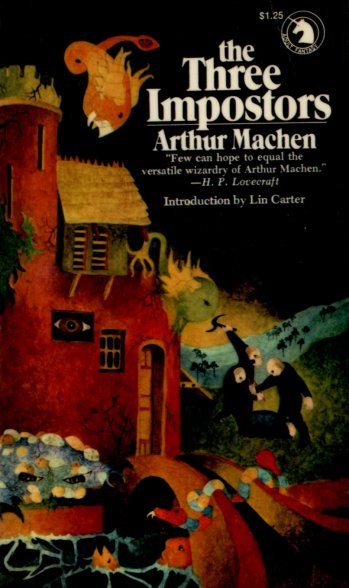
That’s an amazing cover illustration. Shame the story doesn’t sound quite my sort of thing.
I can´t be parcial with Arthur Machen; i love his work in weird fiction. Yes, i see all the defects and trouble around his view on problematic issues, but i still love his take on the supernatural. About this fragment, i´ve always thought that even if Professor Gregg´s a real person and died in the novel, Miss Lally´s narrative is a complete Hoax from start to finish. It never ocurred to me that those events with poor Jervase happened for real in the least. I think it´s a debatable subject, but once knowing that the three impostors are evil experts in deceiving people, every story they refer in search for the man with the round glasses is really complex lie.
Sorry, i meant “impartial” in my first comment…
Yes to Seba Cabrol @19 – I’ve always taken it that way too.
I think the whole point of the stories in The Three Impostors is that we the readers are supposed to realize the conspirators – the three impostors – are making up their stories on the spot, based on whatever they think might most engage the person they’re talking to, in the hopes it will either reduce their suspicion or possibly net them a clue to the whereabouts of “the young man in spectacles.”
Publishing ‘The Black Seal’ by itself has always been an odd choice, as that takes it out of this context, where Phillips is the more foolishly credulous and naive of the two main characters in the framing narrative, Lally/Helen is actually a superficially charming psychopathic murderer, and we’re supposed to momentarily suspend disbelief as we hear her story while then seeing all the ways in which it’s ridiculous.
It’s quite a complex thing Machen was trying to do there, not just with stories within stories, but with repeatedly reversing the implied believable/unbelievable nature of the nested stories.
A question:
Does anybody remember a homage or pastiche of the Three Impostors, published as a PB probably sometime in the late ’80s or ’90s, which incorporated a number of quasi-Lovecraftian stories in the internal stories, and with the framing narrative involving a similar plot but with a missing man called Septimus, a pair of good occultists up against evil cultists, and a mysterious “woman with the auburn hair”? I recall it as being fairly good, and it has been bugging me in particular because I think I should have a copy but I can’t seem to find it in my F&SF collection and can’t remember the title or author’s name.
DemetriosX @@@@@ 1: Machen was Welsh, and grew up in Wales, so I suspect the bits about Welsh being a terrible unearthly language and the hills unknown to Englishmen were probably an attempt to subtly poke fun at Englishmen and English writers’ stereotypes about the Welsh people.
Final comment, seconding a few voices above: Yes, everyone who’s a fan of this column should definitely read T. Kingfisher’s The Twisted Ones. It’s outstanding, does some brilliant things with Machen’s story ‘The White People’ – that’s not a spoiler – and in my opinion creates a much better and more horrifying story than Machen’s original story through using it as source material.
T.E.D. Klein’s excellent folk horror novel The Ceremonies was also much inspired by ‘The White People’. I think it’s an unusual distinction for a short story to have inspired two such different novels by two different authors.
@CliftonR: Well, that or he’d internalized those English attitudes. Probably not, though, given his interest in Celtic Christianity.
Machen seems to have had some issues with some woman named Helen. Or … Is the Helen here the same as the Helen Vaughan in the Great God Pan?
Neal @@@@@ 25: That had never occurred to me, but it would make complete sense in-world.
One of my problems with The Great God Pan is that I have always been skeptical of how genuinely awful Helen Vaughan’s deeds might have been – due to the limitations of “unspeakable” as a description, without further details. She posed nude for drawings, fine. What else? Orgies and group sex? Bisexuality? Drugs? Blasphemy? Paganism (gasp)? Pfff, so what.
On the other hand if the implication was always supposed to be that she’s a genuine psychopathic sadist and torture killer, now there’s some genuine horror attached.
Helen of Troy and Pan are both from Greek mythology.
Catching up on multitudinous comment threads after a hectic several weeks…
Old_fan @7: That’s actually a question for Tor.com (the imprint, not the site). I know what happens next, whenever they’d like me to get to work!
Necessary_evil @14: Are you sure this wasn’t in an alternate universe slightly sideways of this one? While I’d have been happy to blurb it, in this reality I’ve only just finished reading it! What did my doppelganger have to say?
If she tricked Gregg into the offer of a job, did she also trick him regarding the fair folk? Or, as an operative for a larger occult organization (as Impostors would have her), is she using her closeness to Gregg to spy on his research?
The impression I got was that the entire story was an invention and she never met Professor Gregg at all. She doesn’t just say goodbye to Miss Lally, but also to “occult adventure.” (On the other hand, the little people do show up elsewhere in the Mr Dyson stories).