





Savannah is recuperating at her parents’ lake house in upstate New York, in the winter after a breakdown during her last year at uni. There was a traumatic event that included a breakup with her best friend. Now Savannah is trying to deal with that and with her unmedicated OCD in isolation, with the help of far too much wine dangerously mixed with a nightly sedative.
A few months prior to this, Ava went on a camping trip with her colleagues Megan and Chad in the Adirondacks. Chad’s “competitive masculinity” takes them off the trail and into the wilds; by January, Ava is the only one left, and she is still lost. We know from the start that Ava is now dead because we meet her as a corpse, but even so, her journal entries leading up to her death create an inevitable feeling of sadness, of a pathos for these two young women whose lives will end because a man insisted he knew what he was doing.
One night Savannah wakes up in the woods behind the house with no memory of having sleepwalked out there, and finds a dead woman propped up against a tree. After her initial shock, Savannah goes through the bag next to the corpse, finding a journal that tells her who the woman is and what happened to her.
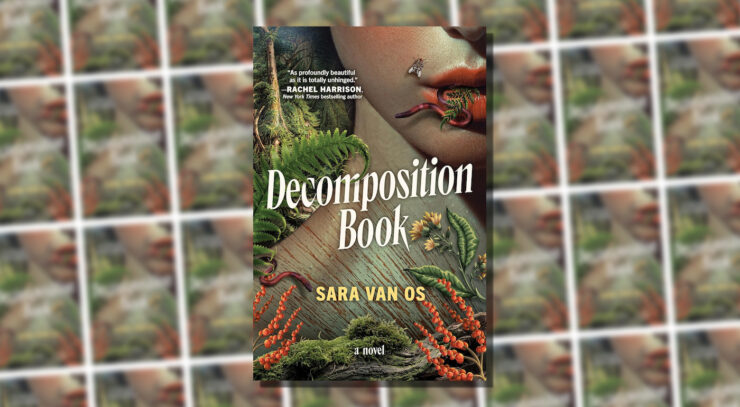
Sara Van Os’ debut novel Decomposition Book is named for the journal Savannah finds, which is the second of the two parallel narratives that form this story. The journal contains Ava’s story in her own words, written towards the end of her life and recounting the camping trip that turns into a nightmare. Savannah, with intrusive thoughts that take the shape of her ex-best friend Michelle who goads her on, chooses not to report the corpse right away and instead read the journal first. In doing that, she begins to know who Ava was, and starts to see the corpse as a friend. She visits her daily, and sits with her as she reads her story. She goes back home and looks Ava up online, finds out that she was an opera singer, sees what she looked like when she was alive, and builds her a personality based on her digital footprint and her journal entries. It would all sound creepy, if it wasn’t so painfully clear just how lonely and miserable and in need of loving intimacy Savannah is.
Not just has Savannah had a traumatic experience (we do find out what it was, at the end), but she is trying very hard to cope with an unmedicated disorder. Her OCD isn’t the kind where she feels the compulsion to clean, though she wishes she had that instead of the constant intrusive thoughts. It is jarring to read someone else’s compulsive thoughts this way, especially for neurodiverse readers: the cruelty we subject ourselves too, the terrible ways we talk to ourselves, the ways our brains trick us into spiralling down to the unhealthy depths are all made so painfully clear via Savannah’s narrative. It can be heartbreaking to read as this young woman tears herself down in fear and loneliness, as she repeats terrible things her (awful) best friend had told her that she has absorbed as truth about herself. Savannah convinces herself she has no empathy, but that “it can’t be [her] fault. It’s a generational problem. Corpses have been walking in and out of my life as long as I can remember: 9/11 as a baby, true crime docs always on the TV, the news, live streamed wars, that Reddit video of a cartel beheading that went around my middle school, Twitter… One time the high school next to mine got shot up and I just went back to school the next day like nothing had happened,” but with Ava, Savannah starts to feel something, because Ava is “not just a story; she was a life. I have her voice. I have her handwriting. I have her body. I have something real, for once, in a world where everything unpleasant can just be scrolled past.”
Buy the Book

Decomposition Book
So much of Savannah’s OCD has to do with chasing certainty, and in Ava (or rather in Ava’s dead body) she finds that. Here is a person who won’t find her too much, won’t think as Michelle did, that Savannah is “always spilling out over [her] own edges.” Here is a person who is slowly, systematically wasting away physically, but also coming together in Savannah’s mind, as she reads more and more of Ava’s journal entries.
The slow decomposition of Ava’s body parallels the slow unravelling of Savannah’s mind, as she tries to figure herself out and as her intrusive thoughts take on a desperate shape. What is real, and what isn’t almost doesn’t matter, because what we see is a young girl so scared and alone that she needs the ghost of a stranger to guide her to her true self. Ava, the more experienced and confident gay woman who was firmly rooted in her identity, turns out to be Savannah’s catalyst, in more ways than one. As much as one version of Ava takes on life and gives a new life to Savannah, her body continues to rot, until she becomes “Las Vegas for maggots… feasting at the all-you-can-eat buffet that is her corpse… a blanket so thick that I can barely see her underneath.”
What really stands out in Decomposition Book is Savannah’s loneliness: the sheer loneliness of coping with a mental illness, of trying to figure out sexual identity, of trying to heal from trauma, as well as from being physically alone, because it still feels safer than to be around people. Her dark humour and rapid spiralling all signal deep grief and fear, so well played out against Ava’s narrative, which shows her being steadfast and secure even when trying to survive physical dangers.
The one part where some suspension of disbelief is required is that three adults with existing family, friends and colleagues are lost in the woods for many months with apparently no one being able to find them, or any trace of them. Surely someone must have known where they were going? Surely someone would have found them or some trace of them or their phones? Sniffer dogs? Helicopters? Nothing? Even given the sheer size of the Adirondacks, this feels a little unlikely, but it isn’t a huge misstep in the novel, which turns out to be horrific in unexpected, emotional ways.
We are in Savannah’s head as much as she (and we) are in Ava’s. Both narratives are close first person, and because they are both loaded with so much grief and trauma and yes, also love, there is a deeply intimate feel to Decomposition Book. This is in turns a body horror thriller, a coming out and coming of age novel filled with queer longing, an examination of a debilitating invisible mental illness, and a young woman’s attempt at moving on from a trauma that she does not want to let define her. Sometimes it takes a long time to figure out who you really are, and sometimes it’s the ghosts of the people we wish we’d been who help us find ourselves.
Decomposition Book is published by Hanover Square Press.
Read an excerpt.
