


“What is a monster but a creature of agency?”
Lenore has been a dutiful wife to steel magnate Henry for a decade, and she knows how lucky she is to have landed him as a husband. The carriage accident that orphaned her as a child left her in the dubious care of her bitter Aunt Daphne. Marriage to a social-climbing man of industry seemed the only way towards anything resembling freedom. It helps that Henry is handsome, an obvious prize—and that they’re bonded by the great secret she helped him keep.
Lenore employs her survival skills and traumatized demureness to elevate their status in British society. She dutifully inhabits the role of perfect wife, managing their increasing staff and maximizing social opportunity, tending to the outwardly enviable life purchased by her husband’s industry. There is only one thing Lenore cannot do for Henry, one thing her body seems to refuse to provide—after ten years of marriage, still no child. It’s been over a year since he came to her bed, and the hope seems lost.
Tensions are simmering when Henry uproots their London life to settle in Nethershaw, an enormous, isolated estate deep in the moorlands. He’s decided to host a hunting party in just over a fortnight, which means a nigh-untenable amount of work for a wife. Nethershaw is a mouldering thing, half a ruin, rendering their London fripperies absurd against the vast, lonely moors.
On their way to the estate, an eerily familiar carriage accident brings a strange woman into their lives—a woman who cannot, of course, be the one who’s appeared in Lenore’s dreams. Brought to Nethershaw to recover, Carmilla’s presence exacerbates the tension. She’s blunt and unapologetic; her behaviors indicate a volatility that Lenore has no idea how to navigate. Her very existence goes against so much of what Lenore knows of womanhood and the world. Carmilla knows what she wants at any given moment, and she gets it. Lenore can’t remember ever asking herself what she wants, instead focusing on what she should be doing, the actions best suited to keeping herself safe. The more Carmilla’s strange unruliness disrupts the life Lenore’s built for herself and her husband, the more Lenore is drawn to her with a magnetic pull that feels less like a reverie and more like waking up, at last.
“To be a woman is a horror I can little comprehend.”
Everyone who’s stayed in a bad relationship too long knows: If you stay after the Big Bad Thing, the once uncrossable line, all the other bad feels manageable in comparison. Henry makes an accomplice of her—or rather, she makes an accomplice of herself, a choiceless choice, when she binds herself to him. She knows who she is as his wife, for better and for worse. Like so many white “well-bred” wives of their class, she finds herself either complicit or utterly alone, so she chooses to be complicit in the hopes that she can rise with him, instead of being one of the bodies he pays someone else to hide. Until Carmilla shows her there is another way, and the tension between what is “proper” and what is true comes to a bloody head.
Buy the Book
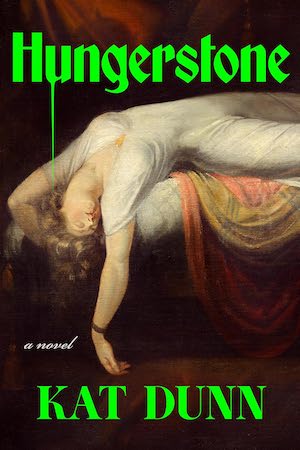
Hungerstone
Hungerstone falls in the genre of some of my favorite kinds of horror: The monstrous element only reveals what was already evil there. Violent industry is an abusive relationship, a broken promise and ceaseless exploitation, which means Lenore, presently and through what Carmilla opens in her, is able to recognize it. Henry is the standard, not a deviation.
This is a story of the way trauma, emotional abuse, and gaslighting literally wires our brains, and how we must find ourselves within the survival mechanisms. Dunn’s writing is eviscerating, pleasurable, and inviting; a masterclass of first person present, it knits close to Lenore’s traumatized mind, so the reader is beguiled by Carmilla alongside her. The choice is immediate and textural, embellishing upon the original Carmilla’s intimate, unreliable narrator. The events feel both shocking and inevitable, an elegantly intoxicating slow burn of mounting suspense. There’s some influence from “The Yellow Wallpaper” here, some of Wide Sargasso Sea’s reframe of the “madwoman in the attic.”
Carmilla as awakening, as savior, as the self, as desire, self-trust and confidence and want, true pure want! Carmilla as avenging supernatural presence, goading and enticing trapped women to gnaw their way free.
Here the monster is not the killing thing, but the thing that wakes Lenore to life. Monstrosity means at its core transgression, and therefore is defined against what a society has deemed appropriate. When society deems appropriate, then, the dominion of violent men who systemically and casually rise in each other’s esteem by wreaking harm on those who build their fortunes, “monstrosity” becomes the only true course for anyone who is not those men, so long as she wants to survive. Carmilla’s “monstrosity” lies within her honesty. She does not adjust herself for other people’s comfort, and she does so shamelessly, as she knows she deserves personhood as much as anyone else—more, if he’s a selfish monster with punishing appetites.
Within this story of property, status, and duty, Lenore’s relationship with her body evolves compellingly throughout. Early on she states her body is “not her own”; she experiences it as a site of fear and failure, a thing to master—and presently, a mutual victim. She doses herself with laudanum and pastilles to survive menstruation and her own mind, forcing herself into careful detachment until Carmilla sinks her teeth into the meat of her, rending her prettily crafted domesticity until all that remains is the truth.
“Perhaps I have been haunting myself, Carmilla has but given it form.”
Hungerstone’s gender dynamics are more complicated than simply man has agency, woman fights back. The effects of Aunt Daphne emphasize this, as does the intermittent presence of Cora, Lenore’s socialite frenemy who appears happy in her limited role, a delicate foil to Carmilla’s lusty version of femininity. But Dunn also emphasizes that Henry “unmans” Lenore at key moments. He unsexes her throughout, referring to her as “not like other women,” as if womanhood is an impediment she should be glad to be free from, superior to. As if his manhood isn’t wholly dependent on the dominion of others, thus necessitating someone to profit from. As if the dominion of white Western masculinity isn’t dependent on constructed, violently maintained subservience. Men will use women to advance their status in the regard of other men, then dispose of them, conscience clear and absolved by those same men. Henry means “not like other girls” as a way of conditioning her away from her own emotions, and for a long time, it works.
But Henry underestimates her, and overestimates himself. His own careless confidence reveals the Omelas-like open secret at the root of his “providing.” The safety of the patriarchy is a lie; there is no level of compliance that guarantees protection from an angry man when he has decided you’re in the way of his wants. A person is an imperfect appetite, and a woman is a person—you cannot starve her and expect her not to bite the hand that promised to feed. “He does not understand why he should be limited,” Lenore observes, and how can you reason with that? You can only use their misperceptions against them. Henry, like his father before him, like so many powerful men, sees a woman’s personhood as an impediment to his own. There is nothing to reason with there, only escape from. The slow fray of Lenore’s subconsciousness as she awakens to the horrors of her life, the way Carmilla guides and goads her into knitting it back together, until she’s someone at once new and the same, but less afraid. Or, at least, afraid of the right thing.
Kat Dunn builds on Le Fanu’s text to explore patriarchal appetite: a man’s hunger for status at any self-serving cost, a woman’s starved personhood, the tension between fear and desire. Women’s sexuality outside of feeding her husband’s or providing heirs has historically been seen as sinful, if not nonexistent, and Carmilla upends this farce. Still, it’s not a clear-cut story with a clear-cut villain or hero. Not even the tragedies nor the magic are fully defined or moralized, and that renders the hard half-choices clearer somehow, more satisfying. This is a study in motive, mastery, and monstrosity. Only the consequences of exploitative industry are wholly drawn as the horrors they are, which works well as a foundational, far-reaching truth.
Hungerstone begins with blood, blood as a signifier of the absence of new life, and the ending twists back to blood in glorious, gory catharsis. That said, don’t expect bombastic violence, or even much about what it is to be a “vampire”—the story does Carmilla justice in that you can understand the events of Hungerstone as the beginning of the English understanding of the concept. So there isn’t one to compare it to. Very effective at what it is, but not splashy genre vampire horror.
Indeed, my one major wish is that we’d gotten more on the specifics of what, exactly, Carmilla incites in Lenore. Bodily autonomy, an awareness of her own desires and disenfranchisement yes, but it’s kept largely general, at times nearly generic. This may be to emphasize how magnetic their attraction is, how base Lenore’s suppressed hunger, but ultimately comes across almost shallow. Carmilla winds up more of an emblem of “appetite personified” than a multi-dimensional character in her own right. I wish it delved deeper into the intimate specifics, because it lands more of an allegory than either a love story or a horror story. Carmilla becomes, for Lenore, a darkly vindicating deus ex machina.
Nonetheless, it’s a fun, fast-paced subversion. If you (like me) just enjoyed Nosferatu, this might just be the sapphic gothic spin you’ve been hoping for—she visited me in a dream, haunting me with a desire I didn’t know belonged to me before we met. There’s also something of The Substance’s horrible vindication—nothing I am will ever be good enough for you—and a tender, believable bisexuality that marries well with Lenore’s almost Mean Girls-like social circle.
I wanted a bit more of a spectacular ending. It felt a bit rushed. But it’s genuinely one of those endings where I don’t want more than this, just more of this. I love how it ended, and would have liked to dwell in its explosiveness a bit more, as we dwelled so long in its coming. Still, it doesn’t feel wholly accidental, or a flaw of craft, that I come away from the ending wanting more, more, more, that my mind alights with what might come next. It’s fitting, not frustrating, that Dunn leaves the reader whetted. It is, after all, a beginning of sorts. It feels like a spell—like the reader could be next, haunted by dreams of a soft, clawed cat and freshly wakened awareness of her own snarling appetites.