


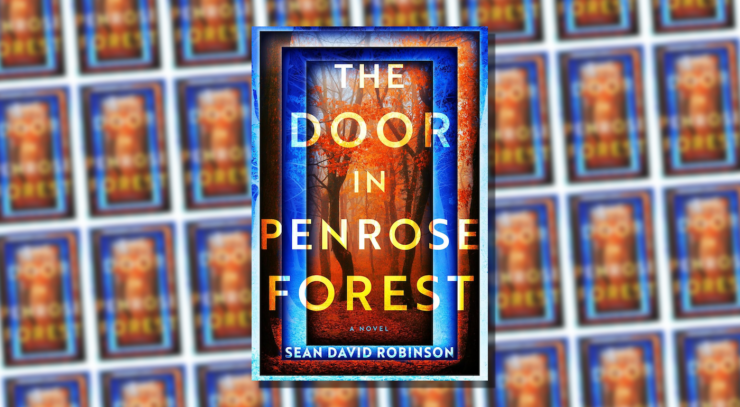
I will always say yes to the quasi-gothic decline of a messy backwater empire, because I am someone whose preteen story time consisted of Lorna Doone, NBC’s Passions, and crusty old Barbara Cartland novels that I hid under pillows. I love mess. I love stories about adult men who call their parents Mother. I hoped, fervently, that The Door in Penrose Forest, whose description promised family secrets and alternate Gilded Age history and weird shit in the woods, would give me the drama I crave. Mess—it’s soup. For my family.
Sean David Robinson’s mystery/speculative fiction debut follows Nico Calloway, whose mother goes missing during an eerie Unsolved Mysteries incident on a family trip in Penrose forest. At the first mention of “monarchs,” a small part of me hoped that the novel was setting itself up among forgotten Appalachian royalty rather than butterflies, as I have a bad phobia of moths. But no, these are definitely butterflies—Dr. Julia Calloway is a lepidopterist studying a migration crisis amongst monarchs—and there are lots of them, which added an unexpected personal dimension of lowkey horror to my readthrough.
After Julia appears to walk through a door of light in the middle of the woods, things take a downward turn for Nico and his dad; the inevitable conspiracy theory TV documentary and morbid sensationalization makes life even more difficult for the family. Nico, an uncannily clever child who is far better at puzzles than playing with other kids, grows up into a restless loner, unable to fit into a formal profession or social niche. He dabbles in scientific research and career-making projects as a form of charity from his mother’s old colleagues, and eventually finds a rhythm in everyday minimum-wage work; the traumatized introvert’s inclination to avoid well-meaning but exhausting questions about life and direction is deeply relatable. When his dad falls sick, Nico heads back to Penrose, a small town saddled with intense historical baggage and bizarre folklore, to face the past.
Lots of things tend to happen when someone goes home for the first time in a long time. Awkward interactions with exes, painful family encounters, wistful reflections on the person you were versus the person you’ve become—the list goes on. There are also a lot of stories out there about precocious gifted children who grow up into awkward unfulfilled adults who can’t find a foothold in the real world, for many different reasons. This is a popular stereotype and narrative trope, but it does not always make for an interesting story, depending on execution; it is one thing to feel sympathy for a character with unrealized potential, and another to constantly echo the most entitled person you know without a decent payoff.
Buy the Book

The Door in Penrose Forest
To this end, Nico isn’t quite the latter, but it is difficult to define him as a person without invoking his Mother and his past, which is arguably the point of his characterization. Yes, this is a story strategically weighed down by emotional baggage, but the recurring references to his quasi-polymath gifts and unapplied intellect sometimes feel like dead weight. The Door in Penrose Forest is functionally a smaller, local version of a chosen-one storyline where only a singular, special soul can fix the world. It treads a fine line, and depending how these themes speak to you, it could either be a comforting binge read, or a meandering and occasionally frustrating speculative drama that pulls some of its most impactful punches.
When the book does lean fully into its own weirdness—it dips into other character perspectives told through old journals and books from the past—it’s mostly a fun, polished read that pulls the reader through an alternate history filled with robber baron philanthropy and Gilded Age shenanigans. Penrose was once the home of American royalty: Cornelius Penrose IV, scion of an obscenely wealthy dynasty, and his socialite wife Odessa. There are some really great ideas here about what this tiny backwater could have been, had the Penrose family continued to nurture the town and turn it into “the Paris of Appalachia” (paraphrasing loosely from the book) with their wealth and influence. We’re told of diplomats and celebrities and visionary artists and esteemed scientists (including everyone’s favorite misfit scientist, Nikola Tesla) turning up at the Penrose estate, with the town itself booming thanks to Penrose-funded infrastructure. There’s also—without spoiling too much—a brief glimpse at an alternate timeline that feels both Back to the Future-familiar and pleasantly fresh. There’s a lot of fun stuff to read through a critical modern lens, and the period worldbuilding (minus a couple of draggy portions in the journal recaps) was arguably my favorite part of the book.
Despite some rough edges, there is real warmth at the heart of The Door in Penrose Forest. Robinson does a good job at fleshing out Nico’s relationship with his beatnik dad, painting a living portrait of grief and loss colored with dry humor. Although all roads in the novel lead to finding Mother, there is something irrepressibly dad-coded embedded in the prose, from the humor to the pop culture references. There is real warmth in Robinson’s portrait of a small, scarred town, a trauma-riddled Cheers where everybody knows your name and the horrible story behind your Mother’s disappearance and probable death (to be fair, everyone on Cheers had trauma too, but they also had Frasier and a lot of beer) and your inability to recover from it. There’s a quaint, intimate charm on these pages that kept me going, and to Robinson’s credit, once the book builds up to a nice crescendo in the final third, it was hard to put it down.
The Door in Penrose Forest is published by Crooked Lane Books.