







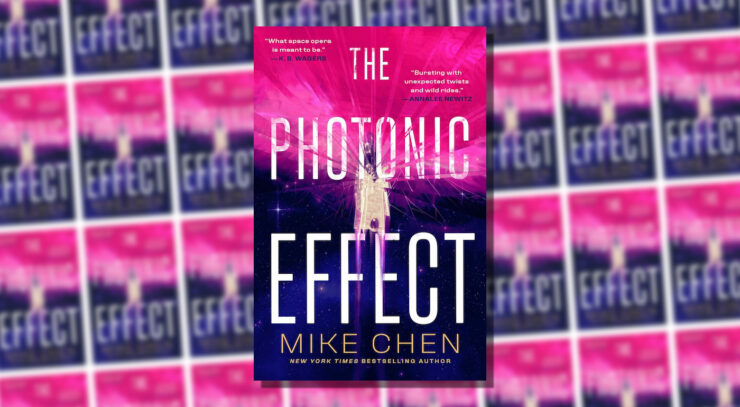
In the late 23rd century, the GCF Horizon was unexpectedly yanked, with a surge of energy, away from its survey-mapping mission and deposited in a gravity well 20,000 light-years from Earth. While stuck there, they encountered unknown aliens and parallel-universe humans similarly pulled through to this strange collection point and brought many of them aboard as crew. Ten years of work later, helped along by the Lumersians, beings of pure light who occupy the well, Captain Demora Kim and her crew used an experimental photonic engine to leap back to explored space—but not all is well when they return.
No, this isn’t Star Trek, but Mike Chen’s The Photonic Effect draws much of its inspiration from Captain Janeway and the Voyager. What if, he wondered, Janeway and the crew returned smack in the middle of the Dominion War? And what if, struggling with their role in the war, they received a distress call summoning them back to the place they were stranded?
For the crew of the Horizon, war is a distant memory, a school subject; they’re understandably shocked to find themselves in the middle of a bitter civil war between the Cluster and the Withdrawal Movement. Captain Kim, distressed by the death of her Lumersian partner “Chuck” during their escape from the gravity well, cannot find a way to balance her loyalties as a Cluster officer with her responsibility to her crew. Tanav, a parallel-universe musician and corporate heir, now the Horizon’s unofficial morale officer, wavers between his burgeoning relationship with communications officer Lynn and the promise of returning home. And Neera, a Dywan engineer fleeing his own empire, only wants the chance to buckle down and tease out the secrets of the photonic engine.
These tensions lay dormant for months as the Horizon sits on the back lines, far from the shooting. But when attacks on the Cluster threaten to drive every available ship into active service, and a Lumersian message reports urgently that the Horizon’s escape has fatally destabilized the well, Kim sees just one way to extricate themselves. Mutiny.
The good news is, it works. The bad news is, Kim isn’t the only one to think of stealing the Horizon.
Both the Withdrawal Movement (WM) and the Cluster’s black-ops division have spies on the Horizon; two jumps of the photonic engine later, unreachable and isolated, they make their moves. Kim, Tanav, and Neera find themselves held hostage at the ends of the universe, the secrets of their expedition demanded from them. They haven’t escaped the war at all—they’ve only brought it with them.
In some ways, The Photonic Effect matches the classic, future-looking sci-fi story of “a new technology’s just been discovered—how does it reshape the universe?” The photonic engine the Horizon brings back from the gravity well is, in essence, a warp drive, allowing near-instantaneous (if a little nauseating) travel between two points thousands of light-years apart. Every fleet admiral on either side of the war salivates at the prospect. The fact that Neera, tinkering with the engine, upping its output, hooking up the sparking wires, is a natural pacifist only makes it harsher when his work is exploited; the most exhilarating section of the book, where I sat up and went “oh damn, we’re really in it now”, was when the Cluster’s black-ops man reveals they’ve already figured out how to weaponize photonic energy and people start disappearing in brilliant flashes of white light.
Buy the Book

The Photonic Effect
Chen also isn’t afraid to start killing off the Horizon’s crew as he raises the stakes. Every Star Trek-inspired show’s got to have its share of “redshirts”, and, well, there are a few plucky ensigns on the command deck and engineering bays who fit the bill…
But for all it looks towards the future, The Photonic Effect is also a book about reckoning with the past. Readers are asked to join the Horizon at the end of a long journey, not the beginning, with a crew who’ve spent the better part of a decade living in a ship the size of a city block. No exploring strange new worlds or going where no one has gone before, either (last Trek reference, I promise)—we’re following in the steps of the Horizon all the way back to the gravity well, older and hopefully wiser. Surely, this time, the Horizon can do everything right?
The dynamic can feel stifling at times, the weight of those ten years preventing the characters from changing as quickly or dynamically as I might have liked. Which is a shame, because the Horizon is a perfect example of a “crucible”: the container that holds characters together as things heat up, the bond that keeps them in conflict rather than cutting a truce or extricating themselves from the situation. Sometimes, those are intangible connections of love or vengeance; other times, it’s the simple physical geography of being trapped on an island, in a prison, or aboard a confined spaceship. But too often, Chen allows his characters reprieve.
Take the mutiny. It doesn’t go as it should: Cluster-appointed first officer Matthews lingers too long on the bridge, so Kim has to sedate him and drag him to the brig, and the Horizon’s hasty exit leaves several crew aboard who don’t want to be criminals, actually. Their anger threatens to provoke a reckoning against the captain—but we never get one. Kim’s able to push them off by promising “a conversation” after the next few photonic jumps, and they grumblingly accede; the crucible simmers, but does not boil.
Maybe I came into The Photonic Effect expecting it to be something it wasn’t: full of flashy lasers, spaceship pursuits, and pitched battles. Like the Horizon’s crew, Chen prefers the quieter side of space travel, defined by ramen nights, investigative greyhound dogs (belonging to Demi), and long-forged friendships. If that sounds like the way you like your starships, The Photonic Effect is the book for you.
The Photonic Effect is published by Saga Press.
