





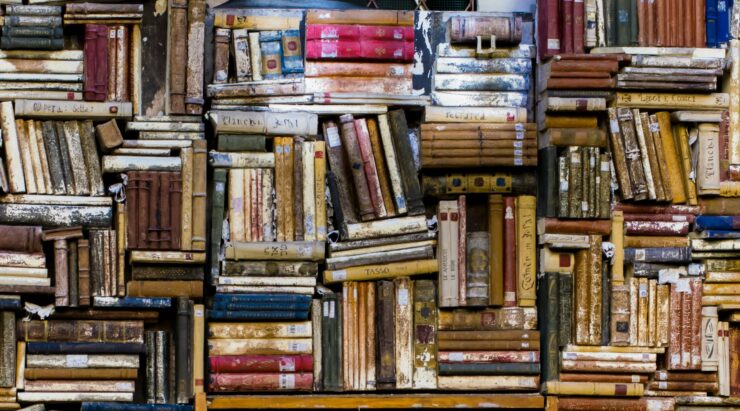
Most days, I look at my books and find a whole mess of positive feelings: Memories of the experience I had reading them; snippets of story; fond thoughts about characters I adored; themes or feelings or ideas that I still carry tucked in my pockets. The unread books are hope, things not yet learned, characters not yet met. The TBR stacks I can never seem to unstack are wishes: I will read this next. I will read this before I start work on that project. I will read this. There will be time.
And some days I want to chuck them all out a window. (Metaphorically speaking. I would never, not really.)
Okay, not all the books. Some? Most? A fraction? It’s not a decluttering urge that brings me to this place, though I understand that temptation, which lurks in the part of my brain that asks Why do you need this are you going to read it again what is it for do you think it looks nice what about this book that there is no room for on the shelf? No, what gets under my skin is something else, something slippery and unavoidable, something I’m trying to be more comfortable with: Mortality. Just plain old ordinary mortality, in the form of a thought: What will become of all of this?
While this isn’t a pressing concern yet—I hope—as I age, as death comes for people closer to me, as the world continues to turn and continues to burn, I find myself wondering: Where is the tipping point? What happens? What do I keep forever? What feels like a piece of who I am? What meaning does this collection have to anyone else?
I am no minimalist. I once joked that if I ever could fit all my stuff in a Mini Cooper, I should be allowed to buy a Mini Cooper, the joke being that this will literally never happen. Most of my stuff is paper: Books, notebooks, journals, copies of a weekly paper I used to work for, more books, yet more books, notebooks stuffed full of ticket stubs and mementos. My books tell a story about who I am, what I value, what matters to me. But it will only matter to me, and only for so long.
And so I keep finding myself thinking about the act, the art, of collecting, of picking and choosing what matters, what we keep, and what—ultimately—we want to deal with later. I think about the digital clutter of unorganized photos, old blogs, little bits of myself scattered around the internet.
Books have always been separate from this train of thought, not a collection but a kind of mental necessity. What is a home for if not to fill it with books? What would I do without them? I can’t get rid of these stories, even though I’ve internalized them. They’re part of me. They’re mine, and the physical reminder of that needs to be here, on the shelf, too rarely dusted.
Does it, though?
My partner and I joke about Swedish death cleaning like it’s a hobby. We don’t have kids; we don’t know who would want our old mementos. Who cares about the weird, massive keychain—a bundle of other keychains smashed together like some terrible mutant—I for some reason carried all through high school? What about cheap earrings in the shape of the Legend of Zelda’s Triforce? What about this old copy of Sophie’s World with the name of everyone I ever lent it to written on the inside cover? Plastic unicorns from the mystery boxes that I can never resist when in the checkout line at Powell’s? What is any of this for?
“Books, even ones I desperately want to read, still have to have a limit. Because truly, the more I buy, the less I read,” Vanessa Ogle writes in “On Book Hoarding and the Perilous Paradox of Clutter.” I have tried to do that math, the math that tracks books in and books read. I tried it for about a month and immediately grew tired of it; it missed the point. The point was that when I buy books, I’m spending money on the idea of the book, the idea of being the person who reads it. If I buy more, do I read less? No, there is always more to read. Always more to buy. There is always another story.
And there’s always another story to tell myself about why I have all these books. They’re my library, my memory; they’re also my nostalgia, for better or worse, for having been the person who read some of these books, and the person who dreamed of reading others. I am comforted by the fact that I will never be without something new to read, but I’m also, absurdly, concerned that I will never read all the things already on my shelves, let alone everything else I want to read. It’s not a real problem. It’s a luxury. But there it is, in my thoughts.
I would like there to be a simple reason for this, a single thing that sent me into a series of thoughts about death and life and what happens to our things, but there isn’t. There is instead an endless series of things: a death in the family, thousands of deaths in the news, the warmest winter on record, piles of discarded fast fashion in other countries, friends’ pets dying, more deaths in the news, war, famine, the list goes on. Maybe, though, it’s not a bad thing to think these slightly morbid thoughts about what I have, what I am, and what happens to all of it. In Make Your Art No Matter What, Beth Pickens talks about “death acceptance,” which is a practice of cultivating a specific relationship to death and grief: “Learning to tolerate and make some peace with the fear and dread is how my brain, slowly and over time, changes to be more in the present, able to endure grief and discomfort.”
Later, she writes, “Where there is death, there is art, and vice versa.”
Sometimes thinking about death acceptance feels like a privilege. Death comes for us all; many of us don’t even have time to think about it. Sometimes it feels like a necessity, for all the reasons Pickens lists. And sometimes, it just turns into thoughts about things, about what we leave behind, about why I have things, whether I want things, whether it’s time to shed another layer or reframe my relationship to what I have and who I am. Most of my trains of thought lead back to stories, in the weird and winding paths of my mind. But the story of a book as an object—the story I impose on my books, whenever I look at them—is not the same as the story it contains. No one else will pick up a specific copy of a book and know the experience you or I had reading it. You can’t pass that on, not without writing it down yourself. What is a collection without its collector?
What do you want to happen to your books? What are they, to you? Are you a keeper or a giver-away, a collector or a borrower? Do they have a future in your family, or with your friends, or on the shelves of the bookstore next door? Does it matter to you? Do you think about it, about what happens to the pieces of a life?

I don’t know that any of my possible heirs have the interest and ability to preserve my bookhoard, so the solution I’ve arrived at is simply not to die. So far, I have been almost entirely successful.
“No one else will pick up a specific copy of a book and know the experience you or I had reading it. You can’t pass that on, not without writing it down yourself.”
Even then, you’re not passing on your experience so much as a transliteration of your subjective view of your experience.
Besides which, who would even want that? Scholars, perhaps, but in that case there’s a lot more I need to get in order than my bookshelves.
Let people see the books I had. Let my loved ones take from those the ones they associate with me, and have their own experiences. Let my enemies weep and rend their clothing upon seeing what the signed ones sell for.
My mother died earlier this year and I’ve been confronted with the reality that what was to her a comfortable home, is now (mostly) unwanted things that her children have to get rid of. So I’ve been ruthlessly cleaning out my own home. With no partner and no kids, I look at my stuff and think about what will happen to it. And then I look at my library. When I die there will be a room full of books to deal with. I’ve already told my nieces and nephews they can take any of them they want (which probably won’t be many) and then they will be donated to my local library for their annual used book sale. I suspect when I’m dead I won’t really care what happens to them, but I hope they find new homes.
Yes. My mom died 2 years ago and I had lived with her for the last 10 years. Going through all her stuff is an ongoing process. She loved what she had, but neither my sister nor I want it particularly. I have been donating it in batches – the sewing and crafting batch to her sewing group, the gardening batch to the garden club, and so on. Her Western history books and art collection went to the local museum for a fundraiser.
For my own books, I started switching to ebooks for most things several years back, so at this point my physical book collection is relatively small – only 500 volumes or so, and most of that either signed or special editions. I am considering leaving a note in my papers for my nieces about how to sell them when the time comes.
I sometimes fantasize about having only enough stuff to fit in a van, but that would mean parting with my favorite overstuffed chair and other furniture that I still enjoy having. And possibly all the cat furniture, too. :-)
I, too, would be foiled my cat’s furniture :)
This is a very important article for me right now. My (younger) brother, who lived 130 miles away, has died unexpectedly, without a will. His heirs are a brother who lives about 300 miles away , and me, and I’m the administrator of his estate. I’ve been working on dealing with his stuff for 4 months now, and hope to finish in another 2 months. My husband and I do have children and grandchildren, and we also have a LOT more stuff than my late brother did. We’ve made sure that they know what’s in our wills and where they are, and they assure us it’s no problem, they’ll take care of it…We don’t want them to have the struggle I’m having now, but we aren’t done with our stuff.
It’s sooner than that — I have 71 boxes in the basement full of books that I’ve mostly replaced with Kindle versions that I need to find a disposition for. The ones I care about most, I have in hardback, and will keep, but my paperbacks that I have electronically need to find their way to new hands.
this speaks to me. I DO have more books than I can possibly read and, yet, I still acquire more. I have made improvements to my lifestyle. I get more books from my local Library. Unfortunately some of the books I want to read are available only electronically from the library and, try as I might, I cannot get comfortable reading books on an electronic device. So, those few books, I buy used copies. I recycle a lot of books piling up books read and not worth keeping to take to Goodwill. So I’m much better than I used to be. I plan on purging my personal library if and when I need to leave my home because that will result in a much smaller place, I’m sure. I tend to follow books down a rabbit hole, seeing a book mentioned in a book I’m reading, seeing a book mentioned in a review, or discovering a book in various other ways. Those times make me want to read a book that is often old and new to me. when I acquire one of those when the library does not have it, I tend to read it right away and put it in the recycle pile. Loved this article
I tooo find myself following various “trails” and mentions to more books that I just have to read!
Thank you Molly for this piece. When my surrogate grandmother died she left me her books, because we shared a love for them. She’d worked in a library and had many discontinued library books with barcodes still on them. But of course I ended up only choosing a select few that reminded me most of her and wasn’t able to take them all. Maybe that’s fine: our loved ones looking at our collections & choosing the stories they care about most, like the core memories they choose to keep of us. Only small pieces of ourselves living on in and with others. Dust in the wind, and all that.
Molly, as someone who owns a Mini Cooper, you’d be surprised at how much can fit into one!
Most of my hard copies came from thrift shops/used bookstores, and I’m fine with the majority returning there; there are notes for my children about the signed editions. My Nook is 10 years old next month and much of the personal library lives there and on a backup hard drive or two (stupid vision problems).
Lois McMaster Bujold was right that, “A man’s library gives information about the shape of his mind the way his clothing gives information about the shape of his body.” (_Komarr_)
I look at (all) the books around me and how they show the shape of my mind: shapes it took in the past, shapes it might have now, shapes I wanted it to take. Now my eyes are goofy; I can’t easily read physical books; yet I’m still surrounded by towering bookcases. Far too many are not available in e-editions, so holding onto a copy is the only option for ever reading or rereading them. When I first started going to conventions, 30-some years ago, there were panels on how to maintain and curate a collection. Now the panels are about disposing of them. It’s far too easy to say do this or do that, but even leaving aside that I’d rather my carefully-curated collection go to an appreciative connoisseur, there’s the sheer mass of volumes. It’d be such a massive effort to get boxes, box them, haul them off (anywhere), that despairing inertia sets in, and I scurry to comfort-read a familiar friend.
My husband and I are childfree seniors in good health. What has made me think about death is Covid and the fact that society is now doing very little to prevent its spread. People die, people get long Covid, and no one seems to care.
My husband and I have literally thousands of books in our personal library. Several hundred of them are unread and in our designated bookcases for unread books. We love being able to choose whatever we want to read at the moment. We refuse to think of our books as a chore that we are responsible for getting through somehow, either by reading them or throwing them away. We read every day. We discuss the books we read with each other. Our books are doing their job: To make us happy. They do not need to have any practical value (but some of them do).
We have no nieces or nephews, no younger relatives at all. Our estate will go entirely to charities. They can do some work for the assets by holding an estate sale. If we actually had relatives, we’d feel the same way. The decluttering movement has done a huge disservice by making people think their possessions are nothing but a burden to the owners and to everyone else. It also does seniors a huge disservice by urging their direct heirs and all younger people to tell seniors they are going to die, maybe soon; so they should get on with it, throw everything out, and move to assisted living. In general, that seniors should go hide in a corner and not bother anyone, before or after death.
Nope. I’m going to enjoy my books! Also, did I mention my sewing fabric stash and my crochet yarn stash?
Molly, I absolutely love your column. It’s great to know there are others out there who have a similar relationship with their books. I feel like you were able to verbalize many of my own feelings about how I think about my (ever growing / ever daunting) book collection and TBR pile (and by extension, mortality). Thanks for taking the time to flesh all of this out and write it down.
I’ve always been a shedder of objects, including books–except of course for the ones I hold onto for dear life! It fascinates me which books persist as almost iconic objects on my shelves for years–decades, even–until one day I notice them in a new way and suddenly know I’m ready to let them go OR reaffirm their enduring meaning to me. I’m fortunate to have access to an almost magical used book store (the legendary Montague Book Mill — “books you don’t need in a place you can’t find” is their slogan) and periodically sell them many boxes full of my former silent choir of meaning. Just the other day, I put my Mary Stewart CRYSTAL CAVE series in a box to bring there. It was time. I’m also bringing them a few of my late parents’ similarly iconic bookshelf denizens, books I’m pretty sure they never read, but which stood watch over us for my whole youth. And still, some books will need to be with me forever (they’ll pry my suntanned battered mass market paperback of Keith Roberts’ PAVANE out of my cold, dead hands, as I’ve probably said here before!).
Years ago I lived in a big farmhouse with one large room dedicated to my books and my husbands books. It was heaven on earth. Since then I’ve moved several times, and now live solo in a small ranch house. I’ve got one room with lots of shelves, and another back up shelf-and I’ve told myself that now that I have 10-20 years left on this earth, I can only bring in a new book if I let an old one go. My books have to fit in my available space. So far that’s working ok–because I use my library a lot. But the day is coming when I need to let some more books go–and then choosing which friends to give away is going to be challenging. Meanwhile, the handful of my childhood Scholastic books are still with me, bringing me almost as much joy as they did on the school days I first got them. My books are my friends.
My eldest son will most likely inheret my library. The other one is not a reader since he’s very busy as a 1st responder for the City of NY.
In 2006, I donated everything but my scifi collection. It continued to grow. It was always presumed my daughter wanted them as both a bibliophile and a scifi fan. Then suddenly my son matured and he wanted it too. 17 years later I moved across country to be near my granddaughter. My book collection took up 25% of my largest size pod I had rented and put me way over the weight limit. There were some I wanted one shelf in my condo – the Petn series and Elizabeth Moon’s Vatta series but they got mixed in with the boxes packed by others. Most of all, I didn’t want them thrown put or donated to a places that would sell it as paper by the pound. Some of the books are older than me by publication date. Mostly, I know which happens books are the 1st ones I bought thanks to the science fiction book club when I was 17 years old, 47 years ago. In the meantime. I now have about 50 books on my shelf TBR, 20 of which are hard cover so that her collection of my books remains up to date. That 1st batch of books from the sci fiction club was Dune; so is my most recent purchase a Dune book.
Since I have yet to move out of my parent’s house, my book collection is the family collection. When the house passes down to me, then it will fully be my collection. I don’t plan to move my books from this house, so in the end, whoever owns the house will own the book collection. After I’m dead, they can do whatever they want with the books.
What I’d really like is to specify in our will that there will be an online spreadsheet of our books (we have a book spreadsheet) and everyone we know can flag a particular book that they want, with a chunk of our savings set aside to have someone mail all. those. books. After that: library book sale.
(we did the online collaborative spreadsheet thing with a list of not-food-pantry-candidate things from our pantry we were jettisoning before we moved, and it was glorious to see people excited about obscure ingredients. and also not have to just throw away the fancy cocoa powder, 3/4 of a bottle of olive oil, etc. I could see it not working if friends overwrote others’ claims, but it worked that time, anyway.)
(and one might mitigate potential overwrite issues by having a macro so the paid executor could easily snip out all claimed books once or twice per day and transfer them to a non-public-write file – or have a form where people can see the as-yet-unclaimed books with the form removing them from the list – but multiple methods of sorting/searching is *really* useful for books so I do like the spreadsheet…)
My position is a little different 1) I’m still in my 20’s and hope to live for many years yet, 2) I only have three bookshelves worth and 3) I rarely buy books I haven’t read, so everything on my shelf is something I’d like to reread (or thought I would at the time *mournful look at childhood books that stayed childish while I grew up*). I like the idea of my library being inherited by my entirely theoretical descendants, but I admit, it’s a bit of an egoist desire for the memory of what I was like to live on through the selection of the books that were important to me.
But also, it feels a bit empty because whoever inherits my library won’t know all the stories behind the books. They won’t know that those two random books from the Honor Harrington series are from the beginning of COVID because I had just finished In Enemy Hands when the library closed down, and rather than suffer through the cliffhanger, I bought the next two used online. They won’t know that I bought those four Bujold books with the gift card that my fellow lab members gave me when I left to go to graduate school and how I think of my friends every time I pick one of those books up to read. And probably they won’t care, because even if I told them, I can’t pass on the feeling of that memory, which is what really matters. I suppose more than just passing on my library, I want to benevolently haunt my books so people feel the joy I did when reading them.
When I started getting rid of my excess belongings two years ago, I looked with despair at my bookshelves. I was almost physically incapable of getting rid of any books. They were my friends. My many bookshelves were packed two deep. It was pretty bad. My daughter helped me do an initial purge. It was painful to say the least but when we were finished, there was a small mountain of books in the middle of the floor waiting to be boxed up and given away. I found so many books I had bought and never read. I vowed to read every one of those books and after reading give them away. It may take me 20 years but I will do it. So far I’ve found a few treasures and some stinkers but I have a feeling of accomplishment every time I read one of those books and release it into the wild.
I’ve been running a free book table at our local Convention for a few years now. The community donates all year, then we pass out thousands of books at con. It’s hugely popular and I’ve got to where the act of giving a book is far more satisfying than hoarding one (that gasp when someone finds something special to them is delightful). However, that said, I do have a few hundred still that are special to me and won’t be going to con :) But now I look at my bookcases and every book I see, I love, instead of being buried amongst piles that are just “meh.”
One of the things I love about the internet(I grew up before the world wide web was public) and sites like these is; I found out that I’m not the only person out there that thinks about this stuff – by stuff I mostly mean books.
I’m on my fifth home, and I finely have my own little library, chock-full of all things geeky – books, comics, rock music in vinyl, cassette, and cd, Frazetta pics on the walls, a map of the Hyporian Age, etc… And I often wonder what will happen to it all. There’s several items with a significant monetary value but I’ll probably never sell them.
I’ve enjoyed and still enjoyed this life as SFF geek but I have topped the hill and what happens to all this stuff? My adult son isn’t a reader and my 18 year old daughter is but she doesn’t read what I do.
I just want it all to be enjoyed by someone or many ones as much as I have. If I can figure out how to make that happen, I think dying won’t be as bad and maybe at some level a part of me will stay-on in these books full of stories.
When we moved across the continent to Nova Scotia, we gave away ~70 boxes of books. The majority to younger folks who picked through and chose what they wanted, then passed the reminder forward. One comment we received was ‘there’s gold in these boxes’. Our daughter & son-in-law got first pick, of course. We still moved with ~150 boxes.
Rick LeBlanc
I don’t buy nearly as many books as I used to. Even the ones I really want to read, I usually get from the library. I rarely have time to read them twice, and I figure someone else could enjoy them a lot more than I will enjoy seeing them sit on a bookshelf or (horrors!) trying to move them across the country. I only keep my very favorites. But I cannot bear to get rid of the books I loved as a child. Therein lies my nemesis. Those books were read and reread, held, smelled, engrained into my being. No matter how much I tell myself that some other child could be enjoying them, I keep them. They mean security and hanging onto a really lovely, innocent childhood in some way.
Cierto, no sabes que hacer, regalé algunos a un librero…….