







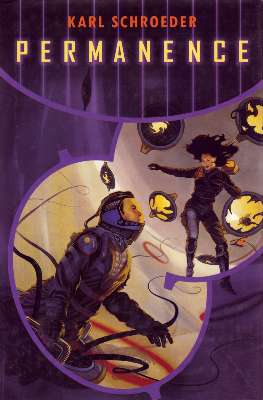
The problem with talking about Permanence (2002), or any of Schroeder’s work really, is that it’s too easy to get caught up in talking about the wonderful ideas and backgrounds and not pay enough attention to the characters and stories. I think Schroeder’s one of the best writers to emerge in this century, and his work seems to me to belong to this century, to be using newly discovered science and extrapolating from present technology, not just using the furniture of science fiction we’ve been familiar with for decades. The idea density of Schroeder’s work reminds me of Poul Anderson. Permanence proposes two different answers to the Fermi Paradox, for instance. But it’s really all about the people. And what makes his work really unusual is that Schroeder pays as much attention to the social systems of the future as he does to the physics, or vice versa. It’s surprising how little SF does precisely calculated orbits and anthropology simultaneously.
Permanence is set in a future that we could still get to. This used to be ubiquitous for science fiction, but it seems to be getting rarer. When I see so many futures of alternate Earths I wonder whether science fiction has lost faith in the future. Schroeder definitely hasn’t. Permanence is set several centuries in our future. Humanity has spread through the nearer universe, building colonies on the halo worlds: worlds circling brown dwarfs and “lit stars” making great wheels of human civilization held together by slower-than-light cyclers. Then FTL was invented, and FTL needs big lit stars to work, so the halo worlds are becoming abandoned backwaters. FTL is synonymous with the Rights Economy, hypercapitalists who feel everything must be owned by a rights-holder, and everything must be labelled with nanotech tags telling you what it’s worth. This history lies beneath everything that happens in the novel; it has shaped the characters and their reactions, they are deeply rooted in it. These are people it’s easy to identify with, but people from very different cultures.
The story begins simply. Meadow-Rue Cassells has grown up in a halo habitat. Her parents are dead and she’s running away from a brother she believes wants to sell her. She flees to another halo world, and on the way discovers an abandoned cycler. So far so Rendezvous With Rama. But while there’s plenty of exploring nifty alien artifacts in Permanence, that’s only one of the points of focus. Rue wants to make the alien cycler part of the economy of the halo worlds. Other people have other ideas. This isn’t a book about exploration but about the question of the legitimacy of government, of revolution, of xenophobia, of aliens and their motivations, of what it means to be free and make choices and shape your environment. There is an enormous spaceship, there are people and aliens with their own agendas, there’s a man questioning his faith. There are a number of different cultures with their own ideas. There’s the interesting background detail that the Earth-culture that most influenced some of them is Japan—Shintoism is a major, if banned, religion, and people quietly and normally eat with chopsticks.
Permanence raises very interesting questions and answers them well, and while bubbling over with ideas also tells a story about what it means to grow up in the halo worlds. This is a book that reminds me why I love science fiction.
Jo Walton is a science fiction and fantasy writer. She’s published eight novels, most recently Half a Crown and Lifelode, and two poetry collections. She reads a lot, and blogs about it here regularly. She comes from Wales but lives in Montreal where the food and books are more varied.

I was about to add this to my wish list, and then realized that these are by the author of the Virga books, which failed to thrill me. So how much like the Virga books is this? Are there girls (plural) in? Who aren’t prizes for the guys?
Permanence blew me away. It made me babble incoherently at my non-skiffy partner, trying to explain the physics of the cyclers–although, to be honest, it doesn’t take that much to get me to babble. The cycler economy sounds like a future I’d want to live in. (The Rights Economy not so much…) While I don’t buy either of his solutions to the Fermi Paradox, I do find them thought-provoking in the best way: they make me think through my own assumptions in order to build a good counter-argument. Very like Blind-sight that way.
To answer R. Emrys’ question, the main character is female, as are several of the supporting characters. None of them are hero rewards. And Rue really is the main mover and shaker, not merely the central damsel-in-distress around whom the plot pivots *cough*Sookie Stackhouse*cough*.
Ahem.
I’m disappointed to hear the Virga books are scarce on good female characters. Schroeder has done a pretty good job writing independent women in the books of his that I’ve read (YMMV), and I’ve been looking forward to reading the Virga books. Hrmph.
I’m glad you liked this one. I’ve read Schroeder’s Ventus and absolutely loved the world-building, and now I’m looking to read more of his stuff. I’m sad to hear the Virga books weren’t heavy on the female heroics, but I can safely say Ventus has them in aces. Maybe I’ll skip the Virga books and go straight to Permanence.
I want to like Schroeder’s work. People keep recommending it to me as having all the elements I look for in science fiction: thoroughly thought-out ideas, multidimensional characters, actual emotional depth… So I tried Lady of Mazes, which was so poorly written that I’m hesitant to try anything else by him.
Is there anyone else who hated LoM but liked something else by Schroeder, who can make a recommendation?
R.Emrys: Permanence has a female central character, and I like her. Same goes for Lady of Mazes. I don’t know what it is about Virga that makes it light on girls.
(Rue is first seen breaking in to her brother’s room to steal the precious fossil her grandmother brought from Earth, and then escaping through unheated parts of the habitat to a shuttle and onwards from there.)
re: lack of female heroics in the Virga books…
Did you all read the same books that I did? What about Queen of Candesce,/i> with its female protagonist (Venera), female villain (Margit), and appealing, heroic female supporting characters like Corinne. There are some male characters, too, but IIRC they spend most of the book reacting to Venera. She drives the novel.
Ventus is a brilliant novel. If you haven’t read any Schroeder, start there. If you have read Schroeder but not Ventus you are missing one of his best works.
Jo: I’m going to suggest that you have a quick check that the books you review are available to purchase. No point building us up with a good recommendation when: Barnes & Noble don’t carry the paperpack version; Amazon UK’s cheapest is over GBP 60.00 per copy; Tor’s own store also doesn’t carry the paperback edition. You’re a bit of a tease, I think :)
Well, I certainly hope Jo will continue reviewing out-of-print books. The whole point of the series, to me, is for her to talk about what’s worth re-reading, and that certainly includes the old and neglected as well as the new.
As to “not available for purchase”, she did make her first link, on the second line of the post, to Abebooks which has used copies starting from $1.00 US. I admit I don’t know what the good UK online used book sites are, but I assume there must be some.
Decco, Clifton: I’m much happier if a book is available and the author will benefit from anyone deciding to read it because of what I say about it, but the important thing is talking about books, not selling them. Libraries and used bookstores exist. Meanwhile, the Virga books are in print (and very good) and Ventus is available for free download on Karl Schroeder’s site.
Heseriarch, Jo–thanks, I will try it.
Re Virga: The first Virga book has two strong, central female characters, and yet the only conversation between the two is about whether one of them is going to sleep with the male protagonist. When I realized this, there was much eye-rolling. I happen to find Bechdel Test type 3 failures more annoying than type 1 failures.
Decco, Clifton.
Permanence is also available as an e-book for Stanza (USD14) and for the Kindle (USD10).
I’ve been surprised by how many of the books Jo reviews are available electronically — I’ve been travelling a lot this year, so ebooks are particularly attractive.
Just another Schroeder-plug, for Ventus & Permanence. For that matter, here’s a plug for Schroeder’s website, which is (to extend a Rich Horton comment) “head-snappingly cool.”
Have a look at his Permanence stuff, in particular the Cycler background stuff. It’s, well, head-snappingly cool.
I reviewed the book back then for SF Site, and really should reread it. Ventus too.
Has anyone here read his Crisis in Zefra?
Happy reading–
Pete Tillman