


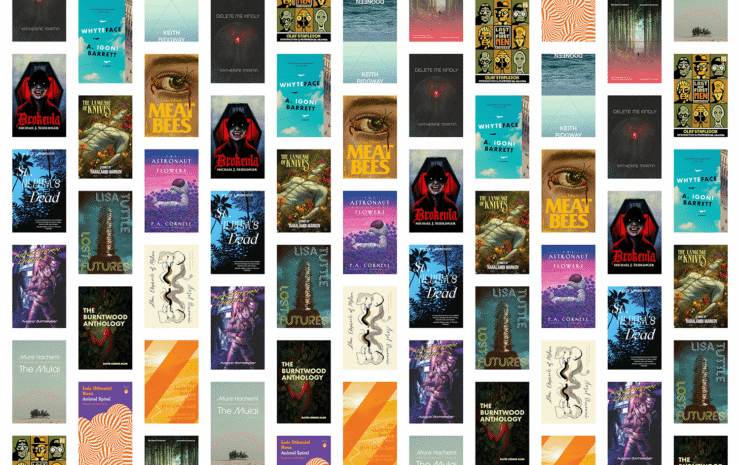
Welcome, somehow, to the second half of 2026. There have been no shortage of things for you to watch this summer, including Backrooms, the World Cup, and a new season of The Vampire Lestat. But if it’s reading you’re looking to do—and if you’re reading this, it probably is—you might be eyeing books due out later this summer. To that end, what follows is a selection of intriguing-looking science fiction, fantasy, and horror books due out from indie presses in July and August. Here’s to good reading and a pleasant season.
File under: Borders and the Traversal Thereof
Longtime readers of A. Igoni Barrett might see the title of his novel Whyteface and suspect that there’s a connection between it and his earlier novel Blackass. That novel, you may recall, tells the story of a Black man who wakes up in a white man’s body one morning. (Several Reactor articles have discussed it.) Whyteface is indeed Barrett’s followup, following protagonist Furo Wariboko (aka Frank Whyte) as he travels through Europe several years after his initial transformation, and encountering memorable characters on his way. (Graywolf; Aug. 4, 2026)
For some writers, national borders can be transformed into strange or evocative settings for creative works. (Mohsin Hamid’s Exit West is one memorable example.) In Jiyar Jahan Fard’s novel The Shadeless Border (translated by Chiya Parvizpur), turns the border between Iran and Iraq into a metaphysical space where characters human and unearthly converge. The result is an evocative work and a chronicle of the current condition of Kurdistan. (Common Notions; Aug. 4, 2026)
Keith Ridgway’s fiction is nearly impossible to pin down: one novel might memorably riff on pulp plotlines, while another contains a thrilling structural decision. For his new novel Dooneen, he follows the life of a man who travels from London to a surreal version of Dublin via an unexpected route. Michael Donkor’s review at The Guardian mentions “sudden, unnerving presences” and a general sense of “uncanniness”—all of which makes for a compelling investigation of memory and the idea of home. (New Directions; July 21, 2026)
File under: Evolution and its Discontents
Garth Marenghi’s War of the Wasps is not real. However, Dane Erbach’s Meat Bees is—and, yes, it is indeed about bees that have developed a taste for human flesh. If the idea of a swarm of flying insects capable of skeletonizing a person sounds like a thoroughly disquieting concept, well, this one should give you some sleepless nights. Library Journal called it “an off-the-wall, delightful, brain-melter of a novel.” (CLASH; Aug. 4, 2026)
Do you enjoy your science fiction on the experimental side? Publisher Calamari Press describes Katherine Martin’s Delete Me Kindly “a found-fiction/sci-fi novella,” which suggests interesting formal decisions are afoot here. In a review, S.D. Stewart described its setting as a world in which people are engaged in “[s]urrendering your collected self for freedom from unbearable loneliness.” (Calamari Press; July 1, 2026)
Evolution takes a technological turn in Luis Othoniel Rosa’s Animal Spiral (translated by Katie Marya). This novel involves two siblings in a near-future Puerto Rico who connect their minds and then follows the repercussions for them and humanity as a whole. In a review for The Skinny, Ema Smekalova observed that this novel would “appeal to fans of Octavia Butler, Jorge Luis Borges and Donna Haraway with its exploration of radical reimaginings, the magic of dreams and cyborg-like assemblages.” (Charco Press; July 2026)
I’m a relatively recent reader of Olaf Stapledon’s Last and First Men, a story of the ongoing evolution of humanity that’s considered a classic of the genre. Radium Age’s new edition has a few enticing extras, including an introduction from IF THEN author Matthew De Abaitua and some truly excellent cover artwork from Seth depicting several stages in humanity’s development. (Radium Age/MIT Press; Aug. 25, 2026)
File under: Midwestern Intrigue
A number of SF writers have pondered the future of New York, Los Angeles, and the Southwest. Milwaukee, less so—but maybe it’s time for that to change? Michael Bettendorf offers a glimpse of the future of a certain Wisconsin city in Midwestern Chrome, which this review hailed for its revitalization and subversion of multiple cyberpunk tropes. Between this and Thomas Pynchon’s Shadow Ticket, it’s a boom time for Milwaukee on the page. (Tenebrous Press; Aug. 11, 2026)
David Loring Nash is no stranger to the supernatural; his earlier novel The Man in the Pines revisited the life story of an oversized lumberjack by the name of Paul Bunyan. His new book The Burntwood Anthology brings together several interconnected narratives set in Minnesota’s Northwoods; the presence of witchcraft and other supernatural occurrences takes this firmly into an uncanny territory. (Unsolicited Press; July 14, 2026)
File under: Isolation and Community
Science fiction is home to a long tradition of space explorers encountering colonies that became separated from their home planet ages ago. Munir Hachemi’s The Mulai (in Julia Sanches’s translation) offers a fresh spin on this concept, one which ventures into the very nature of humanity. Rachel Cordasco’s review called it “an intriguing polyphonic novel about language, translation, human culture and adaptation, religion, history, and the search for meaning.” (Coach House; Aug. 4, 2026)
In Scott Lambridis’ new novel St. Ulphia’s Dead, a pair of researchers (Mirs and Jo) arrive in a remote community to explore a mysterious (and possibly psychological) phenomenon. As Lambridis explained in an interview, “much of the plot is driven specifically by this tension between Mirs and Jo: what possible circumstances could lead two people who would never be in love to believe they were in love?” It’s an uncanny investigation indeed. (Regal House; July 7, 2026)
Brokeula author Michael J. Seidlinger is fond of high concepts in his fiction, and this novel absolutely taps into that. Specifically, we’re in a world where vampirism and multi-level marketing operations collide. (Full disclosure: Seidlinger is a friend of mine.) It’s a memorably contemporary spin on an ageless figure in supernatural fiction. (CLASH; July 7, 2026)
It doesn’t take much to get me to wistfully recall the early-90s heyday of the Dell Abyss imprint, which published a host of fantastic writers and unsettling fiction. One of those books was Lisa Tuttle’s novel Lost Futures, which Valancourt is bringing back into print. It’s a haunting look at one woman’s journey into alternate lifetimes; Tim Pratt has a good overview of it as part of this list. (Valancourt, August 2026)
File under: Stories and the Sinister
I’ve been excited to read more from Ángel Bonomini after reviewing the collection The Novices of Lerna. Bonomini was part of the same circle of writers as Jorge Luis Borges, and it’s been good to see more of his work in translation. Slow Elephants of Milan, translated by Jordan Landsman, brings a 1978 collection of uncanny fiction to Anglophone readers, offering more from a disquieting perspective on the world. (Transit Books; Aug. 11, 2026)
P.A. Cornell’s short stories have earned acclaim from across the SFF spectrum, including Alex Brown’s discussion of notable short fiction in early 2023. Cornell’s collection The Astronaut Among the Flowers and Other Stories is her first collection of short fiction; given that this year brought her second Nebula nomination, it doesn’t seem strange to think that we’ll be seeing another collection from Cornell before too long. (Stars and Sabres; August 2026)
Jacqueline Harpman’s I Who Have Never Known Men has developed a cult following in recent years. Readers seeking more of Harpman’s work can find exactly that in the three novellas collected in We Were Forbidden (with translation by Ros Schwartz). These works transport readers to a variety of settings, including a forest in the aftermath of a mysterious conflict. (Transit Books; July 7, 2026)
One enticing aspect of Haralambi Markov’s The Language of Knives concerns the book’s introduction, which comes from Ann VanderMeer, someone who knows her way around excellent short stories. Another element in its favor are the range of stories on display, which range from the mythological to the horrific. In an interview with Uncanny in 2022, Markov cited “Kaaron Warren, Angela Slatter, Lisa L. Hannett, Karen Tidbeck, A.C. Wise” as his short fiction influences, which is also encouraging. (Mythic Delirium; July 7, 2026)