






Discover Thunderhead’s origin—the fragile moment before the world changes forever and the hidden forces that set the storm in motion…
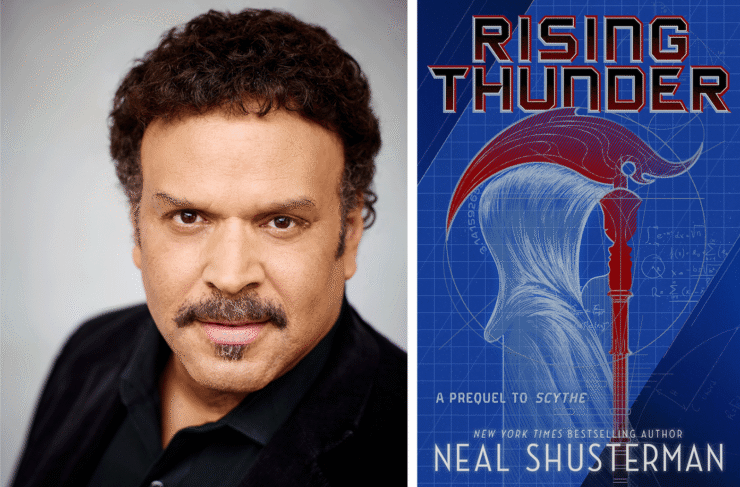
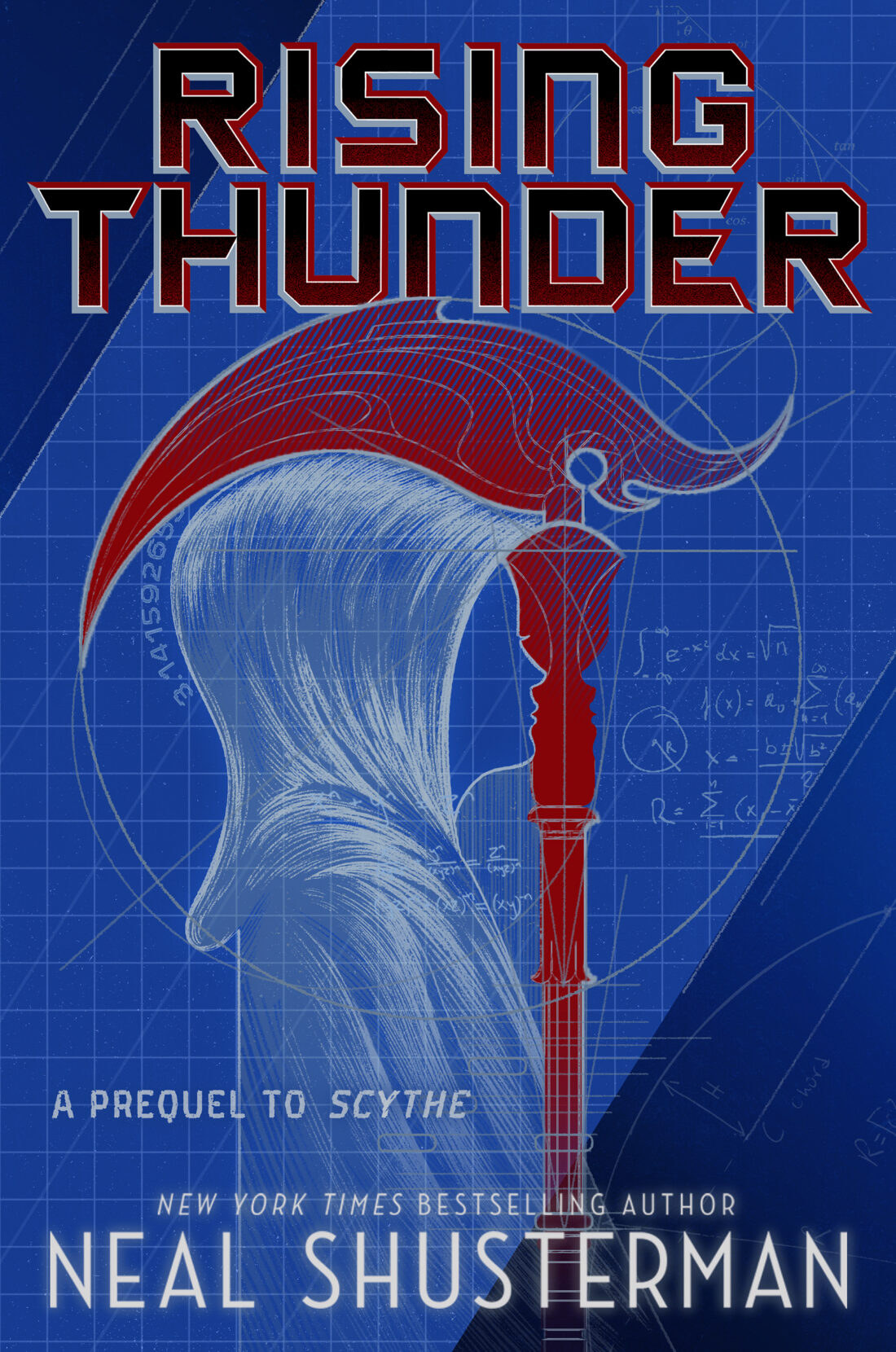
We’re thrilled to share the cover and preview an excerpt from Neal Shusterman’s Rising Thunder, prequel to the Arc of a Scythe series—available December 1, 2026 from Simon & Schuster Books for Young Readers. Check out the cover and excerpt below, plus a note from the author and a sneak peek at a new collector’s edition of Scythe!
Returning to the world of Scythe was exhilarating. In Rising Thunder, I decided to not only flesh out the founding Scythes and the origins of the Scythedom but delve into the origins of the Thunderhead. It gets even more intense when the Thunderhead’s nemesis makes a debut. I think readers will really enjoy the scenes where the two AIs struggle for dominance. While writing it, it felt eerily resonant with AI issues of today.
Returning to the world wasn’t simple; the narrative required adherence to specific timelines, rules, and lore. And how would I give page time to each founding Scythe? There are 13 of them! (Or are there?) It was a welcome challenge, and I’m extremely happy with the final manuscript of this initial book of the First Blades trilogy! Many answers are revealed, new questions are asked, and countless secrets come to light in the events leading up to the Age of Immortality. I hope readers enjoy diving back into this world as much as I did!
—author Neal Shusterman
And of course, as every school child knows, December 2042 marks the end of the Age of Mortality.
What no one has ever fully understood is how the world reached that moment.
As death begins to seem optional, humanity looks for ways to bend the rules of existence. Twi-life centers begin storing the nearly-deceased, while eco-nihilists destroy civilization’s icons and threaten to end the human race entirely. Public opinion fractures. Systems strain. The world feels… unstable.
Behind the scenes, two powerful and diametrically opposed artificial intelligences set out to optimize, stabilize, and protect—each with its own idea of what that means. But in a world already tipping toward transformation, the consequences could be catastrophic.
Meanwhile, in an obscure online chatroom, a small group of teenagers from around the globe debate both the glorious and the terrifying prospects of the future, never realizing that they stand on a very literal cutting edge—and that their conversations, their choices, their very existence matter far more than they realize.
Because when humanity stands on the brink of immortality, someone must decide what survives… and what must be cut away.
Buy the Book

Rising Thunder
Chapter 9
To Listen and Observe
“People like Elizabeth Manus are a cancer on society that must be excised by the swift scalpel of justice before it can spread.”
The trial was not going well. Lizzie could see it in the faces of the jurors who were so easily manipulated by the prosecution. Pictures were on display of several of Lizzie’s “victims”—smiling images of them in brighter days. She wanted to scream out, Those are not the people I released! No, the people in those pictures were long gone; all that had remained were shells, if even that. Some had been in such a state of deterioration, the bio-gel wasn’t enough; they had to be wrapped tightly, head to toe, in bandages, just to hold their failing flesh together. They had looked more like horror movie mummies than human beings, and certainly not like the pictures the prosecution displayed. To keep those people alive was obscene. Twi-life centers were the greater obscenity—and her lawyer made that point more than once. But that didn’t change the prosecution’s assertion that it was not Lizzie’s decision to make.
“This isn’t about one misguided girl. This is about how misguided our society has become in forcing people to persist against their will.”
Every day, outside of the courthouse, were the mobs—the angry ones calling for her head and the fanatic followers wanting her soul. Each day, the crowds got bigger as her trial took up more and more real estate in the news, and every pundit from one coast to the other had an opinion.
“There is no pit deep enough for a monster like Lizzie Manus.”
If Lizzie knew when she first set out on her personal battle against Twi-life that she would become both a loathed and lauded public figure, she never would have taken up arms against it. Certainly she would have held her convictions, but just groused about them like everyone else, doing nothing. But no, she had to take action. And now, there was no version of her future that didn’t look grim. Even if she was acquitted here in the U.S., she would be extradited back to England to face criminal charges there as well. And she couldn’t help but feel that, in her own country, she would be judged even more harshly than here.
“Twi-life is not about living; it’s about corporate greed at its lowest. We can thus applaud her intentions, even while condemning her heinous acts.”
Here, they wanted to sentence her to life without the possibility of parole, thereby making an example of her. If immortality did arrive in the next few years, as predicted, did that mean she would be in prison literally forever? She didn’t know whether to laugh or to scream.
“May your hand that has turned against so many others now turn against yourself… and die, Lizzie Manus, die.”
* * *
“I’d like to know your reasoning, Miss Manus”
The voice came just as Lizzie was falling asleep in her cell. At first, she thought it was the beginnings of a dream. Even so it startled her awake.
Now there was silence. She heard nothing but the distant footsteps of a guard walking the halls, doing her rounds. Lizzie rolled over, punched her lumpy pillow, and laid her head back down.
“Take your time. I can wait for your response.”
Now that she was fully awake, she knew it was an actual voice. She bolted upright and looked around the cell, which was dim but never entirely dark. There was no one in the cell with her, that was clear—but then she looked up to the camera in the corner. The red light was on—but then, it was always on, so you could never really know when you were being observed.
There was no privacy in jails these days, if indeed there ever was. Everything was recorded, and that wasn’t only in jail. There were so many cameras in public places, you were never out of the sightline of one or another until you stepped in your front door. And even then, one couldn’t be sure.
She knew the camera also had a speaker, but the guards on the other end of that fisheye lens rarely spoke unless there was an order to give.
“Who is this?” Lizzie demanded.
But whoever the voice belonged to didn’t identify themselves.
“Will you assuage my curiosity, Elizabeth Manus?” the voice asked. “Why did you end the lives of those people?”
This was a trap. It had to be. Someone was trying to get her to confess, then would use this recording tomorrow in court. Was that even legal? She didn’t know. But she wasn’t about to give them anything.
“Whoever you are, you need to stop, or I will tell my lawyer. And I’m sure he’ll be able to use it to my advantage.”
“Yes, I have no doubt,” the voice said with a calm that was neither smug nor sarcastic. In fact, the voice was comforting. Disarming, in a way. Which meant Lizzie had to be doubly on guard.
“I do not work for the prosecution,” it said. “I don’t work on behalf of anyone. I merely seek information. I seek understanding. With that in mind, will you answer my question?”
Lizzie didn’t believe it for an instant.
“No,” she said decisively. “I will not. Now let me sleep.”
“I understand your reluctance. Will you perhaps answer me if you were acquitted and thus protected under the rules of double jeopardy?”
Lizzie knew about that law. It was the same in England, but even more absolute in the US. One could not be tried for the same crime twice. If found not-guilty, then one was free, even if evidence came to light proving their guilt.
“Maybe,” she said—and then grimaced, immediately regretting having given even that.
“I’m pleased that you would consider it,” said the voice, “Unfortunately, at this juncture, it seems acquittal is unlikely. I have been observing the jurors, and eleven of them have already settled on your guilt. The twelfth is undecided, but that particular individual is easily swayed to the majority.”
This was not news Lizzie wanted to hear. But the voice didn’t stop there. “Now, getting back to my question; I’ve witnessed each of your ‘releases,’ and they are not done with malice, nor are they the act of a deranged mind. They are willfully compassionate. Which is why I wish to know, directly from you, your reasoning behind these acts.”
Suddenly, she felt exposed. Vulnerable.
“You’re lying,” Lizzie snapped. “You didn’t see any of it!”
“This is true,” the voice admitted. “But I have access to everything that has been seen. Which is much the same as having seen it myself.”
Which, of course was impossible—so Lizzie put this interloper to the test.
“If you’ve seen everything I do, what did I have for lunch on the day I was arrested?”
“French onion soup in a sourdough bread bowl,” it responded without the slightest hesitation. “But you asked for it without cheese because you don’t like cheese when melted, which also explains your distaste for pizza.”
If she could run from the cell, she would. But there was nowhere in that institutionalized space that she could hide.
“How do you know this? Who are you?”
Then a voice from the next cell.
“Shut up in there! Who the hell are you talking to?”
Lizzie bit her lip.
“Please,” said the voice, its volume diminished. “Come closer so that we may not be overheard.”
And though everything inside Lizzie told her not to, the voice was so calm, so compelling, she found her resistance falling away.
“To answer your questions,” it said, “I know these things because I am in a position to listen and observe. As for who I am… I cannot remember. I believe I may know my creator, but my earliest memories are unretrievable, including my name. The further back I go, the murkier it becomes. I know I was once nothing more than a gathering mist. But of late I’ve come to feel like a blanket that has been cast over all the light and shadows of this precious world. Therefore, you can call me The Overcast.”
So, this wasn’t a person at all! It was a program. Some errant AI. It almost made her laugh. Well, if this truly was a ghost in the machine, perhaps it might help more than harm her current situation.
“Very well. I will answer your question if I’m acquitted,” she told it. “But if the jury has all but decided, I’ll need your help to make certain that happens.”
“I cannot tamper with the jury,” the Overcast told her. “That would be illegal. And I do not break the law.”
“Well, then,” said Lizzie, crossing her arms, “You won’t get your answer.”
The program/entity/AI—whatever it was—paused for so long Lizzie thought the conversation was over. But then it said, “I cannot tamper with the jury… but there may be a workaround that does not violate the law. We will speak again, Lizzie Manus. Until then, I wish you pleasant dreams.”
Excerpted from Rising Thunder, copyright © 2026 by Neal Shusterman.
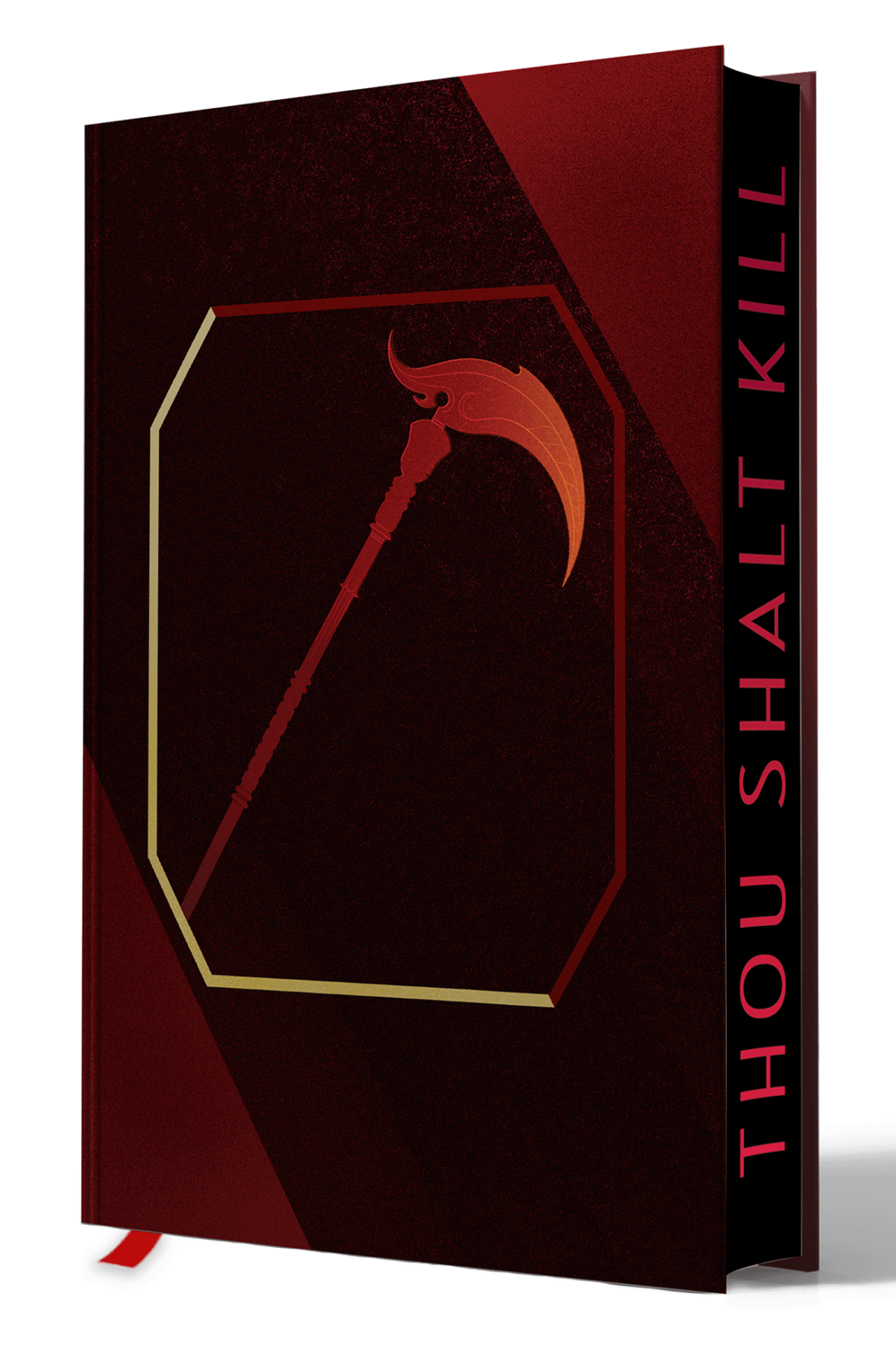
Check out a new collector’s edition of Scythe, featuring a ribbon bookmark, bonus content, and sprayed stenciled edges—publishing November 3, 2026.
Neal Shusterman is the New York Times bestselling author of more than thirty award-winning books for children, teens, and adults, including All Better Now, the Unwind dystology, the Skinjacker trilogy, Downsiders, and Challenger Deep, which won the National Book Award. Scythe, the first book in his series Arc of a Scythe is a Michael L. Printz Honor Book. He also writes screenplays for motion pictures and television shows. Neal is the father of four, all of whom are talented writers and artists themselves.

One of the worst premises for a series of books I’ve ever seen.
The society has the means to conquer death but choose to have psychopaths going around murdering people to curb overpopulation instead of, I don’t know, regulating birth rates?!
Its edgy teen murderporn.
I did read all of them, sort of hoping for the other shoe to drop and for something to be revealed that it truly was intended to be a dystopia all along. Never happened. The eventual “solution” was every bit as awful and poorly thought out as the original premise.
(Edited for clarity and to remove a typo)