








The early 1990s brought us two high-concept comedies that boldly challenged our traditional notions of the meaning of life. The first would be the classic Groundhog Day (1993), a peak Bill Murray film in which a man relives the same miserable day again and again for what could be centuries for all we know (though the filmmakers later claimed it was merely a decade). Smuggled in between Murray’s snarky comments is a surprising message of hope and resilience that becomes downright moving when you think about it. When faced with an endless expanse of meaningless repetition, our jaded hero at first indulges in carnal pleasures, then descends into a suicidal despair when it all grows boring. Eventually, he learns to wrestle meaning from his endless winter, not through some profound mystical epiphany, but through the everyday experiences of love, kindness, delight, learning, and the never-ending challenge of becoming a better person.
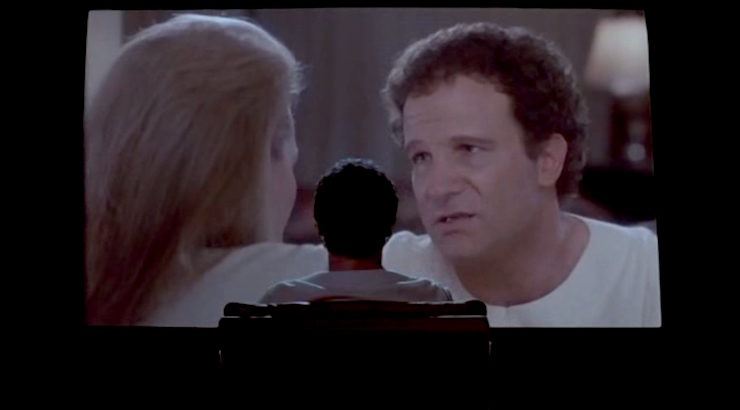
A similar film that demands multiple viewings is the brilliant Defending Your Life (1991), a satire written by, directed by, and starring Albert Brooks. Brooks plays Daniel Miller, a neurotic, materialistic, recently divorced ad man who, in a moment of truly dark humor, drives his brand-new BMW into an oncoming bus. He wakes up in Judgment City, a way station in the afterlife where the newly dead must prove that they are worthy to move on to a higher plane of existence—not heaven exactly, but a place where they will continue to grow and explore, free from the limitations of life on Earth.
The universe, however, has a vicious joke in store. Rather than providing the dead with clouds and harps, Judgment City simulates an international conference from hell, with its sanitized hotels, annoyingly chipper staff, mind-numbing lobbies, and bland concrete plazas. (Believe it or not, some of the exterior shots were adapted from the visual effects used in Total Recall, from the matte paintings to the tiny projector inside a train.) While the weather is always perfect, and the visitors can eat all the junk food they want, the relentlessly “normal” setting makes a few of the newly dead wonder if they are being punished. Even worse, the humiliating judgment process forces the defendants to sit through outtakes of their lives, while lawyers bicker over the cosmic significance of every major life decision. Daniel, a perpetual sad sack, awkwardly relives the time he crumbled while giving a speech, or the time he chickened out of making a small investment that would have made him rich. There’s even a blooper reel that makes the judges giggle.
According to the rules of this universe, the main purpose of life on Earth is to conquer one’s fears. Daniel’s lawyer Bob Diamond (Rip Torn) puts it this way: “Fear is like a giant fog. It sits on your brain and blocks everything…You lift it, and buddy, you’re in the for the ride of your life!” Of course, this pep talk only makes Daniel more scared. “I’m on trial for being afraid!” he whines. Bob tries to reassure him with some corporate doublespeak. “Well, first of all, I don’t like to call it a trial,” he says. “And second of all, yes.”

To complicate things, Daniel falls in love with Julia (Meryl Streep), a recently deceased woman whose own trial is going much differently. A warm, outgoing mother of two, Julia has conquered her fears so convincingly that even her prosecutor admits to watching her outtakes merely for enjoyment’s sake. Her success in life both attracts Daniel and makes him realize his own inadequacies. While he may have dated women who were out of his league in the past, here his love interest is destined for adventure in another realm of existence, while he resigns himself to being demoted back to Earth for nearly the twentieth time. “I must be the dunce of the universe,” he says.
This business about conquering fear and expanding your mind as the main purpose of life might sound a bit New Age-y for some. Certainly it is a concept that doesn’t get the nuance it deserves in a ninety-minute screenplay. But the film uses this idea to create a surprising payoff, a truly raw moment in which Daniel realizes how badly he has failed himself, and how narrow his view of life has become. These days, a flawed, unlikable protagonist is often used as a joke, accomplishing little more than mere shock value. But Daniel is all of us, a scared little human hypnotized by trivial matters, convinced that he still has time to talk his way out of his failings.
Even better, the film gives Daniel a chance to redeem himself, not through some contrived therapy-induced revelation, but through his love for Julia. Yes, her character veers a bit into Manic Pixie Dream Girl territory (though in Streep’s able hands, it’s difficult to notice), but in this case, the film makes it clear that she is the superior of the two characters, the leader, and not merely a stepping-stone for the protagonist.
In creating this intriguing world, Brooks avoids the problems that many movies face when dealing with a traditional understanding of the afterlife. Namely, how do you create tension in a place that is meant to be the sum total of all our desires? What story is left to tell when a person suddenly learns all there is to know, suffers no pain or hardship, and never needs to improve or strive for anything ever again? When such a blissful afterlife is actually confirmed within the confines of a story, it often undercuts the plot and the characters’ motivations—take Ghost (1990), for example. Recently deceased Sam (Patrick Swayze) tries to warn his girlfriend Molly (Demi Moore) that people are trying to kill her. But why bother? He now knows—beyond any doubt, mind you—that she’ll simply go straight to paradise if she dies. Or look at Peter Jackson’s The Frighteners (1996), in which mischievous ghosts flee from a Grim Reaper-like demon. But at the end, we discover that the Reaper’s touch merely frees the spirits from their limbo and sends them to heaven. So what was the point?

It is no wonder that movie critic Roger Ebert was a fan of Brooks’ film. Ebert produced some of his most moving prose in the months leading to his death in 2013 from cancer, and many of the ideas in Defending Your Life are echoed there. Starting with his television program, Ebert defended the film when partner Gene Siskel argued that the script lost its way by moving from a biting satire to a love story. In contrast, Ebert felt that the sweet, optimistic ending was well earned, sending a refreshingly hopeful message to the audience. Later, in his 2011 memoir Life Itself, Ebert talks about his deteriorating condition in a way that would impress the administrators of Judgment City. Rather than fearing the end and the unknown that lies beyond it, the author stubbornly writes, “I have plans.”
I don’t expect to die anytime soon. But it could happen this moment, while I am writing. I was talking the other day with Jim Toback, a friend of 35 years, and the conversation turned to our deaths, as it always does. “Ask someone how they feel about death,” he said, “and they’ll tell you everyone’s gonna die. Ask them, In the next 30 seconds? No, no, no, that’s not gonna happen. How about this afternoon? No. What you’re really asking them to admit is, Oh my God, I don’t really exist. I might be gone at any given second.”
Moreover, Ebert has no desire to live forever. “The concept frightens me,” he writes. Instead, he wishes to live such a good life that the kind things he did for other people will ripple outward, long after he is gone. Though never stated outright, this sentiment permeates Defending Your Life. Rather than dangling salvation, purity, and bliss, the film challenges the viewer to accept the unknown that waits on the other side of death as a catalyst to strive for goodness in the here and now. If there is to be redemption, it exists in the present, it is in our control, and the process never ends.
 Robert Repino (@Repino1) grew up in Drexel Hill, Pennsylvania. After serving in the Peace Corps in Grenada, he earned an MFA in Creative Writing at Emerson College. He is the author of Mort(e) (Soho Press, 2015), Leap High Yahoo (Amazon Kindle Singles, 2015), Culdesac (Soho Press), and D’Arc (Soho Press, forthcoming). He works as an editor for Oxford University Press and has taught for the Gotham Writers Workshop.


This is possibly one of the strangest films I’ve ever seen, including everything directed by Terry Gilliam. It’s odd, though, as I was just thinking about this film last night.
My favorite part: the viewing of the past lives. “What the hell?”
I enjoyed your synopsis of Groundhog Day. I love that movie, but didn’t realize its depth or how it can be a metaphor for everyone’s life.
The “manic pixie dream girl” trope is a very specific type of character that doesn’t match how I remember Julia at all. It’s been awhile since I saw it though.
My only problem with that movie was the concept or reincarnation itself: considering that the previous 19th lives of the protagonists left so few impressions even after death that without visiting the halls of previous lives he would not even have known of them, whats the difference between that and simple oblivion?
They could have at least pointed that, if managed to “graduate”, he would have had access to those memories too, or something similar… otherwise, the previous lives have absolutely no worth.
For anyone interested – compare this movie to a small Japanese film called “After Life.” In that movie, the newly dead arrive in what seems to be an abandoned campus. there are rooms where the “ghosts” spend the week and classrooms/offices where they meet with “guidance councilors” to choose a single memory from their lives to take with them when they “move on.” Good and bad, success and failure don’t matter in this place. Just the one memory that you will be happy with as the the representation of your time on earth.
It makes for some fascinating character development with both the ghosts and their councilors, who may be more than they seem.
I think of both of these movies often and how I would react in each situation. Exploring the boundaries of the philosophies each suggests.
I’ve had this movie on my mind a lot the last couple of years, and had it on my mind again this weekend, when my kid, thirteen and a half, told me about a Rick Riordan book where people get judged in a Norse afterlife by viewing their movies.
I may have the details wrong–my kid is an enthusiastic explainer!–but the gist of it is right.
Although I do not agree with this movie completely I do agree with the man theme. Maybe not how we will witness it with great tasting unending food and trials. But I do believe in a creator. Not so much a god, but a being that created us. I do not know if this being waved its hand and life just began, or if some sort of evolved being simply deposited us as seeds into this planet creating amino acids that would eventually form into a protein and keep evolving from there. I do not know. And I will never know until I die. I believe I am correct about our creator. Did you notice no God in the movie? That is because the journey is not that simple. People in all major faiths have their good places to go after death and the bad places as well. I think that us dying on this planet is only the first stage. To get to the creator we will have to die and move on many more times. Besides. In the philosophy of going to heaven when we die, how can we really say that is not insane. It is so easy for people in the USA, Canada, most places in Europe to be good and do the right thing. But we live under idealistic conditions, so it is much easier to be a good person. Is that really a fair test? There are people in 3rd World countries that are starving. Have disease. Oppression. They do not have the opportunities that we in a free country have. You can say that The USA is falling with the current fighting within our government that is mainly between old baby boomers who are so old, and so set and stubborn in their ways, that there is no room left for compromise. That is because Generation X has been babied so much that they have not taken their place as the next generation of adults to run this country. Millennials are too young and hungry to take power, and yet all my generation(Generation X) does is live with our parents still well into our 40s and wait for bad remakes or sequels to movies we loved in the 80s and 90s. What I was trying to say is even if you believe that in this day and age in The USA that we are not free anymore, we still have the commercial illusion of freedom, which in turn makes this one of the easiest countries to live in. So of course it is easier for us to be moral and idealistic. My point here is that it is just not one journey. We have a lot more brains then 3-5 percent to be used as we evolve into higher beings. Perhaps after that long journey through each stage of evolution and each stage of existence, we will meet the creator. When we are ready too. Another example of us not being ready yet is space. We watch movies like Star Wars, and tv shows like Star Trek, and Babylon 5. or Battle Star Galactica. Those are all great movies and tv shows. I tend to enjoy Babylon 5 more, even though I love Star Trek. But Star Trek is not very accurate of humans. According to that universe, humans can just about solve any problem out there. Babylon 5 pains humans much more closely then Star Trek. it shows that humans are still flawed, and are still growing. In Babylon 5 the Vorlons and Shadows were both evolved beings, that at one time or another were probably more humanoid, but evolved into energy. they used encounter suits to deal with the younger species, like the humans, the minbari, or the centari. We were no match for them when it came time for war. There was even a first being older than those 2 races by the name of Lorien, who was supposedly the first being even. Now jump to Star Trek Voyager. Season 4 introduced species 8472, which was actually created by the same people that created the vorlons and the shadows on Babylon 5, a few years before Voyager Began. They had bio ships they merged with that were a part of them. Just like in Babylon 5. But before the 2 part season finale and next season premier were over with the humans in Star Fleet along with the holographic doctor found a way to defeat them. Star Trek puts humans on the level of perfect gods. The point of all this is too realize that as humans we are not ready for outer space. Not in this point in our existence. If we were ready, then we would not need artificial gravity, and artificial oxygen to survive space. The answer there is evolution. I do not even think when we go to the next world we will be ready to physically go into space although if we use more of our brains, perhaps we can explore space with our minds in a limited way. And yes. if we have not defeated are misgivings in this life, instead of moving into the next world as a weak link in the chain that is the universe, perhaps we will be reincarnated as a new life. Same soul nut no memories of our past lives. Does that mean that if in the next life we do make it, that my persona will no longer exist? Is Joseph gone forever, in favor of my new body making it finally to the next world? Will I remember Joe’s life? Or will the body my soul goes to in my next life be the one to move on? I do not know. Defending Your Life started me on this path. I was born and raised Roman Catholic. I do not know what I would be classified as now. Someone with their own beliefs? A pagan? An agnostic? A deist? No matter what, I will always love this movie that started me on this journey of mine. Anywho