






In this bi-weekly series reviewing classic science fiction and fantasy books, Alan Brown looks at the front lines and frontiers of the field; books about soldiers and spacers, scientists and engineers, explorers and adventurers. Stories full of what Shakespeare used to refer to as “alarums and excursions”: battles, chases, clashes, and the stuff of excitement.
There are authors who work with the stuff of legends and make it new and fresh and all their own. There are authors who make their prose sing like it was poetry, and authors whose work explores the cosmos in spaceships, dealing with physics and astronomy. And in a few rare cases, there are authors who bring all those elements together into something magical. One of those authors is Samuel R. Delany, whose book Nova is a classic of the genre.
Delany, still in his 20s, burst onto the science fiction scene of the 1960s like a nova himself. He has been nominated for many awards, and won two Nebulas back to back in 1966 and 1967. My first exposure to his work was The Einstein Intersection, a reworking of the legend of Orpheus. My second was Nova, which became a lifelong favorite. In Nova, he created a novel that works on many levels, including myth and legend, unfolding against a solidly-researched science fiction background. There are other authors who would happily build an entire book around merely a tenth of the ideas that Delany packs into Nova. After Nova, I’ve continued to read the author’s work, and while I appreciated the craftsmanship in novels like Dhalgren and Triton, nothing ever hit my personal sweet spot like the headlong narrative rush of Nova.
What I did not know at the time, as I was not yet connected to SF fandom, and because it was not mentioned on the paperback copies of his books, was that Delany is African-American and a gay man. So he was not only winning awards (at a remarkably young age), he was breaking down barriers in the SF community, which at the time was overwhelmingly dominated by white male authors.
About the Author
Samuel R. Delany (born 1942) is a native of New York, who grew up in Harlem and attended the Bronx High School of Science and City College. In his younger days, he traveled the world, working in a variety of jobs before he reached the point where he could support himself with his writing. Delany became a professor in 1988 and has taught at several universities, most notably serving on the faculty of Temple University’s English Department from 2001 until he retired in 2015. He received vital support early in his career from editor Fred Pohl, and was quickly and widely acclaimed from the start of his career as a gifted and skillful author. He has won the Hugo Award twice and the Nebula award four times, collecting many more nominations for those awards over the years. In addition to Nova, his novels include Babel-17 (Nebula Award winner in 1966), The Einstein Intersection (Nebula Award winner in 1967), The Fall of the Towers, The Jewels of Aptor, and Dhalgren. Of his many short stories, “Aye, and Gomorrah…” won the Nebula Award in 1967, and “Time Considered as a Helix of Semi-Precious Stones” won both the Hugo and Nebula Awards in 1968. He won another Hugo, in the Best Related Work category, in 1989 for The Motion of Light in Water: Sex and Science Fiction Writing in the East Village 1957-1965. He was inducted into the Science Fiction and Fantasy Hall of Fame in 2002, and named as a Science Fiction Writers of America Grand Master in 2013.
Mr. Delany has been called “the first African-American science fiction writer,” a label he rejected in a New York Review of Science Fiction article in August 1998, pointing out several African-American authors before him who wrote stories that could be identified as science fiction. If not the first to write in the genre, however, he was definitely the first to make such a large and lasting impact on the genre right from the beginning of his writing career. During his career, he also came out as gay, and did not shy away from including sexual situations in his fiction. This reportedly caused some discomfort among booksellers and publishers at the time. When Mr. Delany started his career, science fiction writers and the characters they portrayed were largely male, white, and heterosexual (particularly when it came to their protagonists). Mr. Delany has been a pioneer in changing that, and helped to open the doors of the science fiction genre for the many diverse authors who followed in his footsteps.
The World of Nova
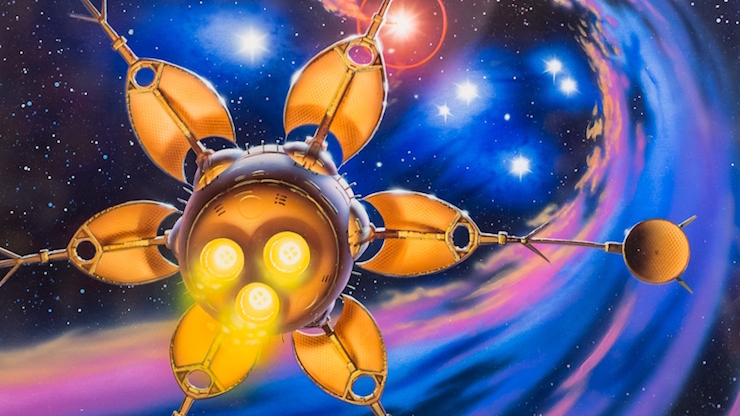
In the novel, which takes place in the 32nd Century CE, human civilization is split between the Earth-led worlds of Draco and the worlds of the Pleiades star cluster, where shorter travel distances have allowed a younger confederation to blossom. These powers compete in the non-aligned Outer Colonies. The economy of these worlds is controlled by a few families, whose power exceeds that of the robber barons of the United States at the end of the 19th Century. The Pleiades worlds are dominated by the Von Ray family, while the Draco worlds are dominated by the Reds of Red Shift Ltd. The Von Ray family has played a large role in keeping the Pleiades free from domination by the corporations of Draco—something that is seen as patriotism among the Pleiades, but as piracy by the people of Draco.
This future civilization is fueled by the fictional element Illyrion, a power source like none ever seen before. There is not much of this element available, but even the smallest amounts can generate huge amounts of energy. The discovery of even modest amounts of Illyrion could completely upset the balance of power among human worlds. From a scientific standpoint, while Transuranium elements tend toward faster and faster radioactive decay rates as they get heavier, scientists have long speculated that there might be “islands of stability,” where super-heavy elements such as the fictional Illyrion exist. No trace of these elements has ever been found in nature, but they remain an intriguing possibility.
Novas have long captured the imagination of those who watch the sky. The very idea of a star becoming unstable and exploding into cosmic fury—one that could destroy every world that orbits—it is both frightening and fascinating. Scientists now separate the phenomena into two types of events: classical novas, which are caused by two binary stars interacting, and supernovas, which involve a massive star exploding toward the end of its lifespan. Supernovas can reshape the elements of the star itself in a process known as nucleosynthesis.
Interstellar travel in Delany’s 32nd Century, which involves journeys at speeds faster than light, is made possible by manipulating the flow of forces unknown to us today in a process akin to sailing. These forces of the space-time continuum are accessed by energy vanes, each of which is controlled by a computer operated by the “cyborg studs” who make up the crew of a starship.
Most humans have been outfitted with cybernetic control sockets in their wrists and at base of their spines. This allows them to control a range of devices and power tools, from vacuum cleaners to mining machines and right up to starships. It also allows people to be much more flexible in moving from career to career. Some reviewers have drawn a parallel between these sockets and the jacks that would later appear as a popular element in the cyberpunk genre. But unlike those jacks, which connect people with a virtual world that stands apart from the physical world, the sockets in this novel connect people to devices in the physical world, and allow the physical world to be sensed in different ways.
Nova
As the novel opens, we meet a young man from Earth nicknamed The Mouse, a cyborg stud who has been knocking around the Solar System, looking for a berth aboard an interstellar ship; he’s also a musician who plays the multi-media sensory-syrynx. On a terraformed moon of Neptune, the Mouse meets a ruined and blind old man, Dan, who rants about diving into a star for Captain Lorq Von Ray. He then meets Katin, a young intellectual from Luna, and the two of them encounter Von Ray, who is not only looking for Dan, but is also looking to form a new crew. Von Ray has a hideously scarred face, and is more than a bit obsessive. The Mouse and Katin agree to join his crew, along with the brothers Lynceos and Idas, and the couple Sebastian and Tyÿ, who have amorphous, black, flying pet “gillies” accompanying them. Von Ray tells them they are heading toward a nova, attempting something that has led to failure twice before, and in a race with scions of one of Draco’s most powerful families, Prince Red and his sister Ruby Red. Poor Dan stumbles into a volcanic chasm and dies—he’s not the last character in the book that will meet a fiery fate.
The story not only charts the preparations of this crew and their voyage to their nova, but reveals Von Ray’s motivation through two long flashback scenes. The first is a childhood encounter between Lorq, Prince Red, and Ruby Red on Lorq’s homeworld. Prince Red has a birth defect that has damaged one of his arms, and wears a cybernetic prosthesis. He has been sheltered and coddled by his family to the point where he sees even a mention of his arm as a personal insult, and shows signs of a cruel and sadistic nature. Lorq is attracted to Ruby Red, who is already dominated by her brother’s forceful personality.
The second flashback involves another encounter between Lorq, Prince, and Ruby. Lorq has become an accomplished spaceship racer, and is invited by the Reds to a costume party on Earth. When he arrives, Prince gives him a pirate costume. Lorq has not paid much attention to his family history, and it falls to Ruby to explain that the pirate costume is an insult. He is again attracted to Ruby, who remains unhealthily devoted to her cruel brother. There is a confrontation, and Prince attacks Lorq, leaving him with a scarred face. Lorq returns to his family, finds out from his father that Draco is finally making inroads into the Pleiades, and that unless something changes, they will lose their independence, and his family will lose its fortune. Lorq decides to keep his facial scar as a reminder of his duty, and develops a plan to harvest Illyrion from an exploding star, upsetting the interstellar economy in the favor of the Pleiades. His first attempt, with a carefully selected crew, leaves Dan crippled, and Lorq decides to depend more on chance than planning in his second attempt.
Lorq is reckless and driven, and constantly seeks personal confrontations with Prince Red, even when they are unwise. His search for a crew in the heart of Draco is just one sign of his aggressive approach. His randomly selected crew does prove useful, as at one point Sebastian’s pets save him from Prince, and he draws inspiration and guidance from the various crew members, especially Tyÿ, who is a skilled reader of Tarot cards.
I will refrain from further summary of the plot, because if you haven’t read this book, you should do so at your earliest convenience, and I don’t want to spoil things. Suffice it to say, the nova of the title is not only a physical presence: it also represents conflict and destruction, along with renewal and rebirth.
Katin and the Mouse represent two different vehicles for the author’s viewpoint to enter the story. Delany worked as a guitarist and singer in his younger days, and Mouse represents the attitude of a performing musician, focused on senses, emotions, and the immediacy of the moment. Katin, on the other hand, is an intellectual and a Harvard graduate, and his continual note-taking for a novel he has yet to start offers a wry commentary on an author’s challenges. Katin is cleverly used as a vehicle for expository information, as he has a habit of lecturing people. The observations of Katin and the Mouse on the events of the novel are entertaining and often amusing.
Delany draws on his travels around the world, and the book is notable for the diversity of its characters and the various cultures it portrays, especially among Lorq’s crew. Lorq is the son of a mother with Senegalese heritage, while his father’s heritage is Norwegian. Mouse is of Romani heritage, Dan is Australian, Katin is from Luna, Sebastian and Tyÿ are from the Pleiades, and the twin brothers Lynceos and Idas are of African descent, with one being an albino.
Delaney explicitly evokes Tarot cards and grail quest legends in the book, but I also noted an array of other possible influences, as well. Dan reminded me of the old blind sailor Pew who sets the plot in motion in Stevenson’s Treasure Island. Von Ray’s obsession recalls Captain Ahab’s search for the white whale in Melville’s Moby-Dick. There is also a hint of Raphael Sabatini’s protagonists in Von Ray, a man driven by a need for revenge. And perhaps most strongly of all, Von Ray functions as an analog for Prometheus, striving and suffering to bring fire to his people. The book works on many levels, and is all the stronger for it.
Final Thoughts
Nova worked well upon my first readings, and holds up surprisingly well after fifty years. There are very few of the obvious anachronisms you often find in older works, where new developments in real life society and science have rendered the portrayed future as obsolete. The book contains interesting scientific speculation, social commentary, compelling characters, and action and adventure aplenty. I would recommend it without reservation to anyone who wants to read an outstanding science fiction novel.
And now, as I always do, I yield the floor to you. Have you read Nova, and if so, what did you think? What are your thoughts on other works by Delany? And how do you view his work in terms of the history of the science fiction field?
Alan Brown has been a science fiction fan for over five decades, especially fiction that deals with science, military matters, exploration and adventure.

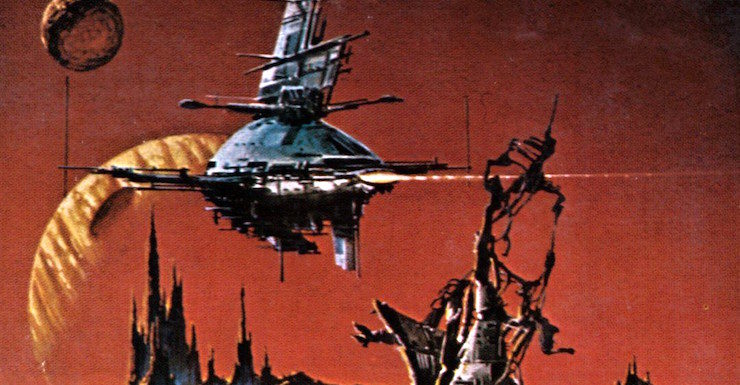
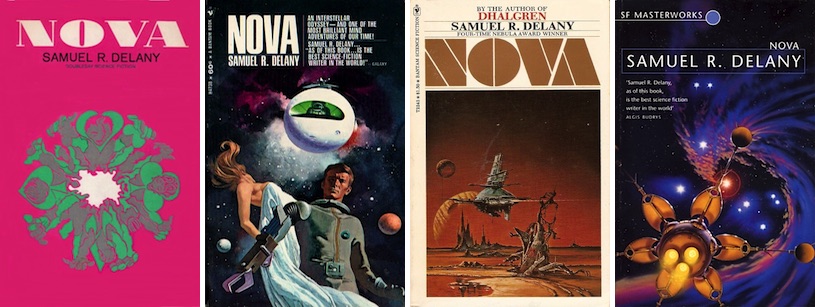
Delany’s early work (of which Nova is the culmination) fits into that strain of the early American New Wave which aimed to introduce a high level of literary quality and ambition to pulp fiction material without losing any of the colourful adventures: I see him as a successor to Alfred Bester and Cele Goldsmith and a kindred spirit to Roger Zelazny (they used to get asked to sign each other’s books by confused fans). I have that Chris Moore cover on my edition.
@1 Alfred Bester. There is a name I hadn’t thought of in a while. Time to dig through the piles of old books for some of his work.
I had never thought of it before, but having just re-read Neverwhere, I could also argue that Delany is a literary ancestor of Neil Gaiman; bringing “literary quality and ambition to pulp fiction material.”
Ah, Nova. It wasn’t quite my favourite Delany when I read it the first time, but remarkable for two things: 1) it was the first science fiction story I read featuring a character sharing my Romani heritage – and the Mouse isn’t some kind of magical gypsy. A musician, an encorporation of the artist-criminal, yes, but also educated and equipped to fly spaceships.2) It’s so vibrant and colourful and exhuberant, almost synesthetic. I too was reminded of Alfred Bester here.
I’m currently reading the newly published The Atheist in the Attic (appearing in PM Press’ Outspoken Author series). I haven’t started the titular novella yet – had to educate myself on Spinoza first – but the volume also contains Delany’s essay on racism in Science Fiction mentioned in the article above, which is well worth reading on its own.
@2: Oh please do re-read some Bester. Those 50’s stories reprogrammed my mind.
There’s an insightful Gaiman foreword in my Wesleyan Press edition of The Einstein Intersection about the novel and what he learned from it, misconceptions about science fiction and Delany considered as an Orphic bard (this essay may also be found in The View from the Cheap Seats).
@3: His essay is also online at NYRSF.
@@.-@ I don’t have the “Cheap Seats” book, but I think my son does; I will have to borrow it.
I love Nova, although Babel-17 is my favorite Delany. A couple of great points from Nova
– Novel writing (and reading) is a lost art. Katin will only get his work published by a museum, who is much more interested in the writing process than the result.
– Everyone in the book, and, it’s implied, in society, believes in the Tarot, and uses it- everyone but Mouse.
Pam
Delany’s one of those authors that I’ve always admired, but never quite been able to wrap my head around. Possibly because I was too young when I was trying — in high school or maybe even junior high when I saw those Bantam editions of Nova and Triton on the public library paperback spinners and, really, how could I resist those covers?
Someday …
@7 I liked Nova on first reading, and appreciated it a lot more when reading it with adult eyes. There was quite a bit in the book that went right over my head as a young teenager. I imagine I would get more out of Delany’s other work as well.
i’ve more than once recommended nova, calling it the greatest science fiction novel ever written.
it’s really a pity there aren’t more old delanys kicking around (i work in the used book business) compared with the plethora of worse writers, although perhaps this might also mean people haven’t been letting go of them so much.
Nova was one of the first Delany novels I ever read (the first was – extremely confusingly – The City of 1,000 Suns, the final in the Fall of the Towers trilogy; perhaps I was getting ready for Dhalgren), and I fell in love with it. I didn’t understand it – I was a teenager who read too fast and not well enough – but that didn’t matter. It was hallucinatory and brilliant. I’ve reread it two or three times, and I’ve understood it better, or differently, or both, as I’ve gotten older. I’ll never stop reading it.
I’m so glad you’re pumping Delaney! I’m in a Delaney phase presently. always blown away with his work and my new favorite of his, “stars in my pockets-like grains of sand” its some of his best work! A treatise on love, the slavery of capitalism, information suppression and yet like all his stuff, that barely scratches the surface of the bitten down nails of the cast!
I just finished his first short three “a,b,c.” and I’m about to devour the tower series.
I first came upon him as a teen in a used bookstore-“Dhalgren” and I was so stunned when the lead comes across the drifter in the first 40 pages-It’s hard to explain as a gay youth coming across your first gay protagonists in scifi. It was such a rush, bc I was so used to imagining romance and lusty looks between characters. Or always looking for hidden implications. But yet there it was. In Print. In an epic scifi. It was incredible. I didnt have the patience or endurance back then to finish that mammoth text. But I happened back upon his stuff a few weeks ago and so happy I did!
Delaney is really a gift to us! Such trippy, fun & whimsy-laced with heartbreak and poignancy!
I haven’t read the book. With all the words about “diversity,” I wish you’d called out that the only female character of note appears to be The Love Interest.
@12/nancymcc: There’s also Tyÿ. Von Ray turns command over to her when he leaves the ship in a critical situation, and she does a good job. So that’s at least something. But it’s true that she’s a pretty minor character before, part of a couple, and the only woman in the crew.
@13 Thanks for pointing out Tyÿ. Looking over the review, I never gave a clue to her gender. The rest of the crew accepts the presence of a female crewmember as unremarkable, which for the time it was written, was pretty remarkable. And there is a female museum director in a pretty pivotal role, who is the key to Lorq finding his nova.
But @12, despite those exceptions, you have a point. Like many books of its time, the male characters, especially those with major roles, outnumber the females.
I read Nova for the first time a few months ago, loved it. (and should have known I’d enjoy it, as Babel-17 was fantastic as well!)
Among many other thoughts I came away from Nova with, was Why is Prince such a jerk? Why is having a prosthetic arm such a terrible thing? It’s mentioned a handful of times in the book that you need plugs to pilot a ship, and the plugs are in your neck, spine, and specifically your wrists. You’d need a plug in both wrists. . . Prince only has one wrist. All the money in the world, and he will never be able to pilot a ship on his own. I don’t remember if that is explicitly mentioned in the book, that something others take for granted, being able to hop into a ship, get a job on any old freighter because they have a plug in each wrist, is something he will never be able to do, and maybe that’s one of the reasons he is is angry at the world?
I loved this novel, can’t wait to read it again!
@15/Andrea J: IIRC one of the characters suggests the same thing. But it doesn’t make sense to me. Surely it would be possible to build a prosthetic arm with a plug and connect the plug to the nerves in his shoulder?
Four things from the book stuck in my mind:
A character who says something about people from another time and place’s making assumptions about how he and his companions absorb nutrients (and remove waste from their bodies? I don’t remember) as an example of what’s left out of narratives, both a great point and sidling up to the Fourth Wall and gently rapping on it.
The necessity of extensive training’s being needed to use one’s socket—too many science-fictional inventions are too easy to use proficiently. Now, years later, this looks to be exactly the case, the code for (e.g.) operating a video-game with the brain’s electrical impulses needs training-up, for example to identify the pattern of impulses that are coïncident with your thinking ‘Go left!’ differing from anyone else’s more than you and your same-accented neighbours’ ‘Go left!’ utterances….
Katin meeting Von Ray (or was it a Red?) and noting that he had passed by a building at Harvard named for an ancester of the other—in context, it felt strange that some things about the world hadn’t changed in over a millenium. Spoiler:The same went for the incest tabou.
The notion that tarot’s validity was near-universally accepted I found odd, but was willing to give Delany for his story’s stake…I guessed that he might even be using it to plot, as I had heard Dick had used I Ching, making it in fact a fact about his little universe. Alternately, now I see it as possibly being a statement about any society’s vulnerability to delusion….
i read nova in high school, and I immediately told my friends that this was the best science fiction novel I‘d ever read. Simply as a literary creation, it was so much better than the stuff I’d been used to; Dune was fascinating world-building, but the writing was clunky, and so much else was merely serviceable, or ther was Bradbury, who was quite literary, but the science… he wasn’t writing epics, anyway.
i could not paraphrase Delany’s novel, but the tone and the strangeness of this future were hypnotic. I remember the twins, who finished one another’s sentences, and Kaitin, who “like all eccentrics for thousands of years,” attended Harvard, or the Illyrium itself, which found the poetry that was in the periodic table, with its “islands of stability” and its “noble gases that were not so noble.” And its Arthurian echoes, and its ending, which paid homage to the “Faerie Queene “ by ending like