





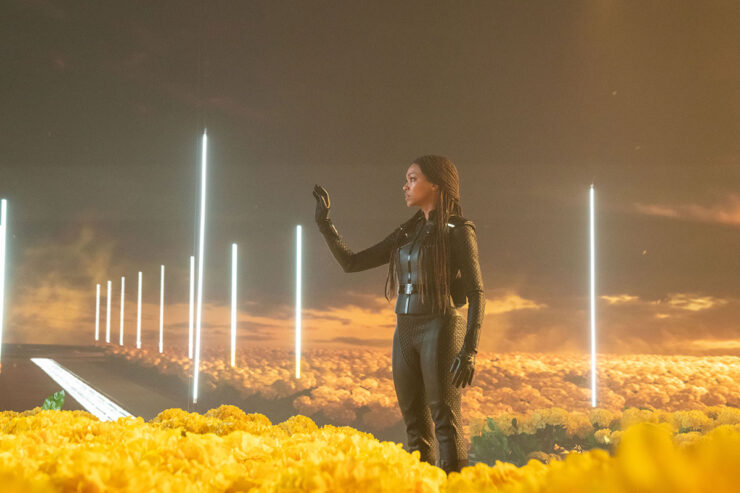
Some of the most iconic words in science fiction television are those uttered by William Shatner at the top of every episode of the original Star Trek: “These are the voyages of the Starship Enterprise—its five-year mission…” The intention was that Kirk’s ship would be out in space for five years exploring the unknown. Alas, the show was cancelled after three years.
In fact, none of the shows that spun off of Trek hit the five-year mark exactly—until now. The animated series was only two seasons, TNG, DS9, and Voyager all lasted seven years, while Enterprise and Picard fell short at four and three, respectively, the latter by design, the former not so much.
However, thanks to the surprising decision by CBS/Paramount to cancel Discovery after five seasons, we finally have a show that lives up to that nearly-six-decades-old voiceover.
And what a long strange trip it’s been.
It’s not entirely clear why the show was cancelled. By all accounts, Discovery was doing fine by streaming standards. Of course, it’s also possible that’s why it was cancelled. The resolution to the actors and writers going on strike last year included the studios being more forthcoming with two things regarding the success of streaming shows: data and money. This is also why Prodigy is no longer on Paramount+, because the corporation getting a tax break was considered more important than the branding of Paramount+ as the exclusive home of Star Trek—which is supposed to be a major reason for shelling out for the service in the first place.
What’s especially frustrating is that, as just the next season of Discovery, the fifth season wasn’t bad. It had many many problems, mind you, but it asked some interesting questions, had some good stuff, and ended very nicely. It was fun to have most of a season given over to a quest narrative. It had all the usual tropes of such a narrative, but it was enjoyable, especially since so much of it involved thinking through problems and solving them, and Discovery is absolutely at its best when its collection of nerds science the shit out of something.
On top of that, the storyline made interesting use of Trek’s history: galactic history, as outlined in TNG’s “The Chase,” as well as the specific history of the Dominion War era as portrayed on DS9’s latter seasons, a time of great fear and paranoia as fostered by the Changelings who ran the Dominion. Plus we finally got to learn more about the Breen, and while the execution of that particular part of the story left a lot to be desired—did they really have to be just another set of Forehead Aliens?—at least they made an effort to give texture to the universe. Still, they managed to make the Breen—who were never all that interesting in the first place—significantly less interesting on two different levels. One was that they were pretty simple humanoid aliens like any other, except they hide their faces from outsiders and avoid the universal translator, which manages to be less interesting than the many speculations that had been floating around since the Breen were introduced in the 1990s, even the dumb ones. And the other is that they’re less interesting because the world-building doesn’t really make any sense. They suppress individuality—but they’re aggressively hierarchical?
Still, I really like Discovery’s tendency to use Trek’s extensive catalogue of existing aliens, whether for simple guest appearances or to be fleshed out a bit, rather than constantly churn our new species. Probably the best example is the newest cast member, Rayner, played by Callum Keith Rennie. He’s a Kellerun, a species seen only in one second-season DS9 episode, and who are best remembered as having one of the worst sets of hairdos ever seen on Trek (which is against some fairly stiff competition, even if you ignore Shatner’s toupee and Anson Mount’s entries in the Johnny Bravo lookalike competition…).
Had it just been the fifth season, we would have enjoyed what we could and looked forward to the next season, especially seeing more of the Breen in the fond hope that they might actually become more interesting (unlikely, but one can hope).
Instead, they had the rug pulled out from under them. Worse, unlike Enterprise, they had already filmed their final episode by the time the cancellation order came down, so they turned the 70-minute season finale into a 90-minute series finale that had a lovely coda at the end.
But you really wonder what these writers would’ve done had they known they were ending it. I mean, this is the same writing staff that gave us season four of this show, which was the most purely Star Trek series of episodes in the franchise’s five-plus decades.
And so Discovery has come to an end. The show that started the ball rolling on the current renaissance of Trek on TV will no longer be with us.
Discovery has been so many different things in its seven years on the air. It arrived with so many expectations. Some of those were on the back of the show’s co-creator and initial show-runner Bryan Fuller. Fuller got his start on the writing staff of Voyager, and was later responsible for a mess of shows that were at once well received and underperforming (Dead Like Me, Wonderfalls, Pushing Daisies). Many fans had been clamoring for Fuller to be responsible for a new Trek series.
Unfortunately, what he did with this opportunity didn’t always work as well as one might have hoped. To start with, Fuller mistook backstory for frontstory, starting off the TV show Star Trek: Discovery by giving us two hours of Star Trek: Shenzhou, and the fantastic dynamic among Michelle Yeoh’s Captain Philippa Georgiou, Sonequa Martin-Green’s Commander Michael Burnham, and Doug Jones’ Lt. Commander Saru.
It’s been seven years, and I still resent that the show I was promised in the first two episodes didn’t come to pass. And I wouldn’t have that resentment if the show had started with its actual first episode, “Context is for Kings,” which is where the story of Discovery truly begins.
For reasons passing understanding, Fuller continued the wrong direction the franchise had been stuck in since 2001 in looking backward, making the show a prequel that took place prior to the original series.
What’s especially maddening is that the general storyline of season one of Discovery could’ve been done in, say, the late 25th century, following the lead of the first wave of feature films and of TNG and its immediate spinoffs by advancing the timeline. Yes, it would’ve meant no Sarek, no Harry Mudd, and possibly no Mirror Universe, but that wouldn’t be much of a loss.
From that incredibly weak foundation, Fuller then abandoned Gene Roddenberry in favor of Neil Gaiman, going off to show-run American Gods, turning Discovery over to Gretchen J. Berg and Aaron Harberts. Berg and Harberts made it to midway through season two and then Michelle Paradise took over, and you can very much see the seams, as the opening episodes of the sophomore season promised a much different show than the second half gave us.
Yet the second season also provides the great paradox, as everything I said about how season one shouldn’t have been a prequel is shitcanned by the second season, which wound up becoming a fourteen-episode backdoor pilot for Strange New Worlds. Besides being fabulous, SNW is also an example of how a prequel can work. And without season two of Discovery, we never in a million years would’ve had (or even really wanted) SNW.
Meanwhile, Discovery got vaulted into the 32nd century for reasons of plot, and it was by far the best thing to happen to the show, as it got a billion times more interesting in the fictional future history’s future than in its past. And Trek has always been more successful when it moves forward than backward. It took a couple of seasons, but Discovery finally went in the right direction.
Discovery has also done something no other Trek show had done: show the journey of a character to the role of captain. Every other lead in a Trek show started out as a person in command with their place at the top of the ensemble a fait accompli as the show began. But unlike Kirk, Picard, Sisko, Janeway, and Archer before her (and Pike and Freeman after her), we saw Michael Burnham work her way to it, from her lowest point as a rank-less prisoner to a bridge officer to first officer and finally to captain of the U.S.S. Discovery. She did it with brains, she did it with fearlessness, she did it with a certain arrogance (she was raised by Vulcans, who have raised arrogance to an artform), and she did it—like all Trek commanders—with compassion and love. More to the point, she built a community. And she’s the first woman of color to lead a Trek ensemble, which matters for the same reason why Sisko and Janeway mattered.
In fact, Discovery truly did that journey twice, as we also saw Saru go on a similar odyssey. The Kelpien officer is Discovery’s greatest contribution to the Trek oeuvre, a magnificent character who embodies so much of what’s important to Trek: scientific curiosity, become greater than oneself, questioning assumptions, evolving. We met Saru as a prey animal, and he evolved into a predator (Action Saru indeed).
One of the most important aspects of any Trek show is that it’s about smart people solving problems, ideally with as little violence as possible. Prior shows always had a pair who Did The Science: Spock and Scotty on the original series, Data and La Forge on TNG, Dax and O’Brien on DS9, Torres and Kim on Voyager, and T’Pol and Tucker on Enterprise. But on Discovery, the whole crew is like that! Indeed, it’s from the top down, as Burnham and Saru are both brilliant (and we get one final example of the two of them being the science pair in “Under the Twin Moons”), but there’s also Stamets and Tilly and Reno and Adira. For that matter, we often see the bridge crew get in on it…
I’m grateful that Starfleet Academy is going to take place in the 32nd century as well, because we haven’t seen nearly enough of it. We’ve seen the unification of the Vulcans and Romulans on the world now called Ni’Var, we’ve seen a Federation president who has both Bajoran and Cardassian blood, we’ve seen the Ferengi as part of the Federation, we’ve seen the Andorians and Orions allying, we’ve seen the Trill. But what about the Klingons? The Betazoids? The Tholians? The Xindi? The Dominion?
Plus there’s all the things we were hoping for in future seasons that we’ll never see, like possibly fleshing out the bridge crew (I’ve been dying for more of Owosekun and Detmer (they were absent for much of the season due to scheduling conflicts (which wouldn’t have been an issue had this just been the fifth season instead of the final season (although I should mention that I’ve got a story coming up in an issue of Star Trek Explorer called “The Sirius Snarl” that focuses on the two of them (why am I doing so many nested parentheticals????)))))
Whatever one thinks of Discovery—and opinions have flown fast and furious over the past seven years and will likely continue to do so—one cannot deny that it ushered in the current era of Trek. Without Discovery paving the way, we wouldn’t have SNW or Picard or Lower Decks or Prodigy or Starfleet Academy or whatever else comes next.
Meantime, we’ve got more SNW, more LD, more Prodigy, and both SA and (sigh) the Section 31 movie to look forward to…


“The intention was that Kirk’s ship would be out in space for five years exploring the unknown.”
Well, no, because the show opened in mid-mission, with no indication that it was just starting out. Implicitly, Kirk and this crew had been on the mission for some time, even years. (The Making of Star Trek said he was in his fourth year commanding the Enterprise during its second season, though that wasn’t necessarily all during the current 5-year exploration tour.) TV shows back then existed in a timeless present — look at Run for Your Life, a 3-year series about a guy with 18 months to live, or M*A*S*H, an 11-year series about a 3-year war. If TOS had made it to a sixth season, they probably would’ve continued to say “a five-year mission” without bothering to explain the discrepancy. It wasn’t a literal deadline so much as just a way of giving a sense of the long-haul nature of the ship’s mission deep into uncharted space.
As for DSC, I’m also torn about the prequel seasons — I think it was problematical in a lot of ways (the Klingon War was implausibly big and destructive, and I’ll never forgive them for turning Harry Mudd from an essentially harmless con artist into a gleefully ruthless mass murderer), but it also gave us a few superb episodes that recontextualized and deepened TOS in powerful ways, like “Lethe.” Still, it was a relief when the show moved to the far future, and it didn’t really come into its own until Michelle Paradise took over as showrunner and stayed.
Still, I don’t think it went far enough with the future worldbuilding. Not only have we not seen that many of the known cultures’ futures, but what we have seen is mostly too similar to what we knew before, not reflecting the profound changes a society could go through in eight centuries. Instead we just got superficial tech changes like magically appearing phasers and the complete pointlessness of detached nacelles on the ships. I’m hoping the Academy show gets more daring with its worldbuilding in that regard.
Mudd was never a “harmless con artist”. In his very first episode, he was knee-deep in human trafficking and the drug trade. In his second, he hijacked a top-of-the-line military vessel.
No, Harry Mudd was not engaged in “human trafficking.” That’s a common modern misunderstanding of the “wiving settlers” practice of the Old West that inspired “Mudd’s Women,” one that would have been familiar to viewers in the 1960s when Westerns were common TV. The goal of that real-life program was the exact opposite of prostitution or sex slavery — it was about convincing respectable Eastern women to choose to settle in the West to bring that respectability and civilization to frontier towns, to perform jobs like schoolteacher and seamstress and similar things that helped make a community livable, and hopefully to find men they would fall in love with and choose to marry. The women signed on because they wanted to find husbands and thought there might be more eligible prospects for them in Western frontier towns with mostly male populations.
“Mudd’s Women” made it clear that Eve, Ruth, and Magda were not Harry’s victims, but his co-conspirators in a con game aimed at wealthy frontier miners and the like. They were “gold-diggers” seeking to marry into wealth (a common stereotype in that era), and they chose to use the Venus drug to make themselves irresistible to their chosen marks. The intent of the script was that the men they married were the victims because they’d been tricked into marrying women who were less alluring than they appeared. That’s certainly sexist, but it had nothing to do with sex trafficking.
As for “I, Mudd,” the episode made it clear that hijacking the Enterprise was not Harry’s idea, but something he was pressured into by his androids:
” I simply ran out of things for them to do, and they insisted that I bring them more human beings. They need human beings to serve, to study. So I had to promise them a prime sample. A starship captain. Bright, loyal, fearless and imaginative. Any captain would have done. I was lucky to get you.”
Was Harry a criminal? Yes, absolutely. But there are degrees of criminality. TOS and TAS established Harry as guilty of smuggling, fraud, counterfeiting, patent theft, spaceship theft, and the like — never of any violent crimes. It was never even remotely hinted that he’d killed anyone, and that was necessary to allow him to fit the “lovable rogue” mold he was intended to fill. But Discovery showed him casually, gleefully murdering dozens of people — and no, the “he knew the time loop would reset them” excuse doesn’t wash, because he condemned Ash Tyler to an incredibly excruciating and sadistic death at a point when he expected the time loops to be over and had no intention of resetting things again. He had to be tricked into reversing time again to restore Tyler. He was turned into a psychopathic mass murderer, and the most disgusting part is that the episode still expected us to see him as a lovable rogue.
Well, they also expected us to see a genocidal, cannibalistic dictator as a lovable rogue … so par for the course, I suppose!
And now, she’s getting a movie!
So I’m going to be honest; I have enjoyed this series, and I’m going to miss the characters, but I think that it’s probably for the best that it’s ending now.
This last season felt…uninspired in a way that Star Trek hasn’t really felt since the last few years of Voyager/ first few years of Enterprise. I won’t call it bad, because it’s not, and it even had some good episodes (though, I will note, no great ones), but it really felt like it was going through the motions. There were no big swings, no real plot twists, no flourishes on the basic plot-coupon structure, and it wasn’t really *about* anything. It’s a treasure hunt! Well, what’s the treasure? It’s Progenitor tech, from that one TNG episode! What’s it do? What do they learn by finding it? Why should we care? They never really answer any of these questions, but at least there’s a little fun to be had on the way.
Taking a broader perspective on the series, I’ve come around somewhat to the first season upon rewatching it. The second season started out strong but then took a nose-dive when it was retconned into being about time travel and (ugh) Section 31. I was really excited to see what they would do when they got to the future, but then there was just…minimal worldbuilding. When Trek leapt to the 24th century at the start of TNG, it felt like there was a lot of planning on how the universe had changed in the intervening century. Leaping nine times longer, and there seemed to be little thought beyond “the Federation has imploded” and “the Vulcans and Romulans” have reunified. There just wasn’t the sort of vision that I think you need for making such a big move in an established universe. Season 3 was actually good, although the explanation for the Burn made me roll my eyes and the Emerald Chain were uncompelling villains (I think it would have been more interesting if the UFP had merged with them, as Osyyra had proposed). Season 4 was the best season; Species-10C were fascinating aliens of a type that Star Trek really hasn’t done before , and the science was the hardest that it had been on Star Trek since TNG; but even then, the plot was based around an extremely simple and easily resolved misunderstanding, and it dragged horribly in its back half. And then there was this season, which promised a grand tour of the Galaxy and never really delivered.
Again, I will miss this series; I will miss Michael and Saru and Book and Hugh and Paul anf Owo and Detmer (I assume Tilley will be in SFA); I will miss the science and the music and the big emotions and the queer love. And I hope Starfleet Academy turns out good. But honestly, I don’t feel any great need for more stories set in the 32nd Century.
My ultimate conclusion is that Discovery felt like a great seven-season series that some producer “fixed” by taking out all the boring-to-them “filler.”
We’re constantly being told things (that Disco’s crew are a tight-knit family, that Airiam is the glue that brought them together, that Linus is the comic relief, that the 32nd-century galaxy is a lawless hard-to-traverse frontier, that Starfleet has covered up Discovery‘s origins, etc), but aside from Linus’ misadventure with the new transporters, we don’t actually get to see any of it.
(For example, that bit about 32nd-century Starfleet classifying Discovery‘s origins –we eventually see new crew members who could only have come aboard post-time jump [including apparently two different Ferengi]. Have they been “read in,” or is the crew keeping them at arm’s length, or has Discovery‘s history become common knowledge –and if the latter, were there any consequences to breaking the Temporal Accords?)
Discovery really suffered from its high-stakes seasonal story-arc format, I think. Which is really too bad, because, with the exception of “Species 10C” in season 4, most of the best episodes were relatively standalone stories. Having always ratcheted up to maximum took away the feel of what normalcy in this setting is supposed to be.
Given the seemingly much more positive reception of SNW than Discovery or Picard, I’m actually now wondering whether the story arc format will survive going forward.
I’ve said before, I think the seasons were better in their more episodic first halves, where the arc elements were just a catalyst for the individual stories, than in their latter halves where they got more serialized.
And I hope you’re right that we’re starting to see a shift away from the season-arc format back to a more episodic approach, or at least a healthy mix of the two. There was a time when season arcs were innovative, but now they’ve become formulaic and obligatory, tacked onto shows that don’t really need them. The best thing would be to let episodic shows be truly episodic (with evolving character and worldbuilding continuity like TNG had), while also having serialized shows alongside them.
Of course, one thing Western civilization is terrible at is finding a healthy balance in the middle. We’ll probably react against one unhealthy extreme by overcorrecting to the opposite unhealthy extreme, like we always do.
Still, I don’t see serialization vanishing altogether. In the early decades of TV, episodic storytelling was preferred and serialization was seen as the stuff of cheesy soap operas and kids’ adventure shows, but that’s because they had no home video to ensure that people could see episodes they missed, so it made more sense to make each episode self-contained and independent. These days, we have box sets and streaming sites and show wikis, giving us a much more holistic overview of series rather than the granular episode-by-episode way we used to experience them. That’s a large part of why serialization caught on, to adapt to our more panoramic view of series storytelling, so I don’t think it’s likely that we’d drop it entirely.
I mean, I think there’s definitely room for both, and I personally don’t want the wholesale abandonment of story arcs; but I also think that Star Trek has now had five season-long story arcs on Disco and three on Picard (and one on Enterprise way back when), and none of them have really fully pulled it off, so eventually one needs to wonder whether it’s worthwhile to try.
I’d be fine with just having continuously evolving story arcs, instead of the Buffy-pioneered model of each season having a separate “Big Bad” or crisis arc that the whole season is devoted to dealing with. Really, it’s incredibly artificial to give characters a different main villain or problem each year that takes just about a year to solve. (Although The Flash found a better balance in its last few seasons, breaking them down into 2-3 shorter “Big Bad” arcs with occasional 1-parters in between.) It’s that need to give every season a separate overarching plot that I could do without. Let there be story arcs, but let them take as much or as little time as they need to get resolved, whether that means wrapping up in half a season or extending over part of two seasons.
Oddly, I don’t mind the season-arc model in the Japanese tokusatsu superhero shows I watch, but that’s because each season is a whole separate series with a separate cast and continuity (though they often pretend to be in the same reality during crossover specials). Also, they run longer — a full 48-52 episodes in the case of Toei’s Kamen Rider and Super Sentai franchises and pre-2010s Ultraman, 25 episodes for modern Ultraman. So there’s more time to develop the character arcs and the worlds and tell lots of episodic adventures along the way. They tend to have serialized storylines that evolve through several escalating phases, with changing characters and growing stakes and game-changing revelations. I modeled my Tangent Knights audiobook trilogy on that format, which worked very well for a set of three novels that each told a distinct story while adding up to a larger saga.
Sounds cool. Speaking of Ultraman, will you review the new CG movie on Netflix? It takes ultraman in a rather…. unorthodox direction.
Hmm, it hadn’t occurred to me, but I’ll consider it. I was planning to rewatch it in the Japanese dub anyway.
Tellingly, what I consider to be Star Trek‘s most successful forays into arc-based storytelling (the ongoing Vau N’Akat arc on Prodigy and, especially, the Dominion War arc on DS9) really don’t fit the “Buffy” model.
I want to say the Klingons would have made for better antagonists that the Breen. Though I suppose it wouldn’t matter which species they picked if they didn’t put more effort into the storytelling.
I’d prefer that they picked some new species. Or some absolutely minor species from a previous series that has risen to prominence over the last thousand years.
BTW, I apologize for the delay in getting this to y’all. It should’ve happened two weeks ago, but I was in the throes of revisions on my 2025 novel The Thin Blue Ley-Line, the first book in my new Supernatural Crimes Unit series that will be published next year by the new Weird Tales Presents imprint of Blackstone Publishing. I’m afraid the rewrites totally consumed my brain and made it impossible to focus on Discovery‘s fifth season until it was done and sent back to my editor.
Thank you all (and all the fine folks at Reactor) for your patience.
—Keith R.A. DeCandido
“why am I doing so many nested parentheticals”
Did you take a Lisp class back in college?
I’ve enjoyed this show from the beginning. Pound for pound, I think it has the most talented acting troupe Star Trek has ever had. Even when there was a bad story (and this show has had some), there wasn’t a bad performance to be had by the main cast.
That said, Season Five is easily my least favorite thing this show has had to offer. It all feels cut and pasted together, with secondary cast members coming and going with little rhyme or reason. Detmer and Owo get replaced by Asha and the other lady (and a third person shows up later) and then apparently are sent off on a mission with the ISS Enterprise …? That might’ve worked better had we not seen Asha and the other lady at helm and navigation in an earlier episode.
Had I watched week-by-week instead of bingeing 2-3 episodes at a go, I think some of that might have been less obvious.
Moll and Lak were not particularly effective antagonists and I started to feel like this was a Road Runner cartoon with our usually competent crew playing the part of Wile E. Coyote for most of the season.
All in all, the finale did a good job of wrapping it all up, given the constraints they were under.. Good on CBS/Paramount for allowing them to film the extra material. That said, if Season Six was going to have the same issues as five did, I’d think it would’ve been fairly easy for the suits to say that now was as good a time as any to pull the plug.
We never had the full story behind Fuller’s departure. Though he has a pattern of dropping out of projects halfway through. Whatever the original plan was, it was probably for the best.
The first two seasons definitely had their ups and downs. Though ironically, I had less of a problem with the first season than I did the second. Season 2 was like the worst aspects of streaming shows magnified – so serialized you lost focus of the story – characters all over the place. Also ironically, one of my favorite episodes that year was a Berg/Harberts episode that mostly stood alone from the overall plot, the one where Saru and his race finally overcome centuries of genetic and cultural limitations.
But once Paradise came onboard and the show shifred to the 3100s, it vastly improved. Introducing Book was also a major upgrade to the cast. He was a lot more consistently written than Burnham’s other significant other, Ash Tyler aka Vok.
I enjoyed season 5 as much as as I did the last two seasons. Some wonderful Saru/T’Rina scenes. Some welcome material for Culber. And it had that excellent episode with the Halem’nites and the ritual race that almost ended in a needless religious sacrifice. I welcomed the attempt at exploring the Breen, even if they stumbled the final result a bit.
But most of all, it was a travesty to cancel the show like that without warning. A spat on the face of the people who worked hard to produce the very work that brought the franchise back. And I’m immensely grateful we got that extended coda for Michael Burnham. A more or less fitting end to the character.
I’m glad we’re getting more 32nd century action with the Starfleet Academy show. And I’m even looking forward to seeing Yeoh’s Mirror Georgiou again once we get Section 31, whatever it ends up being. I’m glad Discovery isn’t the end of the Trek for now and we have more to look forward to. Whatever is happening behind the scenes at Secret Hideout, I’m glad Kurtzman is keeping things going, putting in the work. Rick Berman, for better and worse, was a force that kept the franchise going during the TNG/DS9/VOY/ENT era.
The other day I watched season 3’s “Forget Me Not” and it was *so much better* than your typical season 5 episode. They’re in a changed galaxy. They have mysteries and problems to solve. Characters are suffering (this is the Detmer meltdown episode) and it’s all tied together with fantastic directing, great score, excellent effects, and not a single stupid bridge flamethrower in sight.
Season 5 to me felt like much of recent Doctor Who – a series-long arc regarding some made-up thing that threatens all life everywhere that only our heroes can stop through a series of increasingly implausible somethings. You could have improved the whole plot by eliminating the Breen entirely (heck the finale basically did that once it got to the point) and made Moll and L’ak one-offs in a single episode.
The show’s need to insert Burnham/Book heart-to-hearts in the most inopportune moments was puzzling. Likewise the show writing Owo and Detmer basically out midway through the season. I don’t care that they didn’t know the show was being cancelled at the time – that doesn’t excuse the sloppy way these previously important characters suddenly disappeared from the show (never mind that taking the centuries-old ISS Enterprise back as a prize ship was a more interesting story idea than what they showed us instead (KRAD these parentheticals are in your honor)).
There was too much formula, too many cut-and-paste scenes. I agree with some of the comments above that the show’s time seemed to have come. How many times does Rayner need to figure out how to be a captain? How many times does Adira need a pep talk, or does the bridge crew do their one-sentence-each brainstorm, or Burnham and Book have a chat? These scenes are fine in the abstract, but once they become repetitive filler episode after episode you get the sense the creativity isn’t there. Adding more bridge fireballs isn’t the answer.
I remember sometime in the early 80s a network show premiered about a group of cowboys from the 1890s who’d somehow traveled through time to contemporary LA. It was a cool concept. By the second episode they’d become private detectives solving crimes-of-the-week and the only nod to their origin was that they carried six-shooters. Discovery season 5 reminds me of that.
The third season (and, in particular, the first bit of it before they found the rump Federation) was the only time that 32nd Century setting really worked for me, honestly; because it’s the only time when being set so far in the future was actually relevant to the plot. Both the DMA arc in season 4 (which I actually liked) and the Progenitor arc here could just as easily have been set in the 24th century and it wouldn’t have changed anything. It was a disappointing failure to use the setting.
Ah, yes, Outlaws, created by Nicholas Corea (former producer of The Incredible Hulk) and starring Rod Taylor as the Old West lawman, Charles Napier, William Lucking, Richard Roundtree, and one younger guy I can’t remember as the gang flung forward in time along with him, and Christine Belford as the present-day woman they teamed up with. I was rather fond of it for its impressive cast, and I thought well of Corea as a writer from his Hulk days, but it was definitely about as SF-lite as you can get, uninterested in its time travel element except as a mechanism for setting up the fish-out-of-water premise of Western characters in the present day.
To be fair, even today, it’s still common to push any show with an unusual premise into the crime-procedural mode — look at Lucifer, for example.
Yep that was it. A classic example of the network’s pathological need to fit everything into an existing category. “Bonanza meets Rockford Files”. Lots of promise. It didn’t last long.
I wouldn’t call it pathological, just cautious. Networks have to make a profit in order to exist and continue producing shows, and from that standpoint, it’s safer to make shows that fit categories with proven mass appeal to audiences than it is to gamble on something experimental or with niche appeal.
So upon consideration, it occurs to me that “The Chase” actually had the perfect format to add dramatic interest and make this season work, namely: have *multiple* galactic powers competing for the Progenitor tech; that way, we could get more of the lay of the land politically in the 32nd Century, and Discovery could have been facing competition that’s more imposing than Boris and Natasha.
One of the biggest issues I had with DSC and the time jump was that the future felt way too familiar. 1,000 years (give or take) from now I’m pretty sure the very essence of humanity will be different. The way we physically look and act, social mores, speech etc will all be radically changed. Instead, it was like slipping into a favourite shoe, very comfortable. There are still ranks, still an Academy, etc etc. I get that that is necessary for the show and for audiences to identify with it, but it reinforces that notion for me that most sci-fi is nothing other than wish fulfilment for the audience.
In universe, I think that maybe the Federation has maxed out the amount of scientific progress that it’s possible to make while remaining culturally allergic to transhumanism.
But yes, I agree that the 32nd century seems like a failure of imagination: basically the same as the 24th, but with personal transporters and programmable matter. Even accepting the idea that the Federation has imploded, it has done so in such a bland way compared to, say, Foundation, or even Gene Roddenberry’s Andromeda (or any number of real-life examples of civilizations that have collapsed). I was so excited when we met Book at the start of season 3 and he had the ability to empathically communicate with animals, because that would have been a fascinating thing to reveal about future humanity, but then it just turned out that he was an alien.
That’s a valid point, but it occurs to me that the producers were somewhat constrained in terms of how far ahead they had to jump. They wanted to establish right off the bat that this time jump was permanent, that it wasn’t just some temporary plot twist like the Mirror Universe arc in season 1. So they needed to postulate a ban on time travel, yet ENT had established that the Federation was using time travel as late as the 31st century. So they pretty much had to set it in at least the 32nd century in order to have the post-time-travel galaxy they wanted (insofar as that means anything, since time travelers could always come forward from the past, as Discovery did). Even aside from the time travel element, they wanted to be further forward than any future Federation we’d glimpsed so that they’d have free rein.
Although it seems they were also trying to tie into “Calypso” and its reference to Zora waiting a thousand years, given that a character in episode 3×2 used the same “V’draysh” term for the Federation. Although that was obviously rethought later on.
Don’t get me started on the ending! A finale should be self-contained, not referencing unseen elements. I haven’t watched Short Treks, so no idea what was going on at the end there. Even after watching Calypso it’s still unclear. As you say, they’re obviously trying to echo the thousand year jump at the end of S2, problem is I have no interest in this new character or his eventual importance, so it just fell flat for me. Then they have to shoehorn the nacelles back on, to make the continuity fit. But just how does Discovery sit there for 1,000 years in the harshness of space and still be in any way functional when Craft shows up? It’s stuff like that that does my head in
Correction: “Calypso” came out between seasons 1 and 2. It wasn’t echoing anything; it was a standalone story at the time.
And really, you don’t have to know anything about “Calypso” to follow the final scene; all you need to know is that the ship is being sent on one last mission and Burnham is saying farewell to it. The details don’t matter, since the important aspect of the scene is its emotional impact to Burnham. The nods to the short are just a bonus for people in the loop, not essential.
“But just how does Discovery sit there for 1,000 years in the harshness of space and still be in any way functional when Craft shows up?”
Actually it would be far easier for something to survive that long in the vacuum of space than on a planet surface with wind and water eroding it and gravity compressing it under its own weight. The only hazards would be radiation and micrometeorites, but a starship would be well-shielded against both. And the ship is self-repairing thanks to the DOT drones, as we’ve seen.
Apologies, I didn’t make that clear enough, or you misunderstood me. I did not mean to infer that ‘Calypso’ was echoing the ending of DSC, rather the reverse. What Michael Chabon said at the time was that it was “isolated from the vast tapestry of Star Trek.” The speculation when it aired seemed to be that it was set in the 33rd century, as Zora mentions the wait time but no star date is given. By pushing the ending of DSC into the 43rd century, or whenever it was, there was obviously an echo of ‘Calypso’ and the underlying Odysseus/Calypso myth.
I stand by my opinion that it wasn’t a good way to end a series, when potentially people haven’t watched the reference. Details do matter, and they raise questions that didn’t need to be raised. As for the emotional impact on Michael Burnham, I’ve seen enough of that already, thank you very much. ‘Calypso’ should have remained a curio. I would much rather have seen the emotional windup for the other crew. How are they coping with life 1,000 years on from when they were born? I’m always bemused by time travel as represented on screen, people get hurled all throughout time but just shrug their shoulders and carry on as if there is no impact on the psyche. I imagine the reality would be more the future shock William Mandella experienced in The Forever War. Perhaps references could have been made to the actual sphere data, a topic mostly ignored, with the recognition that Zora was already a time traveller, and how some things change across time but others stay the same.
Also, how was Kovich aware of this future hinge point? Wasn’t he from the 33rd century? I think Trek is at its weakest when it does time travel, and the idea of temporal agents wandering freely across time raises more questions than it answers. Knowing Zora needed to be there for Craft 1,000 years beforehand implies a knowledge of that intervening period and the time beyond. How?
Yes, I suppose the ship could have survived but then 1,000 years is a hell of a long time, DOT or no DOT. That area of space seemed to be quite hostile as well, space storms etc. DOT drones aren’t magic wands, there would be limitations.
“I stand by my opinion that it wasn’t a good way to end a series, when potentially people haven’t watched the reference. Details do matter, and they raise questions that didn’t need to be raised.”
It’s not wrong for a story to mention details that it doesn’t explain. The original Star Wars didn’t explain what the Clone Wars or the Kessel Run were, and it didn’t need to; they were just bits of texture, creating the feel that there was a larger universe and history beyond the story itself. The very first Star Trek story, “The Cage,” was a sequel to a mission we hadn’t seen, the battle on Rigel VII, and we only got a few vague hints about what had happened, but those hints were all we needed. A story should feel like it’s part of a larger world we haven’t seen, because that makes it feel more like real life. If it makes us wonder about the unexplained details of that larger world, that’s good, because it means it’s stimulated our imaginations, which is the purpose of fiction.
I still say that the ending is perfectly comprehensible to people who know nothing about “Calypso,” because the ending is not about the facts and details, the ending is about the characters and emotions. The ending is about Michael Burnham saying goodbye to Discovery and reminiscing about her crew. Everything else is superficial. Audiences today have become too fixated on surface details and continuity and technicalities and forgotten that stories are fundamentally about people and emotions. What a scene is about is not what the characters are doing or planning to do, but how it affects them emotionally. What the ship is being sent to do is irrelevant, because that’s beyond Michael Burnham’s experience and has no bearing on what she feels as she says goodbye to the ship.
“Also, how was Kovich aware of this future hinge point? Wasn’t he from the 33rd century?”
Okay, maybe this is something they should have explained more clearly. Kovich said he was really Agent Daniels, Matt Winston’s character from Enterprise, who was a Temporal Agent from the 31st century. Since time travel has been banned in the 32nd, he’s taken a different job. But presumably he learned about Discovery‘s future during his tenure with the Federation Temporal Agency.
Thanks for the response Christopher. I’m aware of your pedigree in the Trek universe and that you do this for a living, but I will humbly disagree. The examples you cite are for character context and all occur early in the movie/episode/series:
the Clone Wars establish that this mysterious Ben Kenobi isn’t just a superannuated codger wandering the Jundland Wastes, but rather a soldier with the experience to lead this missionthe Kessel Run lets us know that Han Solo is an ace smuggler, and can get them to AlderaanRigel VII serves as the motivator for Pike to resist Vina during the illusions he is subjected to by the Talosians. Understanding early on that crew members were lost in this battle, that it haunts Pike, allows us to understand Pike’s strength and fitness to lead as he successfully resists the crafted reality to save someone from the battleThe ending is perfectly comprehensible, no doubt, my argument is that throwing in these details at the end of a show raises questions that don’t need to be raised, in the context of giving characters an appropriate send off. If you’ve made it through 5 seasons of DSC and then a reference to some Short Trek episode arises, of course you’re going to wonder “what is this all about?”, but it’s a sub-optimal way to wrap things up, IMO.
Why not have Burnham, Zora and crew reflect on the sphere data? Burnham rejected the Progenitor tech, in part because the galaxy is full of multiple permutations of life, the legacy of the original Progenitor seeding. How about Zora showing some of this life history, and the patterns and lessons that keep arising? It would back up Burnham’s actions and provide plenty of emotional material to mine. But of course the writers had to throw in a Red Directive as the final mission, ignoring one of the chief criticisms of DSC in that every season had OTT stakes. This could end all LIFE IN THE GALAXY! If we don’t stop them, the very future of THE FEDERATION IS AT STAKE!! etc etc. Now Zora gets one more turn at some galaxy-altering event. It was too much. I wonder what Michael Chabon thinks. His neat two-hander that should have stayed an unwrapped puzzle has been tethered to the finale..
By way of contrast, the excellent finale for Ashes To Ashes has a neat, meaningful coda that also features new details, but only as a continuation of what has already come before. Gene Hunt is alone again, like Zora doomed to continue on without his friends and family as he willingly accepts his role as a psychopomp to a new generation of traumatised police officers. That’s the way to do it.
As for Kovich/Daniels, this ending just raises more frustrating details/questions for me. As you point out, the Temporal Wars are over and time travel has been banned as at the 32nd century. So why would he know about events 1,000 years on? It would be hard to ban time travel at a certain date if people had been freely traversing the spacetime continuum thousands of years into the future.
All in all, a pretty cruddy effort for the finale. Of course Rayner and Discovery lure ALL of the Breen fighters into a plasma cloud or some such. Of course ALL 30 of them follow them in. And of course ALL of them are destroyed. How perfect and neat. At least the writers and producers were true to their own worst instincts all the way through, they headed right into their own plasma cloud. Sorry to be so negative, but the more I’ve examined it the less impressed I’ve become with Discovery’s ending.
“my argument is that throwing in these details at the end of a show raises questions that don’t need to be raised, in the context of giving characters an appropriate send off. If you’ve made it through 5 seasons of DSC and then a reference to some Short Trek episode arises, of course you’re going to wonder “what is this all about?”, but it’s a sub-optimal way to wrap things up, IMO.”
I don’t agree. I don’t share the modern assumption that every series has to end conclusively for its characters. I like it when a story ends by saying “Yes, these heroes’ journeys will go on even after we stop seeing them.” Sometimes, you want a conclusive ending, like if the characters are pursuing a specific quest goal. You want to see the hero find the One-Armed Man or find the way back home or cure the raging spirit that dwells within him. But if they have an open-ended mission, like space explorers or superheroes or detectives, it’s a bad thing if their stories end, if they stop doing what they do. Sometimes an ending that teases a new adventure without explaining it is a good thing.
For instance, the ending of Back to the Future. Doc shows up, tells Marty there’s a new crisis in the future, they head off to deal with it, the end. That wasn’t intended as a sequel hook at the time; the movie is perfect and complete the way it is. It was meant to fire our imaginations about what comes next. The Incredibles ends with a new villain emerging and the heroes rushing into action. We didn’t need conclusive answers to who the villain was or what he wanted; the fact that the story would continue beyond what we saw was the whole point. (And the answers the eventual sequel gave were unsatisfying.) The happy ending was that there was no ending, just more adventures for our heroes. It’s not bad for a story to raise questions without answering them, because then the story is turning it over to our imaginations to play with.
I won’t deny that including the “Calypso” setup was awkward and gratuitous. I’m just saying I don’t think it’s fatal to the ending, because there are a lot of stories that end with vague hooks for unseen future adventures, and the fact that the ending raises unanswered questions is a feature, not a bug. If you saw the ending and had no idea that “Calypso” had ever existed, you might have questions about what came next, but they’d be little different from the questions raised by the endings I mentioned above. The fact that it doesn’t all wrap up in a neat little bow with nothing more to add is the whole point.
More importantly, the “Calypso” references are just a handful of lines. They aren’t the whole sequence. Like I said, the sequence isn’t about that part, it’s about Burnham revisiting the ship one last time, reminiscing, and saying goodbye. Having Burnham mention overhearing the word “Craft” as a wink to the audience is awkward, sure, but it’s just a detail, a glitch that’s past in moments, not the exclusive purpose of the scene.
“Now Zora gets one more turn at some galaxy-altering event.”
They never said it was “galaxy-altering.” Burnham only said it was a Red Directive, which means an urgent and secret mission. Rayner said he’d been on seven Red Directives in his career, which means they can’t all be galaxy-altering, just classified and sensitive. Presumably the secrecy here was because it involved an ex-temporal agent’s knowledge of the future, and the urgency was making sure the timeline played out consistently, nothing more than that.
“As you point out, the Temporal Wars are over and time travel has been banned as at the 32nd century. So why would he know about events 1,000 years on?”
Isn’t that obvious? No doubt he learned about it back when he was a time agent a century before. As a time traveler, he would’ve had access to knowledge of the future as well as the past. But of course, he couldn’t arrange for Discovery to be sent on the mission until the time was right, until all its purposes in the 32nd/33rd century had been fulfilled.
“It would be hard to ban time travel at a certain date if people had been freely traversing the spacetime continuum thousands of years into the future.”
Yes, it’s a flawed concept. Obviously any such ban is not going to prevent past or future travelers from coming to the time when the ban is theoretically in effect, as we saw with Discovery itself and the Red Angel before it. All you can do is try to prevent time travel from being initiated within your own time. There may be ways to regulate access by time travelers, as I explored in my Department of Temporal Investigations novels, but regulation is not the same as absolute prohibition.
I think we agree on the fundamentals here. I’m not arguing a story has to end definitely, with neat resolutions for all characters. I’ve already cited one show where the main character continues on. We all understand they would have had further adventures and missions. My point is they didn’t need to shoehorn the ending into the Calypso short. Of course you don’t have to go and watch it, and of course it’s comprehensible, but I bet if there was a Trek episode you hadn’t seen and people were talking about it, you’d hurry off to watch it and not leave that itch unscratched. I’m invested in Trek enough that I wanted to understand the reference, but I shouldn’t have to when it’s literally the last few minutes of the primary show. It also drained the mystery of Calypso, and if I was Michael Chabon I’d be a little peeved.
Ok, this wasn’t a galaxy-altering event but it was clearly an extremely important one. Zora had to save a man 1,000 years in the future. Why? Was she going to teach him about love and human compassion? No, he already understood those. Clearly, he is some vital figure, the John Connor of the 43rd century, if you will. So yet again, DSC set very high stakes when too many sugar hits had already detracted from the story.
Lastly, you say it’s obvious that Kovich would know about the future, specifically 1,000 years on from the 33rd century. Why would he? As far as we know he’s from the 33rd century, the TCW was about changing the past, but there has to be a reference point. Is someone form the 43rd century coming back to tell them what to do? Just how many futures have been spun off? Why would Daniels/Kovich visit the 43rd century? Why would the 43rd century need rescuing? Just how far into the future has the timeline been traversed? Does this 43rd century timeline even exist, given all the changes that happened during the TCW? You’ve written books about this stuff, the paradoxes pile up pretty quickly. For the people who wanted Craft dead, why not change history and have a ship jump in and destroy his life pod 20 min before Zora rescues him? Again, these are questions that shouldn’t be asked, and they only exist because some idiot thought it a great idea to jam Calypso into the narrative.
There was a time traveler RIGHT THERE IN FRONT OF THEM – Zora aka the Sphere. Hundreds of thousands of years of history, millions of observations and lessons about life and civilisation, its rise and fall, etc. To Zora, the crew of DSC were a blip in time, literally. If you can’t write a poignant ending with those elements then you should put your writing pen down and take up a job as an Amazon delivery driver.
The mob usually gets it right, the ratings for DSC are not the greatest including the finale. The 33rd century turned out to be pretty boring, even Daniels/Kovich (Danich?) couldn’t fix that. I’m sure you’ll want to have the final say on this so I’ll vacate the stage. I’ve wasted quite enough time already on the Michael Burnham ‘Emotions’ Tour of the far future.
“My point is they didn’t need to shoehorn the ending into the Calypso short.”
I agree that they didn’t. I wasn’t crazy about it. I’m just being philosophical about it and saying it’s not a fatal problem, that someone who had no idea that “Calypso” existed could still follow the ending reasonably well, and that for those of us who do know about “Calypso,” it’s a brief, minor distraction in a scene that isn’t actually about that. You’re choosing to blow it up into a far bigger issue than it actually is. It’s a few lines, and then it’s over.
“Ok, this wasn’t a galaxy-altering event but it was clearly an extremely important one. Zora had to save a man 1,000 years in the future.”
They never said that. Burnham said Zora was being sent on an unspecified mission, and that she’d overheard the word “Craft” mentioned in an unspecified context. Everything else is viewers making reckless assumptions and mistaking the audience’s priorities and knowledge for the characters’. “Calypso” itself makes it explicit that Zora’s mission is not to save Craft, because she can’t take him home and they have to split up at the end. Meeting Craft is just a brief interlude while she’s waiting for whatever her actual mission is. We have no actual information about the nature of that mission. Since it’s a secret mission, the fact that Burnham was allowed to hear Craft’s name implies that he was not an essential part of it.
“Lastly, you say it’s obvious that Kovich would know about the future, specifically 1,000 years on from the 33rd century. Why would he? As far as we know he’s from the 33rd century, the TCW was about changing the past, but there has to be a reference point.”
First off, why would you assume that the Federation Temporal Agency never dealt with anything except the Temporal Cold War? That’s like assuming Starfleet never did anything but fight the Dominion War. A Temporal Agent could have gone on any number of missions that would entail travel to or observation of the future.
Second, why in the world would you assume that a war waged by multiple factions throughout time would not involve altering the future? Think it through. Future Guy was from the 28th century; his rival Daniels and the Federation Temporal Agency were from the 31st. From his perspective, his adversaries were in the future, so of course he’d be interested in targeting the future as well as the past. Not to mention that there were multiple other factions in the TCW, including the Sphere Builders, the Na’kuhl, possibly the Tandarans, and (according to DSC) the Krenim. It stands to reason that a temporal conflict waged by multiple factions from different times would overlap many eras beyond the ones we know about, past and future alike. We have no idea how far its extent was.
I’ll admit that I’m more of a casual Star Trek fan, but I preferred the first two seasons to the rest of the series. They offered something different than previous Star Trek series. I recognize that this was an affront to many, but with the introduction of additional series, especially Strange New Worlds, offering the more traditional Star Trek tone, Discovery stood in its own special place. When they transitioned into the 32nd century, the show became less interesting as it adopted the traditional tone and captain POV, which was already being done better in other series. I stopped caring about the characters because everything had become so cliche. I felt like the series was worth ending just because there was nothing interesting be said anymore.
While I enjoyed Discovery, the only thing I will really miss is that we won’t get more Rayner (spinoff anyone?).
One line that rubbed me up the wrong way was: “We already have infinite diversity in infinite combinations”. I get the sentiment (the Progenitors used their tech to seed the Galaxy with lifeforms like them; Burnham’s Galaxy already has those lifeforms and doesn’t need more). But because IDIC is the name of a philosophical system, the line sounds uncomfortably fundamentalist: We already have the highest truth, anything we might learn from the Progenitors’ archive would be superfluous or heretical.
When I first watched this season, I said I would probably enjoy it more during a rewatch, when I knew where it was going. This turned out to be true, but only slightly. I still only really enjoyed half the episodes, and I didn’t absolutely love any of them, which is a first for this show. However, I also still think it had the best series finale since 1994’s All Good Things… Heck, it was probably the best season finale of live action Trek since 1997’s Call to Arms.