







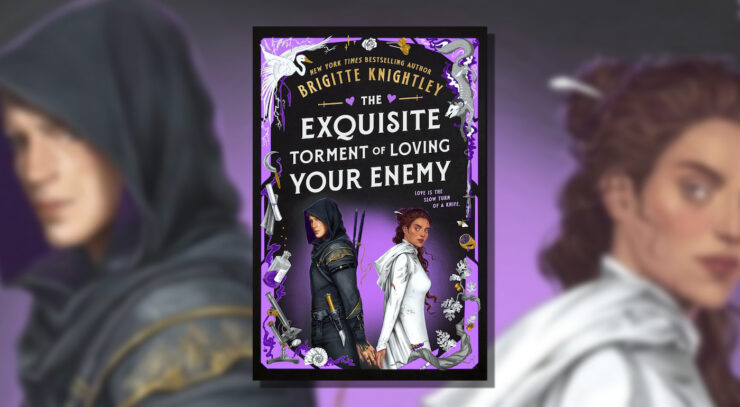
We’re thrilled to share an excerpt from The Exquisite Torment of Loving Your Enemy, the second book in Brigitte Knightley’s Dearly Beloathed romantasy series, out from Ace on July 7th.
Osric is a member of the Fyren Order, a guild of assassins who gleefully murder for money. Aurienne is a Haelan, a scholar-healer whose Order’s motto is Harm to none. Clear-cut absolutes separate them: good and bad, right and wrong, light and dark…
Until they don’t.
When Osric first bribed Aurienne to heal him, he never imagined those lines would begin to blur. But every healing session draws them closer together. He finds himself developing unwanted feelings for Aurienne as her capable hands heal his body—and his heart.
Aurienne’s perfect life has been flung into chaos in the form of a devastatingly handsome assassin. She should be in her research lab, not illicitly healing a Fyren every full moon—nor wrestling an attraction to him that threatens to slip into something else.
Things go superbly sideways when Osric and Aurienne discover more about the deadly Pox deliberately unleashed through the Tīendoms. The plague may be the work of another Order—an Order far nastier than either of them can handle.
As the lines between Osric and Aurienne continue to blur, the balance between peace and war, and love and hate, trembles, shifts, and hinges on a heartbeat.
When Aurienne materialised at Rosefell Hall, she clung to the waystone to wait for her stomach to turn right way up. Waystone travel always made her woozy; successive dips into the graticule made her nauseated. The stars spun too quickly overhead. The gravel drive ribboned queasily away.
A piece of darkness detached itself from the waystone. It said, “Hiya.”
Aurienne did not pierce Mordaunt’s eardrums with a scream, but he would have deserved it if she had.
He was dressed in his deepest hood and blackest cowl. Only his pale eyes were visible among the shadows, along with a few artistically placed strands of hair, silver white in the dark.
He pulled down his cowl to uncover a scar-crossed grin. Aurienne had not foreseen the tingle of gladness that possessed her at the sight. As though she had missed it. As though it mattered to her. She quelled the feeling.
Mordaunt swept towards her in an elegant bow. “My saviour has returned. You’ll no doubt find it impertinent of me to tell you what a delight it is to see you again.”
“I wouldn’t if I thought you were sincere,” said Aurienne. “Spare me your theatrical ardours.”
The smile gave way to a laugh. Mordaunt had cast off the softness of their rooftop talk. He was himself again: debonair, arrogant, mocking. There was, however, a new thinness to his face. Cíele was right—he looked like he’d been ill.
“Have you been sick?” asked Aurienne.
“Why?”
“Your face.”
“How dare you?”
“Answer me.”
“I’m fine,” said Mordaunt. “Quite over it, actually.”
“What happened?”
“Stomach bug. Don’t start quizzing me about diarrhoea. It’s not manners.”
“You should tell me when you’re not well,” said Aurienne. “I’m your Haelan.”
“You’re my Haelan,” repeated Mordaunt. He passed a hand along his jaw. His smile lingered but his eyes were unamused.
Then, as one seeking distraction, Mordaunt gave Aurienne’s outfit a look of assessment—this she did find impertinent—and asked, “What look were you going for? Lonely Adventuress? Exploratrix?”
Aurienne gave his ensemble an identical look of assessment and asked, “And you? Widow in mourning? The remains of the deceased?” And then they were at each other again, irresistibly, a pin to a magnet.
Mordaunt, vexed, called her a Paroxysm.
She informed him, on general grounds, that he was an Adhesion.
He called her a Vortex.
“Fiasco,” said Aurienne.
“Crisis,” said Mordaunt.
“Sybarite.”
“Malapert.”
“Furuncle.”
“Niminy-piminy.”
“That’s not a noun.”
“Neither are you.”
Buy the Book

The Exquisite Torment of Loving Your Enemy
It was a fruitful exchange. It reminded Aurienne that Mordaunt was the most constitutionally irritating man she could possibly have been cursed with healing.
They glared at each other; aggravation simmered and spat between them. Mordaunt said, “I’ve so missed the pleasures of your company.”
He led Aurienne into crumbling, rambling Rosefell Hall through the kitchens, where he shed his cloak and cowl to reveal a wildly unnecessary—though splendidly cut—silver suit.
Aurienne was greeted by his motley pack of dogs. Rigor Mortis (Great Dane), Arson (retriever), Perjury and Forgery (border collies), Outraging Public Decency (bulldog; prolific farter), High Treason (borzoi) and Crème Brûlée (whippet) all limped to her and collapsed around her feet. Tails flumped at the floor in greeting.
Diverse Felonies, an arthritic terrier who usually objected to Aurienne’s presence through vigorous, voiceless barks, greeted her with cheerful belligerence. Crème Brûlée, the timid one-eyed whippet, permitted himself to be stroked. Arson liberally coated her black clothes with cream fur. High Treason, possessor of a long empty vessel instead of a head, leaned into her from behind and buckled her knees.
Mordaunt snapped out an instruction to sit, which his pensioners ignored as they smeared wet noses all over her.
Aurienne was also greeted by Mrs. Parson, Mordaunt’s steward—a sturdy, sensible woman, out of place in the household of a Fyren—and Mr. Parson, the groundskeeper, kindly and shy.
Mordaunt opened the door of the house’s sole usable sitting room.
Perjury and Forgery herded Aurienne in.
The sitting room was in its usual state: it was a room of rococo exuberance in which an art gallery and an antique shop had fought. The antique shop had won; both had left debris upon every surface.
Aurienne cleared away the bric-a-brac on the coffee table—crystal bottles shaped like anemones, a terracotta horse—and replaced it with Grette’s pies from the Publish or Perish.
“Did you buy me dinner?” asked Mordaunt.
“Yes.”
“Romantic.”
“Economic.”
“What?”
“They were on offer, two for one,” said Aurienne. “Steak and ale or chicken and mushroom?”
Mordaunt chose the steak. They ate. Mordaunt said his pie was lovely and tender, unlike Aurienne. She said her crust was superbly flaky, just like him.
Aurienne extracted materials from her satchel. She laid a map of Glastonbury Tor—the outcrop upon which the Druids had built their stronghold of the Færwundor—on the table.
“We were meant to pool our information on the Færwundor tonight,” she said. “I brought what I could find. What have you got?”
“I’ve got a plan.”
“Show me.”
Mordaunt fished about in his pocket and pulled out a bit of paper, which he gave to Aurienne. It said:
Plan:
Make a plan.
Aurienne delved deep into the font of her patience.
“Your plan is to come up with a plan?” she asked.
“Bit shit, isn’t it?”
“It’s well shit,” said Aurienne. “You are riding my last nerve.”
“My favourite place to be,” said Mordaunt.
“But at least you’ve been inside the Færwundor. That’s something.”
“Er—I haven’t, actually.”
“You haven’t? But you killed the Druids’ Seer.”
“I killed him at a restaurant,” said Mordaunt. “In London.”
“A restaurant?” repeated Aurienne.
“It was his birthday party.”
“You killed a man at his own birthday party?”
“Obviously: I knew he’d be there. What?”
Aurienne and Mordaunt stared at each other in mutual incomprehension. The gap between their principles yawned wide.
“So many of the things you do frankly erode my faith in our species,” said Aurienne.
“I’m not convinced we are the same species,” said Mordaunt.
“Immoralist.”
“Valkyrie.”
Aurienne pressed fingertips to the bridge of her nose. “Right. Excellent. Perfect. So we’re going into the Færwundor blind.”
“Not that blind,” said Mordaunt, pointing to the table. “You’ve got a map.”
“Exterior only. We’ve got a few Druid contacts at Swanstone—they’re a major source of plantings for our medicinal gardens—but I daren’t ask for too much information about their headquarters. All this map confirms is Glastonbury Tor’s position over three ley lines and that two watercourses cross somewhere within it, which coincides with Widdershins’ translation notes for the Begbéam moon.”
Widdershins was a professor who claimed to have translated the inscriptions on the Monafyll Stone, an ancient obelisk depicting a healing pilgrimage to be followed at the full moon. Aurienne and Mordaunt had harassed the man in his own home to obtain his translations, which described the pilgrimage in the vaguest and most unhelpful terms.
Aurienne was using Widdershins’ notes to guide her interpretation of the data—it being understood that by “data” she meant a quantity of ill-sourced, poor-quality, unverified anecdotes describing miraculous healings at the full moon.
This was the sum total of the research project upon which Mordaunt’s healing was predicated: maps with scribbles on them, fabricated translations, and anecdata. Ludicrous.
Ludicrous, and yet.
Frankly, the most ludicrous part of it all was that, following this poorly conceived “treatment,” Aurienne had arrested Mordaunt’s seith degeneration. Somehow, on the basis of fairy stories and healing sessions at the full moon, they had done something heretofore medically impossible and stopped the progress of an unstoppable disease. That was immense. A triumph. Or a coincidence. It was too late to be sceptical, but too soon to celebrate.
Aurienne looked up. Mordaunt had placed two heart-shaped nipple pasties over his eyes.
No: the most ludicrous part of it all was him.
“La vie en rose,” said Mordaunt, looking about.
Aurienne had been using the nipple pasties as markers on her map. She plucked them off his face. “Focus, please. The two watercourses may be subterranean. There’s a persistent legend that Glastonbury Tor is hollow—that there’s a large cave system within the hill. Some myths suggest that passage to Annwn can be found down there. The Celtic Otherworld,” she added, in the face of Mordaunt’s blank look. “A paradise of eternal youth, where disease is absent.”
“What are all those wiggly bits going round the Tor?” asked Mordaunt, tapping at white lines circling the Færwundor. “Fortifications?”
“That’s the labyrinth I’d mentioned to you.”
“Not much of a labyrinth,” said Mordaunt. “Looks more like a spiral.”
“Whatever it is, we’ll have to go through it. It’s the only way to the entrance of the Færwundor.”
“And what’s in the Færwundor itself?”
“I don’t know,” said Aurienne. “It’s the Druidic headquarters, so I imagine it’s fairly rustic. A stone tower full of herbs and pestles and things, like an old-fashioned apothecary. Maybe an altar or two. Almost ninety percent of my data for the Begbéam moon points to dawn as the best time for a healing. I suggest we meet at three in the morning to give ourselves time to get into the Færwundor to attempt it. The nearest pub is the Hairy Hodmedod.”
“All right.”
“I wish we could’ve entered the Færwundor by legitimate means.” Aurienne sighed. “This would’ve been so much easier.”
Mordaunt emitted a disdainful tut. “Legitimate is boring. It lacks Incident.”
“How do you propose we proceed, then?”
“I’m going to shadow-walk the two of us right through,” said Mordaunt, in an extremely offhand way, given the ludicrousness of the suggestion.
Aurienne was a Haelan. Haelan did not walk the Dusken Path. She could not possibly have heard him correctly.
“I’m sorry,” she sputtered, “shadow-walking? Me?”
“No,” said Mordaunt. “Me. I’ll carry you along.”
“You’re joking.”
“I’m not,” said Mordaunt. “Stop clutching your pearls. We’ll be in and out before you can blink.”
Aurienne—who had actually been clutching invisible pearls at her throat—lowered her hands. “I follow the Bright Path. I don’t even know what will happen to me if I try to walk a Dusken one.”
“Nothing. You’ll be a passenger.”
“You’ve shadow-walked others along with you before?” asked Aurienne.
“Yes,” said Mordaunt.
“How did they fare?”
“All right, I think. They hadn’t an opportunity to share how it felt afterwards.”
“They ‘hadn’t an opportunity’?” repeated Aurienne.
“No.”
“Because you murdered them?”
“Because I murdered them.”
“Brilliant.”
“I promise you’ll be fine. Let’s do a few practice runs. Come with me.”
Mordaunt drew his cloak and cowl back on, and led the way to a high-columned ambulatory round the back of the house. Like most of Rosefell Hall, it was overgrown and derelict; poor Mr. Parson, solely in charge of the estate’s thousands of acres, had managed to keep most of the flagstones clear, but moss crept inexorably between cracks and up columns. It also made its way onto the statue of a kore at the far end of the ambulatory. The kore’s chiton was adorned now with green lacework. Her stone basket held scruffy dandelions and a single courageous daisy.
There was a surprisingly lush, well-kept kitchen garden bordering one side of the ambulatory, which Mordaunt indicated was Mrs. Parson’s.
Aurienne remained unenthused by Mordaunt’s idea but, having no better suggestion to make, found herself limited to sprinkling a bit of disaster-mongering into the conversation. “I don’t think it’s wise of you to shadow-walk two people at once. Your seith system is fragile. You mustn’t push it to extremes.”
“Carrying you along isn’t extreme.”
“Is the carrying along literal?” asked Aurienne.
“Yes,” said Mordaunt. “Do you want to be my sack of potatoes or my bride?”
“Potatoes,” said Aurienne.
“Unromantic choice, but you are starchy.”
“Have I got to do anything?” asked Aurienne. “Use my seith?”
“No,” said Mordaunt. “I’m going to sweep you off your feet.”
Which he proceeded to do. He slung Aurienne over his shoulder, exactly as though he were handling a sack of potatoes, which offended her. She hung there with her arse in the air. The chicken and mushroom pie she had just eaten sloshed into a new position.
“I’ve changed my mind,” said Aurienne, tapping at Mordaunt’s back. “Bridal-style, please, or I’m going to lose my dinner.”
Mordaunt slipped Aurienne into place accordingly. Now she found herself in the appalling position of being held like a lover by him. He smelled of blackthorn smoke and shaving soap. He radiated his usual warmth.
She had desired to be In Control, and would have preferred anything to this intimate positioning. It felt perilously natural to be held by him. Such was Fate’s sense of humour. Aurienne wished that Fate would mind its own business and not meddle in her affairs.
The moon above was almost full. Lovelily she cast her light on Mordaunt, who held Aurienne like a paramour in the dark.
“Ready?” Mordaunt squeezed her tight. “Don’t want to leave bits of you behind.”
“Leave bits behind?” repeated Aurienne.
Before she could ask for a more fulsome report of the risks involved in the shadow-walk, Mordaunt swept her into it. First they were here, at one end of the ambulatory, and then they were over there, at the other end.
About ten percent of Aurienne’s brain registered fascination with this feat. The rest of it sloshed against her skull in a nauseated stew. Mordaunt might’ve warned her that every moment in the shadow-walk would feel as though her molecules had spun out and joined the iniquitous dark—that she would lose all sense of sight; that her breathing would be oppressed by the thickness of his seith over her; that, after each discombobulating step, she would be left with a brain like a centrifuge; that she would want to spew out the entire contents of her GI tract, as well as the organs themselves, if they would kindly detach themselves for the purpose.
Aurienne came out of a near faint to find herself clinging to the front of Mordaunt’s cloak. Masticated chicken pie heaved ominously in her stomach.
She would never eat again.
“Bit vomity, eh?” said Mordaunt.
Aurienne disentangled herself from Mordaunt to stand on her own. Her triumph lasted but a moment; the world whisked itself out from under her feet and sent her scuttling sideways like an excited crab. She fell into a heap.
The world oozed. Presently it congealed. A swimmy eye cast in Mordaunt’s direction confirmed that he was trying not to laugh about as hard as she was trying not to vomit.
Also: he had lied. He had promised that she would be fine. She was not fine.
Mordaunt squatted next to Aurienne and said, “Down like a bag of spanners.”
“This isn’t funny,” said Aurienne, clinging to flagstone and dirt.
“It’s an unalloyed delight.”
Aurienne could normally stem nausea with her tācn pressed to her own forehead. She tried. It didn’t work. This was not regular nausea. This was sickness born of walking the unwholesome Path. Her every fibre shook in revulsion; her very seith tingled in alarm at the wrongness of it.
“You’ve walked the Dusken Path now,” said Mordaunt. “You must be the first Haelan to do that.”
Aurienne was not gratified by the honour. “I’m a d-disgrace to my Order.”
“Let’s try again,” said Mordaunt. “Permit me to help you up.”
She flung a hand in his direction and said, tragically, “If I die tonight, see to it that someone feeds my cat.”
Mordaunt’s gloved hand closed on her bare one. He pulled her up, took her in his arms again, and stepped back into the shadow-walk. Blackness came over Aurienne; the pressure of his seith pushed against her brain, against her guts. She was conscious, in ways she had never wished to be, of the exact shape of her pancreas and her eye sockets.
Aurienne and Mordaunt materialised a few feet away. Aurienne squirmed out of Mordaunt’s arms. She went down again, exactly like a bag of spanners.
Mordaunt knelt next to her. “You’re doing better.”
His confidence seemed imprudent to Aurienne, presently indisposed. The world continued its spin. She considered anchoring herself to it using her teeth, but didn’t, because she needed her mouth to say, “I wish to die.”
Excerpted from The Exquisite Torment of Loving Your Enemy by Brigitte Knightley Copyright © 2026 by Brigitte Knightley. Excerpted by permission of Ace. All rights reserved. No part of this excerpt may be reproduced or reprinted without permission in writing from the publisher.
