







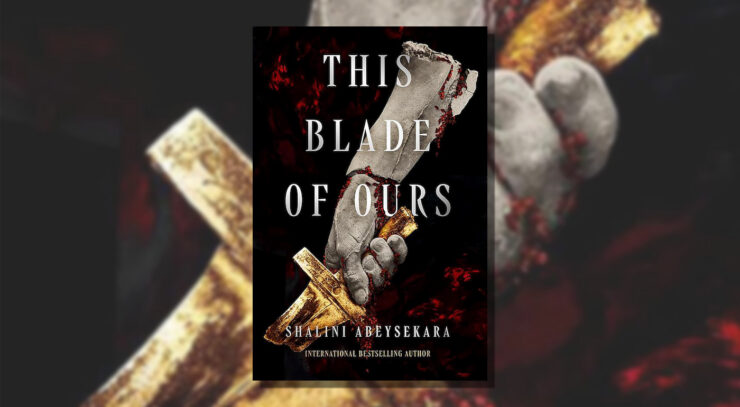
We’re thrilled to share an excerpt from Shalini Abeysekara’s This Blade of Ours, the conclusion of the dark romantasy duology that began with This Monster of Mine—available from Union Square & Co. on June 30th.
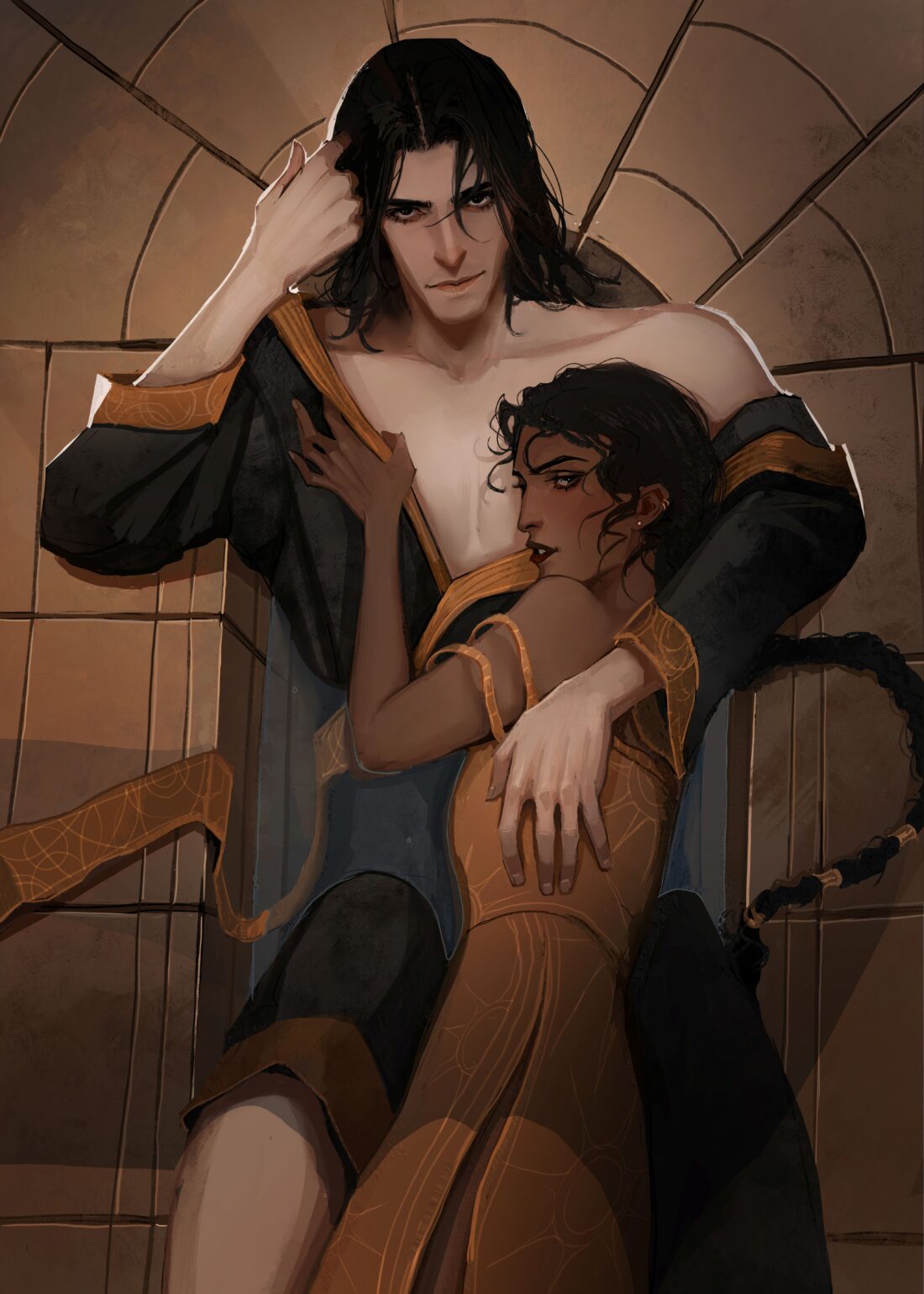
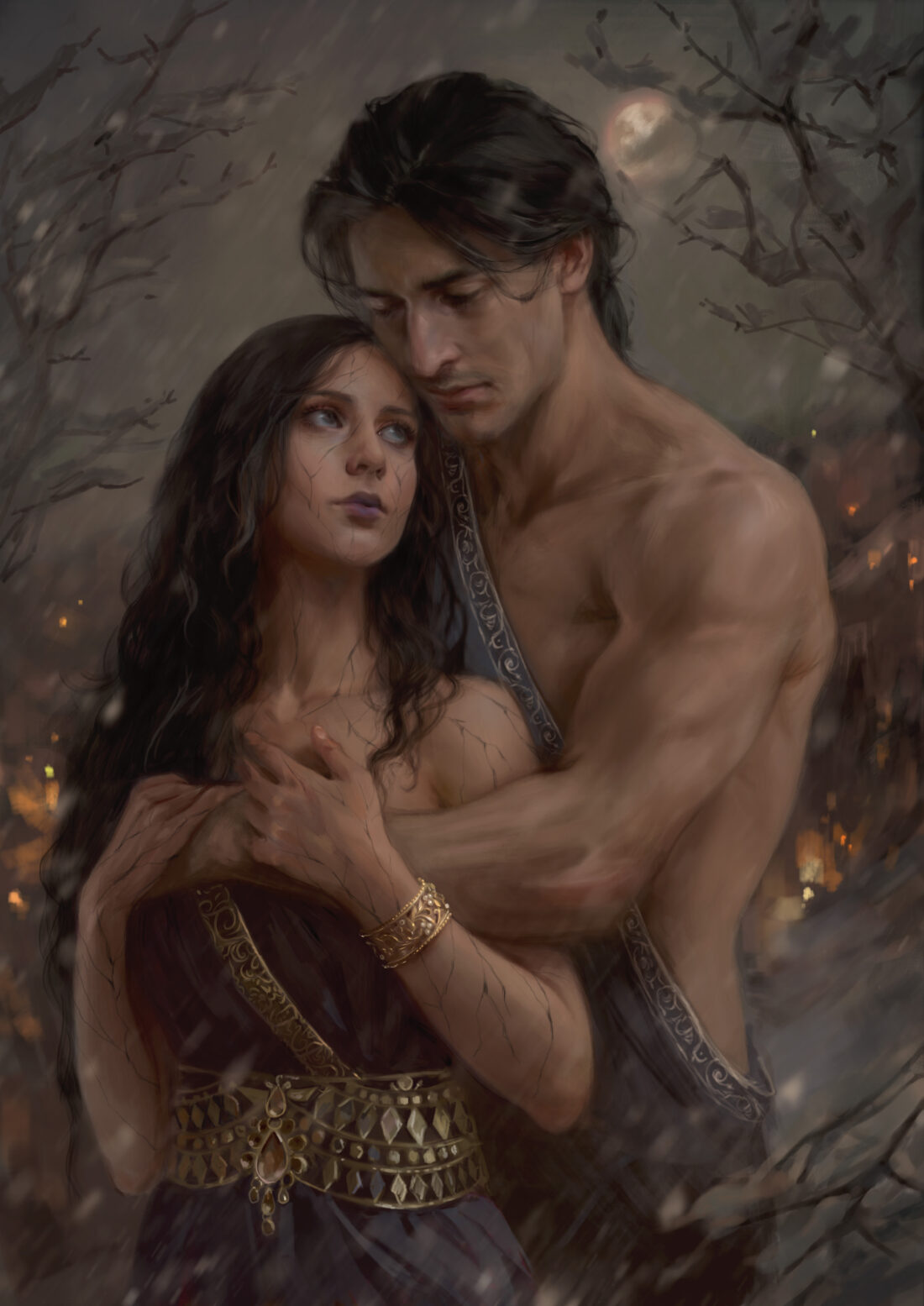
Read the prologue below, and check out character art of Sarai and Kadra from artists Avendell and Bella Bergolts!
Sarai believed the worst was behind her. However, months after exposing the government’s corruption in what has now been deemed “the Great Unravelling,” she faces scorn from citizens who preferred her and Kadra as the underdogs. Worse, eerie omens rock the country: from a deadly plague outbreak to a sweeping madness that leave the afflicted ranting of an approaching reckoning. Accused of angering the gods, Sarai returns to the only place that can clear her name: Ur Dinyé’s frozen north. But among the secrets buried in its ice are Kadra’s.
When historical tensions between the north and the south worsen, a powerful religious order seizes control in the chaos, led by a man whose very voice can kill—Noceo bu Kader. Trapped between love and a crumbling country, Sarai and Kadra must outwit a power with roots as deep in fear as in cruelty. But the gods are always watching, and Sarai and Kadra may not escape a second time.
Buy the Book
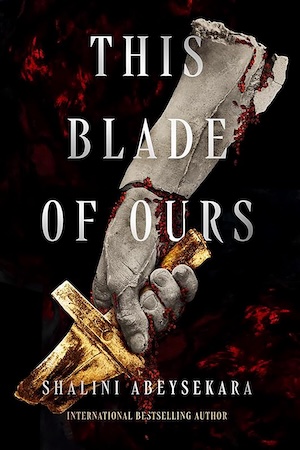
This Blade of Ours
Prologue
Her
“Beware you would‑be, God‑Summoners! Take heed, all you who would call the Elsar to our plane! For when the infinite touches the finite, the latter does not emerge unscathed. A scar forms at the point of the meeting. And from it, what blood will spill? Who else will part the seams of our world as a sword does flesh and enter?
Aim not for the lofty. Restrict yourselves to prayer and relinquish the selfishness of seeking out a personal boon. Let us worship as a hand does by the hearth. Plunge not into the fire!”
—excerpt from The Teachings of Inquisitor Caminus of Ur Dinyé
The collapse of a country was a quiet affair.
Few historians would agree. They preferred to point to crushing defeats in battle, assassinations, or civil unrest to explain the peaks and troughs of political chaos. Yet, those were merely the symptoms of a rotting land’s disintegration. Its cause would have snuck in earlier, quiet enough that no academic would entirely pin it down and capable enough to reach gnarled fingers through history to throttle the present.
Countries died in silence. As Ur Dinyé would today. Its current iteration, at least.
Her lips lifted in a smile. Squinting against the wind hurling orange sand across the Xārōmand Desert, she urged her mare toward one of the imposing mountains ahead. Thousands of miles long, the Kaycakh Range’s jagged terra‑cotta peaks formed a land border separating Ur Dinyé’s inhospitable Xārōmand from the neighboring land of Errigal—with whom they’d been at war centuries prior.
But these rocky giants had seen more than history. They had once held the future.
A millennium ago, in the heart of one of these mountains had existed a temple of such renown that only Ur Dinyé’s monarchs had been permitted to know its location. Within its cavernous halls, devotees of Lord Time had meditated upon the past and present and been blessed with brief glimpses into potential futures. The Seers’ prophecies had steered Ur Dinyé from devastation for centuries, until they’d been massacred by a king who had taken umbrage at what would become the Head Seer’s final prophecy.
Oh, the powerful and their fear. She cast a bitter look in the direction of Ur Dinyé’s capital of Edessa, thousands of miles to the south. She wouldn’t be freezing her ass off in the fucking Xārōmand if it weren’t for them.
Temperatures dipped lower under the slow wash of night. Above, Praefa and Silun surveyed her nightly routine of the past three months. Time and time again, she halted before the sheer face of a mountain and listened. The desert graced her with a wail of wind and spit sand across her cheeks.
Another night without hope. It had ceased to cut. For ninety nights, she’d ridden through half the Kaycakh Range in search of the Lost Temple’s entrance. The records she’d dug up from the Scourgemaster’s time had spoken to the temple’s rediscovery some five and a half centuries back but had neglected to mention the location after the unexplained deaths of those scholars and treasure‑seekers who’d ventured within.
No matter. It was the nature of history to be lost and found again.
She steered her mare toward another peak. Her mare balked, whinnying in fear as they neared the base. Sand gave way to barren soil littered with chunks of limestone. No sooner had her lips shaped a frown than she felt it, soft as gossamer. A hum of otherness like the scrape of jaws over skin. Magic. Hunger.
Hatred.
The reins slipped from her trembling hands, elation heating her blood. It’s here. Dismounting, she tethered her recalcitrant mare to one of the boulders fencing the mountain like teeth. Nothing in the rock face ahead indicated the presence of a door, yet the desert’s fearful thrum under her feet spoke otherwise. A warning. A proclamation of recognition.
“We know your blood,” the wind seemed to hiss. “It has spilled here before.”
“Go.” Sand curled around her ankles when she continued up the incline. “You are not wanted.”
Cursed land. Soiled with the innocent blood of thousands of Seers and sundered by even uglier secrets the Lost Temple had witnessed. The laws of the mortal world applied loosely here.
Her smile broadened. At last.
The mountain’s base vied with the Aequitas for breadth, rough slopes worn by Time’s chisel. At one corner, a pile of rubble listed precariously to the left, shielding what must once have been an entrance. A cave‑in or a barricade? she wondered. The elongated finger bones extending in silent plea from a gap in the rock could speak to either. She steeled her spine against a shudder. It doesn’t matter.
She placed her shaky palms against the cool, stone face and felt an answering ripple within. Now for the price of entry. Withdrawing a dagger, she pricked each fingertip, barely noticing the pain. So great was her excitement that she barely winced. Five crimson streams rolled down her hand to dribble onto parched soil. Red faded to terra‑cotta. The earth drank deep.
The wind halted.
Quiet. It was so very quiet now.
A hammering began in her chest, exultation and fear warping in a dangerous weave. She drew on the rock with bleeding fingers. A straight line, then a curved one, then several more. Zuvrai, the Urdish rune for “Time.” Mortal concept and immortal god. A rune so dangerously taxing that to draw it was to risk all the time that the user had left. The same rune Seers would have drawn to enter the Lost Temple millennia ago. Her chest squeezed with every pass of her fingers over the rock face, breaths dwindling and labored. Zuvrai was a Tenth‑Tier rune, demanding a torrential, inherently unsustainable flow of power from its user. She was no Seer. She didn’t have long.
Faster.
Magic was a peculiar thing. An inner well of power shaped by ancestry and tied to blood, accessible only by drawing the right patterns in one’s life force. Runes were the language of the gods, the Elsarian priests said, and their first gift to humans to allow them a taste of the divine. It was also their first test, a sieve to separate the greedy and power‑drunk from those good and faithful who would pass the gates into the Bright Realms where the High Elsar resided.
When all was said and done, where would she be placed? Monster or martyr?
A choked laugh tore from her. Had she access to her own epitaph, she would have written it now before history did it for her: Judge me or justify me, you know I was necessary.
Red flooded her vision as she drew the final set of zuvrai’s lines, arteries bursting in her eyes like swollen streams. Blood laced her tongue when she swallowed. Her fingers drew the last stroke and paused midair. Gods help me.
The rune flashed gold. Soul‑deep agony arced through her with the ferocity of a lightning bolt as zuvrai came to life, unspooling her time. Unspooling her. Invisible hands clawed at her lungs, wringing, twisting. Her screams were quickly swallowed by the now‑cacophonous desert, alive with a thousand jeers. Every pulse of her heart was a clap of thunder. Falling to her knees, she clutched her head and gasped for air.
The ghosts laughed. “You were warned.”
“No,” she croaked. Teeth clenched, she slowed her panicked breaths. “I won’t die here.”
Slapping a palm against the rock face, she dragged herself up, gaze fixed on the now‑glowing rune drawn into the mountain. Scarlet wove into the gold lines, warning that she would soon be drained of power and life.
Fifteen minutes? No. Ten.
“You know me,” she hissed to her listeners, heart thudding so hard that she feared it would stall any moment. “You know my kin and my kind. You will yield,” she snarled.
The ground shuddered. Yes. YES.
“Let. Me. In!” she screamed.
A chunk of the mountain’s craggy face crashed down with an earthquake’s force. She lost her footing and tumbled down the incline, cowering from the spray of rock and sand. Coughing, she raised her head when the rumbling ceased. By the Saints and Wretched.
The chunk had reduced the rubble blocking the entrance to dust. The Xārōmand quieted when she staggered back up to that pitch‑black mouth. A torch flared in an ancient sconce by it. Then another, and another, leading her in. She shuddered. Welcome or trap, it doesn’t matter. She was going where even the dead couldn’t touch her.
Pain clawed through her chest, hooking in and ripping down. Blood gurgled in her throat. Eight minutes. She ignored the broken corpses piled around the entrance, red tears snaking past her jaw from her own bleeding eyes.
She ran into the temple.
Firelight hissed to life in her wake, drawing golden fingers down frescoed corridors of battles past, fates avoided, futures won, gods appeased, murdered Seers—Elsar save me. The bones! Hollow eye sockets regarded her flight with mockery, their jaws unhinged in laughter.
“Will you make it in time?” they asked. “Can you control what even we couldn’t?”
I will, she vowed. The Seers had glimpsed the land’s future but been sequestered from its workings. She knew the people of Ur Dinyé. I can control them.
Libraries. Lecture rooms. Worship halls. Marble columns and limestone walls. The gilt had been chipped off, gaping holes left where statues and prayer tablets must once have stood. How many treasure‑seekers and scholars had the dead punished for it?
Three minutes. She had never known such pain even when—Faster. She rounded a corner, kicked down the banquet hall’s rotting doors, then froze.
There. A mighty oval courtyard hollowed into the center of the mountain. It opened to the sky, milky moonlight accompanying braziers that roared awake at her entrance. Avoiding the mess of collapsed columns, she ran to the shattered altar at the center, split down the middle by an unnaturally large handprint.
There had once been a god here. Chained for centuries by magi and Seers alike and twisted into an abomination that had been trapped in a man’s body so that Ur Dinyé could win its wars. But that had been during the time of the Scourgemaster, a time of monsters, prophecies, and men with honor. This was a new age. And yet, it needed a monster too.
She knew this to be debridement not death, but the arbiters of history took such umbrage to change. They needed their compartmentalizations of time and firm delineations of how the dust had settled. To stop it from happening again, they would argue, but knowledge of the past had never stopped its repetition.
Blood did.
Two minutes.
Dagger. She sliced both palms open. Safsher, she drew the Urdish rune for “Sword” atop the altar. Tuhig for “Void.” Zefis for “Weave.” Sweat slid down her temples, stung her eyes. Her strained gasps were a preliminary death rattle as the agony in her chest pulled tight.
“Soon.” Something caressed her neck. A fingertip? The past clawing for blood. She flinched. “You will join us soon.”
Faster. She bit straight through her lip and drew. Khon, frazam, layk, sayag. Blood, End, Unity, Shadow, and finally, Sleep. Nibas.
And she was out of time.
Thick iron welled at the back of her throat. She choked. Blood sprayed from her lips to coat the altar, smudging her desperate runes. SHIT.
She collapsed. The temple screamed in glee, a thousand voices grasping through death and time to claim her for their own. Blood seeped up from the courtyard’s tile, reaching inky fingers for her. A new ghost. A new scream. She tried standing but her limbs no longer worked.
It can’t be for nothing! She silently pleaded with herself as the blood neared. Stand up! Stand—
Blue‑green flames roared from the altar and spread to fence her from the dead. Dazed, she watched the fire climb toward the sky and coalesce into a wall. The voices vanished.
She’s here.
She had Summoned a god.
Her fingers moved quickly across the tile, drawing zuvrai once more. The magic unspooling from her stoppered. Pain fled like a ghost. Exultation brought her to her feet right as the goddess entered the mortal plane.
By all that’s holy. She fell back on her knees. Like all Naaduir, Faragathe had been human before her elevation to the minor pantheon for her service to Lord Time of the all‑powerful Elsar. It no longer showed.
Starlight wove through black hair that trailed long past the goddess’s ankles to float midair. Midnight‑blue ribbons of sky slid over her twenty-foot body like an ever‑shifting gown. Four eyes, sans iris and pupil, blinked on each bare shoulder and across her clavicles. Two more apiece slitted open on both high cheekbones, and the human two stared down at her. Eighteen eyes, holding an esophageal darkness.
One dark, blue‑green foot touched the ground. Faragathe tilted her head, curved horns gleaming bone white. “You call me to cursed land.” For a melodious voice, it cut like a blade.
So, this is power. “I had little choice,” she said bitterly. “I’m not so powerful a magus to Summon you otherwise. But those damned Elsarian priests were right after all. A Summoning does leave a mark of incursion on the mortal plane.”
“So, you pulled me through.” Faragathe’s eyes narrowed as she took in the courtyard. “Great evil was done here. A god Summoned. Brutalized.”
“I don’t seek to do the same to you! I swear—” She screamed when the goddess hoisted her with a flick of her finger, inches from her unearthly blue‑green face.
Faragathe waved a taloned hand, spinning her dangling body in a slow circle. “A mortal’s oath means as little as their life.” She grinned, baring sharp teeth. “You couldn’t hurt me if you tried. Now, what do you want?”
For the first time, she wondered if she had made a mistake. What if she doesn’t care? The goddess’s many eyes were utterly blank. She had never seen anything so devoid of humanity.
“I ceased being human millennia ago,” Faragathe sniffed daintily, reading her thoughts. “Why? Do you seek to offer your body as a vessel? Keep it. I take no pleasure in walking this plane.”
“Because of what they did to you.” She trembled when the goddess stilled but kept speaking. “Faragathe, Devotee of Time.” She took a deep breath. “The Heretic Priestess.”
The goddess’s eyes flashed. “You dare—”
“I’ve risked everything to come here tonight for this, for you!” she screamed. “I spent years of my worthless, mortal life digging through ancient texts for how to Summon you. The woman whose prophecies everyone ignored because Time granted them through dreams instead of the out‑of‑context flashes of the future accepted as canon by the Elsarian Order. The priestess who was mutilated and burned alive for saying what the Order didn’t like hearing. One of history’s most brilliant minds, ultimately proven right and still all but written out of the Codices and every other religious text.”
Faragathe’s smile was tight. “A choice that the Order has since learned to regret. Fear is bred in the unconscious, in the nameless things that walk between death, sleep, and waking. Unlike some of the other Naaduir and even a few Elsar, my power doesn’t depend on human belief. Everyone inevitably comes to me.”
“I know. That’s why I wanted to offer you—” She jerked when the goddess planted her on her palm and leaned in. The words died in her throat.
She had been wrong. It wasn’t just starlight glistening in Faragathe’s hair but bone and tar. The eyes on her shoulders were voids into worlds with terrors beyond comprehension. Darkness crowded the courtyard, extinguishing the braziers, and within it seemed to be a universe with the goddess as its epicenter, amid others of horrific, larger—all those eyes—
She realized she was screaming when Faragathe laughed.“Well, mortal? What can you possibly offer me?”
Mind. Where was her mind?
“Recognition,” she gurgled, a portion of her mind irrevocably altered. Her gaze shied from the goddess. “There was a time after your death when people heeded you. Now, they’re viewed as mad. Remind them of you once more. Shroud this land and bind it to you. Make the priests of the Elsarian Order return your name to the Codices. We have a capital, Edessa. A cesspit of the pretentiously religious, corrupt, and greedy. Destroy them, and history will never forget you again.”
“How quaint. So, this is about vengeance.”
“You see my mind.” She knelt on the goddess’s palm. “It’s about more than just that.”
Eighteen black, empty orbs swiveled toward her and watched. Faragathe’s brow pinched. “Yes,” she murmured. “A great deal more.”
A blur of wind and limestone and she found herself deposited on the ground.
“The Naaduir don’t grant wishes, mortal.” Faragathe sounded contemplative. “We accept what appeals to us and reject the rest.”
Her heart sank. “Please, at least—”
“We never made the same promises to humans that the Elsar did. We reached this state of minor godhood because we served them and not you. You have Summoned me, and your request was heard. There is no debt.”
A tear ran down her nose to drop on her bloodied palms. “I understand.”
Blue‑green filled her vision. A finger the size of her arm tipped her chin.
“But in this, I will hear you.”
Her head shot up. To her horror, she realized that she was sobbing. “You will?”
“Violence may be the sinew of authority, mortal. But power, true power, lies in the shadows.” Faragathe trailed a hand over the ruins they stood in, the remainder of a place that had once shaped the nation. “Let them see it,” she said to the night sky. “Let it drive them mad. I will stand behind you.”
Blood rushed in her ears, warmth spilling through hollows that life had carved in her chest and left to fester. So, this is joy. She bowed low. “My goddess,” her voice cracked, “from this day forth, I bind myself to you and only you.”
For the first time, something almost sad flickered in Faragathe’s many eyes. “Very well, mortal. To ancient history.”
She squeezed her still‑bleeding palms. The blood spattered on the ground in a silent vow. “To ancient history.”
Excerpted from This Blade of Ours, copyright © 2026 by Shalini Abeysekara.
About the Artists
Born and raised in Munich, Germany, Avendell has been drawing and painting ever since she could hold a pencil. She pursued her art education in Savannah, GA and now lives and works in Pennsylvania. During the Covid lockdown she combined her passion for art with her love for reading and found her creative home in book illustration.
Bella Bergolts is a professional digital artist specializing in fantasy illustrations, book covers, and character design.
