






If your solution to an underperforming superteam is “let’s make the next one retro!” you might want to ask yourself if you’ve got a bigger problem here.
Before anyone makes the assumption that this is bad faith talking, I was so down for the retro take when they started the promotion wheel. I might be in the perfect cross section for their assumed audience on Fantastic Four: First Steps? You see, I didn’t read their comics as an impressionable youth, but my dad did (a common theme among dads and grandpas of a certain era). He infused me with an affection for this crew via his own affection. It was fun to listen to him talk about this highly dysfunctional super family, and I wanted this movie to live up to his memories. To bring back a little piece of that joy for him, and share it with me via proxy.
Personally, I’m the Doom fan in all this. But I wanted to see the family of four done right by for a change. “They can be fun in the right hands!” I scream into the void at the end of time. (All that answers back from the void is a whisperscream: “This one has the highest Rotten Tomatoes score of any Fantastic Four film!” Because the void thinks that’s a metric we should judge creative endeavors by, clearly.)
The setup is simple enough: On a different Earth out there in the multiverse, our crew go to space, hit an anomaly, develop superpowers. Same old, same old. Now the Fantastic Four are a team, who all live together in the same smart house skyscraper designed by Reed Richards (Pedro Pascal). The world loves them, and they use their powers to help us all. They even stop Mole Man (Paul Walter Hauser) and make him a friend! Now for the initial curveball: Sue Storm (Vanessa Kirby) is finally pregnant after trying for a couple years with Reed. They announce the happy news to brother Johnny (Joseph Quinn) and best friend Ben (Ebon Moss-Bachrach), and everything is great… until the Silver Surfer (Julie Garner) shows up to herald the death of their world via Galactus’ great hunger.
Second curveball: Galactus might be willing to stop if the group give him Sue and Reed’s baby, because he’s got super special powers he’s hiding. Only the god-like baby can fix what ails Galactus. How? Uh, we never really get to that part. Who cares, the big giant wants a baby—and now the world is mad that the Fantastic Four won’t consider giving up an infant to a world-eating monster.
Which brings me to my first issue with this film, being that the general populace of this planet are tepid cardboard cutouts of real global populations. It seems as though the writers of the film thought that giving this alternate Earth an anodyne sheen of nostalgia would exempt them from any need to show the wide world as a complex place full of people with differing opinions. Every thought about the Fantastic Four as protagonists is a unified one being spoken by the planet at large: We adore them, we hate them, we need them, we’re disappointed with them. It’s not merely that it feels unrealistic—it’s creepy. As though everyone’s been hypnotized and doesn’t seem to notice or care.
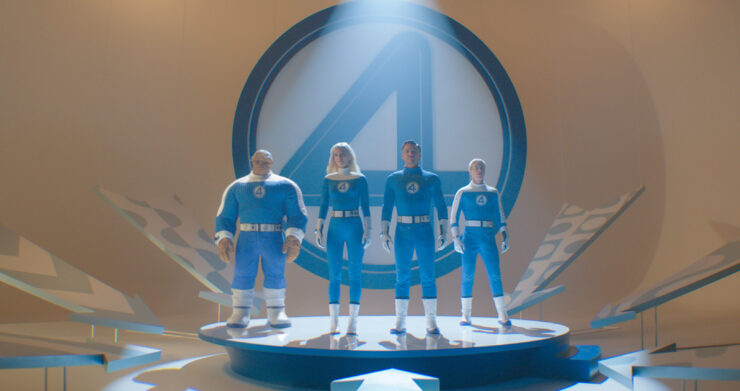
The construction of said world is also puzzlingly rendered: Where the retro futuristic technology is concerned, things largely work out. We’ve got the family’s robot butler, H.E.R.B.I.E., whom they’re all affectionate with; the stylized cars; the midcentury modern automated kitchen that Ben loves working in. But there are so many areas where real design and thoughtfulness was needed, then seemingly omitted in its entirety: The film’s version of New York City is created by grafting famous architectural structures from other cities around our world onto their version of Manhattan; the first space flight the team takes appears to be on a normal-ish rocket with a landing capsule that hits the ocean, but four years later they’ve got a souped up version with laser guns and an FTL ring docked in space; they decide that it’s completely fine for a very pregnant Sue to launch in said rocket with no concern for her or her unborn child in the mix.

Guess what happens on the heels of that choice? (Yeah, sorry.)
It’s hard to believe that we’re a quarter of the way into the 21st century and still begging movies and TV not to do women-in-labor scenes unless there’s an interesting reason—and preferably some realism to add into the mix. Yet here we are. Maybe they thought they were being edgy having a superhero try it out this time? But there’s absolutely nothing new here—you can set your watch by it.
There’s a much larger elephant in the room—being that this alternate earth seems to suggest that there’s no (or very little) day-to-day racism or general bigotry that anyone needs to contend with… or at least that the audience shouldn’t be thinking about it. Which is made even more awkward when there are very few speaking roles given to Black actors in a film that takes place in potentially-egalitarian retro-60s America. And gets even worse when you note that one of the only speaking roles for a Black actor in the entire film is Sarah Niles’ Lynne Nichols, a woman meant to be Chief of Staff of the Future Foundation, who spends most of her time in the film doing work you would expect of a publicist for the Fantastic Four.
Is this world more utopian than our own? If it is, shouldn’t they bother to tell us how it came to be that way? And if the answer is “the Fantastic Four were around,” shouldn’t we all be concerned over how creatively and ethically bankrupt that concept is?
There are so many holes in the logic of this world, it barely forms a coherent environment. Among said holes we’ve got a few silly gems like: The group launches their rocket from the middle of Manhattan; gravity can apparently be achieved by pinning someone to a surface in zero G; Johnny can translate alien languages despite showing no inclination or aptitude it; city evacuation plans that are fun to consider, but woefully inadequate on paper.

And then there’s the Reed Richards of it all. Richards is widely regarded as one of the more openly neurodivergent characters on Marvel’s roster: Though never canonized outright (aside from an alt-universe miniseries), plenty of fans go by the interpretation that Reed Richards is autistic, citing his intellect, tendency to hyperfocus, and bluntness. But while Pascal is doing his compassionate utmost to show the ways in which Reed’s mind can become a pitfall, the script does wrong by the character in explicitly stating that Reed Richards’ neurodivergence is harshly calculating, unfeeling, and hurtful to Sue. The reason why is hardly a shocker either: It’s all because he’s having a hard time solving their problem in a way that doesn’t involve their infant son.
This isn’t to say that it’s wrong for marital problems or character conflict to pop up in these stories, just that this particular depiction of neurodivergence is old hat and badly rendered. Reed Richards is shown to be a loving partner and parent here; accusing him of being the opposite due to clichéd misunderstandings around his neurotype—from his own wife, the person who ostensibly loves him, chose him—is plain lazy. It does Sue dirty at the same time, suggesting that new motherhood prevents her from having the most basic empathy toward her partner at a point in time when everyone is terrified and stressed about the impending end of everything.
There’s plenty of casual sexism rooted throughout Sue’s character, and… friends, I’m so tired. Genuinely, I would love if motherhood was a facet of one superhero’s journey. A facet, mind you, rather than the framework. But First Steps crashes through midcentury nuclear family nonsense with all the subtlety of a wrecking ball. It’s not that Sue is the only member of the team with emotional intelligence—we see plenty of that from the whole group, thankfully—but whenever it’s time to verbalize emotion, or unity, or the importance of family to the public, it’s only ever on Sue to do it. Only Sue builds bridges. Only Sue can convince the entire world to demilitarize (you read that right). Only Sue can reach Mole Man. But if the men around her are no longer absurd archetypes of pure genius, womanizing hot-headedness, and gruff punchy anger, then why hasn’t she evolved along with them? (Could it be because there was not a single women writing this screenplay…)
The Silver Surfer’s storyline is similarly bogged down in the most rote way imaginable. Using the Shalla-Bal iteration of the character could have been an enjoyable redux from the last time the character appeared on screen (in 2007’s Rise of the Silver Surfer), but the change is relevant only for Johnny Storm. Because obviously Johnny is more interested in connecting with the Silver Surfer if she’s an attractive women. Johnny later proceeds to guilt her for serving as herald of Galactus in order to keep her own world safe, something that no one from any of the previously-destroyed worlds apparently ever thought to do before(?). Rather than the Silver Surfer deciding that they might have a chance at stopping Galactus because of the Fantastic Four’s abilities, this instead becomes about a change of conscience only the Human Torch can bring about.
Did I mention that the soundtrack is just as irritating throughout as it is in the trailers? It’s like Marvel told a bad joke and was so annoyed that people didn’t get the joke, they decided to double-down to punish us. It adds another layer of strange fatigue to the whole experience.
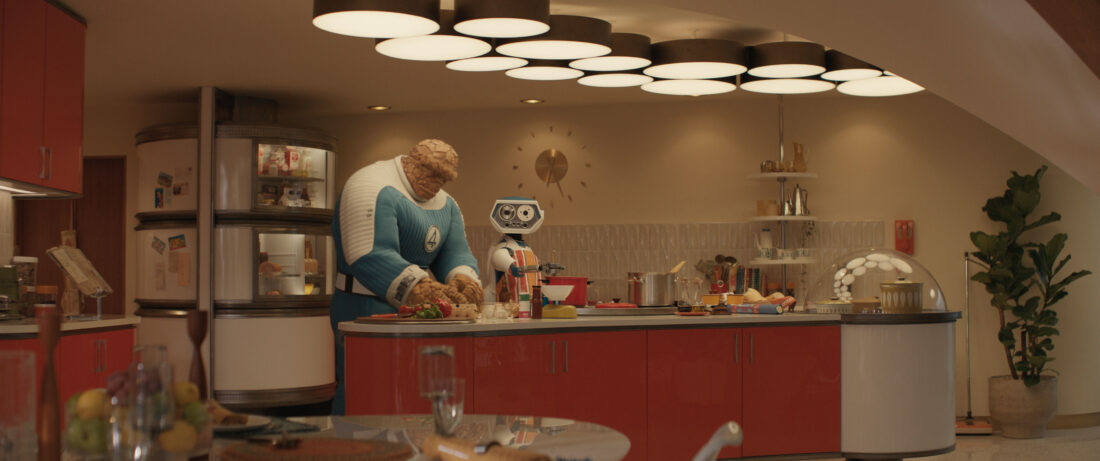
These are well-known comics plot lines, by the by, but the MCU has garnered much of its goodwill off their more clever remixes of these stories. There’s little variance here, and what shows up is either dull or plumb confusing. Every once in a while the characters lay around and talk, or give H.E.R.B.I.E. a scritch, or sit down to a meal, and we’re reminded of what we want these films to be: fantastically human. But then the moment passes, and Galactus sticks his humorless head into frame once again.
I’ll stick with their in-universe cartoon series, thanks.

I have no interest in the movie but I have to say, based on the photos I’ve seen, this is yet another example of how unbelievably poorly Hollywood does trying to mimic period design. The sets, hair, props and costumes aren’t even close to even the most fanciful of sixties aesthetics. It’s another classic example of a production staff ramming their own ideas down a movie’s throat without the slightest regard for whether they are actually appropriate. Much of what I’ve seen looks like crummy, generic sci-fi streaming fare.
Sue’s hair is unbelievably 2010s/2020s, much like SNW’s Chapel or the entire cast of Don’t Worry Darling. In 10 years, it’s going to look very dated; consider the 1980s miniseries of North and South, where the supposedly 1840s characters look like fashion plates from 1985.
If you’d like to take part in the discussion, please be aware of our commenting guidelines; keep the tone civil, and avoid being dismissive or making things personal.
This nails it. I wish it didn’t, but it does.
A few added points.
I liked it. A little cluttered setting things up in the first act, but pretty solid once the Surfer kicks off the main plot. I found myself emotionally engaged during the Big Action Climax, and that NEVER happens.
One thing. The actor playing Johnny wears blue contact lenses (in order to read as Sue’s brother, I guess) and I found that SUPER distracting, verging on disturbing.
I’ve been a fan of the FF since the first appeared in the 1960s, about the same time I went to NYC to see the 64/65 World’s Fair. And I loved the retrofuturist tone. Some of the flaws of that time were also, for better or worse, part of that portrayal. I thought all the actors were great and well cast. The action moved right along, and there were some nice, light, touches. Johnny becoming a linguist was a stretch, but at least they gave him something to do besides being a shallow womanizer.
I thought the “give me your baby” subplot was an interesting counterpoint to Arthur Clarke’s Childhood’s End, where humanity is largely passive as aliens steal their children and their future, and also to the Torchwood TV show’s Children of Earth arc, where the government hands over children to aliens in return for being left alone.
I have seen such a completely different movie from the one you have seen hat I have trouble addressing that endless list of complaints without feeling like I’m just being contrarian. It feels particularly bizarro to me (pun intended) because I absolutely loathed the Superman movie that everyone is raving about. More movie like Fantastic Four, please.
(I do agree on the lack of prominent black characters, but to be fair, no one who isn’t the FF gets much to do in this film. And we have a latino lead and (finally) an actual jewish actor to play Ben, so it’s not like there’s no representation at all.)
(Unrelated, but I would like to know why all my comments end up in the moderation queue since the change from Tor to Reactor. As far as I can remember, I have never received even a moderator warning in all my years on this website.)
All comments on this thread, and many other active threads on the site, remain unpublished until they can be reviewed by the moderation team, in order to keep the tone of the discussions civil and to help maintain the aims laid out in our moderation policy. This isn’t a new feature–it’s been standard practice for many years (at least the last decade).
Small point of correction- Sarah Niles’ Lynne Nichols was listed in the credits as the F4’s Chief of Staff, not CEO of the Future Foundation.
I overall loved the aesthetic of the movie, and think that the last song in the credits is hilarious.
Thunderbolts had a lot more emotional heart.