







In this column, we’re looking back at the 1980s as their own particular age of fantasy movies—a legacy that largely disappeared in the ’90s only to resurface in the 2000s, though in many ways, the fantasy films of the Eighties are far weirder and less polished than what we got in the aughts. In each of these articles, we’ll explore a canonical fantasy movie released between 1980 and 1989 and discuss whatever enduring legacy the film has maintained in the decades since.
For a more in-depth introduction to this series of articles, you can find the first installment here, focusing on 1981’s Dragonslayer. Last time, we talked about the original Millennial trauma text, The NeverEnding Story. This time, we’re looking at an immortal tale of swords and sorcery—or maybe cleavers and cleavage: 1983’s Fire and Ice.
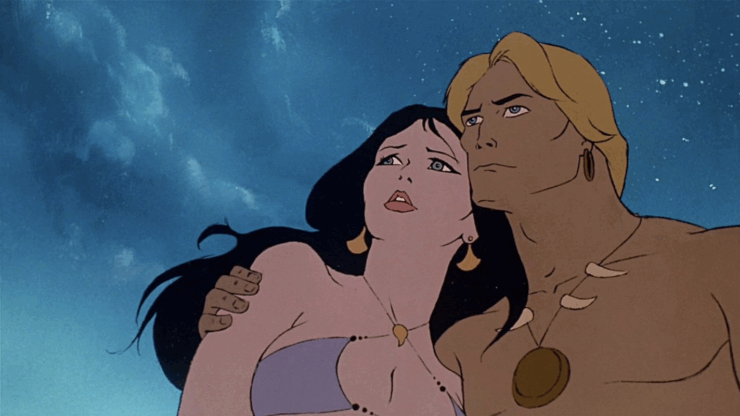
Directed by the dubious lord of adult-centered animation, Ralph Bakshi, and produced and art directed by the legendary comic book and fantasy novel illustrator Frank Frazetta, Fire and Ice is a film that feels as though it should be part of Robert E. Howard’s Conan universe (and was written by Conan comics writers Gerry Conway and Roy Thomas) but is technically an original story. The film follows the exploits of the mostly nude tribesman Larn, whose village is destroyed when it’s caught in the midst of a war between King Jarol of the volcanic citadel, Firekeep, and the evil ice sorcerer Nekron, alongside his equally evil and sorcerous mother, Queen Juliana. After Jarol’s daughter, the aggressively underdressed Princess Teegra, is kidnapped by Nekron’s subhuman servitors, the princess teams up with Larn and the masked barbarian Darkwolf to stop Nekron and unite the land under a banner of peace. [Note: the full cast includes both performance models and voice actors, and can be found here.]
The film is a picaresque adventure with very few plot points that last more than the length of the scene in which they are introduced. These set pieces focus on typical sword-and-sorcery fare, from fighting an antediluvian horror in the ruins of a flooded city to rescuing Princess Teegra from orc-like “subhumans” (more on that later), as well as an encounter with a wicked sorceress and her Neanderthal servitor (definitely more on that later). The whole film contains very little dialog and mostly serves as a showcase for Frazetta’s designs and Bakshi’s rotoscoped storyboards.
While Fire and Ice is obviously beautiful, in terms of its visual and artistic elements, it is a film that suffers from too little cohesion and a lot of material that has aged very poorly in the last forty-two years. It may be that its dedicated fans regard it simply as a visual delectation (and that’s perfectly alright), but it is hard to watch without wondering what more it could have accomplished if it had been a bit better written and more focused.
Take, for instance, the sequence in which Teegra is kidnapped by Otwa, the hulking, Neanderthal-like son (surrogate or biological is never made clear) of the sorceress Roleil, who plans to get back into Juliana’s good graces by sending Teegra along to Nekron. There are implications that Roleil uses sorcery to stay young and beautiful, potentially by murdering young women, and she lapses into a campy, screechy fit of unadulterated pique upon discovering that Teegra is Nekron’s intended. And there is some great visual storytelling in the way that Roleil’s hut showcases more and more menacing objects the longer Teegra stays there—mirroring her rather slow realization that the sorceress means her harm. But for all this fun set-up, the plot point is resolved almost immediately as Nekron’s subhumans show up and murder Otwa and Roleil. A scene or two later, Larn comes across the charred remains of their hut and Roleil’s corpse briefly rises up from the ashes, swearing revenge against Nekron, but quickly disintegrates after telling Larn where Teegra is. The whole sequence could have taken up twenty or so minutes as a middle act of the movie. It is over in about three, and all the visual interest and worldbuilding it begins to provide evaporates.
Similarly, there is an entire port city, by far the largest and most impressive settlement the film has shown, which is featured for, conservatively, forty-five seconds. The ships the characters sail out on are delightfully detailed, covered in spider and bat iconography but again are on screen for only a couple of seconds. The ruined city in which Larn and Teegra have their meet-cute (emphasis on the meat) features bas-reliefs of Darkwolf’s head, implying it was once populated by his people but no further information is given on his backstory. Both moments feel like parts of cut sequences (and they may very well be), and so much of the movie feels like an unfinished prompt.
What Fire and Ice mostly fills its runtime with is flesh. It is a film where almost everyone is perilously close to being completely nude at any given moment. And beyond costume design, Bakshi’s rotoscoping allows for a discomfiting amount of sensuality. His films are, let’s face it, uncomfortably horny. It’s not just Teegra—though she receives a lot of focus, stumbling about in her diaphanous bikini, jiggling in ways that have been too-lovingly animated—but pretty much every character in the story. One of the subhumans grabs at Larn early in the film, and his hands slide across his hips and buttocks in what feels like sensual slow motion. Nekron writhes orgasmically as he casts his ice magic, resulting in the stark white spires of ice to thrust, phallically, into the air. The entire film feels like one is walking in on something one shouldn’t have seen—a private fantasy painstakingly committed to celluloid. It’s a movie that leers at itself, drooling endlessly over its own creations.
Moreover, these preoccupations often seem to indulged at the expense of overall consistency. Teegra’s body may be thoroughly showcased but there is a strangely loose and mutable quality to her face. It’s as though she has been erased or rendered less detailed in an effort to not give her face too much personality. It’s very odd, and pretty off-putting.
We also need to discuss just how poorly this film has aged. Sure, there is some of the typical misogyny in how much the film wants to put Teegra in danger while she’s basically naked and wiggling into pin-up poses (though it, perhaps, gets a few points for allowing her to occasionally rescue herself). It should also be noted that her father’s keep flaunts a singularly distasteful mural of a woman being kidnapped by lizard people. But there are also unbelievably grotesque racial politics. Fire and Ice is far from the first fantasy property to feature faceless hordes of monstrous grunts which echo racist caricatures of non-white people, but it is remarkably relentless in showing its darker skinned “subhumans” hooting, leering, and boiling out of their caves to slay lighter skinned heroes and kidnap white women. It’s disturbing, to say the least.
Less egregious, but no less uncomfortable is the way in which Darkwolf—stoic, grim, and at home in the natural world—plays into the noble savage tropes so often laid at the feet of Indigenous Americans. If he is meant to represent the last vestige of a vanished civilization (as the film vaguely implies), it plants us firmly in squirm-inducing Last of the Mohicans territory.
Similarly, it’s hard to ignore the queer-coding of Nekron, who shimmies moodily in a loose tunic and reedily scoffs at having to marry Teegra. I’ll be honest that, had I seen Fire and Ice as a kid, he might have joined the pantheon of beloved queer villains that still-closeted me idolized alongside Scar, Jareth the Goblin King, and James from Pokémon. But seeing him as an adult, there is something that feels especially petulant about Nekron, who isn’t even granted the dignity of being especially powerful, devious, or catty. He’s queer-coded without being fun or interesting enough to make one feel conflicted or secretly reverent about it. Eyebrows notwithstanding, Lee Pace as Thrandruil, he’s not.
Honestly, it’s hard to see the value of Fire and Ice in any arena but the visual. Obviously, Fire and Ice has a long artistic legacy, not the least of which because it helped launch the careers of Dinotopia artist and scribe James Gurney, “Painter of Light” Thomas Kincaid, and Æon Flux creator Peter Chung, all of whom worked as background artists. Three very different illustrators with three very different careers, all raised up through Bakshi and Frazetta’s tutelage.
The visual language that Frazetta created throughout his career has cast a long shadow over film. Fire and Ice, in particular, however, has sculpted the visual language of fantasy across a generation of creators; for example, the aquatic, eldritch beast that Larn fights seems to have influenced Weta’s designs for the Watcher in the Water in The Fellowship of the Ring. And outside the realm of film, there are even closer ties. Blizzard Entertainment, the gaming company whose Warcraft, StarCraft, Diablo, and Overwatch series were co-written by shameless Fire and Ice fanboy Chris Metzen, was the gold standard for a certain sort of real-time strategy gamer throughout the ’90s and aughts and still runs the most successful and long-lived massively multiplayer online roleplaying game (MMO), World of Warcraft. Metzen’s clear love of the Bakshi film is obvious in everything from naming the mounts of the popular Blood Elf species “dragonhawks” (though, unlike the Dragonhawks of Fire and Ice, they aren’t just pterodactyls), to the centrality of an ever-expanding glacier linked to Necromancy across their Warcraft series, to the fan favorite character Rexxar being a visual carbon copy of Darkwolf. Given how much Blizzard games have influenced the visual language of fantasy video games, Fire and Ice has had an outsized effect, for better or worse, on how we conceptualize primitive sword and sorcery worlds.
But let me know your thoughts. Have I been too hard on what is clearly, for its fans, a cherished animation landmark? Did I miss something essential that causes the whole film to fit together as a cohesive whole? How do you think it compares to Frazetta’s or Bakshi’s other work? Let me know in the comments. And be sure to join me next time when we move from one of Bakshi’s fleshy messes to an attempt to clean up one of his earlier mistakes with the Rankin/Bass animated Return of the King…

Just a reminder of our commenting guidelines: if you want to take part in the discussion, we ask that you keep the tone civil and constructive–don’t make disagreements personal. The full guidelines can be found here: https://reactormag.com/moderation-policy/
I’ve never seen another film in which every shot looks as if it could be directly airbrushed onto the side of a van.
(Not necessarily a van you’d want to get into.)
I’d say Guardians of the Galaxy Vol. 2 comes close.
Bakshi never lacks for ambition, but most of his films feel unfinished in some way or other. I think Fire and Ice is his most visually cohesive production, though I still wish the FX animation of advancing ice formations and flowing lava had more nuance.
It’s definitely his best achievement in rotoscope-based animation, keeping to clean lines and streamlined designs instead of attempting to overwhelm with fiddly, jittery detail.
Strangely enough, this was my introduction to fantasy genre. I was maybe six or seven. To be fair, my parents had no idea. It was in the TV guide, listed as an animated film, and at the time nobody suspected “animated” could mean “but NOT for kids”. They’d let me watch alone. It was early in the morning, days after Christmas; I remember that morning chill, snowy outside and me eating the last gingerbread cookies. Anyway, luckily, all that nudity and stuff went way over my head at that age. I loved it because it was not Disney-ish, it was different, and I loved something about it I couldn’t put my finger on at the time: it was set in a magical world. Much later, when I finally rewatched it as an adult, I went: Oh no, the six-year-old-me watched this?? This is the movie that made me fell in love with the genre? Oh no.
(The things that stuck in my memory during my childhood were, in that order: there was a guy climbing a really tall tree, there was a princess with a panther as a pet, and there were guys riding pterodactyles in ice caves. Those were the defining characteristics of the movie for six-year-old me.)
I probably saw commercials for this film back in the day but had completely forgotten its existence until I saw this column. Luckily it’s free to watch on Tubi. I’ve never been fond of Bakshi’s rotoscoped style, but what struck me here was how sloppy the art and animation were throughout, as if this were a rushed production with barely more than a TV budget. I don’t think the simplicity of Teegra’s face was deliberate; it was just part and parcel of the rough drawing style for everyone’s face.
Speaking of TV, it’s notable that one of the animators on this film was Tom Tataranowicz, an animation director/writer whose first (uncredited) story sale was on the similarly Frazetta-esque He-Man and the Masters of the Universe, which also came out in 1983. (He had the story idea for the classic episode where Skeletor tricks He-Man into thinking he’s killed someone so that he gives up his power.) He went on to direct for the Filmation shows She-Ra, BraveStarr, and Filmation’s Ghostbusters, and later directed and produced Biker Mice from Mars, and the better of the two seasons of each of the ’90s Marvel animated shows Iron Man, The Fantastic Four, and The Incredible Hulk.
Other credits: Steve Sandor (Darkwolf) was Lars in Star Trek: “The Gamesters of Triskelion.” Teegra’s voice was done by Maggie Roswell, best known for her work on The Simpsons as Maude Flanders, Helen Lovejoy, and others.
The movie had its moments, but it was kind of a mess, especially the climax. Why was Firekeep designed to be able to unleash molten lava on command? What purpose would that normally serve? And how did the lava flow all the way to Nekron’s kingdom? I thought the opening narration said that was the far north.
Trope I hate: A whole squadron of fighter pilots or dragon riders or whatever charges into the line of fire, and every member of the squadron is killed except for the one or two lead characters. I mean, statistically it’s just as likely that it’d be the leads who got killed and the nameless extras who made it to the target. I’d kind of like to see that happen just once. (Although it kind of did in Rogue One, in a way.)
I remember reading about this as Bakshi’s passion project back in the day but completely gave up on the guy after the back-to-back fiascos of “Wizards” and “Lord of the Rings” and never realized he’d actually made the flm. Based on the clips here I’m glad I never saw it as it clearly leans fully into rotoscoping which just sucks the magic out of animation. I imagine he also fell back on his habit of partially animating Xeroxed live action footage, making everything somehow even worse.
The whole thing looks like it was filmed in Bakshi’s trademark Crud-O-Vision with muddy colors, half-baked designs and overall crude graphics, like vintage Filmation through the mind of an emotionally arrested adolescent boy who poured through far too many of his uncle’s damp Hustler collection.
For reference, I’d recommend the Richard Williams’ Jovan Sex Appeal aftershave commercial from the late seventies. It too was directly derived from Frazetta (I think he may have been officially involved) but was completely hand drawn and is just masterful by comparison. It’s on YouTube.
“I imagine he also fell back on his habit of partially animating Xeroxed live action footage, making everything somehow even worse.”
No, I didn’t notice any shots like that. It was fully rotoscoped in the manner of Disney films and the stock action shots in Filmation shows like Tarzan and He-Man, just more sloppily drawn. (Filmation may have had limited animation, but it was usually quite well-drawn; the limited motion was the tradeoff for the cleanly drawn art. Bakshi went for the opposite tradeoff.)
What struck me was how slow a lot of the movements were. Purely animated characters tend to move faster than live-action people, which is part of the uncanny-valley effect of rotoscoped animation. But a number of the action shots were actually filmed in slow motion, which looks really weird when traced into animation.
Anyway, I found myself amazed that Teegra’s tissue-thin bikini and thread-thin straps were able to survive all the tumbling and fighting she went through. Heck, that outfit might not even have survived her swim to get away from the subhumans. Not to mention how flawless and unmarred her mostly exposed skin remained in spite of everything. At least Frazetta’s pinup women didn’t have to do anything more threatening to their minimal costuming than posing at the feet of muscular barbarians.
The art reminds me of the Lord of the Rings animated film.
As a teenager, I was fascinated by the way the cartoon characters looked like a Frazetta painting come to life, but what I felt most when leaving the theater was disappointment that the plot and characterizations were as thin and scanty as the costumes.
For me, the stylistic difference between Frazetta’s painted art and animation’s inked outlines and solid fill colors made it hard for me to see the resemblance, although I could see it in the opening shots, which appeared to be just someone pointing a camera at Frazetta’s pencil sketches on rough paper. If anything, it reminded me of a more sloppily drawn version of the art in Filmation’s He-Man or Blackstar.
As a fan of Bakshi and Frazetta who was a young adult when Fire & Ice came out, I found the film disappointing at best. And for two of the hallmark comics writers of their era, Conway and Thomas wrote shockingly awful screenplays. I wish the attempted remake by Robert Rodriguez hadn’t fallen through, as I feel he could have had a lot of fun with the story’s premise. If nothing else, he probably could have fixed the original’s horrific racial tropes; given current cultural standards, however, he also probably would have been forced to dress his characters more conservatively, thus neutering the Frazetta aesthetic entirely.
My issue with Roy Thomas’s writing is that his characters always speak in an unnaturally stilted manner. That works fine in something like Conan, or the Ring of the Nibelung graphic novels he did for DC, but it was really cumbersome in something more modern like a superhero comic or his run on the early issues of Marvel’s ’70s Star Wars comic.
I thought there was actually some decent writing here once or twice, like when Teegra tried to convince Nekron to pursue peace. I recall wondering if that was Conway’s work.
I feel that, as a genre, sword & sorcery has yet to have its Lord of the Rings moment. I’m not fond of the Schwarzenegger Conan films, and remain absurdly bitter that Jason Momoa – who could have been, and clearly WANTED to be, the definitive cinematic Conan – got saddled with a bad Mummy-knockoff script and 1990s TV show-level direction. The closest films have gotten to the grimy glory of sword & sorcery’s source material are two low-budget grindhouse flicks: The Sword and the Sorcerer, and the first Deathstalker film. Despite their many flaws, these movies at least feel true to the gleefully disreputable tone of their genre. Even now, I suspect, that tone is simply too niche for the investment level a prestige film requires.
This movie is epic and stands the test of time
As huge Frazettta fan, I so wanted Fire and Ice, to be more.
I watch it for the art but the story is typical 80’s fantasy or sword-and-sorcery fair.
As a matter of fact, it was those bad 80’s S&S movies – some were so bad they were fun but most were just bad-that kinda gave sword-and-sorcery such a bad rap.
I somehow missed this one as a kid (or else my parents carefully made sure I didn’t see it!) I remember seeing Bakshi’s Wizards and his LOTR all the time on Canadian pay cable. I will have to check this out.
It’s worth seeing but it’s a pretty slight film in terms of anything other than the animation.
I’m a huge fan of Wizards, and Bakshi’s Lord of the Rings, but Fire and Ice just doesn’t have much about it.
And I’d say the animation is pretty slight too, given that it’s all fairly sloppy rotoscoping.