





While searching through the ISFDB for one piece of information, I stumbled across a bit of trivia that was new to me. In this case, it was the curious fact that Jim Baen’s New Destinies went from issue four to issue six without the traditional intervening issue five. As I did not (at the time) read New Destinies, I’d overlooked this curious omission.
How could this happen? Was it due to simple error? Time-travelling book collectors absconding with all copies of issue five the way they did transcripts of Lincoln’s Lost Speech? Or was it perhaps the machinations of a sinister organization I dare not name? It remains a mystery, largely because I didn’t bother to look for the answer.
However, New Destinies V did bring to mind other works that, for one reason or another never appeared, at least as originally envisioned. Here are five, drawn from the work of authors who are now dead1.
New Alabama Blues by Richard A. Lupoff (1935–2020)
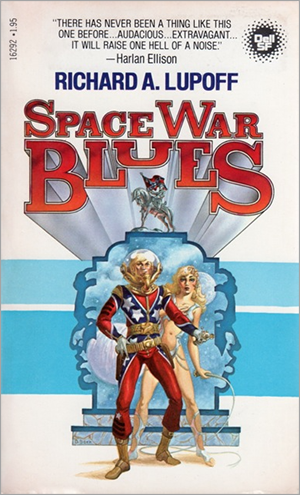
New Alabama Blues would have expanded on Lupoff’s story “With the Bentfin Boomer Boys on Little Old New Alabama,” and would have been a space opera detailing the military struggle between the chuckleheads of New Alabama and their technologically superior New Haitian neighbours. New Alabama Blues would have appeared in the late 1960s or the late 1970s.
Informed SF readers will interject “Isn’t that 1978’s Space War Blues?” Well, it is and it isn’t. Because “With the Bentfin Boomer Boys on Little Old New Alabama” had been sold to Harlan Ellison for Again, Dangerous Visions, and because Ellison absolutely would not release the rights and because ADV was late, Lupoff had to defer New Alabama Blues for a decade. Since it incorporates material published after ADV, Space War Blues is likely not the novel Lupoff originally envisioned.
A very important difference between New Alabama Blues and Space War Blues is context. For one thing, a New Wave Space Opera would have been timely in 1970. It was not in 1978, which is no fault of Lupoff’s. For another, had Lupoff written an introduction to New Alabama Blues, it would not have sounded as despairing and exhausted as the intro he wrote for Space War Blues. Harlan Ellison, man…
(Probably best to get all the “Harlan Ellison, man” entries out of the way. On to the second and for the purposes of this essay, final one.)
“The Life and the Clay” by Edgar Pangborn (1909–1976)
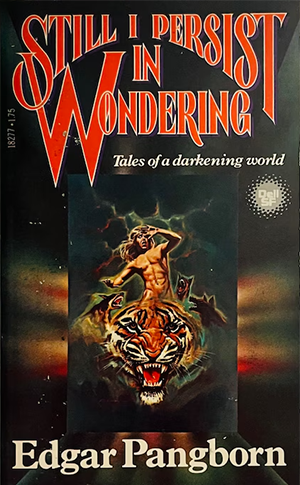
Edgar Pangborn was a talented, increasingly pessimistic2, humanist SFF author of the 1950s, 1960s, and 1970s. His best-known work is undoubtably the Hugo finalist Davy3, although his collection Still I Persist in Wondering is strongly recommended. Anything with his name on the spine is worth considering.
Alas for Pangborn fans, “The Life and Clay” was sold to Harlan Ellison for The Last Dangerous Visions. Ellison’s Again, Dangerous Visions had been years late; LDV was decades late, so late that Ellison died before finishing it. When a slender volume bearing The Last Dangerous Visions title appeared, it did NOT include the Pangborn, which remains unpublished. Fucking Harlan Ellison, man.
I live in hope that Pangborn’s literary executor Peter Beagle will convince a publisher to offer Pangborn’s complete works (including the as-yet unpublished ones) in lavish, yet surprisingly affordable editions for which I would be presented with review copies.
The Universal Pantograph by Alexei Panshin (1940–2022)
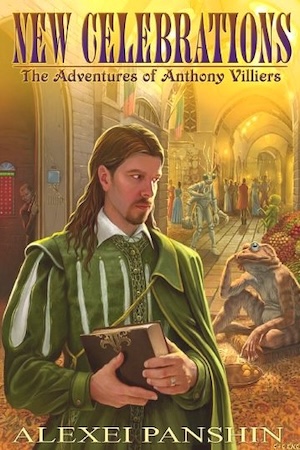
In 1968 and 1969, Panshin published four remarkable novels. One was a standalone coming-of-age novel, Rite of Passage. The other three were volumes in a cheerful comedy of manners space opera, which covered the adventures of charming remittance man Anthony Villiers: Star Well, The Thurb Revolution, and Masque World. The Universal Pantograph was to have been the fourth Villiers volume.
In the context of 1969, knowing that Panshin had rattled off four novels in two years, as well as the non-fiction Heinlein in Dimension, Villiers fans no doubt felt confident that the wait for the fourth book would be a matter of months. A year or two at worst. Even by 1978, when I encountered the reprints of the first three Villiers books, there was reason for measured optimism. As it turned out, The Universal Pantograph never appeared and neither did the three volumes that would have followed.
The City in Stone by Phyllis Eisenstein (1940–2020)
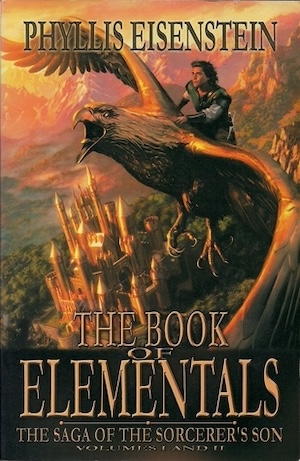
Eisenstein’s first Book of Elementals entry was Sorcerer’s Son, which detailed the struggles of magical adepts Lady Delivev Ormoru and her son Cray to fend off the machinations of the thin-skinned sorcerer Smada Rezhyk. A sequel, The Crystal Palace, focused on Cray’s quest for a young woman he was certain is his heart’s desire. The City in Stone would have been the third novel in The Book of Elementals series.
Alas. The City in Stone publisher Meisha Merlin abruptly closed shop in 2007. Not only did the Meisha Merlin edition never appear, but no other publisher has thus far acquired the rights.
Eisenstein could have supplied four entries for this essay all on her own, if I didn’t eschew mentioning the same author multiple times in one piece. Eisenstein’s The Walker Between Worlds is completed but (aside from a 38,000-word extract) unpublished. Her intent seems to have been to hold off until the trilogy of which The Walker Between Worlds was finished, but the actual result is that Walker and the rest of the trilogy remain unavailable.
Untitled Don’t Bite the Sun Sequel by Tanith Lee (1947–2015)
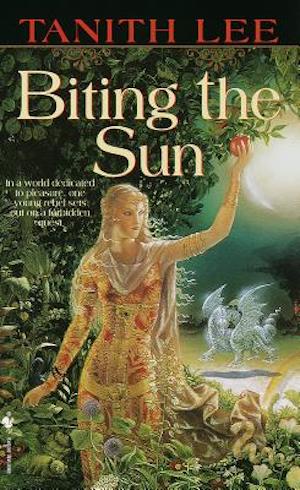
Don’t Bite the Sun4 presented a seemingly utopian world in which the unnamed narrator and their peers were free to enjoy any luxury they could imagine… except any sort of meaningful endeavour. Drinking Sapphire Wine detailed what followed when the protagonist attempted to found a society outside of this smothering utopia. Mavis Haut’s “An Interview with Tanith Lee” revealed Lee’s intentions for the third novel:
I had wished… to write a third book in which I would try to set out an alternative life-style, adventurous and stretching to mind and heart, but still, and importantly, free of the retributions of unprotected life. I did and do think a world would be feasible which gives pleasure and safety alongside excitement and development.
For whatever reason, this third volume never materialized.
Many works have gone unpublished, of course. Have I overlooked obvious examples? Feel free to name them in comments below… but please, only those works by authors confirmed to be deceased5.
- Why focus on dead authors? Two reasons:
(1) I don’t want to hurt the feeling of living authors, who after all are people and might have good reasons for not finishing a project. To offer some real-world examples: the author belatedly realized the premise was unworkable, the author suffered a nigh-Biblical series of bereavements, the author suffered a cognitively debilitating health crisis, the author chose the wrong editor, or someone stole the steamer trunk with all of their manuscripts.
(2) I really, really, really don’t want this to become a discussion of The Winds of Winter. In fact, if the mods could delete every comment mentioning The Winds of Winter, that would be peachy.
A drawback of focusing on the dead is that in those cases where the anticipated work was not finished (or begun), hope that the work will appear is meager. Death has a notoriously deleterious effect on productivity.
Donald Kingsbury’s The Finger Pointing Solward presents an interesting edge case. I’ve been waiting for Finger since I first heard about it in 1978. In fact, work began on it in the 1950s which means that, technically, I have been waiting longer than I have been alive. The reason Finger is relegated to a footnote is because although I have seen confident claims that Kingsbury is dead, verifying that—and I have tried—is inexplicably difficult. I did find obituaries for several Canadian Donald Kingsburys around the time he is said to have died, but details in the obits make it clear that none of them were the SF author. As well, a letter to Kingsbury’s agent went unanswered. ↩︎ - To give a sense of the arc of Pangborn’s optimism, his later works were notably bleaker than Davy, which was in part about the slow death of hope in the irreparably damaged world after a civilization-ending nuclear war. ↩︎
- Which inexplicably came in second to Leiber’s wretched The Wanderer. What the helling hell, SF fans of the mid-1960s? To quote Spock, too much LDS? ↩︎
- Don’t Bite the Sun and Drinking Sapphire Wine are slender volumes. Unsurprisingly, they have been omnibused. Somewhat annoyingly, they were omnibused at least twice, with two different titles: 1979’s Drinking Sapphire Wine, and 1999’s Biting the Sun. Yes, the 1979 omnibus uses the same title as the second novel. Yes, this is confusing. ↩︎
- I cannot stress strongly enough that you may NOT knock off authors for the purposes of discussing their unpublished works. In fact, knocking off authors for any reason is heartily discouraged. (“Not” is bolded because in draft one, I omitted it.) ↩︎


How about partially-written/published works, e.g., Chaucer only writing 20% of the Canterbury Tales before becoming an ex-parrot?
And since this is only about dead authors, I won’t mention that The Splendor and Misery of Bodies, of Cities is 40 years overdue…
Unfortunately, he has said that it was unlikely he would ever finish it. *Sigh*
https://retrospeculative.wordpress.com/tag/the-splendor-and-misery-of-bodies/
Edwin Drood also comes to mind…
Think how much fun later authors have had finishing and/or revising it!
I would have liked to read “The Stone Pillow” by Heinlein and “The New Shadow” by Tolkien
The first chapter of “The New Shadow” was and maybe is available on-line, and I read it. As Tolkien said, it was a thriller. The chapter ended with rather a cliff-hanger. But I am inclined to agree that it likely would have been nothing more than a thriller, not an elegy for a passing rich and magical world or anything else deep.
Heinlein said that “The Stone Pillow” would have been very depressing to write.
I’ve long thought about what would happen if someone managed to dig Sauron’s palantir out of the rubble of Barad-dur.
Whether someone finding the palantir would be a problem would depend entirely on who found it. The palantir can be used for evil if someone evil is using it, but it isn’t evil in itself.
It’s pretty depressing living through, too.
Tanith Lee: In my book I invented biting the sun as a cautionary metaphor.
Tech Company: At long last we have created the Sun-Biting Device from the classic sci-fi novel Don’t Bite the Sun.
there’s still hope for the long-awaited third in a fantasy series i cannot name as the author is still with us. book 1, 1994. book 2, 1997. i still enjoy the occasional re-read. but book 3… 🙏🏽🕊️ i guess the author just got hung up somewhere in writing it and hasn’t figured it out yet. they have written lots of other stuff since.
There’s also the series that starts with What We Call the Air, or something like that.
Does it rhyme with Bellamy Swan?
Singer Smong the Nightingales is the never finished (not sure if even started) collaboration between Marvin Kaye and Parke Godwin, following the bittersweet conclusion of The Masters of Solitude, about half-brothers Arin and Singer, and the tragic conclusion of Wintermind, with just Arin. So it was time to pick up with what became of Singer after he finished carving the epitaph on his mother’s gravestone at the end of the first book. But we never got the planned third volume.
I’d still have liked to see The Dancing Girl, which I think was planned to be (or was written as?) the fourth novel in the Master Li and Number Ten Ox series by Barry Hughart. Even though he wrote
I can’t easily find references to The Dancing Girl, so I don’t know whether he wrote it and couldn’t get it published, or whether he had just planned it.
Hughart sat for an interview which is no longer online at the original location, but can be found on the Wayback Machine here.
I don’t know if the manuscript still exists or who would own the rights to it if it does.
Gene Wolfe left the story arc of his Latro series open-ended – it finishes with A Soldier of Sidon, Latro being left stranded in the wilderness south of Upper Egypt, and while the survival to the present day of each segment of his self-narrated story is accounted for, it seems that there was more to tell.
Perhaps a cuneiform tablet salvaged from the ruins of Babylon is sitting in a modern museum somewhere, waiting to be translated.
Questions:
1) The way the last Riverworld book by Farmer ended, was there any intention of his following up on the Gardenworld direction?
2) Jack Vance: many of his latter series were open ended; I had expected to see more Alastor books to be written…did he run out of ideas, or just became bored with some of his series?
The fifth book in Adrienne Martine-Barnes’ series that started with The Crystal Sword would be my pick. Been waiting for it for about three decades now. The only other work I’ve ever found of hers is a recipe or two in an ancient WorldCon (or World Fantasy–I can’t remember now, and the book is packed away) spiral-bound cookbook.
I believe that David Feintuch’s _Galahad’s Hope_, eighth in his Hornblower-space-opera series, was substantially complete in manuscript form at the time of his death. IIRC the previous novel ended with the discovery that the alien scourge were sentient. I’m rather curious as to where he was going with that.
Whose steamer trunk full of work got stolen? Because it immediately makes me think of Robert E. Howard’s trunk full of stuff, but he died almost 90 years ago.
Ernest Hemingway.
https://lostmanuscripts.com/2010/07/31/hemingways-lost-suitcase/
Which brings to mind Haldeman’s The Hemingway Hoax.
There is of course John D. MacDonald’s fabled Black Border for McGee, about series protagonist McGee’s death. It probably doesn’t exist and his estate has (or at least had, the last time I saw news about the estate) no interest in having other authors write McGee books.
The McHill Feighan books don’t particularly need another volume but I’ve always wondered why O’Donnell just stopped writing.
For what it’s worth, Tor tried to revive the McGill Feighan books. We acquired the rights to the first four books and contracted for a fifth book to finish the series.
Alas, O’Donnell never delivered the fifth book — so there was no point in reprinting the earlier books.
To this day, I’m not sure what happened there. O’Donnell kept apologizing for being late, blaming real-world complications — the kids got sick, the car broke down, that kinda thing — while insisting he would absolutely, positively deliver the book in a few months. And then we would have same conversation every six months or so.
In hindsight, I wish I had been pushy enough to ask him what the REAL issue was, whether he was wrestling with writer’s block or what, but, ultimately, no fifth and final book ever materializied.
Possibly because he died in 2012.
On the other hand, his last published novel was over two decades earlier, so perhaps there is more to it.
At a Baycon many many moons ago, I had the opportunity to chat with him, and asked him what had happened to the McGill series; he said that Berkeley had dropped him, and no other publisher wanted to pick up the series in midstream. There were, I believe he said, ten planned.
Perhaps he got tired of non-success and did something else for a few years? Wikipedia mention him serving a few positions in SFWA in his post-publishing years, and on the board of The Lunar Resources Company, whatever that is.
In fact, SFWA established a “Service to SFWA” award named in Kevin’s honor for his extensive volunteer work (he was, among other things, heavily involved in at least one of the major revisions of its Bylaws; I was on one of the relevant committees at the time). My recollection is also that there may have been personal – perhaps medical – issues in that household in that period.
There were still unpublished packets of The Flashman Papers unpublished at George MacDonald Fraser’s death. Flashman’s adventures in Mexico and during the American Civil War come to mind, but I’m sure that there are others.
Fraser was working on the next novel when he died but his estate never even revealed what it was other than that it was not the American Civil War. It must have been either very unfinished or very bad, given that they dusted off the diabolically poor Captain in Calico MS and published that to cash in on the obituaries.
Thanks – I’d never heard of this one.
Calico Jack was a major figure in Fraser’s The Pyrates, which was wonderfully silly.
The third volume in Lupoff’s Twin Planets series.
Howard Waldrop sometimes mentioned working on a novel to be titled “I, John Mandeville,” which was presumably to be about the mysterious (and possibly pseudonymous) 16th century explorer who published a volume on his purported travels in the Near East and Far East, and which featured much that was fantastical and strange.
There were also two other short novels that Howard would frequently mention he was working on – The Moone World and The Search for Tom Purdue. Given how many of his short stories seem to have gestated for many years, before finally being committed to paper in a brief burst of actual writing, I wonder how much of these was completed. From memory a brief extract from one of them was published (was it The Search for Tom Purdue ?) but that’s it. I fear we’ll never actually see anything more.
While I’m at it, I’d love the opportunity to see the film versions of some of Howard’s short stories that George RR Martin has producing! I know that at least one of them has appeared at some film festivals, but that doesn’t help those of us Waldrop fans who didn’t have that opportunity.
Mervyn Peake intended his Titus Groan books to be a series of, I think, six books, but health problems forced him to stop with the third book.
Which was published in mangled form. There is a restored edition, which I have not yet read but have been assured is significantly better than what I am familiar with.
There is a fourth book (“Titus Awakes”), by his wife Maeve, based on about one page he wrote on his sickbed; but it is nothing like Mervyn’s work at all.
Lost works can turn up! This month saw the publication of a new Virginia Woolf work, ‘The Life of Violet’, after a finished manuscript was discovered in an English manor house. It’s a bit of a pastiche written long before her other work, and in tribute to her friend/mentor Violet Dickinson, but…new work by Virginia Woolf? Who was expecting THAT?
And it has fantastical elements in it (reminding me of the Woolf who wrote ‘Orlando’ and ‘Flush’), so it could be considered genre-adjacent.
Now if someone could only find the lost script for Shakespeare’s ‘Cardenio’….
It’s Vernor Vinge who left me hanging. “Children of the Sky” follows the brilliant “A Fire Upon the Deep” by about 10 years of internal chronology and while it advances some of the overall story, it really sets up a sequel Vinge never published (or even wrote, I suppose). With his passing in 2024, we’ll never find out what transpires on Tines’ World.
I had forgotten that, but—yes! Now I’m sad all over again. :(
Fledgling by Octavia Butler was going to be a trilogy. I’m still sad she died before she could get the sequels out.
City of Diamond was supposed to have sequels also, but Doris Egan/Jane Emerson went out to Hollywood and made a lot of $$$ writing for television. She’s still kicking, so I guess there’s hope.
I so agree on this one. I’d pay for scraps of the next Parable, or really anything else she’s left around.
There were also to be more “Parable” books, but she took time out to write the “Fledgling” trilogy. Oh well.
So it IS her writing for TV??? I’ve seen her name in the credits a few times…
Yes indeed; I’m not sure what she’s doing at present, but she was a writer and story editor for Profiler and Smallville, and later graduated to various levels of producer credit (notably on Black Sails).
Buttercup’s Baby by William Goldman!
I came here to mention this! He wrote the first chapter and published it in some of the anniversary editions, but could never quite make more headway than that. “I desperately want to write it, and I sit there and nothing happens and I get pissed at myself. I got lucky with The Princess Bride the first time, and I’d love to get lucky again.” Because of what happened in the framing story about his attempted “abridgement” of the original, it would be hilarious if Stephen King were to finish it.
I would’ve loved to see how Frank Herbert wrapped up the Dune series. Bless his son for trying, but the writing of the sequels he put out just isn’t nearly as compelling as Frank’s writing was.
Herbert the Younger and his collaborator Kevin J. Anderson have stated that the two sequels (as opposed to all the prequels) are based on notes for “Dune VII” Papa Frank had left behind. I question that, because it relies significantly on characters from the prequel novels; but it is possible, maybe even likely, that those characters were actually in the file cabinets of background information FH had accumulated.
Not SF, but adjacent- 21 by Patrick O’Brian.
Note to publishers of posthumous work- use typescript for the whole thing, not handwriting!
In the YA category, at the meeting last night of my local Silent Book Club, one person has started rereading the Night World series by LJ Smith (of The Vampire Diaries fame). There were 9 books published, but the 10th/final book never was. Smith died last spring, but her editor said that the 10th book *was* written (the originals were published in the late nineties), and they say it will eventually be publshed.
I was also surprised to see that the Halblood series by Mercedes Lackey and Andre Norton (Elvenbane, Elvenblood, and Elvenborn) will be rereleased in ebook next year along with the much promised/never published fourth book (Elvenbred by Mercedes Lackey and Ben Ohlander)
And then there is the Book 5 of The War Against the Chtorr series by David Gerrold. It’s been promised for years (Tor was supposed to publish it in 2015, but it never materialized).
Thanks to this article, I went to find out what happened to the Halfblood series by Andre Norton and Mercedes Lackey and discovered that the fourth book is to be published next year. I was going through the comments waiting to see if anyone would mention it and here it is- a mention. It’s even got more information that I picked up in my quick wikipedia scan.
Is “The “Halfblood Chronicles” series, as Wikipedia calls it, recommended to readers who have enjoyed Andre Norton’s “juvenile” works? The page records mixed reviews, and of course they can’t say much about the new entry. There is some unclarity there as to whether Norton had anything to do with it. If she isn’t credited, then you wonder if one of the latest credited writers did nearly all the work, and the other, as far as this project is concerned, mainly is not yet dead. All of which speculation doesn’t mean it’s bad.
Elvenbane got a highly positive review from me back when it appeared (I was writing the book column for Dragon Magazine at the time), and I liked the second book as well. I recall having some structural issues with the third book, but they’re all squarely in the reading demographic for both Norton’s and Lackey’s core audiences.
And yes, it’s accurate to assume that most of the late-career Norton collaborations were written primarily if not entirely by the partner author; the details are complex, but the gist is that Norton had both serious medical issues and financial difficulties (some of the latter involving dubious conduct on the part of one or more caretaker/advisors).
(That said, I would not assume that the same would hold for a Lackey/Ohlander collaboration.)
Regarding L. J. Smith – I had read similar news regarding Strange Fate, the last Night World book, and am cautiously optimistic about seeing that one in print (her later published Vampire Diaries work struck me as having “grown up” in ways that didn’t quite fit the tone of the prior novels). That said, from what I saw, it sounds like we will *not* see the third book in the series that began with Night of the Solstice, which is immensely frustrating – Solstice and Heart of Valor are, to my mind, some of the best children’s/YA fantasy of their generation.
How about The Hitchhiker’s Guide to the Galaxy, in its computer-game format? Douglas Adams wrote & co-designed the original, which teased a sequel. He kept writing novels in the series, and also did a separate text-based game called Bureaucracy, but he never returned to the Hitchhiker’s game.
Patricia Kennealy-Morrison had promised at least two more novels in her Keltiad cycle of Gaelic and Arthurian space operas (that will sound very odd to those who’ve not read them – and it is – but I found them astonishingly readable), but it’s been several years since she died now, and if there were publishable drafts left behind, I’d have expected to see them by now. Given that she had switched to mystery writing and also to self-publishing in later years, I suspect that she may be among the cluster of writers who failed to designate anyone to take charge of her manuscripts and copyrights after her passing.
The one I’d have loved to see was Iain M. Banks’ last Culture novel—but he died before he could start writing it. He meant to leave notes for his literary executor Ken Macleod, but took a turn for the worse while he was telling Ken, and had to be rushed to hospital, from whence he never returned.
The late Paul Edwin Zimmer’s novel in his Dark Border series/universe, The King That Was of Old.
It was rumored that there was a manuscript floating around back in the old days of Usenet, but I’ve never heard anything but rumors about it.
David Gerrold’s ‘ War Against the Chtorr’ series!
Though Gerrold is still alive – or at least he was last I heard!
Edgar Pangborn! Bud Webster was kind enough to assemble this list of the unpublished Edgar:
In addition, Pangborn left behind a number of unpublished stories and novels, including an erotic novel set in the “Davy” timeline titled An Atlantean Night’s Entertainment. Phil Stephensen-Payne, raconteur, historian and bibliographer extraordinaire, was kind enough to alert me to that one, as well as the following:
“Amateur Snatch” — written in 1934 for Detective Story Magazine .
“Birth of a God” — “sold to Terry Carr for an anthology.”
The Boss is Dead — a novel that may or may not have been published; the manuscript says “published in 1935/36” but no trace of it has yet been located.
Hurricane Hill — unpublished mystery novel.
Island of Departure — unpublished novel from the 1960s.
“The Life and the Clay” — his Last Dangerous Visions story.
Light Another Candle — unpublished historical novel, written in the 1970s with his sister, Mary Pangborn.
Miranda— unpublished novel written in 1967.
Poor Devil — unpublished three act play.
The Training of Karen O’Reilly — unpublished novel.
The Voyage of the Fulmar — unpublished novel.
I was told at one time that Panshin had finished The Universal Pantograph but refused to publish it. I thought that, if the preceding was true, after his death his estate might need money and allow it to be published. Does anyone know who is Panshin’s literary executor?
I remember talking to Panshin when I was a new fan back in 1981 or ’82 and asked about TUP. He told me that no publisher had been willing to pay the advance he was asking. That certainly sounds as though it was never written (maybe outlined, with maybe an initial chapter or two).
I believe later on (I may have read it in one of JDN’s posts) he indicated that too much time had passed for him to be able to write it satisfactorily (or make it fit with the original 3 novels anyway).
For an author not dead but the series is, there’s Esther Friesner’s Twelve Kingdoms series. She documents why it stopped at four.
https://www.blackgate.com/2023/06/21/emtwelve-kingdomsem-but-for-you-four/
Thank you so much for comment 5, it made my day (and may safe a life!)
“I don’t want to hurt the feeling of living authors, who after all are people and might have good reasons for not finishing a project.”
“Long-delayed, much anticipated sequels that actually were completed, by the same author” might be a good essay topic, but I can’t think of any examples.
David Weber’s Hells Gate series. Book 1 in 2006, book 2 in 2007. Book 3 in 2016 albeit w new co-author.
But of course, that didn’t finish the story so this might get deleted Maybe 2036 and 37?
If I were a billionaire I could try commissioning a multi-series author to work next on the series I want to read the most Instead authors consider their own wishes, contracts, market, and real life
no one commented on the legendary The Zephyr of the Cold Months??
In the early 1980s, Sterling Lanier wrote the first two books (The Unforsaken Hiero and Hiero’s Journey) of a planned trilogy about a priest traveling in a post-apocalyptic world. The second book ended in a major cliff hanger, and I was going to say that the final book never came out. But a quick google turned up the information that the trilogy is about to be completed – it appears his god daughter gathered up his drafts and finished the book. Hiero’s Answer is supposed to be coming out in November.
I always hoped that he would write a few more “Brigadier ffellowes” stories. But alas…….
I’d settle for someone bringing the existing stories back into print. I read them at the library once, but that copy is long gone now.
I was worried restricting this to dead authors might preclude discussion. Glad it didn’t.
For some reason I can’t see any comments, just thumbs up emojis, so this may well have been suggested already, but Buttercup’s Baby the supposed sequel to The Princess Bride by William Goldman.
what comes to mind for me is that Michael Scott Rohan was unable to finish his Winter of the World series before he died. He was working on the latest book in the series at the time of him becoming ill, I had even emailed him about it. But he was never able to finish it.
Rosemary Kirstein’s Steerswoman series remains unfinished with four of the planned seven published. Where there is life there is hope.
Disch’s THE PRESSURE OF TIME.
There is a YA fantasy I was desperately waiting for — the third volume of Kathleen Duey’s The Resurrection of Magic. The first book (Skin Hunger (2007)) is outright great, the second one (Sacred Scars (2009)) very good. I kept looking and looking for the third, and it never came. It turns out she contract early onset dementia and could not finish the third book. She died in 2020, after several years of illness.
I did see a post on Reddit, not long after her death, in which someone had spoken to Duey’s husband, who said she had completed a first draft of the third volume, but the publisher didn’t want to publish it. It would be nice to see that eventually see print.