






The Laundry Files is a cross-genre series; it’s British, but beyond that it transgresses wildly by crossing the streams of normally rigid marketing categories. We have comedy, we have horror, we have magic, we have technology, we have spies. So: what else is out there that has a not-dissimilar feel to the Laundry Files?
The works I want to point you at today all share three or more from a set of six attributes: they’re mostly British, their protagonists mostly work for bureaucracies (government or police, but also academia), and they mostly involve magic. They may also share other attributes—humour, time travel, and a seasoning of steampunk—but the latter three are a little more optional. So, without further ado, here’s my “if you liked the Laundry Files you may like these” list.
The Peter Grant Series by Ben Aaronovitch
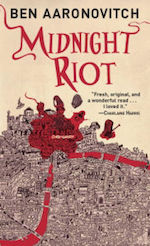 Midnight Riot (UK title: Rivers of London)
Moon over Soho
Whispers Under Ground
Broken Homes
Foxglove Summer
The Hanging Tree
Police Constable Peter Grant of the London Metropolitan Police is a young, snarky, mixed-race cop from the east end. We first meet him interviewing a witness at a murder scene in London. Only problem is, the witness is a ghost. Peter’s unwelcome (because unverifiable) report comes to the attention of his higher-ups, and not in a good way: he’s reassigned to The Folly, a small and very eccentric station in the city that, he rapidly learns, deals with the kind of stuff nobody else in the huge, technocratic bureaucracy of the Met wants to acknowledge—namely, magic.
Apprenticed to the last registered wizard in the UK, Detective Chief Inspector Thomas Nightingale, Peter and fellow apprentice magic cop Leslie May find themselves sucked into the pursuit of magical criminals and the affairs of London’s local gods and goddesses.
So, here’s the thing: Aaronovitch nails 21st century British police bureaucracy and modern London’s vibrant, rich, multi-ethnic society. Peter Grant is a distinctively original cop, with family ties a-plenty in the streets he patrols. And there’s a seriously creepy vibe to the back story that gradually unpacks itself along the way to explaining why there is only one surviving registered wizard in London. Seriously? If you want more stuff like the Laundry Files? This is your number one destination.
The Shadow Police Series by Paul Cornell
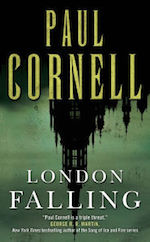 London Falling
The Severed Streets
Who Killed Sherlock Holmes?
While the Peter Grant books mostly focus on one wisecracking protagonist (albeit an organization man), the Shadow Police series recognizes that modern policing—especially detective work—is a team activity. In this case, the detective team of Quill, Costain, Sefton, and Ross find themselves trying to work out why a gang boss’s head exploded in front of them in the interview room when he was about to spill his guts. As their investigation expands they find themselves sucked down a horrifying rabbit hole of kidnapping, child sacrifice, murder, and worse. London, it appears, faces supernatural threats from time to time, and at least one of them was so deadly that it wiped out the previous Metropolitan Police team that policed the occult; now their lives are on the line as they try to prevent the “smiling man” from taking the whole of London to hell.
While the Peter Grant series has a rich vein of humour running through it, and a submerged vein of horror that occasionally breaks out, this is reversed in the Shadow Police books: occasional wise-cracking aside, they’re tense with foreboding and a sense of creeping doom that never quite leaves you.
The Rise and Fall of D.O.D.O. by Neal Stephenson & Nicole Galland
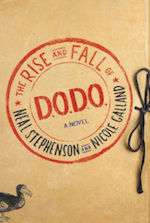 Okay, so neither Neal Stephenson nor Nicole Galland are British, but The Rise and Fall of D.O.D.O. is in other respects a good match for the same micro-genre as the Laundry Files. We have a secret research project run by the Pentagon, which is trying to establish why magic stopped working globally on one particular day in 1851 (and more importantly, whether it can be rebooted by technological means). We have a meet cute between Melisande, a very academic linguist, and Tristan, a West Point graduate with expertise in manipulating bureaucracy. Not to mention an egomaniacal (and extraordinarily old) Hungarian witch, a not-actually-mad professor’s attempt to verify the Many World’s Hypothesis by building a machine to carry out the Schrödinger’s Cat experiment (spoiler: the cat survived to a ripe old age), and then TIME TRAVEL. Lots of time travel, to the 16th century and the Victorian era. Lots of exciting ways to die as a result of time travel! And did I mention the bureaucracy?
This is clearly a collaboration, and what Galland brings to it is a lighter and more accessible tone than your standard Neal Stephenson doorstep, rising almost to the level of a Pratchett comedy in its better sequences. It’s a lightweight, fun romp, and I’m looking forward to the expected sequel.
The Invisible Library Series by Genevieve Cogman
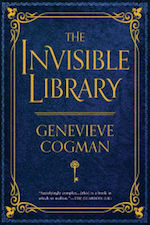 The Invisible Library
The Masked City
The Burning Page
The Lost Plot
We’ve come a long way to get here, but The Invisible Library drops another circle on the Venn diagram of our micro-genre, this time adding an intermittent steampunk flavour. We live in a multiverse; in particular, all fictional worlds are real, existing somewhere on a continuum between Order (repressively dominated by Dragons) and Chaos (cavorted in by the Fae—who are always the protagonist of their own narrative). Outside of these worlds lies the Invisible Library, an infinitely large extradimensional institution whose librarians catalog and collect unique books from the entire multiverse (and by “collect” I mean “steal”).
Irene is a junior librarian (or perhaps “spy” or “crazed bibliophile thief”) whose superiors assign her to a version of London in a chaos-infested realm—complete with steam carriages, fae ambassadors, a detective who is a dead ringer for Sherlock Holmes, incompetent werewolves, and clockwork alligators. Irene is a drily understated and extremely competent agent, but frequently finds herself struggling against challenges that threaten to outmatch her, both external and from within the bureaucracy of the Library itself.
In the hands of a less accomplished author this collection of tropes could easily turn into a disorganized and chaotic mess, but Cogman skillfully juggles seemingly disparate elements so skillfully hat she makes it look effortless. Again: the very highest quality of popcorn reading, and completely addictive.
The Chronicles of St. Mary’s by Jodi Taylor
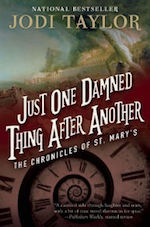 Just One Damned Thing After Another
A Symphony of Echoes
A Second Chance
A Trail Through Time
No Time Like the Past
What Could Possibly Go Wrong
Lies, Damned Lies, and History
And the Rest is History
Max is an obsessive, somewhat damaged, history PhD when she manages to land a research position at the St. Mary’s Institute for Historical Research, one of those eccentric and small colleges British universities somehow can’t seem to get rid of. However, St. Mary’s harbours a secret in the shape of a small fleet of time machines, which the historians use “to investigate major historical events in contemporary time”. Keeping from damaging the course of history is easier said than done, especially when the incompetent and brutal Time Police show up and some of your colleagues are manipulative psychopaths: and time travel is far from safe hobby for academic historians as Max rapidly discovers (pursued by carnivorous dinosaurs and an abusive co-worker; nearly roasted during the destruction of the Great Library at Alexandria). And then there’s always the fun of writing grant proposals and ensuring the Institute can get enough funding to repair the damage the eccentric and accident-prone academics keep inflicting on the place.
Taylor’s time traveling academics are a far cry from the Laundry but they share a common feature in the shape of heedlessly damaging bureaucratic forces that are almost as much of a threat as the Black Death and time-travelling murderers. Max is a fierce but occasionally fragile protagonist, with a line in sarcastic wise-cracks that reminds me of someone else …
Honorable Mentions
This has of necessity been a really short list. Lots of good stuff didn’t make the cut, and if I had room I’d rabbit on about some or all of: John Dies in the End (David Wong), Bookburners (Max Gladstone et al), Zero Sum Game (SL Huang), and the Rachel Peng series (K.B. Spangler). But I’m out of space for now!
Top image: Cover of The Hanging Tree; art by Stephen Walters.
 Charles Stross was born in Leeds, England, in 1964. He has worked as a pharmacist, software engineer, and freelance journalist, but now writes full-time. To date, Stross has won two Hugo Awards and been nominated twelve times. He has also won the Locus Award for Best Novel, the Locus Award for Best Novella, and has been shortlisted for the Arthur C. Clarke and Nebula Awards. The Delirium Brief, the latest novel in the Laundry Files series, is now available from Tor.com Publishing. You can visit his blog, follow his Facebook page, or find him on Twitter at @cstross.

Also excellent if you like a meld of noir and fantasy: the Twenty Palaces books by Harry Connolly. There are three traditionally published novels and a self-published prequel novella.
Seems to me you missed out on including The Checquy Files series by Daniel O’Malley. Magic? Comedy? Horrow? Spies? Bureaucracy? They’re all there! There are only two books in the series right now but I can’t wait for more!
https://www.goodreads.com/book/show/10836728-the-rook
Jasper Fforde’s Tuesday Next series. Cogman’s “Invisible Library” series is a bastard child of this series which has most of the same ideas. Fforde also has an earlier “Nursery Crimes” series about fairy tale beings in the real world.
I don’t like purchasing eBooks that cost more than the paperback editions, so I guess I’ll avoid these.
I’m delighted to see the Rivers of London books on your list. They are wonderful. I would especially recommend the audio versions; narrator Kobna Holdbrook-Smith inhabits the role of Constable Peter Grant perfectly.
Don: Yes, the Twenty Palaces books are good. Alas, Harry’s series tanked and he moved on to other things.
Dani: I omitted the Checquy Files series for reasons I’m not going to go into ex cathedra.
MByerly: I prefer Cogman’s style to Fforde’s, and think it’s all the stronger for not being based on real-world books. Also: bureaucracy!
Important detail about Rivers of London: it’s really more of a serial than a series. Read them all in one go if possible, because if you wait between (say, you neglect to re-read the previous books when a new one comes out), they don’t make nearly as much sense.
I enjoy the Rivers series and, differently, Jodi Taylor’s books, so I’ll have to check the others out. I sometimes feel a little hesitant recommending the St. Mary’s series to people because it is very lightweight, yet I do think that its thoroughly enjoyable.
If I’m not mistaken, Aaronovitch and Stross have discussed doing a Laundry-Rivers crossover, though they decided the two magic systems were not compatible.
China Mieville’s “Kraken” is only a single novel, not a series, but considering the source, it stands up well. London, mystical phenomena, overworked cops, existential dangers, it’s all here
I’d recommend a bunch of Tim Powers’ novels, I’d specifically recommend ‘Declare’ and ‘Three Days to Never’, as a start.
Wizardry, SCIENCE!, and espionage are a heady mix.
The Rachel Peng series isn’t British, true, but it is a multi-genre-crossing series, political thriller, detective novel, murder mystery, scifi cyborg story with a cool twist, and a lot of humor gets mixed in amongst the tension. Start with DIGITAL DIVIDE, go on to MAKER SPACE, enjoy STATE MACHINE, and Rachel appears in some of the other books, too. (Warning, THE RUSSIANS CAME KNOCKING has smut, if really good smut, so be of age; it, too, is a mix of genres, as is GREEK KEY, etc.)
Seconding the recommendation of “Declare” – Tim Powers isn’t British, but “Declare” is set in Britain or at least among Brits, and (unlike Stephenson, O’Malley, Connie Willis and others) his portrayal of country and culture is completely convincing. I like all his stuff, but “Declare” is the only one that edges into Laundry territory – the others are very much rooted in America, California in particular, and don’t have the same espionage/technology elements. (The spirits which live in the ionosphere and whimsically interfere with skywave HF radio are a particularly fine touch. I find this a completely credible explanation.)
“The Rise and Fall of D.O.D.O.” was the point at which it became clear that Stephenson has lost his edge. (“Seveneves” was just disappointing; “DODO” was worse.) I thought “Cryptonomicon” was closer to the Laundry model; though of course it doesn’t include magic. Or, at least, it doesn’t seem to.
How about the wonderful Jasper Fforde books in his brilliant Thursday Next novels?
Declare might be my favorite Tim Powers book, even if the supernatural elements aren’t quite as strong as the spy stuff. But read Kim first, and maybe bone up on (the real) Kim Philby for full enjoyment.
Kate Griffin’s two Urban Sorceror and Magicals Anonymous series – “A Madness of Angels” and its sequels and “Stray Souls” and its sequel.
I’m not sure I’d put Jasper Fforde’s books in the same category as the Laundry Files, but personally I love both, and it seems there’s a lot of other people here who do too.
I’d include Simon R. Green’s Secret History series. Not only is it by a British author, with a British main character, and British supporting characters, but the series is also an homage to the James Bond franchise. Every title is a twist on a Bond title, and the influence from Bond is present consistently.
Seconding the recommendation for The Rook and Stiletto by Daniel O’Malley. The only reason I can think of why Mr. Stross won’t recommend them is they’re too blatant a ripoff of Stross’s own scenarios, magical systems, characters, and bureaucratic humor. But O’Malley steals with elan and his books are entertaining and memorable on their own.
Mira Grant’s News Flesh.
Surprised you did not mention the Felix Castor series by Mike Carey, which captures London as well as Ben Aaronovitch, I think, and is a lot scarier. It has the advantage to me of being centred on the part of London (Haringay) in which I lived for a number of years! I always think of it alongside the Laundry and the Peter Grant books. And then there is Benedict Jacka’s series about Alex Verus…
Just wanted to toss the Magic Ex Libris series from Jim C. Hines in the mix here.
I loved Libriomancer, and its follow up books were pretty good too.
Randall Garrett – Lord Darcy series
@20: I loved the Felix Castor books but they seemed to be building towards a revelation that never came – it felt as if there should have been at least one more of them, but Mike Carey has moved on to other things
Thank you! I have just finished Delerium Brief and was wondering what to read next!
I second the recommendation of Declare by Tim Powers!!
was expecting to see “Declare”, happy to see it multiple times in the comments, strangely intrigued by the Chequery intrigue, pleased to add Ian Tregillis’s “Milkweed Triptich” into the mix where british Lovecraftian warlocks battle Nazi ubermench.
Laird Barron’s “Old Leech” horror, particularly “Swift to Chase” has a very “Case Nightmare Green” bent to it as well
I second Simon Green – his Nightside books were wonderful!