






Interest in all things Viking-related has really boomed over the past decade. This is probably due, at least in part, to the popularity of the History Channel’s Vikings television series, which in turn rode the coattails of Game of Thrones’ success. But the whole theme has been steadily building momentum for much longer. In the early 2000s, The Lord of the Rings films brought Norse imagery to an unprecedented number of moviegoers, while around the same time, Bernard Cornwell penned the first volume of his Saxon Tales, which was eventually adapted for television and lent the entire series its name: The Last Kingdom. And that’s to say nothing of the 20th century’s offerings—though, aside from Tolkien, those tended to be more peripheral than the releases that we’re seeing more recently.
The latest strands are now quite multitudinous and range from the critically acclaimed historic fiction of Linnea Hartsuyker and the best-selling fantasy novels of John Gwynne to the big-budget motion picture The Northman, to the crude and quirky Netflix humor series Norsemen, to the influential musical albums of Amon Amarth and Wardruna.
While all of these examples involve some degree of inspiration from (and often feature direct allusions to) the Norse myths, actual retellings of the mythology itself tend to pop up less frequently. In the world of books, two prominent retellings have been released in the past ten years: Neil Gaiman’s Norse Mythology, which is a very straightforward recap of the standard mythological arc, and Genevieve Gornichec’s The Witch’s Heart, which relates the same general arc but from the unique perspective of a female protagonist—a minor character in the original stories who becomes the heroine of her own tale in this version. Both of these books provide a solid entry point to the world of the Norse myths—particularly the stories contained in the Icelandic Eddas, which remain our foremost medieval sources on the subject. If you enjoyed either Gaiman’s book or Gornichec’s book or both, and are interested in going deeper into that mythological world, then the following five novels are very much worth your attention.
War of the Gods by Poul Anderson

Poul Anderson was an author best known for his science fiction as well as for his role as a founding member of the Society for Creative Anachronism, but he also wrote a number of fantasy novels directly inspired by Norse history and mythology. War of the Gods is the most blatantly mythological of these—it is essentially a novelization of the life of the legendary Danish hero, Hadding, who predates the more famous Hrolf Kraki by several generations and appears early in Saxo Grammaticus’ Gesta Danorum (one of the few major non-Icelandic medieval sources of Norse mythology and ancient folklore).
Set against the backdrop of the mythical Aesir-Vanir war, War of the Gods fleshes out Saxo’s violent, action-packed story of Hadding from his early youth being raised by giants, through his encounters with Odin and years of warfare and adventure, to his eventual and highly ritualistic death. Anderson relied heavily on the research of French philology and religion scholar Georges Dumézil in his construction of the book, and consequently, Njord, the god of the sea, plays a very big role in it. War of the Gods is incredibly entertaining and offers a great gateway to the mythological tales that exist outside of the Icelandic Eddas.
Rhinegold by Stephan Grundy
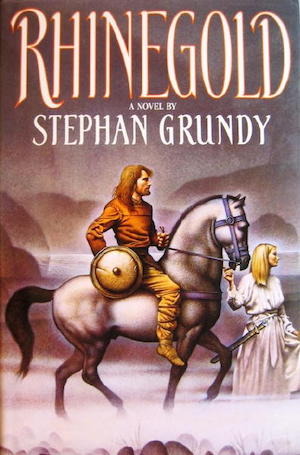
Rhinegold is a retelling of the Old Norse Saga of the Völsungs by Stephan Grundy, a scholar of Germanic paganism and leading figure within the Asatru faith during his lifetime. Incorporating additional details from the German Nibelungenlied and Thidrek’s Saga and taking the form of an epic, heroic fantasy novel, Rhinegold is a multi-generational saga that focuses on Sigurd the Dragonslayer, who also appears in the Icelandic Eddas (although outside the main narrative arc of both). This is the ancient story that inspired Wagner’s Ring Cycle and many elements of the work of Tolkien. Partial retellings of the story have been tackled previously (as evidenced by Diana L. Paxson’s Wodan’s Children trilogy) and since (as evidenced by Kate Heartfield’s forthcoming The Valkyrie).
Grundy’s version, which is sadly now out of print, is unique in following the entire narrative arc of The Saga of the Völsungs—not just the ill-fated Sigurd/Brynhild/Gudrun love triangle. The setting is Western Europe during the Migration Period, when the Germanic tribes were on the move, Rome was sliding toward ruin, and Attila the Hun lurked as an ever-present threat in in the east. Taking on his alternative name of Wodan, Odin appears on a recurring basis throughout Rhinegold, just as he does in the original sources, to pull the strings of the mortal heroes and heroines. Featuring swan maidens, a gold-hoarding dragon, magical swords, valkyries, sinister dwarves, werewolves, twisted acts of revenge, ill-fated love—Rhinegold provides a rousing rendition of one of the original blueprints for all of these now-classic fantasy genre tropes.
The Gospel of Loki by Joanne M. Harris
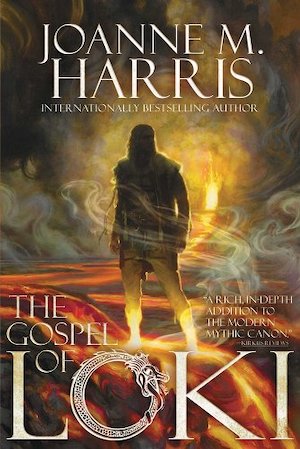
The lightest and probably best known book on this list, The Gospel of Loki is a novelization of the standard mythological arc—so, in that sense, similar to Gaiman and Gornichec’s novels—but, as its name suggests, retold from the point of view of the trickster god, Loki. As with Grundy’s Rhinegold, this is not actually very unique in and of itself, because at least one other book with this same premise was published prior to Harris’ effort: Lois Tilton’s Written in Venom, which is now out of print and incredibly hard to find. That said, Harris, who is best known for Chocolat, does a wonderful job with the material. Her characterization of Loki really carries the day; it’s just great fun reading the familiar tales—such as the crafting of Thor’s hammer or the binding of Fenrir—from his colorful perspective. A sequel exists, The Testament of Loki, which continues the story and mythical theme, but it veers into entirely author-invented, post-Ragnarök territory.
Children by Bjørn Larssen
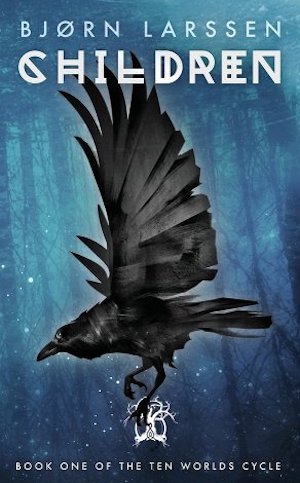
The first volume in Bjørn Larssen’s grimdark Norse mythology-based fantasy series, Children is a fascinating amalgamation of original characters and plotlines set against the backdrop of the core mythological stories. The book follows Magni, son of Thor (attested to in the old sources) and Maya, foster-daughter of Freya (Larssen’s invention), and their individual exploits as the familiar myths—such as the theft of Thor’s hammer and the building of Asgard’s wall—unfold around them, influencing their actions and behavior. In that sense, Children is something of a story within a series of stories.
Other novels that draw directly upon the Norse myths typically adopt one of two approaches: they either retell some aspect of the mythology which thus forms the backbone of the resultant book’s plot (and is elaborated upon as the author sees fit), or they eschew any real attempt at an actual retelling in favor of focusing on the author’s own invented plotline while simply incorporating select gods, events, places, etc. from the old sources as desired. Children is highly unique in that it performs a balancing act that embeds the author’s inventions within and concurrent to a broader sequence of retellings, and it does it very well.
The Hurricane Party by Klas Östergren (translated by Tiina Nunnally)

The Hurricane Party is the most fantastical book on this list—and that’s because it’s actually more of a Nordic noir-meets-science fiction novel rather than a fantasy novel. Set in a despair-ridden, climate-ravaged future version of Stockholm, The Hurricane Party focuses on the Icelandic Poetic Edda’s tale of “The Flyting of Loki,” a scene of exchanged insults and confrontation between Loki and the rest of the gods and goddesses that paves the way for the eventual coming of Ragnarök.
Östergren, a prominent literary novelist in Sweden who has not enjoyed the same degree of success outside of his home country, introduces Hanck Orn, a character of his own invention, as the protagonist. Orn is the father of the ill-fated Toby (known to those he worked with as Fimafeng—the name of a minor figure from the old sources who is slain at the scene of Loki’s flyting). The grief-stricken Orn investigates his son’s death amidst the societal decline, religious extremism, and government corruption of dystopian Stockholm as he gradually makes his way towards the scene of the crime itself—Aegir’s hall. It is a very atmospheric and very effective retelling, set in a grim, futuristic world that feels more and more relatable to our own.
Rowdy Geirsson is the author of The Scandinavian Aggressors and translator of The Impudent Edda. His writing has appeared in McSweeney’s, Metal Sucks, Scandinavian Review, the Sons of Norway’s Viking Magazine, and is forthcoming in Medieval World: Culture and Conflict. He skulks under the shadow of the dead blue bird at @RGeirsson.

Huh. An Anderson I don’t own.
I just reviewed The Sword and the Satchel (World of Alfar) by Elizabeth H. Boyer. It’s a studiously derivative retelling of Lord of the Rings, to the point some scenes map right onto LOTR. Boyer distances her tale from the original by setting hers in a world of Norse mythology and by relying more heavily on humour. Now that I think about it, I wonder if her starting point was “Suppose instead of Frodo and the Fellowship, all Gandalf had to work with was a Merry or a Pippin and further suppose that Gollum and Saruman were the same character?
It’s not so much about the mythology, but Juliet Marillier writes historical fantasy that tend to presume the myths/magic are somewhat true, and she has a duology (The Saga Of the Light Isles – Wolfskin/Foxmask) that take place in the Norse/Viking mileau.
I still have a soft spot for Diana L. Paxson’s Brisingamen (1984)
It’s been close to 40+ years I think since I read “Sword and the Satchel” (along with her following works with a Norse flavor) but I don’t recall it being that heavily LOTR inspired (but as I said, 40+ years). I certainly don’t recall it as being as blatant as early Terry Brooks or Dennis McKiernan.
One of my favorite Norse inspired novels is one of Poul Anderson’s earlier works “The Broken Sword.” It features the tale of Odin thrusting the sword into the support pillar of a mead hall and following the tragedy that ensues. I have the gorgeous 1973 paperback by UK Sphere books.
See also “The Roaring Trumpet,” the first of the Fletcher Pratt/L. Sprague de Camp “Harold Shea” series.
When I was 12 a well-meaning librarian, having noticed that I’d gone through much of the kids SF/fantasy in the library recommended Grendel by John Gardner to me. I assume she hadn’t actually read it, but just saw that it was a fantasy, with a Hero and a Monster and wasn’t a Tome, but a regular (for the time) paperback.
Fortunately the really problematic and advanced parts (for a 12 year old) went over my head. It’s an existentialist retelling of Beowulf from the Grendel monster’s point of view.
David Drake’s Northworld books.
The author’s highly eccentric personal history notwithstanding (and not yet known at the time I reviewed the first of them), Song of the Dwarves and Revenge of the Valkyrie by “Thorarinn Gunnarsson” deserve inclusion in this discussion. The duology, sadly, has not survived the occasional culling of my personal library, but I recall the books as both highly readable and reasonably honest about being modernized retellings of their source material. The challenge is likely to be getting one’s hands on copies at this late date, especially given the probable challenges involved in orchestrating some sort of reprinted edition.
Good of Tor.com to finally get around to mentioning The Northman, which must be the best fantasy movie of at least the last several years.
@@.-@, thanks for mentioning The Broken Sword; if you hadn’t I would have. Although I suppose it’s less a retelling of Norse mythology than a fantasy set within Norse mythology: an idiosyncratic version of it in which the gods of Asgard exist alongside those of Celtic, Japanese, Greek, and other mythologies. It’s a well worn concept by now, but I think it was pretty innovative when Anderson wrote it in the 1950’s.
Like troyce i don’t remember the Sword & the Satchel being especially derivative of LotR compared to other books at the time. I think The Wizard and the Warlord was my favourite of those books.
SF stories mildly based on the Norse myths would include Elizabeth Bear’s All the Windwracked Stars and its sequels, along with Stephen Donaldson’s Gap series (ignore if you find his Thomas Covenant books unreadable) and Pyramid Power by Dave Freer and Eric Flint.
Tom Holt included Norse mythology in some of his comedy books – but I can only remember Expecting Someone taller and Valhalla.
Gene Wolfe used elements of both Norse and Celtic mythology in his duology The Wizard Knight.
I will always go to bat for the United States of Asgard series by Tessa Gratton. It’s a Norse urban fantasy with a very unique spin on a lot of the myths.
@12 Thank you, I was going to mention that trilogy if no one else did. I adore those books.
I do love Elizabeth Bear’s Edda of Burdens series! Happy to see Strontium mention The United States of Asgard–talk about an under-the-radar series.
Lots of wild mythological happenings, many of them Norse-centric, in the lesser-known Applegate series EverWorld.
One of my favorites was Joel Rosenberg’s sadly unfinished “Keepers of the Hidden Ways” series.
I was reminded, with the release of the middle grade Fenris & Mott, of Greg van Eekhout’s entries in this space.
I fondly remember listening to Wolves Till the World Goes Down on PodCastle.
Then there was the novel Norse Code, which I also enjoyed.
Poul Anderson also wrote a retelling of Hrolf Kraki’s Saga, called Hrolf Kraki’s Saga, of all things. Pretty good, as I recall. He pulled in material from a variety of historical sources, and I seem to recall that some of the book was based upon his own translations from a few of these.
@17, I’m tempted to say Poul Anderson was the original point of interface between Norse mythology and modern fantasy, but I’m not enough of a student of the genre’s history to say for sure. (Maybe it was E.R. Eddison?)
@18 – Depends upon how you define modern fantasy, I guess. Certainly Tolkien was influential before Anderson was, though he came after Eddison. James Branch Cabell brought Nordic elements into The Silver Stallion – one of Manuel’s champions wound up in Valhalla, due to a perfectly understandable error on the battlefield – but I think that his influence on modern fantasy was rather narrow, as he was in eclipse until the late 60s. So yes, I’d agree that Anderson was a major proponent of Scandinavian influence on modern modern fantasy. Tolkien drew more heavily on Anglo-Saxon literature – understandable, he taught it – and a lot of what he did with it was eclipsed by the strong Christian undertones and echoes of Atlantis etc. in The Lord of The Rings. The closest we come to a Nordic element in that world is the Rohirrim, and they are more Anglo-Saxon than anything else.
My opinion – I’m not a scholar of this subject.
@19 I’m embarrassed I forgot The Silver Stallion‘s Valhalla episode! My favorite chapter of my favorite Cabell novel. Of course, Cabell and Anderson were tonal opposites, with Anderson striving for the authentic flavor of the sagas, and Cabell exploiting their tropes for absurdist satire (even if beneath the levity he did sometimes make serious points).
I’d agree that Tolkien’s inspiration is more broadly Germanic, with Christian undertones, than specifically Norse. Certainly nothing he wrote that I’m aware of can called a retelling of Norse mythology.
Ada Palmer, as part of the musical group Sassafrass wrote/sang filk songs based on Norse mythology. Wonderful stuff!
“Eaters of the Dead” by Michael Crichton is another retelling of Beowulf. “The Thirteenth Warrior” is the movie version and was fun to watch once. Once…
@19 & 20: Not retellings, exactly, but plenty of stock elements, especially names, as detailed here:
Norse Myths That Shaped the Lord of the Rings
The segment of the Voluspo referenced is simply a list of now familiar Middle Earth names:
Catalogue of Dwarves
@23 – Thank you. Tolkien looked more deeply into Scandinavian literature than I realized.
Forgot about the dwarves and their names. A dead giveaway.
Cannot recommend The Broken Sword by Poul Anderson or Stephan Grundy’s Rhinegold enough. They pull you into a mythical time and keep you enthralled. The mouth full of honey scene is burned into my psyche,,,
<something of a nitpick>
Here’s a usage note (for Mr. Geirsson et al.):
‘Unique’ is an absolute term, and thus it cannot be qualified. It means “one of a kind”, so a thing cannot be “very unique” or “highly unique” (or “somewhat unique”, etc.). It can, however, be (for example) nearly or almost unique.
The needed word here is ‘unusual’, which is susceptible to qualification: “very unusual”, etc.
(Obviously, what is unique is therefore unusual; but what is unusual is not necessarily unique.)
</something of a nitpick>
Thank you for ‘listening’….
I’m surprised that no one mentioned Rick Riordan. His “Magnus Chase and the Gods of Asgard” series has a lot of Norse God information. Neil Gaiman did the best job.
Add Evangeline Walton’s The Mabinogion retellings as well as The Witch’s Heart by Genevieve Gornichec to this list!
The old pulp novel A Tank in Valhalla by Edmond Hamilton. This novel was science fiction rather than fantasy. At least I think that was the intent. It dates from the 1930s I believe. Also titled Jotunheim!
Also what is arguably the first great fantasy “franchise” in modern culture, Richard Wagner’s “Ring of the Nibelungen” opera cycle.
Shadowline by Glen Cook is the tale of Ragnarok reskinned as military science fiction.
I love Norse Mythology. Almost as much as Greek mythology, I read renditions of the myths constantly as a kid, and I love the world and the view of it that they reveal.
More re-tellings/books that pull from Norse mythology that I highly recommend would be:
1. American Gods is honestly just as much a re-telling of elements of Ragnarok and other Norse Myths, even beyond the way that Gaiman twists them and folds them upon themself and transposes them to a new world with new gods and characters.
2. Sea of Trolls is a re-telling of both how the Norse Vikings would raid villages and take people as slaves, and then pushing it into the land of mythology by including magic and skald or bard culture, and then the Norse myths themselves, as well as Beowulf beyond that. I think there’s a second one, but I don’t remember reading it. I just remember this book as one I constantly read in middle school and beyond. I should actually pick it up and read it again.
3. This time, a music album instead of a book, and that’s The Bifrost Incident, by an Oxford band by the name of The Mechanisms. It’s another Ragnarok story re-telling, and it’s also a locked-room murder mystery on a train in space. Genderbending abounds (both Loki and Odin are instead women within this story, rather than their usual men or genderfluid selves), as does criminal elements and intrigue, and the main character narrating everything is this delightfully dry Inspector that can’t help but figure out what happened to this train. I love it, it’s a fun, weird rock album, and some of the best music that The Mechanisms wrote.
Like James, I went: “An Anderson I don’t own?” and I checked to see if War of the Gods was available for my Nook. It was, and priced very low. Enjoying it a lot so far!
@21 – And for those who’d like a link to where one can acquire a CD, video or digital download of Sundown: Whispers of Ragnarok, here’s Sassafrass’ web page.
(Provided courtesy of the guy who, when Ada Palmer asked him if she could premiere the complete song cycle at Balticon, was insane enough to say, “YES!”)