






I love games, and have spent most of my life playing them in one form or another. I’ve worked for two game companies and have been involved in development with different hats ranging from manual writer to technical director. So when I was writing United States of Japan, one of my favorite parts was imagining what video games would be like in an alternate history where the Japanese Empire ruled. Speculative works can always push the boundaries, and as early consoles were intertwined with military research, I pushed gaming technology ahead twenty years from where it was in 1988 in our world, considering Japan would no longer need to undergo two decades of reconstruction. One of those changes involved Yakuza-sponsored gaming tournaments where players put everything on the line. Not like Running Man, but more akin to a virtual first person shooter match where the loser loses their life.
Here are five other books that also have games with deadly consequences.
Battle Royale by Koushun Takami
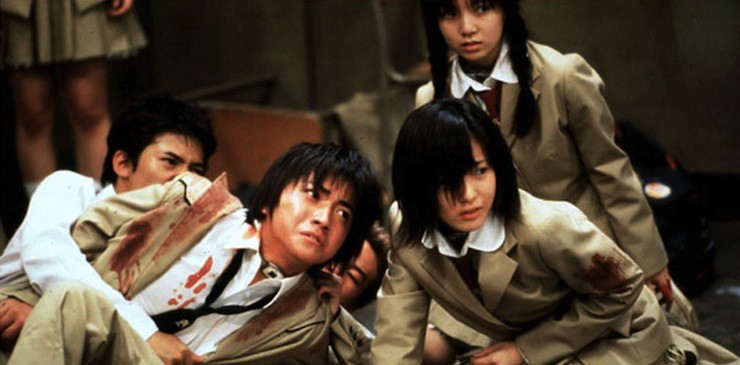
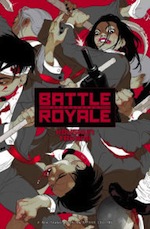 I had no idea what the book by Koushun Takami was about when I first picked it up. I knew there was a movie based on the book and it was a bestseller in Japan. But when a group of classmates in junior high are subjected to sleeping gas and wake up, only to be informed they’ll be taking place in a deathmatch against each other, I was stunned. Metal collars are placed around their necks that will explode if they try to escape, and they’re each given a weapon ranging from guns to worthless items like a fork. Some embrace the violence, like Kazuo Kiriyama who is a sociopath and relishes his chance to take part in the games. Others try to resist, only to be mercilessly slaughtered. I was both enthralled and repulsed, unable to put the book down but wishing it wasn’t disturbing me so much (the extreme violence resulted in the book being condemned by the Japanese National Diet).
What’s most chilling is how they start to turn on one another and how that forces you to wonder what you would do in their shoes. Morality is turned upside down and the social commentary is disturbing as you realize everything is being broadcast for the public. It’s as though The Purge were vicariously mixed with something on E!, audiences chowing on sponsored popcorn and soda as analysts commented on the brutality and effectiveness of each killing.
(Note: As much as I enjoyed Running Man and The Hunger Games, I’m leaving them off this list because of the similarities they share with Battle Royale).
The Player of Games by Iain M. Banks
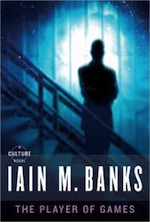 The Player of Games is arguably the most entertaining Culture book and probably the best starting point for those interested in Iain M. Banks’s postscarcity universe. Jernau Morat Gurgeh is a master of games, but he’s bored. It’s not just because he’s the best at everything—there are even some games he is not good at. But as he puts it: “I… exult when I win. It’s better than love, it’s better than sex or any glanding; it’s the only instant when I feel… real.” Unfortunately, he rarely feels the same adrenaline from gaming anymore because so few offer him a real challenge.
Enter Contact. They send him on a mission to learn about the ultimate game called Azad that’s integrated into the political and social fabric of the Empire of Azad, setting the stage for an entirely different type of gaming experience. “The game of Azad permeated every level of society… Azad is so complex, so subtle, so flexible and so demanding that it is as precise and comprehensive a model of life as it is possible to construct. Whoever succeeds at the game succeeds in life; the same qualities are required in each to ensure dominance.” Gurgeh initially struggles, embarrassingly for a so called master. But he quickly adapts and begins to excel when he focuses less on the rules of the game and more on the psychology of his opponents. That’s when he learns that the game doesn’t rely on merit alone and various machinations put his life at risk with each victory as those in power don’t like the idea of an alien outsider winning. Gurgeh overcomes using his superior playing skills as well as his coming to understand how the “Culture” is superior to Azad on a philosophical and “cultural” level. I love Gurgeh’s passion for gaming as well as his flexibility and adaptability. But I couldn’t help wonder, if he was bored before the Game of Azad, what will his life be like after it?
Ready Player One by Ernest Cline
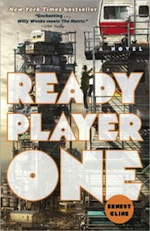 Part of why I love games so much is that independent of your background, you can excel with time and practice. I spent a lot of time moving around as a kid so that at every new school I attended, I was an outsider. The way I bonded with other students was talking about our favorite video games and how to beat them. That’s why I don’t like stories featuring young protagonists who are “chosen” as it’s less about them earning their victory and more about them being some arbitrary victor with innate skills. Wade, AKA Parzival, is by no means a chosen one. On the surface, he’s an outcast who doesn’t fit in. But he has a love for OASIS and all things Halliday, a devotion I could relate to. Ernest Cline has created an almost perfect mishmash of every awesome pop-culture phenomenon from the 80s, but brings his own unique sensibility to weave something not just inspiring, but genuinely addictive. I kept on wishing there was a real-world OASIS.
Things take a deadly turn when the corporation, IOI, gets serious about the egg hunt. They want to make OASIS an ad-flooded hell where everything is monetized- kind of the way our browsers would look without ad block x 1000. Is that worth killing for?
“The Game of Rat and Dragon” from The Best of Cordwainer Smith
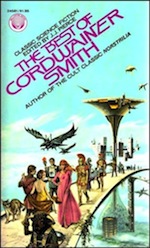 I’ve always wondered why Cordwainer Smith doesn’t get more attention. He was one of my favorite writers growing up, introduced to me by my high school AP English teacher. The stories of the Instrumentality, influenced by Smith’s time in China (whose godfather was Sun Yat-Sen), were unlike any other fiction I’d read. They were fueled by a strange imagination that melded outlandish science fiction with Asian myths, epitomized by this short story about pilots, “pin-lighters” who fight off mysterious entities they’ve coined dragons in the deep of space. Since humans by themselves are mentally too slow to tackle the dragons, they need a partner in the form of telepathic cats. These feline companions see it as a game, triggering a miniature nuclear bomb before the dragons can kill everyone on board. The Instrumentality, a government that acts like musical strings, is always present, looming, shaping history that unfortunately enough, often goes into discord. Of course, those are the best parts of the symphony.
Romance of the Three Kingdoms by Luo Guanzhong
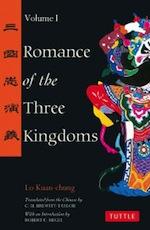 Arguably one of the most epic and grand novels ever written, Romance of the Three Kingdoms, based on actual history, is considered one of the four essential classics in China. I’ve read this massive series multiple times, played the games that were inspired by it (the simulation ones, not the beat em’ ups in the form of Dynasty Warriors), watched all the shows, read the 60-volume Manga inspired by it eight times, and been horrified by the terrible English translations.
This example isn’t strictly a deadly game as it is one of the most gut-wrenching scenes involving a game I’ve ever read. General Guan Yu has won a crucial victory against the enemy, but been wounded by a poisoned arrow in the Battle of Fancheng. His surgeon, Hua Tuo, tells him he needs to have surgery to cut the venom out. As Guan Yu is in the middle of a game of weiqi AKA go (a Chinese game which made recent headlines when Google programmed an AI that could beat a weiqi professional), he insists the doctor perform the surgery right there. Guan Yu continues the game while the doctor cuts the flesh open, scrapes the poison off his bone, and even patches it. In the manga, it’s noted the doctor sweated more than Guan Yu. I’m curious how that scene would have played out if Guan Yu was playing against the so-called AlphaGo.
Bonus Round: The Book of Job
I spent a lot of time pondering the fate of Christianity if the Japanese Empire took over. In USJ, they incorporate it into their Shinto pantheon, which brings us to the Biblical Book of Job. If you take Job as fiction, it is one of the most provocative and poetic speculative works ever written. If fact, then the universe is a pretty scary place. God and Lucifer are wagering on a man’s life. Along the way, Job loses most of his family, his worldly possessions, and his health. His friends arrive and duly lecture him on being ungodly and sinful. Job resists them, scandalizing his friends who pontificate with fancy arguments. In the end, there are no answers, no resolution, just a literal deus ex machina as God doubles Job’s blessings after hundreds of questions. Theodicy, or the question of “why do the righteous suffer?” takes on an unnerving perspective from the viewpoint of a game between a creator and accuser. Good thing there’s a restart button.
Top image from Battle Royale (2000)
Article originally published in March 2016
 Peter Tieryas is the author of United States of Japan and has worked for game companies like LucasArts and EA. He likes tweeting about games at @TieryasXu.

I would have added Ben Bova’s The Dueling Machine. That book was genuinely creepy in many ways.
Sheri Tepper’s “The True Game” books were the first to come to mind for me.
The Hunger Games.
Of course the more I thought about the basic concepts of the idea the less sense it made to me. If there is one thing that tends to be universal, with a few exceptions, across time, country and culture is the value and protection we place on our children. How subjecting the children of your slave states to the Hunger Games and than forcing the populace to watch is suppose to keep civil disorder in check is beyond me, and even more puzzling is how they lasted for 75 years, they were just asking for a rebellion.
“Would you like to play a game?” /Joshua
Does The Great Game (of espionage) count?
“The Game of Rat and Dragon” is a marvelous story, great choice!!
Jumanji. Even with all the expertise of grown-up Alan Parrish, Judy is probably already dead from that poison flower before the final toss of the dice.
The Final Reflection by John M. Ford. Honorable Klingons playing Klin-zha with Thought Admirals and “the game with living pieces.” This was long before Roddenberry was ready for them.
Going with the classics- how about Gladiator-At-Law, by Frederik Pohl ans C.M. Kornbluth?
I humbly submit:
This is NOT a game by Walter Jon Williams.
and
Ack-Ack Macaque by Gareth L. Powell
The Blood Spire in Alastair Reynolds “Diamond Dogs”
Jetan — the Barsoomian version of chess, most particularly the version played with live pieces actually dueling to the death for possession of squares as in Edgar Rice Burroughs’ Chessmen of Mars.
I no longer actually remember the story, having read it 30 years ago, but I think Interstellar Pig, by William Sleator, would qualify.
I am reminded of the “Tough Guide to Fantasyland”‘s entry on CARD GAMES, which states (from memory):
Klin zha from John M.Ford’s The Final Reflection.
In Dan Simmons’ horror novel Carrion Comfort, revolving around a group of people with enormous psychic powers, there’s an impressive description of a chess game played by two chess masters with “the Ability”, each chess piece being a mind-controlled prisoner. When captured the “pieces” are ruthlessly killed.
Not quite as memorable as Azad, but I would also nominate Iain M Banks’ “Damage” in “Consider Phlebas”. A weird and vicious variation on Poker where cards can be used to directly manipulate opposing players’ emotions, and where the players play not with chips but with the lives of suicidal human volunteers. A lesser writer than IMB would have written an entire book around it, but in “Consider Phlebas” it was just an episode.
Sometimes I wonder how many people would embrace these games if they were real. How much reward would people need? How much esteem? Yes, people are willing to put their lives in danger for motorsport and other “ultimate” sports, but there’s an awareness that effort will be made to keep them alive.
Do you have a preferred translation of Romance of the Three Kingdoms then?
Surprised nobody’s mentioned “Rollerball Murder” by William Harrison, and the two movies based on the story.
What was the James Bond movie where Bond & the villain played a kind of holographic Risk variant while wired to harnesses that would give them electric shocks as they lost troops?
(Was that even a James Bond movie? Am I hallucinating again?)
@20 nope you got it right. Off the top of my head I don’t remember which film it was, all the 007 movies tend to run together after a while. If I remember right the villain called the game “World Domination.”
EDIT ADDED:
I looked it up Never Say Never Again. A very aging Sean Connery played Bond, I believe his last Bond film.
@15 Jen That brings ERB’s The Chessmen of Mars to mind.
Claire North’s Gameshouse trilogy had a bunch of gamblers whose game board was the world of nonplayers.
20, 21, oh that made me think of one game with an element of death added. Mahjong! Wait, no I mean this Mahjong!
The secret way to win was to donate your own blood!
Brockian Ultra-Cricket!
@21 — Thanks! Yeah, that was not one of the better Connery Bond movies, and is of dubious canonicity; but at least I wasn’t just making it up in my own head.
The Prisoner, of course, had Kosho, which can be best described as “trampoline dunk-tank boxing”.