







Who among us is not delighted to receive boxes of assorted chocolates, each one a complete surprise1, even novelty? Anthologies are the narrative equivalent. Whereas one might tire of reading story after story by the same person2, anthologies ensure that one is opening a chocolate box of stories by many authors. The only common thread: the editor’s taste.
Long-running anthology series offer the above and more. Finish one volume… there’s more chocolate boxes to sample. In addition, a long-running series comes with the promise of additional delights: haunting used bookstores in quest of missing volumes. There just no way to lose with long-running anthologies series3.
Here are five series that you might consider adding to your to-be-read pile (otherwise known as Mount Tsundoku).
The Year’s Best S-F edited by Judith Merril (1956–1968)
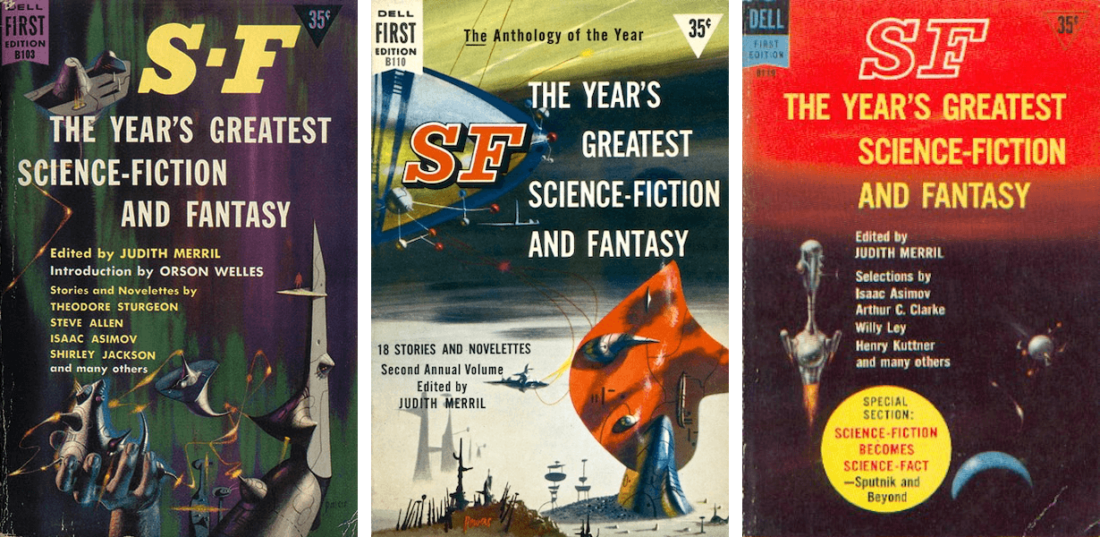
Judith Merril’s The Year’s Best S-F was notable for a number of reasons. One was that (as far as I know) her series was the only Best SF annual series helmed by a solitary woman in the 20th century (at least in English). Another was Merril’s diligence in searching out good stories in venues that other editors overlooked4, as well as highlighting stories by authors not known for writing SF. One could never be quite sure what one might find in a Merril Best S-F volume.
Appearing under various titles as S-F: The Year’s Greatest Science-Fiction and Fantasy, The Year’s Best S-F, 9th Annual S-F, and The Best of Sci-Fi, Best S-F lasted twelve volumes… unless one counts Merril’s Best of the Best, which depending on how you view the overlapping anthologies from Delacorte and Mayflower, added between one and three more volumes to the list5.
Nebula Award Stories (1966 onward)
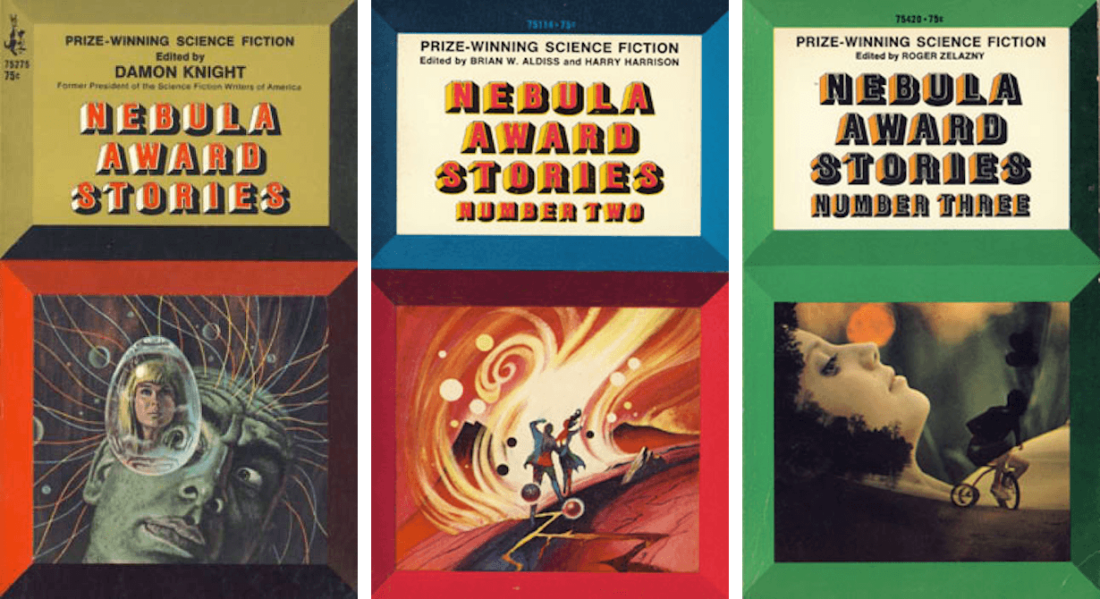
The Nebula Awards honor noteworthy speculative fiction, as voted upon by the members of the Science Fiction and Fantasy Writers of America. Following a 1965 proposal by Lloyd Biggle, anthologies showcasing Nebula winners and (some) runners-up have been published almost every year, helmed by a rotating roster of editors.
The series can be read as a documentary of speculative fiction’s evolution over the last seven decades. This is reflected in the charming diversity of titles under which the stories were published: Nebula Award Stories, Nebula Winners, The Nebula Awards, Nebula Awards, Nebula Awards Showcase, and perhaps others I have missed. Despite what appear to be Covid-instigated stumbling blocks in the path of recent volumes, the series has racked up an impressive fifty-five volumes to date.
The Year’s Best Science Fiction (1984–2018)
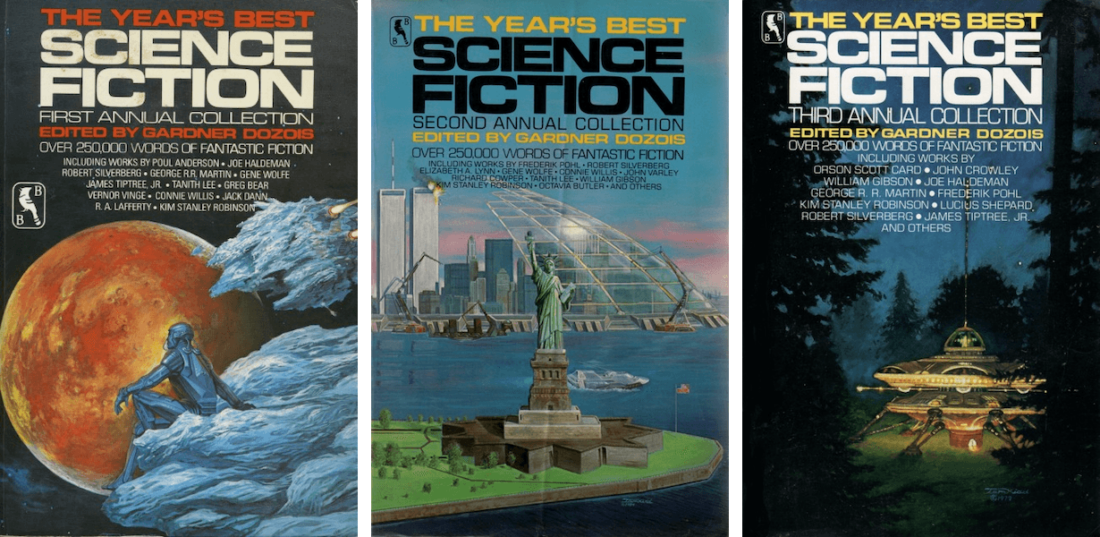
Gardner Dozois’ The Year’s Best Science Fiction could be easily spotted amongst the legions of Best SF annuals. Dozois’ anthologies (which he inexplicably called “collections”) were massive tomes, ranging from just short of six hundred to seven hundred-plus pages long. Astonishingly, Dozois’ The Year’s Best Science Fiction was a one-man show: Dozois read voluminously and broadly, without the legions of helpers one might assume he enlisted.
Not only is each volume hefty enough to present a challenge for those readers on whose shoulders time weighs heavily, Dozois edited a prodigious number of volumes: thirty-five, plus three additional volumes offering the Best of the Best. The series would be worth seeking out simply for its annual summary of events in the field. Good thing most (or all?) of the volumes appear to be in print, at least in ebook.
Tesseracts (1985 onward)
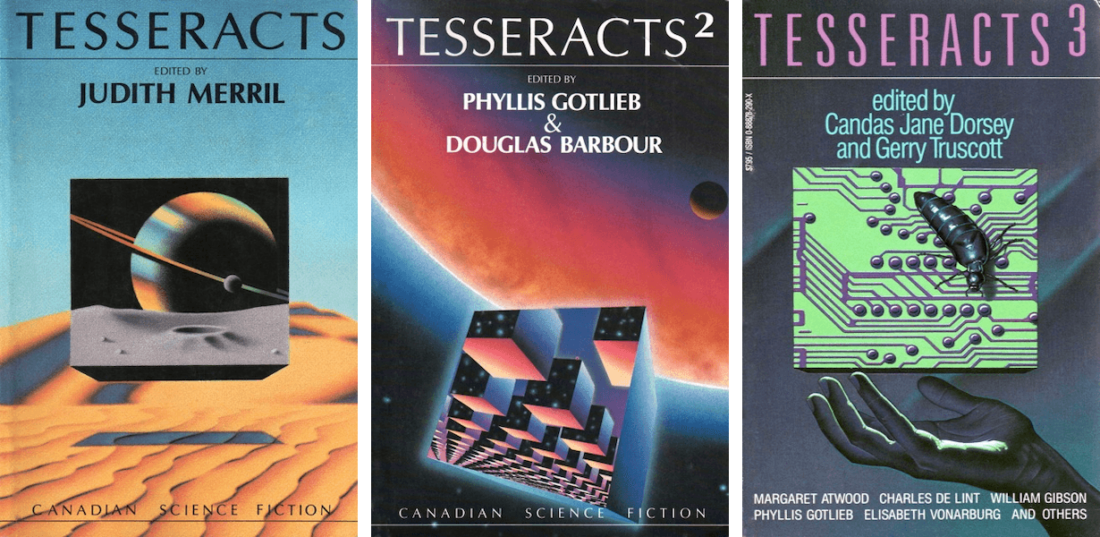
Tesseracts curates noteworthy Canadian science fiction6. First helmed by Judith Merril—Merril appears over and over in the history of 20th century SF—each volume is edited by a different editor or pair of editors7. As well, the volumes vary in theme, sharing only the requirement of being as Canadian as possible under the circumstances.
To date, Tesseracts comprises an impressive twenty-two numbered volumes, plus Tesseracts Q (featuring 20 years of SF stories from Quebec-based authors, and available in an English translation). There does not seem to have been a new volume since 2019 (blame Covid?). Unusually for a series whose initial volumes appeared so long ago, the entire series appears to be available for purchase from publisher Edge.
The Year’s Best Fantasy and Horror (1987–2008)
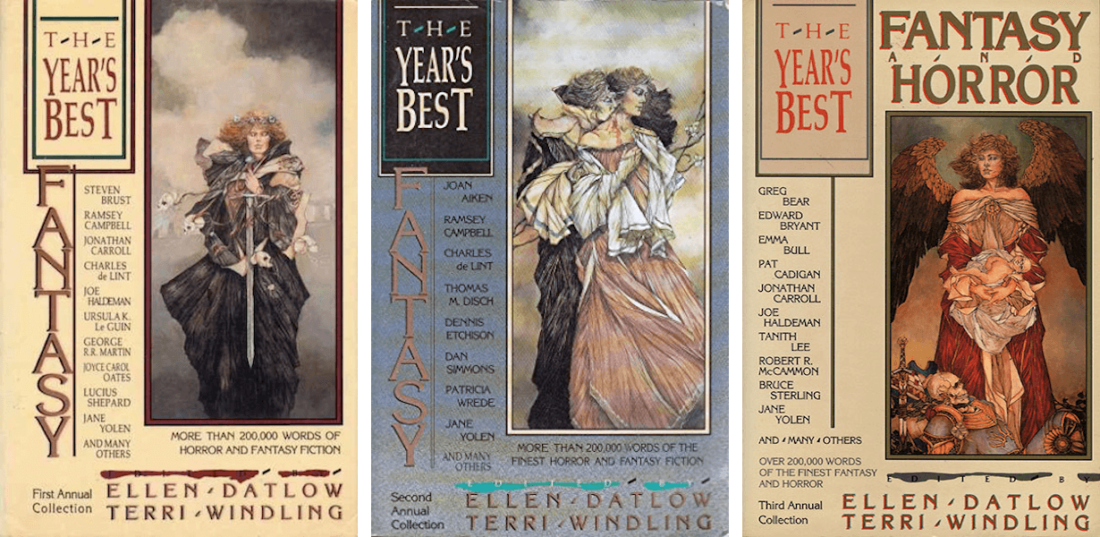
Initially titled The Year’s Best Fantasy, horror was added to the title in the third year. For many years, Ellen Datlow and Terri Windling8 shared editorial burdens, Datlow covering horror and Windling fantasy. In later volumes Gavin J. Grant and Kelly Link take over for Windling.
As with the Dozois series, this multiple-World Fantasy Award-winner offers shelf-threatening reading enjoyment. Each of the twenty-one volumes is a tome. While the series didn’t quite enjoy the longevity of Dozois’ series, Datlow, Windling, Grant, and Link offered something Dozois did not: eye-catching Thomas Canty cover art.
Have I overlooked your favourite long-running anthology series? One certain to delight and intimidate readers with duration, quantity, and vast shelf-space requirements? Feel free to mention it in comments below.
- There’s no surprise if one reads the convenient guide that so many boxes of chocolates have on their inner lid, but where is the fun in that? ↩︎
- Unless one could somehow set one collection aside to resume later, a development I am assured is only as far off as inexpensive commercial fusion. I assume it involves blockchain somehow. ↩︎
- Well… it would be a losing proposition to read Best Speculative Fiction Printed With a Lethal Contact Poison. Good that no publisher has yet taken up this challenge. ↩︎
- Also of interest, the extremely inclusive definition of “year” that Merril embraced: it was a rare volume that didn’t span two calendar years, and at least one volume spanned decades. ↩︎
- One to three entirely redundant volumes for anyone who read the first twelve, as all the stories were drawn from volumes one to twelve. ↩︎
- Tesseracts is not a year’s best Canadian SF. That would be Stephen Kotowych’s Year’s Best Canadian Fantasy and Science Fiction, now in its second year. ↩︎
- Including at least three from Waterloo County, which is as unexpected to me as was the number of Mennonite or Mennonite-adjacent authors amongst nominees and inductees for the Canadian Science Fiction and Fantasy Association’s Hall of Fame. ↩︎
- In general, one cannot go wrong with Windling anthologies. Unfortunately, readers are aware of that. Accordingly, Windling anthologies are rare enough on used bookstore shelves that when I asked a proprietor if he had any, he laughed at my temerity. ↩︎

Footnote 3 seems to be truncated.
Footnote 1 also?
Also fixed, thank you!
Fixed, thanks!
So does Footnote 1, unless it was intended to end with
^_^
The series I first started collecting was Donald Wollheim’s, then later Terry Carr’s.
There are sufficient footnotes here alone to contemplate starting an anthology along the lines of Best of James Davis Nicoll Footnotes 2024.
For some reason my public high school in the early 80s had the hardcovers of the Nebula books going back to sometime in the 60s.
See also Anthopology 101 (2010) by Bud Webster , a collection of his long-running series of columns on SF anthologies, in which he discusses the history of SF anthologies, various editors, and series.
The Snow White, Blood Red series, also edited by Datlow and Windling.
If I didn’t try to limit each editor to one appearance, this could have been all Datlow or Datlow & Windling series.
All Ellen, all the time😂😂😎
Damon Knight’s Orbit for the New Wave 1960s-1970s. There were about 20 volumes.
How about Years Best SF by David G. Hartwell, later Hartwell & Kathryn Cramer ?
On reflection, footnote three should have said publishers don’t use contact poisons now. They did with great enthusiasm back in the 1800s. These days, intrusive nanny states forbid distributing books whose ink will make fingers rot off or send the reader into biochemically-induced derangement.
My hometown newspaper had an article about that a couple of weeks ago.
https://www.washingtonpost.com/home/2024/07/24/toxic-victorian-bookbinding-arsenic/
Orbit. New Dimensions. ’nuff said.
The Merril anthologies were fascinating to a teenage reader who didn’t read anything that was obviously New Wave and almost nothing that looked mundane. (As you note, she was widely read and generous in her definition.) There are times I think she consciously avoided anything that was already lauded, e.g. ISTM she skipped both of Ellison’s early Hugo/Nebula winners in favor of a strange piece about an actor who took The Method a great deal too far. Definitely a good experience for people who think SF before year XXXX was all boring/sexist/….
Star Science Fiction might be too short (6 volumes of shorts, plus 1 of “short novels”) or too old (1950’s) to appeal to some readers; OTOH, it’s original work rather than best-of-previously-published.
Somewhere on the opposite end of the spectrum is John Joseph Adams’s Best American Science Fiction and Fantasy, which IIRC comes with an interesting gimmick: he picks 80 favorites, then invites a different guest editor each year to cut the list to 20. The guests (e.g., Rebecca Roanhorse) and the stories tend to be cutting edge politically and/or emotionally (rather than stylistically as was sometimes true of Orbit). I don’t remember him saying in a foreword why he restricts the list to USian work; possibly he feels he can’t read all English-language less-than-novel-length work and have time to cut down to 80 stories. 9 volumes so far, and AFAIK still going.
I’ve only read a few of Rich Horton’s The Year’s Best Science Fiction and Fantasy, but my notes say all of them were good. ISFDB shows them from the early oughts (originally 2 separate volumes) through 2021; I thought he’d announced more-recent volumes but haven’t been following closely.
Discovered the John Joseph Adams anthologies this year; the 2 I’ve read so far were awesome. Hearty recommend.
This post got bookmarked before I started reading it. I roam Dutch (and once a year, British) second hand book shops, and ever since I tried an anthology by George Martin and Gardner Dozois (Dangerous women) anthologies are the first thing I scout for. They are great for trying out new authors. There are also so, so many of them :D
Pohl’s 1950s Star inspired del Rey’s 1970s Stellar, and PNH’s 1990s Starlight. Which means we were due another series in the 2010s. To whom do I direct my letter of complaint?
Oh, actually the last Starlight was only 23 years ago so the latest series is not as overdue as all that.
I find it suggestive that the 35 Gardner Dozois anthologies are all still in e-book, but the Ellen Datlow & Terry Windling anthologies have never been in e-books.
I remember enjoying the Dangerous Visions anthologies edited by Harlan Ellison. It was the first in a three-volume series, published in 1967, and followed by Again, Dangerous Visions in 1972. The final volume, The Last Dangerous Visions, was unfinished at the time of Ellison’s death but will now be released in October 2024.
Seeing Tesseracts on this list is incredible! It’s published by Edge from my hometown in Calgary (Canada)!!!
The lovely publisher of it is the nicest guy, and truly wonderful to talk books with. It’s sad it’s no longer on-going.
I wish I still had my copies of The Year’s Best Fantasy Stories, which were published by DAW Books and edited first by Lin Carter and second (and last) by Arthur Saha. They were trim volumes which ran from the mid-’70s to the late ’80s.
One of their pluses for me is that this best-of series did not shy away from the adventure/pulp part of fantasy – a lack in later spec-fic anthology series that I find irritating to this day.
Among the later such general best-of SFFH anthos that I’ve read (which is NOT all of the anthos or editors, please note!), I’ve only noticed Ellen Datlow’s year’s best horror choices as having the same catholicism/inclusiveness when it comes to subgenre.
Some SFF year’s-best anthos read like they’re making the argument that spec-fic is a form of mainstream literature, instead of a different genre with its own approaches and considerations. In other words, these anthos seem assembled to try to win over English professors and mainstream literary critics.
I’d rather just see the best stories regardless of whether or not they’d please people who disregard SFFH.
What about Sword and Sorceress? Originally by Marion Zimmer Bradley, but taken over by a whole list of others. Started I belive in 1984 and possibly still being printed, but definitely over 30 yearly volumes.
Seems like a worthy one for your list.
It’s quite striking that all of James’s choices are reprint anthologies. The 1970s were the heyday of the original anthology series–Knight’s Orbit, Silverberg’s New Dimensions, Jim Baen’s Destinies, and a bunch of shorter-run series such as Star, Continuum (a novelty series where all the stories were four-part serials), and many others. Baen’s New Destinies and Lou Aronica’s Full Spectrum were 1980s attempts to revive the format but didn’t run very long; by that point, the main venue for original anthology series was the shared universe.
Many thanks for this feature. There’s something I love about anthologies of various kinds, especially (but not exclusively) in SFF. They have (for me) a wonderful portal-like quality. I can easily imagine having a library of nothing but anthologies. Dedalus Books has done an excellent line of anthologies of fantasy from various European countries (The Dedalus Book of Spanish Fantasy, etc.) but I don’t know if they plan on publishing any more.